An American colonel in Iraq, writing to The Washington Post's Thomas E. Ricks, recently observed: “The phrase ‘inshallah’ or ‘God willing’, has permeated all ranks of the Army. When you talk to U.S. soldiers about the possible success of ‘the surge’, you'd be surprised how many responded with ‘inshallah’.” The phrase seems to have permeated all ranks of the diplomatic corps, too: Zalmay Khalilzad, when he was the U.S. ambassador to Iraq, once stated at a conference, “Inshallah, Iraq will succeed.” (Murphy Reference Murphy2007)
INTRODUCTION
The iconic status of the phrase inshallah Footnote 1 for Arabic speakers, and its salience for non-Arabic speakers, is amply exemplified in the observations above. Its English translation, ‘God willing,’ lends itself to ready adoption by English native speakers as an appendage to any statement regarding the future, or one's hopes for the future. Its usage in Arabic interaction generally, however, goes beyond this most salient of contexts;Footnote 2 the widespread use of religious expressions in ordinary Arabic conversation, irrespective of the religious affiliation (or otherwise) of the speaker, has long been noted (see e.g. Abboud Reference Abboud, Jazayery and Winter1988, Gilsenan Reference Gilsenan1983). As Morrow notes:
the Arabic language is saturated with a rich variety of expressions invoking Allah explicitly or implicitly and … the name Allah permeates both spoken and written Arabic to the point where we can speak of the omnipresence of Allah in the Arabic language. As a result, an Arabic speaker could scarcely conceive of a conversation where the name of God would not appear. (2006:45)Footnote 3
The most comprehensive collection of so-called “Allah expressions” in English are in Piamenta Reference Piamenta1979, Reference Piamenta1983, who discusses the religious and cultural presuppositions drawn from them; Castleton Reference Castleton and Morrow2006 surveys what she calls “the Allah lexicon,” not only in speech but also in other forms of communication.Footnote 4 In a pioneering study on a specific Arabic dialect, Ferguson (Reference Ferguson1983) examined what he called “God-wishes” in Syrian Arabic—in a corpus of thirty-one religious invocations involving inshallah and its cognates—and explains the appropriate occasions for their use.Footnote 5
It is evident, however, that such religious invocations are also embedded in Arabic interaction in contexts more fugitive than previously described, contexts that repay close investigation of recorded data. Such data allow us to attend to the sequential contexts in which the expressions occur, and to identify the interactional motivations for their use.Footnote 6 For example, in the following Levantine Arabic exchange, inshallah (line 6), prefacing qareeban ‘soon’ (line 8), follows a jokey tease and prompts a response—‘thanks be to God’ (line 9)—and then, in line 10, the inshallah speaker initiates talk on a new topic.Footnote 7
(1) (Helani: Hana 2:36)

What is manifest here is that talk relating to Ruba's pregnancy is, in the course of this exchange, closed down, and discussion of another mutual friend, Huda, is subsequently initiated. In what follows, we use the methods of conversation analysis (CA) to focus on this particular deployment of inshallah and its cognates in the context displayed here: that of topic transition.Footnote 10
Our corpus consists of twelve hours of naturally occurring Levantine Arabic telephone conversations, recorded both in Syria and in the UK,Footnote 11 and transcribed according to the conversation-analytic methods as developed by Gail Jefferson.
As we show, inshallah, as an invocation to God, occurs in a variety of forms. It is deployed not only as a preface, as in (1) (inshaallah qareeban ‘inshallah soon’), but it can also be used as a freestanding turn, as in (2), where it is produced with emphasis—inshallah walla (walla and wallahi are literally ‘by God,’ and thus emphatic)—or as in (3), where it is embedded in a more extended turn, consisting of a disclaimer and assessment (see arrows at ‘a’). But whatever their local instantiations, the expressions serve a common interactional project. In both of the following extracts, as in (1), the next full turn after what is here generically called the invocation (which in our data is what we call the inshallah turn), serves to shift the topic (see arrows at ‘b’).Footnote 12
(2) (Helani: AR3:26)

(3) (Helani: HA2:36)
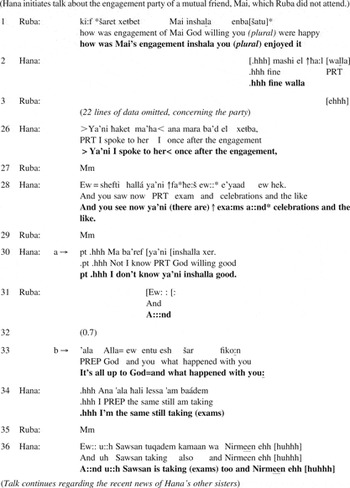
Thus in each of these cases (1–3), the inshallah turn is associated with the termination of one topic and the move to another. We examine in some detail here this transitional sequence.
Work on English has greatly illuminated the management of topic transition (see, in particular, Button Reference Button and Psathas1990, Jefferson Reference Jefferson, Atkinson and Heritage1984a, Reference Jefferson1993, Maynard Reference Maynard1980). Drew and Holt (Reference Drew, Holt, Everaert, van der Linden, Schenk and Schreuder1995, Reference Drew and Holt1998; see also Holt & Drew Reference Holt and Drew2005), in their groundbreaking work on figurative expressions in topic transition, note the regular occurrence of such expressions in a turn where a topic is summarized; such turns initiate the closing of the topic. Thus, So he had a good innings, didn't he serves as a figurative summary of the long life of a man whose death two speakers are discussing (Drew & Holt Reference Drew and Holt1998:496), which provides for transition to a new topic. In our Levantine Arabic data, the invocation, as we see, follows what is potentially the close of the sequence; upon its production, further topical talk is withheld and, in some cases, a response to the invocation is produced, and talk on a new topical line is subsequently taken up. In this article we examine the turns that could potentially close the sequence and show how the invocations are fitted to them, before showing how they occasion withdrawal from topical talk, and a subsequent move to another topic.
Underwriting sequence closure: Inshallah after potential topic close
In each of the three extracts we have seen so far, it is evident that the invocation follows potential topic closure. So in (1), Hana's enquiry about whether Ruba's pregnancy is now visible (line 1) is met with a negative response that is, hedged (lines 2, 4) in both its formulation (lá lessa … bawader ‘not yet … symptoms’ and production, and is delivered with a smile voice. Hana's jokey response, Sho mestania? ‘What are you waiting for?’ is followed by chuckling laughter, recognizable as a potential sequence-closing device (Jefferson Reference Jefferson, Atkinson and Heritage1984b). It is at this point that Ruba produces the inshallah turn. In (2), following prompting from Mohamed in line 1, Abdullah has been detailing at length the procedure Mohamed needs to follow in order to arrange his flight home from the UK at the Syrian embassy. In lines 29–30 he produces an assessment as part of the upshot: .hhh iza jama'et hal mawa:d hado:l biħjezo:lak bishola ‘I think if you compile these materials they'll book you (a ticket) easily.’ As Goodwin and Goodwin (Reference Goodwin and Goodwin1987:21) note, “participants … attend to assessments as marking a move towards closure,” and indeed what follows is nearly a second of silence, after which Mohamed responds with Inshaalla walla. In (3), Ruba's question regarding Mai's engagement party is answered at length by Hana. By line 26 Hana is moving beyond the issue of the party to the more general one of contact with Mai, and in line 28 reports what is happening “now” as an account for the lack of contact since: Ew=shefti hallá ya'ni ↑fa*ħe:š ew::* e'yaad ew hek ‘And you see now … there are exams and celebrations and the like.’ Thus Hana brings the topic of Mai to a possible close both in bringing the talk back to the present and the three-part list (Jefferson Reference Jefferson and Psathas1991), the completion of which facilitates transition to a next speaker. After a minimal, noncommittal response by Ruba, Hana produces a disclaimer and an assessment as part of an invocation: Ma ba'ref ya'ni inshalla xer ‘I don't know ya'ni inshalla good.’ In all three cases, then, the talk has moved to a potential close by various means: in (1) a recognizable joke and laughter, in (2) by an assessment, and in (3) by the three-part list—all potential closure-relevant devices. The inshallah turn—produced either by the same speaker or by the recipient—underwrites that closure.
The inshallah turn as a context sensitive invocation
As we have noted, what we call the inshallah turn, or more generically, the invocation, clearly has a variety of different local instantiations, fitted to the sequential contexts in which they are produced. Both (1) and (2) show inshallah produced in environments similar to the one noted at the beginning, where it marks the expression of hope for a desired outcome. In (1), it is used as a response to the other's jokey chiding about her pregnancy being not yet visible, and it prefaces a descriptor, qareeban ‘soon’; in (2), it is an emphatic response to the assessment of the other speaker, who has expressed confidence about the outcome of a particular bureaucratic procedure. In extract (3), the inshallah turn similarly follows a potential topic closure and its acknowledgment (lines 28–29) but one that, in contrast, does not concern the future, but the present. Here it is a multi-unit turn that consists first of a disclaimer, Ma ba'ref ‘I don't know’, the particle ya'ni (an upshot marker) and then, following inshallah, the assessment xer ‘good.’ Thus inshallah in this context is clearly not used in its familiar form as an expression regarding the future; across all three extracts, however, its use in topic transition as a device to underwrite topic closure is evident.
Furthermore, in (1) and (3) the inshallah turn elicits a response that is also an invocation. In (1), Ruba's invocation, inshallah qareeban ‘inshallah soon’, an expression of hope with respect to her pregnancy, is followed by Hana's response, yalla el hamdla ‘yalla thanks be to God.’ In (3) Hana's turn, launched with a disclaimer, Ma ba'ref ‘I don't know,’ is initially met by Ruba's potential continuation in line 31. But the stretched Ew::: ‘And’ already suggests her attentiveness to the possibility that she might have to abandon it, and indeed she does, as Hana continues hers, now in overlap. What transpires in Hana's continuation is the invocation, so Ruba deems it necessary to abandon what was originally launched with Ew::: in order to respond to that invocation with her own, 'ala Allah ‘it's all up to God.’ Only then does she recycle what she started in line 31 (Schegloff Reference Schegloff, Button and Lee1987) and subsequently launch a new topic.
What extracts (1) and (3) show, then, is that an invocation may elicit reciprocity—the recipient of the initial invocation thereby exhibiting attention to the coparticipant's talk.Footnote 14 This reciprocity may simply work as an acknowledgement, whereupon the speaker continues with a rushed-through shift of topic as in (3), or it may serve to endorse the inshallah speaker's expression of hope (in this case, regarding the unproblematic progression of a pregnancy in (1)). Indeed, in some cases, where the topical focus is on a future outcome, the inshallah turn may be but the first in an extended sequence of multiple invocations; in the extracts below, expressing hope for a successful outcome becomes the business itself.
(4) (Helani: MH5:70)

(5) (Helani: AR6:29)

In (4), Ayham builds off his lá ‘no’ response to Mohammad's query—first a ‘thanks-be-to-God’ expression (see also extract (1), line 9), followed by an invocation (lines 8–9), to which Mohammad responds (line 11). Ayham in turn responds (lines 12–13) with the invocation Ew='ala Allah ‘And it's all up to God’ and post-positioned laughter. Mohammad agrees and underwrites that invocation by repeating it, in a smile voice that acknowledges the prior laughter. Ayham then moves to change the topic, in line 15. In (5), Abdullah produces a positive response in line 7 to Ismaeel's query, initially in overlap, and then, after a post-overlap resolution hitch, a soft repetition of it; Ismaeel responds with the invocation Xer inshaalla ‘all will be good inshaalla’ in line 10. Abdullah agrees and expands on this—first with an expression of resignation, hek hai hie yalla ‘that's how it is yalla’ and then with one of hope, inshaalla tenħal mai mshkila ya'ni ‘inshallah it will be sorted out no problem ya'ni’. Ismaeel, in turn, reiterates and expands on his prior invocation in line 13, endorsing Abdullah's prior turn.
These sequences show how invocations are not simply devices used for transitions from one topic to another, but may have sequential implications of their own, leading to collaborative, step-by-step disengagement from the prior topic. This is particularly evident in contexts where the initial invocation expresses hope (e.g. of sorting out a problem, of success in exams, or regarding a pregnancy) that the other speaker chooses to endorse.
This concurrence achieved in the wake of a figurative expression recalls many of the topic-transition sequences discussed by Drew and Holt (Reference Drew and Holt1998) for English. As they observe, with respect to the figurative expressions that in their data serve to summarize the preceding topic:
Agreement, sympathy, or affiliation may describe the particular response by a recipient to the figurative summary in question; in any case, contiguity or alignment between the co-participants is expressed in some way … so as to foreclose further talk about that topic and enable the speakers to move on to a next topic. (1998:506)
The withholding of topical talk after the inshallah turn
The production of an invocation can thus make relevant reciprocity—either another invocation or an expression of thanks. But, as (2) also shows (repeated below), reciprocity is not always forthcoming; the invocation in line 32 (at arrow ‘a’) is followed not by a reciprocal response but instead by silence of nearly a second (at arrow ‘b’), and then by a move by the recipient of the invocation to another topic in line 34 (at arrow ‘c’).

As we have seen, inshaalla walla here underwrites the possible close of the sequence. In the silence in line 33 that follows its production, both speakers decline the opportunity for further topical talk, or to initiate talk on a new matter at that juncture. And again in (5) (repeated below), we also see how, subsequent to the production of, in this instance, an extended invocation sequence (see the arrows at ‘a’), there is a period of silence (at arrow' b') in line 14, before the prior speaker starts up again with a shift of topic (at arrow ‘c’).

In (6), we also see a sequence come to a possible close, an invocation underwriting that closure, a reciprocal invocation, and then a withholding of further topical talk.
(6) (Helani: AR3:27)

Mohammad's question in line 8 receives a negative response in lines 10–11, reiterated, after withholding from its recipient, in lines 13–16. After half a second's pause, Abdullah's repetition, Aiwa aiwa aiwa ‘Yes yes yes,’ “proposes that the [prior speaker's perseverating] course of action be halted” (Stivers Reference Stivers2004:269); thus, the sequence is twice brought to a possible close. After withholding from Mohammad, Abdullah produces both a potential move to new business with okay and then an invocation that underwrites the topic-close proposal: Okay yalla sidi Alla ywafé ‘Okay yalla sidi (may) God help’ (line 20). Following Mohammad's soft, and gently laugh-infiltrated, reciprocal invocation, Abdullah produces a minimal response in overlap (Mm), but nothing further. Once more we see withholding of further topical talk from both speakers following the production of an invocation, before one speaker, in this case Abdullah, moves to shift topic, again marked here specifically with okay as a preface.
These examples display how invocations underwrite sequence closure not only in their positioning, but in speakers' withholding of further on-topic talk. As (1) and (4) show, speakers may move immediately to shift topic, or, as (2), (5), and (6) show, speakers may simply withhold further immediate talk. In all cases, the topic-transition potential of the invocations are clearly attended to by the speakers, and the withholding of further on-topic talk after their production allows for either speaker to shift topic, with (as in (6)) or without an explicit marker to do so.
The move to a new topic after the inshallah turn
The suspension of further topical talk following an invocation thus allows for the shift to a new topic. As examples (2), (5), and (6) have shown, this shift may follow a pause, and we can see from the extracts below that there may be a direct shift to a new topic without any such hiatus. In the extract from (1) (repeated below), topic shift (at arrow ‘b’) is initiated immediately after the reciprocal invocation (at arrow ‘a’, line 9).

In (3), it is rushed through by the producer of the reciprocal invocation; and in (4), in overlap with the end of the prior speaker's invocation:
From (3)

From (4)

The extracts above clearly show that topic shift is available as an option to both speakers. In (3) it is undertaken by the producer of the reciprocal invocation; in (1) and (4), by their recipients. In each case in the data presented here, the shift to a new topic is done by means of a question that opens a new sequence; in most of the cases in the current data, this question is a news inquiry, of the coparticipant (in (3), (5), and (6)) or of a specified other (in (1) and (2)). While the invocations provide for a shift of topic without, as it were, further ado—Esh da assálak ‘What I wanted to ask you…’ in (4) is a clear case in point—in some cases the topic shift is overtly marked. This is either with a marker (most obviously okay in (6)) or with some other lexical means of marking a move to new business. In the data here, this is achieved most commonly by treating the upcoming shift of topic as part of a larger activity within the talk, in this case, exchanging news. So in (5), the new sequence is launched by Esh fi'andak axba:r tanye? ‘What other news do you have?,’ and in (1) and (3) the shift of topic is marked by the prefacing of Ew ‘And,’ indicating what Heritage and Sorjonen (Reference Heritage and Sorjonen1994), discussing institutional interaction in English, refer to as an “on-agenda” question:
And-prefacing is primarily used by professionals to establish and maintain an orientation to the course-of-action character of their talk across sequences of question/answer adjacency pairs. Associated with this activity linkage, we argue, is the maintenance of an orientation by both parties to the questions as agenda-based, i.e. as members of a series that are in some way routine elements of an activity …, or as elements the questioner has anticipated or has ‘in mind’—or commonly as externally motivated components of a bureaucratic task or other agenda which is being managed by the professional questioner as part of the ‘official business’ of the encounter. (1994:5–6)
In these instances, Ew Huda sho axbara? ‘And Huda what is her news?’ (from (1)) and ew entu esh šar fiko:n ‘and what happened with you’ (from (3)) launch new sequences within what are thereby proposed as the wider activity of news exchange in the talk. But, as extract (2) shows, an invocation can make possible a direct shift to a new topic without lexically marking it as either new or part of a wider ongoing activity; following a pause of nearly a second, abyħki ma'ak Ne'me … ‘Is Ne'me speaking with you …’ is prefaced by a relatively high-pitched ↑ E:h as the only indication of such a shift.
CONCLUSION
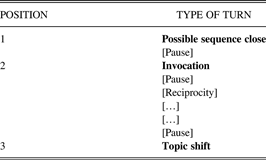
This study has examined the sequential distribution of one type of religious expression in Levantine (predominantly Syrian) Arabic—an invocation to God, overwhelmingly expressed by what we call the inshallah turn (inshallah and its cognate forms). As we noted in the introduction, such forms are widely used in Arabic talk-in-interaction in a number of contexts. Here we have identified one specific contextual usage: in topic-transition sequences. Just as there are other uses to which religious expressions are put, there are clearly other means by which speakers shift topic. But this particular convergence of linguistic object and sequential context has emerged as a recurrent feature in our data of Levantine Arabic interaction. Across the data, we represent the transitional sequence schematically as shown in Table 1, with the optional turns enclosed in square brackets.
Transitional sequence of topic in Levantine Arabic.

Given the production of a possible sequence- and topic-closing move in position 1, our examples clearly show that either speaker may produce an invocation in position 2. In examples (3), (4), and (6), the speaker who brings the topic to a possible close then underwrites that closure by means of the invocation; in (1), (2), and (5), it is the recipient who produces the invocation. Similarly, either the producer of the invocation (or a reciprocating expression), as in (3) and (5), or its recipient, as in (1), (2), (4), and (6), may then move to shift the topic. Thus an invocation is a resource for either speaker to move away from a prior topic, and, upon its production, for either speaker to move to a new one.
As we have seen, an invocation is used in combination with other turn-constructional elements in response to a prior turn. This may simply be an emphatic form, such as inshaalla walla in (2), or a more complex turn that accomplishes more than just the invocation, such as in (4) where the invocation is tied to a negative response to the prior question: Lá el ħamdella: insha:Alla: ya'ni. In some cases, we see the familiar use of inshallah to mark the expression of hope for a desired outcome—an expression that may have sequential implications of its own, prompting in the first instance reciprocity and thus agreement. However, it is equally the case that (as in extracts (3) and (6)) they may simply be used to facilitate a transition from a prior topic. Following the production of an invocation, it is clear from the data here that no further topical talk is forthcoming; the withholding of talk to the prior topic provides for the shift to a new topic. We propose here that the essential disjunctiveness of invocations, however attentive they may be to the prior talk, is what provides for the transition to new topical matter; they constitute an initial disengagement from the prior turn even in attending to it. They are thus a resource for participants in their management of this basic interactional task of shifting topic.
In bringing conversation-analytic methods to bear on the data of interaction, we identify the systematic practices used in the accomplishment of particular actions. We thus hope to have extended the growing literature on topic shift. As we have noted, the pioneering work on this subject has been conducted on English; the work reported here therefore provides a useful comparison with existing findings for English. But on a broader scope, this study marks a significant departure in its focus on talk-in-interaction in Arabic. By taking a familiar phrase, inshallah (and its cognates), and examining its placement not only in single utterances and their responses but also across sequences of talk, we have highlighted an aspect of its use that is perhaps less salient, but no less intuitive to its users. We also sought to ground ethnographic observation regarding the prevalence of such religious invocations in the detail of actual moment-by-moment usage. We hope, in doing so, to have contributed to ongoing research in the linguistics of Arabic in general, and spoken Arabic in particular.
APPENDIX 1: TRANSCRIPTION CONVENTIONS
The transcription symbols adopted for this article are those conventionally used for CA work, devised by Gail Jefferson (adapted from Ochs et al. Reference Ochs, Schegloff and Thompson1996:461–65). The corpus was transliterated into the Roman Alphabet and then transcribed at a later stage. This also entailed introducing a list of symbols to present sounds that do not occur phonologically in English (see Appendix 2). Moreover, for analytic purposes, we have avoided the use of some conventional transcription symbols in the transliteration process. Hence, double letters, for instance, are used to indicate: (i) long vowels in words like salaam ‘peace,’ and (ii) a default stress on a consonant, known as shadda ‘accent,’ as in ennas ‘the people,’ rather than a colon or an underline, respectively.

APPENDIX 2: TRANSLITERATION CONVENTIONS
The data analyzed in this article is transliterated in a modified Roman alphabet. Unless otherwise indicated, the transliteration symbols of consonants and vowels are adapted from the International Phonetic Alphabet, as illustrated in the following table.