

I. INTRODUCTION
Wireless power transfer (WPT) is gaining importance in several sectors: telecoms, automotive industries, medical electronics, and sensors [Reference Carvalho1–Reference Tang6]. The most prevalent WPT function up to date is wireless charging that has captured a lot of interest [Reference Musavi and Eberle7]. Still for any new wireless technology, the issue of safety and regulatory compliance is of paramount importance. Such compliance affects the technical characteristics of the devices, the adoption by the public and alleviates consumer worries about radiation.
In this work, we focus on the regulatory framework for WPT. This is deemed necessary considering the complex regulatory regime spread along numerous organizations across the globe and the interdisciplinary nature of WPT applications. The review includes standardization activities as well, since compliance is directly related to standardization. The main target audience is academics who conduct research in the field of WPT. However, parts of the review also aim to be useful to regulatory professionals looking for concise regulatory information. Very few studies have appeared that review regulatory and standardization developments. In [Reference Shoki8] activities with a focus on Japan were presented. In [Reference Jiang, Brazis, Tabaddor and Bablo9] some radiation safety compliance regulations were reviewed and in [Reference Taki10] a similar brief review discussion about radiation safety for emerging technologies including far-field systems was presented.
In Section II, a brief top level description of the WPT ecosystem of devices is given to set the scene for the discussion. In Section III, a primer on the regulatory framework is presented, including safety considerations and related procedures. In Section IV, the current status of WPT pertinent regulations is analyzed and ongoing regulatory activities are surveyed. Conclusions are drawn in Section V.
II. THE WPT ECOSYSTEM: A BRIEF DESCRIPTION
As mentioned in the Introduction, the dominant WPT function is wireless battery charging which finds applications most notably in:
-
(1) Electric vehicles
-
(2) Mobile communications devices
-
(3) Implantable medical devices
-
(4) Building automation sensors.
WPT systems can be categorized based on the field mechanisms they use, i.e. coupling for near-field and radiation in the far-field case.
Wireless charging systems that operate in the near field are spatially confined. They are brought in the close vicinity (up to a few cm) of the device to be charged. Usual frequencies of operation start from as low as 20 kHz up to 13.56 MHz [Reference Carvalho1, Reference Musavi and Eberle7]. Such systems are practically cordless chargers.
Besides the low-frequency systems, WPT systems operate in GHz or radiofrequency (RF) range using the radiative far field. The system that needs to receive energy is already placed in a fixed position and access is not easy or possible. For the purpose of this work, WPT-NF will denote a near-field system and a far-field WPT will be denoted explicitly as WPT-FF.
A note should be made about a subclass of WPT-FF systems, called energy-harvesting systems (EHS). These are passive systems in the sense that they only receive ambient energy from all available sources [Reference Pinuela, Yates, Mitcheson and Lucyszyn11–Reference Guenda, Santana, Collado, Niotaki, Carvalho and Georgiadis18]. Because of their expected widespread use in quite different sensor systems [Reference Visser and Vullers2, 19] interoperability is important. This topic is examined further in Section V.
Another notable application of WPT-FF is the Space Solar system where power is collected by satellites and then transmitted via microwaves to earth stations [Reference Sasaki20, Reference Jaffe and McSpadden21].
Medical devices always generate a huge interest. As there is a need to avoid batteries and provide power wirelessly, implantable devices have given WPT a lead as a solution [Reference Ho3–Reference Tang6].
III. BACKGROUND ON REGULATORY PROCEDURES
Regulation is a function common in any industry sector, transparent to the final user. Regulatory bodies are usually organizations created by governments. Contributions are also made or new topics are even initiated by other interested stakeholders, e.g. industry. Regulation aims to boost industrial and market development but making sure at the same time that necessary protection of the state and the citizen is taken care of. Subsequently, any wireless technology must operate within a regulatory framework. There is a minimum number of parameters to be set for each wireless technology.
-
− Frequency band of operation. These frequency bands should be as harmonized as possible across the globe.
-
− Power. The power rating is dictated by the technological limitations but must also satisfy human exposure radiation safety limits.
Amongst the other regulations, equipment type approvals are the most important and include compliance with other legislation such as:
-
− Heat/noise limits
-
− EMC/EMI
-
− Electrical power limitations (such as the European Union Low Voltage Directive [22])
-
− Manufacturing considerations such as the RoHS directive [23] which prohibits the use of lead and other materials in Printed Circuit Boards (PCB).
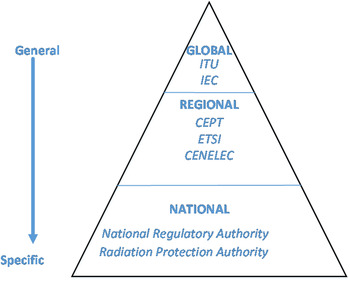
In order to elucidate the regulatory process and considering the multitude of regulatory bodies and related organizations, a taxonomy of regulatory authorities is introduced. Two basic criteria are used – geographical and sectorial. In terms of geography, there are three levels that can be discerned (Fig. 1).
Geographical levels of regulations. Examples of organizations are given for each level.

Global reach organizations produce regulations which are general in nature. Then these regulations are processed first in a regional level for adaptation to specific regional needs. However, any output from these organizations is not legally binding for any sovereign state if it is not adopted in the end as national legislation/regulation.
Each regulatory body is responsible for specific sectors. In response to sector activities that are regulated, three major areas can be distinguished.
-
− Telecommunications. The most important technical parameters that are regulated are frequency and power. The frequency is allocated through a frequency coordination process dictated by ITU procedures. In this procedure, power is usually known by EMC/EMI considerations, radiation limits and industry standards. In some cases, devices are also expected to meet other equipment type approvals as noted above.
-
− Electrical. This is most commonly related to EMC/EMI standards and thus includes a larger number of devices and systems, since they are not limited to radio devices only.
-
− Health and safety. The emphasis is on human radiation exposure and safety rules.
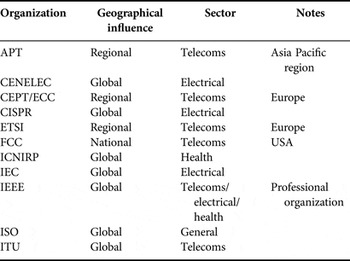
In Table 1, all the related organizations that are active in WPT are shown. It is apparent that a lot of organizations exist and the boundaries between them are not always clear cut. It is not rare to have strong connections among them which take the form of liaison statements or even attendance of the activities of one organization by representatives of the other organization.
Regulatory bodies.

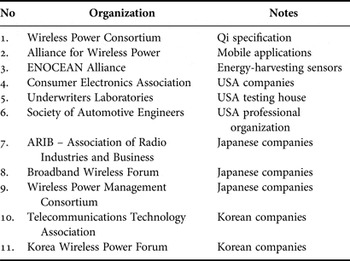
At this point, a necessary clarification between standardization and regulation is required. Regulations have legal power and they are adopted by an authority in a national context. Standards are documents that are developed and approved by a recognized body. Standards provide for repeated use, guidelines and characteristics for systems or devices [24]. Technical regulations, a subclass of regulations that provide technical compliance requirements, are always standard driven, either directly or indirectly. As such, there is quite a close collaboration among these bodies. Standards can be broadly described as compliance and application oriented. Compliance standards are always connected with a technical regulation. Application standards, on the other hand, are design specifications that aim more toward interoperability and open technical details such as the data structure or components characteristics, usually without resorting to implementation. Application standards are not necessarily connected with technical regulations, but they are frequently invoked as a reference. The difference is somehow subtle resulting in the use of the terms, standards and regulations, interchangeably in the open literature. It must be stressed out that regulation and standardization are not done in the absence of industry. Industry contributes significantly to the activities of these bodies and most often takes an initiative when new technologies appear. In order to speed up interaction, companies that work in the same field form representative bodies that focus on specific topics. These organizations come by the terms forum, alliance, or initiative. In the WPT-NF area (Table 2), there are two such international forums, the Wireless Power Consortium [25] and the Alliance for Wireless Power (A4WP) which advocates on Loosely-Coupled WPT [26, Reference Grajski, Tseng and Wheatley27]. These organizations are also active in application standards through the issue of design specifications. Another forum, called ENOCEAN should also be mentioned [28] which represents companies from the building and automations sector. There are also established industry alliances in the area of WPT-NF, in countries where there is a large automotive industry such as Japan, USA, and Korea [29, 30] (see Table 2)
Industry-related organizations active in WPT standards development.

Considering the multitude of organizations, the overlap and work duplication is highly probable. In order to cover the imperative need for efficient information exchange, an organized and formal way of interface between most of these organizations has been established; the Global Standards Collaboration (GSC). GSC takes the form of an annual meeting with ITU hosting the repository [31] and ETSI the web presence [32].
A) Radiation safety regulations
As far as radiation safety is concerned, the 1998 Guidelines by the International Commission on Non-Ionizing Radiation Protection (ICNIRP) [33], as amended in 2010 for frequencies up to 100 kHz [34], have been globally recognized as the de facto standard although other guidelines are possible both internationally i.e. IEEE [35] or nationally. In fact, several national legislations (Belgium, Switzerland, and Greece being typical examples) impose more stringent limitations based on political decisions rather than scientific data. It is worth noting that ICNIRP and not the IEEE is usually referenced in national legislations.
Specific absorption rate (SAR) is the most well-known metric as it is the widespread adoption for assessing safety radiation limits of mobile telephones [36]. SAR at a given position can be evaluated using
 $${\rm SAR}=\displaystyle{{\sigma E_{inc}^2 } \over \rho }\comma \;$$
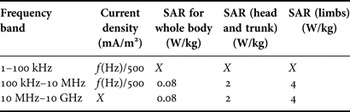
where σ is the tissue conductivity, ρ the tissue material density, and E inc the incident electric field. In most cases, SAR requires integration over a volume (1 or 10 g in weight) which is exposed for the measurement time. In these cases, the above quantities become functions of position and time. SAR is related to the issue heating and is applied from frequencies 100 kHz to 10 GHz. SAR on humans can be computed from simulations or alternatively by phantoms that emulate human bodies [Reference Grudzinski and Trzaska37]. However, as WPT systems and especially near-field systems operate in lower frequencies, there are other metrics that must concurrently be used. In Table 3, the frequency bands where WPT systems exist and the corresponding metrics with limit values are noted.
Basic ICNIRP maximum exposure limits for frequency bands of interest.

Other adverse health effects are possible in frequencies from 1 kHz to 10 MHz such as nerve and muscle stimulation. Retinal phosphene is such an effect where electromagnetic waves can induce the sensation of light in the retina without light actually entering the eye. In this frequency band, current density limits also apply (see Table 3). In common frequencies i.e. from 100 kHz to 10 MHz, both SAR and current density limits must be met.
Additional limitations apply for contact currents up to 110 MHz. These should not exceed 20 mA [33, Reference Grudzinski and Trzaska37].
B) Introducing a new technology in the regulatory landscape
We turn our attention to the very important question of how a novel technology is embodied in a regulatory environment. When a new technology arrives, there are two major questions to answer:
-
(1) Can it be used in existing spectrum or will it require new spectrum bands to be allocated.
-
(2) Does it need frequency coordination with other technologies in other parts of the spectrum, i.e. does it need to be recognized as a new service.
Let us clarify these questions using three illustrative examples. When GSM-type cellular communications technology was introduced, a new frequency band allocation was needed. Furthermore, due to the long-distance nature of the system, interference potential was great, leading to the fact that the GSM telephony had to be characterized as a service with exclusive usage rights in its 900 MHz band. The rights did not come without obligations. Every cellular operator had to pay a frequency license fee which was a sizeable amount of money. The existence of a network is not a prerequisite for a technology to be a service. For instance, the fixed service corresponds to a wireless point to point communications link between two set locations. A fixed service realization is the connection of a broadcasting studio with the transmission sites can be done with a radio link. This radio link operates on a frequency that is licensed with a small fee and it needs to be coordinated with other radio links and other services in neighboring bands. On the other hand, RFID technology operates in a short-range and low-power context, i.e. its interference potential is in general small in several frequency bands. RFID use is permitted without protection from interference as a short-range device (SRD). Consequently RFID is not categorized as a service and carries no obligation for a frequency license fee.
There is a notable exception that should be mentioned; the Industrial Scientific and Medical (ISM) bands. These bands do not require a license fee and thus no protection from interference can be claimed from the regulator. For example, a Wi-Fi system can be used to create a radio link-based fixed service. ISM bands devices are required to follow EMC/EMI regulations that are region specific such as the FCC Part 15 [38] or the EU EMC Directive [39]. These points should be born in mind when the WPT case is discussed below in Sections IV and V.
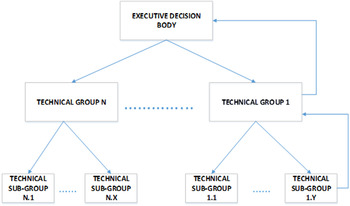
All international regulatory (and standardization) bodies tackle new technologies in a well-organized manner as shown in Fig. 2. A decision is made usually in administration (political) level and the required technical work is assigned to group of experts who provide feedback in documents with predefined structure so that a decision can be reached.
The generic procedure of working with new technologies in a regulatory context.

For instance, in ITU for radiocommunications issues, a proper decision body such as the radiocommunications assembly issues a formal statement called Question. A question can belong to one of the several categories depending on its urgency and relation with assemblies that take decisions. This question is tackled by groups of regulatory and industry experts who are organized in technical groups, called Study Groups (SG) in ITU context, under the guidance of ITU staff engineers. Each SG can split its work in several subgroups called Working Parties that have a designation that denotes the SG. Thus WP1A means the first working party of SG1 that deals with spectrum engineering. The products of SG are usually two kinds of formal documents,
-
− Recommendations are binding documents that form part of Radio Regulations and are embodied in national legislations. As such they are formally structured texts with the bare minimum required technical details.
-
− Reports. These are documents that contain considerably more detailed technical information on a topic. It is usually related to a recommendation.
In a similar way, in standardization organizations, like ETSI for example, technical reports and standards are produced by the technical groups.
IV. WPT REGULATORY ACTIVITIES
Regulatory, including the standardization, activities have to address several questions in the WPT context,
-
− How WPT should be treated? As a device only or as a service? Can WPT coexist with other technologies?
-
− Are current radiation safety limits adequate? If yes, do standardized measurement procedures are adapted for such devices?
Currently no specific frequency band for WPT is allocated. Many WPT-NF systems operate in the ISM bands 6.78 and 13.56 MHz. As analyzed in the previous section, these bands do not need license fee and EMC/EMI compliance is required. Still the issue of the human safety radiation limits must be resolved. A further issue of high KW power at 13.56 MHz is the potential compatibility problem in locations where radio telescopes operate at 13 kHz. In the case of RFID systems, no realistic scenario was found [40], yet this exercise might have to be repeated for high-power WPT.
The USA regulatory authority FCC treats WPT devices as general equipment that intentionally radiates and therefore requires compliance with Part 15 [36] and Part 18 [41].
Specific frequency allocation goes through ITU first, although national specific regulations are possible in some neutral parts of the spectrum. Usually radio regulations on a system without communication are quite different from those on a communication system. A decision has not been made yet if WPT is a subcategory of a communication system although it contains a transmitting part and a receiving part.
EHSs as receivers require Electromagnetic Immunity compliance from a regulatory point of view. As far as interoperability is concerned, the ENOCEAN Alliance was instrumental in the creation of the ISO/IEC standard [42]. An interesting question is that whether EHS should be allowed to operate in any band. For example, are EHS in large numbers able to produce disruption in areas whereas GSM-type networks have marginal coverage? Perhaps, EHS could be limited to bands where excess energy is abundant, i.e. close to high-power transmitters or close to microwave ovens.
Regardless of the exotic nature of the Space Solar Power application, this application must conform to regulations which exist for space too! At the moment no specific regulatory activities have been initiated. However, in this case additional regulations will apply for the satellite part. The most notable is the extra requirement of the orbital position and the difficulty of getting such an approval by ITU due to the large size of the collecting satellite. Furthermore, further restrictions apply to space activities [Reference Ernst43].
As far as medical electronics are concerned, the regulatory process must include regulatory approval by the related authority. In USA, for example where much of this research is carried out, Food and Drug Administration (FDA) approval must be met before market submission [44] although the RF part is not regulated by FDA.
In terms of health and safety regulations, no need is seen to put new limits. For the moment, existing procedures can be used for the assessment of radiation limits as in the case of far field of mobile devices [45].
There is an array of significant activities in progress by many of the regulatory and standardization bodies shown in Table 1. These ongoing activities are analyzed below. Apart from efforts in the international stage, two notable contributors in the national level, Korea and Japan, are examined.
A) ITU
A Question was recently updated (see Section III.B above on ITU procedures), that is handled by SG 1 and its subgroup called WP1A. The WPT Question [46] falls in category, S3 i.e. required studies which expect to facilitate the development of radio communications.
The target is to produce a report and a recommendation. The proceedings of the meetings [47] indicate a preliminary recommendation draft with major inputs from Korea and Japan. The draft recommendation is expected to be completed by the end of 2015. The major outcome is that ITU is adopting a split between WPT devices. The near field are presently called non-beam WPT whereas WPT-FF are called beam WPT. A report is in preparation that reviews proposed frequency ranges and out-of-band radiation levels that require further investigation for non-beam devices [48].
B) ETSI
ETSI is working on the subject through the EMC and Radio Spectrum Matters (ERM) technical group. They are currently aiming in the revision of standard EN 300 330 [49] to include wireless charging and an update of the 13.56 MHz RFID mask. An early draft revision is already available [50]. The work is based on the revision of the Technical Report TR 103 059 which is in the publication stage. The revision is about the spectrum mask requirements for narrow-band but long-range and wide-band but short-range RFID systems.
Furthermore, ETSI has assigned the ERM technical group TG28 to prepare material on inductive wireless charging for inclusion in EN 300 330. The task is to clarify the type of WPT-NF systems, the technical requirements and possible interference scenarios to existing SRD devices. The work concentrates on frequencies below 30 MHz. The task includes the revision of the guidelines for Notified Bodies and Test houses which carry out the EMC/EMI compliance procedures [51]. ERM also discussed the interference potential from wireless chargers that use power from 100 W to many kW. Some products proposed are intended to operate in recognized ISM bands. Other products intend to operate in bands already allocated to radio communication services. The interference potential of such equipment would need to be assessed separately in ITU context. ERM on the latter issues is in close collaboration with CEPT/TCAM and ITU [52].
C) CEPT/ECC
CEPT/ECC has two technical groups called Spectrum Engineering (SE) and Frequency management (FM). As noted, for EMC/EMI issues there is a close collaboration between these Groups and ETSI [52–54]. The revision of ETSI EN 300 330 [46] is being carried out in consultation with CEPT technical subgroup designated SE24 [52].
D) IEC and ISO
International Electrotechnical Commission (IEC) has initiated work through two technical groups. IEC Technical Committee 69 [55] works on Electric vehicle WPT-NF systems in order to produce the forthcoming standard IEC/TS 61980 “Electric vehicle wireless power transfer (WPT-NF) systems”. The standard will be composed on the following three parts;
-
− Part 1: General requirements
-
− Part 2: specific requirements for communication between electric road vehicle (EV) and infrastructure with respect to wireless power transfer (WPT-NF) systems
-
− Part 3: specific requirements for the magnetic field power transfer systems.
At this stage, the standards are in very early draft status. The full standard is expected to be released in 2017, although parts of the standard will be available by 2015.
Moreover, Technical Committee TC100 [56] has also launched activities on creating IEC 62827 – WPT – Management which is more in general and not limited to vehicles. It is also expected to be composed by the following parts:
-
− Part 1: Common Components
-
− Part 2: Multiple devices control management
-
− Part 3: Multiple sources control management
ISO has initiated in Feb 2014 an activity on a new ISO standard 19363 [57]. The group responsible for the drafting is subcommittee TC22/SC2 “Road Vehicles-Electrically propelled Road Vehicles” and in specific its working group WG 1. WG 1 deals with vehicle operation conditions, vehicle safety, and energy storage installation.
A joint IEC/ISO technical committee on Information Technology Standards (JTC 1) has included information technology issues that are related to WPT such as wireless communication support, interoperability with NFC, convergence with RFID and security for WPT [58]. The creation of the ISO/IEC standard on interoperability is also noted [42]
E) CISPR
The International Special Committee on Radio Interference (CSIPR) works in the context of IEC but is operating separately from the other IEC Technical committees. CISPR is working to develop emission limits below 30 MHz for WPT. The primary effort is occurring in its Subcommittee B, CIS-B [59] which deals with interference relating to industrial, scientific, and medical RF apparatus, to other heavy industrial equipment, to overhead power lines. Similar requirements will be applied to multimedia equipment, once the limits and test methods are well founded.
F) CENELEC
European standardization body CENELEC has initiated follow-up work on the IEC work with its technical committee CLC/TC 69X [60] in order to produce an European standard in accordance with the IEC forthcoming standard described above in Section IV.D. The standard will carry the same code number as the IEC work i.e. EN.61980-1:2013. Part 1 is in the voting stage.
G) Activities in Japan
In Japan, the WPT activities have attracted a lot of interest by both communications and automotive industries [Reference Shoki8, Reference Sasaki61]. The activities were initiated by the Ministry of Internal affairs and Communication which formed a working group on WPT in June 13 [Reference Sasaki61] to establish specific regulatory procedures. The communication industry efforts are led by Broadband Wireless Forum (BWF). The working group WPT–WG has developed guidelines for the use of wireless power transmission technologies which have reached version 2.0 [62]. The guidelines concerns ISM band systems. An interesting feature of these guidelines is safety measures for heating which occur due to induction. The use of the international standard IEC-60335-1, ‘‘Household and similar electrical appliances-Safety-Part 1 General requirements’' is suggested. The absence of a near field SAR measurement method below 30 MHz is noted too.
The BWF through a technical working group WPT/WG has commenced standardization activities through a subgroup called the Standard Development Group (SDG). The intention is that the developed standard will be submitted to the Association of Radio Industries and Businesses (ARIB) Standards Assembly. Note that ARIB participates in the GSC [32].
A related industry body Japan Electronics and Information Technology Industries Association (JEITA) has formed a group called The Wireless Feeding Project Group. JEITA is participating in the work of IEC/TC100 which was discussed above in Section IV.D.
As far as the automotive industry is concerned, the Japan Automobile Research Institute (JARI) has also assigned a technical team to work on the subject namely the Inductive Wireless Charging Subworking Group (SWG). Its work is supplemented by the Society of Automotive Engineers of Japan (JSAE) through its Wireless Charging System Technical Committee [Reference Shoki8]. The JARI/SWG is the national voting member in the corresponding IEC and ISO standards (i.e. JPT61980 in IEC TC69 and ISO 19363 in ISO TC22).
H) Activities in Korea
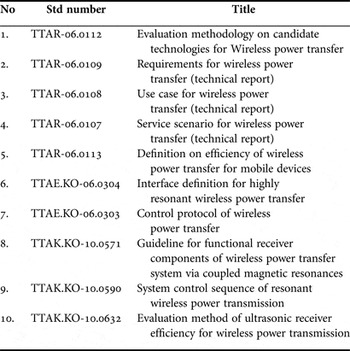
In Korea, the activities are led by the Telecommunications Technology Association (TTA) [63]. Three technical subgroups have been established;
-
− Project Group 709 (PG709) established in March 2011 and has already produced a series of national standards in 2011 and 2012 (see Table 4). The work is based on cellular and low-power WPT.
-
− Project Group (PG309) works on EMI/EMC.
-
− Project Group (PG422) concentrates on high-power, especially electric vehicles.
New Korean standards on WPT.

TTA has introduced a liaison team to coordinate the work among the three groups [Reference Lee64]. A particular note should be made about the standard TTAE.KO-06.0303 which deals with the practical issue of control signaling.
It must also be noted that TTA is very active in the GSC [Reference Lee64] and ITU levels [47]. Moreover, considering the interest by Japan as analyzed in Section IV.F, a regional collaboration group was formed with Korea. China also joined the collaboration which has been named China Japan Korea (CJK) and has started to become an active player in ITU level [47].
I) Activities in USA
The Society of Automotive Engineers has initiated standardization work through a task force called J2954 on wireless charging for vehicles [Reference Schneider65]. Furthermore, UL is working on safety aspects [66]. Procedures for Electric Vehicle Wireless Charging procedures, under UL 2750 have been developed [67]. It should also be noted that IEEE Industry Standards Technology Organization had the initiative of founding the Wireless Power Consortium program [68]. IEEE Standards has commenced pre-standardization activities on Electric Vehicle WPT with a focus on motion wireless charging [69].
V. RADIATION SAFETY STUDIES IN WPT
The prevailing opinion is that current radiation safety limits standards are in general adequate. However, there is a need to further and better understand in a cellular and molecular level the mechanisms of interaction with the electromagnetic fields on humans [Reference Miyakoshi70]. The anticipated deeper understanding does not necessarily imply a change on the current standards.
There is also a recent discussion about the appropriateness of SAR calculations based on phantoms. There are concerns about the height characteristics of computational phantom models since height does affect considerably absorption via the resonance of the human body [Reference Ding, Bernard, Pichon and Razek71]. There are also concerns on the proper phantoms for both genders. This falls in line with the directive of the European Commission in the framework of the Horizon 2020 [72] that promotes the integration of gender analysis in R&D activities. It seems that further specific standardized procedures for measuring WPT [Reference Christ, Douglas, Nadakuduti and Kuster73–Reference Kuster77] are required. In any case, considering the capability of kW operation in close range to humans, radiation hazard safety should be integrated in the engineering design process for better results [Reference Jiang, Brazis, Tabaddor and Bablo9]. In the open literature, several cases have been demonstrated that WPT systems do not violate the radiation limits when humans are located in some distance in the order of cm from the charging device [Reference Chen78–Reference Sunohara, Hirata, Laakso and Onishi90]. In [Reference Laakso and Hirata93] a magnetic field value that exceeded the maximum field strength was found locally. It is to be noted that in comparison, the RF dosimetry studies in the RF region are vast in number comparing to such studies for frequency up to 10 MHz [Reference Christ, Douglas, Nadakuduti and Kuster73].
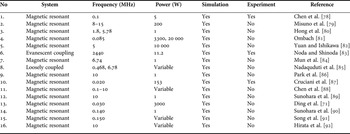
In Table 5, a list of exposure studies in WPT-NF and WPT-FF systems that have been recently published are given. Both computational studies and experimental approaches are mentioned. For easier identification the first author of the study and the reference number is used. A very interesting application of these studies is the optimization of the WPT frequency range with respect to compliance with exposure safety guidelines. In [Reference Chen78] it was shown that the optimal range is for operation between 1 and 2.5 MHz. For the kHz region, in [Reference Nadakuduti, Lu and Guckian85] it was shown that a frequency of 450 kHz is optimal. Safety studies can be also quite important in determining experimentally the power rating that results in exposure beyond the limits.
Recent exposure studies in WPT systems.

A point should be made about an important parameter of radiation limits conformity; the assessment of uncertainty. It is worth noting that none of the studies give uncertainties in the measured results. Probably, the reason is that in general, the exposure is an order of magnitude away from the limit. Nevertheless, any such measurement should contain uncertainty assessments [Reference Grudzinski and Trzaska37]. Uncertainty is even more important in the case of outdoor measurements where more uncontrollable conditions may appear compared to a laboratory.
VI. CONCLUSIONS
A survey of safety regulations and standards pertinent to WPT has been presented. Up-to-date, WPT devices are not treated as a separate category and several operate in ISM bands. However, there is a lot of ongoing work in several international organizations, the majority of which focuses on the near field WPT and corresponding EMC/EMI issues. Safety studies demonstrate conformity to the general limits and could be used as a tool to select some frequencies over other available frequencies. More radiation safety studies with experimental results and the consideration of uncertainties are needed.
From a regulatory point of view, WPT in the near field should be treated as new device that must meet EMC/EMI standards. EMI/EMC issues are quite significant for entering into the market. Such considerations become more pronounced when the transmission power is getting higher and higher. Furthermore, radiation safety regulations impose additional power limits. WPT in the far field must be additionally coordinated in frequency with other systems. As a matter of fact, ITU in its ongoing work recognizes the need to treat WPT devices that operate in the near field differently than the ones which operate in the far field. In terms of progress at a national level, Korea and Japan have advanced significantly further with the publication of several national standards in the case of near-field devices.
ACKNOWLEDGEMENTS
The research was supported by the EU COST Action IC1301 WiPE (Wireless Power Transmission for sustainable Electronics). The authors would like to thank Dr. Ana Collado for useful discussions. We would also like to thank the anonymous reviewers for their careful and constructive comments.
 Christos Kalialakis, IEEE Senior Member, was awarded the Ph.D. Degree in Electronic and Electrical Engineering from the University of Birmingham, UK in 1999. He received the B.Sc. in Physics and the Master in Telecommunications in 1993 and 1995 both from the Aristotle University of Thessaloniki (A.U.Th), Greece. He has industry experience in UK as an antenna designer and then in Greece and USA as an RF Hardware Engineer. Since the end of 2002, he has been employed at the National Regulatory Authority of Greece for ICT (EETT) as an Expert on Wireless Communications. He serves as the Deputy Head for the largest EETT regional office since 2004. While at EETT, Dr Kalialakis has been a member of the national delegation in conferences held by international regulatory organizations. Since 2004, he has also been a lecturer adjunct at the Radiocommunications Laboratory, AUTh. Dr Kalialakis has over 40 publications mostly in antenna and microwave engineering topics. He has served as a member of the Technical Programme Committee in 5 international conferences and is currently on the editorial board of 3 journals. He has also been serving as a regular reviewer for several IEEE and IET journals for over 15 years.
 Apostolos Georgiadis was born in Thessaloniki, Greece. He received the Ph.D. degree in electrical engineering from the University of Massachusetts at Amherst, in 2002. In 2007, he joined Centre Tecnologic de Telecomunicacions de Catalunya (CTTC), Barcelona, Spain, as a Senior Researcher, where he is involved in energy harvesting, wireless power transfer and radio-frequency identification (RFID) technology and active antennas and antenna arrays. Since Apr. 2013 he is Group Leader of the Microwave Systems and Nanotechnology Department at CTTC. He was the Chair of the 2011 IEEE RFID Technologies and Applications (RFID-TA) Conference. He was the Chair of EU COST Action IC0803, RF/Microwave communication subsystems for emerging wireless technologies (RFCSET) and presently he is vice-Chair of EU COST Action IC1301 on Wireless Power Transfer for Sustainable Electronics. He serves as an Associate Editor of the IEEE Microwave Wireless Components Letters, IEEE RFID Virtual Journal and IET Microwaves Antennas and Propagation journals. He is past Chair of the IEEE MTT-S Technical Committee MTT-24 on RFID Technologies and member of IEEE MTT-26 on wireless energy transfer and conversion. He is Editor in Chief of Wireless Power Transfer journal.