Introduction
Gerontology research has demonstrated the importance of social connections (e.g. Antonucci Reference Antonucci, Birren and Schaie2001; Berkman and Syme Reference Berkman and Syme1979; Russell and Cutrona Reference Russell and Cutrona1991; Seeman Reference Seeman1996) and social capital (e.g. Cannuscio, Block and Kawachi Reference Cannuscio, Block and Kawachi2003; Onyx and Bullen Reference Onyx and Bullen2000) for positive outcomes in later life. Social capital can be defined broadly as the resources available through social connections, particularly those that emphasise norms of mutual aid or reciprocity. According to Putnam (Reference Putnam2000: 134), the principle of reciprocity is ‘the touchstone of social capital’. In spite of the positive effects of social capital (Cannuscio, Block and Kawachi Reference Cannuscio, Block and Kawachi2003), and despite the psychological benefits of reciprocal relationships espoused by equity theorists (Rook Reference Rook1987), which have been established by research (e.g. Jung Reference Jung1990), social capital appears to be on the decline in the United States (Putnam Reference Putnam2000). This is disconcerting given the ageing of the population. Research has shown that maintaining reciprocity may be particularly crucial for older people (Litwin Reference Litwin2004a; Rook Reference Rook1987; Schwarz et al. Reference Schwarz, Trommsdorff, Albert and Mayer2005; Stevens Reference Stevens1992), in part because their diminished health tends to increase dependence and reduce their capacity to reciprocate support at an age when the value of positive relationships is augmented (Carstensen Reference Carstensen and Jacobs1993; Rook Reference Rook1987).
Understanding the factors that influence the degree of reciprocity among older adults may help us understand better both current trends in the United States and effective ways to promote ‘successful ageing’. According to Antonucci and Jackson (Reference Antonucci, Jackson, Sarason, Sarason and Pierce1990), reciprocity may influence an individual's ability to cope with life in general and with ageing in particular. Although ‘social exchange theory’ posits that reciprocity is a universal norm (Gouldner Reference Gouldner1960); that is, that all groups try to keep their support exchanges in balance; the degree to which relations are seen as reciprocal may be affected by the context of the exchange (i.e. the types of relationship and exchange), ethnic background, and specific life circumstances (e.g. socio-economic status) (Antonucci, Fuhrer and Jackson Reference Antonucci, Fuhrer and Jackson1990). In the present study, we examine how older adults' specific life circumstances (i.e. income and education) interact with their ethnicity to influence patterns of social exchange and, in particular, the perceived reciprocity of social relations.
This examination of ethnic and socio-economic variation in social exchange among older adults addresses several shortcomings of previous research. First, although ethnic differences in social relations are well-documented (e.g. Ajrouch, Antonucci and Janevic Reference Ajrouch, Antonucci and Janevic2001; Peek and O'Neill Reference Peek and O'Neill2001; Silverstein and Waite Reference Silverstein and Waite1993), research on ethnic differences in social relations in the United States has focused on differences between Blacks and Whites (although there have been exceptions, e.g. Consedine, Magai and Conway Reference Consedine, Magai and Conway2004; Kim and McKenry Reference Kim and McKenry1998). This focus obscures potentially important variations within these groups. Secondly, given the clear social stratification of ethnic groups in the US, researchers have recognised the importance of examining concurrently race/ethnicity and socio-economic status (SES), but few studies have allowed the possibility that there is ethnic variation in the effects of SES on social exchange (Kessler and Neighbors Reference Kessler and Neighbors1986). Reciprocity norms may in fact be expressed differently and may vary by available resources depending on (ethnic) group membership. We address these issues by examining ethnic differences in the effects of income and education on social exchange among an ethnically diverse sample of older adults (US-born European-Americans, immigrant Russians/Ukrainians, US-born African-Americans, and immigrant English-speaking Caribbeans).
The relational context of social exchange among older adults
Because older adults may be especially likely to rely on previously provided support to perceive a balance with the support that they currently receive, i.e. they may hold the notion of a ‘support bank’ (Antonucci, Fuhrer and Jackson Reference Antonucci, Fuhrer and Jackson1990), perceived reciprocity of exchange may be more important to them than an actual balance. In this study, we assess the perceived reciprocity in specific relationships. As mentioned above, reciprocity norms may vary both by the type of relationship in which exchange occurs and by the type of support exchanged. In general, the reciprocity literature tends not to distinguish exchanges among relationship types, e.g. kin or non-kin. Because non-kin relations are voluntary whereas many kin relations involve obligation, less reciprocity may be expected in kin exchange and, by extension, kin relations may be more robust when inequities exist (Krause and Borawski-Clark Reference Krause and Borawski-Clark1995; Rook Reference Rook1987). Some empirical evidence supports these propositions, particularly for older adults (e.g. Rook Reference Rook1987). Furthermore, social connections with non-kin (e.g. neighbours) may be particularly important for fostering social capital in a community (Cannuscio, Block and Kawachi Reference Cannuscio, Block and Kawachi2003). Reciprocity norms may also vary with the type of support exchanged (e.g. instrumental or emotional) (e.g. Ingersoll-Dayton and Antonucci Reference Ingersoll-Dayton and Antonucci1988; Väänänen et al. Reference Väänänen, Buunk, Kivimäki, Pentti and Vahtera2005). Given declining health with age, a lack of reciprocity in instrumental support may be more acceptable than imbalances in other types of support, such as emotional or informational support. In the present study, we distinguish among instrumental and informational (advice) exchanges with kin and non-kin.
Ethnic and cultural differences in social exchange and reciprocity
In addition to the relational context in which exchanges occur, ethnic group may influence the degree of reciprocity that individuals experience or expect in their relationships (e.g. Gleason et al. Reference Gleason, Iida, Bolger and Shrout2003; Ikkink and van Tilburg Reference Ikkink and van Tilburg1999). Research has shown cultural differences in social exchange and reciprocity norms, notably in levels of reported reciprocity (e.g. Antonucci, Fuhrer and Jackson Reference Antonucci, Fuhrer and Jackson1990) and in the provision of help by children (Litwin Reference Litwin2004b; Lowenstein and Daatland Reference Lowenstein and Daatland2006), which lends support to the possibility of ethnic differences. United States research on ethnic differences in reciprocity appears to be limited to differences between Blacks and Whites (e.g. Antonucci and Jackson Reference Antonucci, Jackson, Sarason, Sarason and Pierce1990), although the former encompass not only US-born African-Americans but also immigrants from Africa and those of African descent from the West Indies (Consedine, Magai and Conway Reference Consedine, Magai and Conway2004). Similarly, ‘Whites’ include both US-born European-Americans and European immigrants. The present study distinguishes four ethnic groups that are well represented in the northeastern United States: US-born European-Americans, immigrant Russians/Ukrainians, US-born African-Americans, and immigrant English-speaking Caribbeans.
Although the absence of prior work on sub-population differences in patterns of social exchange means that further generalisations are provisional, a few ethnographic studies have provided indirect evidence of differences in reciprocity between and within ethnic groups. African-Americans are thought to have especially strong kinship ties (Markides and Black Reference Markides, Black, Binstock and George1995), and family, friends and the church appear to be consistent sources of support (Antonucci Reference Antonucci, Birren and Schaie2001; Kim and McKenry Reference Kim and McKenry1998). Some research has also shown that US Blacks are more likely to be in reciprocal family relationships than US Whites (Antonucci and Jackson Reference Antonucci, Jackson, Sarason, Sarason and Pierce1990). We therefore predicted that US-born African-Americans would be more likely than US-born European-Americans to have reciprocal exchanges with kin and non-kin. By contrast, immigrants from the English-speaking Caribbean usually migrated to the United States alone and subsequently sent for other family members (Brice Reference Brice, McGoldrick, Giordano and Pearce1996). As a result, contacts with networks back home may be an especially important source of support (Jaskinskaja-Lahti et al. Reference Jaskinskaja-Lahti, Liebkind, Jaakkola and Reuter2006). Since, therefore, the tendency may be for their exchanges to be unbalanced, as when sending remittances home or providing advice to network members who immigrate later, we predicted that they would be more likely than US-born African-Americans to display non-reciprocal exchanges with both kin and non-kin.
Finally, older Eastern Slav immigrants in the United States (the Russians and Ukrainians in the present sample) are likely to have immigrated with extended, multi-generational families (Aroian, Norris and Chiang Reference Aroian, Norris and Chiang2003). Because this cohort had low material resources in the Soviet Union before they migrated, they may be particularly reliant on the mutual assistance of friendship networks – in the past these provided much-needed emotional and instrumental support (Althausen Reference Althausen, McGoldrick, Giordano and Pearce1996; Leipzig Reference Leipzig2006; Patico Reference Patico2002; Treas and Mazumdar Reference Treas and Mazumdar2002). We therefore predicted that Russians and Ukrainians would be more likely than US-born European-Americans to display reciprocal exchange patterns with non-kin.
Socio-economic status, ethnicity, and social exchange
Ethnic values and norms have both historical and developmental roots but are enacted in particular contexts (Phinney, Ong and Madden Reference Phinney, Ong and Madden2000). In addition to the immediate relational context, as discussed, macro-life circumstances, such as socio-economic status, or education and income, are likely to be major determinants of patterns of exchange. Much previous research has conflated ethnicity with SES, however, and although recent research has considered them concurrently, it has tended to pit one against the other. For example, some researchers have found that ethnic differences in social exchange disappear once income and education are controlled, and so believe that SES is the principal influence on exchange (Kim and McKenry Reference Kim and McKenry1998; Mickelson and Kubzansky Reference Mickelson and Kubzansky2003), but others have found that ethnic differences in reciprocity and exchange persist even after income and education are controlled (Antonucci and Jackson Reference Antonucci, Jackson, Sarason, Sarason and Pierce1990).
One interesting possibility is that ethnicity and SES interact to influence patterns of reciprocity; that is, that ethnic reciprocity norms are expressed differently or are differentially impacted by resource variations. Cross-cultural research indicates that perceptions of reciprocity and social exchange appear to be more strongly affected by SES in certain cultures (Antonucci, Fuhrer and Jackson Reference Antonucci, Fuhrer and Jackson1990; Broese van Groenou et al. Reference Broese, Glaser, Tomassini and Jacobs2006). In individualistic societies with established welfare states, for example, informal (i.e. kin) care may increase with higher SES (because help from formal services in these countries is particularly needed by older people of low SES who live alone), whereas in familistic societies, such care may be provided regardless of SES (Broese van Groenou et al. Reference Broese, Glaser, Tomassini and Jacobs2006). In the United States, SES may also moderate the effects of ethnicity (Kessler and Neighbors Reference Kessler and Neighbors1986; Peek and O'Neill Reference Peek and O'Neill2001), though this possibility remains relatively unexplored.
In sum, although there may well be important ‘main’ effects for SES on exchange and reciprocity (Antonucci Reference Antonucci, Birren and Schaie2001; Antonucci and Jackson Reference Antonucci, Jackson, Sarason, Sarason and Pierce1990; Kim and McKenry Reference Kim and McKenry1998; Krause and Borawski-Clark Reference Krause and Borawski-Clark1995; Mickelson and Kubzansky Reference Mickelson and Kubzansky2003), they may be moderated by the ethnic or cultural context. More specifically, it could be that ethnic differences in reciprocity are more pronounced among those with higher education and income, since the possession of social or economic resources may enable the shared ethnic value to be enacted. Alternatively, if some ethnic groups place an exceptionally high value on reciprocity, ethnic differences could be maximised among those of lower SES – there is evidence that the ability to maintain reciprocity with network members is critical in a context of economic scarcity (Dominguez and Watkins Reference Dominguez and Watkins2003). Another possibility is that socio-economic conditions have an impact on the perception of reciprocity by some ethnic groups but not others, since groups may find it more or less acceptable for exchanges to be unbalanced under different conditions. Given the absence of prior work on these questions, the possibility that there are interactions between ethnicity and income and/or education is an open question.
The present study
Ethnic differences in reciprocity may be differentially expressed depending on the socio-economic context in which social exchanges occur, and the differences may in turn vary with the immediate relational context, viz. whether the exchange is instrumental or informational and by type of relationship (kin or non-kin). In the present study we sought: (1) to describe ethnic differences in patterns of social exchange with kin and non-kin (differentiating instrumental support and advice); and (2) to establish whether there were ethnic differences in the effects of income and education on patterns of exchange among kin and non-kin. We assessed both education and income as indicators of SES, since income represents the ‘material’ component of SES, whereas education reflects its cognitive and cultural components. Although the two are generally highly correlated (Grundy and Holt Reference Grundy and Holt2001), in the analysed sample the overall correlation was low, and in fact was not significant for one of the ethnic groups (the Russians/Ukrainians). Furthermore, the effect of education may be particularly pertinent for some types of exchange (such as advice) that are especially relevant for older people (Carstensen and Löckenhoff Reference Carstensen, Löckenhoff, Ekman, Campos, Davidson and de Waal2003).
Methods
Data source and the sample
The data were drawn from a population-based study of stress and coping in older Americans, the Brooklyn Older Adults Study (BOAS), conducted from 1997 to 1999. A community-dwelling sample of 1,118 people stratified by ethnic group and income was compiled using a cluster technique. The first step was to extract census block data from the ‘Household Income and Race Summary’ tape of the 1990 United States population census.Footnote 1 Blocks were then stratified by ethnic group and income (high, medium and low). Random selection without replacement was then applied to choose samples of block groups from each stratum. Respondents in the selected blocks were interviewed by trained interviewers and paid $20 for their participation. For further details of the sampling design, see Magai et al. (Reference Magai, Cohen, Milburn, Thorpe, McPherson and Peralta2001).
To maximise cultural homogeneity, the immigrant European sample was limited to the largest sub-population; namely, Eastern European participants from the former Soviet Socialist Republics of Russia and Ukraine (eliminating 75 individuals from other Eastern and Western European countries, such as Poland and Italy). Because Russians and Ukrainians, as Eastern Slavs, are ethnically similar (Althausen Reference Althausen, McGoldrick, Giordano and Pearce1996), we combined them to yield a sample that was sufficiently large to compare with the other ethnic groups. As a result, the final sample size was 1,043. The data were collected during face-to-face interviews by race-matched interviewers. The interviews lasted approximately 90 minutes, and were conducted in the respondent's home or at another location of his or her choice (e.g. a senior centre or church).
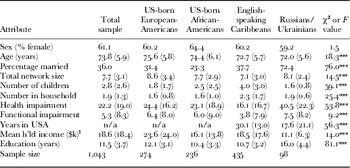
Table 1 presents the socio-demographic characteristics of the sample as a whole and by ethnicity. The mean age of the participants was 73.8 years (standard deviation 5.9) and 61.1 per cent were female. Thirty-six per cent of the sample were married. With the exception of gender, there were significant ethnic differences for all the background variables: age, marital status, total network size, total number of children, total number of people living in the household, total health impairment, total functional impairment, time in the United States, mean household income, and education. Whereas the US-born European-Americans were the oldest and had the largest total networks and highest household income, the Russians and Ukrainians were the most likely to be married, were the most highly educated and the least healthy. The English-speaking Caribbean immigrants had the most children, the largest households, and reported living in the United States for significantly longer than the Russian/Ukrainian immigrants.
Socio-demographic characteristics of the sample by ethnic group, 1997–99

Notes: Standard deviations are shown in parentheses, after the means. 1. Mean household income. n/a not applicable.
Significance level: *** p<0.001.
Measures
This section describes only the measures used in the present analysis, not all those collected by BOAS. It also comments on the reasons for including particular measures in the analyses. Information on the following variables was obtained from the socio-demographic questionnaire (they were co-varied in all analyses since the cited studies have shown that they are important in predicting patterns of social exchange): gender (Antonucci Reference Antonucci, Birren and Schaie2001), age (Ajrouch, Antonucci and Janevic Reference Ajrouch, Antonucci and Janevic2001), marital status (Antonucci Reference Antonucci, Binstock and Shanas1985), total number of children (Johnson and Barer Reference Johnson and Barer1997), living arrangements (e.g. as indexed by total number of people living in the household; Antonucci Reference Antonucci, Binstock and Shanas1985), and acculturation (e.g. as indexed by time spent in the US among immigrants; Miller et al. Reference Miller, Sorokin, Wang, Feetham, Choi and Wilburt2006).
Gender (0=male, 1=female) and marital status (0=not married, 1=married) were dichotomised. Years of education was treated as a continuous variable (with a range from one to 23 years and a mean of 11.5 years), and total household income (representing the ‘material’ component of SES) was coded by quartile (‘0’=$2,000 through $4,900; ‘1’=$4,901 through $10,000; ‘2’=$10,001 through $16,000; 3=$16,001 through $150,000). An ‘immigration’ variable was created in order to control for differences based on immigrant status and duration of residence in the United States, with the categories ‘0’ for non-immigrants (i.e. all US-born African and European-Americans), ‘1’ for immigrants who had lived in the US for 29 years (the median duration of residence for US immigrants) or less, and ‘2’ for immigrants who had lived in the US for more than 29 years. This variable was omitted from analyses of only non-immigrants.
On the health measures, total health impairment (Rook Reference Rook1987) and total functional impairment (Brown, Consedine and Magai Reference Brown, Consedine and Magai2005) were included as covariates because of their effects on social exchange. Physical health was measured using the ‘Comprehensive Assessment and Referral Evaluation’ (CARE) instrument (Golden, Teresi and Gurland Reference Golden, Teresi and Gurland1984). For this study, the 12 physical health sub-scales of the 150 items that are scored as present/absent were aggregated into a total score for impaired health. The remaining sub-scale, activity limitations, has 39 items that were summed to create an index of functional impairment in the ability to perform activities of daily living. The coefficient alphas ranged from 0.75 to 0.95 for all sub-scales.
The social networks and social exchange variables were assessed through the ‘Network Analysis Profile’ (NAP) (Cohen and Sokolovsky Reference Cohen and Sokolovsky1979). NAP is derived from the responses to a semi-structured interview, by which the participants identify kin (family) and non-kin (defined as friends or neighbours) with whom they had had a 15-minute or longer conversation during the previous three months, or with whom they had engaged in other activities or material exchanges. For each member of the kin and non-kin network, and separately for instrumental (e.g. money, food, help when sick) and informational (advice) exchanges, the interviewees indicate whether there has been ‘no exchange’, primarily ‘self to other exchange’ (giving), primarily ‘other to self exchange’ (receiving), or primarily ‘reciprocal exchange’.
Following Antonucci and Jackson (Reference Antonucci, Jackson, Sarason, Sarason and Pierce1990), total network size, i.e. the number of mentioned kin and non-kin, was included as a covariate. In addition, four categorical ‘patterns of exchange’ dependent variables were created in an identical four-step process (instrumental exchange with kin, advice exchange with kin, instrumental exchange with non-kin, and advice exchange with non-kin). First, the numbers were independently counted of the people that the participant felt he or she ‘gave more to’, ‘got more from’, ‘had no exchange with’, or ‘had reciprocal exchange with’. Secondly, the scores were adjusted to control for total network size. Thirdly, because the distributions of the adjusted scores were bimodal, median splits were performed. Finally, for each of the four exchange combinations (instrumental or advice exchange in combination with kin or non-kin), the individuals were categorised into one of the following three patterns of exchange:
No exchange. Individuals without network members (16 of the sampled individuals had no kin, and 22 had no non-kin), or who had no exchange with an above-median proportion of the people in their network and below-median proportions on all other exchange balance measures.
Reciprocal exchange. Individuals with an above-median proportion of network members with whom they had reciprocal exchange, regardless of their scores on the other exchange balance measures.
Non-reciprocal exchange. Individuals with an above-median proportion of network members with whom they engaged in at least one type of exchange (i.e. giving or receiving), and a below-median proportion of network members with whom they reported reciprocal exchange.
The analysis strategy
To test for ethnic differences in the prevalence of the three patterns of exchange, the standardised residuals were examined using chi-squared tests separately by type of relationship (kin, non-kin) and type of exchange (instrumental, advice). The predictive analyses began with an examination of ethnic variation in the effects of education and income. First, two-step hierarchical multinomial logistic regressions were estimated for each of the four combinations of types of exchange using the full sample, in each case with the ‘no exchange’ category as the reference group.Footnote 2 At the first step, only the background variables (including education and income) and ethnicity (dummy-coded with US-born Europeans as the reference group) were included (Model 1). At the second step, the interactions between ethnicity and income and between ethnicity and education (using the ethnicity dummy-codes) were added (Model 2). Likelihood ratio (LR) tests that compared Models 1 and 2 determined whether the second model had a significantly improved fit. If so, the interactions added significantly to the explained variance.
Because models using the full sample required a single reference group, within-group heterogeneity could not be examined. The second approach was therefore to split the sample by race and compare the black sub-samples (US-born African-Americans with English-speaking Caribbeans), and the white sub-samples (US-born European-Americans with Russians/Ukrainians), and to conduct two-step hierarchical multinomial logistic regressions as before, namely, separate regressions for each of the same four exchange combinations. Initially ‘no exchange’ was the reference category, and then further models were run with ‘reciprocal exchange’ as the reference category (so that all possible comparisons were made). To be consistent with previous research and to examine ethnic group differences, separate regressions were run for US-born African-Americans and US-born European-Americans. Finally, to examine whether the combined effects of ethnicity and acculturation processes affected the association of SES with exchange, separate regressions were run for English-speaking Caribbeans with Russians/Ukrainians. As with the full sample, LR tests compared Models 1 and 2 and established whether the interaction terms significantly improved the model fit. Finally, in cases in which the fit was improved and the interactions (between ethnicity and income or education) were significant, post-hoc analyses by ethnic group were conducted to clarify the direction of the effects.
Results
The patterns and types of exchange by ethnic group
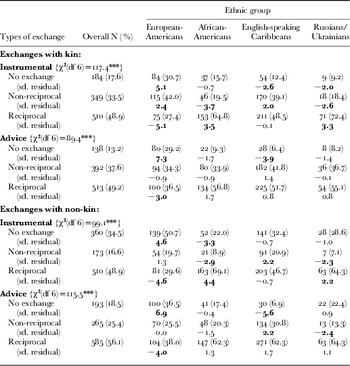
Table 2 presents the numbers and percentages of individuals who fell into each pattern of exchange by type of relationship (kin or non-kin) and type of exchange (instrumental or advice), for the entire sample and separately by ethnic group. Examination of the standardised residuals using chi-squared tests indicates that, for instrumental exchange with kin, more than the expected number of European-Americans fell into the ‘no exchange’ and ‘non-reciprocal exchange’ categories, whereas fewer than the expected number were in the ‘reciprocal exchange’ category. In contrast, a greater than expected number of African-Americans and Russians/Ukrainians fell into the ‘reciprocal exchange’ category, and a greater number of Caribbeans than expected were in the ‘non-reciprocal exchange’ category. Fewer than the expected number of English-speaking Caribbeans and Russians/Ukrainians were in the ‘no exchange’ category.
Types of social exchange by ethnic group
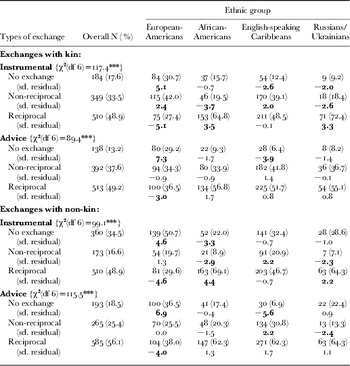
Notes: Standardised residuals greater than the absolute value of 1.96 (an indication that the cell is a major contributor to the overall chi-squared value for the four ethnic groups by three exchange types comparisons) are shown in bold. df: degrees of freedom.
Significance level: *** p<0.001.
For ‘advice exchange with kin’, only Caribbeans and European-Americans stood out: there were fewer than expected Caribbeans with ‘no exchange’, whereas there were more than expected European-Americans in this category and fewer than expected in the ‘reciprocal exchange’ category. A similar pattern for European-Americans was found for both ‘instrumental exchange’ and ‘advice exchange’ with non-kin. In contrast, for ‘instrumental exchange with non-kin’, fewer than expected African-Americans had ‘no exchange’ and ‘non-reciprocal exchange’, whereas more than expected had ‘reciprocal exchange’. More than the expected number of Caribbeans had non-reciprocal instrumental and advice exchanges with non-kin, whereas fewer than expected had no advice exchange with non-kin. Finally, fewer than expected Russians/Ukrainians had non-reciprocal instrumental and advice exchange with non-kin, whereas more than expected had reciprocal instrumental exchange with non-kin.
Predictive analyses
The analyses of the full sample showed that the addition of the interactions between ethnicity and income and education improved the model fit for ‘instrumental exchange with kin’ (χ2 (12 degrees of freedom [df])=26.9, p<0.01), ‘instrumental exchange with non-kin’ (χ2 (df 12)=23.2, p<0.05), and ‘advice exchange with non-kin’ (χ2 (df 12)=22.4, p<0.05). The fit was not significantly improved for ‘advice exchange with kin’ (χ2 (df 12)=14.7). Because the model fit for the full sample was not improved by the interactions for ‘advice exchange with kin’, sub-sample analyses were not performed for this type of exchange. Furthermore, only for the cases in which the addition of the interactions between ethnicity and income or education significantly improved the fit are the ethnic sub-sample analyses presented, and in these cases, only Model 2 with the interactions is presented together with the LR test.
US-born African-Americans and English-speaking Caribbeans
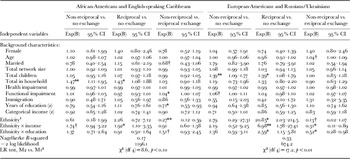
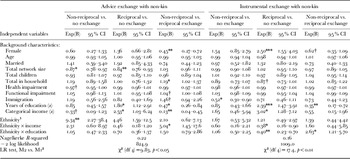
Starting with ‘instrumental exchange with kin’ among US-born African-Americans and English-speaking Caribbeans, the LR tests showed tendencies towards significance for the interactions with income and education (left side of Table 3) (χ2 (df 4)=8.6, p<0.10). For this type of exchange, there was a significant interaction between ethnicity and income for reciprocal as compared to no exchange. The interactions between ethnicity and income for non-reciprocal compared to no exchange, and between ethnicity and education for non-reciprocal compared to reciprocal exchange, were both marginally significant. With increasing income, the African-American participants had greater odds of having non-reciprocal compared to no exchange (odds ratio (OR)=1.66, p=0.06), primarily the result of ‘giving only or giving/getting’ rather than ‘getting only’, and having reciprocal compared to no exchange (OR=1.96, p<0.01). For the English-speaking Caribbeans, however, there was no association between the odds of being in an exchange category and income. In addition, with increasing years of education, the English-speaking Caribbean participants had lower odds of having non-reciprocal compared to reciprocal exchange (OR=0.92, p<0.05), this primarily through ‘giving only or giving/getting’ rather than ‘getting only’, whereas there was no such association for the African-Americans.Footnote 3
Multinomial logistic regressions: instrumental exchange with kin for African-Americans and English-speaking Caribbeans, and for European-Americans and Russians/Ukrainians

Notes: CI confidence interval of exp(B). 1. Comparison of the two ethnic groups in the model, i.e. left side, African-Americans with English-speaking Caribbeans; right side, European-Americans with Russians/Ukrainians. 2. Likelihood ratio test of Model 2 versus Model 1.
Significance levels: † p<0.10, * p<0.05, ** p<0.01.
US-born European-Americans and Russians/Ukrainians
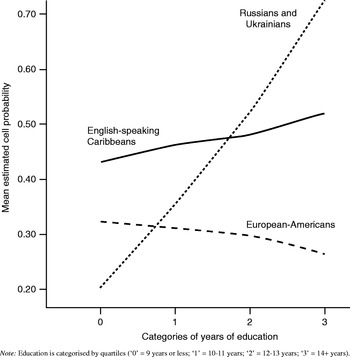
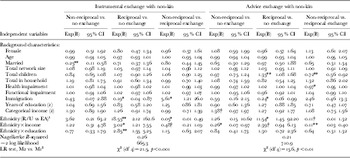
Turning to the US-born European-Americans and Russians/Ukrainians, the LR tests of the addition of interactions between ethnicity and income and ethnicity and education to the models were significant for ‘instrumental exchange with kin’ (right side of Table 3) (χ2 (df 4)=17.2, p<0.01), for ‘instrumental exchange with non-kin’ (left side of Table 4) (χ2 (df 4)=21.5, p<0.001), and for ‘advice exchange with non-kin’ (right side of Table 4) (χ2 (df 4)=15.6, p<0.01). For ‘instrumental exchange with kin’, the interactions of both ethnicity by income and ethnicity by education were significant for reciprocal compared to no exchange, and for non-reciprocal compared to reciprocal exchange (right side of Table 3). According to the post-hoc analyses, with increasing income and education, the Russians/Ukrainians had higher odds ratios of having reciprocal compared to no exchange (respectively OR=7.15, p=0.07, and OR=1.22, p=0.19), and lower odds of having non-reciprocal compared to reciprocal exchange (respectively OR=0.35, p=0.08, and OR=0.88, p=0.08), whereas there were no such associations for US-born European-Americans. As for ‘instrumental exchange with non-kin’, the interactions of both ethnicity by income and ethnicity by education were significant for reciprocal compared to no exchange (see left side of Table 4). The post-hoc analyses then revealed that with increasing income (OR=3.57, p<0.05) and years of education (OR=1.28, p<0.01), the Russians/Ukrainians had higher odds of having reciprocal compared to no exchange, whereas there were no such associations for US-born European-Americans. Figure 1 graphically shows the differential probability of having reciprocal ‘instrumental exchange with non-kin’ by level of education.
Reciprocal instrumental exchange with non-kin: interaction between ethnicity and education for US-born Europeans, English-speaking Caribbeans, and Russians/Ukrainians.

Multinomial logistic regressions: instrumental exchange with non-kin, and advice exchange with non-kin, for European-Americans and Russians/Ukrainians

Notes: CI confidence interval of exp(B). 1. Comparison of Russians/Ukrainians with European-Americans. 2. Likelihood ratio test of Model 2 versus Model 1.
Significance levels: † p<0.10, * p<0.05, ** p<0.01.
For ‘advice exchange with non-kin’ among US-born European-Americans and Russians/Ukrainians, the interaction of ethnicity by income was significant for non-reciprocal compared to no exchange, and for non-reciprocal compared to reciprocal exchange (right side of Table 4). The post-hoc analyses revealed that with increasing income, US-born European-Americans had increasing odds of having non-reciprocal compared to no exchange (OR=1.38, p=0.06), and of having non-reciprocal compared to reciprocal exchange (although the odds (1.02) were not significant). Interestingly, these associations seemed primarily the consequence of ‘giving advice or giving and getting advice,’ rather than ‘getting advice only’. There were no such associations among the Russians/Ukrainians.
African-Americans and US-born European-Americans
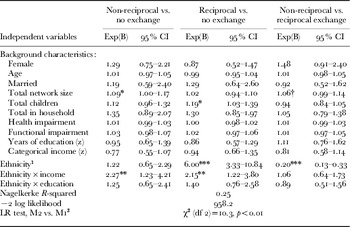
Among African-Americans and European-Americans, the only type of exchange for which the LR test indicated significant interactions with the SES measures was ‘instrumental exchange with kin’ (Table 5) (χ2 (df 2)=10.3, p<0.01). For this type of exchange, there was a significant interaction between ethnicity and income for both non-reciprocal compared to no exchange, and for reciprocal compared to no exchange. As mentioned above, with increasing income, the African-Americans had higher odds of having one of these two exchange categories compared to no exchange. For the US-born European-Americans, there was no such association with income. There was also a main effect of ethnicity for non-reciprocal as compared to reciprocal exchange, such that the African-American participants had much lower odds than the European-Americans of having non-reciprocal compared to reciprocal exchange (OR=0.20, p<0.001), which was driven by both ‘getting only’ and ‘giving only or giving/getting’.
Multinomial logistic regressions: instrumental exchange with kin for African-Americans and European-Americans
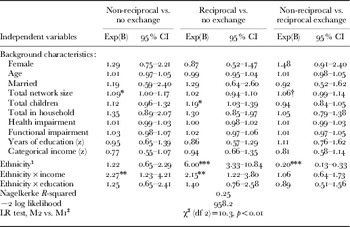
Notes: 1. Comparison of African-Americans and European-Americans. 2. Likelihood ratio test of Model 2 versus Model 1. CI: confidence interval of exp(B).
Significance levels: † p<0.10, * p<0.05, ** p<0.01, *** p<0.001.
Comparison of English-speaking Caribbeans and Russians/Ukrainians
Among English-speaking Caribbeans and Russians/Ukrainians, there were significant interactions between ethnicity and the SES measures for ‘instrumental exchange with non-kin’ (χ2 (df 4)=17.4, p<0.01) and ‘advice exchange with non-kin’ (χ2 (df 4)=9.8, p<0.05) (Table 6). For ‘instrumental exchange with non-kin’, there was a significant interaction between ethnicity and education for reciprocal exchange compared to no exchange, and for non-reciprocal compared to reciprocal exchange. Specifically, with increasing education, the Russians/Ukrainians had higher odds of having reciprocal compared to no exchange and lower odds of having non-reciprocal compared to reciprocal exchange (OR=0.30, p<0.05), which was driven by both ‘getting only’ and ‘giving only or giving/getting’. For the English-speaking Caribbeans, there was no such association with education. There was also a significant interaction between ethnicity and income for reciprocal compared to no exchange; with increasing income, the Russians/Ukrainians had higher odds of having reciprocal compared to no exchange (as mentioned above), but for English-speaking Caribbeans there was no such association. This interaction is illustrated in Figure 1. For ‘advice exchange with non-kin’, there was only one significant interaction between ethnicity and income for non-reciprocal compared to reciprocal exchange; namely, with increasing income, English-speaking Caribbeans had lower odds of having non-reciprocal compared to reciprocal exchange (OR=0.64, p<0.001), whereas there was no such association for Russians/Ukrainians. These associations for English-speaking Caribbeans seemed primarily the result of ‘giving advice or giving/getting advice’ rather than ‘getting advice only’.
Multinomial logistic regressions: advice exchange with non-kin, and instrumental exchange with non-kin for Russians/Ukrainians and English-speaking Caribbeans

Notes: 1. Comparison of the two ethnic groups in the model. 2. Likelihood ratio test of Model 2 versus Model 1. CI: confidence interval of exp(B).
Significance levels: † p<0.10, * p<0.05, ** p<0.01, *** p<0.001.
Interactions between ethnicity and income for ‘instrumental exchange with kin’
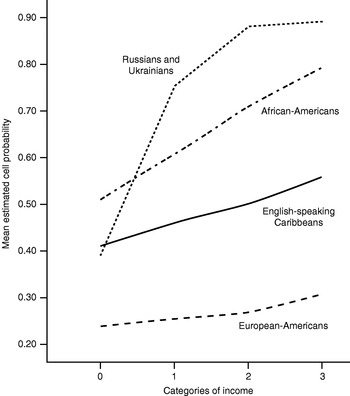
Because there were significant interactions with income for ‘instrumental exchange with kin’ for three of the ethnic group comparisons, Figure 2 graphs the differential probability of these exchanges being reciprocal with higher income for all four ethnic groups. The probability for US-born European-Americans was consistently low, whereas for the other three ethnic groups the probability was higher and increased with income at a greater rate. This increase was not significant for English-speaking Caribbeans, however, and was particularly high among the US-born African-Americans and the Russians/Ukrainians (for whom the association was quadratic).
Reciprocal instrumental exchange with kin: interaction between ethnicity and income.

Discussion
Racial and socio-economic differences in social relations and patterns of social exchange are relatively well established (e.g. Antonucci and Jackson Reference Antonucci, Jackson, Sarason, Sarason and Pierce1990; Kim and McKenry Reference Kim and McKenry1998; Krause and Borawski-Clark Reference Krause and Borawski-Clark1995; Mickelson and Kubzansky Reference Mickelson and Kubzansky2003). To extend this work, the twofold purpose of the present study was first to move beyond studying Black/White differences in patterns of social exchange by examining variation within these two racial groups, and secondly, to look for ethnic variation in the effects of socio-economic status on patterns of exchange, particularly reciprocal exchange. Although ‘social exchange theory’ (Gouldner Reference Gouldner1960) holds that there is a universal norm of reciprocity, the findings suggest that there are ethnic differences in patterns of social exchange, and that the expression of an ethnic norm of reciprocity varies according to the available resources as well as the types of exchange and relationships that are involved. The descriptive analyses showed both between-group and within-group heterogeneity in patterns of social exchange, and the predictive analyses showed that most of these ‘main effects’ were qualified by interactions with income and/or education.
US-born African-Americans and European-Americans
Consistent with some previous research (Antonucci and Jackson Reference Antonucci, Jackson, Sarason, Sarason and Pierce1990) and our predictions, it was found that a higher percentage of US-born African-Americans than US-born European-Americans reported reciprocal exchange with both kin and non-kin, and that this difference was more pronounced for ‘instrumental exchange’ than ‘advice exchange’. Although measures of reciprocity beliefs were not available, these results lead us to speculate that African-Americans have stronger reciprocity norms than European-Americans, in particular for instrumental exchanges. In the predictive analyses, African-Americans showed higher odds of instrumental exchange with kin (either reciprocal or non-reciprocal) than of not engaging in such exchanges at all with higher income. One possible explanation is that an underlying norm for kin exchange may be more easily expressed when resources are available but if income is low may be suspended, so that the ethnic difference is more pronounced with higher income. Social networks are composed typically of people with similar socio-economic backgrounds (Krause Reference Krause and Binstock2001); thus, when resources are scarce, older individuals may feel uncomfortable turning to their kin for instrumental help (although they may continue to support their children/grandchildren with child-care or in other ways). Indeed, when African-American households (which tend to be multi-generational) are impoverished, they may lack the resources to meet the needs of all generations adequately (Hogan, Eggebeen and Clogg Reference Hogan, Eggebeen and Clogg1993).
US-born African-Americans and English-speaking Caribbeans
In terms of within-group heterogeneity, as predicted, there were higher percentages of immigrant English-speaking Caribbeans than US-born African-Americans in the non-reciprocal exchange categories (for both kin and non-kin). This is consistent with the possibility that immigrant Caribbeans engage in exchanges with network members back home (which tend to be unbalanced) or help more recent immigrants in their networks. This finding also makes sense in the context of the family and living situation of the English-speaking Caribbeans; they reported, on average, more children (4.0) and more people living in the household (2.3) than any other ethnic group. Thus, they may be giving more support (in the form of care) than they receive in return. This ‘main effect’ was qualified, however, by several interactions. Unlike African-Americans, English-speaking Caribbeans did not have different odds of engaging in ‘instrumental exchange with kin’ (reciprocal or non-reciprocal) at different levels of income but, also unlike African-Americans, those with more years of education were less likely to have non-reciprocal than reciprocal ‘instrumental exchange with kin’. It is possible that English-speaking Caribbeans with higher education value reciprocity more than those with less education; alternatively, it may be that their kin networks are primarily comprised of kin in the US who require less instrumental support than kin ‘back home’. Although not possible in the present study, it might be fruitful if future research examined the geographical distribution of immigrants’ social networks and its effect on support given and received.
US-born European-Americans and Russians/Ukrainians
Consistent with the importance of non-kin networks to Eastern Slavs (Althausen Reference Althausen, McGoldrick, Giordano and Pearce1996; Leipzig Reference Leipzig2006), we found the expected effect that the Russians and Ukrainians were more likely to have reciprocal exchanges with non-kin as compared to US-born European-Americans. This was particularly true for instrumental exchange. We also found that Russians/Ukrainians were more likely than European-Americans to have reciprocal instrumental exchange with kin. These ‘main effects’ were tempered by significant interactions with income and education. Like the African-Americans, Russians/Ukrainians with higher income and education were more likely to report reciprocal ‘instrumental exchange with kin’, whereas there was no such association for European-Americans. Unlike any other studied ethnic group (and in particular unlike the European-Americans), the Russian/Ukrainian immigrants of higher income and education were more likely to engage in reciprocal instrumental exchange with non-kin. As noted, these ethnic groups may be particularly reliant on friendship networks, which during the Soviet era and before they migrated provided much-needed emotional and instrumental support (Althausen Reference Althausen, McGoldrick, Giordano and Pearce1996; Leipzig Reference Leipzig2006; Patico Reference Patico2002; Treas and Mazumdar Reference Treas and Mazumdar2002). What is referred to colloquially in Russian as blat was very common at that time: namely, the use of social connections and friendship networks to obtain commodities, services and other privileges (Patico Reference Patico2002). Gift-giving and the reciprocal exchange of favours among friends may continue to be important for them. It may be that such reciprocal exchanges become easier with higher income and education, not only because of greater financial resources but also (and perhaps more importantly) because of more contacts and connections as a result of greater intellectual or educational resources.
English-speaking Caribbeans and Russians/Ukrainians
Further evidence that the Russians/Ukrainians have an exceptional pattern of exchange with non-kin (and that it is not simply derived from being migrants) comes from the comparison with English-speaking Caribbeans. Russians/Ukrainians with higher education and income had high odds of reciprocal ‘instrumental exchange with non-kin’, whereas there was no such association for English-speaking Caribbeans. In contrast, although the English-speaking Caribbeans were more likely to report non-reciprocal ‘instrumental exchange’ and ‘advice exchange’ with non-kin than the other ethnic groups, the regressions showed that with higher income they had lower odds of non-reciprocal than reciprocal ‘advice exchange with non-kin’. Once again, it is possible that English-speaking Caribbeans with higher income value reciprocity more than those with lower income, or that the non-kin networks of high-income Caribbeans mainly comprised other immigrants in the US and/or non-immigrant individuals, both of which may be more able to engage in reciprocal advice exchanges than friends ‘back home’. The differences in the association between SES and non-kin exchange between Russians/Ukrainians and English-speaking Caribbeans may reflect differences in their immigration histories or acculturation processes or both.
Conclusions
In sum, the findings suggest that norms and values regarding exchange are resource sensitive. It might be that norms regarding exchange are suspended when resources are scarce, or are more rigorously adhered to when resources are plentiful. A shared ethnic value, such as familism, may be subscribed to at all socio-economic levels but more frequently enacted with more financial and intellectual resources. In other words, economic constraints may prevent groups from participating fully in their exchange networks (Dominguez and Watkins Reference Dominguez and Watkins2003). Alternatively, it is possible that an awareness of the resource constraints on actualising reciprocity is actually embedded in ethnic norms and values, particularly where the group has historically had low resources; unfortunately the data did not allow tests of these two possibilities. It is notable that interactions with income and education for kin exchange were found only in the context of instrumental support; SES may be less crucial for ‘advice exchange’, which is less contingent on money and mobility (Rook Reference Rook1987; Schwarz et al. Reference Schwarz, Trommsdorff, Albert and Mayer2005). In fact, it was only for ‘advice exchange with kin’ that the interactions with income and education did not improve the model fit, perhaps because of the four types of exchange that were examined; it makes the least demands on financial and intellectual resources.
The US-born European-Americans stood out both for the low level of reciprocity and because income and education had very little effect on the reported level. One can speculate that US-born European-Americans (especially in comparison to the other groups) value independence over interdependence (e.g. the mutual assistance of familism) (Phinney, Ong and Madden Reference Phinney, Ong and Madden2000). For instance, older US-born European-Americans may prefer formal care more than relying on their families for instrumental support or personal care (and their children may prefer to purchase formal nursery care more than to rely on their parents for help with care of their children). This would explain their greater likelihood of being in the ‘no exchange’ categories, and why higher income and education did not have a positive effect on reciprocity. Although independence may be highly valued by US-born European-Americans, it may also be that individuals can only ‘afford’ to be independent in certain contexts (i.e. resource-rich environments). Although we did not find a significant negative association between SES and reciprocity for the US-born European-Americans, further research may show that groups who value independence engage in less reciprocal exchange with higher education and income. In contrast, groups who value mutual aid may engage in more reciprocal exchange with more resources. In other words, for all ethnic groups, more resources may be associated with a greater ability to enact shared ethnic values.
Strengths and limitations of the analyses
The presented analyses have several important strengths. In addition to the diverse ethnic sample and the exploration of interactions between ethnicity and both income and education, the measure of reciprocity was relatively direct. That is, we measured the perception of reciprocity in individual relationships, and then calculated the proportion of an individual's dyadic relationships that were perceived to be reciprocal. In addition, unlike previous research (e.g. Väänänen et al. Reference Väänänen, Buunk, Kivimäki, Pentti and Vahtera2005), we distinguished four types of exchange in order to assess the ‘relational context’ – these were the four combinations of ‘kin’ and ‘non-kin’ relationships and ‘instrumental’ and ‘advice’ exchange (Ingersoll-Dayton and Antonucci Reference Ingersoll-Dayton and Antonucci1988; Rook Reference Rook1987). The findings have confirmed the importance of these distinctions. Although higher income and education were associated with greater reciprocity in ‘instrumental exchange with kin’ among several of the ethnic groups, this was not the case for ‘advice exchange with kin’, and for ‘instrumental’ and ‘advice exchange with non-kin’, only for the Russians and Ukrainians was higher income and education associated with greater reciprocity.
In spite of these strengths, some limitations should be noted. First, the findings relied on self-reports of exchange rather than actual behaviour, so a reporting bias is possible. Along the same lines, because we had only self-reports of reciprocity, it is difficult to know whether the respondents considered reciprocity to be relatively contemporaneous or occurring over a period. It may be that ethnic differences in reported reciprocal exchange partially represent differences in the way that reciprocity is understood; for example, perhaps some groups report a higher proportion of reciprocal exchanges because of a stronger belief in the idea of a ‘support bank’ (Antonucci and Jackson Reference Antonucci, Jackson, Sarason, Sarason and Pierce1990). Furthermore, it could be that exchanges need not be reciprocated by the same type of support or by the specific recipient (Ikkink and van Tilburg Reference Ikkink and van Tilburg1999; Treas and Mazumdar Reference Treas and Mazumdar2002). It may be more important to understand reciprocity at a broader level rather than as applying to specific relationships or specific types of exchanges, especially when reciprocity is understood in terms of social capital (Putnam Reference Putnam2000).
Secondly, the analysis has not directly assessed values and norms concerning social exchange among the various ethnic groups. Without directly measuring culture, it is impossible to know whether it plays a role (Betancourt and Lopez Reference Betancourt and Lopez1993). Future research should more closely examine the actual values, beliefs and norms held by different ethnic groups and how they relate to social exchange. Finally, it should be noted that the findings may be unique to the analysed sample. For instance, the characteristics of the urban environment from which the sample was drawn could clearly affect both the structure of social relationships and the nature of social exchange: New York City is densely populated, has good public transportation and, therefore, low reliance on automobiles, and has a distinctive, cosmopolitan culture (Ajrouch, Antonucci and Janevic Reference Ajrouch, Antonucci and Janevic2001). In addition, the cluster sampling techniques that were used to target ethnic neighbourhoods may have increased the likelihood of finding similar reports of reciprocity in ethnic groups, since some may share the same neighbours and friends. Future research could examine these issues with more representative samples that include other sizable ethnic groups in the US (e.g. Asian-Americans and Hispanic-Americans), as well as samples from other countries.
In conclusion, the present study has underlined the importance of moving beyond the broad racial categories that are customarily applied in American social research and of seeking a more sophisticated understanding of ethnic variations in social exchanges. It has explored the possibility that the ability to meet cultural or ethnic expectations and norms may be a function of available resources, and has suggested that ethnic variations in social exchange reflect attributes specific to each group, the immediate relational contexts and the macro socio-economic and environmental contexts. Identifying the contexts in which reciprocity is most strongly expressed among older adults may help us understand how best to promote the development of social capital in ageing communities. Future research should examine the effects of these ethnic variations in social exchange and reciprocity on variations in health and wellbeing outcomes.
Acknowledgements
This research was supported by grants from the National Institute of General Medical Sciences (S06 GM54650) and the National Institute on Aging (K07 AG00921). We gratefully acknowledge Kira Birditt's and Francine Conway's helpful comments on drafts of the paper.