The Emergence of Indigenous Literature in Taiwan
A proper understanding of Taiwanese society cannot be achieved without due attention to the indigenous question. Since Japanese colonial times, indigenous peoples and cultures have continued to excite interest, often being seen to mark what is “truly and uniquely Taiwanese.”Footnote 1 Indigenous peoples constitute about 2 per cent of the population of contemporary Taiwan. Though generally classified as one of the four ethnic groups in Taiwan, indigenous peoples are different from the other three in that they are Austronesian rather than descendents of Chinese immigrants. With the rise of the indigenous movement in the 1980s, more and more indigenous peoples came to see themselves as cultural others with specific rights of their own.Footnote 2
To date, most of the work in English on the indigenous question in Taiwan is anthropological in nature.Footnote 3 Very few studies have dealt with the production of indigenous literature, although this has been gaining momentum over the past 20 years. In anthropological works, indigenous people often play the role of interviewee or native informant.Footnote 4 Indigenous literature, in contrast, prides itself on its capacity for indigenous people to occupy the position of author (and authority). Thus, arguably, what makes indigenous literary production particularly worthy of study is the indigenous writers' assumption of the power of (self-)representation. Indeed, when the indigenous scholar Sun Dachuan 孫大川 promoted the use of the first-person point of view in one of his early discussions of indigenous literature, he made the point that writing in the form of the autobiographical “I” was a gesture to reclaim the subject position which was denied to aborigines in mainstream discourse.Footnote 5
According to data compiled by the scholar Wei Yijun 魏貽君, there are about 100 aborigines in Taiwan who have some sort of publication.Footnote 6 About 20 among them can be defined as writers in loose terms if by “writer” is meant someone who has the experience of literary creation and literary publication. In this article, I take the creative writings of Syaman Rapongan 夏曼藍波安 as a case study to examine the interplay between indigenous discourse and mainstream cultural discourse in Taiwan over the past 20 years.
Starting out as a discourse of cultural otherness in the mid-1980s when Taiwan was undergoing a radical political transformation, indigenous literature began to straddle the seemingly conflicting positions of the other and the self in the late 1990s as the Taiwanese nativist movement turned to indigenous culture for its quest for “genuine” Taiwanese identity.Footnote 7 The reclaiming of indigenous identity in indigenous literary discourse, particularly in the way mapped out by Rapongan in his literary creation, converges with the Taiwanese reclaiming of native roots in the forging of a Taiwanese identity. This interplay between indigenous identity discourse and a particular strand of mainstream identity discourse marks a shift in the significance of the indigenous question. But before delving into the complexity of the indigenous question in contemporary Taiwan, some basic information about the development of indigenous literature in Taiwan is needed.
The Development of Indigenous Literature in Taiwan
The year 1984 is commonly identified as a landmark in the history of indigenous literature in Taiwan. It witnessed the appearance of the first special issue of indigenous literature in a poetry journal called Spring Breeze (Chunfeng 春風). In the same year, the Association for the Promotion of the Rights of the Indigenous People in Taiwan was set up. From the very beginning, indigenous literature was intertwined with the indigenous movement. In a sense, it can be regarded as an offshoot of the indigenous movement.Footnote 8 Since then, indigenous literary production in Chinese has increased steadily, particularly after the lifting of martial law in 1987. Indigenous writers have claimed many important literary awards and the study of indigenous literature has become an important part of the curriculum in Taiwanese literary studies.
As a special grouping of literary writing based on the ethnic identity of the writers,Footnote 9 indigenous literature in Chinese is usually marked by some specific features. First is the use of the autobiographical “I,” a gesture of affirming the subject position of the indigenous writer.Footnote 10 This may explain why prose essays constitute the largest corpus of indigenous Chinese-language creative writing. In contrast to fiction and poetry, which call attention to the literary text as a fabricated artifact, prose essays often operate with an appeal to the notion of “authenticity” in the Chinese literary tradition. This implicitly positions the autobiographical “I” as a scribe and guardian of his or her tribal culture, who faithfully documents tribal knowledge to keep it alive. At the same time, “I” acts as a cultural translation, mediating between tribal culture and the dominant Chinese culture. Since indigenous writers often pose as translators and tribal spokespersons, they are expected to possess authentic knowledge of their tribal culture. Their status therefore implicitly hinges on how well they master indigenous cultural knowledge. In other words, to be “recognized” as an indigenous writer and to lay claim to that title, an author needs to demonstrate a strong sense of “cultural competence.” Without a display of such competence, the sign of indigenous otherness cannot possibly thrive in indigenous writing, nor can it work to challenge the domination of Chinese culture.
Hence, another feature often found in indigenous writing is a tendency to deploy rich ethnographic detail. Syaman Rapongnan is a case in point. To highlight the act of writing as a practice of cultural translation, indigenous writers often use words from their own tribal languages in the construction of their Chinese literary text. It is important to note that very few indigenous writers write exclusively in their tribal languages. This is not simply because these languages have no written inscription systems. Another important reason is that it would strictly limit the readership – to no more than a few dozen in some cases. If one of the important functions of indigenous literature is to build up a sense of collective indigenous consciousness, writing in one's own tribal language (mainly in romanization in current practice) would hardly help indigenous peoples divided by different languages to communicate with each another.Footnote 11 Under such circumstances, the use of the Chinese language for literary creation is understood not so much as a surrender to the power of the dominant group as what Michel de Certeau calls a tactic – a guileful ruse that poaches on someone else's place and turns it for one's own use.Footnote 12
However, to challenge the hegemonic domination of the Chinese language, it is important to stress the un-assimilable indigenous otherness even if the writer is forced to use Chinese in writing.Footnote 13 Many writers therefore resort to the tactical use of indigenous words in romanization to interrupt the smooth flow of Chinese in the construction of a literary text. The persistent appearance of indigenous words in a Chinese-language text is meant to underscore the inerasable traces of indigenous otherness. Interestingly, this peculiar layout of indigenous literary writing not only throws into relief the act of writing as an act of translation but also points to its failure as an adequate translation. In other words, the presence of indigenous words highlights their untranslatability. Thus, paradoxically, it is through this peculiar confessional gesture of its own limitation as a translation transaction that indigenous writing implicitly challenges the assimilating power of the Chinese culture and its dominant signifying system.
All these peculiar features of indigenous literature are found in the works of Syaman Rapongan. Rapongan, a T'au writer from Orchid Island off the south-eastern coast of Taiwan with a small population of about 3,000 people, made his name as an indigenous Chinese-language writer with the publication of a collection of prose essays – Smitten with the Ruthless Sea (Lenghai qingshen 冷海情深) – in 1998. Since then, he has won several important literary awards in Taiwan. Rapongan works mainly with the prose genre. Speaking almost always in the first person, he makes no distinction between the autobiographical “I” in his writing and Rapognan as a person in real life. Moreover, his writing is saturated with what ethnographers call “thick descriptions.”Footnote 14 Literal translations of T'au expressions are often followed by ethnographical explanations which elucidate the meanings in T'au culture. For example, in “Life in waves” (Langtao rensheng 浪濤人生), Rapongan points out that a T'au man who can neither swim nor fish is called “a man being suffocated by the smoke of his neighbours” – a specific T'au figure of speech, meaning that the man enjoys no smell of fish cooking at home but only that coming from his neighbours' houses. This term, the autobiographical “I” explains, is pejorative in T'au culture. It implies that “the man survives on the body heat of his woman rather than the fish he harvests in the sea.”Footnote 15 Highlighting local knowledge and expressions specific to the T'au tribe, ethnographic descriptions of this kind mark the writer as a translator and his writing as imparting a body of knowledge foreign to readers.Footnote 16
Insofar as indigenous writers use various tactics to insinuate a sense of otherness into their Chinese-language texts, a binary opposition between the writer's tribal culture and Chinese culture is created. The writer often takes great pains to suggest that the gap between the two cultures is unbridgeable, for the “indigeneity” of the text (and the writer) is defined by its visible separation from the dominant Chinese culture. But what is particularly intriguing about the question of indigeneity in the context of Taiwan is that it is not simply associated with the idea of “otherness.” In a recent development, indigeneity is also made to stand for the quintessentially Taiwanese, and hence what constitutes “the Taiwanese self.” The oscillation of the indigenous sign between two almost irreconcilable identity positions opens up a whole bundle of questions about the production of indigeneity. How is the notion of indigeneity discursively formulated in a specific historical context? How is it deployed in the field of cultural production, and for what purpose? What conflicting forces come into play in the production of indigeneity?
Transnational Cultural Legacies and the Production of Taiwanese Indigeneity
The celebration of Rapongan as “a writer of the sea” provides clues to these intriguing questions (Figure 1). In a recent interview with Syaman Rapongan, the indigenous scholar Sun Dachuan defines his writing as “oceanic literature” and claims that it makes a great contribution to the discourse of “oceanic Taiwan” which has been gaining currency in Taiwan since the mid-1990s:
I would like to hear more about the connection between your experiences in the sea and your creative writing after your return to the T'au tribe [on Orchid Island]. Taiwan is indeed a very strange place. It is surrounded by the ocean. And now it is said that Taiwan is a country of the ocean. But there is almost nothing related to the ocean in Taiwan's literature or everyday life. I think that you have very good reason to be proud of yourself as your early work Smitten with the Ruthless Sea and your recent writings, such as Recollections of the Waves (Hailang de jiyi 海浪的記憶), make remarkable contributions to Taiwan's “oceanic literature” and to Taiwan's return to “geographical imagination of the ocean.”Footnote 17
There are quite a number of celebrated indigenous writers in Taiwan, including Topas Tamapima 拓拔斯塔瑪匹瑪, Walis Norgan 瓦歷斯諾幹, Liglave A wu 利格拉樂阿媽 and Yaronglong Sakinu 亞榮隆撒可努. But none of their works has been interpreted as anything other than “indigenous writing.” The celebration of Rapongan as “a writer of the sea (haiyang zuojia 海洋作家)” points to his participation in a context of cultural discourse other than that of multiculturalism. Smitten with the Ruthless Sea is now commonly recognized as one of the most representative works of Taiwan's “oceanic literature.” When it came out in 1998, a new Taiwanese cultural imagery was just coming into shape. This re-conceptualized Taiwan as “a country of the ocean,” as compared with China, “a country of the vast land.” In this new discourse, the notion of “ocean” is taken to signify open-ness and an extrovert attitude towards cultural interchanges, whereas land denotes an introvert imagination that stresses agrarian rootedness. To pit Taiwanese culture against Chinese culture in this way is to suggest that they have few similarities. It therefore lays the groundwork for a cultural formulation of Taiwan as a country different from China. Although it is debatable whether a cultural dichotomy between Taiwan and China is fully justified,Footnote 18 the characterization of Taiwan as a “country of the ocean” certainly signifies a new phase in the development of Taiwanese identity narrative.
Syaman Rapongan: a “writer of the sea” (courtesy of Syaman Rapongan)

The discourse first surfaced in the presidential campaign in 1996 when the pro-independence Democratic Progressive Party candidates Peng Ming-min 彭明敏 and Hsieh Chang-ting 謝長廷 coined the term “country of the ocean” to designate Taiwan.Footnote 19 From then on, the notion quickly gained currencyFootnote 20 and has been propagated widely in cultural and literary discourses. In the hands of a pro-independence party, the new discourse has a de-Sinicization slant: China is posited as an Other from which Taiwan has to be differentiated in order to carve out a space for itself in the new age. This strategic portrayal of the Chinese civilization as an Other is reminiscent of the Japanese discourse of civilization in Meiji Japan, where Chinese cultural influence was seen as detrimental to the formation of Japan as a modern society.Footnote 21 It is interesting that an echo of this Meiji discourse is found in the new Taiwanese cultural discourse. Arguably, the Japanese colonial legacy plays a key role in the shaping of the discourse of the new Taiwanese cultural imagery.
In the subsequent development of this discourse, the concept of Taiwan as “a country of the ocean” frequently appears in propaganda from politically opposed camps. Giving a twist to the whole argument about Taiwanese identity, the anti-independence political party (the Chinese Nationalist Party) substitutes a Chinese legacy for the Japanese colonial legacy, tracing the Taiwanese “oceanic” culture to the adventurous voyages of Zheng He 鄭和,Footnote 22 a Chinese eunuch in the Ming dynasty who undertook seven naval expeditions to South-East Asia and the east coast of Africa in 1405–33.Footnote 23 The implicit competition of Japanese and Chinese legacies in the shaping of the Taiwanese new identity discourse testifies to the politics of “invented tradition.” While both political parties participate in the propagation of the idea of Taiwan as a country of the ocean, they draw upon different historical legacies and therefore give their discourse very different significations.
In their attempts to re-define Taiwan through a re-orientation of geographical and historical imagination, the pro-independence, de-Sinicization camp highlights the rich indigenous cultural heritage in the formation of Taiwanese society, in addition to the implicit exploitation of the Japanese colonial legacy of Meiji discourse. It has been argued that most Taiwanese people are descendents of Austronesian-speaking tribes.Footnote 24 The history of Taiwan, by implication, begins with Austronesian oceanic culture rather than with Chinese civilization.Footnote 25 The re-discovery and reclaiming of an Austronesian cultural heritage in Taiwan are seen as essential to the reconstruction of the Taiwanese identity and historical narrative.Footnote 26 Again, Japanese colonial legacies have an active role to play here.
The identification of Taiwan indigenous peoples as Austronesian first appeared in the discourse of Japanese anthropologists and Westerners, who probably did not share one another's findings.Footnote 27 Many Japanese anthropologists came to Taiwan during colonial times and conducted in-depth research using scientific methods. It was they who identified indigenous people and culture in Taiwan as part of the Austronesian family. This therefore creates an act of double inheritance: Taiwanese inherit the Japanese colonial legacy indirectly as they come to see indigenous culture as an inheritance.Footnote 28 Whereas the dominant view of Taiwanese culture tends to be implicitly Sinocentric, representing the Taiwanese as descendants of the Chinese, now we have Taiwanese identity, as Melissa Brown points out, as “an amalgam of Han culture and ancestry, Aborigine culture and ancestry, and Japanese culture (but not ancestry).”Footnote 29
Once these Austronesian indigenous people and culture are taken to be the “origin” of Taiwanese culture, a whole new concept of “Taiwan” emerges. In this context, the question of indigeneity takes on a new significance. When the Taiwanese indigenous movement began in 1983 as an ethnic minority movement, it was couched mainly in multiculturalist terms.Footnote 30 “Indigeneity” was seen to signify cultural otherness which should be respected in a democratic, multiculturalist society. The recent development of cultural discourse about indigenous culture, however, suggests a notion of indigenity as part of the (Taiwanese) self. As both a sign of the other and a sign of the (Taiwanese) self, indigenous inscription is marked as a site of ambivalence. Rapongan's “sea writing” is particularly helpful in understanding how this double signification works.
The (Re)turn to Indigenous Roots
As some critics have pointed out, Rapongan's writing portrays basically his journey home.Footnote 31 Insofar as Rapongan makes the dramatization of the return to his tribal home the core of his writing, he is representative of a group of indigenous intellectuals who chose to go home to practise their literary writing in the heyday of the indigenous movement. In an early discussion of the definition of “indigenous literature,” Sun Dachuan sees “home-coming” as essential to an indigenous writer.Footnote 32 Many indigenous activists argued that in order to reclaim their identities, indigenous people had to reconnect themselves with their tribal cultures. In answer to this call, many indigenous writers returned to their ancestral, rural homes in the mid-1980s.Footnote 33 Rapongan was one of them. Smitten with the Ruthless Sea describes in various ways his journey home and his consequent struggle to reclaim his tribal status as a T'au man through the gradual mastery of traditional T'au skills. In his prose essays, he depicts how he tries “to shake off the stigma of Sinicization” and “to prove himself a T'au man” through the conscious re-immersion in his tribal culture and knowledge.
Rapongan's “homecoming” theme finds resonance in many Native American novels and thus points to a wider context of indigenous/native writing worthy of further comparative study. William Bevis finds that novels in the Native American literature tradition are often structured differently from those in the white American tradition. He argues that many novels in the latter adopt plots which are “‘eccentric,’ centrifugal, diverging, expanding.”Footnote 34 The individuality and freedom of the protagonist are usually the main concerns. In contrast, Native American novels tend to be structured by what he calls “homing” plots: “In Native American novels, coming home, staying put, contracting, even what we call ‘regressing’ to a place, a past where one has been before, is not only the primary story, it is a primary mode of knowledge and a primary good.”Footnote 35 These remarks seem applicable also to the works by Rapongan and many other indigenous writers in Taiwan. Rapongnan's writing dramatizes the process of his journey home. The preface to the English translation of Smitten with the Ruthless Sea, in itself a prose essay which reveals all the characteristics of his writing, is an illustrative example. It is worth quoting at length in order to demonstrate the formal as well as thematic features of Rapongan's works:
I remembered that when I settled down at my hometown and led a traditional life, I rowed the crafting boat father made for me to angle the dolphin fish and that was also my maiden voyage with the tribal people. I was lucky to catch one. Father sat by me and taught me how to dissect it. At that time, I realized the significance of the flying fish and the dolphin fish, or the ritual fish, to the T'au in their generation; to put it precisely, it was their core religious belief. Therefore, father asked me to tell the soul of the big fish.Footnote 36
Particularly notable here is the “novice” status of the autobiographical “I” in the narrative. Although a T'au himself, the autobiographical “I” is apparently alienated from his tribal culture. Under the instruction of his father, he learns how to catch fish. He makes his first voyage only after he returns home after a long period of absence. And apparently he has not yet learned how to make a boat in the traditional T'au way. A lot of T'au cultural experiences and knowledge are new to the autobiographical “I.” The father is represented here as a teacher, trying to initiate his son into the cosmic order of T'au culture. He is almost without exception represented in Rapongan's writing as the model to be emulated.
The description quoted above is followed by a translation of the father's chant in the T'au language (pp. i–ii):
I hope you can visit my home every year
(mangdei ka so awawan a zomagpit do inawurud namen)
This is the heritage from our forebears
(ta niyapu namen do inapu namen ya)
This is the ceremony to bless you and us safe and sound
(ka toyutoyun namen jimo mo katwan)
You shall generously assist me in saving my strength
(macyazonos ka do oyowyat ko)
And then lie on fine level ground
(kazasa mo do kapiyapyan)
Because I will plough the waves to sail to Petite Orchid Island with your soul
(ta ipanavusavuk ko imo Jimagawud)
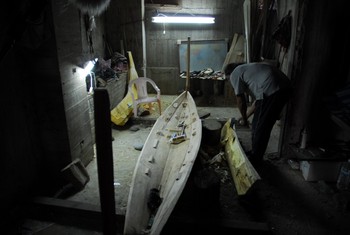
The layout of the father's chanting in romanization alongside the Chinese version speaks tellingly of Rapongan's role as a translator of his tribal culture. He mediates between his tribal culture and the Chinese readers for whom the T'au language is foreign. Also notable is the stress on the importance of keeping tribal customs and ceremonies alive through continuous practices (Figure 2). In addition, the chant gives us a glimpse of the use of “sea vocabulary” in the peculiar figurative expressions of T'au culture.
Syaman Rapongan making a boat in the traditional T'au way (courtesy of Syaman Rapongan)

The significance of the deployment of T'au “sea vocabulary” in Rapongan's writing cannot be stressed too much. Rapongan repeatedly calls attention to the use of “sea vocabulary” in his writing during interviews. In a recent one, he reiterates the cultural specifics of the T'au language which finds expression in his writing:
The phrases the T'au elders use are highly metaphorical, which has had a great impact on my writing. For example, to say “the sun of an old man is low” means he is aged or dying; the stars are “the eyes of the sky”; “men being looked down upon by the wind” refers to lazy men resting on the porch. Such phrases don't exist in Chinese, because these two different cultures are of two different cognitive worlds.Footnote 37
As the interviewer Zoe Cheng points out: “Getting in touch with everything in T'au traditional culture – the ocean, diving, fishing, chopping logs for crafting boats, flying-fish ceremonies, or songs – describes the nature of Rapongan's life.” In terms of content, he not only tells stories about his tribe and his struggle to become a T'au man again, but also tries to pass on in his writing the stories he has learned from older generations. In addition, Rapongan works deliberately with culturally specific T'au expressions and oral tradition to throw into relief indigenous cultural otherness in a Chinese-language text. Thus, in both its form and content, Rapongan's writing embodies his break away from Sinocentric culture to embark on his journey home.
Paradoxically, it is the “homing” movement in his writing that turns Rapongan into a figure of ambivalence and his writing a site of split identity positions. For, in spite of his self-positioning as a guardian and translator of his tribal culture, the pronounced thematic emphasis on his struggle to become a T'au man suggests that he is not yet a T'au man. The fact that he has to reclaim his T'au identity through re-learning all sorts of traditional skills and knowledge already speaks implicitly of his undeniable alienation from his tribal culture. In other words, the “novice” status of the autobiographical “I” calls into question his claim to be a T'au aborigine, pitted against the dominant Chinese culture. Indeed, as he makes a point of showing how hard he struggles to “shake off the stigma of Sinicization,” the image of Rapongan is of someone trying to reclaim his indigenous culture and identity. As such, he comes, probably much against his will, to stand for a typical Taiwanese in the new Taiwanese narrative. For a Taiwanese, as represented in this discourse, is also someone who embarks on the journey home to reconnect himself with the repressed, stigmatized Taiwanese identity. Acknowledging indigenous matrilineal connection is essential to the quest. Moreover, the Taiwanese identity reconstruction project sees de-Sinicization as an indispensable move towards reclaiming Taiwanese identity and culture, which finds much resonance in Rapongan's writing too.
Although Rapongan's story is made to converge implicitly with the story of a Taiwanese's identity quest, he crosses over the line that is supposed to separate the indigenous other from the Taiwanese self. Rather than simply an inscription of otherness compared to other ethnic groups in Taiwan, the sign of indigeneity becomes what constitutes the Taiwanese “self.” It is suggested that many Taiwanese are descendents of aborigines.Footnote 38 In the Qing dynasty, many migrants from China took indigenous women as their wives because very few Chinese women were allowed to come to Taiwan. Since the female ancestors of many Taiwanese were indigenous women, to designate Taiwanese as ethnic Chinese is, in a sense, a patriarchal practice that ignores the important indigenous constituent of Taiwanese identity. In other words, to reshape their Taiwanese identity, people need to acknowledge their matrilineal indigenous roots. It follows that indigenous otherness is an important constituent of their Taiwanese self, identified as “otherness” only because they are alienated from their mother culture due to Sinocentric indoctrination.
Thus, it appears that indigenous cultural discourse and the new Taiwanese cultural discourse have much in common. Both attempt a reconstruction of identity through the reclaiming of indigenous culture. And both have de-Sinocentrism at their heart. In addition, both evoke the power of the indigenous spoken word to exorcize Sinocentrism in cultural formations. As pointed out above, Rapongan practises a strategic deployment of T'au vocabulary to disrupt the smooth flow of the Chinese-language narrative. This creates an alienation effect which points to the symbolic violence of the Chinese language. Such peculiar language behaviour has become a characteristic of indigenous literature. However, it can actually be traced back to the nativist literary movement in the 1970s.Footnote 39 Many writers in the nativist camp at that time practised a kind of “adulterated language” in which transcriptions of spoken Taiwanese are mixed with Chinese Mandarin in narrative. Through the resuscitation of the spoken word of the Taiwanese common people in their writings, nativist writers urged for a reconnection with repressed Taiwanese native cultural heritages.Footnote 40 It is worth pointing out that the reclaiming of the stigmatized Taiwanese spoken language unexpectedly generated a heated debate and paved the way for the development of the Taiwanese identity movement. The contemporary discursive formation of the new Taiwanese identity is but the latest stage of the nativist development. Thus, arguably, the language behaviour in indigenous writing has its precedent in Taiwanese nativist writing of the 1970s. Indeed, as the anthropologist Shih-Chung Hsieh 謝世忠 remarks, the rise of the indigenous movement and that of the new Taiwanese identity discourse were closely interconnected in the beginning.Footnote 41
A few words of caution though. To pay attention to what indigenous writing and the new Taiwanese discourse have in common is not to suggest that the former supports or endorses the latter.Footnote 42 Rather, the aim is to explain how the intriguing operation of the indigenous sign as both an interventional inscription of the cultural “other” and the constitution of the Taiwanese “self” is made possible in the field of contemporary Taiwanese cultural production. Paradoxically, it is through its strong insistence on its otherness and unassimilability with Chinese culture that Rapongan's writing is turned into, metaphorically, the writing of Taiwan. With its call for de-Sinocentric cultural restructuring through the (re)turn to repressed indigenous cultural roots, it fits in with the new Taiwanese cultural orientation. The “oceanic cultural orientation” and sea vocabulary that characterize Rapongan's writing make it particularly serviceable for the strategic differentiation of Taiwanese from Chinese culture.
Referring to Native American literary production, Jeannette C. Armstrong makes the following observation: “All indigenous peoples' languages are generated by a precise geography and arise from it. Over time and many generations of their people, it is their distinctive interaction with a precise geography which forms the way indigenous language is shaped and subsequently how the world is viewed, approached, and expressed verbally by its speakers.”Footnote 43 These remarks also hold true for Rapongan's writing. Rapongan writes about his fish-catching experiences under the sea and about T'au tribal experiences revolving around the sea: spear-fishing, boat-making, knowledge of different species of fish fit or not fit for eating according to T'au custom, and story-telling about sea adventures in times past and present. Rapongan finds in these aspects of T'au life rich resources for his literary creation. It is not difficult to see how this indigenous discourse can be strategically redeployed to illustrate Taiwanese new identity narrative. If the sea culture as depicted in Rapongan's writing appears exotic at first sight, this only exposes Taiwanese readers' alienation from their mother culture and underscores the need to reclaim it. Rapongan's topographical writing with all its rich sea images offers an amendment to the illusive attachment to so-called “cultural China” in abstract space. It is within the context of this specific Taiwanese cultural ambience that Rapongan's writing comes to be celebrated as the most illustrative example of Taiwanese “oceanic literature.” The peculiar blurring of the line between the self of the dominant cultural group and the minority indigenous other makes the case of indigenous writing in Taiwan particularly interesting for study.
Indigenous Culture as Inheritance
Indigenous literature in Taiwan raises critical questions about the production of indigeneity in the context of trans-cultural negotiations. Indigeneity is usually understood as constituting cultural otherness. However, Rapongan's case exposes unexpectedly the aporia in the whole concept of indigeneity that defines an indigenous writer. The theme of “homecoming,” which is often used to structure indigenous writing, compromises the writer's status as an indigenous person speaking for his tribe. In a sense, the struggle to be recognized by his community as a T'au man implicitly undercuts Rapongan's claim to be an indigenous writer. As his writing shows him in the process of becoming a genuine indigenous man again, his indigenous identity is at stake, seen as something in the future rather than a mission accomplished. The intriguing point is that this in-between-ness of Rapongan in the process of becoming an indigenous person makes it possible for him to stand for all Taiwanese in the new Taiwanese narrative. For, in this discourse, the Taiwanese are also reaching out for their matrilineal indigenous roots.
Apparently it is no longer adequate simply to pit indigenous discourse against dominant cultural discourse and stress how the former challenges the basic assumptions of the latter. Although that is certainly true to some extent, there is more in play here. In order to tackle the complexity of the issues, we need a more sophisticated theoretical framework beyond the simple binary opposition to re-conceptualize the sophisticated, probably multiple, positioning of indigenous discourse in any specific cultural context. I would like to draw upon Jacques Derrida's notion of “inheritance” in re-theorizing the complicated relationship between Taiwanese nativist discourse and indigenous culture.Footnote 44
Inheriting, according to Derrida, is more than a passive acceptance of something that is passed on: “Inheritance implies decision, responsibility, response and, consequently, critical selection, choice.”Footnote 45 Indigenous culture can be conceptualized as an inheritance, which Taiwanese do not “naturally” come into. In “choosing” to inherit indigenous culture and identify it as an important constituent of Taiwanese culture (and hence also their responsibility as an heir), they also inherit the Japanese colonial legacy which laid the foundations of Taiwanese indigenous discourse. It is notable that one does not simply “receive” these legacies but “chooses” to inherit them. In Derrida's words: “To inherit is not essentially to receive something, a given that one may then have. It is an active affirmation, it answers an injunction, but it also presupposes initiative, it presupposes the signature or countersignature of a critical selection.”Footnote 46 As an active affirmation and critical selection, inheritance is an attempt to avoid a foreclosure of the possibility of future – in this case, the domination of certain prescribed narratives in envisaging the future of Taiwan. Inheritance, for Derrida, is “a question of making use, as it were, of an exemplary exception in order to loosen the stranglehold of a domination and ensure that time be given time.”Footnote 47 To acknowledge indigenous culture as a Taiwanese inheritance is to give time time, to keep the possibility of the future-to-come open. In other words, as Taiwanese people subject a Han-ethnocentric narrative of Taiwan to critique by choosing indigenous culture as their heritage, they resist the foreclosure of the future and keep alive the unforeseeable future-to-come.
But inheritance in the Derridean sense is not a blind reproduction of heritage; hence it is “in no way traditionalist or backward-looking.”Footnote 48 As a choice and a self-conscious assumption of responsibility, inheritance also involves active intervention which reinterprets and “relaunches the heritage otherwise” so as to “keep it alive.”Footnote 49 For, as Rosalyn Diprose points out, the future would be no future at all if it is merely a foreseeable reproduction of one's heritage. Also, without any interruption or transformation of one's heritage, there is no responsibility.Footnote 50 “Indigenous culture as inheritance” demands the interruption and transformation of the heritage structured by what Johannes Fabian calls “denial of coevalness.”Footnote 51 Instead of being conceptualized as “primitive” in the Japanese colonial anthropological way, indigenous culture as inheritance demands the recognition “that all human societies and all major aspects of a human society are ‘of the same age’.”Footnote 52 On the other hand, reaffirmation of a heritage – reaffirmation in the Derridean sense of continuing and interrupting at the same time – necessarily involves a critique of the heritage one chooses to inherit. Thus, while indigenous culture is recognized as a worthy inheritance, it may also be subject to critical examination. The gender politics of some indigenous social structures (such as the patriarchal system of T'au culture) may invite critical re-evaluation. The reinterpretation of indigenous culture as a heritage is necessary, for only the heir's active intervention can ensure that “something might happen” and the “future-to-come” is kept alive.Footnote 53
Finally, to acknowledge indigenous culture as inheritance means to acknowledge its fundamental “inappropriableness.”Footnote 54 That is to say, it is essential that an heir recognizes not simply what Derrida calls the singularity of the inheritance but also the obligation to preserve its variableness.Footnote 55 Thus, insofar as indigenous culture is taken as an inheritance, one claims it to be one's own. On the other hand, insofar as indigenous culture “remains fundamentally inappropriable,” the heir does not truly own it. Inheritance always involves contradictory injunctions.Footnote 56 As an inheritance “relaunched otherwise,” indigenous culture is conceptualized as a Taiwanese heritage in the new Taiwanese identity narrative. It is no longer adequate to understand indigenous culture simply in terms of its opposition to Taiwanese culture. A proper attention to the complexity of inheritance in Derridean terms would help re-theorize the complicated positions of indigenous culture in Taiwan.
Conclusion
Via the case study of Syaman Rapongan, I have attempted to show that the production of (Taiwanese) indigeneity does not involve questions about indigenous self-representation only. In the Taiwanese context, the intriguing intertwining of indigenous discourse with mainstream cultural and identity discourse shows that a simplistic scheme of binary opposition is not adequate to deal with the complexity of the question. The notion of indigeneity is usually associated with cultural otherness and the self-representation of oppressed indigenous people. I demonstrate in this article how an in-depth investigation of the production of indigeneity in Taiwan exposes the inadequacy of this prevalent theoretical scheme. Borrowing from Derrida, I probed into the significance of the re-interpretation and re-positioning of indigenous culture as a Taiwanese inheritance in the new Taiwanese identity discourse. The recognition of the complex structure of inheritance and the double bind of “re-affirming” heritage in the sense elaborated above may help tackle the issue in a non-reductive way.