Muscle dysmorphia (MD) was recently added to the fifth revision of the Diagnostic and Statistical Manual for Mental Disorders (DSM-5, American Psychiatric Association, APA, 2013) as a specifier of body dysmorphic disorder (BDD). This specification is used when ‘the individual is preoccupied with the idea that his or her body build is too small or insufficiently muscular’. While there are no formal diagnostic criteria for MD as a standalone diagnosis, criteria mirroring those for DSM-5 BDD but with specificity for MD were suggested by Pope and colleagues in the 1990s and are more widely used than the DSM-5 BDD criteria (Pope, Gruber, Choi, Olivardia, & Phillips, Reference Pope, Gruber, Choi, Olivardia and Phillips1997; Sandgren & Lavallee, Reference Sandgren and Lavallee2018; see Table 3). According to the first of these, the cardinal feature of MD is a preoccupation with the idea that one's body is not sufficiently lean and muscular, which may be associated with characteristic behaviors such as weight lifting and adherence to a high-protein diet. The second is the standard clinical significance criterion; that the preoccupation causes ‘clinically significant distress or impairment in social, occupational, or other important areas of functioning’. At least two of four specific subcriteria demonstrating such distress or impairment (e.g. avoidance of body exposure and continuance of behaviors despite negative consequences) must be met. The third and final criterion excludes presentations better explained by other body image disorders, primarily eating disorders characterized by concerns with body fat or weight. This last criterion, which is also included in the DSM-5 BDD criteria, is especially important given that MD was originally conceptualized as a ‘reverse form’ of anorexia nervosa. Further, as a form of BDD, MD is classified in the DSM-5 under the Obsessive–Compulsive and Related Disorders category rather than the Feeding and Eating Disorders Category (APA, 2013; Krebs, Fernández de la Cruz, & Mataix-Cols, Reference Krebs, Fernández de la Cruz and Mataix-Cols2017; Phillips et al., Reference Phillips, Wilhelm, Koran, Didie, Fallon, Feusner and Stein2010; Pope, Katz, & Hudson, Reference Pope, Katz and Hudson1993; Sandgren & Lavallee, Reference Sandgren and Lavallee2018)—a placement that is contested by some (Murray & Baghurst, Reference Murray and Baghurst2013; Murray & Touyz, Reference Murray and Touyz2013).
Available evidence suggests that MD is associated with the marked impairment in psychosocial, educational, and occupational domains and markedly elevated rates of substance abuse, suicidality, and psychiatric comorbidity (Cafri, Olivardia, & Thompson, Reference Cafri, Olivardia and Thompson2008; Murray et al., Reference Murray, Rieger, Hildebrandt, Karlov, Russell, Boon and Touyz2012; Pope et al., Reference Pope, Pope, Menard, Fay, Olivardia and Phillips2005). However, these findings are primarily derived from treatment-seeking or bodybuilding samples. Given that help-seeking is likely to be particularly uncommon among males with MD, that distress and disability are strongly predictive of help-seeking behavior (Mond & Hay, Reference Mond and Hay2007; Mond, Mitchison, & Hay, Reference Mond, Mitchison, Hay, Cohn and Lemberg2013), and because not all those affected by MD are engaging in weight lifting at the frequency of a bodybuilder, these findings are not surprising. Otherwise, and while its inclusion in the DSM-5 was supposed to incentivize further research, the evidence-base for MD remains limited, etiological and maintaining mechanisms remain elusive, and no controlled treatment studies exist.
In particular, there is a dearth of epidemiological data to inform the population prevalence of MD in young people, despite the fact that compulsive muscularity-oriented behaviors are likely to peak during late adolescence (Nagata et al., Reference Nagata, Ganson, Griffiths, Mitchison, Garber, Vittinghoff and Murray2020). One recent study of Australian adolescents found that 1.9% of boys met operationalized criteria for ‘probable BDD’, and, of these, approximately one-third reported primary appearance concerns with muscularity (Schneider, Mond, Turner, & Hudson, Reference Schneider, Mond, Turner and Hudson2017). This figure accords with findings from clinical studies that have found one-third of adult males with BDD are concerned primarily with muscularity (e.g. Phillips, Menard, and Fay, Reference Phillips, Menard and Fay2006). On the other hand, the study was limited by the high SES of the sample, the lack of specific MD diagnostic criteria, and the exclusion of assessment among females in the sample. Although widely believed that MD occurs almost exclusively among males (Phillips et al., Reference Phillips, Wilhelm, Koran, Didie, Fallon, Feusner and Stein2010), the occurrence of cases in females has been recognized since the earliest reports (Pope et al., Reference Pope, Gruber, Choi, Olivardia and Phillips1997) and findings from recent studies suggest that the drive for muscularity and related behaviors may be increasing in women, reflecting Western-led cultural changes in female body ideals to be more lean, toned, and muscular (Bozsik, Whisenhunt, Hudson, Bennett, & Lundgren, Reference Bozsik, Whisenhunt, Hudson, Bennett and Lundgren2018; Cunningham et al., Reference Cunningham, Szabo, Kambanis, Murray, Thomas, Eddy and Griffiths2019; Girard, Rodgers, & Chabrol, Reference Girard, Rodgers and Chabrol2018; Lipson, Stewart, & Griffiths, Reference Lipson, Stewart and Griffiths2020). Hence, the inclusion of females in epidemiological studies of MD is critical for accurate estimation of the population burden of this disorder.
The lack of epidemiological data bearing on the population prevalence of MD is regrettable. Descriptive epidemiological studies are an essential first step in psychiatric epidemiology research. Accurate estimates parameterize the size of the problem, and by doing so can support decisions regarding the development of more specific diagnostic criteria for adoption by classification schemes. This is important for MD, in light of concerns that this condition may be an example of undue pathologizing or ‘medicalization’ of normal behavior (Vandereycken, Reference Vandereycken2011). This in turn will have downstream effects on improved detection and referral to treatment, the development of the first treatments for MD, and allocation of funding for future research and health care from governments. Finally, descriptive epidemiological studies of MD will be crucial in illuminating the true demographic distribution of this disorder which has largely been investigated in white adult men, to stimulate future analytical research in more diverse samples.
With the above considerations in mind, the goal of the current study was to provide point prevalence estimates for MD in a large, population-based, mixed-gender sample of adolescents. Our only a priori hypothesis was that the prevalence of MD would be higher among boys than girls.
Method
Sampling procedure and participants
Data came from the baseline (2017) survey of the EveryBODY Study, a population-based study of eating and body image disorders among Australian adolescents. Sampling procedures have been detailed elsewhere (Mitchison et al., Reference Mitchison, Mond, Bussey, Trompeter, Lonergan, Griffiths and Hay2019; Trompeter et al., Reference Trompeter, Bussey, Hay, Mond, Murray, Lonergan and Mitchison2018). In brief, four independent and nine government schools participated. A passive parental consent procedure was used and assenting students completed an online survey at school. The study was approved by the Macquarie University Human Research Ethics Committee and the New South Wales Department of Education. Data were collected from N = 5171 students. As previously described, in total n = 119 (2.3%) were excluded due to completion of <10% of the survey (n = 39, 0.8%), non-serious responses to open-ended questions (n = 79, 1.5%), and withdrawn consent (n = 1, <0.01%). Given the emphasis on gender in this study, n = 445 (8.6%) participants were excluded from this study due to their school not allowing for ‘other’ to be presented as a response option for gender identity. Of the remaining participants (n = 4627), n = 3605 (78.0%) had complete data on the diagnostic items for MD and were included in the analyses of the present study. On comparing participants with incomplete v. complete data, trivial effects for gender (V = 0.65) and SES (p 2 = 0.006) and a small effect for age (p 2 = 0.035) were observed. Those with missing data were more likely to be boys (24.6%) or indicate their gender as other (22.2%) (v. 19.2% girls, p 2 (2, N = 4625) = 19.57, p < 0.001), have a lower SES [socioeconomic index for the area (SEIFA) score 976.6 v. 984.6; F (1, 4483) = 27.78, p < 0.001], and be older (15.5 v. 14.8 years; F (1, 4531) = 164.18, p < 0.001), than participants with complete data.
Measures
Sociodemographic questions
Participants were asked questions regarding their age, gender, country of birth, parental country of birth, and postcode (later converted to a SEIFA score assigned by the Australian Bureau of Statistics as a proxy for SES; Australian Bureau of Statistics, 2016).
Psychological distress
K10 Psychological Distress Scale (K10) (Kessler et al., Reference Kessler, Andrews, Colpe, Hiripi, Mroczek, Normand and Zaslavsky2002) was used to measure general distress. The K10 measures the frequency of anxiety and depressive symptoms during the past four weeks using 10 Likert-type items. Scores range from 10 to 50, with higher scores indicating higher distress. A score of >15 is indicative of mild distress and >30 of severe distress. The K10 has demonstrated high internal consistency and validity in predicting clinically significant levels of distress in Australian adolescents (Bentley, Gratwick-Sarll, Harrison, & Mond, Reference Bentley, Gratwick-Sarll, Harrison and Mond2015). Cronbach's α for the K10 among girls and boys in the present study were 0.94 and 0.93, respectively.
Quality of life impairment
The 12 items from the physical functioning, emotional functioning, and social functioning subscales of the Pediatric Quality of Life Scale (PedsQL) SF15 (Varni, Burwinkle, Seid, & Skarr, Reference Varni, Burwinkle, Seid and Skarr2003) were used to assess functional impairment. Items asked participants to indicate on a Likert-type scale how true a series of statements were of them in the past four weeks. Scores are reversed and transformed on a 0–100 scale, with higher scores indicating higher functioning. Subscale scores are derived as the mean of the items for that scale. We used the combined emotional and social functioning scales to create a psychosocial subscale (Mitchison et al., Reference Mitchison, Mond, Bussey, Trompeter, Lonergan, Griffiths and Hay2019). The PedsQL SF15 has evidence of good reliability and validity in previous studies of adolescents (Bentley et al., Reference Bentley, Gratwick-Sarll, Harrison and Mond2015; Mitchison et al., Reference Mitchison, Mond, Bussey, Trompeter, Lonergan, Griffiths and Hay2019; Varni, Limbers, & Burwinkle, Reference Varni, Limbers and Burwinkle2007). Cronbach's α in the current study sample for the physical functioning subscale was 0.86 and 0.84 for boys and girls, respectively, and Cronbach's α for the psychosocial functioning subscale was 0.91 and 0.90 for boys and girls, respectively.
Diagnostic assignment
The diagnostic criteria proposed by Pope and colleagues (Pope et al., Reference Pope, Gruber, Choi, Olivardia and Phillips1997) (Table 1) were used to identify cases of MD. Pope's criteria were preferred over the DSM-5 BDD criteria since it encapsulates the full DSM-5 criteria while including additional specificity for MD. As this scheme has not been operationalized previously, we sought to do so by using responses to validated items and scales, as well as questions developed by the researchers that were not included in these scales but reflected in the diagnostic criteria.
MD diagnostic criteria proposed by Pope and colleagues [20] and how these were operationalized in the current study

DMS, drive for muscularity scale (McCreary, Sasse, Saucier, & Dorsch, Reference McCreary, Sasse, Saucier and Dorsch2004); EDE-Q, eating disorder examination questionnaire (Fairburn & Beglin, Reference Fairburn, Beglin and Fairburn2008).
For operationalization of the diagnoses of eating disorders in this sample, please see a previous study on eating disorder prevalence (Mitchison et al., Reference Mitchison, Mond, Bussey, Trompeter, Lonergan, Griffiths and Hay2019).
Preoccupation with being insufficiently muscular (criterion A) was determined using a questionnaire developed by our team: ‘How much of your time each day (on average) is occupied by thoughts about being too small or not muscular enough?’. Response options included none, <1 h/day, 1–3 h/day, >3–8 h/day, and >8 h/day. Responses indicating preoccupation for ≥3 h/day were used to indicate the fulfilment of criterion A, as this is within 1 s.d. of the mean duration of time preoccupied per day documented in previous case−control studies (Cafri et al., Reference Cafri, Olivardia and Thompson2008; Olivardia, Pope, & Hudson, Reference Olivardia, Pope and Hudson2000).
Criterion B requires that the preoccupation causes ‘clinically significant distress or impairment in social, occupational, or other important areas of functioning’, as demonstrated by the presence of at least two of four more specific criteria designed to capture adverse effects of appearance concerns and compulsive muscle-enhancing behaviors. As seen in Table 1, these features were operationalized using relevant items from the Drive for Muscularity Scale (DMS; McCreary et al., Reference McCreary, Sasse, Saucier and Dorsch2004), an item of the Eating Disorder Examination Questionnaire (EDE-Q; Fairburn & Beglin, Reference Fairburn, Beglin and Fairburn2008) assessing discomfort with body exposure, scale scores of the K10 and PedsQL, and items developed by our team for this study that assessed the frequency of adherence to a very high-protein diet and anabolic steroid use for shape and weight control during the past 28 days. The requirement that the individual ‘continues to work out, diet, or use androgenic (performance enhancing) substances despite knowledge of adverse physical or psychological consequences’ was operationalized solely in terms of the frequency of adherence to a very high-protein diet, weight lifting, and use of anabolic steroids, since evidence from case-control studies indicates that the majority of men with MD (50–80%) engage in compulsive dietary and weight-lifting regimens which they feel are beyond their complete control and that 40–50% also use anabolic steroids (Cafri et al., Reference Cafri, Olivardia and Thompson2008; Griffiths & Murray, Reference Griffiths, Murray, Anderson, Murray and Kaye2018; Olivardia et al., Reference Olivardia, Pope and Hudson2000).
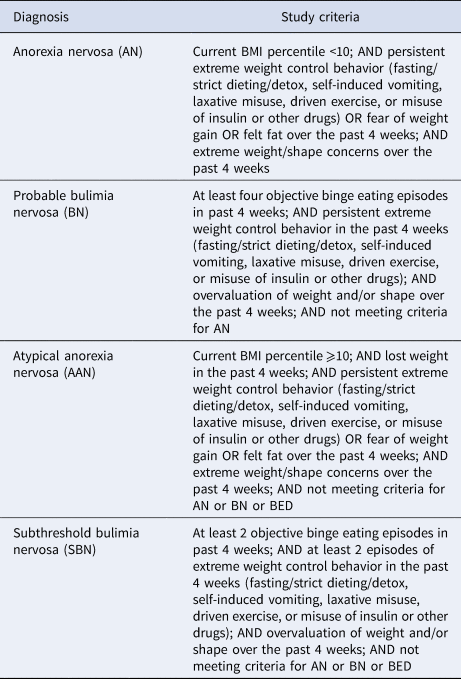
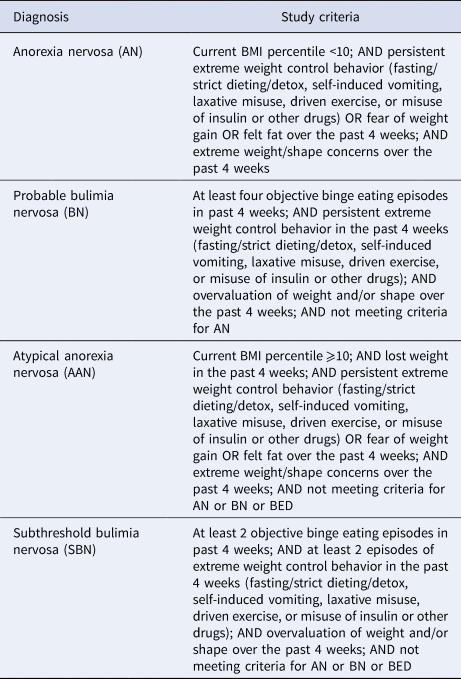
Criterion C stipulates that the primary focus of the preoccupation and behaviors is on ‘being too small or inadequately muscular, as distinguished from fear of being fat, as in anorexia nervosa, or a primary preoccupation only with other aspects of appearance, as in other forms of BDD’. Responses to the DMS item indicating frequent thoughts of wishing to be more muscular were taken as partial fulfillment of this criterion, whereas the exclusionary part of the criterion was operationalized by excluding participants who met criteria for any DSM-5 eating disorder characterized by concerns with fatness, namely: anorexia nervosa, bulimia nervosa, and the subthreshold variants of these disorders (atypical anorexia nervosa and subthreshold bulimia nervosa). The criteria used to operationalize eating disorder diagnoses, which have been detailed previously (Mitchison et al., Reference Mitchison, Mond, Bussey, Trompeter, Lonergan, Griffiths and Hay2019), can be found in Table 2.
Operationalization of DSM-5 Eating Disorder Diagnoses Used in This Study
Statistical analysis
The effect of school on the distribution of MD was checked and did not reach significance (p 2 (12) = 12.73, p = 0.389, V = 0.059); hence, the school was not controlled in further analyses. Prior to the analyses, data were weighted according to the population distribution of gender among adolescents in New South Wales according to the 2016 Australian Census. Prevalence estimates with 95% confidence intervals (CIs) are presented. χ2 tests-of-independence were conducted to examine MD distribution by gender. Owing to the small number of participants who met criteria for MD among adolescents who identified their gender as ‘other’ (n = 1 of 28 individuals), further analyses included only participants identifying as boys or girls (n = 3577). The distribution of MD by age and SES, and moderation by gender were assessed with two univariate analyses of variance 2 (MD: yes, no) × 2 (gender: boy, girl). Additionally, the prevalence of specific MD symptoms was compared between boys and girls by means of χ2 tests. Version 25 of the Statistical Pack for Social Sciences was used for all analyses, effect sizes were reported, and the significance level was set at α = 0.05.
Results
Demographic characteristics
There were 1739 (48.6%) participants who were identified as boys, and 1838 (51.4%) who were identified as girls. Ages ranged from 11.58 to 19.67 years (M = 14.82, s.d. = 1.46). SES (indicated by SEIFA score) centered around the standardized average (standardized M = 1000, s.d. = 100) with a normal distribution; however, there was less overall variation than in the general population (sample M = 984.45, s.d. = 42.05). Most participants were born in Australia (89.0%) however 28.2% had one or both parents born overseas. The most common region of birth outside of Australia for participants was Asia (6.5%) followed by Europe (2.0%), Oceania/Pacific (1.2%), Africa (0.8%), and the Americas (0.6%). This pattern was identical for parental region of birth.
Prevalence of MD by gender, age, and SES
A total of 63 (1.8%) participants met operationalized criteria for MD. The prevalence of MD was higher in boys (2.2%, 95% CI 1.6–3.0%) than in girls (1.4%, 95% CI 0.9–2.0%) but this difference was not significant, χ 2(1) = 3.51, p = 0.061, and the effect size was trivial (V = 0.031). A trivial effect was also observed for age, with adolescents meeting criteria for MD (M = 15.06, s.d. = 1.45) being only slightly older than adolescents without MD (M = 14.81, s.d. = 1.46; F (1, 3586) = 4.11, p = 0.043, partial η 2 = 0.001), and this was not moderated by gender (p = 0.390, partial η 2 < 0.001). There was no association between the likelihood of meeting criteria for MD and SES (p > 0.999, partial η 2 < 0.001).
Symptom profile of MD in boys v. girls
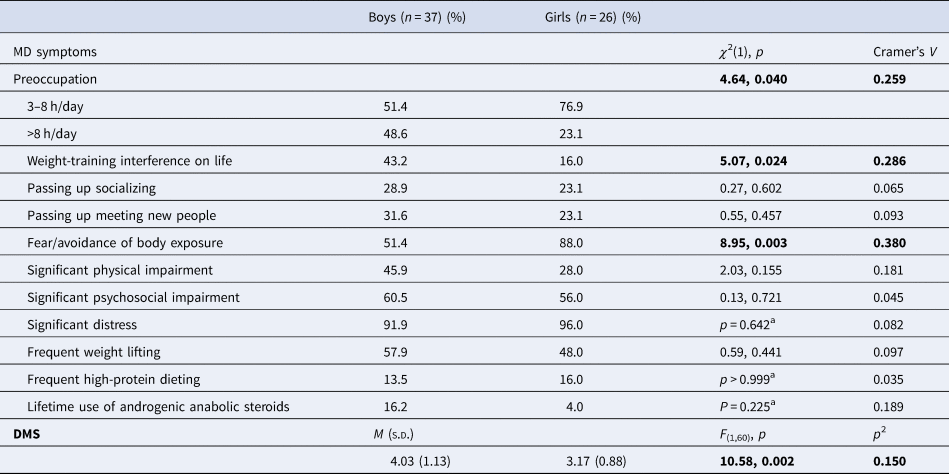
Boys and girls with MD were similarly likely to endorse symptoms related to a high-protein dietary intake, frequent weight lifting, passing up of social events due to exercise and eating regimens, any previous use of anabolic steroids for muscle building, psychosocial quality of life impairment, physical quality of life impairment, and distress (see Table 3). Small, statistically significant effects were observed for boys with MD being more likely than girls to endorse a greater severity of preoccupation with muscularity and interference of their weight-training regime in their life. On the other hand, a medium significant effect was observed demonstrating girls with MD were more likely than boys to endorse discomfort related to exposure of one's body.
Endorsement of MD symptoms and comorbidity with eating disorders among adolescents who met criteria for MD by gender

Bold indicates p < 0.05.
a Fisher's exact test was used as 50% of cells had an expected frequency of <5. Interpretation of Cramer's V with 1 df: 0.10 = small effect, 0.30 = medium effect, 0.50 = large effect.
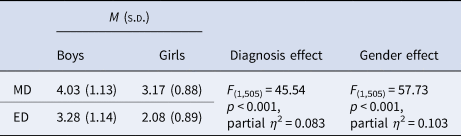
Given the unexpected similarity in the prevalence of MD between boys and girls, in post hoc analyses we examined differences in scores on the DMS between boys and girls who were classified as either meeting criteria for (i) MD, or (ii) one of the eating disorders that formed the exclusionary criterion (i.e. anorexia nervosa, bulimia nervosa, atypical anorexia nervosa, subthreshold bulimia nervosa; see Table 4). A small effect was observed indicating that both boys and girls with MD scored higher than boys and girls with eating disorders characterized by concerns with body fat or weight.
Drive for muscularity scores among boys and girls with MD or an eating disorder (ED) characterized by concerns with body fat or weighta
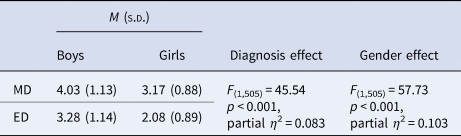
Note. The interaction effect between gender and diagnosis was not significant (p = 0.211).
a Eating disorders included anorexia nervosa, bulimia nervosa, atypical anorexia nervosa and subthreshold bulimia nervosa.
Discussion
Applying the diagnostic criteria proposed by Pope et al. (Reference Pope, Gruber, Choi, Olivardia and Phillips1997), the point prevalence of MD among Australian adolescents in the current study was 1.8%. While the prevalence was marginally higher for boys (2.2%) than for girls (1.4%), this difference did not reach statistical significance and the effect size for it was trivial. Hence, the current findings do not provide support for the hypothesis that MD is more common in boys than in girls. On the other hand, MD was slightly more likely to present in older adolescents than in younger adolescents, although the likelihood to be classified with MD was unrelated to SES.
Estimates of the point prevalence of MD in the current study are comparable to those previously documented for BDD in German (Rief, Buhlmann, Wilhelm, Borkenhagen, & Brahler, Reference Rief, Buhlmann, Wilhelm, Borkenhagen and Brahler2006), US (Mayville, Katz, Gipson, & Cabral, Reference Mayville, Katz, Gipson and Cabral1999), and Australian (Schneider et al., Reference Schneider, Mond, Turner and Hudson2017) adolescent population- and community-based samples using both interview and self-report methods (1.7–2.3%), while being considerably higher than those documented for other-related conditions, including obsessive–compulsive disorder (0.25%) (Heyman et al., Reference Heyman, Fombonne, Simmons, Ford, Meltzer and Goodman2001), anorexia nervosa (0.2–0.5%) (Mitchison et al., Reference Mitchison, Mond, Bussey, Trompeter, Lonergan, Griffiths and Hay2019; Swanson, Crow, Le Grange, Swendsen, & Merikangas, Reference Swanson, Crow, Le Grange, Swendsen and Merikangas2011), and bulimia nervosa (0.6%) (Swanson et al., Reference Swanson, Crow, Le Grange, Swendsen and Merikangas2011) in this sample and in others. Hence, the findings suggest that, in terms of prevalence at least, MD is not ‘rare’ (Vandereycken, Reference Vandereycken2011) but rather is a significant concern among adolescents that warrants further investigation, particularly given the absence of an evidence-base to guide public health and/or clinical interventions. Previous research has shown that behaviors typically associated with MD peak in later adolescence and early adulthood among men (Nagata et al., Reference Nagata, Ganson, Griffiths, Mitchison, Garber, Vittinghoff and Murray2020), and thus we may expect the prevalence estimates to rise among the current cohort as they age. This hypothesis, which is a question for future epidemiological research to address, differs from the pattern of onset for eating disorders, the peak onset of which commences in mid-adolescence (Mitchison et al., Reference Mitchison, Mond, Bussey, Trompeter, Lonergan, Griffiths and Hay2019). One explanation could be that behaviors to pursue muscularity in part require monetary resourcing (e.g. to obtain gym membership, supplements, anabolic steroids), which may be beyond the reach of school-aged adolescents. Clearly, since this is the first study to document the population prevalence of MD among adolescents, further research in the same and other populations is now needed to determine the replicability of the estimates reported. Nonetheless, the fact that the current sample was representative of adolescents from New South Wales, the largest and most populous State in Australia, provides some confidence in the findings' generalizability to adolescents in the Australian population.
The finding that the prevalence of MD was only marginally, and not significantly, higher in boys than in girls was unexpected. The central cognitive feature of MD, an excessive drive for muscularity, has to date been conceptualized as the male analogue of the drive for thinness (the central cognitive feature that promotes the development of eating disorders such as anorexia nervosa) among females (Murray et al., Reference Murray, Nagata, Griffiths, Calzo, Brown, Mitchison and Mond2017a). In support of this conceptualization is the evidence that males internalize a more muscular body ideal (McCreary & Sasse, Reference McCreary and Sasse2000) and report more frequent engagement with muscularity-oriented ‘fixing’ behaviors designed to achieve this ideal than do females (Nagata et al., Reference Nagata, Ganson, Griffiths, Mitchison, Garber, Vittinghoff and Murray2020). Consequently, studies on the clinical manifestation of the drive for muscularity, MD, have almost exclusively focused on males, a reversal of the gender-based sampling bias observed, until recently, in the eating disorders literature (Mitchison & Mond, Reference Mitchison and Mond2015). The current findings of a similar prevalence of MD between the genders, despite a higher drive for muscularity among boys, suggests that the ‘pathological’ endpoint of the drive for muscularity spectrum may not be as gendered as thought. Whether and to what extent the drive for muscularity may have recently increased among young women is also debated (Bozsik et al., Reference Bozsik, Whisenhunt, Hudson, Bennett and Lundgren2018; Karazsia, Murnen, & Tylka, Reference Karazsia, Murnen and Tylka2017). Ultimately, however, these findings taken together underscore the need to include females in future research addressing the occurrence and correlates of MD, including research designed to inform clinical and public health interventions.
While the prevalence of MD did not differ by gender in this study, boys did report a greater frequency and/or severity of certain MD symptoms—particularly those tapping into the cognitive and impairment aspects of the disorder. Boys were more likely than girls with MD to report severe levels of preoccupation with a perceived insufficiency of muscularity, that their weight-training regime interfered with their daily lives, and a higher drive for muscularity in general. Further, although the study was underpowered to detect statistical differences, 6 (16.0%) boys as opposed to just 1 girl (4.2%) with MD reported lifetime anabolic steroid use. These differences likely reflect gender differences in body shape ideals, with the feminine ideal characterized by both thinness and visible muscular tone (Bozsik et al., Reference Bozsik, Whisenhunt, Hudson, Bennett and Lundgren2018; Cunningham et al., Reference Cunningham, Szabo, Kambanis, Murray, Thomas, Eddy and Griffiths2019), and the male ideal being more conspiciously muscular, and, in turn, associated with a greater investment in muscle-building behaviors. To the extent that both leanness and muscularity are increasingly idealized by females, these gender differences might be expected to diminish over time. By contrast, the only symptom more often reported by girls was discomfort related to the exposure of one's body. Fears of negative appearance evaluation have been well-documented to be correlated with body dissatisfaction (e.g. Mackey & La Greca, Reference Mackey and La Greca2008), and thus this finding likely reflects the higher levels of general body dissatisfaction among girls and women than boys and men (Griffiths et al., Reference Griffiths, Murray, Bentley, Gratwick-Sarll, Harrison and Mond2017).
Key strengths of the current research include, in addition to its novelty, the use of a large and representative mixed-gender sample of younger and older adolescents and a comprehensive assessment of both MD and eating disorder symptoms. Limitations of the current study should also be considered when interpreting the findings. The use of self-report measures in assessing MD symptoms may have impacted (i.e. potentially overestimated) prevalence. Ideally, the current findings would be replicated using a two-phase epidemiological design, in which screening is followed by diagnostic interview. This would also allay concerns regarding the self-report assessment of anabolic steroid use, namely the overestimation of steroid use for muscle building among adolescent girls (Kanayama, Boynes, Hudson, Field, & Pope, Reference Kanayama, Boynes, Hudson, Field and Pope2007). Responding to these concerns, however, we took care to emphasize the use for muscle building when wording the steroid-use questions in this study, which perhaps explains the lower endorsement in this study. Further, given that shame is suggested to result in under-reporting in BDD (Veale & Neziroglu, Reference Veale and Neziroglu2010), the confidential online questionnaire format used in this study may have been the most sensitive design for capturing the true prevalence of MD. Since having an eating disorder is an exclusion criterion for the diagnosis of MD according to Pope's criteria, the assignment of eating disorder diagnoses on the basis of self-report, as opposed to interview, assessment also needs to be considered. This includes the fact that eating disorder symptoms were measured over the past month rather than the past three months. Given this exclusionary criterion, it is important to also note that to the extent that the prevalence of eating disorders may have been overestimated in the current study, estimates of the prevalence of MD will have been underestimated. Also in this regard, it should be noted that a stringent operational definition of ‘any eating disorder’, including both full- and subthreshold forms of anorexia and bulimia nervosa, was employed in the current study. The impairment and distress criteria for MD were assessed using non-disease specific measures of general distress and quality of life impairment, which may have captured participants who were impaired or distressed for reasons other than symptoms of MD. Although the parceling out of impairment related to specific symptoms is questionable (Mitchison et al., Reference Mitchison, Hay, Engel, Crosby, Le Grange, Lacey and Touyz2013), researchers should consider valid ways of doing so for MD symptoms in future. Finally, country of birth rather than ethnicity was assessed in this study, a common approach in Australian research since ethnic groups are not as clearly demarcated as in other countries such as the United States. Further, although data were collected on Aboriginal and/or Torres Strait Islander ethnicity, this will be presented separately according to culturally appropriate methods and led by Indigenous researchers (see Burt et al., Reference Burt, Mitchison, Dale, Bussey, Trompeter, Lonergan and Hay2020).
These findings have implications for diagnostic classification, clinician education, and funding, and also should stimulate the generation of new research. In regards to classification, the prevalence of MD was similar to other related psychiatric disorders in adolescence. While further research will be needed to determine whether and to what extent community cases of MD are associated with distress and/or impairment in role functioning, the current findings support MD as a specifier of BDD. In future, should the burden of MD in the population be firmly established, this may provide support for specific and separate diagnostic classification using criteria akin to those proposed by Pope et al. (Reference Pope, Gruber, Choi, Olivardia and Phillips1997). This would assist efforts to educate clinicians (e.g. in tertiary programs) regarding the prevalence and burden of MD, which, alongside public health messages, should improve self and other detection of this disorder and lead to much-needed improvements in treatment access. With regard to research funding for MD, to the extent that dollars spent are matched to the burden of the condition under investigation (and this is not always the case, see Murray et al. Reference Murray, Nagata, Griffiths, Calzo, Brown, Mitchison and Mond2017a, Reference Murray, Pila, Griffiths and Le Grange2017b), the prevalence of MD documented in this study should assist in building the rationale to fund future research that aims to further examine the burden of this disorder in other populations, and develop the first interventions for MD across the spectrum from health promotion, to prevention and treatment. Other research directly related to this study which we hope to pursue in future include investigation of the spectrum of impairment associated with MD, and elucidation of the overlap and differentiation between MD and eating disorders, including by examining longitudinal trajectories of and diagnostic crossover between these different conditions over time.
Conclusion
In conclusion, this study was the first to investigate and report the prevalence of MD in adolescence. The findings suggest that MD is relatively common in young people and that gender differences in prevalence may be minimal. This study provides a platform for future, analytical, and/or longitudinal research designed to inform clinical and public health interventions.
Acknowledgements
The authors also thank the staff and students of the 13 schools that participated in the EveryBODY Study.
Financial support
This study was funded by the Macquarie University Research Fellowship and the National Health and Medical Research Council Early Career Fellowship (GNT: 1158276) awarded to DM.
Conflict of interest
DM is funded by the National Health and Medical Research Council Early Career Fellowship (GNT: 1158276). PH has received sessional fees and lecture fees from the Australian Medical Council, the Therapeutic Guidelines publication, and the New South Wales Institute of Psychiatry and royalties/honoraria from the Hogrefe and Huber, the McGraw Hill Education, the Blackwell Scientific Publications, and the Biomed Central and PlosMedicine and she has received research grants from the NHMRC and ARC. She is Chair of the National Eating Disorders Collaboration Steering Committee in Australia (2012−) and Member of the ICD-11 Working Group for Eating Disorders (2012–2019) and was Chair of the Clinical Practice Guidelines Project Working Group (Eating Disorders) of RANZCP (2012–2015). In the past 5 years, she has consulted for, conducted education of Psychiatrists, and prepared a report under contract for Takeda (formerly Shire) Pharmaceuticals. All views in this paper are her own. SG is supported by the National Health and Medical Research Council and Medical Research Future Fund (GNT: 1121538, 1179321, and 1193738). JN was a participant in the Pediatric Scientist Development Program, funded by the American Academy of Pediatrics and the American Pediatric Society, and a recipient of the American Heart Association Career Development Award (CDA34760281). All other authors report no financial relationships with commercial interests.
Ethical standards
The authors assert that all procedures contributing to this work comply with the ethical standards of the relevant national and institutional committees on human experimentation and with the Helsinki Declaration of 1975, as revised in 2008.