The overutilization of low-value healthcare services is a major problem in the United States.Reference Colla, Morden, Sequist, Schpero and Rosenthal 1 – 3 Even when the test itself is low risk, the downstream impact of the test has the potential to harm patients and negatively impact healthcare quality.Reference Trautner 4 , Reference Rotjanapan, Dosa and Thomas 5 For urine testing, indiscriminate urine culture orders in patients without symptoms often leads to the identification of asymptomatic bacteriuria through a positive urine culture.Reference Hartley, Valley and Kuhn 6 , Reference Leis, Gold, Daneman, Shojania and McGeer 7 Positive urine cultures, even in the absence of symptoms, are strongly linked to subsequent inappropriate antibiotic use in hospitalized patients.Reference Leis, Gold, Daneman, Shojania and McGeer 7 – Reference Hartley, Valley and Kuhn 10 Inappropriate antibiotic use contributes to antibiotic resistance and is a threat to public health. 11 – Reference Cai, Nesi and Mazzoli 13 For these reasons, the Choosing Wisely campaign and several national guidelines strongly recommend against urine culture testing in the absence of urinary tract symptoms. 3 , Reference Nicolle, Bradley, Colgan, Rice, Schaeffer and Hooton 14 Despite these recommendations, 58%–68% of urine cultures ordered during inpatient admissions in North America are not clinically indicated.Reference Hartley, Valley and Kuhn 6 , Reference Leis, Gold, Daneman, Shojania and McGeer 7
Unnecessary urine cultures may also lead to longer hospital stays. False-positive urine cultures may create unnecessary delays in hospital discharge as providers wait for the organism type and antibiotic susceptibilities to be finalized. Similar delays in discharge have been documented after false-positive reports from contaminated blood cultures.Reference Alahmadi, Aldeyab and McElnay 15 Adding to the potential for prolonged hospitalization, patients who receive frequent antibiotics may have urinary colonization by organisms that are resistant to common oral antibiotics.Reference Grein, Kahn and Eells 9 Treatment of asymptomatic bacteriuria in these patients may require broad-spectrum intravenous antibiotics, which may add to discharge delays.Reference MacVane, Tuttle and Nicolau 16 Finally, unnecessary antibiotic use contributes to the development of nosocomial infections, such as Clostridium difficile.Reference Rotjanapan, Dosa and Thomas 5 We hypothesized that indiscriminate urine testing on day 1 of hospital admission leads to an increase in hospital length of stay (LOS) in addition to increased antibiotic use.
Prior studies examining the effect of inpatient urine culture testing on antibiotic use have been limited to small samples drawn from a few institutions.Reference Hartley, Valley and Kuhn 6 – Reference Hartley, Valley and Kuhn 10 The aims of this study were to examine the impact of inpatient urine culture testing on inpatient antibiotic use and hospital LOS using a national administrative dataset. To guide development of interventions aimed at reducing unnecessary urine testing, we identified the inpatient medical and surgical diagnoses most impacted by urine culture testing on admission.
METHODS
This retrospective cohort study was completed using a database of 22 million hospitalizations from The Advisory Board Company from January 1, 2009, to December 31, 2014. The database provides a cross-payer perspective including hospital billing and administrative data for inpatient and outpatient encounters covered by commercial insurance, government insurance, self-pay, and charity care. The database has been deidentified in accordance with the Health Insurance Portability and Accountability Act (HIPAA) Privacy Rule. Contributing hospitals are generally representative of hospitals across the United States, except for fewer small facilities (ie, <50 beds) and fewer facilities in the Western United States (ie, in which differences are ≤5% from the national average from the American Hospital Association).
Study Sample
We identified all inpatient admissions for patients 18 and older with a hospital LOS of ≤30 days. During our study period, national guidelines recommended screening for and treatment of asymptomatic bacteriuria in pregnant women and patients undergoing urology procedures where mucosal bleeding is anticipated.Reference Nicolle, Bradley, Colgan, Rice, Schaeffer and Hooton 14 Therefore, we excluded all inpatient admissions of pregnant women, admissions with a urology procedure code, and admissions with a discharge diagnosis of hematuria using International Classification of Disease, Ninth Revision (ICD-9) and current procedure terminology (CPT) codes (Supplementary Material). All emergency, urgent, elective, and trauma center admissions as defined by the claim inpatient admission type code meeting our inclusion criteria were included in the cohort. 17 Admissions where the admission type was unknown were excluded.
Measures and Variables
The exposure of interest was a urine culture charge on day 1 of hospital admission collected in the emergency department or on the inpatient unit. Day 1 of hospital admission was defined by the calendar day (ie, midnight to midnight). Urine culture charges were identified by reviewing an aggregate list of charge names for urine tests for all hospital admissions that met the inclusion criteria. Antibiotic use during the hospital stay was measured as the total number of days receiving ≥1 antibiotic, regardless of antibiotic type or dose. To query the dataset, a list of oral and intravenous antibiotics was developed by an infectious diseases expert (B.W.T.). Using both the generic and US trade names, charges for prescribed antibiotics were identified, and the day that the charge was submitted was recorded (eg, hospital day 1, hospital day 2, etc). Any part of a calendar day spent in an inpatient setting counted as a full day of admission (eg, admission at noon on Monday with a discharge before noon on Tuesday was counted as 2 hospital days).
Matching
Coarsened exact matching was used to identify a matched sample based on the exposure of a urine culture sent on day 1 of hospital admission. Coarsened exact matching is a nonparametric matching method in which variables are divided into predetermined groups and cases and controls are then matched based on these coarsened variables.Reference Haider, Gupta and Zogg 18 – Reference Iacus, King and Porro 20 Coarsened exact matching is an efficient method for matching and is a viable alternative to propensity score matching.Reference Iacus, King and Porro 20 Hospital admissions were matched exactly on the following variables: facility, gender, year of the admission, Medicare severity-diagnosis related group (MS-DRG), all patients refined diagnosis-related group (APR DRG) severity level, APR-DRG mortality level, whether the admission was a readmission event, admission type (eg, emergency, elective), and whether an ICD-9 code for infection was included in the list of inpatient diagnoses as present on admission.Reference Elixhauser, Steiner, Harris and Coffey 21 , Reference Christensen, Holman, Steiner, Sejvar, Stoll and Schonberger 22 Hospital admissions were also matched by age, with age rounded to the nearest increment of 5. Because the dataset is deidentified in accordance with the HIPAA privacy rule, all patients 90 years and older are combined as a single age category in the dataset. For the Elixhauser comorbidity score, scores were matched as 0, 1, 2, 3, 4, 5, 6, 7, 8, and 9 and above. A many-to-1 matching technique was used.
Statistical Analysis
We developed 2 regression models for the dependent variables of days of antibiotic use and LOS. The unit of observation in both models was the hospital admission. For days of antibiotic use, we developed a multilevel Poisson regression with fixed and random effects (MS-DRG, facility). To mitigate the problem of multiple comparisons and to ensure model parsimony, we chose the predictors of our statistical model through repeated bootstrapped samples rather than single regression. This procedure mitigates multiple comparisons problems by insisting on predictor significance across many random samples. The model was developed using repeated random samples of 15,000 admissions (7,500 with urine culture on day 1 and 7,500 without a urine culture on day 1) until the model’s estimates were stable. With each sample, we noted which predictors influenced the model (P<.25) and excluded predictors that had a P≥ .25 in the previous step. We repeated the procedure 50 times. Repeated random samples were used to determine which effects were constant over many samples and to limit any statistical artifacts that may have been seen if the model had been developed with a single dataset. Because each random sample was large (n=15,000), there was no substantive statistical power lost compared with using the full dataset. Once the model was stable, we replicated the regression with the full matched sample to estimate the impact of urine culture on days of antibiotic use. Coefficients from the multilevel Poisson regression were exponentiated to provide incidence rate ratios. The incidence rate ratios were estimated for each MS-DRG using the MS-DRG random effects. We then estimated the difference in the predicted number of antibiotic days between admissions that included a urine culture on day 1 of the hospital stay and hospital admissions that did not included a urine culture for each MS-DRG. In this estimate, we included both the MS-DRG and facility-level random effects.
For hospital LOS, we developed a multilevel linear regression with fixed and random effects (MS-DRG, facility). The model was developed using repeated random samples of 15,000 admissions until the model’s estimates were stable (same procedure as the multilevel Poisson regression for days of antibiotic use) and then the regression was replicated with the full matched sample. The model was then used to estimate the impact of urine culture on day 1 of the hospital stay on hospital LOS for each MS-DRG using the MS-DRG random effects. To estimate the difference in bed days of care for admissions with and without a urine culture on day 1 of the hospital stay for each MS-DRG, we included the MS-DRG and facility-level random effects. Additional bed days of care are reported as the total additional bed days of care across all facilities in the cohort.
The Institutional Review Board at Baylor College of Medicine and the Research and Development committee at the Michael E. DeBakey VA Medical Center reviewed this study and determined that it did not constitute human subject research.
RESULTS
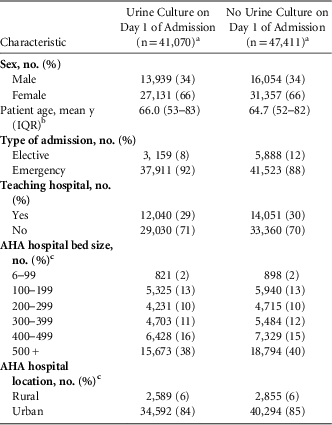
From 2009 to 2014, the database contained 4,774,048 hospital admissions that met our inclusion criteria. Matching within this dataset of 4.77 million admissions provided a cohort of 88,481 admissions from 230 hospitals, with 41,070 admissions that included a urine culture on day 1 of admission and 47,411 admissions without a urine culture on day 1. Table 1 provides patient- and hospital-level characteristics for the cohort.
Patient Demographics and Hospital Characteristics of Hospital Admissions

NOTE. IQR, interquartile range; AHA, American Hospital Association.
a Many-to-1 matching strategy was used, which accounts for the increased size of the group with no urine culture on day 1 of hospital admission.
b The deidentified dataset combines all patients 90 years of age and older as 90+ to remain HIPAA compliant. For the analysis, the ages of all patients 90 and older were recorded as 90.
c AHA hospital characteristics were not available for 9% of the hospital admissions in the matched cohort.
Days of Inpatient Antibiotic Use
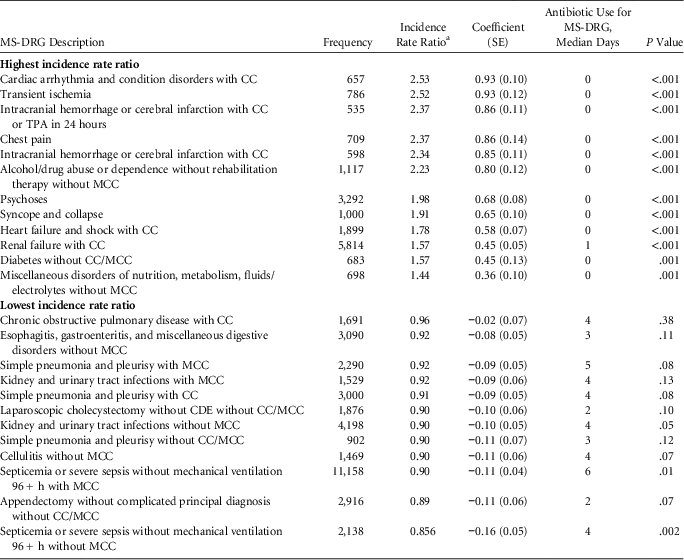
Across the cohort, ordering a urine culture on day 1 of admission was associated with a statistically significant increase in days of antibiotic use (incidence rate ratio, 1.26; P<.001). The association of urine culture testing with an increase in antibiotic days was greater for admissions from the emergency department (incidence rate ratio, 1.41; P<.001). Table 2 provides the highest and lowest incidence rate ratios for the most common MS-DRGs (see Supplementary Material for all MS-DRGs). Incidence rate ratios were highest for diagnoses (MS-DRGs) where antibiotic use was uncommon, as measured by the median days of antibiotic use (Table 2). For example, most admissions for cardiac arrhythmias receive no antibiotics (median days of antibiotics=0), yet those patients who receive a urine culture on day 1 of admission have an increased risk of receiving antibiotics during their hospital stay (incidence rate ratio 2.53; P<.001).
Medicare Severity-Diagnosis Related Groups (MS-DRGs) With the Highest and Lowest Incidence Rate Ratios for Days of Antibiotic Use

NOTE. SE, standard error; CC, complications and comorbid conditions; TPA, tissue plasminogen activator; MCC, major complications and comorbid conditions; CDE, common bile duct exploration.
aTable provides the 12 highest incidence rate ratios among MS-DRGs with a frequency of 500 or greater. An incidence rate ratio of 1.78 for the MS-DRG of heart failure and shock with CC means that patients admitted with that MS-DRG have 78% more days of antibiotics when they receive a urine culture on day 1 of hospital admission compared to patients with that MS-DRG without a urine culture on day 1 of admission.
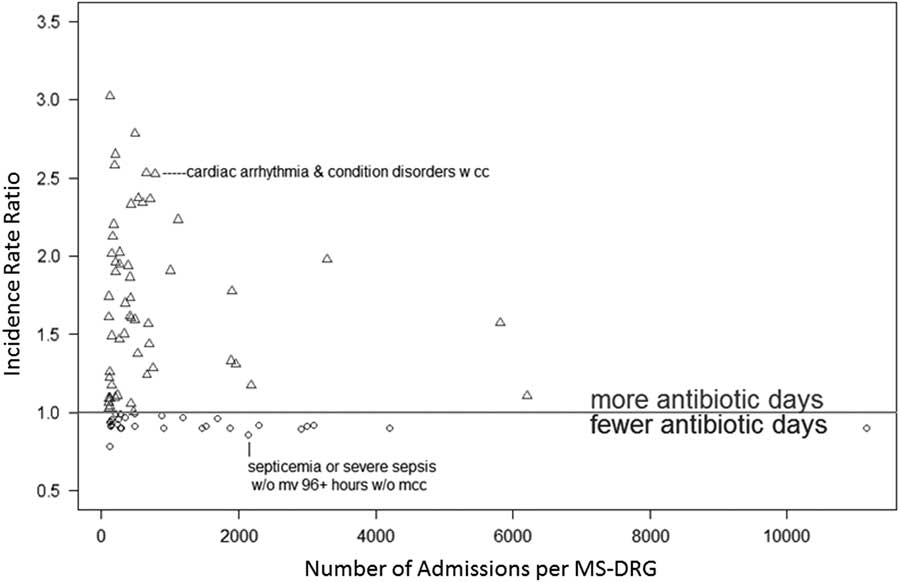
The overall impact of a urine culture on day 1 of the hospital admission is illustrated in Figure 1, in which the incidence rate ratio of antibiotic days for the most common diagnoses is shown. For the entire cohort, the difference in antibiotic use between admissions that included a urine culture on day 1 of admission and admissions that did not include a urine culture resulted in an additional 36,607 days of inpatient antibiotic use.
Impact of urine culture testing on days of antibiotic use by MS-DRG. NOTE. Figure represents all MS-DRGs with >100 admissions in the cohort. Triangles represent MS-DRGs with incidence rate ratios >1, indicating more antibiotic days in hospital admissions with a urine culture on day 1 of admission. Circles represent MS-DRGS with incidence rate ratios <1, indicating fewer antibiotic days in hospital admissions with a urine culture on day 1 of admission.

Hospital Length of Stay
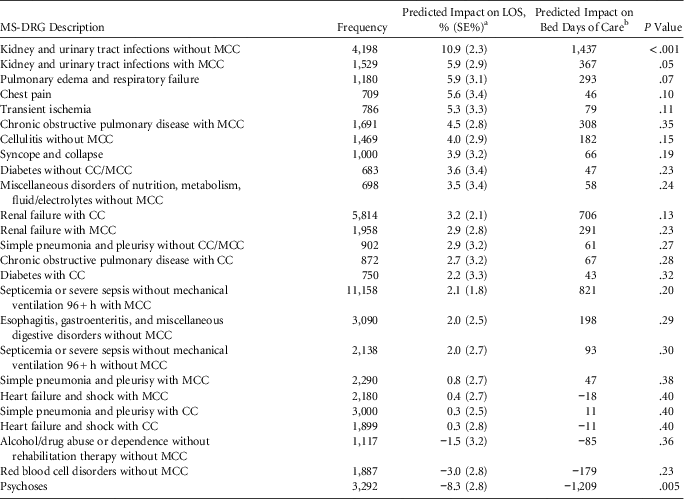
Urine culture testing on day 1 of hospital admission was associated with an increase in hospital LOS (2.1%; P=.004). The impact of urine culture testing on hospital LOS varied by diagnosis and ranged from an increase in LOS of 11.5% to a decrease of 8.3%. Table 3 provides the predicted impact of urine culture testing on hospital LOS for the most common medical diagnoses (see Supplementary Material for all MS-DRGs). Although the impact on LOS was greatest for admissions with a principal diagnosis of urinary tract infection (10.9%, P<.001 without major complications and comorbid conditions [MCCs], and 5.9%; P=.05 with MCCs), most diagnoses with an increase in LOS were for nongenitourinary conditions. For example, urine culture testing on day 1 of admission for patients admitted with chronic obstructive pulmonary disease had a 4.5% (P=.35) increase in hospital LOS, resulting in an estimated 308 additional bed days of care.
Impact of Urine Culture on Hospital Length of Stay (LOS) for Top Medical Medicare Severity-Diagnosis Related Groups (MS-DRGs) by Frequency

NOTE. CC, complications and comorbid conditions; MCC, major complications and comorbid conditions; TPA, tissue plasminogen activator.
a Predicted impact on LOS included only the MS-DRG random effects.
b To predict impact on bed days of care, the random effects from both MS-DRG and facility were included. This accounts for the findings seen in “heart failure and shock with MCC” and “heart failure and shock with CC” in which the predicted impact on LOS is positive and the predicted impact on bed days of care is negative.
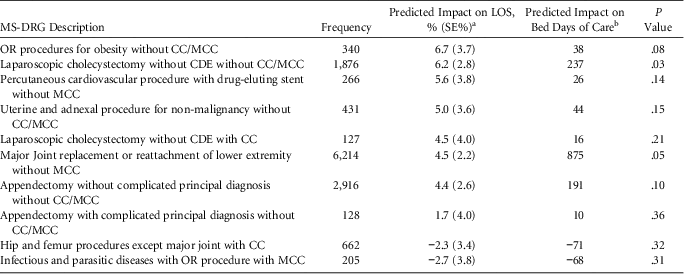
Table 4 provides the predicted impact of urine culture testing on LOS for the most common surgical diagnoses. Uncomplicated cholecystectomy, uncomplicated appendectomy, and uncomplicated joint replacement were all associated with increases in hospital LOS when a urine culture was sent on day 1 of hospital admission: 6.2% (P=.03), 4.4% (P=.10), and 4.5% (P=.05), respectively. Alone, these 3 surgical procedures had an estimated 1,303 additional bed days of care for admissions with a urine culture on day 1 of admission.
Impact of Urine Culture Sent on Hospital Length of Stay (LOS) for Top Surgical Medicare Severity-Diagnosis Related Groups (MS-DRGs) by Frequency

NOTE. SE, standard error; CC, complications and comorbid conditions; MCC, major complications and comorbid conditions; OR, operating room; CDE, common duct exploration.
a Predicted impact on LOS included only the MS-DRG random effects.
b To predict impact on bed days of care, the random effects from both MS-DRG and facility were included.
Overall, the predicted difference in bed days of care between hospital admissions with and without a urine culture on day 1 of admission resulted in 1,306 additional bed days of care for the surgical diagnoses, 5,035 additional bed days of care for the medical diagnoses, and 6,071 additional bed days of care overall.
DISCUSSION
The impact of urine culture testing on hospitalized patients reaches far beyond the simple act of collecting urine. Our findings demonstrate that patients with a urine culture sent on day 1 of the admission receive more days of antibiotics and have a longer hospital stay (LOS) than patients who do not receive a urine culture on day 1 of admission. These findings were significant in a cohort where observations were matched by age, gender, facility, diagnosis, presence of an infection on admission, and 3 different measures of disease severity. In total, the impact of urine culture testing on day 1 of admission on subsequent antibiotic use and hospital LOS resulted in 36,607 additional days of inpatient antibiotics and 6,071 additional bed days of care.
Positive urine cultures are a powerful behavioral stimulus for treatment with antibiotics regardless of medical appropriateness.Reference Grein, Kahn and Eells 9 , Reference Hartley, Valley and Kuhn 10 Our findings provide 2 important contributions to the literature. First, the association of urine culture testing on antibiotic use was greatest for patients admitted through the emergency room. This finding supports a recent single-center study that demonstrated that antibiotics started by emergency room providers are often continued in the inpatient setting even when tests return negative.Reference Kiyatkin, Bessman and McKenzie 8 The second notable finding is that the impact of urine culture testing on antibiotic use varied by diagnosis group. Urine cultures had the greatest impact on antibiotic ordering for diagnoses where antibiotic use was uncommon and, presumably, where routine urine culture testing would not be indicated as part of the hospital workup, such as cardiac arrhythmias and chest pain. When urine cultures were sent for principal diagnoses for which antibiotics are typically provided (eg, pneumonia, cellulitis, and urinary tract infection), the impact of ordering urine culture on the days of antibiotic use was minimal, with incidence rate ratios close to 1. Although the predicted additional days of antibiotic use following a urine culture was modest for any single diagnosis, the cumulative impact across diagnoses was substantial, with >36,000 additional days of inpatient antibiotic use.
Recent studies have demonstrated that 61%–71% of positive urine cultures in hospitalized patients represent asymptomatic bacteriuria.Reference Grein, Kahn and Eells 9 , Reference Hartley, Valley and Kuhn 10 Prior literature has routinely demonstrated that hospitalized patients are often inappropriately started and continued on antibiotics in response to false-positive urine cultures.Reference Leis, Gold, Daneman, Shojania and McGeer 7 – Reference Hartley, Valley and Kuhn 10 Unnecessary antibiotics have risks, not only for the patients receiving the antibiotics but also for other patients cared for in the same hospital. One recent study demonstrated that receipt of antibiotics by prior hospital bed occupants was an independent risk factor for Clostridium difficile infection in subsequent patients occupying the same bed, regardless of whether the initial occupant had Clostridium difficile.Reference Freedberg, Salmasian, Cohen, Abrams and Larson 23 Given the national efforts toward antibiotic stewardship, even modest reductions in antibiotic use may have an impact on preserving antibiotic efficacy and reducing the burden of drug-resistant organisms. 11
Our finding that urine testing on day 1 of hospital admission is associated with increased hospital LOS adds to our understanding of the potential impact of commonly used tests on hospital outcomes. For patients without a clinical indication for testing, cultures with bacteriuria are “false positive” tests that require no treatment. A study examining the impact of contaminated blood cultures in the hospital setting demonstrated an increase in hospital LOS and total hospitalization costs for patients with false-positive blood cultures.Reference Alahmadi, Aldeyab and McElnay 15 Although the overall association between urine testing and hospital LOS was small, the impact on healthcare costs over the population is notable. Using national estimates for hospital expenses (expenses incurred by the hospital to provide a day of inpatient care), the 6,071 additional bed days of care for patients in our sample would have cost more than $13 million. 24
The association between urine culture testing on day 1 of admission and antibiotic use and hospital LOS varied by MS-DRG. Targeted interventions for specific diagnosis groups may achieve the best balance between reducing low-yield urine cultures and supporting clinician autonomy to order a urine culture in the appropriate clinical setting. Common, uncomplicated surgeries, which were responsible for most additional bed days of care among the surgical diagnoses, could be an important target for intervention. Admissions for major joint replacement without complications that had a urine culture sent on day 1 of admission had 1,006 additional days of antibiotics and 875 additional bed days of care compared to admissions without a urine culture. Prior literature has demonstrated that preoperative urine culture testing is common, yet screening for and treatment of asymptomatic bacteriuria does not reduce prosthetic joint infections or other postoperative complications.Reference Sousa, Munoz-Mahamud and Quayle 25 – Reference Bailin, Noiseux and Pottinger 27
This study has several limitations. First, the study used administrative data, and it is unknown whether the urine cultures sent met clinical guidelines for testing. We recognize that some of the urine cultures sent likely met clinical guidelines, particularly for MS-DRGs related to systemic infection. However, published literature from chart reviews has demonstrated that the majority of urine cultures sent in emergency rooms and hospitals do not meet clinical criteria.Reference Hartley, Valley and Kuhn 6 , Reference Leis, Gold, Daneman, Shojania and McGeer 7 Second, the results of each culture (positive result or negative result) are unknown; however, we know from prior literature that asymptomatic bacteriuria is common, particularly in older adults.Reference Juthani-Mehta 28 Third, our exposure of interest was any urine culture collected in the emergency room or on the inpatient unit during the first calendar day corresponding to admission. Although this results in a variable amount of time for each admission during which the culture could have been sent, our prior work has demonstrated that the majority of urine cultures are sent on the first calendar day.Reference Horstman, Spiegelman, Naik and Trautner 29 Finally, our analysis was restricted to outcomes during the index admission and does not reflect outcomes occurring after discharge, such as total days of antibiotic use or readmissions.
In our analysis of hospital admissions matched by facility, numerous patient characteristics, and 3 measures of disease severity, a urine culture sent on day 1 of admission was associated with 36,607 additional days of antibiotics and 6,071 additional bed days of care. Urine cultures are a simple test to order and to collect. However, urine culture testing is often the first step in a series of events that leads to unintended consequences for patients and, as we have documented here, for hospitals. To limit harm from unnecessary urine cultures, targeted interventions are required that engage patients, caregivers, and healthcare providers in appropriate decision making for testing. Testing stewardship is an important component of antibiotic stewardship and a means to achieve more with less in health care.
ACKNOWLEDGMENTS
The views expressed in this article are those of the authors and do not necessarily reflect the position or policy of the Department of Veterans Affairs, the United States government, or the Baylor College of Medicine.
Financial support: This material is based upon work supported in part by the Department of Veterans Affairs, Veterans Health Administration, Office of Research and Development, and the Center for Innovations in Quality, Effectiveness and Safety (grant no. CIN 13-413) at the Michael E. DeBakey VA Medical Center, Houston, Texas (Drs Horstman, Naik, and Trautner). Dr Spiegelman’s effort is supported by The Advisory Board Company.
Potential conflicts of interest: All authors report no conflicts of interest relevant to this article.
SUPPLEMENTARY MATERIAL
To view supplementary material for this article, please visit https://doi.org/10.1017/ice.2018.55.