Bicuspid aortic valve is the most common congenital heart condition. Bicuspid aortic valve is not only a valvular disease but also a disease of the whole aorta. Cardiovascular complications such as aortic aneurysm, dissection, aortic stenosis and/or regurgitation, and infective endocarditis may occur in the presence of bicuspid aortic valve. Aortic dilatation is frequent in patients with bicuspid aortic valve, besides valvular dysfunction. Aortic root and ascending aorta are enlarged compared with the normal population even in the absence of aneurysm in patients with bicuspid aortic valve.Reference Cecconi, Nistri and Quarti 1 , Reference Gurvitz, Chang, Drant and Allada 2 The location of aortic dilatation varying with the valve phenotype suggests that bicuspid aortic valve is a coexisting disease of the valve and aortic wall.Reference Della Corta, Bancone and Quarto 3 Previous studies have demonstrated that valve dysfunction is more common in right–left valve phenotype – fusion between right and left coronary cusps – and aneurysm of ascending aorta is more common in right–non-coronary valve phenotype – fusion between right and non-coronary cusps – of the bicuspid aortic valve.Reference Pagé, Mongeon, Stevens, Soulière, Khairy and El-Hamamsy 4 – Reference Shin, Shin, Chee, Kim and Ko 6 This difference raised the question whether elastic properties of the aorta also differed with changing valve morphology. Previous studies usually focused on the elasticity of ascending aorta and abdominal aorta; however, the histologic abnormalities causing dilatation and elastic properties may involve all segments of the aorta. There is an ongoing debate about whether the aortic dilatation is due to histologic abnormality of the aortic wall or because of the haemodynamic effect of the turbulent blood flow as a result of abnormal valve structure or both. The presence of altered elasticity in the segments other than the ascending aorta may support the influence of intrinsic changes within the aortic tissue. Inflammatory activation and impaired signalling of nitric oxide were found in aortic tissue specimens in previous studies.Reference Forte, Della Corte and Grossi 7 , Reference Grewal, Gittenberger-de Groot and DeRuiter 8 Flow-mediated dilatation is another method used in the assessment of vascular elastic properties.Reference Wang, Li and Deng 9 We also applied this method in our study group.
We aimed to examine the dimensions of the aorta in its entirety, the aortic elasticity properties at each level of the aorta, and the effect of valve morphology on aortic elasticity. This information may contribute our knowledge on aetiopathogenesis and what to expect in the follow-up.
Material and methods
Patients
The study group was recruited from the patients followed up in paediatric cardiology outpatient clinics between January 2014 and December 2015 who were referred for evaluation of a murmur and found to have bicuspid aortic valve, and the control group was selected from the patients referred to paediatric cardiology for an atypical chest pain or an innocent murmur with normal cardiac findings and no systemic disease. None of the patients had more than mild stenosis (gradient >20 mmHg), more than mild regurgitation, associated CHD, or systemic disease, and patients with bicuspid aortic valve with prior surgical or catheter-based intervention were excluded. Patients with very poor echocardiographic views causing uncertainty of measurements were not included in the study. Physical examination findings, weight and height measurements, and blood pressures of all patients were recorded. Patients were divided into two groups according to opening type of the aortic valve: horizontally as right–left valve phenotype – fusion between right and left coronary cusps – and vertically as right–non-coronary valve phenotype – fusion between right and non-coronary cusps. According to age of the patients they were divided into younger patients (5–10 years) and older patients (11–16 years). Patients gave written consent forms and the study was approved by the local ethics committee in Marmara University.
Echocardiography
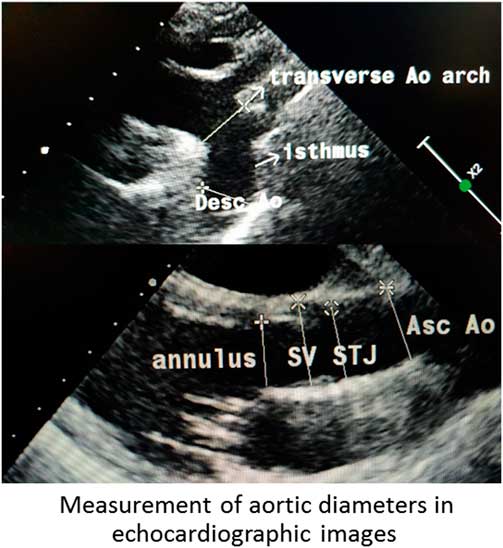
Echocardiography was performed using Philips IE33 Echocardiography machine (Philips Medical Systems, Bothell, Washington, United States of America) equipped with 5 MHz and L-11 MHz linear transducers. All patients underwent M-mode, two-dimensional, and Doppler echocardiographic examinations. The frame rate was 50 Hz in two-dimensional echocardiography. Left ventricular end-diastolic diameter, left ventricular end-systolic diameter, left ventricular posterior wall thickness, and left atrial diameter were measured and ejection fraction and fractional shortening were calculated from M-mode echocardiographic tracings using parasternal long-axis view of the left ventricle. Left ventricular and left atrial dimensions were adjusted to body surface area of children. Mitral inflow parameters, mitral E, mitral A wave velocity, isovolumetric relaxation time, and deceleration time were measured by pulse-wave Doppler echocardiography for assessment of left ventricular diastolic functions. The measurements were obtained with standard techniques according to the recommendations of the American Society of Echocardiography and the European Association of Cardiovascular Imaging.Reference Lang, Badano and Mor-Avi 10 Morphology of the aortic valve was evaluated at parasternal short-axis view. Images were acquired at end-diastolic phase simultaneous with the tip of R-wave and at end-systole phase simultaneous with the end of T-wave on electrocardiogram. Systolic and diastolic diameters of aortic annulus, sinus valsalva, sinutubuler junction, ascending aorta 3 cm distal to aortic annulus, proximal aortic arch between truncus brachiocephalicus and left carotid artery, descending aorta 1 cm distal to the origin of left subclavian artery, and abdominal aorta at the diaphragm level were measured with two-dimensional echocardiography (Fig 1). All measurements were performed by the same investigator, and aortic measurements were averaged over three beats and z-scores were obtained using Detroit Data.Reference Pettersen, Du, Skeens and Humes 11 Aortic strain, aortic distensibility, and aortic stiffness index were calculated using the formulas below:
Measurements of aortic diameters in echocardiographic images. Asc Ao=ascending aorta; Desc Ao=descending aorta; STJ=sinutubular junction; SV=sinus valsalva.

Aortic strain = (Systolic dimension-Diastolic dimension) / Diastolic dimension
Aortic stiffness index = natural logarithm (Systolic blood pressure/Dastolic blood pressure) / [(Systolic dimension-Diastolic dimension/Diastolic dimension]
Aortic distensibility = 2x (Systolic dimension-Diastolic dimension) / [(Systolic blood pressure – Diastolic blood pressure) X Diastolic diameter]Reference Nistri, Grande-Allen and Noale 12
Flow-mediated dilatation
Flow-mediated dilatation was performed by using L11 MHz linear array transducer from the brachial artery after resting for 10 minutes in supine position. A non-branching, straight segment of the brachial artery above the antecubital fossa was identified and images were recorded. Baseline brachial artery diameter was measured off-line at the tip of the R-wave of simultaneous electrocardiography tracings. A pneumatic cuff on the forearm was then inflated up to 50 mmHg above systolic blood pressure for 5 minutes and then released. After cuff deflation, brachial artery diameter was measured every 30 seconds over 3 minutes at end-diastolic phase. Flow-mediated dilatation was calculated as the percentage change in diameter from the baseline value to the biggest value after cuff deflation.Reference Celermajer, Sorensen and Gooch 13
Statistics
Statistical analysis was performed using SPSS for Windows (Version 22.0., IBM Corp., Armonk, New York, United States of America). Continuous variables were expressed as mean±standard deviation and categorical variables as frequencies and percentages. For comparison of continuous variables among or between groups, the unpaired Student’s t-test was used. Categorical variables were analysed with the χ2 test. For correlations between continuous variables, the Pearson correlation coefficient test was performed. The p values <0.05 were considered statistically significant.
Results
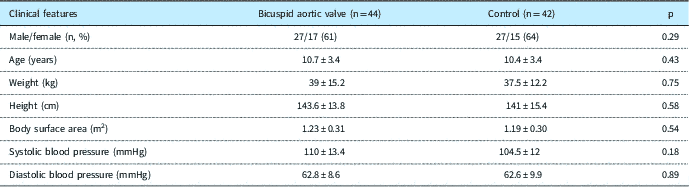
The study group consisted of 44 patients with bicuspid aortic valve aged between 5 and 16 years of age (mean age±SD: 10.7±3.4, median: 12, range: 5–16 years of age; male/female: 27/17) and 42 healthy children (mean age=10.4±3.4, median: 11, range: 5–16 years of age; male/female: 27/15) as the control group. There was no statistically significant difference with regard to age, height, weight, body surface area, and systolic and diastolic blood pressures of patients with bicuspid aortic valve versus control group and right–non-coronary valve phenotype versus right–left valve phenotype groups. Baseline characteristics of patients are listed in Tables 1 and 2. There were 19 patients with bicuspid aortic valve and 20 control patients of a younger age group, and 25 patients with bicuspid aortic valve and 22 control patients.
Demographic and clinical characteristics of patients.

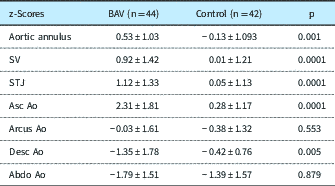
Aortic z-scores of patients of bicuspid aortic valve (BAV) and control groups.

Abdo Ao=abdominal aorta; Arcus Ao=arcus aorta; Asc Ao=ascending aorta; Desc Ao=descending aorta; STJ=sinutubular junction; SV=sinus valsalva.
Echocardiographic features of patients
Valve morphology was right–left valve phenotype in 29 patients and right–non-coronary valve phenotype in 15 patients (p=0.035). In patients with right–non-coronary valve phenotype, seven patients (46%) had valve dysfunction, three had mild stenosis, four had mild stenosis and regurgitation, and eight patients had no valve dysfunction. In patients with right–left valve phenotype, 11 patients (41%) had valve dysfunction, five had mild stenosis, six had mild regurgitation, and 18 patients had no valve dysfunction. There was no statistically significant difference in terms of valve dysfunction frequency between groups. There was no significant difference in the assessment of left ventricle and left atrium dimensions and systolic/diastolic function of left ventricle between bicuspid aortic valve and control groups. The M-mode measurements did not differ in terms of left ventricular end-diastolic and end-systolic diameters, interventricular and left ventricular posterior wall thickness, ejection fraction and shortening fraction, and aortic and left atrial diameters adjusted to the body surface area between patient and control groups. Mitral A wave velocity was higher in the patient group (0.65±0.15 m/s) than in the control group (0.58±0.11 m/s) (p=0.050).
z-Scores of aorta
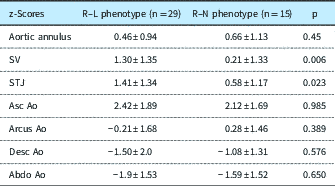
z-Scores of aortic annulus, sinus valsalva, sinutubular junction, and ascending aorta of patients with bicuspid aortic valve were higher than those in control patients (p=0.001, p=0.0001, p=0.0001, p=0.0001 for annulus, sinus valsalva, sinutubular junction, ascending aorta, respectively) (Table 2). At the descending aortic level, z-scores of patients with bicuspid aortic valve were lower than those in control patients (p=0.005). The differences in z-scores of aortic dimensions between patients with bicuspid aortic valve and control patients were significant in both younger and older patient groups at levels of aortic annulus, sinus valsalva, sinutubular junction, and ascending aorta (p=0.036, p=0.001, p=0.0001, p=0.0001 for 5–10 years of age group; p=0.018, p=0.011, p=0.028, p=0.0001 for 6–11 years of age group). In the age group of 6–11 years, z-score of the descending aorta was lower in patients with bicuspid aortic valve than in control patients (p=0.006). In comparison of younger and older patients, no statistically significant difference was found in terms of z-scores of aortic diameters. When the aortic dimensions of the patients with right–left valve phenotype were compared with the patients with right–non-coronary valve phenotype, z-scores of sinus valsalva (1.30±1.35 versus 0.21±1.33) and sinutubular junction (1.41±1.34 versus 0.58±1.17) were found to be higher in the right–left valve phenotype group (p=0.006, p=0.023, Table 3). No correlation was found between the z-scores of aorta and age, body surface area, and blood pressure in the study group.
Aortic z-scores of patients with bicuspid aortic valve according to valve phenotype.

Abdo Ao=abdominal aorta; Arcus Ao=arcus aorta; Asc Ao=ascending aorta; Desc Ao=descending aorta; R-L phenotype=fusion between left and right coronary cusps; R-N phenotype=fusion between right and noncoronary cusps; STJ=sinutubular junction; SV=sinus valsalva.
Elasticity parameters of aorta
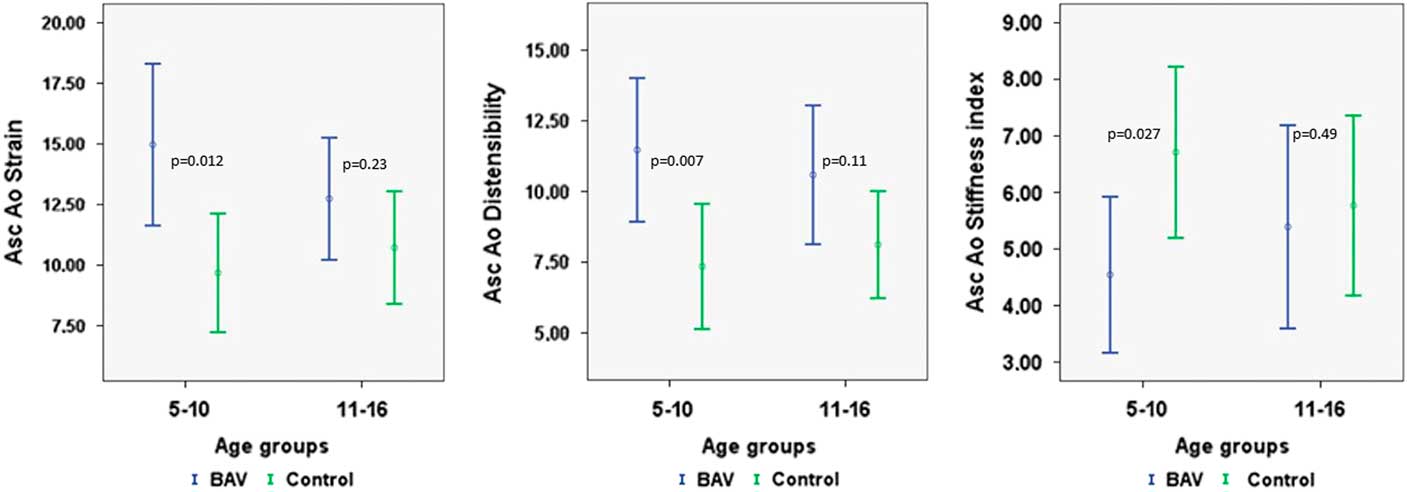
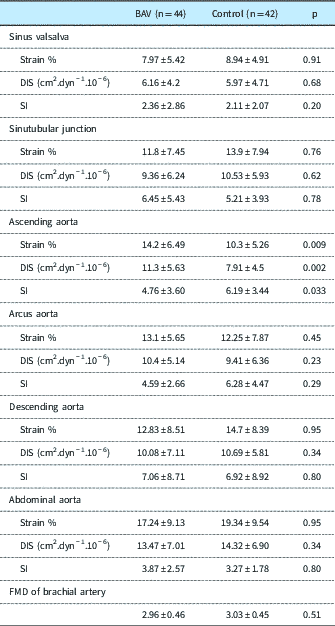
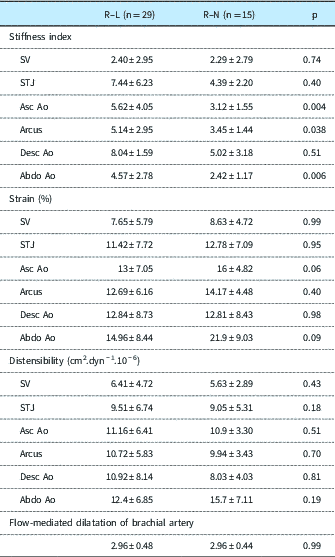
In bicuspid aortic valve group, the ascending aorta was more distensible and less stiff than that in the control group (p=0.002, p=0.033). Elasticity parameters are shown in Table 4. In the assessment of elasticity parameters according to the valve morphology, stiffness index of ascending aorta, arcus aorta, and abdominal aorta was higher in the bicuspid aortic valve group with right–left valve phenotype compared with the bicuspid aortic valve group with right–non-coronary valve phenotype (p=0.004, p=0.038, p=0.006, respectively). Elasticity parameters according to valve morphology are shown in Table 5. In the younger age group (5–10 years), ascending aorta was more distensible and less stiff in the bicuspid aortic valve group than in the control group (p=0.012 for strain, p=0.007 for distensibility, p=0.027 for stiffness index, respectively), but in the older age group (11–16 years) there was no significant difference in terms of distensibility or stiffness at any level of aorta between bicuspid aortic valve and control groups (Fig 2) (p=0.24, p=0.44). z-Score of ascending aorta was over 2 in 20 patients. In 29 patients with right–left valve phenotype, 15 of them (%51) had z-scores over 2, and in 15 patients with right–non-coronary valve phenotype five of them (%33) had z-scores over 2; the difference was statistically significant (p=0.0001). Patients with ascending aorta dilatation, whose z-scores were higher than 2, had lower strain values than patients with bicuspid aortic valve with z-scores of ascending aorta within the normal range (p=0.032).
Aortic elasticity parameters of patients with bicuspid aortic valve (BAV) and control patients according to age groups. Asc Ao=ascending aorta.

Elasticity parameters of aorta of patients in bicuspid aortic valve (BAV) and control groups.

DIS=distensibility; FMD=flow-mediated dilatation; SI=stiffness index.
Aortic elasticity parameters and flow-mediated dilatation of patients of with bicuspid aortic valve according to valve phenotype.

Abdo Ao=abdominal aorta; Arcus Ao=arcus aorta; Asc Ao=ascending aorta; R-L phenotype=fusion between right and left coronary cusps; R-N phenotype=fusion between right and noncoronary cusps; STJ=sinutubular junction; SV=sinus valsalva.
Flow-mediated dilatation
Flow-mediated dilatation of the brachial artery was 2.96±0.46 in the bicuspid aortic valve group and 3.03±0.45 in the control group (p=0.51), 2.96±0.48 in patients with right–left valve phenotype, and 2.96±0.44 in patients with right–non-coronary valve phenotype (p=0.99) (Tables 4 and 5).
Discussion
Bicuspid aortic valve is the most common congenital valve disease, occurring in 1–2% of the population.Reference Braverman, Güven and Beardslee 14 Some of the patients with bicuspid aortic valve are diagnosed because of murmur, some of them may present with symptoms due to valvular dysfunction, while others may go unnoticed until adulthood. They may even present with sudden death or severe cardiovascular deterioration because of aortic dissection or rupture.Reference Papagiannis 15 , Reference Disha, Rouman, Secknus, Kuntze and Girdauskas 16 It is the most common coexisting disease with aortic wall abnormalities in patients without genetic syndromes such as Marfan disease, Ehler Danlos disease, or Loetz Dietz syndrome.Reference Cury, Zeidan and Lobato 17
The bicuspid aortic valve may have different phenotypes according to the fusion of different leaflets. Right–left valve phenotype – fusion of right and left coronary cusps – is the most common phenotype of bicuspid aortic valve.Reference Sievers and Schmidtke 18 , Reference De Mozzi, Longo, Galanti and Maffuli 19 Right–left valve morphology was more common than right–non-coronary valve morphology in our study group, consistent with this knowledge. It is known that valvular dysfunction is more prevalent in right–non-coronary valve morphology than right–left valve morphology, but in our study valve dysfunction frequency was not different between the groups with right–left and right–non-coronary valve morphology.Reference Fernandes, Khairy, Sanders and Colan 20 This may be because of exclusion of patients with moderate or severe valvular stenosis or regurgitation as haemodynamically significant valvular functional abnormalities could affect aortic dimensions or arterial functions. For instance, in borderline hypoplastic left ventricle or Shone complex, aortic valve disease is a component of the disease and hypoplasia of ascending aorta and aortic arch is expected rather than aortic dilatation.Reference Prakash, Bossé and Muehlschlegel 21 On the other hand, aortic regurgitation may have a different effect causing more dilated aorta.Reference Fernandes, Khairy, Graham, Colan, Galvin and Sanders 22 We found higher z-scores in patients with bicuspid aortic valve at the levels of aortic annulus and aortic root, and ascending aorta than in control patients.
Higher z-scores at aortic root or ascending aortic level in patients with bicuspid aortic valve compared with the patients with tricuspid aortic valve were found in children in previous studies.Reference Mart and McNerny 23 , Reference Nistri, Sorbo, Marin, Palisi, Scognamiglio and Thiene 24 Higher z-scores of arcus aorta compared with normal population were demonstrated in patients with bicuspid aortic valve older than 40 years.Reference Cecconi, Manfrin and Moraca 25 Lower z-score was found in patients with bicuspid aortic valve especially in the older age group in our study. Aortic dilatation in patients with bicuspid aortic valve was related to elastic fibre degeneration, smooth muscle cell apoptosis, abnormal extracellular remodelling, and aortic cystic medial necrosis.Reference Tadros, Klein and Shapira 26 – Reference Della Corte, Quarto and Bancone 28 There is still a debate concerning the aetiology of aortic dilatation in patients with bicuspid aortic valve. Wall shear stress caused by the eccentric bicuspid aortic valve orifice jet and the flow-induced genetic modifications causing inflammation of aorta are thought to be the reasons for aortic dilatation.Reference Cripe, Andelfinger, Martin, Shooner and Benson 29 – Reference Girdauskas, Disha, Borger and Kuntze 33 MRI showed different blood flow velocity patterns in patients with bicuspid and tricuspid aortic valves. Asymmetry in flow and higher flow velocity was prominent in bicuspid aortic valve models.Reference Viscardi, Vergara and Antiga 34
Genetic mutations causing CHD such as Fallot’s tetralogy with aortic dilatation may have also effects on aortic wall structureReference John, McDonald-McGinn, Zackai and Goldmuntz 35 , Reference John, Rychik, Khan and Yang 36 Overexpression of some particular genetic polymorphisms and typical histological abnormalities in the dilated ascending aorta wall was shown in patients with bicuspid aortic valve.Reference Pisano, Maresi and Balistreri 37 Intrinsic aortic wall properties and genetically oriented histologic changes may serve as a cause for aortic dilatation. The absence of dilatation after ascending aorta, besides smaller z-score at descending aorta, indicates that these histologic changes are present especially in the proximal parts of the aortic arch or the flow dynamics are more effective in the ascending aorta.
In our study, z-scores of aortic annulus, aortic root, and ascending aorta were higher in patients with bicuspid aortic valve compared with the control group in both younger and older age groups. There was no significant difference between aortic z-scores of younger and older patients; this finding suggests that the aortic dilatation started at young age and the growth of aorta followed a linear pattern parallel to somatic growth. In a previous longitudinal study, z-scores of patients with bicuspid aortic valve in both the aortic dilatation group and the aortic non-dilatation group remained stable throughout childhood; no acceleration in aortic dilatation was found.Reference Fernandes, Khairy, Graham, Colan, Galvin and Sanders 22
In another study, bicuspid aortic valve was diagnosed in a wider age range (between 0 and >40 years of age) and a correlation between ascending aorta diameter and age was found to be present in only patients older than 12 years.Reference Cecconi, Manfrin and Moraca 38 Progression of aortic dilatation was observed even after aortic valve replacement in adult studies.Reference Yasuda, Nakatani and Stugaard 39
Patients with right–left valve morphology had higher z-scores at the aortic root than patients with right–non-coronary valve morphology in our study. Previous studies reported that while patients with right–left valve morphology had dilatation at the aortic root, patients with right–non-coronary valve morphology had dilatation at the ascending aorta.Reference Huang and Le Tan 40 , Reference Schafer, Lewin and Stout 41 In the study of Fernandes et al,Reference Fernandes, Khairy, Graham, Colan, Galvin and Sanders 22 one of the predictor factors of higher z-scores at ascending aorta level was right–non-coronary valve phenotype and the predictor of higher z-scores at aortic root level was right–left valve phenotype; the other predictor factor for dilatation in both ascending aorta and aortic root dilatation was aortic regurgitation. It can be assumed that bicuspid aortic valve with different valve phenotypes are distinct diseases that cause aortic dilatation at different locations of aorta and varying frequency in valve dysfunction.Reference Kim, Ko, Chee, Shin, Song and Shin 5 , Reference Yasuda, Nakatani and Stugaard 39 Disproportion between matrix metalloproteinases and their inhibitors at the aortic wall was demonstrated in patients with bicuspid aortic valve with dilatation of ascending aorta; this finding was more marked in patients with right–left valve morphology.Reference Ikonomidis, Ruddy, Benson, Arroya, Brinsa and Stroud 42 Another cause of dilatation at different levels of aorta may be flow dynamics with changing direction and pattern of turbulent flow at the supravalvular level.
We found that patients with bicuspid aortic valve in younger age had a more distensible ascending aorta than control patients. The older age group consisted of patients aged 11–16 years and had elastic properties similar to those of control patients. In adolescence, aortic elasticity might have different properties. Aortic distensibility and stiffness show differences with age in normal population; it was shown that aorta becomes less distensible and stiffer with age.Reference O’Rourke and Hashimoto 43 In the study of Pees and Michel-Behnke,Reference Pees and Michel-Behnke 44 impaired elasticity of aortic root in children with bicuspid aortic valve was revealed especially in older age. There are studies showing increased aortic stiffness in children with bicuspid aortic valve.Reference Weismann, Lombardi, Grell, Northrup and Sugeng 45 Even if these findings seem controversial, we consider that at earlier age aortic wall has increased elasticity in patients with bicuspid aortic valve compared with the healthy children; however, continuing sheer stress, abnormal haemodynamics, and scarring of aortic wall may cause fibrotic changes and decreased elasticity of the aortic wall at an older age. The absence of significant difference between bicuspid aortic valve and control patients at older age supports this idea. We can speculate that if we had extended the age range towards adulthood the elasticity would have decreased more in the patient group as other adult studies. Most of the studies demonstrating increased stiffness in patients with bicuspid aortic valve are conducted in patients older than those in our study group. We found no correlation between aortic z-scores and aortic elasticity. A previous study also found no correlation between aortic dimensions and aortic elasticity.Reference Nistr, Grande-Allen and Noale 46 Right–left valve phenotype had less distensible and more stiff ascending aorta, arcus aorta, and abdominal aorta than right–non-coronary valve phenotype in our study. Studies investigating the relation between valve morphology and aortic elasticity are variable. Patients with right–left valve phenotype had stiffer and less distensible ascending aorta and arcus aorta in a previous study in children.Reference Pees and Michel-Behnke 44 A study conducted in adults reported stiffer sinus valsalva in patients with bicuspid aortic valve with right–left valve phenotype.Reference Schaefer, Lewin, Stout, Byers and Otto 47
High incidence of bicuspid aortic valve was found in a study performed in mice lacking functional endothelial nitric oxide, indicating the important role of endothelium-derived nitric oxide in cardiac valve morphogenesis. There are studies that found decreased flow-mediated dilatation and increased plasma inflammatory markers in patients with bicuspid aortic valve.Reference Ali, Chapman and Nguyen 48 , Reference Tzemos, Lyseggen and Silversides 49 Cystic medial necrosis, smooth muscle cell loss, and increased matrix metalloproteinase activity in aortic wall may contribute to the abnormalities in flow-mediated dilatation of aorta.Reference Bonderman, Gharehbaghi-Schnell, Wollenek, Maurer, Baumgartner and Lang 50 , Reference Forte, Della Corte and Grossi 51 Some studies found a correlation between aortic dimensions and endothelial nitric oxide synthase expression in aortic wall tissue specimens.Reference Aicher, Urbich, Zeiher, Dimmeler and Schäfers 52 There was no statistically significant difference in terms of flow-mediated dilatation between patients with bicuspid aortic valve and the control group in our study. Age of the selected group or exclusion of the patients with valve dysfunction may be effective in this result.
Conclusion
We showed that aortic dimensions were larger in patients with bicuspid aortic valve than control patients. Dilatation of aorta started at an early age not later. On the other hand, aortic elasticity is impaired by ageing. Follow-up studies are needed in both evaluation of dimensions and elastic properties of aorta. In addition, histologic studies would enlighten us about the underlying mechanisms of aortopathy which is present in children with bicuspid aorta. Early identification of patients with bicuspid aortic valve and periodic assessment of aortic dimensions and functions are needed for being aware of progressive dilatation and performing the interventions on time.
Financial Support
This research received no specific grant from any funding agency, commercial or not-for-profit sectors.
Conflicts of Interest
None.
Acknowledgements
None.