Nomenclature
- 2PBVP
-
two-point boundary value problem
- ACSYNT
-
AirCraft SYNThesis
- BADA
-
base of aircraft data
- CFD
-
computational fluid dynamics
- CNSGA-II
-
Constrained Non-dominated Sorting Genetic Algorithm II
- CO
 ${_2}$
-
carbon dioxide
- Comac
-
Commercial Aircraft Corporation of China, Ltd.
- DLR
-
German Aerospace Center
- ECMWF
-
European Centre for Medium-Range Weather Forecasts
- EPNL
-
effective perceived noise level
- ERA5
-
ECMWF Reanalysis v5
- FAA
-
Federal Aviation Administration
- FASST
-
Framework for Advanced Supersonic Transport
- FL
-
flight level
- FLOPS
-
Flight Optimization System
- HISAC
-
Environmentally Friendly High Speed AirCraft
- ICAO
-
International Civil Aviation Organization
- IPOPT
-
Interior Point OPTimizer
- ISA
-
International Standard Atmosphere
- JAXA
-
Japanese Aerospace Exploration Agency
- L/D
-
lift-to-drag ratio
- LAPCAT
-
Long-Term Advanced Propulsion Concepts and Technologies
- LTO
-
landing and takeoff
- MOCA
-
multi-objective cruise altitude
- NASA
-
National Aeronautics and Space Administration
- NCAR
-
National Center for Atmospheric Research
- NCEP
-
National Centers for Environmental Protection
- NLP
-
non-linear programming
- NLR
-
Royal Netherlands Aerospace Centre
- NO
${_{\rm{x}}}$
-
nitrogen oxides
- NPSS
-
Numerical Propulsion System Simulation
- ONERA
-
French Aerospace Lab
- SAR
-
specific air range
- SFC
-
specific fuel consumption
- SID
-
standard instrument departure
- SNOPT
-
Sparse Nonlinear OPTimizer
- SST
-
supersonic transport
- STAR
-
standard terminal arrival
- STCA
-
supersonic technology concept aeroplane
- STOP
-
Supersonic Transport Optimization Program
- VNRS
-
variable noise reduction system
- VOT
-
value of time


1.0 Introduction
In recent years there has been renewed interest in the development of supersonic transport (SST) aircraft. For customers willing to pay a premium, supersonic airliners and business jets offer reduced flight times, though issues regarding economic viability, environmental impact and supersonic overland flight are yet to be resolved [Reference Bushnell1–Reference Smith3]. Concorde and the Tupolev Tu-144 remain the only two SSTs to have entered commercial service. The Tu-144 first flew in December 1968, two months before Concorde [Reference Kaminski-Morrow4], but was withdrawn from passenger service less than seven months after beginning commercial operations. Concorde, on the other hand, was in service for 27 years and eventually retired in 2003 due to prohibitive operating costs, waning demand and technical problems [Reference Horsnell5]. Since then, there have been no commercial supersonic passenger flights (see Fig. 1).
Several startups and government-funded research programmes have sparked contemporary interest in supersonic air travel. Boom’s Overture [6], a Mach 1.7 SST designed to carry 64–80 passengers, is perhaps the most well-known current concept. American Airlines, United Airlines and Japan Airlines have agreed to purchase Overture aircraft, but whether the planned 2029/2030 entry-into-service is realised remains to be seen. Indeed, the previously promising Aerion AS2 business jet concept was cancelled in 2021 after seven years of development [Reference Sheetz7], prompting much skepticism about the future of commercial supersonic flight. Nevertheless, Boom’s XB-1 demonstrator aircraft made its first flight in March 2024 and flew supersonic in January 2025 [8]. In addition, major research studies such as the Federal Aviation Administration’s (FAA’s) ASCENT supersonic programmes and the EU SENECA project have brought together academics and industry to develop understanding of next-generation SST concepts, operating principles, regulations and emissions. Similarly, a trilateral collaboration between the Japanese Aerospace Exploration Agency (JAXA), the German Aerospace Center (DLR) and the French Aerospace Lab (ONERA) has led to advancements in supersonic aircraft design and trajectory optimisation methods [Reference Liebhardt, Lütjens, Ueno and Ishikawa9, Reference Ishikawa, Ueno, Koganezawa, Makino, Liebhardt and Lütjens10]. Even more recently, in March 2025 the Commercial Aircraft Corporation of China, Ltd. (Comac) is reported to have published details of the Comac C949, a Mach 1.6 SST capable of flying 50% farther than Concorde [Reference Goss11].
Because of the disturbances sonic booms cause to humans and wildlife, as well as concerns about structural damage and potential earthquake and avalanche triggering [Reference Maglieri, Bobbitt, Plotkin, Shepherd, Coen and Richwine12], supersonic overland flight remains prohibited in many parts of the world. Such restrictions are expected to impact the economic viability of future commercial supersonic operations, with Speth et al. [Reference Speth, Eastham, Fritz, Sanz-Morére, Agarwal, Prashanth, Allroggen and Barrett13] estimating that the global market potential could be reduced by as much as 78–100% if supersonic overland flight bans remain in place. These concerns have prompted researchers to develop novel aircraft designs and operating principles. Low-boom aircraft that produce quieter sonic booms than previous types are an active area of research [Reference Han, Qiao, Zhang, Chen, Yang, Ding, Zhang, Song and Song14] and have been popularised by NASA and Lockheed Martin’s X-59 QueSST (Quiet SuperSonic Technology) demonstrator, which made its public debut in 2024 and first flight in October 2025 [15]. Overland flight at Mach-cutoff Footnote 1 is seen as another possible solution [Reference Bonavolontà, Lawson and Riaz16–Reference Plotkin, Matisheck and Tracy19], though potential flight time savings compared to traditional subsonic operations are smaller for an aircraft flying at Mach-cutoff than, say, a higher Mach number. A third option is to plan a trajectory for the aircraft to fly such that its sonic booms do not reach land or, if they do, do not reach densely populated areas. This third option, along with the need to limit landing and takeoff (LTO) noise [Reference Wuebbles, Baughcum, Barrett, Catalano, Fahey, Madden, Rhodes, Skowron and Sparrow20], has led to renewed interest in SST trajectory optimisation, despite SSTs not having flown for over two decades.
Timeline of civil supersonic operations and key developments. Past and future events are indicated by green and blue circles, respectively.

Compared to the relatively niche topic of supersonic aircraft trajectory planning, there is a much greater body of literature on the topic of subsonic aircraft trajectory planning. In recent years a number of reviews summarising different optimisation methods have been published; see, for example, Refs (Reference Simorgh, Soler, González-Arribas, Matthes, Grewe, Dietmüller, Baumann, Yamashita, Yin, Castino, Linke, Lührs and Meuser21–Reference Betts24). In these works, emphasis is placed on optimal control formulation as being the most common approach to solving aircraft trajectory optimisation problems. Although optimal control methods have been used to optimise SST trajectories, these trajectories have typically been only two-dimensional and have often not considered some of the idiosyncrasies of supersonic flight. In more complex cases, such as when Mach-cutoff and boom-restricted flight routing are considered, and realistic atmospheres and/or topography are modelled, graph search and metaheuristic methods – regarded as being easier to implement and less computationally expensive than optimal control methods – have proved popular. Graph search algorithms, in particular, have been developed to generate boom-compliant routes on discrete latitude-longitude grids. While these methods can account for factors such as speed and acceleration, the underlying aircraft dynamics are generally simplified compared to the three (or higher) degree-of-freedom models typically used in optimal control formulations. The resulting trajectories therefore become progressively less realistic at higher Mach numbers where turn dynamics can no longer be neglected. Even simpler still, manual methods that involve procedural flight profile generation (for example, by adjusting heading, altitude and/or airspeed) have recently been used to investigate noise-minimising LTO trajectories and potential conflicts between sub- and supersonic air traffic. These three distinct approaches to trajectory planning (as shown in Fig. 2) are used hereafter to classify the different methods of SST trajectory planning found in the literature. To the best of the authors’ knowledge, this paper is the first to review the research in this area.
Classification of techniques used to plan SST trajectories.

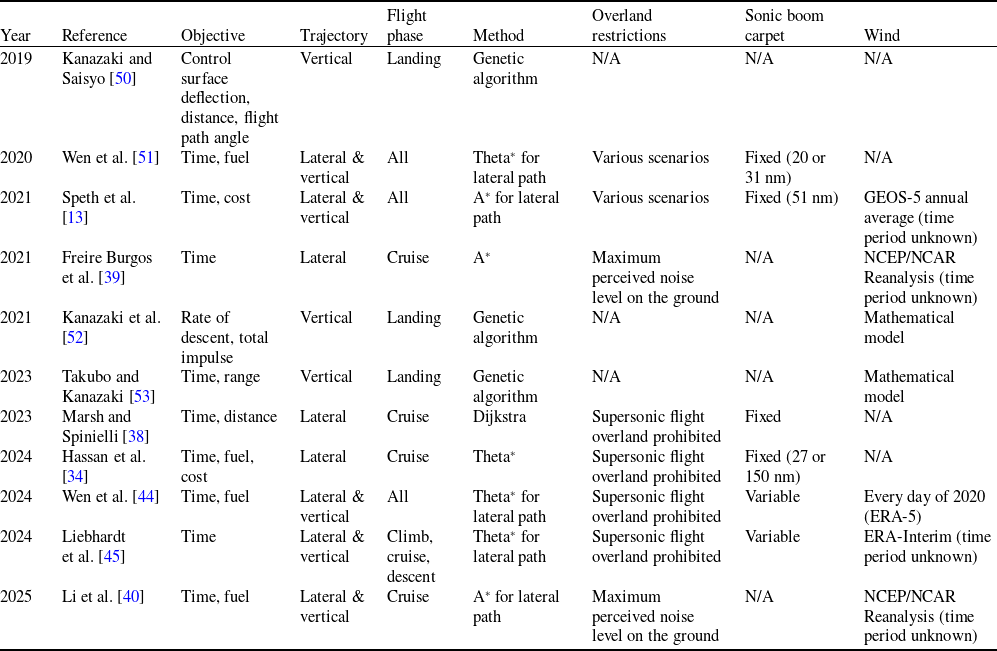
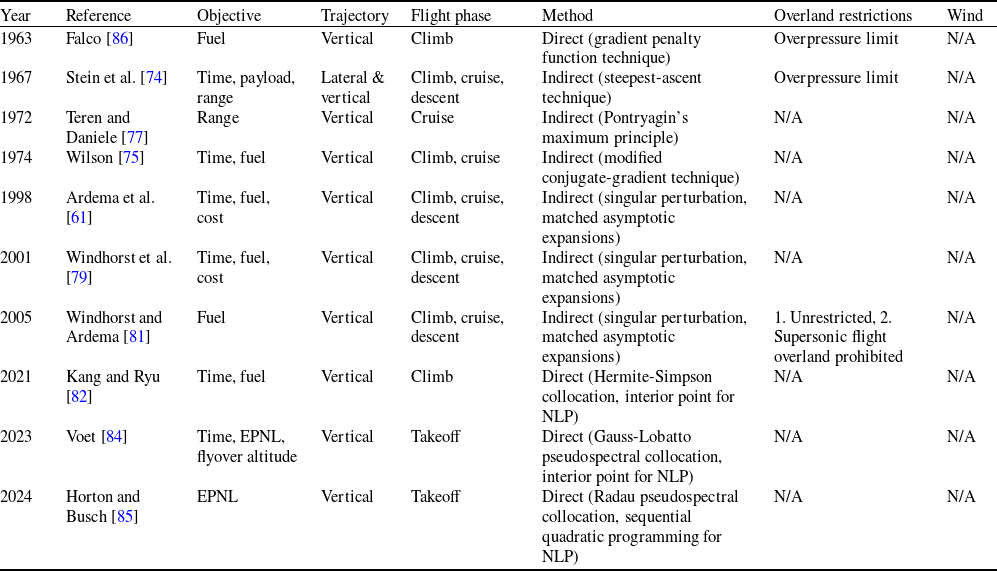
The rest of the paper is set out in six sections. In Sections 2 and 3, the methods that have been used to plan lateral and vertical SST trajectories, respectively, are reviewed. These are categorised as manual methods, graph search and metaheuristic methods, or optimal control approaches in Tables 1–3, respectively. Section 4 provides an overview of the methods for estimating SST fuel burn and is included because minimising fuel burn is a common objective in trajectory optimisation problems. Section 5 discusses pertinent challenges, identifies gaps in the literature, and recommends areas for future research. Finally, Section 6 summarises the key findings of this review.
Manual methods used in the literature for SST trajectory planning

Graph search and metaheuristic methods used in the literature for SST trajectory planning

Optimal control approaches used in the literature for SST trajectory planning

2.0 Lateral Trajectory Planning
Much of the lateral trajectory planning work in the literature has focused on preventing sonic booms from a supersonic aircraft reaching land. The shock waves caused by an aircraft flying faster than the speed of sound propagate away from the aircraft along ray paths, which are bent or refracted by the atmosphere. Temperature, wind and atmospheric pressure profiles and gradients (macro effects), and turbulence, atmospheric absorption and molecular relaxation (micro effects) all have an effect on the shock wave propagation, meaning that ray paths extend both vertically and laterally away from a supersonic aircraft [Reference Maglieri, Bobbitt, Plotkin, Shepherd, Coen and Richwine12]. The lateral extent of the ray paths defines the primary and secondary sonic boom carpets, as shown in Fig. 3.
Determining the extent of a boom carpet is traditionally treated as a two-stage process. First, the aircraft’s near-field pressure signature is calculated. This is then propagated through the atmosphere to the ground, where the signal evolves into the characteristic N-shaped waveform that gives rise to the ‘double boom’ phenomena. Numerous methods exist for calculating both near-field and far-field pressure signatures. Lower fidelity methods have their origins in the fundamental theory established by Whitham in the 1950s [Reference Whitham25, Reference Whitham26] based on supersonic flow theory and the supersonic area rule for near-field calculations, coupled with geometrical acoustics for atmospheric propagation. With increases in computing power, higher fidelity boom prediction methods featuring computational fluid dynamics (CFD) have subsequently been developed. Many of these methods use CFD to determine highly accurate near-field pressure signatures of aircraft with geometries more complex than those modelled in earlier works. These signatures are then propagated using three-dimensional ray tracing equations of geometrical acoustics implemented in codes such as NASA’s PCBoom. Research effort has also focused on full-field simulation methodologies that use high-fidelity CFD to calculate sonic boom generation and propagation in a single computational domain [Reference Yamashita, Makino and Roe27]. However, there are concerns about the computational cost associated with full-field simulations [Reference Han, Qiao, Zhang, Chen, Yang, Ding, Zhang, Song and Song14]. For more details about sonic boom prediction techniques and tools, interested readers are referred to recent review papers by Han et al. [Reference Han, Qiao, Zhang, Chen, Yang, Ding, Zhang, Song and Song14] and Bonavolontà et al. [Reference Bonavolontà, Lawson and Riaz16].
The overpressure levels of the secondary booms are smaller than those within the primary boom carpet. Supersonic lateral trajectory optimisation work has therefore focused on routing flights such that the primary boom carpet remains over the sea and/or avoids populated areas. Different methods of sonic-boom restricted flight routing are discussed in the following subsections.
2.1 Manual planning methods
Because of the complexities associated with SST routing, manual trajectory planning has proved to be a popular and relatively simple strategy for predicting where next-generation supersonic will operate (see Table 1). In their assessment of sonic boom-restricted flight routing, Liebhardt et al. [Reference Liebhardt, Linke and Dahlmann28] used Google Earth to manually draft routes between 250 city pairs believed most viable for the supersonic market. The work compared three scenarios for operating civil supersonic aircraft: full-permit, where supersonic flight overland is permitted and aircraft can fly great circle tracks; mixed-permit, where flight over populated areas is flown at Mach-cutoff; and no-permit, meaning that overland flight can only be flown at subsonic speeds. For the second and third scenarios, a fixed buffer of 50 km (27 nm) between the flight path and coastlines or permanent settlements was assumed on the basis that 50 km was the usual offset of former Concorde routes from coastal areas. Given that globally distributed mean atmospheric data (including winds) were used to calculate flight time and fuel burn, this fixed buffer is overly simplistic because, as already discussed, boom carpet width depends on atmospheric properties. To address this simplicity, Liebhardt et al. [Reference Liebhardt, Lütjens, Swaid, Müller and Ladewich29] subsequently used a proprietary sonic ray tracing computer code to obtain more accurate boom carpet widths. ERA-InterimFootnote 2 atmospheric data for 1 January 2015, provided by the European Centre for Medium-Range Weather Forecasts (ECMWF), were used to draft a route between London and Jeddah such that the primary boom carpet did not reach the coastline (see Fig. 4). Like in Ref. (Reference Liebhardt, Linke and Dahlmann28), vertical trajectory, flight time and fuel burn were determined with a proprietary mission simulation tool. Conversely, the lateral trajectory was adjusted manually using Google Earth because at the time, full three-dimensional optimisation proved difficult. Later, Liebhardt et al. [Reference Liebhardt, Lütjens, Ueno and Ishikawa9] conducted a market assessment of JAXA’s low-boom S4 airliner, again using Google Earth to draft routes, but this time sonic boom carpets were not considered because they were assumed not to have a significant impact on the study’s outcome.
Lateral propagation of shock waves from a supersonic aircraft. The downward propagating rays form the primary boom carpet whereas the rays that are bent by the upper atmosphere and subsequently impact the ground at a greater lateral distance define the secondary boom carpet. Figure obtained from Maglieri et al. [Reference Maglieri, Bobbitt, Plotkin, Shepherd, Coen and Richwine12], public use permitted.

London-Jeddah manually-drafted flight path (green line) and boom carpet (white lines) for 1st January 2015. Over Egypt the aircraft was flown at Mach-cutoff, hence the discontinuity in boom carpet. Reprinted with permission from Liebhardt et al. [Reference Liebhardt, Lütjens, Swaid, Müller and Ladewich29]. Copyright 2019, DLR.

Jain et al. [Reference Jain, Ogunsina, Chao, Crossley, Ueno and DeLaurentis31] performed a similar analysis of future supersonic operations, though their focus was on 205 routes to and from the United States. Eligible routes were first identified by manually adjusting the great circle path between two airports. Incremental deviations in departure heading of
 $ \pm 7$
° from the great circle generated 15 possible flight paths. Flight time for each option was calculated based on the percentage of time spent overwater and overland, along with the respective airspeeds, and the minimum-time option was taken to be the most viable. A more sophisticated routing method based on a weighted sum of time and fuel [Reference Hassan, Pfaender, Oliveira, Ougazzaden, Dussauge and Mavris34] was then used to identify the most profitable city pairs. However, it is not clear whether boom carpet width was accounted for. Mane et al. [Reference Mane, Swaine, Fung, Crossley and DeLaurentis33] assessed routes between 5317 origin-destination airport pairs using the same principle of departure heading adjustment. In common with Ref. (Reference Jain, Ogunsina, Chao, Crossley, Ueno and DeLaurentis31), the route offering the lowest flight time was assumed to be the ‘best’, and the effects of wind and time taken to accelerate and decelerate between sub- and supersonic flight were ignored.
2.2 Graph search methods
More recent works have automated lateral routing using graph search algorithms such as Dijsktra [Reference Dijkstra35], A* [Reference Hart, Nilsson and Raphael36] and Theta* [Reference Daniel, Nash, Koenig and Felner37] (see Table 2). This class of algorithm is typically easy to implement and scale. For flight planning applications, the graph is often a two-dimensional grid with resolution specified in terms of latitude and longitude. The optimal path from a start node to a goal node is then found for some given objective function. Penalty areas can be defined in the grid to prevent aircraft flying through restricted airspace or to stop supersonic aircraft flying overland, for example. More dimensions can be added to the graph by considering acceleration, deceleration, climb and descent, though computational effort increases with the dimensionality of the problem space.
Marsh and Spinielli [Reference Marsh and Spinielli38] created EUROCONTROL’s open-source himach tool to find minimum-time routes assuming different airspeeds overland and overwater. The tool, written in R, uses a bidirectional Dijkstra algorithm, a primitive aircraft performance model and a fixed coastal buffer to find paths that satisfy user-specified range requirements. In its current form, however, himach does not allow for non-standard atmospheric conditions or wind to be modelled. The tool is best suited to market studies and simple environmental impact modelling, and was recently used in a noise and emissions study of a proposed Mach 1.6 supersonic business jet [Reference Mourouzidis, Del Gatto, Adamidis, Villena Munoz, Lawson, Martinez Corzo, Leyland, Marsh, Lim, Owen, Terrenoire, Atinault, Legriffon, Huet, Schaefer, Plohr, Bake and Madden41].
Dijkstra’s algorithm tends to be more computationally expensive than the A* algorithm, because with A* a heuristic function reduces the number of grid nodes to be explored. Speth et al. [Reference Speth, Eastham, Fritz, Sanz-Morére, Agarwal, Prashanth, Allroggen and Barrett13] used an implementation of A* to identify optimal flight routes under three scenarios: an unrestricted scenario where supersonic aircraft fly great circle tracks; a scenario where supersonic flight overland is completely prohibited; and a scenario where supersonic flight is only prohibited over areas with population density greater than 50 inhabitants per square kilometer. For the two restricted scenarios, the objective function comprised flight cost, flight time and a monetary value of time (VOT) a passenger assigns to an hour of travel time saved. Figure 5 shows the different routes produced by the algorithm for two different VOT options. In this work, only annually averaged winds from the GEOS-5Footnote 3 dataset were used for flight time and fuel burn calculations. A fixed buffer of 95 km (51 nm) around restricted areas was assumed, 95 km being the maximum carpet width for an aircraft with a maximum cruise altitude and Mach number of 19.8 km (65,000 ft) and 2.2, respectively, reported in Ref. (Reference Liebhardt, Lütjens, Swaid, Müller and Ladewich29). This buffer is arguably pessimistic given that the majority of the notional aircraft types studied were designed for lower cruise Mach numbers and altitudes. Nevertheless, the algorithm solutions in Fig. 5 highlight how changing just one parameter in an objective function can yield drastically different routes.
A* routing solutions for New York City to Mexico City assuming two different values of time. Figure obtained from Speth et al. [Reference Speth, Eastham, Fritz, Sanz-Morére, Agarwal, Prashanth, Allroggen and Barrett13], public use permitted.

Although not explicitly stated in the publications, A* is inferred to have also been used by Freire Burgos et al. [Reference Freire Burgos, Trani, Hinze, Marien, Geiselhart, Dollyhigh and Seidel39] and subsequently Li et al. [Reference Li, Geiselhart, Palma, Patterson, Dollyhigh, Wang, Hinze and Trani40] to find minimum-time, wind-optimal routes for a low-boom SST. Atmospheric data were taken from NCEP/NCARFootnote 4 Reanalysis, and coastal buffers were not required due to the low-boom nature of the aircraft considered. In Ref. (Reference Li, Geiselhart, Palma, Patterson, Dollyhigh, Wang, Hinze and Trani40), three different mission profiles were simulated: a mixed mission with low-boom cruise at Mach 1.7 for overland segments and unrestricted cruise at Mach 1.8 for overwater segments; a low-boom mission with a constant cruise Mach of 1.7; and an unrestricted mission with a constant cruise Mach of 1.8. NASA’s Flight Optimization System (FLOPS)Footnote 5 was then used to generate a vertical flight profile. The work demonstrated how conceptual aircraft design, mission profile analysis and market demand studies can be integrated to support regulatory decision making on supersonic overland flight.
In the most recent publications, fixed buffers have been replaced in favour of buffers that vary with atmospheric and flight conditions. Efforts to integrate carpet width computation with automated boom-restricted routing were first presented by researchers at Georgia Tech. Hassan et al. [Reference Hassan, Pfaender, Oliveira, Ougazzaden, Dussauge and Mavris34] used the Theta* algorithm to identify optimal supersonic flight routes with an objective function comprising a weighted sum of time and fuel burn. Theta* is similar to A*, but the addition of a line-of-sight check – in this case using Bresenham’s line of sight algorithm [Reference Bresenham42] – determines if the path between two nodes encounters an obstacle. Whereas the A* implementation in Refs (Reference Speth, Eastham, Fritz, Sanz-Morére, Agarwal, Prashanth, Allroggen and Barrett13, Reference Freire Burgos, Trani, Hinze, Marien, Geiselhart, Dollyhigh and Seidel39) featured a 48-node neighbour scheme, Hassan et al. [Reference Hassan, Pfaender, Oliveira, Ougazzaden, Dussauge and Mavris34] used only an 8-node neighbour scheme. Without the line-of-sight check, the latter would result in tracks that can change by only
 $ \pm 45$
°. Theta* therefore helps to smooth the lateral flight route while simultaneously preventing the aircraft overflying a restricted area. A baseline buffer of 27 nm was added around the edge of land masses (consistent with a 50° turn angle for Concorde), though a sensitivity study using a 150 nm buffer was also conducted. The number of routing solutions generated was found to vary with both buffer distance and airport pair. Wen et al. [Reference Wen, Pfaender and Mavris43] used PCBoom and ECMWF’s ERA5 reanalysis data for every day of 2020 to quantify the global variation of primary boom carpet width. They found that boom carpet width tends to increase for an aircraft flying (a) at higher Mach numbers and altitudes, (b) in warmer seasons regardless of flight direction, and (c) eastbound with the North Atlantic jet stream. The methods for calculating 95th percentile global carpet widths developed in Ref. (Reference Wen, Pfaender and Mavris43) were subsequently integrated with the Theta* algorithm from Ref. (Reference Hassan, Pfaender, Oliveira, Ougazzaden, Dussauge and Mavris34) to create a bespoke flight planning tool [Reference Wen, Pfaender and Mavris44]. An artificial scaling parameter,
 $\alpha $
, was used to trade between time-optimal (
 $\alpha = 0$
) and fuel-optimal (
 $\alpha = 1$
) routes. The addition of acceleration/deceleration flight phases coupled with lengthy routes with complex geographic features meant that the algorithm became computationally expensive, in some cases taking up to a few hours to run. Although atmospheric data were used to estimate boom carpet width, the effect of prevailing wind does not seem to have been considered when calculating flight time or fuel burn for the different routes.
Building on previous work at DLR [Reference Liebhardt, Linke and Dahlmann28, Reference Liebhardt, Lütjens, Swaid, Müller and Ladewich29], Theta* was also used by Liebhardt et al. [Reference Liebhardt, Ehlers and Shah45] to develop an automated routing tool. In contrast to Georgia Tech’s probabilistic approach to boom carpet estimation, the DLR toolchain allows for unique atmospheric conditions to be used as inputs. In this way, real-world operational routes that account for daily weather variations can be generated. A changeable route buffer was used to keep the supersonic aircraft sufficiently far away from the coast so as to prevent the sonic boom making landfall (see Fig. 6). Unlike the Georgia Tech tool, which allows for a trade-off between time- and fuel-optimal routes, only minimum-time routes were considered in this work. The transitions between sub- and supersonic flight were accounted for using simple averaged rates of acceleration and deceleration. While boom carpet edges were estimated using wind data from ECMWF’s ERA-Interim, it is not clear if the effect of wind on flight time was considered.
Part of a route between New York City and London. A varying route buffer is used to ensure that the edge of the boom carpet does not infringe a specified coastal buffer. Reprinted with permission from Liebhardt et al. [Reference Liebhardt, Ehlers and Shah45]. Copyright 2024, DLR.

3.0 Vertical Trajectory Planning
In addition to lateral route planning, research effort has focused on optimising the vertical trajectories of civil supersonic aircraft. The faster speeds and higher cruise altitudes of these aircraft lead to more complex vertical trajectories than those of subsonic aircraft. The transonic acceleration manoeuvre, for example, has been modelled variously as a climb, a dive and a constant altitude flight phase, while supersonic cruise segments have been assumed to take a step-climb, continuous cruise-climb or constant-altitude form. The myriad supersonic concept aircraft found in the literature (see, for example, Tables 1 and 2 in Sun and Smith [Reference Sun and Smith2]), each with different cruise Mach numbers and altitudes, has led to a wide variety of vertical trajectories being presented, the earliest of which can be traced back to the 1960s. Early works applied optimal control theory to solve the minimum time-to-climb and minimum fuel-to-climb problems. Contemporary works have used similar approaches to optimise entire flight trajectories, but manual and metaheuristic methods have also become more prevalent. This section reviews the different approaches taken to generate and optimise vertical trajectories for civil supersonic aircraft.
3.1 Manual planning methods
Manual planning methods have proved popular with researchers trying to understand how future supersonic aircraft will integrate with existing air traffic. Underwood and Guminsky [Reference Underwood and Guminsky30] and later Underwood [Reference Underwood46] investigated flight time savings and potential conflicts with subsonic aircraft that could arise if SSTs are permitted to fly over the contiguous United States. SST trajectories were assumed to include intermediate subsonic level-off altitudes prior to acceleration to, and after deceleration from, supersonic cruise. The level-off altitude and length were varied between FL275 and FL395, and 0 and 100 nm, respectively. Using a joint NASA-NLR tool named Traffic Manager eXecutable, 1695 different scenarios were generated and analysed. The results showed that unsurprisingly, the most conflicts occurred when SSTs were held at altitudes where there is a high density of subsonic traffic. The number of encounters was also greater during the ascent to cruise compared to the descent from cruise. On average, SST flights were found to be 53% faster than a subsonic airliner flying the same route. The study did, however, rely on the assumptions that supersonic overland flight will be permitted, and that between the end of a standard instrument departure (SID) and beginning of a standard terminal arrival (STAR), SSTs fly great circle tracks. Wind and other weather phenomena were also not simulated, despite these potentially affecting aircraft routing.
Liebhardt et al. [Reference Liebhardt, Linke and Knaack17] instead investigated how atmospheric conditions and global topography affect Mach-cutoff. Building on previous work [Reference Liebhardt, Linke and Dahlmann28, Reference Liebhardt, Lütjens, Swaid, Müller and Ladewich29], a proprietary trajectory calculation environment known as SuperTraC (supersonic trajectory calculator) was used to simulate Mach-cutoff flights between eight representative city pairs. An example for the New York City-Los Angeles route is shown in Fig. 7. Unlike in much of the literature, daily prevailing winds were considered and shown to affect the flight time of a marginally supersonic aircraft. Cruise altitude and Mach number were adjusted to ensure sonic booms did not reach the ground, and flight time savings and additional fuel burn consumption were compared to purely subsonic flight. Cutoff Mach numbers were also determined for latitudes between 60° S and 80° N, flight levels between FL330 and FL510, and for eastbound and westbound routes in January and July. However, the frequent accelerations and decelerations shown in Fig. 7 suggest that the trajectory may be suboptimal with respect to fuel burn.
Mach-cutoff flight between New York City and Los Angeles with headwinds prevailing. A cutoff altitude of 5000 ft above ground level was chosen as a conservative safety buffer. Reprinted with permission from Liebhardt et al. [Reference Liebhardt, Linke and Knaack17]. Copyright 2022, DLR.

SuperTraC was used by Ishikawa et al. [Reference Ishikawa, Ueno, Koganezawa, Makino, Liebhardt and Lütjens10] to assess the under-track perceived sonic boom loudness of JAXA’s S4 low-boom SST concept. Maximum-range missions were simulated, though a zero-wind standard atmosphere was assumed, and no details of the origin or destination airports were provided. Loudness was assessed by varying between 28,000 and 42,000 ft the altitude at which the aircraft accelerates from subsonic to supersonic flight. This constitutes a novel approach given that in other works, acceleration altitude is simply specified as part of the flight profile [Reference Morgenstern, Buonanno, Yao, Murugappan, Paliath, Cheung, Malcevic, Ramakrishnan, Pastouchenko, Wood, Martens, Viars, Tersmette, Lee, Simmons, Plybon, Alonso, Palacios, Lukaczyk and Carrier47–Reference Villena Munoz, Lawson, Riaz and Jaron49]. Acceleration at higher altitude was found to give slightly quieter booms on the ground, suggesting that a combination of trajectory optimisation and innovative aircraft design will be needed to realise low-boom operations.
As well as en route sonic boom modelling, the noise generated by an SST during landing and takeoff has received considerable attention. Compared to subsonic aircraft, SSTs have higher specific thrust on account of their increased cruise Mach number and the associated increase in wave drag. The thin, highly swept wings used to minimise cruise drag typically exhibit poor low-speed flying qualities [Reference Torenbeek54], meaning that SSTs takeoff and land at faster speeds than conventional subsonic aircraft. High specific thrust and LTO speeds lead to high jet velocity and hence noise. Advanced LTO trajectories that minimise effective perceived noise level (EPNL) compared to standard trajectories are therefore of particular interest. A standard takeoff trajectory is one that conforms to the noise certification regulations for subsonic aircraft in ICAO Annex 16 Volume 1. An advanced trajectory features modification(s) to takeoff speed, automatic thrust control and/or altitude at which the aircraft’s thrust is reduced (known as the cutback altitude) [Reference Voet, Prashanth, Speth, Sabnis, Tan and Barrett55]. Nöding [Reference Nöding, Schuermann, Bertsch, Koch, Plohr, Jaron and Berton32] simulated standard and advanced takeoff procedures for an SST concept developed in Ref. (Reference Schuermann56). Airspeed, thrust and cutback height were varied, as shown in Fig. 8, and the optimum trajectory was identified as the one that provided the lowest EPNL at the flyover measurement position.
A comparison between advanced (panels a, c and e) and standard (panels b, d and f) takeoff trajectories. Trajectories with the same cutback height are assigned a specific colour (grey = lower, blue = middle and black = higher cutback height). Figure obtained from Nöding et al. [Reference Nöding, Schuermann, Bertsch, Koch, Plohr, Jaron and Berton32] licenced under CC BY 4.0.

3.2 Optimal control approaches
Optimisation of supersonic aircraft vertical trajectories has been accomplished predominantly using optimal control approaches. Optimal control theory is a vast topic for which a complete overview is beyond the scope of this review. For a comprehensive introduction to optimal control problem formulation and solution, interested readers may wish to consult Refs (Reference Betts24, Reference Betts57, Reference Longuski, Guzmán and Prussing58). In general, however, an optimal control problem formulation requires definition of the following:
-
• A cost functional, objective function or performance index (terms used interchangeably). The optimal control (for example, a sequence of pitch angles to fly) is designed to minimise or maximise the performance index.
-
• A mathematical model of the system in the form of differential equations. These equations describe the evolution of the states of the system.
-
• Boundary conditions. For example, the flight time may be ‘free’ or it may be ‘fixed’ subject to air traffic control requirements. The geographic location of origin and destination airports may also be represented as boundary conditions.
-
• Constraints on the control and state variables. These can be used to limit the aircraft’s altitude (typically a state variable) and engine thrust (typically a control variable), for example.
Optimal control problems generally do not have closed-form analytic solutions and are therefore solved numerically using indirect (‘optimise then discretise’) or direct (‘discretise then optimise’) methods. Indirect methods are so named because they solve a different optimisation problem (a boundary value problem) that indirectly represents the original optimal control problem. Indirect methods are based on the calculus of variations and require derivation of the necessary conditions for optimality. This, as well as the need to make initial guesses for the adjoint variables, can prove difficult. On the other hand, direct methods discretise the problem directly and convert it into a finite-dimensional non-linear programming (NLP) problem that can be solved using efficient non-linear optimisation algorithms. Direct methods are regarded as easier to set up and solve than indirect methods, but they lack the in-built accuracy metric of an indirect method [Reference Betts57].
It should be noted that the majority of early works optimised trajectories for military supersonic fighter-interceptor aircraft. A seminal paper by Bryson et al. [Reference Bryson, Desai and Hoffman59] demonstrated how the energy-state approximation could be applied to the minimum time-to-climb and minimum fuel-to-climb problems but then also extended this to maximum-range problems. The energy-state approximation simplifies such problems by using only one state variable: energy per unit mass, or specific energy. Importantly, the work highlighted for the first time the counterintuitive nature of optimal supersonic trajectories in that such an aircraft must actually dive first before climbing to a given altitude in minimal time. Despite its relative simplicity, the energy-state approximation was shown to give similar optimal climb profiles to more complex (up to five-state) models [Reference Shaw60]. However, others have argued that the energy-state approximation is best suited to transport aircraft due to their benign manoeuvres making the assumptions involved in the approximation ‘less questionable’ [Reference Ardema, Windhorst and Phillips61]. Nevertheless, Bryson et al.’s work [Reference Bryson, Desai and Hoffman59] led to significant interest in the optimisation of high-performance fighter aircraft trajectories. Subsequent research found two-dimensional minimum-time turns [Reference Hedrick and Bryson62], three-dimensional minimum-time [Reference Hedrick and Bryson63, Reference Lin64] and minimum-fuel turns [Reference Hedrick and Bryson65], and maximum-range trajectories [Reference Seywald, Cliff and Well66]. More recently, Nevrekar et al. [Reference Nevrekar, Striz and Vedula67] and Levin and DeLaurentis [Reference Levin and DeLaurentis68] maximised glide range, and Jasa et al. [Reference Jasa, Brelje, Gray, Mader and Martins69] and Jasa et al. [Reference Jasa, Mader and Martins70] optimised entire flight trajectories subject to thermal management system constraints. The minimum time-to-climb problem has also remained popular, with contemporary textbook [Reference Betts57] and MATLAB [Reference Nie, Faqir and Kerrigan71] examples providing modern, accessible solutions.
3.2.1 Indirect optimal control methods
Because the focus of this review is on civil supersonic aircraft trajectories, attention now turns to optimal control approaches that have been used specifically for SST trajectory optimisation (see Table 3). Indirect methods for solving optimal control problems are discussed first.
In 1967, Stein et al. [Reference Stein, Matthews and Frenk72] developed the Supersonic Transport Optimization Program (STOP), believed to be the first tool capable of three-dimensional trajectory optimisation for SSTs. STOP used a point mass simulation model and control variables of pitch angle, bank angle, wing sweep and throttle setting. The boundary value problems were solved with the steepest-ascent technique [Reference Bryson and Denham73]. Eighteen SST flights of an aircraft with either fixed or variable wing sweep were optimised for minimum time, maximum range and maximum payload [Reference Stein, Matthews and Frenk74]. Sonic boom overpressure limits near fictitious, circular-shaped cities were imposed to investigate whether the aircraft would climb over or, as was found to be the preferred option, fly around populated areas. STOP was certainly ambitious, but ‘excessive’ computational times meant that in many cases, the iterative procedure was stopped short of the true optimum.
To combat lengthy computation times, Wilson [Reference Wilson75] chose to restrict the problem to two dimensions and optimised Concorde’s vertical trajectory from just after takeoff to the end of cruise. The cost function comprised a weighted sum of time and fuel. Attitude and throttle were used as control variables with switching-time control parameters to allow reheat to be selected on or off. The conjugate gradient technique adapted for unconstrained optimal control problems [Reference Lasdon, Mitter and Waren76] was used to solve the nonlinear two-point boundary value problem (2PBVP), though some modification was required so that the reheat switching parameters were treated as parameters, not control variables. While the method was shown to be appropriate, only one optimal trajectory was presented for a 2860 nm flight and an ambient temperature of ISA + 5°. Computation times on the order of 30 minutes were also required; presumably, however, these would be reduced significantly using a modern computer.
Teren and Daniele [Reference Teren and Daniele77] considered the range of a large (
 $ \approx $
300 tonnes) supersonic aircraft and investigated whether an optimal thrust control could improve on the standard Breguet range equation. Unlike in the derivation of the Breguet equation where altitude becomes a control variable (steady flight is assumed and the climb rate is neglected), in this work altitude was instead included as a state variable. The problem was formulated using Pontryagin’s maximum principle [Reference Pontryagin, Boltyanskii, Garnkrelidze and Mishchenko78] in minimum form. The difference in range between the optimal and Breguet solutions was found to be small (< 7 km, or 3.8 nm) for long-range cruise (
 $ \approx $
6000 km, or 3240 nm). Few subsequent works – and none, to the best of the authors’ knowledge, using an optimal control approach – have included range as an objective to be maximised (see the ‘Objective’ columns of Tables 1–3).
A comprehensive treatment of SST vertical trajectory optimisation was provided by Ardema et al. [Reference Ardema, Windhorst and Phillips61], where the main focus was modelling the altitude transition that occurs in the energy climb path during transonic drag rise. In this research, the fixed-range optimal trajectory problem was formulated with five state variables (mass, range, energy, altitude and flight path angle). Because application of the maximum principle would result in an unstable and difficult-to-solve 2PBVP, singular perturbation theory was used to approximate the dynamic system by a series of single state equations, thereby avoiding the need to solve the 2PBVP. Similar to Ref. (Reference Wilson75), the optimal cruise point was identified using a weighted sum of time and fuel, but when searching for this point, mass was held constant and the range during climb and descent was ignored. To address these limitations, Windhorst et al. [Reference Windhorst, Ardema and Kinney79] solved the fixed-range optimal trajectory problem to first order, rather than to zero order as previously. In this later work, the singularly perturbed model adopted was not fully timescale separable, so the method of matched asymptotic expansions was used to solve the 2PBVPs. Timescale decoupling led to two systems of equations: weight/range dynamics modelling the cruise segment of the trajectory, and energy dynamics modelling climb and descent. Combining these solutions using the matching principle [Reference Ardema80] meant the entire trajectory could be plotted, as shown in Fig. 5 of the original publication. Of interest is the difference between the minimum-fuel and minimum-time trajectories; whereas the former adopts a cruise-climb, the latter maintains a constant cruise altitude. Gaining altitude means the trajectory also gains energy, which increases flight time during descent and is hence undesirable for the minimum-time case. For the minimum-fuel case, altitude jumps during climb are particularly noticeable. As the aircraft encounters the transonic drag rise (and thus increased fuel consumption), it dives to pass through this region as quickly as possible. Ardema et al. [Reference Ardema, Windhorst and Phillips61] in fact showed that a pushover dive followed by a pullout at load factors acceptable to passengers could be used to smooth such jumps. In Windhorst and Ardema [Reference Windhorst and Ardema81], the trajectory optimisation algorithm was applied to a mixed subsonic/supersonic mission that accounted for overland Mach number restrictions. However, no real routes were considered; sub- and supersonic flight segments were instead given arbitrary lengths of 1000 and 3000 nm, respectively. In addition, some of the trajectories featured unrealistic jumps in altitude during cruise, though this was attributed to ‘nonsmoothness’ of the aerodynamic and propulsive data provided for the concept aircraft.
3.2.2 Direct optimal control methods
In more recent works, direct methods have been employed to optimise takeoff and climb profiles of SST aircraft. In their determination of an aircraft’s optimum cruise altitude, Kang and Ryu [Reference Kang and Ryu82] used the Hermite-Simpson direct collocation method followed by the interior point solver, IPOPT,Footnote 6 to solve the resulting NLP problem. The minimum time-to-climb and minimum fuel-to-climb trajectories were obtained, and the altitude at which the difference between these two trajectories exceeded an acceptable error level was taken to be the multi-objective cruise altitude (MOCA). Confusingly, however, performance data for a supersonic aircraft were only used due to a lack of subsonic aircraft data. The MOCA of 10.91 km (approximately 36,000 ft) quoted may be appropriate for a subsonic airliner but is significantly lower than the cruise altitude expected for future supersonic transports. Although trajectories for two supersonic aircraft were presented for altitudes up to 20 km (approximately 66,000 ft, see Fig. 9), flight path and Mach number trends above MOCA were not discussed, even though they displayed similar transonic dives to those seen in previous work [Reference Windhorst, Ardema and Kinney79, Reference Windhorst and Ardema81].
Minimum-time and minimum-fuel climbs. A multi-objective cruise altitude was selected based on the altitude at which the two different trajectory types diverge. Figure obtained from Kang and Ryu [Reference Kang and Ryu82] licenced under CC BY 4.0.

Pseudospectral collocation methods [Reference Garg, Patterson, Hager, Rao, Benson and Huntington83] have increased in popularity in the past two decades, especially in the aerospace sector, and have been used to optimise the takeoff trajectories of SSTs. Voet [Reference Voet84] investigated the extent to which variable noise reduction systems (VNRS) could minimise EPNL during takeoff. A Gauss-Lobatto pseudospectral collocation method implemented in NASA’s DymosFootnote 7 was used to discretise the optimal trajectory problem, and IPOPT was subsequently used to solve the NLP problem. VNRS trajectories with automatic control of thrust and high-lift devices were shown to offer reductions in EPNL, but the most effective measure was found to be an increased takeoff speed. Although runway length was assumed not to be a limiting constraint, takeoff speeds on the order of 250 knots would likely limit airports from which SSTs can operate. Horton and Busch [Reference Horton and Busch85] compared VNRS trajectories generated using NASA’s new open-source design framework Aviary, which incorporates Dymos trajectory components, with trajectories generated using the legacy FLOPS tool. In this work, a Radau pseudospectral method and Sparse Nonlinear OPTimizer (SNOPT,Footnote 8 a sequential programming approach) were used. Aviary VNRS trajectories provided additional takeoff EPNL reductions of between 0.8 and 1.3 EPNdB, though concerns over computational speed and robustness of the new tool warrant further development.
Despite the renewed interest in supersonic flight and sonic boom computation, Falco’s 1963 paper [Reference Falco86] remains one of the few examples of an optimal control approach to supersonic trajectory optimisation that includes a constraint on sonic boom intensity. Minimum-fuel acceleration climb paths were obtained using a gradient penalty function technique [Reference Kelley87] with a simplified overpressure formula [Reference Carlson88] added as an inequality constraint. Compared to a trajectory with no regard for overpressure limitations, the climb trajectory optimised for an overpressure limit of 2.25 pounds per square foot burned almost twice as much fuel. This corresponded to a net range reduction of ‘approximately 500 statute miles’ (434 nm), highlighting the commercial difficulties arising from overland supersonic flight restrictions.
3.3 Metaheuristic methods
To date, there has been limited application of metaheuristic approaches to SST vertical trajectory optimisation. Research has focused on the use of genetic algorithms to optimise landing trajectories. Inspired by biological evolution, genetic algorithms assume that a trajectory is characterised by discrete variables, and for a finite number of samples, randomly select values for the unknown problem variables. The ‘optimum’ trajectory is that which provides the best solution after all samples have been analysed. Genetic algorithms are typically straightforward to implement, but their randomness means that convergence to a globally optimal solution is not guaranteed [Reference Betts24, Reference Dancila and Botez89].
Kanazaki and Saisyo [Reference Kanazaki and Saisyo50] optimised the flight path of a delta-winged SST from a height of 500 m (1640 ft) down to the surface. Uniquely, the cost function comprised distance, control surface deflection and flight path angle. The algorithm employed in the study used a real-coded representation, simulated binary crossover and polynomial mutation. The work was developed further in Kanazaki et al. [Reference Kanazaki, Setoguchi and Saisyo52] with the introduction of additional controls and consideration of wind. Two cases were considered: landing using elevator control only, and landing using elevator and thrust controls. Both still air and microburst conditions were analysed, the latter relying on a simple mathematical model. The Constrained Non-dominated Sorting Genetic Algorithm II (CNSGA-II) was used to solve each problem with a population size of 30 and 30,000 generations. Compared to the still air condition, the differences in the controls among the objective functions were lower under microburst conditions, from which it was suggested that pilots’ controls should be limited during unexpected weather. The operational implications of this were not discussed. In addition, the work is somewhat limited in that it focuses on a very short time period (flight from 250 m, or 820 ft, down to the surface) and models only one microburst position (2 km, or 1.1 nm, from the aircraft’s starting point).
Takubo and Kanazaki [Reference Takubo and Kanazaki53] noted that the problem transcription used in Ref. (Reference Kanazaki, Setoguchi and Saisyo52) could lead to overly aggressive flight control design under meteorological uncertainties. To address this, non-intrusive polynomial chaos expansion was introduced to formulate a robust constrained multi-objective optimal control problem which was subsequently solved using CNSGA-II, with polynomial mutation and simulated binary crossover for the evolution strategies. Uncertainty in wind velocity was modelled over the interval [-5,5] m/s. Compared to nominal trajectories, robust trajectories were shown to minimise the aircraft’s tendency to touchdown ahead of the runway (i.e. crash) in the event of a headwind. The wind velocities modelled, however, are low compared to what might be expected in a real operational environment.
4.0 SST Fuel Burn Estimation
Because the objective of SST trajectory optimisation is often solely, or partly, to minimise fuel burn, some means of estimating the aircraft’s performance is required. For subsonic aircraft, this has been achieved using EUROCONTROL’s Base of Aircraft Data (BADA) (see, for example, Refs (Reference Sridhar, Ng and Chen90–Reference Murrieta-Mendoza, Romain and Botez93)), Lissys’ Piano-X [94] and open-source methods that rely on known aircraft performance characteristics [Reference Wells, Williams, Nichols, Kalise and Poll95, Reference Sun, Hoekstra and Ellerbroek96]. However, there have been no operational civil supersonic aircraft since Concorde was retired in 2003. Optimising trajectories for aircraft that do not yet exist is therefore a challenge, especially given that such aircraft are expected to burn significantly more fuel per passenger seat mile than comparable subsonic types [Reference Rutherford, Eastham, Sanz-Morère, Kim and Speth97]. This section reviews the different methods for estimating SST fuel burn.
4.1 Aircraft design environments
A variety of tools have been used to estimate fuel burn for clean-sheet supersonic aircraft designs (see Table 4). Here, an overview of the software developed by different organisations is presented, and some of the limitations are discussed.
Software tools used to estimate fuel burn for supersonic aircraft designs

Researchers at Cranfield University used the GENUS multidisciplinary design analysis and optimisation environment to develop a number of conceptual supersonic aircraft designs [Reference Sun and Smith48, Reference Sun and Smith98, Reference Sun and Smith99]. The propulsion module of GENUS uses the NASA EngineSim model to build a rubber engine system. Given user-specified engine geometry, bypass ratio, materials and temperature limits, EngineSim provides specific fuel consumption (SFC) as a function of Mach number and altitude, from which total fuel burn can be calculated. Compared to other supersonic concepts found in the literature, however, the cruise SFC of 47.74 g/kN/s given in Sun and Smith [Reference Sun and Smith48] appears quite high. A fuel consumption per seat-km flown of up to 11.6 times the subsonic baseline is also greater than found in other sources, with Rutherford et al. [Reference Rutherford, Eastham, Sanz-Morère, Kim and Speth97] instead estimating only a seven to nine times increase, for example.
Windhorst et al. [Reference Windhorst, Ardema and Kinney79] developed a new trajectory optimiser for a similar design environment, NASA’s AirCraft SYNThesis (ACSYNT) code. ACSYNT includes a subroutine that generates a trajectory for each mission segment, then simulates a vehicle flying these segments by integrating the vehicle’s equations of motion. In this work, trajectories between London and New York were analysed for a modified Boeing High Speed Civil Transport. Although some aircraft parameters were specified, fuel flow rate was simply stated to be a non-linear function of throttle, altitude and Mach number, but the function itself was not provided.
Georgia Tech’s Framework for Advanced Supersonic Transport (FASST) was used in [Reference Hassan, Pfaender, Oliveira, Ougazzaden, Dussauge and Mavris34] to derive average sub- and supersonic specific air range (SAR) cruise values for a 55-seat Mach 2.2 SST. Although SAR is a function of instantaneous weight and altitude, average values were used for simplicity. In common with other aircraft design and simulation software, FASST combines multiple modules. For example, engine cycle modelling is performed by NASA’s Numerical Propulsion System Simulation (NPSS), and mission analysis is conducted using NASA’s FLOPS [Reference Baltman, Tai, Shi and Mavris100]. Access to both NPSS and FLOPS is, however, controlled by NASA.
DLR’s flight performance code SuperTraC simulates subsonic-supersonic missions by iteratively solving the equations of motion [Reference Liebhardt, Linke and Dahlmann28, Reference Liebhardt, Ehlers and Shah45]. Details about the tool are scarce, but it is said to require aircraft performance specifications including masses, aerodynamic polars, engine maps and segment speeds to determine the flight trajectory [Reference Liebhardt, Lütjens, Swaid, Müller and Ladewich29]. Like GENUS, ACSYNT and FASST, SuperTraC is proprietary, and published works that have used the tool have all relied on aircraft performance data that are not in the public domain [Reference Ishikawa, Ueno, Koganezawa, Makino, Liebhardt and Lütjens10, Reference Liebhardt, Linke and Knaack17, Reference Liebhardt, Ehlers and Shah45].
Researchers at the University of Michigan instead demonstrated how open-source tools can simultaneously optimise a supersonic aircraft’s design and flight path. Jasa et al. [Reference Jasa, Brelje, Gray, Mader and Martins69] used OpenMDAO as the underlying optimisation framework, as well as a variety of other tools written in Python, to minimise fuel burn subject to thermal constraints. Their propulsion module, for example, uses the open-source tool pyCycle which has been verified against NPSS [Reference Hendricks and Gray101]. Although this work focused on optimising the trajectory for a reconnaissance flight (i.e. a military application), it was suggested that a similar method could be used to assess a wide variety of mission types.
4.2 Concorde performance data
In other works, fuel burn has been estimated using historic Concorde data. Gonzalez-Gallego [Reference Gonzalez-Gallego, Perez and Jansen102] calibrated the turbojet SFC model from Ref. (Reference Mattingly, Heiser, Boyer, Haven and Pratt103) using data for the Rolls Royce-Snecma Olympus 593 (Concorde’s engine). Aerodynamic and propulsive efficiency factors were then varied to quantify the technology improvements required for a feasible supersonic business jet. A similar calibration approach was taken by Hassan et al. [Reference Hassan, Pfaender and Mavris104] when creating their conceptual mission analysis tool, but in this work both turbojet and turbofan engine models were considered. The fuel required for different flight phases was estimated using the weight fraction method from Ref. (Reference Mattingly, Heiser, Boyer, Haven and Pratt103), and takeoff weight reductions relative to Concorde were calculated for assumed improvements in SFC and drag coefficient. The tool was subsequently used to estimate acceleration, takeoff and climb, and descent and landing fuel burn for the Georgia Tech 55-seat Mach 2.2 SST described in Section 4.1 [Reference Hassan, Pfaender, Oliveira, Ougazzaden, Dussauge and Mavris34].
Researchers undertaking market assessments and environmental impact evaluations as part of FAA ASCENT Project 010 [Reference Mavris, Crossley, Jimmy and DeLaurentis105] have tended to use simple performance models based on data from the Concorde flight manual. Guided by information about Concorde, Jain et al. [Reference Jain, Ogunsina, Chao, Crossley, Ueno and DeLaurentis31] used ‘engineering judgement’ to estimate the supersonic SFC of the aforementioned 55-seat Mach 2.2 SST. A corresponding subsonic SFC was calculated by multiplying together the supersonic SFC and Concorde’s subsonic-to-supersonic SFC ratio. A similar albeit slightly more sophisticated method was employed by Weit et al. [Reference Weit, Wen, Anand, Mayakonda, Zaida and Mavris106] and Wen et al. [Reference Wen, Weit, Anand, Mayakonda, Zaidi and Mavris51]. In these works, specific distance was presented as a function of flight condition (sub- or supersonic) and mass, and acceleration fuel burn was given simply as a function of mass. Both specific distance and acceleration fuel burn values were scaled from the Concorde flight manual. The scaling factor was determined using high-fidelity mission analysis of the 55-seat Mach 2.2 SST, and the simple fuel burn method was found to give accurate enough estimates for a first-order analysis. Supersonic-to-subsonic fuel flow rate ratios from the flight manual were then used to estimate the NOx emissions indices during subsonic cruise and transonic acceleration in accordance with the Boeing Fuel Flow Method 2 [Reference DuBois and Paynter107].
4.3 Look-up tables
Aircraft performance look-up tables are a fast and convenient way to estimate fuel burn. BADA’s performance summaries, for example, provide fuel flow rate for different flight phases, altitudes and airspeeds. The BADA generic military fighter model (denoted FGTN) was used in Ref. (Reference Underwood and Guminsky30) to investigate commercial supersonic transport operations in North American airspace. However, according to the BADA user manual [Reference Nuic108], the FGTN model is representative of a variety of small sub- and supersonic fighter aircraft. Using the FGTN model as a surrogate for a future supersonic transport is, as Underwood and Guminsky [Reference Underwood and Guminsky30] admit, a major limitation of the study, though they appear to have only taken airspeed and climb rate data from BADA. BADA’s use is regulated through a licence agreement with EUROCONTROL which, coupled with the current lack of representative SST model, makes it unappealing for supersonic trajectory optimisation research.
Look-up tables also feature in older trajectory optimisation works, but the origins of the data are often obscure or poorly explained. Wilson [Reference Wilson75] relied on Concorde aerodynamic and engine information provided by the British Aircraft Corporation, but these data were not published due to their proprietary nature. Teren and Daniele [Reference Teren and Daniele77] presented a plot of SFC as a function of thrust coefficient for an engine operating with and without afterburner. Their aircraft engine data were ‘representative of a supersonic transport’, though it is unclear where these data originated. Falco [Reference Falco86] used the fact that fuel flow is a function of Mach number and altitude to obtain minimum-fuel acceleration-climb profiles for an SST but provided no details of the function itself. Bryson et al. [Reference Bryson, Desai and Hoffman59], on the other hand, included look-up tables for thrust and fuel consumption as a function of Mach number and altitude for two supersonic interceptor aircraft. These aircraft were subsequently used in Ref. (Reference Kang and Ryu82) as proxies for commercial aircraft; however, this was due to a lack of accessible contemporary data. Baber [Reference Baber109] provided a comprehensive set of aerodynamic and performance data for a transpacific, Mach 2.6, 273-seat supersonic concept aircraft, but the report is relatively old (published in 1979) and the aircraft’s design mission is substantially different to those proposed in contemporary literature [Reference Mourouzidis, Del Gatto, Adamidis, Villena Munoz, Lawson, Martinez Corzo, Leyland, Marsh, Lim, Owen, Terrenoire, Atinault, Legriffon, Huet, Schaefer, Plohr, Bake and Madden41, Reference Sun and Smith48, Reference Villena Munoz, Lawson, Riaz and Jaron49, Reference Li and Geiselhart110].
4.4 Non-proprietary performance data
Rather than relying on proprietary models or Concorde data, NASA designed a 55-tonne supersonic technology concept aeroplane (STCA) using information entirely from the public domain [Reference Berton, Huff, Geiselhart and Seidel111, Reference Berton112]. Developed primarily for ICAO environmental and noise studies, the STCA features three CFM56-derived low-bypass ratio turbofan engines. Noise and performance data for the aircraft were shared with researchers undertaking takeoff trajectory optimisation work [Reference Voet84, Reference Voet, Prashanth, Speth, Sabnis, Tan and Barrett113]. The STCA is, however, relatively small (eight passengers) and slow (Mach 1.4 cruise) compared to other civil supersonic concepts found in the literature. Speth et al. [Reference Speth, Eastham, Fritz, Sanz-Morére, Agarwal, Prashanth, Allroggen and Barrett13] used the STCA and an updated version of Concorde [Reference Roxburgh114] as reference aircraft, and from these defined eight notional supersonic aircraft. These notional aircraft have cruise Mach numbers between 1.4 and 2.2 and capacity for 20–100 passengers. Cruise SFC, lift-to-drag ratio (
 $L/D$
) and operating empty weight were specified for each notional aircraft in line with past supersonic aircraft concepts (see Fig. 10). However, very few concepts of similar design mission from the literature were considered; notable omissions are the aircraft developed as part of the Environmentally Friendly High Speed Aircraft (HISAC) project for which performance characteristics are published [Reference De Saint Martin115]. To calculate fuel burn, the flight profile developed by Morgenstern et al. [Reference Morgenstern, Buonanno, Yao, Murugappan, Paliath, Cheung, Malcevic, Ramakrishnan, Pastouchenko, Wood, Martens, Viars, Tersmette, Lee, Simmons, Plybon, Alonso, Palacios, Lukaczyk and Carrier47] in response to NASA’s ‘N+2 Supersonic Validation: Advanced Concept Studies for Supersonic Commercial Transports Entering Service in the 2018–2020 Period’ contract was assumed. SFC and
 $L/D$
values for phases of flight other than cruise were scaled using ratios from Refs (Reference Morgenstern, Buonanno, Yao, Murugappan, Paliath, Cheung, Malcevic, Ramakrishnan, Pastouchenko, Wood, Martens, Viars, Tersmette, Lee, Simmons, Plybon, Alonso, Palacios, Lukaczyk and Carrier47, Reference Berton, Huff, Geiselhart and Seidel111).
Performance characteristics for six notional supersonic aircraft, compared to existing designs. Figure obtained from Speth et al. [Reference Speth, Eastham, Fritz, Sanz-Morére, Agarwal, Prashanth, Allroggen and Barrett13], public use permitted.

Janić [Reference Janić116] adopted an even simpler approach to fuel burn calculation using aerodynamic data for the Reaction Engines Mach 5 A2 concept that was developed as part of the EU-funded Long-Term Advanced Propulsion Concepts and Technologies (LAPCAT) programme. A basic climb-cruise-descent trajectory was assumed, and the average thrust for each of the three flight phases was determined analytically. Multiplying the thrust by the length of each segment gave the energy requirement and, by accounting for propulsive efficiency and fuel specific energy, the fuel consumption. This work focused on network-scale infrastructural, technical, operational, economic, environmental, and social impacts of supersonic aircraft, so a high-fidelity fuel burn model was arguably not required. However, it would have been straightforward to split the flight profile into smaller segments to avoid averaging values over large (
 $ \gt $
6000 nm) distances.
5.0 Discussion
It is clear from Fig. 11 that there is growing interest in the topic of SST trajectory planning, with more papers published on the topic since 2010 than in the preceding five decades combined. Based on the studies surveyed in this paper, the following section summarises the key challenges associated with SST trajectory optimisation and suggests directions for future research work.
The number of studies in the literature employing different approaches to SST trajectory planning.

5.1 Trajectory planning and optimisation methods
Efforts to plan SST trajectories have tended to treat vertical and lateral flight profiles in isolation, with half of the studies surveyed focusing solely on vertical trajectory optimisation. In works that did consider both trajectory types, the lateral trajectory was typically first manually drafted or optimised using a pathfinding algorithm, following which a separate tool or method was used to generate the vertical flight profile (see, for example, Refs (Reference Speth, Eastham, Fritz, Sanz-Morére, Agarwal, Prashanth, Allroggen and Barrett13, Reference Liebhardt, Linke and Knaack17, Reference Li, Geiselhart, Palma, Patterson, Dollyhigh, Wang, Hinze and Trani40, Reference Wen, Pfaender and Mavris44)). Three- and four-dimensional trajectory optimisation (where time is the fourth dimension) has, however, been achieved for conventional subsonic aircraft. For example, Murrieta-Mundoza et al. [Reference Murrieta-Mendoza, Romain and Botez93] used an algorithm inspired by the Floyd-Warshall algorithm, and Sun [Reference Sun117] developed an open-source trajectory optimiser that employs an optimal control approach. It is evident from Table 3 that optimal control approaches have very rarely been used to optimise the lateral trajectories of SSTs. Despite dominating the pre-2010 literature, such approaches now appear less popular than manual and graph search and metaheuristic methods (see Fig. 11). It is possible that the complexity associated with optimal control problem formulation, as well as the myriad different solution techniques and limited high-fidelity SST performance data, make these approaches unattractive. However, optimal control theory has been applied successfully in subsonic routing research, especially for aircraft operating over the North Atlantic [Reference Wells, Williams, Nichols, Kalise and Poll95, Reference Wells, Williams, Nichols, Kalise and Poll118] and for flights seeking to minimise condensation trail (contrail) formation [Reference Sridhar, Ng and Chen90]. Interestingly, a recent study by Cheung et al. [Reference Cheung, Wells and Steele119] found that for minimum-time wind-optimal routing, an indirect optimal control ‘shooting’ method provided similar trajectories to those generated using the A* pathfinding algorithm [Reference Cheung120]. Nevertheless, application of optimal control methods to SST lateral trajectory optimisation, as well as combined three-dimensional (or higher) trajectory optimisation, remain largely unexplored areas of research.
5.2 Operational considerations
Uncertainties surrounding supersonic overland flight make it difficult to predict where future SSTs will operate. If low-boom technologies materialise then the scope for SST trajectory optimisation will grow significantly. Conversely, if sonic boom overpressures remain unacceptably high and supersonic overland flight bans are upheld, routes will likely remain constrained by the extent of primary and secondary boom carpets. This will significantly impact the viability of commercial supersonic operations. Furthermore, there has been limited study of the air traffic management implications of fleets of SSTs operating alongside conventional subsonic aircraft. The dissimilar airspeeds and flight profiles of sub- and supersonic aircraft may have an impact on traffic conflicts and controller workload. While some work has been conducted in this area (see, for example, Refs (Reference Underwood46, Reference Morgenstern, Norstrud, Stelmack and Skoch121, Reference Wright, Blake, Smith and Mediavilla122)), this is by no means exhaustive.
5.3 Atmospheric effects on SST flight routing
Tables 1–3 show that there has been limited study of the effect of wind on SST flight time and fuel burn. Operational assessments of this aircraft type have tended to assume zero-wind standard atmospheric conditions [Reference Sun and Smith48, Reference Villena Munoz, Lawson, Riaz and Jaron49, Reference Gonzalez-Gallego, Perez and Jansen102]. Where winds have been considered, these have often been taken as annual averages or modelled using simple mathematical formulae. Researchers at Georgia Tech [Reference Wen, Pfaender and Mavris43] and DLR [Reference Liebhardt, Ehlers and Shah45] have shown that sonic boom carpet width can be computed using reanalysis data for individual days, though it is rare that such unique conditions have been considered when calculating flight time and fuel burn. Given that transatlantic routes are expected to remain popular for future SSTs [Reference Jain, Ogunsina, Chao, Crossley, Ueno and DeLaurentis31] and that there is evidence the North Atlantic jet stream is strengthening with climate change [Reference Shaw and Miyawaki123, Reference Williams124], operational assessments under realistic weather conditions warrant further investigation. Even the use of reanalysis data is questionable because reanalysis relies on historical observations of the atmosphere. It may be more appropriate to use climate models that predict atmospheric conditions for the time period covering expected entry-into-service of next-generation SSTs.
5.4 Optimisation indices
Minimisation of flight time was the most common objective found in the studies surveyed, as shown in Fig. 12. This is not surprising given the raison d’être for supersonic aircraft. Fuel burn was the second most common objective, undoubtedly because SSTs consume substantially more fuel per passenger seat mile than their subsonic counterparts. In addition to directly influencing operating cost, fuel burn also leads to CO2 (and other) emissions, which explains why contemporary work has considered the climate effects of future supersonic aircraft [Reference Rutherford, Eastham, Sanz-Morère, Kim and Speth97, Reference Grewe, Stenke, Ponater, Sausen, Pitari, Iachetti, Rogers, Dessens, Pyle, Isaksen, Gulstad, Søvde, Marizy and Pascuillo125–Reference Eastham, Fritz, Sanz-Morére, Prashanth, Allroggen, Prinn, Speth and Barrett129]. An accurate environmental impact assessment requires an understanding of likely flight routes, flight schedules and aircraft types. Indeed, many of the methods discussed in Section 2 were used to generate routes that could be assessed as part of wider environmental studies [Reference Speth, Eastham, Fritz, Sanz-Morére, Agarwal, Prashanth, Allroggen and Barrett13, Reference Mane, Swaine, Fung, Crossley and DeLaurentis33, Reference Wen, Weit, Anand, Mayakonda, Zaidi and Mavris51, Reference Weit, Wen, Anand, Mayakonda, Zaida and Mavris106, Reference Weit, Wen, Zaida and Mavris130]. However, aside from the inclusion of fuel burn in some of the objective functions, the trajectories were not optimised to reduce climate impact (see the ‘Objective’ columns of Tables 1–3). Interest in climate-optimal routing is growing [Reference Simorgh, Soler, González-Arribas, Matthes, Grewe, Dietmüller, Baumann, Yamashita, Yin, Castino, Linke, Lührs and Meuser21, Reference Zengerling, Linke, Lührs, Weder and Gollnick131] and there is now greater focus on the non-CO2 effects of aviation [Reference Lee, Fahey, Skowron, Allen, Burkhardt, Chen, Doherty, Freeman, Forster, Fuglestvedt, Gettelman, De León, Lim, Lund, Millar, Owen, Penner, Pitari, Prather, Sausen and Wilcox132]. Flight around cirrus-forming regions (i.e. to avoid contrails) was recommended by Bushnell [Reference Bushnell1] as a means of reducing the environmental impact of SSTs, but this strategy is yet to be studied. Climate-optimal routing of supersonic aircraft is therefore an area ripe for future research and could be achieved by developing more complex cost functions that penalise flight through climate-sensitive airspace.
The number of studies surveyed that considered different objectives (left) and flight phases (right).

5.5 Aircraft performance models
Finally, the lack of non-proprietary performance data for representative SSTs poses a significant challenge for trajectory optimisation. Data that are available tend to be either for military aircraft, for specific SST flight conditions, or for SSTs that were designed several decades ago. Provision of aerodynamic and engine data for different altitudes and Mach numbers, based on current or near-future technologies, would allow the research community to undertake sophisticated trajectory optimisation work in line with that performed for subsonic aircraft. Detailed data for different aircraft types (passenger capacity, cruise Mach number, range, etc.) would permit comprehensive studies of the commercial viability and environmental impacts of fleets of such aircraft.
5.6 Summary of findings
This review has drawn attention to the complexities of trajectory planning for civil supersonic aircraft. Compared to conventional subsonic airliners, the higher cruise speeds and cruise altitudes of SSTs pose not only challenges to aircraft performance; there also remain concerns about the noise and environmental impacts associated with supersonic flight operations, and moreover, about how supersonic aircraft will integrate with existing air traffic. Based on the studies surveyed in this paper, a number of factors are proposed as being important to consider when planning SST trajectories; these are specified and grouped in Fig. 13. Whereas some of these factors have been researched extensively in recent years (e.g. sonic boom propagation and flight time minimisation), others present ample opportunities for future work.
Different factors to be considered in the trajectory planning of civil supersonic aircraft.

5.6.1 Near-term priorities
In the near-term, investigation of wind-optimal and climate-optimal trajectories during the enroute phase of supersonic flight is recommended. Researchers have already developed sophisticated tools that can read-in realistic atmospheric data and return boom-compliant flight routes. Using these same data to identify climate hotspots and favourable winds could be achieved by incorporating some of the methods already developed in subsonic research. A tool that allows for trade-offs between supersonic flight time, fuel burn and environmental-impact – as well as the other optimisation indices shown in Fig. 13 – would undoubtedly be of value to both research organisations and commercial entities.
The lack of open aircraft models is limiting researchers’ abilities to undertake realistic supersonic trajectory optimisation work. Aircraft performance factors (such as those shown in Fig. 13) that are representative of next-generation SSTs are difficult to calculate without detailed aircraft designs and engine models, which are typically proprietary. Without these, researchers are restricted to using data published several decades ago, in some cases for small military fighter aircraft, or have to estimate likely performance characteristics. Development of an ‘open’ fleet of generic SSTs is therefore suggested as an important near-term goal, though this is likely at odds with the commercially sensitive nature of future SST design.
5.6.2 Longer-term directions
In the longer term, once LTO noise and emission standards are adopted, and next-generation SST powerplant designs are more mature, additional focus could be directed towards LTO trajectory optimisation. Noise abatement procedures by SSTs in the vicinity of airports will almost certainly impact conventional air traffic. The implications of this in terms of fuel burn, emissions, controller workload and commercial impact have received considerably less attention than cruise flight optimisation.
Supersonic aircraft are expected to cruise at higher altitudes than subsonic air traffic, but deconfliction during takeoff, climb, descent and landing will be an important consideration. This is especially true if future supersonic air travel becomes more widespread than previous Concorde operations, which were arguably limited in scale. There is therefore scope to combine market demand analysis with air traffic integration and trajectory optimisation work.
6.0 Conclusion
Despite the rapidly growing interest in future supersonic air travel, there remain many unanswered questions about how, when and where the second generation of SSTs will operate. The dissimilar cruise speeds and altitudes of supersonic and subsonic aircraft present air traffic management challenges, and the sonic booms that result from supersonic flight may continue to restrict the routes that SSTs can fly. Moreover, prohibitive operating costs and fuel burn requirements, as well as concerns about environmental impact, draw much criticism towards the future of commercial supersonic operations. Indeed, many remain skeptical that SST concepts currently under development will ever actually fly.
It is believed that trajectory optimisation can help to mitigate some of the negative impacts of supersonic air travel. This paper therefore reviewed the continually developing field of SST trajectory planning and provided a comprehensive overview of the different strategies that have been employed by researchers over the past six decades. The strategies were categorised as manual methods, graph search and metaheuristic methods, and optimal control approaches. Whereas optimal control approaches were dominant before the year 2010, simpler methods have grown in popularity recently, especially in the last five years.
Fuel burn minimisation was found to be a common objective in trajectory optimisation problems, so this paper also surveyed the methods that have been used to estimate the fuel burn of past and future SSTs. The challenges associated with this, mainly due to the prevalence of proprietary aircraft concepts and design tools, and limited data in the public domain, were discussed.
This review highlighted a number of gaps in the literature which could form the basis of future work. SST trajectory planning has been accomplished primarily by treating lateral and vertical flight paths separately, raising the question of whether three-dimensional (or higher) optimisation could instead provide truly optimal trajectories. In addition, there has been limited study of atmospheric effects (e.g. wind) on SST trajectories, and equally, whether trajectories could in fact be optimised to reduce the climate impact of supersonic air travel. Finally, creation of a fleet of next-generation SST concepts with detailed, non-proprietary performance data would allow the research community to develop more complex aircraft models and trajectory optimisation methods.
Competing interests
The authors declare none.