Introduction
Delivery of health services to rural parts of developing countries is a daunting task. Poor sanitation, lack of infrastructure, widespread poverty and numerous other factors challenge governmental and non-governmental organizations seeking to enhance access to care. In light of this, considerable efforts have been undertaken to understand (Schultz, Reference Schultz, King and Hill1993) and improve (World Bank, 1993) health care access through interventions targeting these and factors within other domains. Although such efforts to improve access through improving health care supply are crucial, addressing the health care needs and delivery of those in rural communities depends not only upon the availability of services but also upon how much these services are sought by community members. This is particularly important for children, who are dependent upon their parents for resources and protection (see Thomas, Reference Thomas1994).
One common model of health care access commonly used in medical sociology and health services research dates back to seminal work in the late 1960s by Andersen (Reference Andersen1968) and distinguishes between different motives for health care demand and utilization (e.g. factors that are predisposing or enabling as well as based on individuals' needs). The Andersen models are very useful to understand the motivation for households to use health care services, to identify and define factors determining equitable access to health care and to develop policies to remove hindrance to such equitable access to health care (Andersen, Reference Andersen1968, Reference Andersen1995).
During the past decades several models have been developed that complement models such as the Anderson model by examining resource allocation within households rather than across populations. These models, initially developed by Becker (Reference Becker1981) and based on formal economic methods, extend the rational model of economic choice to family behaviour (see Grossman, Reference Grossman, Culyer and Newhouse2000). For example, the more that parents care about a child's health the greater the parents' incentives to allocate resources according to the return they will receive based on the outcomes they care about (see Thomas, Reference Thomas1990). Several empirical studies have demonstrated how parental preference for children's welfare may modify decision-making. For example, Francis' (Reference Francis2007) and Qian's (Reference Qian2008) work indicates that as mothers have more power in determining within-household allocation of resources (e.g. through higher income potential in the female-dominated occupations), they have fewer offspring and greater human capital investment in any children that they do have. Similarly, Oster (Reference Oster2007) examined demographic data from India and found that parents actually choose how much to invest in a child's health depending on the sex of the child; an adverse demographic female-to-male ratio in the later age groups can be explained by such a model. Thus, on the basis of this discrimination, the investment in human capital and subsequent health outcomes may be very different between boys and girls in the same family.
This study explores the utilization of health care services within rural communities in Bangladesh following a period of major flooding. It focuses on how resource allocation within households may determine receipt of health services, recognizing that parental bargaining and within-household power sharing over the resources have been found in other settings to be important determinants for child health outcomes in a variety of developing countries (see e.g. Thomas, Reference Thomas1990, Reference Thomas1994; Bankole, Reference Bankole1995; Hoddinott & Haddad, Reference Hoddinott and Haddad1995; Rao, Reference Rao1997; Beegle et al., Reference Beegle, Frankenberg and Thomas2001; Maitra, Reference Maitra2004). It also uses household panel data to control for unobservable community and household heterogeneity that might otherwise bias the observed associations. In addition to examining how household characteristics may be associated with health care seeking for children, it examines the visit to doctors in rural Bangladesh. Although the country has made significant investments in developing the public health sector, there are still significant challenges that remain in ensuring smooth access to necessary services for many citizens, especially in rural areas (World Health Organization, 2008). These challenges raise important policy questions regarding how to deliver health care services to the poor who are so vulnerable to various unexpected changes in income and health status.
Methods
Data
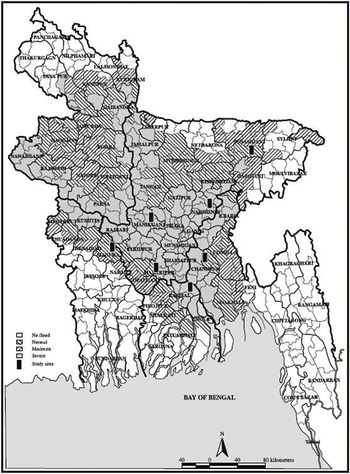
The study uses data from the International Food Policy Research Institute's Food Management and Support Project (IFPRI-FMRSP). The data were collected primarily to examine the impact of flooding around the country, which is an important topic given that Bangladesh occupies a low-lying delta. The study included detailed examinations from 757 households in seven thanas, administrative units usually consisting of several villages. These thanas were selected such that a wide cross-section of households was covered in the study varying in levels of flood severity and geographic distribution (Fig. 1). Special care was taken to make sure that the sample was representative of the rural areas of Bangladesh. For example, criteria were used to select areas based on flood severity, rate of poverty and inclusion of localities already under study to give additional comparability. Households were randomly selected using a multiple-stage sampling technique. One member of the household was identified as the household head, who answered questions common to all members (e.g. household income), while all household members were surveyed for various anthropometric measures (e.g. nutritional intake). Three survey rounds were conducted between November 1998 and December 1999, about two months after floods had subsided. Data collections were spaced by approximately six months (for detailed description on survey design and data collection, see Del Ninno, Reference Del Ninno2001, and Del Ninno et al., Reference Del Ninno, Dorosh, Smith and Roy2001).
Map of flood-affected areas and thanas during 1998 flood in Bangladesh. Survey areas are shown with black rectangles. Source: Del Ninno et al. (Reference Del Ninno, Dorosh, Smith and Roy2001).

Even though the data were not collected primarily to look at health outcomes, detailed health-related information was collected at the individual level. Availability of such detailed micro data along with family-, household- and village-level covariates are not common and this dataset is particularly under-utilized in this regard. Households in each village were randomly chosen and detailed health-related information was collected from each member of the household, including current health status, presence of illness during prior two weeks, consultations with health care providers to treat illness, type of consultation (e.g. registered physician, unregistered physician, homeopath, midwife) and receipt of medicines. In addition to a global assessment of current health status, a detailed history was collected about diarrhoea and respiratory discomfort, given that most flood-related illnesses are respiratory or gastrointestinal in nature. In all three rounds, the same structure and coding were used, thus allowing for comparisons across rounds.
Analysis
Both descriptive analyses and logit models were used to examine the aforementioned panel data. Given that the same households were surveyed up to three times, this study first pooled all three rounds of observations together to span two calendar years. Next, it used simple descriptive statistics to examine the distribution of each study variable and then defined two primary outcome variables: (1) a report of sickness of any kind taking place within the last two weeks at the time of each survey, and (2) for each case, whether the patient was taken to a doctor or not. The study selected an age cut-off of 10 years or younger because it would be likely that care-seeking behaviours for children of this age would be primarily mediated by parental preferences and beliefs, as well as other household or community determinants, rather than the child's autonomous choice. Since it is possible that one child might have experienced multiple sicknesses during the recall period, the present research retained all such observations such that an individual child could contribute more than one observation to the analysis.
The study examined the multivariate association between each household (total income and random component using random effects), parental education (years of schooling for household head and spouse), and community (village-level fixed effects) variable and the first outcome of interest – a report of sickness among children 10 years of age or younger during the previous two weeks at the time of the survey. Note that the analysis focused on total market or monetized income (comprising of wage and proceeds from selling agricultural goods and home-made articles of all members). It restricted the samples to include households with a male head (father) and spouse of the household head (mother), since households with a missing parent and/or a female head will probably be very different from the more common male-headed households with a spouse present. Next, the study used logit models to examine the multivariate associations (see Cameron & Trivedi, Reference Cameron and Trivedi2005). It exploited the panel structure of the data to control for household-level heterogeneity through assuming a household-specific random component in the error structure of the model. In addition to the household random effect, village-specific dummies were included to control for the village-level fixed effect. Round-specific dummies were also included (round fixed effect) to control for possible trends in the data, since the data were collected after a widespread natural disaster and time dummies may be important to control for the possible seasonal impact of the flooding. A number of additional tests were used to check the overall validity of the model and also tests for possible misspecifications of the model. To minimize coefficient bias and to correct the reported standard errors, the model was estimated assuming auto-correlation of various degrees using the generalized estimation equation (GEE) method (see Liang & Zeger, Reference Liang and Zeger1986). This also controls for possible multiple observations for the binary outcomes for the same individuals within the same rounds. The results are very similar for both point estimates and standard errors and are not reported herein.
Next, the study examined the multivariate associations between each household, parental and community characteristic identified above and the demand for health care for a sick child. The research again analysed the binary outcome using logit models. In addition to the results reported in this study two additional modelling techniques were used for robustness checks. To see if the results were susceptible to between-rounds serial correlations in incidence of doctor visits, the model was re-estimated using GEE (see discussion above). It was also checked if the results were dictated by selection (i.e. people who reported illnesses were different from those who did not). The same model was estimated correcting for possible selection bias (see Wooldridge, Reference Wooldridge2002). The results were robust across these different specifications. The coefficients for the logit models were used in a simulation to project the demand for doctors as a function of household income, which was included in the model as a continuous variable. After testing different polynomial structures, a model with a quadratic structure was retained. This non-linear specification was important and again the coefficients were very robust for various alternative models. The function was calibrated to match the sample mean for doctor visit and income. After testing a number of specifications variables were included in which there was a substantive a priori interest such as the education levels of the household heads and their spouses and total monthly household income.
Results
Subjects, rates of illness, physician seeking and household characteristics
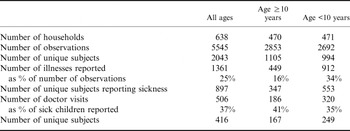
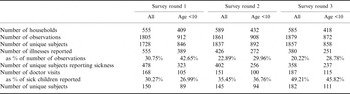
Table 1 describes the total number of observations, number of sick children reported and number of doctor visits during each survey round. Initially, there were 2043 children and 638 households (about 3.1 children per household in the sample). The study focused on 994 unique children younger than 10 years of age who were observed 2692 times over the three rounds of data collection. Of these 2692 unique observations, 912 (34%) were reported sick during the study period (reflecting 553 unique children being sick at least once), as compared with 449 (16%) of total number of observations of 2853 for children aged 10 years or more. Of note, the proportion of children younger than 10 years reported sick varied based on survey round, decreasing from 389 (43%) during Round 1 to 251 (29%) during Round 3, consistent with expected morbidity related to the flood that occurred following the first survey round (see Appendix Table A1 and Del Ninno et al., Reference Del Ninno, Dorosh, Smith and Roy2001).
Frequency of illness and physician visits among households in rural Bangladesh

Rounds spanned 1998–1999; some children had more than one episode of sickness.
Table 2 shows the subject and household characteristics in the sample for children under 10 who reported either sick or not sick. Of these children, approximately 50% were female, and the average length of time in school for the household head was 2.14 years. The average length of time in school for the spouse was 1.25 years, and the average monthly household income was 1539.97 Taka ($US128.33 using 1999 purchasing power parity conversion factor of 12).
Bivariate and multivariate association between household and individual characteristics and illnesses reported

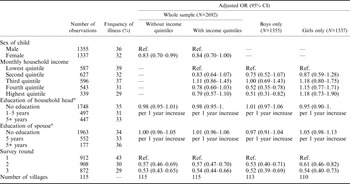
a Education expressed in number of years in school with reference group expressed as per one-year increase; models adjusted for village fixed effects and household random effects; OR=odds ratio, CI=confidence intervals.
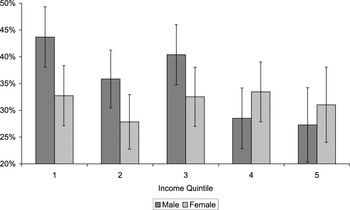
Figure 2 shows the bivariate association between the likelihood of a child reported sick in the last two weeks at the time of the survey and household income quintiles stratified by sex. On average, girls were less likely to be reported sick at lower income quintiles. However, boys from the higher household income levels were much less likely to be reported sick. While there was a clear association between being sick and income levels for boys, such association is completely absent for girls.
Fraction of sick children by quintiles based on total household income in rural Bangladesh. Percentages of sick children are expressed as fractions of total number of children (sick or not) for each income quintile for the whole sample (i.e. all three rounds are included here). 95% confidence intervals are also shown.

Multivariate association with childhood illness
Table 2 also describes the results of regressions examining the association between subject and household characteristics and reports of sickness. In these analyses, there was no statistically significant association between the education of the household head (the father) (odds ratio [OR] 0.98, 95% confidence interval [CI] 0.95–1.01), or spouse (the mother) (OR 1.00, CI 0.95–1.07) and reports of sickness. However, the odds of reporting a female child sick were lower than the odds of reporting a male child sick (OR 0.83, CI 0.70–0.99). To check the robustness of the estimates, the model was also estimated assuming serial correlation at the individual level and included village fixed effects to control for village characteristics. The results remained very similar to these alternative specifications. Additional analyses of goodness-of-fit also supported the overall validity of the model.
In order to further explore the association between sex of the child and covariates of interest, Table 2 also shows regressions stratified by the sex of the child. When the sample was limited to male children, there was an independent association between household income and likelihood of reporting sickness; male children under 10 from a fourth quintile by income were 48% (CI 22%–65%) less likely to report sick and from the fifth quintile 49% (CI 18%–69%) less likely. This income effect was not present when the sample was stratified and included only children who were girls. These differences based on the sex of the child were robust in models that included either village fixed effects or household random effects.
Health care utilization among sick children
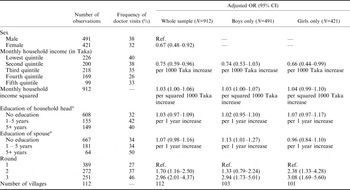
In analyses pooling all children and conditional upon a child's illness (Table 3), there was no association between education of the household head and seeking a doctor's services (OR 1.03, CI 0.97–1.08), and only a marginally significant association between the spouses' education and care-seeking behaviour (OR 1.07, CI 0.99–1.16). The gender bias is particularly striking as girls are 33% (CI 8–52%) less likely to be taken to a doctor. Moreover, results differed considerably after stratifying the sample based on the child's sex. For boys, each additional year of education of the spouse increased the likelihood of a doctor's visit by 13% (CI 1–27%), while for girls there was no statistically significant association. In both subpopulations, education of the household head does not seem to have any significant association. There was no such association between care-seeking behaviours for children of either sex and the father's education (OR 1.01, CI 0.96–1.07).
Bivariate and multivariate association between household and individual characteristics and doctor visits

a Education expressed in number of years in school with reference group expressed as per one-year increase; models adjusted for village fixed effects and household random effects; OR=odds ratio; CI=confidence intervals.
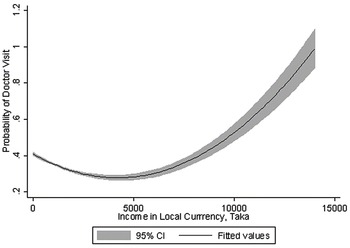
Association between income and utilization of doctors' services
Figure 3 describes the predicted probabilities of care-seeking behaviour at different levels of household income (the shaded region represents the 95% CI). The figure suggests that apart from very low levels of income, the seeking of doctor's services increases as income increases, and that for families with a monthly income or 15,000 Taka (about $US1250 using 1998 real effective exchange rate) or more, a visit to a doctor is a near certainty if a child in the family is ill. Interestingly, for households earning less than 4500 Taka per month (about $US375), the doctor's demand is again increasing as income falls.
Expected probability of doctor visit for a sick child at different level of total household income. The coefficients from the logit model (with no intercept) for the whole sample are used to predict the probability of a doctor's visit conditional on the child being sick. The line is calibrated to fit the sample means for income and average probability of a doctor's visit for the whole sample.

Discussion
In this study of the frequency of illness and receipt of health care for children following a major flood in Bangladesh, there were important differences in the rates of reported illness among male and female children. Furthermore, adjusted analyses suggest that household income modifies the likelihood of such reports for male, but not for female, children. Finally, among children who were reported as ill, rates of seeking health care also varied considerably by household characteristics. For example, girls were less likely to receive physician services than boys and maternal education was associated with receipt of health care for boys, but not girls. These findings were robust for different specifications of the regression models including analyses controlling for unobservable heterogeneity among households and village communities.
There have been many studies examining the health of children from a variety of developing countries, including Egypt (Aly & Grabowski, Reference Aly and Grabowski1990), Ghana (Lavy et al., Reference Lavy, Strauss, Thomas and de Vreyer1996), Malaysia (Panis & Lillard, Reference Panis and Lillard1994), Nepal (Gubhaju et al., Reference Gubhaju, Streatfield and Majumder1992), Pakistan (Iram & Butt, Reference Iram and Butt2008) and Turkey (Alpu & Fidan, Reference Alpu and Fidan2004). Most have examined the association between household resources (e.g. parental education) and health outcomes (e.g. child mortality), rather than exploring how mechanisms such as treatment-seeking may mediate these associations. Such mechanisms are of interest since parents care about the health of their children and have more direct control over the instruments that influence health outcomes rather than actual health outcomes per se (Majumder et al., Reference Majumder, May and Dev Pant1997; Maitra, Reference Maitra2004).
These findings are especially important because of the high rates of illness associated with flooding and famine in many developing countries and because of the poor access to care that is often present. Although Bangladesh has shown remarkable success in extending life expectancy and reducing fertility and childhood mortality, important challenges remain in delivering preventive and curative care to rural populations. For example, during the past two decades, the government has developed a programme in Primary Health Care (PHC) including the training of paramedics (World Health Organization, 2005). Despite this, a more recent World Health Organization report highlights continued access barriers, including the absence of a well-functioning referral system, due to resource and institutional constraints (World Health Organization, 2008).
Consistent with economic theory (Grossman, Reference Grossman, Culyer and Newhouse2000), this study's findings demonstrate that enhancing access to care depends not only on the supply of health care facilities and providers, but also upon the demand for such resources. The results also indicate how resource allocation within households may vary based on parental education and household income. This analysis complements others examining how household resources like parental education and income may be associated with child health outcomes in Bangladesh, such as an analysis suggesting that mothers with higher education are more likely to vaccinate their children (Huq & Tasnim, Reference Huq and Tasnim2008), and that education of mothers but not fathers has a statistically significant impact on children mortality (Maitra & Pal, Reference Maitra and Pal2007).
Historically, there have been many interventions and projects that target education of the parents with emphasis on mothers (World Bank, 1993; Schultz, Reference Schultz2002) with the assumption that this will enhance household welfare. Consistent with this, this study's results suggest that education of the (male) household head has less impact on care-seeking for doctors compared with education of the (female) spouse. Although efforts to increase maternal education are important and laudable, they may fail to equally impact the health and well-being of children of both sexes in rural underdeveloped areas such as those studied here, where parental education was associated with greater care-seeking for male, but not female, children. Thus, additional and more direct incentives may be needed to improve the health of girls in rural areas of developing countries.
The results suggest that both parental education and total household income play an important role in reporting illness as well as receipt of health care services. However, maternal preference for investment in human capital in the form of health care receipt may have a different bias based on the sex of the child. This emphasizes the hypothesis espoused by Sen (1994) that lack of investment in girls at the early age may lead to adverse demographic outcomes (Oster, Reference Oster2007). It is also important, policy-wise, to put emphasis on generating income opportunities (e.g. through public works) in the rural areas of developing countries given the finding that higher income families were less likely to report a child being ill and more likely to take a child to a doctor when sick.
This study has a number of limitations. First, the data were collected after a natural disaster, and it is unclear whether the findings are generalizable to other settings. However, natural disaster introduces unexpected (i.e. random) changes to the resources at the disposal of the household and the analyses were designed to cover both flood-affected and non-affected households in the regions under study. Second, there may be unobserved confounders that may drive the results that are not controlled for using random effects (at the household level) or fixed effects (at the village level). To help address this, a number of covariates were introduced to control for unobserved factors and the results were generally robust. Third, the data did not include care-seeking through Primary Health Care services, which provide an important first contact for many residents of rural areas, nor did they include data on individuals seeking care for a second or third time for the same illness. Fourth, the modest survey sample size precludes meaningful analyses stratified by illness type or severity. Such inquiries are important to ascertain whether the associations described persist among these more homogenous populations. Finally, the data are more than a decade old, and Bangladesh continues with rapid development of its health care infrastructure (National Institute of Population Research and Training (NIPORT), Mitra and Associates & ORC Macro, 2005). Nevertheless, the authors believe that the key associations explored here have continued relevance to social scientists and policy-makers alike.
Conclusions
Members of households in rural underdeveloped areas face complex decisions regarding when to seek health care. In this study of rural Bangladesh following a period of major flooding, reports of illness and care-seeking behaviour varied considerably for male and female children. Furthermore, in some cases there were important interactions between household characteristics, such as parental education and income, and these outcomes for boys as compared with girls. These findings reflect the challenge of not only building a strong public health infrastructure, but also ensuring that it is used to equitably enhance the welfare of the population such as the one studied herein.
Appendix
Frequency of illness and physician visits among households in rural Bangladesh

Rounds spanned 1998–1999; some children had more than one episode of sickness within the same round.
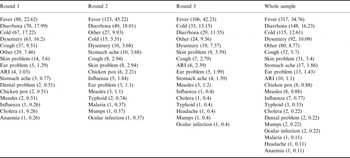
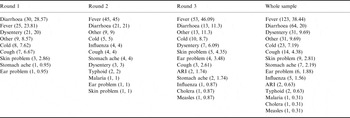
Profile of diseases for all sick children under age 10 in a sample from rural Bangladesh (N, %)

Profile of diseases for children under age 10 who were taken to a doctor in a sample from rural Bangaldesh (N, %)