Music, as sound, physically and figuratively transcends previously erected or conceptualized boundaries. Artists and listeners each have the ability to aurally extend their values into new spaces, where others hear them. Passions and ideas gain traction through a constant aural negotiation that exists within the music that individuals use to soundtrack their public and private lives. As argued by the contributors to this roundtable, music both resides within the larger societal and cultural constellations that surround it and helps to shape those dynamics in active ways. Music, as a loosely defined social practice, plays an important role in self-identification. Musical aesthetics provide an avenue through which listeners and performers place themselves within specific social groups. Al-āla and Andalusian genres typically associated with North African elite classes constitute one prominent example that is threaded throughout this roundtable. These social groups are rarely exclusive, however, and musical aesthetics provide a significant set of data through which scholars might read (or, perhaps better put, listen to) the dynamic nature of social institutions and the cultural formations that mold them.
My own interests lie within the relationship between musical aesthetics and ethical self-fashioning. Musical choices are often made in regard to specific formulations of correct ethical behavior. In the United States, listening to either the metal of Black Sabbath or the old-time hymns of the Carter Family carries very different moral connotations. Aesthetic taste is not exclusively defined by a moral stance, of course (many who are not religious still enjoy the simplicity of old Christian hymns), but it evokes certain values in the listener. Conversely, certain aesthetics also enter into moral practice, identifying subtle differences in values between members of the same larger religious group. Churches that feature choral hymn performances rarely attract the same crowd as those that utilize electric guitar-led rock bands. This musical diversity underlies other discursive perspectives about how Christianity should operate, including opinions on the role of tradition and change.
Across the Middle East and North Africa, similar aesthetic choices engage larger debates of ethical behavior as artists and listeners (roles that are, themselves, unclear) might present their own religious and aesthetic values through an act as simple as changing the radio station. In Politics of Piety, Saba Mahmood writes, “It is only through an analysis of the specific shape and character of ethical practices that one can apprehend the kind of ethical subject that is formed.”Footnote 1 This call for devoted attention to both the intention behind behaviors and the acts themselves, drawn from Michel Foucault and Talal Asad, invites novel approaches into inquiries of the discursive spaces that form quotidian public action, ethical and otherwise. Music's permeations and permutations provide a vast set of nuanced data that can contribute to a study of the performed negotiation of personal and communal values that leads to the dynamic and diverse contemporary perspectives of what Islam is and should be.
An example outlined below demonstrates one way in which aural discourses, both spoken and sung, facilitate social and theological interactions between the musical and ritual practices of two distinct minority spiritual communities. Highlighting the changing boundaries that delineate the “sound” of everyday life, these aesthetic shifts present insights into modern circulations of social, economic, and theological ideas. The song “ʿAʾisha Hamdushiyya,” as performed in many Moroccan Gnawa possession rituals, illuminates the ways in which diverse artists and audiences traverse boundaries between socio-religious practices. The Gnawa, self-identified descendants of slaves brought to Morocco through the trans-Saharan slave trade, perform a syncretic fusion of Islamic and African beliefs through their evening spirit possession ritual. The musical repertoire stands as an aural symbol, an artifact of a distant sub-Saharan past. In contemporary practice, however, the sound that animates the ritual is a rich arena for the negotiation of shifting social, religious, and aesthetic values. The boundaries between the imagined isolation of the Gnawa and other brotherhoods are permeable via musical innovation.
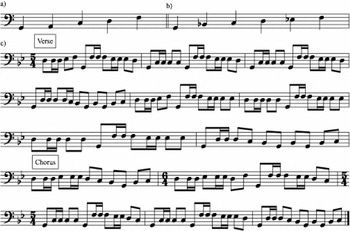
The vast majority of the Gnawa repertoire has a shared set of musical elements including consistent rhythmic and scalar patterns. The primary pentatonic (five-note) scale lacks a major or minor third (see Figure 1a). The open sound, neither distinctly major nor minor, flows over a limited set of simple accompaniment patterns performed on the ḥajḥuj, a low-sounding string instrument. This aural consistency gives space for creativity and interpretation as well as a clear aural component with which the ritual's non-musical activities engage.Footnote 2 “ʿAʾisha Hamdushiyya,” however, is described as heavy (thaqīl) and causes many listeners to fall violently into trance simultaneously.Footnote 3 This weight comes, in part, from the spiritual power of ʿAʾisha herself. She exists throughout Moroccan folk beliefs but is primarily associated with the ḥamādsha brotherhood, popular among the poor.Footnote 4 This experienced “heaviness” also derives from abrupt musical changes. “ʿAʾisha Hamdushiyya” introduces a new scale and meter as the performers put down loud qurāqib, iron handheld percussion instruments similar to castanets,Footnote 5 and clap while the ḥajḥuj shifts into a five-beat pattern, emphasizing a longer melodic phrase in a scale that oscillates between a natural minor (on G) and major (on B-flat),Footnote 6 featuring dissonant half-steps (see Figure 1b and c). ʿAʾisha's presence in the Gnawa ritual can be heard through specific aural adaptations from ḥamādsha musical practice, inviting new aesthetic and spiritual ideas into the Gnawa ritual experience. Furthermore, the sounds, settings, purposes, and theological meanings of this trance continue to change as leaders and listeners engage ever-widening aural discourses, importing musical and theological ideas about the sound of religious life in Morocco from broad aesthetic sources.
(a) The most common set of pitches throughout Gnawa music. These should be read as relative pitches; most significant is the relationship between adjacent pitches, not the absolute frequencies, which can vary widely. (b) The pitches used in “ʿAʾisha Hamdushiyya.” (c) The first melody in “ʿAʾisha Hamdushiyya,” as played on the ḥajḥuj by maʿalim ʿAbd al-Rahim ʿAbd al-Rzaq. Later sections contain a melodic shift to ḥijāz, a maqām featured in many other genres of Arab music.

The divisions between religious practices or groups of listeners are far from definite, and as individuals continue to hear and react to new musical ideas, they incorporate behaviors and beliefs into their lives. In turn, these aural changes follow modern society's networked forms of social organization. Musical tastes and public behaviors identify a web of interactive relationships not unlike those of Twitter or Facebook. As we increasingly see scholarship that steps across supposedly bounded spaces—enclosed communities, places, or practices—we continue to reach for data and tools that are able to identify and understand these interactions. Musical analysis constitutes a methodology that engages a discursive space between listeners and performers, one that extends across communities. It facilitates us as we step outside of isolated ethnographic projects and into the contemporary world of interconnections, collaborations, and adaptations.