1 Introduction
Ontologies are formal, explicit specifications of a shared conceptualization of a domain of interest (Avgoustaki et al., Reference Avgoustaki, Flouris, Fundulaki and Plexousakis2016). Ontologies are not static but they are living artifacts and subject to change (Volkel et al., Reference Volkel, Winkler, Sure, Kruk and Synak2005; Flouris et al., Reference Flouris, Manakanatas, Kondylakis, Plexousakis and Antoniou2008). Due to the rapid development of research, ontologies are frequently changed to depict the new knowledge that is acquired. However, since ontologies are usually managed independently from each other they can be used and extended without the explicit permission of the owner. In several cases, the owner of an ontology is completely unaware of who uses or extends his ontology.
It is therefore vital to be able to support the ontology engineers and the maintainers of the dependent artifacts in this complex process of ontology evolution (Plessers et al., Reference Plessers, Troyer and Casteleyn2007). Several approaches so far deal with closely related problems such as consistency maintenance, backward compatibility, ontology manipulation, change propagation, etc. (Volkel et al., Reference Volkel, Winkler, Sure, Kruk and Synak2005). In the field of a posteriori understanding ontology evolution, most of the approaches use different representation languages to model evolution (Papavasileiou et al., Reference Papavasileiou, Flouris, Fundulaki, Kotzinos and Christophides2013), presenting to the users eventually all changes between the various ontology versions. However, although the developed languages of changes have become more concise and compact—by employing high-level change operators (operators that can describe complex updates, e.g. the insertion of an entire subsumption hierarchy) —still ontology understanding relies on just presenting to the users a huge list of changes between ontology versions.
In this paper, we argue that only listing the changes between two versions is insufficient for understanding ontology evolution. Moreover, we provide a solution to this problem by answering provenance queries concerning both the data and the schema information of an ontology. More specifically, our contribution is the following:
∙ We introduce EvoRDF, a framework for exploring ontology evolution. The modules developed get as input the sequence of changes between two or more ontology versions and are able to answer provenance queries requesting fine-grained information about the evolution of the various resources.
∙ The changes are modeled using an ontology of changes and stored to a triple store using a parser/editor module.
∙ Then a Protégé Module, the EvoRDF Protégé Explorer, and a Web module, the EvoRDF Web Explorer, allow users to issue fine-grained provenance queries and graphically visualize the results.
∙ To achieve that, we define the notions of how and when provenance and we present the corresponding algorithms. Using our framework a user can identify with which change operation a resource was introduced (how) and in which ontology version (when).
∙ Moreover, the list of change operations that led to the creation of that specific resource can be computed and presented to the user (why) allowing further exploration. This knowledge can be used to drive developer’s understanding on ontology evolution for that specific resource.
∙ Finally, we present our experimental analysis using two well-known ontologies CIDOC-CRM and Gene Ontology (GO). Experiments performed show the feasibility of our approach. In addition, a preliminary usability evaluation shows the potential of our solution, enabling users to understand the evolution of specific resources.
A preliminary version of this work was first presented in a workshop (Kondylakis & Plexousakis, Reference Kondylakis and Plexousakis2014) whereas the implemented platform was demonstrated in the Extended Semantic Web Conference (Kondylakis et al., Reference Kondylakis, Melidoni, Glykokokalos, Kalykakis, Lasithiotakis, Makridis, Moraitis, Panteri, Plevraki, Providakis, Skalidaki, Stefanos, Tampouratzis, Trivizakis, Zarvakis, Zervouraki and Papadakis2017). This paper extends our previous work in many ways, presenting the implementation of a whole framework on top of the developed algorithms and extending our approach to handle multiple language of changes, as we shall see in the sequel. Inversibility is an interesting property of the language of changes used, that we further discuss in this paper. In addition, a ontology of changes is introduced to model the change operations, whereas an additional usability evaluation is presented. By changing the change ontology, our system is ready to use a different language of changes. The simplicity of our approach makes it a valuable tool for ontology engineers and provides a unique vantage point on understanding long and complex evolution histories.
The rest of the paper is organized as follows: Section 2 presents related work and Section 3 introduces the preliminaries and the problem by an example. Then, Section 4 presents in detail the algorithms used. Section 5 demonstrates the high-level architecture of our framework and presents the various modules implemented. Section 6 presents experiments concerning the scalability of our approach and a usability evaluation. Finally, Section 7 concludes this paper and presents directions for future work.
2 Related work
Since our approach is unique in terms of the methods employed for exploring ontology evolution, the aim of this section is to provide an overview on the approaches that focus on closely related areas. We have to note, that the purpose of this section is not to provide an overview on all approaches and methods concerning ontology evolution. The interested reader on this topic is forwarder to our two detailed surveys in the area (Volkel et al., Reference Volkel, Winkler, Sure, Kruk and Synak2005; Flouris et al., Reference Flouris, Manakanatas, Kondylakis, Plexousakis and Antoniou2008).
2.1 Provenance information
Management of provenance information has been extensively studied in the literature, using different methods and approaches. Different authors define different provenance management techniques (e.g. Why-provenance (Buneman et al., Reference Buneman, Khanna and Tan2001), Trio-Provenance (Benjelloun et al., Reference Benjelloun, Sarma, Halevy, Theobald and Widom2008), provenance semi-rings (Green et al., Reference Green, Karvounarakis and Tannen2007)) that either try to provide annotations at the tuple level or to extract provenance information by analyzing queries. Other works such as (Chiticariu & Tan, Reference Chiticariu and Tan2006) try to describe the relationship between source and target data in a data integration scenario. However, our approach differs in both methods and goals. To the best of our knowledge, there is no other approach answering provenance queries regarding ontology evolution.
2.2 Existing ontologies describing provenance
Several vocabularies exist already allowing the documentation of related provenance information. Among the most well-known ones, are the Open Provenance Model and the PROV ontology. The Open Provenance Model (Moreau et al., 2011) is designed to allow provenance information to be exchanged between systems in a precise, technology-agnostic manner, supporting digital representation of provenance for any ‘thing’, whether produced by computer systems or not. The approach has been evolved to create the PROV ontology (Lebo et al., Reference Lebo, Sahoo, McGuinness, Belhajjame, Cheney, Corsar, Garijo, Soiland-Reyes, Zednik and Zhao2013) which is now a standard proposed by W3C for the representation and exchange of domain independent provenance. Both the aforementioned approaches, model provenance data as relations between agents, entities and activities, and cannot really drive ontology engineers understanding on the core evolution of the ontologies. As such, they could be used as complementary to our approach in order to document in more detail, actors, editors and activities related to the process of the evolution.
2.3 Versioning systems
Tools like the Git2PROV (De Nies et al., Reference De Nies, Magliacane, Verborgh, Coppens, Groth, Mannens and Van de Walle2013) enable provenance tracking using the PROV ontology for any public repository. However, besides documenting additional metadata described in the PROV ontology, only versioning information related to git is modeled and described. As such, ontology engineers can only identify changes in the RDF document, but they are not able to graphically visualize or query specific information.
Identifying this drawback, Arndt et al. (Reference Arndt, Naumann and Marx2017), R43ples (Graube et al., Reference Graube, Hensel and Urbas2014) and Stardog (Sauro, Reference Sauro2011) focus on versioning on the graph-level. Using those tools versioning happens for each named graph. Revisions are modeled as deltas to the previous versions, used in conjunction with PROV metadata to store activities related to the whole process. Although, these approaches have many similarities to EvoRDF (an ontology is employed to describe the metadata and all changes/deltas are stored in a triple store) still the ontology engineers cannot visualize a sequence of changes for a specific resource since the deltas are modeled at the graph level. As such, coarse-grained information (e.g. a rename) cannot be identified effectively and it is difficult for ontology engineers to trace what happened in the past for a given resource.
2.4 Change detection
Other works that could be employed to understand ontology evolution focus on change detection. Those systems can be classified under two basic dimensions, namely the level of changes they support (low-level or high-level) and the underlying representation language assumed (e.g. Plessers et al., Reference Plessers, Troyer and Casteleyn2007, for Description Logic, Papavasileiou et al., Reference Papavasileiou, Flouris, Fundulaki, Kotzinos and Christophides2013, for resource description framework/schema (RDF/S), etc.). In its simplest form, a language of changes consists of only two low-level operations, Add(x) and Delete(x), which determine individual constructs (e.g. triples) that were added or deleted (Zablith et al., Reference Zablith, Antoniou, D’Aquin, Flouris, Kondylakis, Motta, Plexousakis and Sabou2015; Troullinou et al., Reference Troullinou, Roussakis, Kondylakis, Stefanidis and Flouris2016). However, a significant number of more recent works (Plessers & Troyer, Reference Plessers and Troyer2005; Rogozan & Paquette, Reference Rogozan and Paquette2005; Noy et al., Reference Noy, Chugh, Liu and Musen2006; Zablith et al., Reference Zablith, Antoniou, D’Aquin, Flouris, Kondylakis, Motta, Plexousakis and Sabou2015) imply that high-level change operations should be employed instead, which describe more complex updates, as for instance the insertion of an entire subsumption hierarchy. A high-level language is preferable than a low-level one (Stefanidis et al., Reference Stefanidis, Flouris, Chrysakis and Roussakis2016), as it is more intuitive, concise, closer to the intentions of the ontology editors and captures more accurately the semantics of change. However, there is no agreed-upon list of changes, applicable in any given context. In our case, we do not redefine such a language but we only use one of them. Moreover, our results are not limited to this specific language, as we shall see later in this paper.
2.5 Summaries of ontology evolution
Latest works in the area of exploring ontology evolution, focus on providing an overview of the changes, or the areas of the ontology that were mostly affected by the changes process (Troullinou et al., Reference Troullinou, Kondylakis, Daskalaki and Plexousakis2017). To this direction, they define multiple assessment dimensions and measures trying to identify the ‘intensity’ of the evolution as the authors say. However, they focus only on classes and present static overviews and of the evolution without allowing users to explore a resource of interest.
Other approaches like Stefanidis et al. (Reference Stefanidis, Flouris, Chrysakis and Roussakis2016) focus on providing statistical summaries about the evolution of the ontology. The specific approach allows focusing on specific categories of changes, getting statistics for the different types of changes in the ontology. However, the system implemented only presents a high-level overview of the implemented changes.
2.6 Tracking evolution
A similar approach to EvoRDF is (Plessers et al., Reference Plessers, Troyer and Casteleyn2007) where a change is defined and detected using temporal queries over a version log that contains recordings of the applied changes. However, the version log must be updated whenever a change occurs. This overrules the use of this approach in non-curated or distributed environments. In our approach, on the other hand, the changes can be produced a posteriori and no temporal queries are used.
In Curino et al. (Reference Curino, Moon, Deutsch and Zaniolo2013) the authors provide a mechanism to document schema evolution of relational databases, by automatically presenting the changes (called translational medicine ontology) between those versions. However, those changes are not detected automatically. Moreover, they offer a schema evolution analysis tool, but this tool only provides coarse-grained results.
Finally, in Ruiz et al. (Reference Ruiz, Grau, Horrocks and Berlanga2011) the authors present a tool to allow several developers to make changes concurrently and remotely to the same ontology, track changes and manage ontology versions. However, this tool focuses on conflict resolution and cannot provide answers to fine-grained provenance queries.
3 Preliminaries and motivating example
RDF is a language for describing Web resources [RDF Primer, 2004]. Information in RDF is represented using triples of the form (subject, predicate, object) which record that subject is related to object via predicate. RDF data sets have attached semantics through RDFS schemas. RDFS is a vocabulary description language that includes a set of inference rules use to generate new, implicit triples from explicit ones. In this work we focus on RDF as a large portion of the Semantic Web Schemas (85,45% in 2007 according to Theoharis et al. (Reference Theoharis2007)) are expressed in RDF/S, and RDF/S offers, in our case, an optimum trade-off between expressive power and efficient reasoning support.
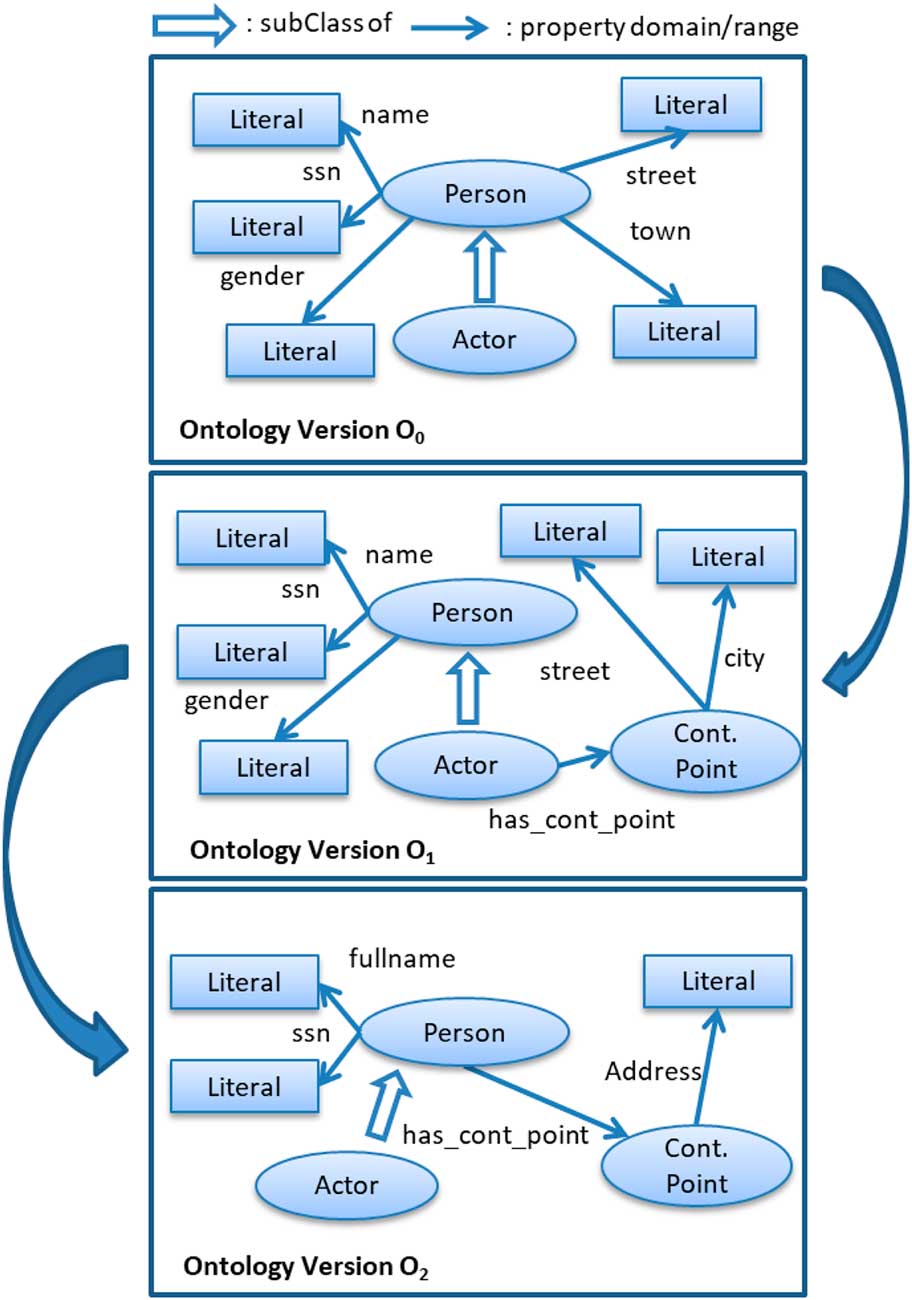
Now as an example, consider an ontology shown on top of Figure 1 (ontology version O0). This ontology is used as a point of common reference, describing people and their contact points. Assume now that at some point in time, the ontology evolves and we get O1 by adding the class ‘Cont.Point’ describing contact points and the property ‘has_cont_point’ between the class ‘Actor’ and the class ‘Cont.Point’. Moreover, the domain of the literals ‘street’ and ‘city’ is changed to the class ‘Cont.Point’. Then the ontology designer decides to evolve again the ontology and to produce O2. Therefore, the domain of the ‘has_cont_point’ property is moved from the class ‘Actor’ to the class ‘Person’, and the property ‘gender’ is deleted. Moreover, the ‘street’ and the ‘city’ properties are merged to the ‘address’ property as shown at the bottom of Figure 1. For modeling this evolution, we will use a language of changes. Independent of the specific language of changes user, a change operation is defined as follows:
Definition 1 (Change Operation): A change operation u over an RDF ontology O, is any tuple (δ a , δ d ) where δ a⋂ O=ø and δ d ⊆ O. A change operation u from O1 to O2 is a change operation over O1 such that δ a ⊆ O2\O1 and δ d ⊆ O1\O2.
Example ontology evolution from O0 version to O1 and then to O2

Obviously, δ a and δ d are sets of triples. For simplicity we will denote δ a (u) the added and δ d (u) the deleted triples of a change u. From the definition, it follows that δ a (u)∩δ d (u)=ø and δ a (u)∪δ d (u) ≠ ø if O 1 ≠ O 2. The application of a change u over an ontology version O, denoted by u(O), is defined as u(O)=(O∪δ a (u))\δ d (u)). Moreover, the application of a sequence of change operations us to an ontology, that is, us(O), is defined as the sequential application of the change operation in us to O. Our system supports multiple language of changes. However, for any two changes u 1 , u 2 in such a sequence we require that δ a (u 1 )∩δ a (u 2 )=ø and δ d (u 1 )∩δ d (u 2 )=ø. The direct implication of this is that the sequence of changes between two ontology versions should be unique.
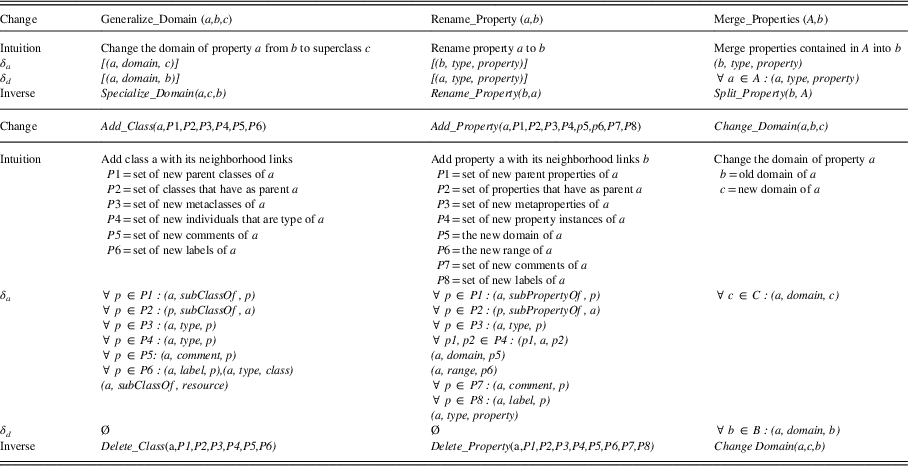
An example language of changes that we adopt in the rest of this paper for reasons of simplicity is the one proposed in Papavasileiou et al. (Reference Papavasileiou, Flouris, Fundulaki, Kotzinos and Christophides2013) and Papavassiliou (Reference Papavassiliou2010). The language classifies the high-level changes it uses into basic or composite. Basic changes are fine-grained and describe changes in one node or edge of the RDF/S knowledge base taking into account RDF/S semantics. Composite changes on the other hand, are coarse-grained and closer to the user’s intuition as they describe changes affecting several nodes and/or edges. In addition, the language satisfies the properties of completeness (capturing any possible change), non-ambiguity (each low-level change is associated with one, and only one, high-level change) and supports a deterministic detection process. In this specific language of change, the inverse of each change operation exists as well, whereas non-conflicting changes (changes that the detection of one requires the addition/deletion of a triple whose deletion/addition is required by the other) can be composed as well.
Example types of changes in that language are show in Table 1. Using the specific language of changes for our example shown in Figure 1, the change log between O 0 and O 1, that is, the E O0 ,O1 , consists of the following change operations:
u1: Add_Class(Cont.Point, ø, ø, ø, ø, ø,)
u2: Add_Property(has_cont_point, ø, ø ,ø ,ø, Actor, Cont.Point, ø, ø)
u3: Change_Domain(town, Person, Cont.Point))
u4: Change_Domain(street, Person, Cont.Point))
u5: Rename_Property(town, city)
Example change operations

In the sequel, the change log E O1 ,O2 consists of the following change operations:
u6: Delete_Property(gender, ø, ø ,ø ,ø, Person, xsd:String, ø, ø)
u7: Generalize_Domain(has_cont_point, Actor, Person)
u8: Merge_Properties({street, city},address)
u9: Rename_Property(name, fullname)
Obviously, E O0 ,O2 =E O0 ,O1 ∪E O1 ,O2 . In this paper, we argue that only presenting a similar sequence of changes is not enough for understanding how ontology evolved. Especially in real world scenarios, the large number of change operations makes it impossible for ontology developers to understand ontology evolution based solely on those. In our experiments, for example, just for a few versions, we had 4175 changes for GO and 726 changes for CIDOC-CRM.
4 Provenance queries
As already mentioned, presenting only the list of changes between ontology versions is not adequate for understanding ontology evolution. To this direction, we argue that a system supporting ontology evolution should be able to support the following types of queries:
∙ When queries: An end-user would like to search for the specific version that a resource was introduced (e.g. When was the ‘address’ literal added to the ontology?).
∙ How queries: In addition, an end-user would like to search for the change operation that introduced a specific resource (how) (e.g. By which change operation was the ‘address’ literal added?).
∙ Why queries: Finally, the change path (i.e. the consecutive list of change operations) that led to the creation of a specific resource can be computed and presented to the user allowing further exploration and understanding of the evolution of the ontology (e.g. What are the change operations that had some influence on the creation of the ‘address’ literal? How was the ‘street’ literal evolved starting from ontology version O0?). Why queries are possible not only for specific resources but for specific change operations as well.
4.1 How queries
As already mentioned, presenting only the list of changes between ontology versions is not adequate for understanding ontology evolution. To answer queries about the evolution of a specific resource we define the notion of an affecting change operation.
Definition 2 (Affecting Change Operation). Let r be a resource of an ontology version O m and E Ok, Om (k<m) be the sequence of changes between O k and O m . A change operation u∈E Ok, Om affects the resource r, denoted by aff(r), if r∈O m and r∈δ a (u).
An affecting change operation captures the way a resource was introduced between two ontology versions. Assuming that we have E Ok, Om already available, it is quite easy to identify the affecting change operation by just scanning the change log once. We have to note that the affecting change operation if it exists is unique. This is due to the fact that for our accepted languages of changes it should hold that for any two changes u 1 , u 2 , δ a (u 1 )∩δ a (u 2 )=ø and δ d (u 1 )∩δ d (u 2 )=ø as described in Section 2.
In our example the query how(‘address’) when applied to E O0 ,O2 it will return the change operation u8:MergeProperties({street, city},address). In the case that no affecting change operation is found, no answer will be returned. This means that we have no indication about how a resource was introduced in the ontology and probably the specific resource was introduced in a past ontology version.
4.2 When queries
Now we would like to know in which ontology version the ‘address’ resource was introduced. The idea is similar to answering how provenance queries. We only have to scan once the change log E Ok, Om =E Ok, Ok+1∪ … ∪E Om-1,Om. If aff(r) ∈ E Ok,Om and r∈δ a (u) then obviously r∈O m so we can conclude that r was introduced in O m . In our example the query when(‘address’) will return O 2 as an answer.
4.3 Why queries
Presenting only the affecting change operations and the ontology version that a resource has been introduced does not necessarily provide insights on the corresponding ontology evolution. When drastic evolution occurs, those are not enough and we would like to get more information about which parts of the ontology evolved to produce the specific resource. Therefore, instead of providing just the affecting change operation and the ontology version, our idea is to present the history of the evolution of the specific parts of the ontology as an answer to why provenance queries.
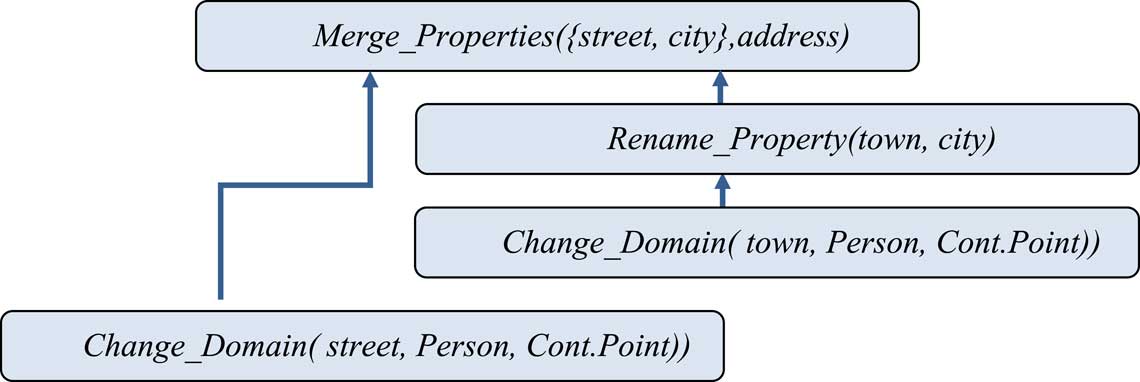
For example, by checking the change log E E O0 ,O2 , presented on Section 3, we can easily identify that the operations shown in Figure 2, describe exactly the evolution of the ‘address’ resource.
The change path for the ‘address’ resource visualized as a tree

Presenting such a graph to the ontology engineers, their understanding on the ontology evolution is focused on the specific parts that evolved to produce the aforementioned resource. Such a sequence of change operations that depict the history of the ontology with respect to a specific resource r is called a change path for that resource. However, before defining the change path for a given resource we will define the change path for a change operation first.
Definition 3 (Change path for a change operation). A change path for the change operation u∈E Ok, Om , denoted by us path u , is the minimal sequence of change operations in E Ok, Om such that u∈us path u and that us path u (O k ) ⊆O m .
A change path is minimal in the sense that one cannot remove any of the change operations in it and still us path u (O k ) ⊆O m . The change path presents the history of the evolution of the specific part of the ontology for a specific change operation. For example, the change path for the change u8: Merge_Properties({street, city},address) is us path u8 =[u 3 , u 4 , u 5 , u 8] as shown in Figure 2 and us path u8 (O0) ⊆O2.
Proposition 1 (Uniqueness): The change path us path u over E Ok,Om is unique.
Proof: Assume us path u is not unique. This would mean that we could have two change paths us path1 u and us path2 u . Since they are both change paths it should hold that size(us path1 u )=size(us path2 u ) since they both have to be minimal. Now let us path1 u =[u k1 , …, u kn ] and us path1 u =[u m1 , …, u mn ]. Since they are both change paths u=u kn =u mn. For i<n, each one of the u ki, u mi deletes a part of the ontology and adds another part. Since the two change paths have the same minimal size and u=u kn =u mn in order to be different there must exist two change operations u ki, u mj such that u ki ≠ u mj and δ d( u ki) ∩δ d (u mi ) ≠ ø since they should delete a common part of the ontology. However, this is impossible since δ d (u 1 )∩δ d (u 2 )=ø for our change operations.
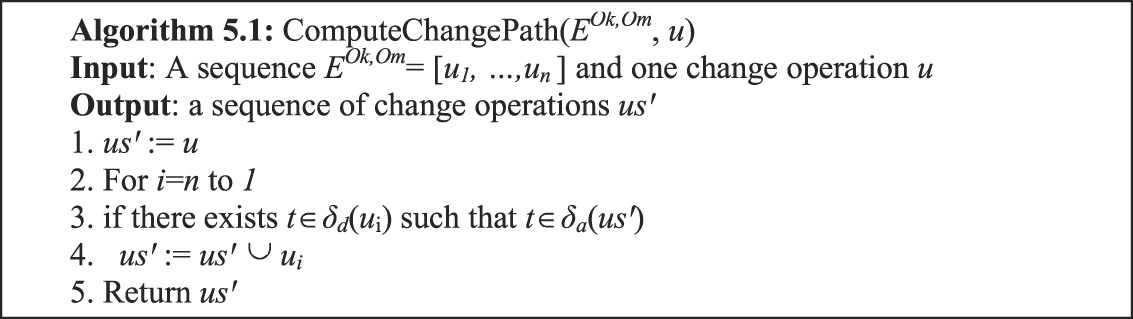
Now, we will present an algorithm that given a change log produces the change path for a change operation u. The algorithm is shown in Figure 3. The idea is that the algorithm starts from the input change operation and identifies the triples that are added to the ontology, possibly by deleting other triples. Then it searches for the change operations that delete that added information in order to add new information and so on. After the execution of the algorithm, the change path for u will be stored in us′.
Theorem 1: The ComputeChangePath algorithm computes us path u over E Ok,Om .
Proof: In order to prove that algorithm Compute Change Path computes the change path for a given change operation u over a change log E Ok,Om we have to prove that (a) u∈ us′, (b) us′ (O1) ⊆O 2 and that (c) us′ is minimal.
Computing the change path for a given change operation

(a) From line 1 of the algorithm indeed u∈us′.
(b) Let’s assume that us′ (O k ) is not a subset of O m . This would mean that there exists at least one triple, assume t′ in us′ (O k ) such that it does not exist in O m . So, to reach O k , there should be a change operation u′ such that t′ ∈δ d (u′) such that t′∈δ a (us′) not identified by our algorithm. However, this is impossible from line 3 of our algorithm.
(c) Now we prove minimality. Let’s assume that us′ is not minimal. This would mean that there is us path with size(us path)< size(us′). This would mean that there exist u′ ∈us′ such that u′ ∉ us path. Of course this would mean from lines 3 and 4 that there exist t′ such that t′ ∈ δ d (u′) and t′ ∈ δ a (us′). However, this would mean that t′ does not belong to O m , and should be deleted by another change operation. However, for our change operations it holds that δ d (u 1 )∩δ d (u 2 )=ø which makes the previous statement impossible. Therefore, us′ is minimal as well.
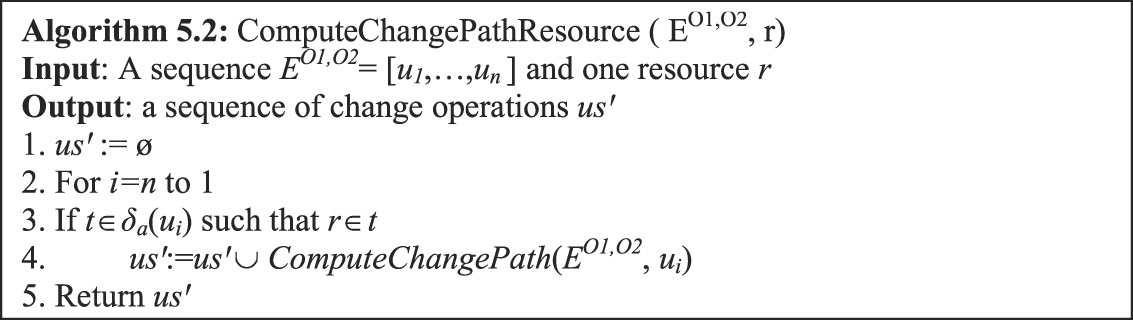
The time complexity of the algorithm is O(N*M*S) where N is the number of change operations, M the maximum size of triples in a change operation u, and S the number of triples in δ a (us′). Moreover, it is easy to adapt Algorithm 5.1 in order to retrieve the change path for a given resource. This will allow the developers to examine the evolution of the ontology regarding a specific resource:
Definition 4 (Change path for a resource). The change path us path over E Ok, Om for the resource r∈O m is us path r =∪us path ui , r∈u i .
The corresponding algorithm is shown in Figure 4.
Computing the change path for a given resource

The idea is that we would like to retrieve the history of the evolution of resource r. However, r might appear in several triples so we need to identify all change paths that have to do with it.
Theorem 2 The algorithm Compute Change Path Resource computes the change path for a given resource r over E Ok, Om .
The algorithm is immediately proved by construction. Algorithm 5.2 needs to scan the change log one time per triple containing the resource r in order to identify the change operation that inserts the given resource. So the complexity of the algorithm becomes O(T*N*M*S) where T is the number of triples containing r, N the number of change operations, M the maximum size of triples in a change operation u and S the number of triples in δ a (us′).
4.4 Inversibility
Our approach is not only applicable for visualizing the change path of a resource from the latest ontology version but can be used to visualize the change path of a resource from a past ontology version as well. To achieve this instead of getting as input to our algorithms the E Ok,Om where k<m we could get the E Ok, Om and search for a resource belonging to O k . However, instead of producing again the change log between the available versions we could exploit the inversibility property of the language of changes used (if available).
Definition 4 (Inverse Change Operation): A change operation invu from O2 to O1 is the inverse of change operation u from O1 to O2 if δ a (invu)=δ d (u) and δ d (invu)=δ a (u).
Although inversibility is not a property of all language of changes, if a specific language of changes is inversible, this would allow us to issue queries from a past ontology version and to explore how resources from a past ontology version have been evolved to a latest ontology version without constructing from scratch the change log.
5 Implementation and high-level architecture
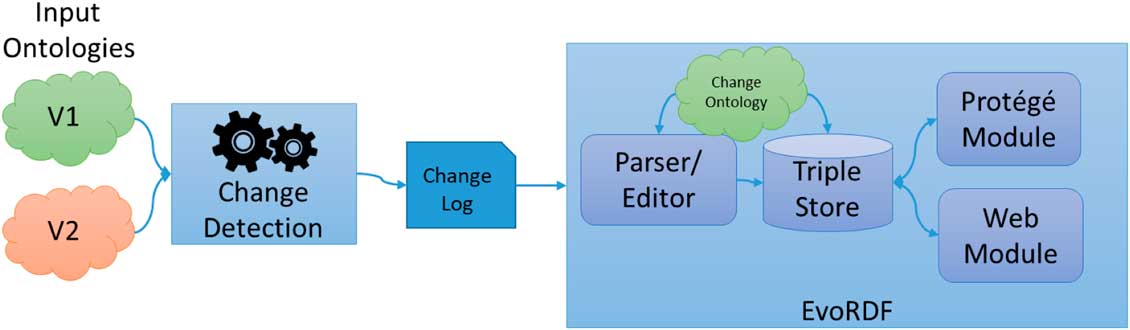
To deliver the aforementioned functionality, we designed and implemented the EvoRDF framework. The high-level architecture of the framework is shown in Figure 5 and all programmatic modules have been developed using Java.
High-level architecture of the EvoRDF framework

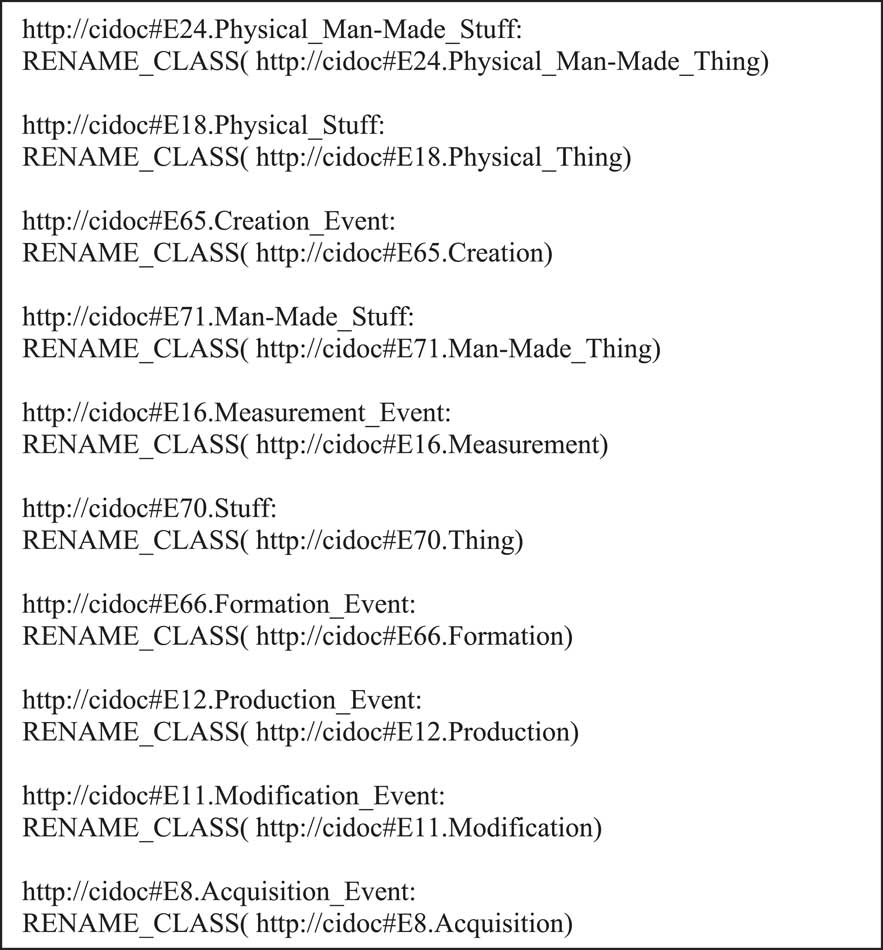
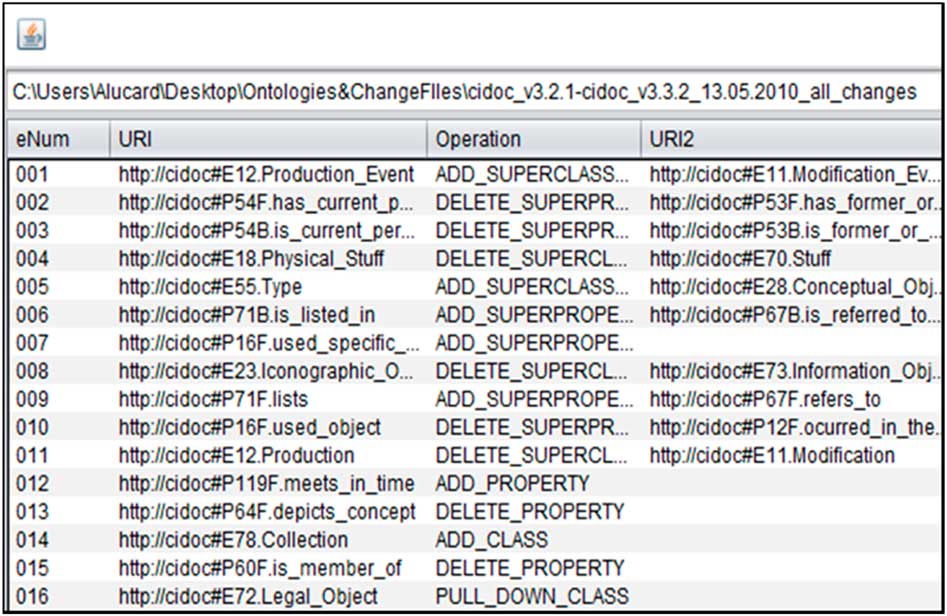
The whole process starts by getting the change log constructed between two ontology versions output from a change detection algorithm similar to (Papavasileiou et al., Reference Papavasileiou, Flouris, Fundulaki, Kotzinos and Christophides2013). An example part of the change log constructed for the CIDOC-CRM versions v3.2.1 and v4.2 is shown in Figure 6. CIDOC-CRM (Doerr et al., Reference Doerr, Ore and Stead2007) is an ISO standard from the cultural domain, which consists of nearly 80 classes and 250 properties. The detected change log that was automatically produced identified 726 changes in total.
An example change log

The file containing these change operations is then provided as input to the EvoRDF framework, which is composed of the parser, the triple store, the change ontology, the Protégé module and the Web module that will be described in the following sections.
5.1 The change ontology
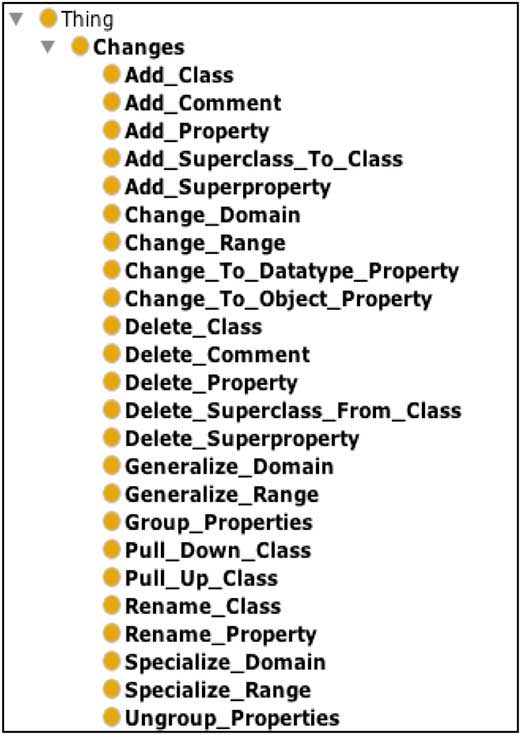
In order to model all changes identified by the change detection mechanism a change ontology has been constructed. The ontology models all available types of change operations and their corresponding arguments. Additional metadata are also modeled, such as the authors, the ontology versions and the corresponding δ a and δ d for each change operation. The change ontology has been implemented using Protégé and a part of the top-level class hierarchy is shown in Figure 7. Adapting our system to another language of changes is a matter of only providing a new change ontology with (a) the change operations used and (b) the corresponding δ a and δ d for each change operation.
A part of the change ontology

5.2 The parser/editor
This module gets the ontology of the language of changes used and the change logs and initially visualizes in a tabular way all changes. Although we argue that only listing the changes is insufficient, the tool syntactically validates the change log and allows editing and cleaning the individual change operations. A screenshot of this module, visualizing some CIDOC-CRM changes, is shown in Figure 8.
The parser/editor tool

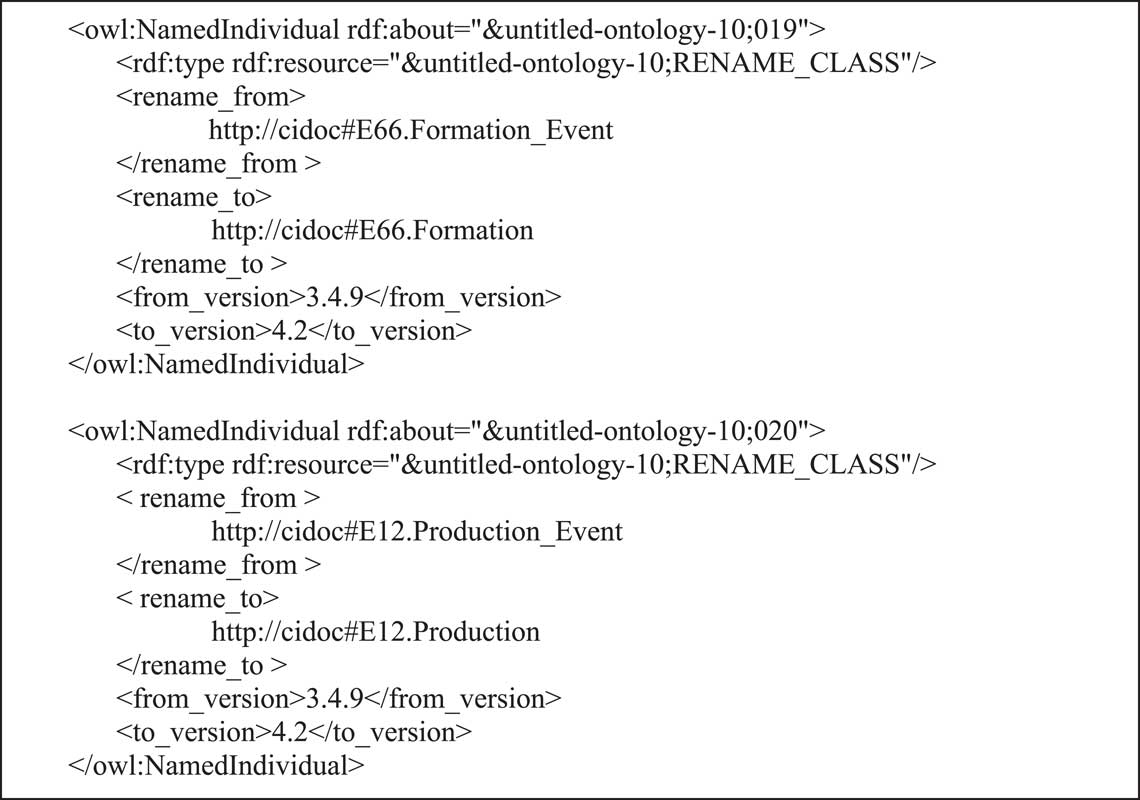
Then, the whole set of changes is transformed to triples using the parser/editor module. More specifically a Virtuoso triple store is published with the change operations included in the change log as instances of the change ontology. An example demonstrating some transformed RDF triples is shown in Figure 9.
Example instances of the change ontology

5.3 The EvoRDF explorer and the Protégé plugin
Having all change operations as instances of the Change Ontology, the EvoRDF Protégé and Web modules and the Protégé plugin can be used to explore ontology evolution. These modules implement all algorithms reported in Section 4. Three types of queries are available using these modules:
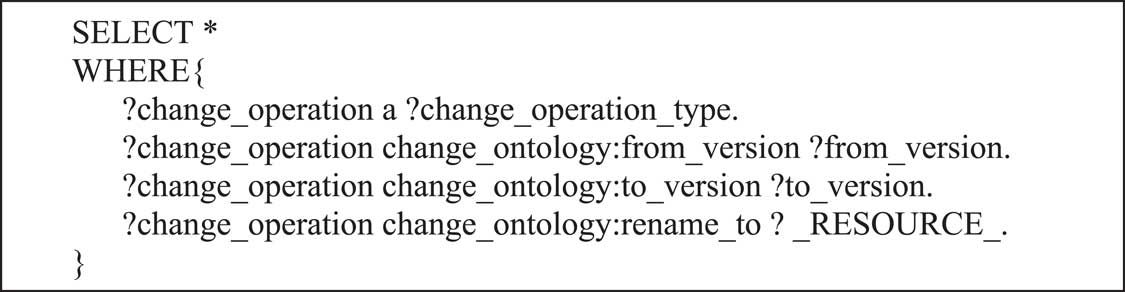
∙ When and how queries: An end-user can search for the specific version that a resource was introduced. In addition, an end-user can search for the change operation that introduced a specific resource (how). As soon as the end-user issues a query, the corresponding SPAQRL query is forwarded to the Virtuoso server in order to retrieve the specific change affecting the requested resource. To retrieve the change operation, that affects the selected resource, multiple SPARQL queries are issued (one per change operation type). An example is shown in Figure 10, requesting the source, the target and the type of a rename change operation affecting a specific resource.
∙ Why queries: In addition, the change path (i.e. the consecutive list of change operations) that led to the creation of a specific resource can be computed and presented to the user allowing further exploration and understanding of the evolution of the ontology (e.g. What are the change operations that had some influence on the creation of the ‘address’ literal? How was the ‘street’ literal evolved starting from ontology version O0?). Why queries are possible not only for specific resources but for specific change operations as well. The corresponding SPARQL queries formulated, similar to the SPARQL query shown in Figure 10, are issued to the Virtuoso triple store and the results are returned to the user.
The SparQL query for retrieving the rename change operations affecting a resource (_RESOURCE_)

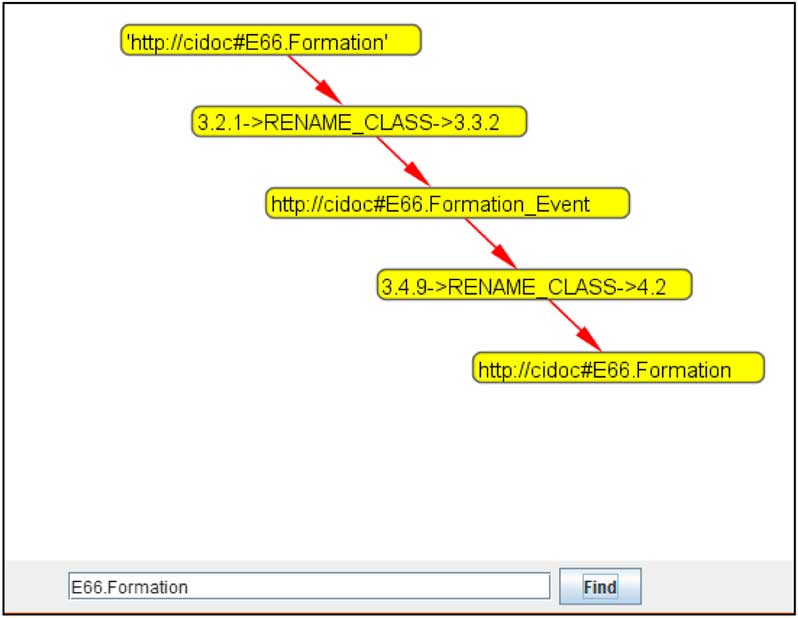
Finally, the graphical user interface retrieves the results and visualizes the returned information. The visualization paradigms adopted by the EvoRDF Protégé and Web modules are shown in Figures 11 and 12, respectively. More specifically the Protégé plugin allows searching a specific resource and automatically the corresponding change path is visualized and presented to the end-user. On the other hand, the online module allows uploading multiple ontology versions and change logs and visually exploring ontology versions and change logsFootnote 1 . Besides visualizing the results as a change path, they can also be visualized in a tabular way. The graphical change path is more appealing, however, the tabular presentation includes more detailed information, for example, comments left by the ontology engineers, additional metadata, etc.
The EvoRDF Protégé module

The EvoRDF Web module

6 Evaluation
In order to evaluate the algorithms reported in this paper, we used a workstation with an Intel Core i7 processor running at 3.4 Ghz, and 4-GB memory, using Windows 7×64. Moreover, we used two well-known ontologies: one medium-size ontology, CIDOC-CRM from the cultural domain, which is rarely changed, and one large-size ontology (GO; Gene Ontology Consortium, 2004) from the bioinformatics domain, which is heavily updated daily.
Besides CIDOC-CRM and the corresponding change log that we already described in previous section, GO is composed of about 28000 classes and 1350 property instances. GO is updated on a daily basis and for our experiments we used the change log from 25.11.08 to 26.05.09. The change log that was automatically produced contained 4175 changes.
The change logs and the ontologies used in our experiment can be found onlineFootnote 2 .
6.1 Answering provenance queries
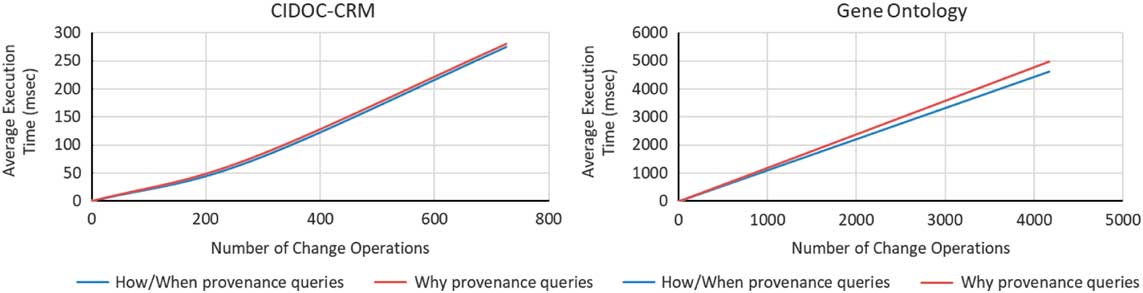
Next, we present experiments evaluating the scalability of the algorithms for answering provenance queries. We report the average execution time for computing answers to how/when and why provenance queries, exhaustively issuing the corresponding queries for all resources from the latest ontology version. The results are shown in Figure 13.
The average execution time compared to the number of changes for CIDOC-CRM and Gene Ontology

As shown in the graphs, the average time to produce a change path increases linear to the number of changes we have to search. This is in line with the complexity of our algorithms. Moreover, the time to compute answers to why provenance queries is greater than computing answers to how/when queries. This is reasonable since in the first case more triples are being searched according to the corresponding algorithm. However, we can see that the overhead for searching the added triples in the change path has little impact in the total execution time since the dominant factor is the number of change operations. So, for CIDOC-CRM after 726 change operations we only need 275 millisecond on average to compute how/when provenance whereas for why provenance we need 280 msec. On the other hand, for GO after 4175 changes we need 4611 msec for how/when queries and 4967 millisecond for why queries.
Obviously, the time to compute a change path is greater for the GO than for the CIDOC-CRM. This is reasonable, since for GO we have to search 4175 changes, whereas for CIDOC-CRM we only have to search 726 changes.
Moreover, we’ve identified that the biggest number of changes in a change path for GO was eight, whereas for CIDOC-CRM it was five. So, independent of the number of changes between ontology versions the interested user has to check at most eight change operations to understand how the specific part of the ontology has been evolved. We have to note here that the average number of change operations that a user had to examine was two for CIDOC-CRM and four for GO, which shows the benefit of our approach even for ontologies that change often.
6.2 Usability evaluation
To evaluate the usability of the system we performed two usability evaluations: (a) A preliminary usability evaluation at the Extended Semantic Web Conference, using the System Usability Scale (SUS) and (b) a complete usability evaluation at the Technological Educational Institute of Greece, using both the ISO/IEC 25000 series and SUS.
In the following, we describe in detail how we implemented each one of those.
6.2.1 Preliminary usability evaluation at Extended Semantic Web Conference
The demo paper of the aforementioned work was presented at the Extended Semantic Web Conference (Kondylakis et al., Reference Kondylakis, Melidoni, Glykokokalos, Kalykakis, Lasithiotakis, Makridis, Moraitis, Panteri, Plevraki, Providakis, Skalidaki, Stefanos, Tampouratzis, Trivizakis, Zarvakis, Zervouraki and Papadakis2017). During the demonstration, ten conference participants were invited to directly interact with the framework and explore CIDOC-CRM ontology evolution. Apart from the interesting discussions made, they were asked to give an overall rating on the usability of the system ranging from 0 to 100 using the SUS (Brooke, Reference Brooke1996), an instrument used for the global assessment of systems usability. The average score of the participants was 87.5 demonstrating the high quality of our implementation. While it is technically correct that a SUS score of 87 out of 100 represents 87% of the possible maximum score, it suggests the score is at the 87th percentile. A score at this level would mean the application tested is above average. Usually, as a gold standard is often used the 68 as reported by Sauro: ‘‘The average SUS score from all 500 studies is a 68. A SUS score above a 68 would be considered above average and anything below 68 is below average’ (Reference Sauro2009, Reference Sauro2011). In our case, the score received identifies the high usability of our modules.
Additional comments were made from the conference participants. For example, the Protégé module visualizes only the latest ontology version and allows querying over the change log. However, several participants would like to be able to see other ontology versions as well without having to load them in separate Protégé instances. In addition, currently, all changes are stored in a triple store in a remote server and the two modules should have Internet connection in order to be able to issue queries. However, some of the participants would like to be able to explore ontology evolution even without Internet connection. Finally, some other participants would like to be able to explore the changes as open linked data. Currently, we are exploring how these requests can be implemented effectively without overloading users with many ontology versions and other unrelated information.
6.2.2 Usability evaluation at Technological Educational Institute of Crete
For the usability evaluation at Technological Educational Institute of Crete, the quality features from both the product quality model of the ISO/IEC 25000 series (ISO/IEC 42010:2007, 2007; ISO/IEC DIS 25023, 2016), and the SUS were used. At the evaluation stage 20 experts from the Department of Informatics Engineering were selected. All users had a background of ontology development and they were given a short presentation of the tool. Then they were asked to use the tool for 5 minutes completing specific tasks. They had to understand how specific resources over GO and CIDOC-CRM were evolved and to visualize their change path. Then they were left to interact freely with the tool. At the end, they had to complete two questionnaires with simple, accurate, non-time consuming, set of questions and to write some comments (Table 2).
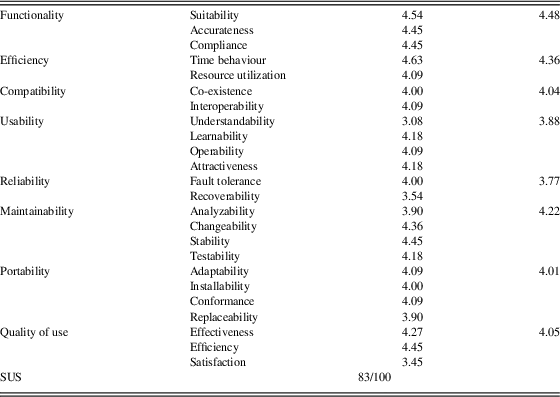
The results for the various evaluation categories

SUS=System Usability Scale.
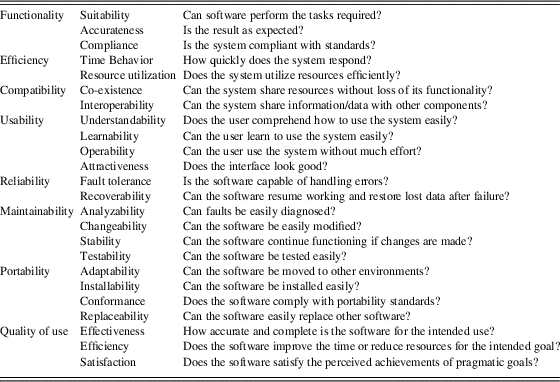
The questionnaire generated for evaluating software quality measures from the ISO/IEC 25000 series included simple questions in natural language (the questions used are shown in the Appendix), that the participants had to answer within a degree of satisfaction using a Likert scale (Likert, Reference Likert1932). For SUS, we used the standard questionnaire with (Brooke, Reference Brooke1996) 10 questions.
The results of our evaluation are illustrated in Table 1. Values greater than three represent high level of the specific software feature; values between 2.5 and 3 are at low risk, whereas values below 2.5 are considered of high risk. In our case, all software features were graded with a high mark, showing again the high quality of the software. The lowest average score was for the understandability (3.08/5) since the purpose and the functionality of the system was difficult to be understood without our presentation. User’s feedback was used to enhance the usability of the modules, so, for example, indicative queries were added to the interface. The highest average score for functionality (4.48/5) shows that the system indeed includes a really interesting set of functionalities. When it comes to efficiency, compatibility, reliability, maintainability, portability and quality of use, our system received high values as well. Finally, a SUS value of 83 received, is in line with our preliminary evaluation, confirming again the high quality of our system.
Additional comments made in the evaluation forms provided additional valuable feedback, suggesting various improvements. For instance, some users proposed to add graphs summarizing the number and categories of different types of changes similar to (Stefanidis et al., Reference Stefanidis, Flouris, Chrysakis and Roussakis2016). We agree that adding such summaries would enhance user experience and we leave this for future work. Another interesting direction proposed was to focus only on the most interesting changes instead of visualizing them all. To some extent, we have already implemented this, visualizing comments only in the tabular view, but moving beyond such simple selection would require a measure identifying the most interesting ones. Nevertheless, in our experiments, a user had to check at most eight changes which we consider a small number.
6.2.3 Interesting observations
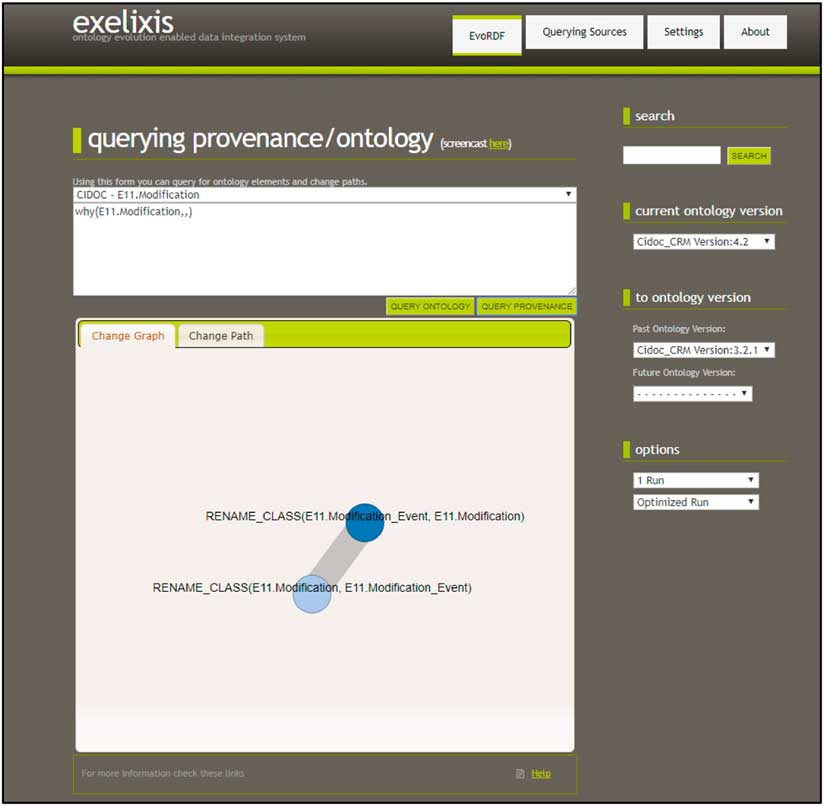
Finally, trying to understand ontology evolution through provenance queries, we made several interesting observations. One of them, for example, was the following: We identified that in the evolution of the CIDOC-CRM ontology from versions v3.2.1 to v3.3.2, one ontology engineer renamed the class ‘E11 Modification’ to ‘E11 Modification Event’. A few years later, another ontology engineer was employed to evolve the ontology. In v4.2 we can see that the class ‘E11 Modification Event’ was again renamed to ‘E11 Modification’. If the second ontology engineer had an indication of the previous renaming he would avoid cycles, as he would also be able to identify the reasons behind each renaming documented in the corresponding comments. As such, using provenance queries to explore ontology evolution can be a valuable tool reducing greatly the time spent on understanding evolution.
7 Conclusion
In this paper, we present a novel framework for enabling exploration of ontology evolution using provenance queries. Instead of just identifying and presenting the changes from one ontology version to another, our framework can answer fine-grained provenance queries for individual resources. It can identify when a resource was created, how it was introduced and it can present the change operations that lead to the creation (or deletion) of that resource visualizing its evolution history. This greatly minimizes the total time for understanding ontology evolution. Experiments performed, show the high usability of the two visualization modules and the potential impact of our approach. For example, for CIDOC-CRM provenance queries can be answered at most within 280 msec and for GO at most within 5secs even if there are more than 4000 changes that have to be examined. Moreover, ontology engineers have to examine at most five change operations for CIDOC-CRM and eight change operations for GO to understand how the ontology evolved.
In addition, our approach is independent of the language of changes used. For reasons of simplicity, we employed a rich language containing over 100 types of change operations but other languages could be selected as well, as long as the following requirements are fulfilled:
a. The (δ a , δ d ) for each change operation type described by the language should be provided.
b. δ a (u)∩δ d (u)=ø and δ a (u)∪δ d (u) ≠ ø if O1 ≠ O2.
c. For any two changes u 1 , u 2 in a sequence of changes δ a (u 1 )∩δ a (u 2 )=ø and δ d (u 1 )∩δ d (u 2 )=ø should hold.
Those properties ensure the uniqueness of the identified change paths. As future work, several challenging issues need to be further explored. A first interesting challenge would be to relax the second and the third requirements for the input language of changes. This would lead to multiple change paths for a given resource that would have to be appropriately visualized. Moreover, cycles might occur, and mechanisms ensuring the termination of the respective algorithms should be provided.
Another interesting direction, as identified by the conference participants, would be to enable ontology exploration in an offline mode. There is no restriction currently on the implemented algorithms, forcing them to use an external triple store. Our algorithms can also work directly on the provided change log files. To this purpose, minor modifications are needed, since both the algorithms and the change log parser exist already. Another dimension highlighted by the end-users is access to the changes as open linked data. This is possible as well, since our triple store includes already a SPARQL endpoint to which anyone can connect and issue queries. However, we believe that the visualization options we provide on top of the triple store, really augment user understanding and enable effective exploration of the ontology evolution, without requiring the formulation of error-prone SPARQL queries. The following months we intend to release a new version of the Protégé module with the offline functionality and to publish the SPARQL endpoint for exploiting the available changes as open linked data.
An interesting extension would also be to combine our approach with other statistical tools (like the ones in Stefanidis et al., Reference Stefanidis, Flouris, Chrysakis and Roussakis2016) offering the best of the approaches for exploring evolution and identifying statistical information over the available changes. Another interesting direction would be to combine the PROV ontology with the ontology of changes we have created, capturing more information and metadata on the activities related to ontology evolution.
Finally, a possible direction for further exploration is to present summaries (Papas et al., Reference Papas, Troullinoy, Roussakis, Kondylakis and Plexousakis2017) of the evolved change path if they become too big or graphical summaries of the entire evolution of an ontology. Although the latest years, a vast amount of research works has focused independently on summarizing information (Theoharis, Reference Theoharis2007; Troullinou et al., Reference Troullinou, Kondylakis, Daskalaki and Plexousakis2014; Troullinou et al., Reference Troullinou, Kondylakis, Daskalaki and Plexousakis2015) and on ontology evolution (Roussakis et al., Reference Roussakis, Chrysakis, Stefanidis and Flouris2015; Stardog, 2018; Troullinou et al., Reference Troullinou, Kondylakis, Daskalaki and Plexousakis2017), currently there is no work combining both worlds in an effective manner and more research is required to this direction. Is obvious, that ontology evolution is becoming more and more important topic and several challenging issues remain to be investigated in the near future.
Acknowledgements
The authors would like to thank Melidoni Despoina, Georgios Glykokokalos, Manos Karapiperakis, Michail-Angelos Lasithiotakis, John Makridis, Panagiotis Moraitis, Aspasia Panteri, Maria Plevraki, Antonios Providakis, Maria Skalidaki, Athanasiadis Stefanos, Manolis Tampouratzis, Eleftherios Trivizakis, Fanis Zervakis, Ekaterini Zervouraki for implementing the framework described in this paper. This work has been supported by the EU project iManageCancer (H2020-643529) and has been partially funded by the European Commission.
Appendix
The selected sub-characteristics for the evaluation form and their translation into simple questions