Implications
Physically effective fiber is needed by high-producing dairy cattle for normal rumen function and milk production. This study showed that corn silage, alfalfa hay, corn stover and wheat straw, when used as physically effective fiber, did not result in differences in rumen microbial communities or abundance of known fibrolytic bacteria and total archaea. Our results corroborated the suitability of corn stover, which is widely and abundantly available and inexpensive, as a source of physically effective fiber.
Introduction
Forage is essential in maintaining rumen fermentation and function because it can affect feed digestion, fermentation and digesta passage rate directly and indirectly (Jung and Allen, Reference Jung and Allen1995). Direct effects include attachment of bacteria to forage particles and subsequent hydrolysis of cellulose, hemicellulose and other polymeric components of the forage, while indirect effects include rumination, passage rates, etc. Forage can also affect biohydrogenation of unsaturated fatty acids in the rumen and subsequently the yield and fatty acid composition of milk fat, including CLA (Li and Meng, Reference Li and Meng2006). In commercial dairy production, feeding highly digestible forage and adequate physically effective fiber is vital for animal health and performance. Corn silage has been the primary forage for many farms. A source of physically effective fiber to include in high corn silage diets is of interest, and alternative sources of physically effective fiber are needed when forage supply is limited. In addition to corn-based forages, grass hay, alfalfa hay and crop residues, such as wheat straw and rice straw, are alternative sources of physically effective fiber. Forages vary in physical and chemical structure, as well as chemical composition. The surface features of different dietary forages can affect the attachment of bacteria and subsequent hydrolysis in the rumen (Bourquin and Fahey, Reference Brulc, Antonopoulos, Miller, Wilson, Yannarell, Dinsdale, Edwards, Frank, Emerson, Wacklin, Coutinho, Henrissat, Nelson and White1994; Varga and Kolver, Reference Varga and Kolver1997; Shinkai and Kobayashi, Reference Shinkai and Kobayashi2007). Different types of forage can also affect digesta passage rate, and thus the retention time of both solid and liquid fractions (Cherney et al., Reference Cherney, Mertens and Moore1991), potentially affecting feed digestion and growth of different rumen microbes.
Diets rich in grain can lead to ruminal acidosis in dairy cattle (Enemark, Reference Enemark2008). Physically effective fiber sources, which promote chewing activity, saliva excretion and rumination, are added to diets fed to dairy cattle to prevent ruminal acidosis or to lower the severity of ruminal acidosis (Zebeli et al., Reference Zebeli, Aschenbach, Tafaj, Boguhn, Ametaj and Drochner2012). Wheat straw has been added to diets of dairy cattle as a source of physically effective fiber, but availability is often limited because it also is used as bedding (Starkey et al., Reference Starkey, Gott, Eastridge, Oelker, Sewell, Mathew and Firkins2009). Corn stover is composed of the leaves and stalks of the corn plant remaining after harvest. As the yield of corn is at least four times greater than that of wheat, corn stover is abundantly available in the Midwest of United States. In addition, corn stover shares similar chemical composition as wheat straw. In a recent study (Starkey et al., Reference Starkey, Gott, Eastridge, Oelker, Sewell, Mathew and Firkins2009), different physically effective fiber sources (alfalfa hay, wheat straw at two levels and corn stover) were found not to affect ruminal fermentation, digestibility or performance of lactating cattle. Similar observation also was reported in a previous study (Poore et al., Reference Poore, Moore, Swingle, Eck and Brown1991). The objective of the present study was to examine the effect of different physically effective fiber sources on the bacterial community and the populations of fibrolytic bacteria and methanogens in the rumen of lactating Holstein cows.
Material and methods
Animals and experimental design
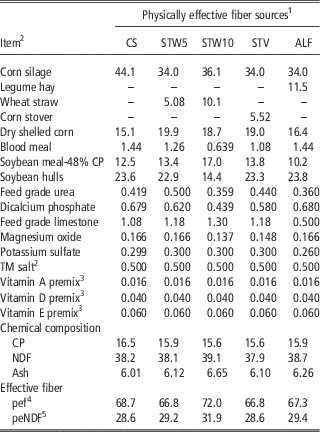
Five ruminally cannulated lactating Holstein cows were each fed the following five diets differing in physically effective fiber sources over 15 weeks (21 days each period) in a 5×5 Latin Square design: (1) CS=corn silage as the sole forage (44.1% forage, based on dry matter, DM), (2) STW5=34% corn silage plus 5.1% wheat straw (39.1% forage), (3) STW10=36.1% corn silage plus 10.1% wheat straw (46.2% forage), (4) STV=34% corn silage plus 5.5% corn stover (39.5% forage) and (5) ALF=34% corn silage plus 11.5% alfalfa hay (45.5% forage) (Starkey et al., Reference Starkey, Gott, Eastridge, Oelker, Sewell, Mathew and Firkins2009). Ingredient and chemical composition of diets are provided in Table 1. Care and handling of the animals followed the protocols approved by Institutional Animal Care and Use Committee of The Ohio State University.
Ingredient and chemical composition of experimental diets on DM basis

DM=dry matter; TM salt=trace mineral salt.
1 Physically effective fiber sources: CS=corn silage as sole forage source (44.1% forage); STW5=corn silage and 5.1% wheat straw (39.1% forage); STW10=corn silage and 10.1% straw (46.2% forage); STV=corn silage and 5.5% corn stover (39.5% forage); and ALF=corn silage and 11.5% alfalfa hay (45.5% forage).
2 Contained 0.10% Mg, 38.0% Na, 58.0% Cl, 0.04% S, 5000 mg/kg of Fe, 7500 mg/kg of Zn, 2500 mg/kg of Cu, 6000 mg/kg of Mn, 100 mg/kg of I, 60 mg/kg of Se and 50 mg/kg of Co.
3 Contained 30 000 IU/g of vitamin A; 3000 IU/g of vitamin D and 44 IU/g of vitamin E, respectively.
4 Physical effectiveness factor determined as proportion of particles ⩾1.18 mm.
5 Proportion of dietary DM as NDF in the particles ⩾1.18 mm.
Rumen sample collection and DNA extraction
Rumen digesta samples were collected 4 h after the 0600 h feeding on day 16 of each period, allowing 14 days for the rumen microbial community to adapt to the new fiber source. One rumen sample was also collected before the initiation of the feeding trial to serve as the baseline for comparison with the treatment samples. Liquid fraction (Lq) of each rumen digesta sample was recovered by squeezing through two layers of sterile cheesecloth. The liquid fraction of each sample was centrifuged at 350×g for 15 min to pellet the plant particles, 1 ml of the supernatant was then transferred to a 2-ml microcentrifuge tube and centrifuged at 4°C again at 10 000×g for 10 min to harvest the microbial biomass as described previously (Larue et al., Reference Larue, Yu, Parisi, Egan and Morrison2005). The squeezed solid fraction (Sld) was washed twice in phosphate-buffered saline with gentle shaking for 30 s, and the supernatant was discarded. The washed solid fraction was transferred to a 2-ml microcentrifuge tube for DNA extraction. Total metagenomic DNA from each fractioned sample was extracted using the repeated bead beating plus column purification method (Yu and Morrison, Reference Yu and Morrison2004b).
Real-time PCR
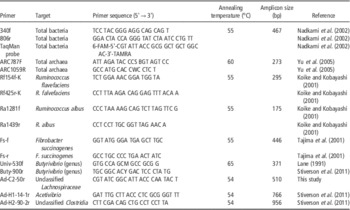
Real-time PCR assays were used to quantify total bacteria, total archaea, the genus Butyrivibrio, Fibrobacter succinogenes, Ruminococcus albus, Ruminococcus flavefaciens and three uncultured rumen bacteria (Ad-H1-14-1, Ad-H2-90-2 and Ad-C2-50) that were identified using 16S rRNA genes (rrs) sequences recovered from the adherent fraction of sheep rumen (Larue et al., Reference Larue, Yu, Parisi, Egan and Morrison2005; Stiverson et al., Reference Stiverson, Morrison and Yu2011). The uncultured bacteria Ad-H1-14-1 and Ad-H2-90-2 were assigned to the genus Saccharofermentans and the order Clostridiales, respectively (Stiverson et al., Reference Stiverson, Morrison and Yu2011), while Ad-C2-50 was assigned to family Lachnospiraceae based on the taxonomy in the Ribosomal Database Project (Release 11, Update 4). The real-time PCR assays were performed in three replicates using respective specific primers (Table 2) as described previously against individual real-time PCR standard for each species or group (Stiverson et al., Reference Stiverson, Morrison and Yu2011; Kim and Yu, Reference Kim and Yu2012). As both the liquid and the solid fractions have different sample matrix and potential different DNA recoveries, the absolute abundance of bacterial groups/species was expressed as rrs gene copies/µg metagenomic DNA, rather than rrs gene copies/g or ml samples. The relative abundance (% of total bacteria) was calculated for the select bacterial species/groups. As the two abundance measurements resulted in similar results, only the absolute abundance was presented in this paper.
PCR primers and probe used in this study

Denaturant gradient gel electrophoresis (DGGE)
DGGE was used to evaluate the effects of the different physically effective fiber sources on total bacteria and archaea using an Ingeny PhorU-2 electrophoresis system (Ingeny International BV, Amundsenweg 17 GP Goes, The Netherlands) as described previously (Yu and Morrison, Reference Yu and Morrison2004a; Yu et al., Reference Yu, Lee, Kim and Hwang2008). Briefly, the V3 hypervariable region of the bacterial and the archaeal rrs genes was amplified by PCR using Bacteria- and Archaea-specific primers. The resultant PCR products for bacteria and archaea were resolved on DGGE gels with a 40% to 60% and 40% to 55% denaturant gradient, respectively. Clustering analysis of the DGGE gel images was performed using the BioNumerics 5.10 program (BioSystematica, Tavistock, Devon, UK), while principle component analysis (PCA) was performed on the BioNumerics output data using PC-ORD 5 (Cressman et al., Reference Cressman, Yu, Nelson, Moeller, Lilburn and Zerby2010).
Statistical analysis
The abundance (rrs copies/µg of metagenomic DNA) of total bacteria, total archaea and the cultured and the uncultured bacteria was log-transformed to improve normality as recommended in a previous study (Benson et al., Reference Benson, Kelly, Legge, Ma, Low, Kim, Zhang, Oh, Nehrenberg, Hua, Kachman, Moriyama, Walter, Peterson and Pomp2010). Comparisons were made with CS as the control. Statistical data were analyzed using the MIXED procedure (SAS Institute Inc., Cary, NC, USA). The statistical model used was as follows: Y ijkl =μ+D i +F j +P k +(D×F) ij +c l +(c×D×P) ikl +e ijkl , where Y ijkl is the dependent variable, μ the overall mean, D i the fixed effect of diet, F j the fixed effect of the liquid v. solid fraction, P k the fixed effect of period, (D×F) ij the fixed effect of the interaction of diet and fraction, c l the random effect of cow, (c×D×P) ikl the random effect of the interaction of cow and diet and period and e ijkl the residual error. Significance and tendency were declared at P<0.05 and 0.05<P<0.1, respectively.
Results and discussion
Quantification of total and select bacteria and archaea
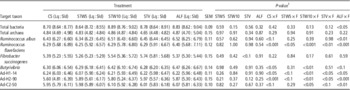
No difference (P>0.10) was noted in abundance of total bacteria among the five physically effective fiber sources (Table 3). The different physically effective fiber sources also had little effect on abundance of total archaea. The abundance of the select bacteria also did not differ (P>0.05) among the physically effective fiber sources. Only F. succinogenes tended to be more abundant (P<0.1) in the STV treatment group than in the CS treatment group, suggesting that F. succinogenes might have a preference for corn stover compared to the other physically effective fiber sources. Similar abundance of total and select bacteria and archaea among the physically effective fiber sources corroborates the finding that similar forage NDF content of different forage types can result in similar animal performance and ruminal fermentation (Starkey et al., Reference Starkey, Gott, Eastridge, Oelker, Sewell, Mathew and Firkins2009).
Least squares means of (log rrs gene copies/µg of metagenomic DNA) of microbial species/group quantified

CS=corn silage as sole forage source (44.1% forage); STW5=corn silage and 5.1% wheat straw (39.1% forage); STW10=corn silage and 10.1% straw (46.2% forage); STV=corn silage and 5.5% corn stover (39.5% forage); ALF=corn silage and 11.5% alfalfa hay (45.5% forage); Lq=liquid fraction; Sld=solid fraction.
1 Comparisons were with CS as control. STW5=effect of corn silage and 5.1% wheat straw; STW10=effect of corn silage and 10.1% wheat straw; STV=effect of 10.1% corn stover; ALF=effect of 11.5% alfalfa hay; CS×F=the interaction of corn silage control and fraction; STW5×F=the interaction of 5.1% wheat straw and fraction; STW10×F=the interaction of 10.1% wheat straw and fraction; STV×F=the interaction of 10.1% corn stover control and fraction; and ALF×F=the interaction of 11.5% alfalfa hay and fraction.
As bacteria can have differential distribution between the liquid and the solid fractions in the rumen (Larue et al., Reference Larue, Yu, Parisi, Egan and Morrison2005; Brulc et al., Reference Bourquin and Fahey2009; Kim and Yu, Reference Kim and Yu2012), interaction of treatment and fraction for total bacteria, total archaea and select bacteria was analyzed in order to assess potential differences in the effect of the different physically effective fiber sources between the two fractions. Total bacterial population amounted to about 108 rrs gene copies/µg metagenomic DNA, while total archaeal abundance was about 104 rrs gene copies/µg metagenomic DNA in both fractions of all the treatments (Table 3). The majority of rumen bacteria are either associated or attached to the feed particles (Olubobokun and Craig, Reference Olubobokun and Craig1990). In the present study, the abundance of total bacteria was only numerically greater in the solid fraction than in the liquid fraction across all the physically effective fiber sources, except the STW5 treatment group and the ALF treatment group (Table 3). The similar abundance of total bacteria between liquid and solid fraction is expected as abundance was based on per µg metagenomic DNA. Total bacterial population in the ALF treatment group was greater (P<0.05) in the solid fraction than in the liquid fraction, suggesting that rumen bacteria might have been increased by the alfalfa hay addition. Genus Butyrivibrio and species R. albus had similar population sizes, about 106 rrs gene copies/µg metagenomic DNA in all the fractionated samples. R. flavefaciens had a comparable abundance as R. albus in the solid fraction but a lower abundance (about 105 rrs gene copies/µg metagenomic DNA) in the liquid fractions, while F. succinogenes had a population about one log lower than that of R. albus in both fractions of all the treatments. R. flavefaciens in all the treatment groups had greater abundance (P<0.05) in the solid fraction than in the liquid fraction, while R. albus had a greater abundance (P<0.05) in the solid fraction than in the liquid fraction of the ALF treatment only. The abundance of F. succinogenes did not differ between the liquid and the solid fractions for any of the physically effective fiber sources. These results suggest that R. flavefaciens, rather than R. albus or F. succinogenes, might play a more important role in fiber digestion in cows fed corn silage-based diets (>34% of DM). However, previous studies showed that F. succinogenes had greater abundance in the solid fraction than Ruminococcus species (Michalet-Doreau et al., Reference Michalet-Doreau, Fernandez, Peyron, Millet and Fonty2001; Chen et al., Reference Chen, Wang, Wu and Liu2008; Singh et al., Reference Singh, Tripathi, Pandya, Parnerkar, Rank, Kothari and Joshi2013). The discrepancy could be attributed to a number of factors, such as methodology, animal breed or species and diets used. For example, the study by Chen et al. (Reference Chen, Wang, Wu and Liu2008) was done in vitro. Michalet-Doreau et al. (Reference Michalet-Doreau, Fernandez, Peyron, Millet and Fonty2001) quantified bacterial populations using dot-blot hybridization, which is less quantitative and sensitive than quantitative real-time PCR. Singh et al. (Reference Singh, Tripathi, Pandya, Parnerkar, Rank, Kothari and Joshi2013) reported abundance of bacteria in Indian buffaloes, which is a different species of ruminants. Other factors, such as age of animals, season and geographic region, can also affect relative abundance of some rumen bacterial populations (Kim et al., Reference Kim, Morrison and Yu2011). The similar population sizes of F. succinogenes between the wheat straw treatments and the other physically effective fiber sources might be explained by the low level of wheat straw used in this study.
Only a small portion (<10%) of the rumen bacteria can be grown by cultivation technique (Kim et al., Reference Kim, Morrison and Yu2011). The most commonly cultured fibrolytic bacteria were shown to account for a very small portion of the total bacteria present in the rumen (0.5% to 1.0% for F. succinogenes and R. flavefaciens each, and 0.03% or less for B. fibrisolvens and R. albus each). A previous study (Krause et al., Reference Krause, Denman, Mackie, Morrison, Rae, Attwood and McSweeney2003) also postulated that the major fibrolytic bacteria present in the rumen remain to be cultured. The result of the present study corroborates the minority status of the cultured fibrolytic species that were perceived to be the major ones (Table 3). In this study, three uncultured bacteria that were recovered from a previous study as potential fibrolytic bacteria (Stiverson et al., Reference Stiverson, Morrison and Yu2011), Ad-H1-14-1 (closely related to Acetivibrio cellulolyticus), Ad-H2-90-2 (closely related to uncultured rumen bacterial clone L406RC-5-E11 and classified to Clostridiaceae) and Ad-C2-50 (closely related to uncultured rumen bacterial clone L406RC-6-F05 and classified to Lachnospiraceae), were quantified in an attempt to gain insight into the potential importance of these newly discovered bacteria that have not been cultured and are poorly understood. As shown in Table 3, these three uncultured bacteria had abundance comparable to that of the major fibrolytic species and were more abundant (P<0.05) in the solid fraction than in the liquid fraction. This result is consistent with that of the previous study (Stiverson et al., Reference Stiverson, Morrison and Yu2011). Therefore, these uncultured bacteria may play a role in fiber digestion in the rumen.
DGGE profiles
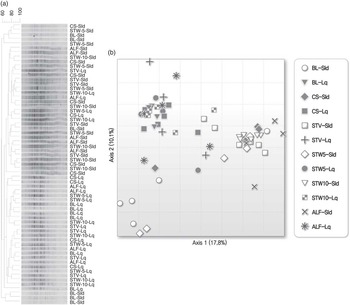
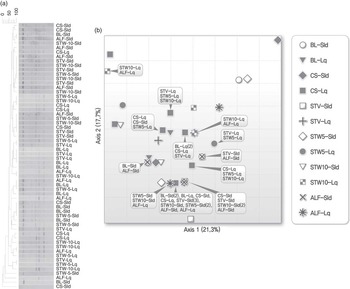
The impact of the physically effective fiber sources on the communities of both bacteria and archaea was assessed using DGGE. Although the DGGE banding patterns varied among the physically effective fiber sources, clustering of some samples were noted (Figures 1 and 2). The two fractions of most of the physically effective fiber sources were separated along PC1 for the bacterial communities and along PC2 for the archaeal communities. Such separation is consistent with the differential distribution of bacteria between the solid and the liquid fractions (Michalet-Doreau et al., Reference Michalet-Doreau, Fernandez, Peyron, Millet and Fonty2001; Larue et al., Reference Larue, Yu, Parisi, Egan and Morrison2005). A major clustering included the solid fraction for the STW10 treatment group, the liquid fraction of the baseline samples (collected before the beginning of the feeding trial) and the CS treatment group. However, based on the similarity scale of the dendrograms and the variations explained by the axes of the PCA plots, the communities of both bacteria and archaea were very similar among the physically effective fiber sources (Figures 1 and 2). The lack of large differences in microbial communities corroborates the similar results observed for BW, body condition score, milk yield, milk fat, milk protein, total VFA concentration and milk urea nitrogen among the cows fed the different physically effective fiber sources (Starkey et al., Reference Starkey, Gott, Eastridge, Oelker, Sewell, Mathew and Firkins2009).
Denaturant gradient gel electrophoresis profiles (a) and the principle component analysis plot (b) of total bacteria derived from solid (Sld) and liquid (Lq) fractions. BL=baseline; CS=corn silage control; STV=10.1% corn stover; STW10=10.1% wheat straw; STW5=5.1% wheat straw; ALF=11.5% alfalfa hay.

Denaturant gradient gel electrophoresis profiles (a) and the principle component analysis plot (b) of total archaea derived from solid (Sld) and liquid (Lq) fractions. BL=baseline; CS=corn silage control; STV=10.1% corn stover; STW10=10.1% wheat straw; STW5=5.1% wheat straw; ALF=11.5% alfalfa hay.

The physically effective fiber sources at the levels evaluated only affected rumen microbial community (both bacterial and archaeal) to a limited extent. The differences in microbial communities and populations were larger between liquid and solid fractions than among the physically effective fiber sources. The similar results on animal performance and productivity can be explained by the limited impact of the sources of physically effective fiber on the rumen microbial communities. As they had little effect on either rumen microbial community or on animal productivity, the fiber sources that have greater availability and lower cost, such as corn stover, may be used in dairy cattle production as an alternative source of physically effective fiber.
Acknowledgments
The authors thank Michael Nelson for his help with DGGE, Coleen Fowler for her assistance with SAS and Jill Stiverson for her help with the BioNumerics and PC-ORD5 analysis. This study was partially supported with a grant from the Will C. Hauk Endowment fund through the Honors Program at The Ohio State University.