Recent natural disasters have highlighted significant gaps in mitigation and response systems to address medical needs in low-income urban communities during a crisis.Reference Zoraster 1 In particular, medically fragile individuals are some of the most vulnerable in disaster conditions and are often beyond the reach of 911-emergency and hospital systems.Reference Zoraster 1 - Reference Keim 3 In the aftermath of Hurricane Sandy, a community-based effort emerged to support vulnerable individuals in Red Hook, Brooklyn. The 2 immediately organizing groups providing disaster relief were a local community center and grassroots activist movements.Reference Schmeltz, González and Fuentes 4 , 5 The 2 groups worked in close collaboration with community members and leaders—including homeowners, small business owners, clergy, and the New York Police Department—coalescing quickly around the makeshift effort. By day 2, volunteers became concerned when their search for an organization or agency to manage the community’s basic medical needs was unmet while individuals were found in declining health. Community leaders, confronting this need for an emergency response organizational structure and coordination, began to develop a grassroots medical relief effort.Reference Mohamed 6
Individuals with chronic medical conditions were presumed to be the most vulnerable because their conditionally stable status could rapidly progress to medical emergencies. Some of these individuals were managed by a complex support system, including home health aides, visiting nurse services, and hospital care, which were beyond reach in disaster circumstances. Individuals at the greatest risk were those normally homebound, those on physiological support like supplemental oxygen, and those who became effectively homebound by their circumstances, such as a senior citizen on an 18th floor with no working elevator. In a prolonged stressed state without access to food, water, electricity, heat, supplies, and medications, these individuals could decompensate. Critically, without functioning phone service, the 911-emergency system would not be a reliable point of access. Thus, the primary goal was to provide these medically fragile community members with access to resources to prevent potential health crises.
Strategy to Identify and Manage the Medically Fragile
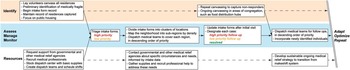
Volunteers developed a strategy to identify, assess, manage, and monitor the conditions of medically fragile community members (Figure 1). The aim was to maintain temporary stability until either utilities or resources normalized or governmental agencies assumed this role.
Strategy to Identify and Manage Medically Fragile Individuals in the Community after Hurricane Sandy, 2012. The flow chart summarizes the acute and ongoing volunteer medical relief strategy spanning 3 weeks after the storm. Vulnerable individuals were identified by repeated canvassing efforts with the use of intake forms, and volunteer health workers responded in priority of urgency. Aid agencies were contacted to request support and coordinate the overall medical relief effort. The above strategy transitioned into a more sustainable structure to focus on a smaller subset of high-risk individuals with ongoing needs of >3 weeks.

The first challenge was a lack of data. A basic medical intake form was developed to rapidly assess each individual’s health status, available resources, and support systems (available for download 7 ). Over 100 lay volunteers knocked on every door in Red Hook to register at-risk individuals who requested help. The public housing population was a particular focus and was screened twice, owing to the density of senior citizens in these buildings, the prevalence of chronic medical conditions among the residents, and the lack of water and sanitation from storm damage and mechanical pump failures.
Simultaneously, via word of mouth, social media, and intermittent cell reception, health care workers were recruited from surrounding communities to create a small group of medically trained volunteers. The health care team included at least one fully licensed physician on site, along with a rotating staff of personnel with diverse types of training. Over the course of the relief effort, approximately 15 medical doctors, 3 physician assistants, 5 nurses, 3 emergency medical technicians, 2 social workers, 3 medical students, and 3 nursing students volunteered. Health care workers were present on a purely individual volunteer basis and within “Good Samaritan” statutes.Reference Hoffman, Goodman and Stier 8 Although credentials were not independently verified, all volunteers were affiliates of known medical institutions or were referred by volunteer organizations. A spare room at the community center was transformed into a medical dispatch center with basic donated supplies and was in operation morning to late evenings.
On the basis of the intake forms started by the canvassing volunteers, the medical team triaged individuals as “high priority” and “low priority” visits. Two volunteers were dedicated to data management, with coordination and prioritization overseen by a licensed physician. Teams of medical personnel were then dispatched to make home visits, focusing on preventative efforts to ensure medical and overall stability. A licensed physician at the dispatch center remotely monitored and supported each team, directed interventions, mobilized when necessary, and called in prescriptions.
The first and primary effort was to reconnect individuals with their preexisting medical resources. When this failed, as it often did, the team pieced together supplies to meet the individual’s needs and activated emergency medical services when necessary. Most commonly, the teams monitored vital signs, blood sugar, and signs and symptoms of escalating disease states and assessed the availability of medications, durable medical goods, family support systems, and phone access. Intake forms were continuously updated with such evaluations at each visit. On the basis of ongoing medical team assessment, individuals were deemed “resolved” if their needs were met. Most individuals, however, were placed into the “follow-up” category, some requiring daily rechecks.
Medical Relief Effort Data and Analysis
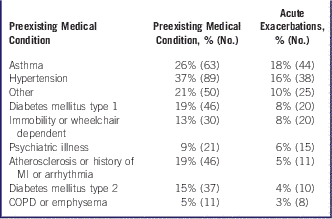
According to diagnosis and needs patterns, the effort adapted to manage high-priority, high-frequency conditions. Among these were respiratory disorders requiring nebulized therapies or supplemental oxygen, hypertension and congestive heart disease, and insulin-dependent diabetes. These common medical conditions are particularly susceptible to physiologic stressors in disaster circumstances. Subsequent retrospective data analysis of 240 sufficiently detailed records, out of 294 recorded, confirmed these initial findings (Table 1). Although harder to quantify, increased risk during pregnancy and mental health issues like depression, exacerbation of chronic mental illness, and persistent post-traumatic stress were also evident.
Exacerbated Medical Conditions in Medically Fragile Individuals After Hurricane Sandy in the Red Hook Neighborhood in Brooklyn, New YorkFootnote a

a Abbreviations: COPD, chronic obstructive pulmonary disease; MI, myocardial infarction. Intake form data from all individuals evaluated during the volunteer medical effort with sufficiently detailed records were quantified in standard categories for exacerbated medical conditions. Percentages correspond to the percentage of total (240) forms analyzed, with absolute numbers shown in parentheses.
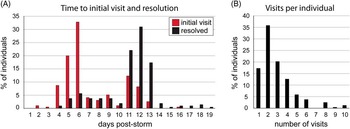
Of the 240 records analyzed, the majority of individuals evaluated were New York City Housing Authority (NYCHA) residents (83%; 199), female (68%; 163), and adults (mean age, 51 years; range, 1–93 years). Initial visits were largely performed 4 to 6 days after the storm, and cases were resolved by 11 to 13 days after the storm (Figure 2A). However, re-canvassing efforts identified a substantial proportion of new individuals first seen on days 11 to 13 with conditions in more chronic decline. Most individuals received 2 or more visits by medical volunteers (median, 2 visits; interquartile range, 2-4 visits), with some receiving as many as 10 (Figure 2B).
Time Course of Initial Evaluation, Resolution, and Number of Visits per Individual. (A) Time to first visit (red bars) and time to resolution (black bars) were quantified per day after the storm, shown as a percentage of total (n=240) individuals over time. (B) The number of visits per individual by medical volunteers, similarly shown as a percentage of the total individuals evaluated (median=2, interquartile range=2-4 visits).

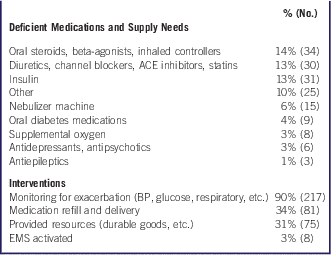
Among the many individuals with respiratory, cardiac, or diabetic conditions, acute exacerbations of asthma and hypertension occurred most frequently (Table 1). Respiratory control and maintenance, cardiac-associated medications, and insulin became the most deficient over time; however, a subset of individuals were in need of other critical medications like supplemental oxygen (Table 2).
Medical Needs Assessment and Management After Hurricane Sandy in the Red Hook Neighborhood in Brooklyn, New YorkFootnote a

a Abbreviations: ACE, angiontensin-converting enzyme; BP, blood pressure. The table shows the medications and durable goods identified as being in low or depleted in supply upon evaluation and the types of care provided by medical team members to evaluated individuals. Percentages correspond to the percentage of total (240) forms analyzed, with absolute numbers in parentheses.
Lack of power and heat were principal concerns of many individuals, likely exacerbating the medical conditions described above, in addition to difficulty securing food, water, or any phone access. Other volunteer efforts in the community were developed to address these particular needs, and communication between the medical relief and “specialized” volunteer groups helped to cross-identify individuals to provide support. Almost all individuals received active monitoring of their conditions by medical volunteers over repeated visits, with approximately one-third receiving medication refills or resources like durable goods (Table 2). Importantly, 8 highly unstable individuals were connected to emergency services by medical volunteers via the 911-emergency system (3% of total individuals).
Because utility outages persisted for over 1 month and government agencies were unresponsive, displaced physicians from New York University (whose hospital lost functionality), along with emergency medical technicians and a social worker from the community center, monitored and coordinated the transitional follow-up effort for 15 chronically ill high-risk individuals (5% of total individuals). To the best available knowledge, there were no storm-related deaths in Red Hook,Reference Neuhauser 9 whereas 97 deaths occurred in other storm-affected communities.Reference Schmeltz, González and Fuentes 4
Conclusions
The storm damage reached far beyond the water line, ultimately creating severe conditions that isolated the medically fragile in deteriorating health for over 1 month. In the public housing high-rises, the residents were using one stairwell for travel and the other in lieu of nonfunctioning toilets. Elderly medically fragile individuals were found huddled in steam-filled apartments, wearing winter coats saturated with condensation from the water they were boiling to stay warm in freezing weather.
The volunteer medical relief effort helped many of these individuals, possibly preventing mortality in Red Hook while other communities were less fortunate. But local, ad hoc altruism is far from an adequate or optimal large-scale disaster medical response. Volunteerism was in abundance, yet the scarcity of trained medical professionals and leaders in disaster management—resources typically available only at governmental levels—was conspicuous. It was over 2 weeks after the storm hit that NYCHA performed their first door-to-door check in the Red Hook Houses.Reference Neuhauser 9 At Sandy’s second anniversary, neither the federal Hurricane Sandy Rebuilding Task Force report 10 nor the City of New York had addressed which agency or organization would take responsibility for these vulnerable individuals during the next disaster. This was highlighted in a 2013 federal court ruling against the city for neglecting individuals with disabilities during the crisis, calling for the subsequent development of governmental emergency response mechanisms to protect the 880,000 New Yorkers with disabilities.Reference Santora and Weiser 11
Like Hurricane Katrina before, Hurricane Sandy revealed how we are still in need of better, faster, flexible, and more comprehensive emergency organizational infrastructure responses in low-income urban environments. Many of the chronically ill at risk in Red Hook could not dial 911 for help or ambulate in search of a hospital, mobile medical unit, or Red Cross truck—medical relief had to walk out into the community to find these individuals in their homes. There may have been a greater degree of exposure for susceptible individuals in this low-income urban environment, where the impacts of a disaster can be more severe.Reference Keim 3 However, Red Hook’s story might be a model for community-based resiliency planningReference Cutter, Barnes and Berry 12 , Reference Adger, Hughes and Folke 13 and may be instructive for capacity-building efforts in disaster risk reduction.Reference Keim 3
Given our experience, a resiliency plan can be inexpensive and medically simple with ongoing maintenance, focusing on preventative measures for individuals who request check-ins. Localities could maintain voluntary lists of vulnerable residents who request wellness checks during a crisis, and organizations like the Medical Reserve Corps could be activated to perform simple monitoring and preventative measures for these individuals. Government health and emergency management agencies could provide trained leadership to direct a general medical response template (Figure 1), which would be adaptable to a community’s specific needs or disaster conditions. Ongoing maintenance of data regarding local health susceptibility factors and exposure risks, combined with an adaptable response activation plan and knowledge of available resources, may create a strong foundation of resilience for each community.
Preparedness planning efforts by Red Hook community members and nonprofit groups (http://www.readyredhook.org/) have already begun to develop local solutions such as these. This system does not replace emergency services or provide advanced medical care, but simply serves as a bridge between isolated medically fragile individuals and these preexisting resources. In extreme events, while headlines and attention turn to dramatic rescues and momentary heroism, the greatest impact is likely achieved by simply knocking on every door.
Acknowledgments
The medical relief effort was part of a larger volunteer effort spearheaded by the Red Hook community including the Red Hook Initiative, Occupy Sandy, business owners, and Red Hook residents including Mr Kraushar. We would like to thank Amin Akhlaghi, MD (Maimonides Medical Center), and Michael Wathen, BA (CSU Channel Islands), for tireless contributions to this effort and for comments on the manuscript.
Conflict of Interest
The authors report no conflicts of interest.