It would be something of an understatement to suggest that the 2016 presidential nominating season did not follow the ordinary script. The Republican field was crowded with an unprecedented number of hopefuls, most of whom had formally announced their candidacy before Donald Trump. Then, to the surprise of virtually all observers and analysts, the Trump candidacy took off, in spite of (or because of) his unorthodox style on the stump, in debates, and in media appearances. In the end, the biggest surprise was that he “trumped” the entire field. On the Democratic side, Hillary Clinton began her second presidential run in much the same way as she started her first, as the prohibitive favorite. However, along the way, Bernie Sanders seemed to fire the imaginations of millions of Democratic voters. This allowed him to remain competitive in a number of states, and thus remain in the national conversation, long after it was mathematically possible for him to secure the nomination.
One narrative that seemed to be present throughout the nomination season was the idea that voters were turning to “outsiders” like Sanders, Trump, Ted Cruz, Ben Carson, and others. In other words, 2016 was supposedly the year in which “politics as usual” was roundly rejected. If true, how would this affect the selection of each party’s vice presidential nominee? Would Clinton and Trump turn to relatively safe choices, ones that largely conform to what we know about the selection of presidential running mates? Or would they follow the 2016 script and break the mold, looking to choices that upend our understanding of the vice presidential selection process?
In this article I present results from a conditional logit model of vice presidential selection that predicts the selection of vice presidential candidates for both Hillary Clinton and Donald Trump in 2016. Previous models predicting contested major party vice presidential nominations from 1960 through 2008 and 2012 found media exposure, political experience, having served in the military, age, and demographic (gender/racial/ethnic) diversity to be significant factors in the selection process (Baumgartner Reference Baumgartner2008, Reference Baumgartner2012b). The 2012 model (which is only a slight variation of the 2008 model) correctly predicts 15 of the 21 (71.%) contested major party nominations during this period. This same model correctly predicts Mike Pence as Donald Trump’s selection but incorrectly predicts Cory Booker as Hillary Clinton’s pick in 2016.
While this year’s results reduce the overall percentage of correct predictions from the model to 69.6% (16 of 23), it remains the case that statistical models based on sound social science are a welcome advancement over traditional speculation regarding the vice presidential selection. Footnote 1
THE “VEEPSTAKES”
Predicting who presidential nominees will select as their running mates seems to hold a special appeal for political analysts and observers. Speculation often begins before a single vote is cast in the presidential nomination season, and once the presumptive nominees are known, it becomes rampant. One simple web search for “vice presidential candidates 2016” (on June 30), for example, returned over three million results. Everyone, it seems, has an opinion on who will or should be selected. In most cases this speculation, which has come to be known as the quadrennial “veepstakes,” is fairly well informed with regard to historical factors that are important in the selection process.
But while entertaining, there are at least two problems with this game. First, for every “rule” that an observer or analyst identifies and employs, one can easily find exceptions. Do presidential candidates look for a running mate from a large or swing state? Frequently, but this was not the case with Dick Cheney and Joe Biden. Is previous government experience important? Certainly, but that does not help us account for the Palin selection. And, while history suggests that vice presidential candidates clearly tend to be white males, Geraldine Ferraro and Sarah Palin were exceptions. In other words, the traditional veepstakes game can identify what appear to be trends, but cannot offer definitive guidelines.
Second, and more importantly, the veepstakes does not systematically account for the relative merits and demerits of any candidate relative to the others in the pool of those being considered. To be sure, those playing the game typically offer reasons why one particular candidate is a better choice than one or more of the others, but these examinations lack the rigor of scientific analysis. This is especially important because in the past several decades, the number of considerations that seem to factor into the selection of a running mate have grown. The choice, in other words, is now more complex (Baumgartner Reference Baumgartner2008, Reference Baumgartner2012b).
There are very few studies which systematically examine vice presidential selection. The first was Sigelman and Wahlbeck’s (Reference Sigelman and Wahlbeck1997) article examining the selection of 22 presidential running mates from 1940 through 1992. The study was pioneering in that the authors used discrete choice (conditional logit) analysis to formally examine the probability of selecting any given candidate as opposed to the others being considered in a given year for a given party. In the end they correctly predicted 68.2% of the eventual nominees. Similar analyses followed. Hiller and Kriner (Reference Hiller and Kriner2008) examined vice presidential selection from 1940 through 2004, demonstrating that in some respects 1972 was a watershed in terms of the factors that drove the process; their model correctly predicted 84% of the selections. Baumgartner’s model of the convention era selections (1832–1928) predicted 18 of 31 (58.1%) of the choices (Baumgartner Reference Baumgartner2012a). His analyses covering 1960–2008 and 1960–2012 (Baumgartner Reference Baumgartner2008; Reference Baumgartner2012b) each correctly predicted slightly better than 70% of the vice presidential nominees (in 2008, 13 of 18, or 72.2%; in 2012, 15 of 21, or 71.4%).
The differences in results, specifically in the success rate of the predictions as well as which variables are significant in the analyses, are due to three factors. First, there are minor differences in which independent variables were included and how they were measured. Both Sigelman and Wahlbeck, and Hiller and Kriner, for example, include a measure of age balance in their analysis. Baumgartner, on the other hand, uses a simple measure of age. Second, each analysis differs slightly in terms of which years—nominations—are included. This matters because these analyses rely on a relatively small number of cases, so differences in case selection easily affect outcomes. Finally, there are differences in the dependent variable (who was selected) itself. Both Sigelman and Wahlbeck and Hiller and Kriner used the presidential nominees’ “first choice” in their analyses. Footnote 2 While there is good justification for this approach in a discrete choice model, Baumgartner uses “the individual who actually received the nomination at the convention” (Baumgartner Reference Baumgartner2012b, 606). This is because in some cases, the first choice of the presidential nominee may not have been willing to accept the nomination.
In spite of the methodological differences in these analyses I would argue that this type of approach, while less entertaining, is a more fitting way for political scientists to predict who will receive the vice presidential nomination. It is, in other words, far more scientific. In the following section I briefly outline the data and methodology employed in this cycle’s predictive model.
DATA AND METHOD
This analysis employs a model that first examines the 21 contested major party vice presidential nominations from 1960 to 2012. The year 1960 is selected as the starting point because prior to this, presidential candidates shared responsibility with their political parties in determining who would receive the vice presidential nomination. This has not been the case since 1956. While party leaders (and others) may exert some influence, in the end the decision is the presidential candidate’s (Mayer Reference Mayer and Mayer2000).
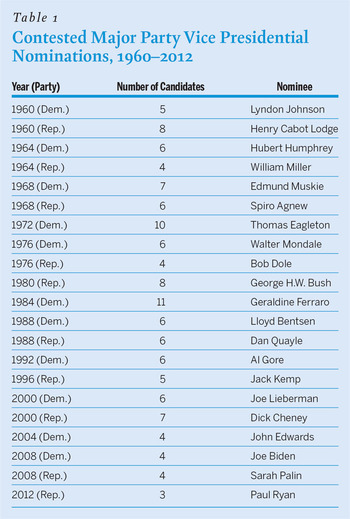
Table 1 lists both the nominations and number of candidates (N = 126) who were reportedly under serious consideration (i.e., on the “short list”) for each party in each election cycle. Sigelman and Wahlbeck’s (Reference Sigelman and Wahlbeck1997) analysis provided the foundation for the list (1960–92), and was supplemented by names included for the years 1996–2004 in Hiller and Kriner’s (Reference Hiller and Kriner2008) examination. Footnote 3 Baumgartner’s (Reference Baumgartner2008; Reference Baumgartner2012b) analysis provided names for the years 2008 and 2012.
Contested Major Party Vice Presidential Nominations, 1960–2012

The unit of analysis is each individual being considered for the vice presidential nomination in a given year for a given party, and each is grouped accordingly (e.g., Tim Pawlenty, Rob Portman and Paul Ryan, for the Republicans in 2012). Data are collected about each individual, and in some cases are paired with data collected about the presidential nominee. Footnote 4
The model presented here replicates that found in Baumgartner’s (Reference Baumgartner2012b) analysis, which in turn contained one minor change in one variable from his earlier (2008) model. The dependent variable is a dummy variable, “nominated” (1=yes, 0=no). All variables, including those that do not attain statistical significance, are included because of the resultant explanatory and predictive power of the model. Because of space constraints, and the fact that each variable has been discussed in greater detail in the analyses mentioned earlier (Baumgartner Reference Baumgartner2008; Reference Baumgartner2012b; Hiller and Kriner Reference Hiller and Kriner2008; Sigelman and Wahlbeck Reference Sigelman and Wahlbeck1997), I will describe them only briefly here.
The first set of variables thought to shape the selection of a presidential running mate can be thought of as the traditional factors. These correspond to what used to be considered (for good reason) the conventional wisdom (see Baumgartner 2102a; Reference Baumgartner2015; Goldstein Reference Goldstein1982).
Each is expected to have a positive effect on the selection of the nominee.
-
• “Size of state”: The percentage of total Electoral College votes from the individual’s home state;
-
• “Regional balance”: A dummy variable, where 1=regional balance between the home state of the presidential candidate and the potential vice presidential selection (0=no regional balance);
-
• “Ideological balance”: Another dummy variable, where 1=ideological balance between the presidential nominee and individual being considered for the vice presidential nomination (0=otherwise).
A second set of factors focuses on the political experience of the pool of possible vice presidential picks. These also are expected to have a positive effect on the selection process, and include:
-
• “Political experience”: This is measured in number of years (through the present election year) the individual served in either (1) sub-national (local and state) office, (2) the US House of Representatives, (3) the US Senate, and (4) other national office;
-
• “Last office”: Two dummy variables, indicating whether the last office served by the individual under consideration was (1) a governor (1=yes, 0=no) or (2) US senator (1=yes, 0=no);
-
• “Insider–outsider balance”: A dummy variable, where 1=the individual being considered for the ticket brought Washington insider–outsider balance (based on the last offices served for both candidates) to the ticket (0=otherwise).
A third group of variables focuses on three different political considerations, although in a real sense one could argue that most of the variables in the model are, to some degree, political. These considerations are:
-
• “State competitiveness”: This variable attempts to capture whether the individual’s home state may be a swing state, and is measured as the average difference (in absolute values) between the percentage of Democratic and Republican presidential vote share in the individuals’ home state for the previous three elections;
-
• “Rivals”: A dummy, where 1=the individual was a challenger for the presidential nomination in the present election cycle (0=not a challenger);
-
• “Media exposure”: A proxy measure of national prominence, this variable is constructed by taking the (natural) logged values of an index (Cronbach Alpha=.88) created by recording the number of stories that mentioned the individual’s name in The New York Times and the Washington Post archives from January 1 of year prior to election through May 31 of election year.
“State competitiveness” is expected to exert a negative influence on the selection, while the other two should move in a positive direction.
The final category of variables measure some aspect of the potential candidate’s demographic profile. In particular, they include:
-
• “Education”: This is an ordinal variable, where 0=no college degree, 1=a four-year college degree, and 2=some post-undergraduate education (does not have to have been completed);
-
• “Veteran”: A dummy variable, where 1=the individual served in any capacity in the military, including reserves or National Guard (0=otherwise);
-
• “Age”: Measured in years at the time of the nomination;
-
• “Gender/racial/ethnic balance”: A dummy variable, where 0=both the individuals under consideration and the presidential candidate were white, male, and of Northwest European descent (1=if one satisfied all of these conditions and the other did not, or both did not);
-
• “Religious balance”: 1=Either the individual under consideration and the presidential candidate was Protestant and the other was not (0=both or neither were Protestant).
All of these variables should have a positive effect, with the exception of age, which in past models has exerted a negative effect.
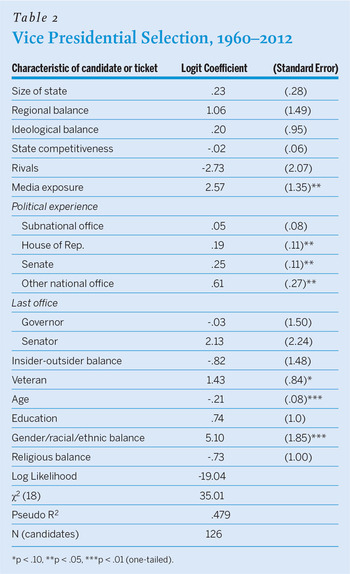
To test the effects of these variables on the dependent variable “nominated,” I used conditional logit, “which estimates effects within predefined groups of choices” (e.g., Republicans 2012; Greene Reference Greene2003; McFadden Reference McFadden and Zarembka1974; quoted in Baumgartner Reference Baumgartner2012b, 607). Despite the fact that the model is not parsimonious, VIF scores suggest there is no problem with multicollinearity (mean VIF=1.76, no single score > 3.37). Results are presented in table 2.
Vice Presidential Selection, 1960–2012

* p < .10, **p < .05, ***p < .01 (one-tailed).
Like the previous analyses (Baumgartner Reference Baumgartner2008; Reference Baumgartner2012b) media exposure is significant and the expected (positive) direction, as are the three national political experience variables. Unsurprisingly, sub-national political experience does not seem to play an important part in the consideration of a running mate. Being able to claim some military experience, as exactly 50% of the sample could do, seems to be important as well. Those who receive the nomination also seem to be younger than the pool of potential selections. Finally, gender/racial/ethnic balance is significant in the model, suggesting that this is also an important consideration.
A few of the variables that do not attain statistical significance are worthy of note, in particular, those that correspond to the conventional wisdom about vice presidential selection. The first is regional balance. In the modern era, as in the pre-modern convention era (see Baumgartner Reference Baumgartner2012a), regional balance is not significant, but this fact hides the reality that the overwhelming majority (87.3%) of all potential nominees would have balanced the ticket regionally. And while the size of state, as measured in Electoral College votes, is not significant, this too masks the reality that the eventual nominee brought an average of approximately 15 Electoral College votes to the ticket, as compared with an average of approximately 16 for the entire pool. In other words, in both cases, a lack of statistical significance can be explained by a lack of variance. Finally, slightly less than half of the potential nominees (47.6%) would have balanced the ticket ideologically, while slightly more than half of the eventual selections (57.1%) did so.
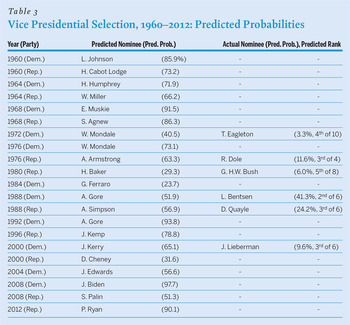
The model correctly predicts 15 of the 21 (71.%) nominees during this period. Table 3 presents the predicted and actual winners.
Vice Presidential Selection, 1960–2012: Predicted Probabilities

2016: REJECTING “MORE OF THE SAME”?
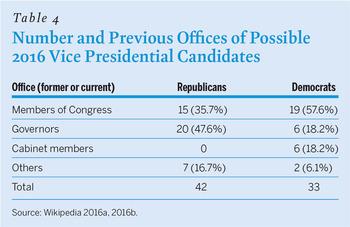
Speculation about possible running mates for the eventual presidential nominees began long before it was known that Donald Trump and Hillary Clinton would prevail. In what amounts to a modern convenience, Wikipedia has a page devoted to each of the party’s possible selections, collecting what appears to be every name mentioned by serious political observers since 2014 in this year’s edition of the veepstakes (“Democratic Party,” 2016; “Republican Party,” 2016). As of July 1, 2016, there were 42 names listed for the Republicans, of which 15 were former or current members of Congress, 20 former or current governors, and seven others. On the Democratic side “only” 33 names were listed, including six former or current Cabinet members, 19 former or current members of Congress, six former or current governors, and two others.
Almost half of the Republicans on the list were former or current governors, as compared with less than one-fifth of the Democrats.
Almost half of the Republicans on the list were former or current governors, as compared with less than one-fifth of the Democrats. On the other hand, former or current members of Congress made up a greater percentage (over half) of the Democratic than of the Republican (slightly more than one-third) list (table 4). Also notable is that there were six Cabinet members included among Democratic names.

Most of the names on Clinton and Trump’s lists reflected the media narrative surrounding the perceived needs of each. For example, the protracted nature of the Democratic nomination struggle seemed to leave Clinton somewhat vulnerable on the Left, which may explain why many believed she needed to select a “real” progressive (for example, Elizabeth Warren) to appease Sanders’ supporters. There are also slightly more Hispanics and African Americans on the Clinton list than on the Trump list, perhaps highlighting the fact that Clinton ended the nomination season slightly weakened and needing to bolster the support of these two important Democratic constituencies. On the Republican side, the once-seemingly unlikely nomination of Donald Trump was accompanied by a focus on selecting a running mate with actual governing experience, a “real” conservative, or both. Although the Trump list had a greater proportion of “outsiders,” 35 of the 42 names listed would have brought governing experience to the ticket. Moreover, most could be considered conservatives.
Of course these lists were not necessarily generated by the candidates, but by veepstakes participants. While some of the individuals listed had been publicly mentioned, or not rejected outright, by the candidates, there was no guarantee that all—or any—were being seriously considered for the nomination. Oddly, neither list necessarily fit the “rejecting more of the same” narrative that dominated much of the nomination season. In other words, most of the individuals would have brought something to their respective ticket to offset a real or perceived weakness of the presidential nominee. In other words, both lists seemed to be a case of politics as usual.
The prediction presented in this paper does not use these lists, nor does it use the lists that presidential candidates start with or those who were formally vetted. Rather, the model includes only those who were included on the candidate’s short list. These short lists are typically made known only after the selection is announced. This is why the “prediction” generated from this model must, of necessity, be made after the fact.
By early July both candidates seemed to have narrowed down their choices to a small handful of possibilities. In Trump’s case these included New Jersey Governor Chris Christie, Oklahoma Governor Mary Fallin, former Speaker of the House Newt Gingrich, and Senator Jeff Sessions from Alabama (“Donald Trump Vice President Picks” 2016; Stokols and Everett Reference Stokols and Everett2016). Both Gingrich and Christie had been openly and actively campaigning for the spot, more evidence of just how much the institution of the vice presidency has changed in the past century. As the month progressed, Fallin and Sessions seemed to be increasingly absent from the discussion, replaced by Indiana Governor Mike Pence and retired Lieutenant General Michael Flynn (Berg Reference Berg2016; Browne Reference Browne2016). During the final week prior to his announcement on July 15 that Pence would join him on the ticket, all indications suggested that Trump’s final short list was limited to Christie, Gingrich, and Pence (Costa and Rucker Reference Costa and Rucker2016; Kurtz Reference Kurtz2016). Because of this, these three were the only ones included in the model.
For her part, Clinton was apparently looking at several individuals. The initial short list included New Jersey Senator Cory Booker, Ohio Senator Sherrod Brown, Secretary of Housing and Urban Development Julian Castro, Virginia Senator Tim Kaine, Labor Secretary Tom Perez, and Massachusetts Senator Elizabeth Warren (Karni and Debenedetti Reference Karni and Debenedetti2016; Zeleny and Merica Reference Zeleny and Merica2016). By mid-July Secretary of Agriculture (and former Iowa Governor) Tom Vilsack and Colorado Governor John Hickenlooper had been added (Claiborne Reference Claiborne2016; Noble Reference Noble2016), and later there were reports that Clinton was considering retired Admiral James Stavdiris (Gass Reference Gass2016) as well. Clinton announced her choice of Kaine on July 22 (Arnsdorf Reference Arnsdorf2016) and there was some suggestion that she had decided on Kaine in the spring, never seriously considering anyone else (Dovere and Debenedetti Reference Dovere and Debenedetti2016). If this was the case, it complicates the construction of a short list, inasmuch as a short list (as such) may have been moot. Moreover, the “short” list at that stage would have been much longer and thus harder to construct. In the event, most reports suggest that in the end her top tier of potential choices included Booker, Vilasck, and Kaine. These then were the names included in the final model.
Using the data from 1960 to 2012 as the baseline, the model correctly predicted Trump’s selection of Pence, with a rather convincing predicted probability of 86%. Pence compares fairly well with the two other finalists in terms of the variables the model identifies as being significant in the selection process. None of the three finalists had military experience on their resume, and none brought gender, racial, or ethnic balance to the ticket. Pence has less political experience than Gingrich, but considerably more than Christie; he is not quite as young as Christie, but is much younger than Gingrich. Of the three, he had the lowest amount of national media exposure. Finally, Pence, like Gingrich, was not a rival for the presidential nomination in this cycle, a factor which was marginally significant in the 2016 model (results not shown). In terms of traditional factors, all three finalists brought a fair number of Electoral College votes and none of the three come from very competitive states. And like Gingrich, Pence brought both ideological and regional balance to the ticket.
Using the data from 1960 to 2012 as the baseline, the model correctly predicted Trump’s selection of Pence, with a rather convincing predicted probability of 86%.
On the Democratic side the model incorrectly predicted that Cory Booker would be Clinton’s pick, with a 48.3% probability. Kaine was assigned a 39.2% probability of being selected, Vilsack, 12.6%. Of these three, Booker was easily the youngest; Vilsack was by far the most politically experienced; Kaine scored moderately higher in terms of national media exposure than the other two. None of the finalists was a rival for the nomination, none had military experience, and all three brought gender, racial, or ethnic balance to the ticket. Of the three, Booker would have brought one more Electoral College vote to the ticket than Kaine, but unlike Kaine or Vilsack, would not balance the ticket regionally. Both Booker and Kaine would have brought ideological balance to the ticket. Finally, Kaine’s Virginia is highly competitive, Vilsack’s Iowa somewhat, and Booker’s New Jersey not at all.
The above discussion demonstrates that the selection of a vice presidential running mate in the modern era is one that is highly complex. Moreover, it is apparent that this model does not capture all of the important factors (e.g., charisma, image). Were the 2016 selections smart ones? Could Clinton or Trump have selected better running mates, in terms of either strategic political advantage or readiness to assume the role of chief executive in the event of a presidential vacancy? As in my previous efforts, I resist the temptation to comment, leaving these questions to the legion of individuals who engage in more traditional veepstakes discussion. What is clear, however, is that neither Clinton nor Trump strayed too far from the path with respect to how running mates are selected. In other words, in both cases the selections were a case of “politics as usual,” not a rejection of “more of the same.”
The 2016 results bring the overall correct percentage of the model’s predictions of major party contested nominations since 1960 to 69.6% (16 of 23). This is a fairly respectable percentage given that in any given election cycle there are several potential selections. Moreover, in spite of going only 50% for this cycle, the model seems to have performed very well for the past 30 years: the correct percentage since 1992 stands at 80%. In the end, it seems a much better way to try and understand what factors presidential nominees consider when they select their running mates than the traditional veepstakes.