Summations
• Substantial preclinical evidence from a variety of animal models indicates that oxytocin (OT) has a role in processes related to schizophrenia. Dopaminergic or glutamatergic systems appear to mediate these effects.
• Examination of aspects of the OT system in humans (i.e. OT levels, OT genes) also suggests links between OT and schizophrenia.
• Recently, several randomised, double-blind clinical trials of adjunctive intranasal OT have shown OT's efficacy in reducing core symptoms in patients with schizophrenia.
Considerations
• Both the neurobiological underpinnings of schizophrenia as well as the dynamics of the human OT system are complex and inadequately characterised.
• Before treatment of schizophrenia with OT can be recommended, large-scale trials in a wide variety of patients are needed.
• These future studies need to clarify the effects of OT in different subpopulations with schizophrenia (i.e. first-break, women) and on different parameters of the illness (i.e. cognition, social function) as well as validate issues around the safety and side effects of chronic use of OT.
Introduction
Schizophrenia is one of the most disabling disorders in psychiatry, with a disturbingly small proportion of patients afflicted with this disorder able to maintain independent function (Reference Van Os and Kapur1). Despite decades of intensive research, a precise, comprehensive, systems-level understanding of its aetiology and pathophysiology remains elusive (Reference Keshavan, Nasrallah and Tandon2,Reference Meyer-Lindenberg3). In terms of the treatment of schizophrenia, though psychosocial interventions add significant value (Reference Guo, Zhai and Liu4), psychopharmacological treatment remains the backbone of care (Reference Van Os and Kapur1,Reference Leucht, Heres, Kane, Kissling, Davis and Leucht5). Regarding antipsychotic psychopharmacology, despite a long program of intense drug discovery, all established medications to date rely on D2 receptor antagonism – either exclusively or in conjunction with antagonism of serotonin 2A (5-HT2A) receptors – as the mechanism of action (Reference Van Os and Kapur1,Reference Agid, Mamo and Ginovart6). This with the possible exception of clozapine (Reference Dziedzicka-Wasylewska, Faron-Gorecka, Gorecki and Kusemider7,Reference Nord and Farde8), an antipsychotic of note in that data reviewed below indicate that clozapine may have a unique relationship with the subject of this review: the oxytocin (OT) system. Recent years have seen a groundswell of clinically oriented research on this system, opening the possibility for a genuinely novel treatment for psychotic illness.
In the context of the current fervent interest in OT as a therapy in psychiatry, it is interesting to note that it was first proposed as a potential treatment for schizophrenia in the early seventies (Reference Bujanow9), 20 years before the structure of its receptor was discovered (Reference Kimura, Tanizawa, Mori, Brownstein and Okayama10) and 10 years before the sequencing of its gene (Reference Ivell and Richter11). Almost 40 years since that initial report, following several decades of basic science and animal research, two recent double-blind placebo-controlled trials have confirmed and bolstered this initial finding, pointing towards OT as having genuine therapeutic potential (Reference Feifel, Macdonald and Nguyen12,Reference Pedersen, Gibson and Rau13). In the following review, after a brief summary of the OT system, we will summarise the data that support the therapeutic use of OT in schizophrenia.
Oxytocin fundamentals
Evolutionarily, the nine-amino-acid (nonapeptide) family of which OT is part is ancient, with slight variants found in species from mollusks to meerkats (Reference Donaldson and Young14–Reference Madden and Clutton-Brock16). Demonstrating a surprising homology of behavioural effects, OT and its homologues have been linked to social and reproductive behaviours in a truly remarkable diversity of species (Reference Goodson, Schrock, Klatt, Kabelik and Kingsbury17–Reference Wagenaar, Hamilton, Huang, Kristan and French19). Structurally, OT is very similar to arginine vasopressin (AVP), and together these nonapeptides share four phylogenically related receptors (AVPR1a, AVPR1b, AVPR2, OTR) (Reference Gimpl and Fahrenholz15). This structural homology is important, as some of OT's central effects (Reference Sala, Braida and Lentini20,Reference Schorscher-Petcu, Sotocinal and Ciura21), as well as potential side effects (i.e. hyponatraemia) (Reference Seifer, Sandberg, Ueland and Sladen22,Reference Stratton, Stronge and Boylan23), may be mediated by binding to AVP receptors (Reference Li, Wang and Summer24,Reference Liggins25).
When considering the therapeutic use of OT in psychiatric illness in general–and schizophrenia in particular – several facets of its central neurophysiology warrant brief mention. These include its synthesis and release, its receptor system, its modes of central action and its regulation by and interaction with other important systems of interest, including gonadal hormones, dopamine and glutamate. Given other comprehensive reviews on these topics (Reference Gimpl and Fahrenholz15,Reference Carter, Grippo, Pournajafi-Nazarloo, Ruscio and Porges26–Reference Meyer-Lindenberg, Domes, Kirsch and Heinrichs30), these issues are addressed only briefly here.
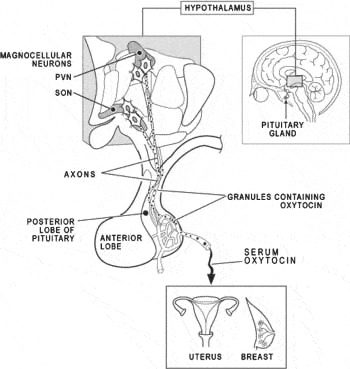
In humans, OT acts as both a hormone and a neurotransmitter, and has been used therapeutically for decades based on its effects on the smooth muscle of the uterus (in the context of delivery) and breast (in the context of lactation) (Reference Sogolow31,Reference Uvnas-Moberg and Eriksson32). These peripheral actions are effected when endogenous OT is synthesised in magnocellular neurons in the paraventricular nucleus (PVN) and supraoptic nucleus (SON) of the hypothalamus, moved by axonal transport to the posterior pituitary and released into the systemic circulation (Fig. 1). Worth noting in this context is that there is some controversy regarding the extent to which peripheral and central release of OT are coordinated, and thus how much peripheral OT levels can be considered a surrogate marker for central activity. In brief, though there is evidence that the activity of the central and peripheral OT systems can be dissociated (Reference Amico, Challinor and Cameron33–Reference Neumann35), there is also accumulating evidence in humans that its central activity and peripheral release are often correlated (Reference Burri, Heinrichs, Schedlowski and Kruger36–Reference Strathearn, Fonagy, Amico and Montague39) [see (Reference Veenema and Neumann40,Reference Veening, de Jong and Barendregt41) for reviews of this topic]. Of interest here, correlations between peripheral OT levels and neurobehavioural outcomes include interesting associations in patients with schizophrenia (discussed below) (Reference Goldman, Marlow-O'Connor, Torres and Carter42–Reference Rubin, Carter, Drogos, Pournajafi- Nazarloo, Sweeney and Maki44).
Oxytocin: central synthesis and peripheral effects. Although there is evidence for oxytocin synthesis outside the brain (Reference Gutkowska and Jankowski45), oxytocin is predominantly synthesised by specialised neurons in two nuclei in the hypothalamus: the PVN and SON. Once synthesised, oxytocin serves dual roles as both a central neurotransmitter/neuromodulator (see Fig. 2) as well as a peripheral hormone. In point of fact, there are receptors for oxytocin throughout the body, although its primary therapeutic uses to date have been been in the gravid uterus and lactating breast, where it stimulates contractions and milk ejection, respectively. Of note, the correlation and coordination of peripheral and central oxytocin release (and therefore the relevance of peripheral oxytocin levels to brain-based illness) is complex and a matter of active research [see (Reference Veening, de Jong and Barendregt41,Reference Feldman, Gordon and Zagoory-Sharon46,Reference Ludwig and Leng47) for contemporary perspectives]. Figure reprinted with permission from Oxford University Press.

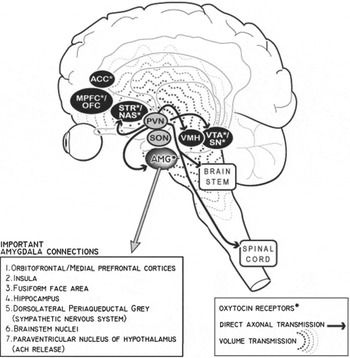
Besides its vital role as a hormone, OT also acts in an important central network as a peptide neurotransmitter (Reference Buijs and Van Heerikhuize48,Reference Sofroniew, Weindl, Schrell and Wetzstein49) (Fig. 2). These central actions, which have been elaborated in a growing variety of human magnetic resonance imaging (MRI) studies (Reference Strathearn, Fonagy, Amico and Montague39,Reference Baumgartner, Heinrichs, Vonlanthen, Fischbacher and Fehr50–Reference Rilling, Demarco and Hackett57), occur via mechanisms that differ significantly from classical neurotransmitters (i.e. gamma-amino butyric acid) (Reference Landgraf and Neumann29) (Fig. 2). That is, unlike classical neurotransmitters, neuropeptide neurotransmitters such as OT have both direct effects via axonal release from parvocellular neurons in the PVN as well as diffuse ‘volume' effects due to somatodendritic release from magnocellular neurons (Reference Neumann35,Reference Ludwig and Leng47) (Fig. 2). These latter effects uniquely occur with neuropeptides because unlike classical neurotransmitters, neuropeptides have no reuptake system and a longer extracellular half-life. As such, they are able to produce a range of effects in areas at some distances from their release due to short-range diffusion in the extracellular fluid and cerebrospinal fluid (CSF) (Reference Landgraf and Neumann29,Reference Veening, de Jong and Barendregt41).
Oxytocin: central effects. Oxytocin has at least two modes of central activity: (a) direct axonal transmission from parvocellular neurons in the PVN (solid arrows above) and (b) volume diffusion effects (i.e. ‘volume transmission’), which has effects in areas with oxytocin receptors. This latter set of ‘volume effects’ are the result of somatodendritic release of oxytocin from both SON and PVN, and may partially occur via short-range diffusion in the CSF (Reference Veening, de Jong and Barendregt41,Reference Ludwig and Leng47,Reference McGregor, Callaghan and Hunt58). As discussed in the text, the amygdala (with important connections in pull-out box) is a critical node of oxytocin's central activity in humans, and plays a role in some theories about oxytocin's role in schizophrenia (Reference Rosenfeld, Lieberman and Jarskog59). Other areas of overlap between schizophrenia and oxytocinergic function include the hippocampus and the dopaminergic ventral tegmental area/striatum. Only selected oxytocin receptor-containing brain areas are shown here (indicated with * in diagram); for a more complete list, see reviews in (Reference Gimpl and Fahrenholz15,Reference de Bono60,Reference Skuse and Gallagher61). Figure reprinted with permission from Oxford University Press. ACC, anterior cingulate cortex; AMG, amygdala; mPFC, medial prefrontal cortex; NAS, nucleus accumbens; OFC, orbitofrontal cortex; SN, substantia nigra; STR, striatum; VMH, ventromedial hypothalamus; VTA, ventral tegmental area.

As noted in Fig. 2, oxytocin receptors (OTRs) have been located in a number of brain areas relevant to schizophrenia, including the substantia nigra, the nucleus of the solitary tract, the central nucleus of the amygdala (CeA), the lateral septal nucleus and parts of the basal ganglia (Reference Gimpl and Fahrenholz15,Reference Broad, Levy, Evans, Kimura, Keverne and Kendrick62–Reference Tribollet, Dubois-Dauphin, Dreifuss, Barberis and Jard65) (Fig. 2). Several factors about OTRs warrant mention here. First, although only one OTR has been identified and cloned, recent research has identified polymorphisms of the OTR in the human population, and the role of genetic variations in human OTRs is an area of intense interest, with several studies showing these variations have associations with important central functions in humans (Reference Inoue, Yamasue and Tochigi66–Reference Thompson, Parker, Hallmayer, Waugh and Gotlib70). Besides polymorphisms in the OTR, basic science research by Insel and others has also shown that a second factor – the spatial distribution and density of OTRs in different brain areas – is a critical parameter determining OT's species-specific central effects (Reference Insel71) as well as dynamic effects based on developmental stages (i.e. parturition) (Reference Bale, Davis, Auger, Dorsa and McCarthy72,Reference Meddle, Bishop, Gkoumassi, Van Leeuwen and Douglas73). Lastly, epigenetic variations in the OTR system can occur as the result of environmental influences like early caregiving, part of the way nurture is transformed into nature (Reference Champagne, Diorio, Sharma and Meaney74,Reference Champagne, Chretien, Stevenson, Zhang, Gratton and Meaney75) and part of the complex role OT plays in the translation of social factors (isolation and social defeat) into neurobiology (Reference Norman, Karelina, Morris, Zhang, Cochran and Courtney DeVries76,Reference Timmer, Cordero, Sevelinges and Sandi77). All told, a greater understanding of variations in the plastic, socially sensitive OT system may be illuminative in understanding the considerable role different social and environmental stressors (i.e. prenatal stress, childhood trauma, social defeat) play in the development of schizophrenia (Reference Lieberman, Sheitman and Kinon78–Reference Selten and Cantor-Graae80).
When considering the treatment of humans with intranasal OT, it is worth noting that although the precise mechanism wherein intranasal OT exerts its central effects is underspecified (Reference Born, Lange, Kern, McGregor, Bickel and Fehm81,Reference Illum82), the central OT system is regulated as feed-forward system, with synchronous bursting of neural networks leading to spikes of OT release (Reference Rossoni, Feng, Tirozzi, Brown, Leng and Moos83). As such, small amounts of exogenous OT delivered to the brain may prime and trigger sustained, endogenous release from the central system. This may account for the interesting fact that in some experiments, intranasal OT increases peripheral OT levels for an extended time (>1 h) (Reference Burri, Heinrichs, Schedlowski and Kruger36), well beyond OT's short plasma half-life, which is on the order of 2–12 min (Reference Mens, Witter and Van Wimersma Greidanus84–Reference Robinson and Jones86). Furthermore, due to its evolutionary role in plastic and long-lasting developmental brain processes (Reference Carter87), the time frame of therapeutic effects of exogenous OT may differ from that of treatments based on classical neurotransmission.
Finally, regarding OT and schizophrenia, it is important to note that OT has significant interactions with other systems of interest in the illness, including oestrogen [which regulates synthesis of both OT and OTRs (Reference Choleris, Devidze, Kavaliers and Pfaff88,Reference Patisaul, Scordalakes, Young and Rissman89), serotonin (Reference Emiliano, Cruz, Pannoni and Fudge90), dopamine (Reference Baskerville and Douglas91–Reference Succu, Sanna, Melis, Boi, Argiolas and Melis93) and glutamate (Reference Hrabovszky and Liposits94,Reference Ninan95)]. These interactions, explored in the experiments reviewed below, are helpful to keep in mind when considering the‘final common pathway' by which OT may exert its therapeutic effects.
Preclinical models of schizophrenia and oxytocin
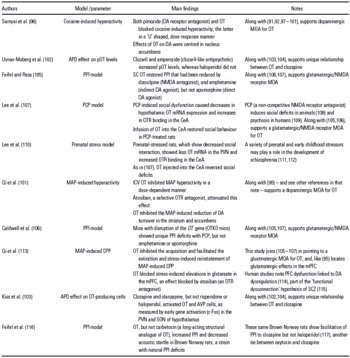
Although all animal models of schizophrenia contain theoretical and translational challenges, they provide an invaluable way to discern putative antipsychotic effects and allow the use of techniques (intracerebral microdialysis, gene knockout, maternal deprivation) not available in humans (Reference Feifel, Macdonald and Nguyen12). In the case of OT, several animal models predictive of antipsychotic efficacy both support its antipsychotic-like effects and point towards putative mechanisms of action (Table 1). These models include a variety of pharmacologic, environmental and genetic manipulations, all of which induce different aspects of the syndrome of schizophrenia.
Preclinical studies supporting antipsychotic effects of OT

APD, antipsychotic drug; DA, dopamine; ICV, intracerebroventricular; MOA, mechanism of action; mPFC, medial prefrontal cortex; pOT, plasma oxytocin level; SC, subcutaneous.
A first model, building on the dopaminergic theory of schizophrenia (Reference Carlsson118,Reference Carlsson and Carlsson119), uses stimulants (amphetamine, cocaine) to model the hyperactivity and hyperdopaminergic state presumed to be associated with psychosis. Established antipsychotics consistently reverse stimulant-induced hyperactivity, and thus this model serves as a predictive screen for potential antipsychotic drugs with antidopamine mechanisms. Using such a model, in 1990 Sarnyai et al. showed that subcutaneous OT decreased cocaine-induced hyperactivity in a ‘U-shaped' dose-response manner, similar to the antipsychotic pimozide (Reference Sarnyai, Szabo, Kovacs and Telegdy96). Histological analysis validated that these findings were related to dopaminergic neurotransmission in the nucleus accumbens, part of the mesolimbic dopamine system implicated in schizophrenia (Reference Weinberger and Lipska115,Reference Sarter, Nelson and Bruno120). In a similar set of experiments using methamphetamine (MAP), Qi et al. showed that intracerebral OT inhibited MAP-induced hyperactivity in a dose-dependent manner; atosiban (an OTR antagonist) attenuated these effects (Reference Qi, Yang, Song, Li, Wang and Wu101). As in the study by Sarnyai above, these dopaminergic effects were localised to the striatum and accumbens. In a later experiment, this same group showed that the acquisition of MAP-induced conditioned place preference (CPP) – an animal model of addiction – was inhibited by OT, which also facilitated the extinction of this preference and blocked its stress-induced reinstatement (Reference Qi, Yang, Wang, Zhao, Song and Wu113). In this experiment, microdialysis in the prefrontal cortex showed that OT inhibited restraint-stress induced extracellular glutamate levels. This finding is of interest given the interaction proposed between prefrontal cortical dysfunction and aberrant dopaminergic transmission in schizophrenia (Reference Meyer-Lindenberg, Miletich and Kohn114), and given that the abovementioned stimulant models implicate a dopaminergic mechanism of action for OT. As discussed earlier, and in a variety of other experiments [(Reference Baskerville and Douglas91,Reference Shahrokh, Zhang, Diorio, Gratton and Meaney92,Reference Drago, Caldwell, Pedersen, Continella, Scapagnini and Prange97–Reference Qi, Yang, Song, Li, Wang and Wu101), and see (Reference Skuse and Gallagher61) for recent review], there are extensive interactions between OT and central dopaminergic systems. As such, and given that the excessive dopamine transmission in the mesolimbic system is strongly implicated in the positive psychotic symptoms of schizophrenia, the above series of experiments support that OT's inhibitory regulation of mesolimbic dopamine may be a part of its mechanism of antipsychotic action.
A second pharmacological animal model of schizophrenia utilises antagonists for the excitatory glutamate/N-methyl-d-aspartate (NMDA) receptor such as phencyclidine (PCP) or ketamine to induce behavioural syndromes that mimic negative symptoms of schizophrenia. For example, chronic PCP administration in rodents causes them to display social withdrawal, a clinical hallmark of schizophrenia (Reference Sams-Dodd108,Reference Qiao, Noda and Kamei121). Importantly, clozapine – considered the most efficacious antipsychotic, especially for negative symptoms (Reference Azorin, Spiegel and Remington122–Reference Lewis, Barnes and Davies124)– reverses PCP-induced social withdrawal more effectively than other antipsychotics (Reference Qiao, Noda and Kamei121) lending validity to this animal model. As noted earlier, OT has been linked with clozapine treatment in several pharmacological studies (Reference Uvnas-Moberg, Alster and Svensson102,Reference Kiss, Bundzikova, Pirnik and Mikkelsen103) and a genetic study (Reference Souza, de Luca, Meltzer, Lieberman and Kennedy125).
Using a PCP model in rats, Lee et al. showed that chronic PCP treatment decreased hypothalamic OT mRNA expression and increased OTR binding in the CeA (Reference Lee, Brady, Shapiro, Dorsa and Koenig107). Notably, direct OT infusion into the CeA selectively restored the normal quality and quantity of social behaviour (Reference Lee, Brady, Shapiro, Dorsa and Koenig107). This latter finding – reversal of experimentally induced social deficits with direct injection of OT into the CeA – has been replicated in a prenatal stress model of schizophrenia (Reference Lee, Brady, Shapiro, Dorsa and Koenig110). As background, rats from mothers exposed to unpredictable prenatal stress show neuroendocrine imbalances, behavioural deficits (reduced social drive), as well as decreased prepulse inhibition (PPI), indicating a resemblance to aspects of schizophrenia (Reference Lee, Brady, Shapiro, Dorsa and Koenig110,Reference Koenig, Elmer and Shepard126). Examining a group of these rats, Lee et al. found they had less OT mRNA in the PVN, increased OTR binding in the CeA, as well as the aforementioned reversal of social incompetence by direct administration of OT to the CeA (Reference Lee, Brady, Shapiro, Dorsa and Koenig110). This group of findings are noteworthy given the presence of OT-responsive neuronal populations in the CeA (Reference Huber, Veinante and Stoop127,Reference Viviani, Charlet and Van Den Burg128), the role of the amygdala in social cognition (Reference Adolphs129), the stress-diathesis models of schizophrenia (Reference Brown111,Reference Van Os, Kenis and Rutten112), as well as broad-scope theories tying OT's activity in the amygdala to its antipsychotic properties (Reference Rosenfeld, Lieberman and Jarskog59).
A third animal model used in schizophrenia research utilises a neurophysiological measure of sensorimotor gating called PPI of the startle reflex (Reference Braff, Geyer and Swerdlow130,Reference Geyer, Krebs-Thomson, Braff and Swerdlow131). Anatomically, PPI is mediated by a cortico-striato-pallido-pontine circuitry, which includes the nucleus accumbens, the hippocampus and the basolateral amygdala (Reference Koch and Schnitzler132,Reference Swerdlow, Geyer and Braff133), all areas implicated in the pathophysiology of schizophrenia. Moreover, the PPI disruptions found in patients with schizophrenia can be restored with established antipsychotics, particularly second-generation antipsychotics (Reference Braff, Geyer and Swerdlow130), and schizophrenia-like deficits in PPI can be induced in animals using psychomimetic drugs acting on different neurotransmitter systems of relevance to schizophrenia, including dopamine enhancers (amphetamine), and NMDA antagonists such as PCP, ketamine and dizocilpine (MK801) (Reference Caldwell, Stephens and Young106,Reference Geyer, Krebs-Thomson, Braff and Swerdlow131,Reference Geyer and Ellenbroek134). Finally, and pertaining to the experiments discussed below, PPI deficits can also be used to distinguish between first- and second-generation antipsychotics: while both families of antipsychotics are effective at reversing PPI deficits induced by dopamine enhancers, only second-generation antipsychotics are effective at reversing PPI deficits induced by NMDA antagonists (Reference Geyer, Krebs-Thomson, Braff and Swerdlow131).
Using a PPI model, Feifel and Reza showed that subcutaneous OT restored PPI that had been disrupted by both a dopamine enhancer (amphetamine) and an NMDA antagonist (diziclopine) suggesting a second-generation antipsychotic-like profile. Interestingly, though, OT did not reverse PPI deficits induced by the direct dopamine agonist apomorphine (Reference Feifel and Reza105). More recently, Feifel et al. extended these findings by investigating the effects of OT in a non-pharmacological model of PPI deficits using the Brown Norway rat. This strain of rat has naturally low PPI compared to other strains, and thus may represent a more appropriate model of the inherent PPI deficits in schizophrenia (Reference Palmer, Dulawa, Mottiwala, Conti, Geyer and Printz135). Moreover, the antipsychotics clozapine, but not haloperidol, restored PPI in Brown Norway rats to normal levels, indicating that PPI deficits in these rats may serve as a valid predictive screen for second-generation antipsychotics (Reference Feifel, Shilling and Melendez117). Most recently, when Feifel et al. tested the activity of a long-acting OT analogue (carbetocin) and OT in this Brown Norway strain, they found that subcutaneous administration of OT (but not carbetocin) significantly enhanced PPI, similar to the effects of clozapine (Reference Feifel, Shilling and Belcher116).
Another group to use the PPI model in a unique strain of mice did so with animals that were genetically engineered without the gene for OT [oxytocin knockout (OTKO) mice] (Reference Caldwell, Stephens and Young106). OTKO mice, it has been shown, have impaired social memory (Reference Ferguson, Aldag, Insel and Young136), show more anxiety-like behaviours than normal mice (Reference Mantella, Vollmer, Li and Amico137) and exhibit inflexibility of change in learned behaviour (Reference Sala, Braida and Lentini20). In this particular experiment, Caldwell et al. showed that homogeneous (OTKO) mice (OT −/−) were significantly more susceptible to PCP-induced PPI deficits than mice expressing the normal OT gene (OT +/+), suggesting that endogenous OT may play an antipsychotic role by protecting against the disruption of glutaminergic circuits. Notably, and similar in some respects to the abovementioned findings from Feifel et al. (Reference Feifel and Reza105), this group did not find a similar genotype-by-treatment effect when the dopaminergic compounds amphetamine and apomorphine were used to disrupt PPI, again suggesting that endogenous OT's antipsychotic-like effects may be specific for glutaminergic, but not dopaminergic, perturbations.
Besides these animal models, another line of evidence supporting OT's antipsychotic activity comes from experiments suggesting that the stimulation of endogenous OT may contribute to the therapeutic effects of certain antipsychotics. For example, Uvnas-Moberg showed that both clozaril and amperozide (a clozaril-like compound) produced elevations of plasma OT levels, whereas haloperidol did not (Reference Uvnas-Moberg, Alster and Svensson102). More recently, Kiss et al. showed that that several antipsychotic drugs induced c-Fos activity in hypothalamic magnocellular OT neurons, with clozaril and olanzapine showing more robust effects than risperidone and haloperidol (Reference Kiss, Bundzikova, Pirnik and Mikkelsen103). Additional evidence that the endogenous OT system mediates at least some of clozapine's therapeutic effects comes from a human study that found that a variant of the OT gene (rs2740204) was significantly associated with clozaril treatment response, and was nominally associated with negative symptoms (Reference Souza, de Luca, Meltzer, Lieberman and Kennedy125). On the topic of potential genetic links between OT and schizophrenia, a just-published report from a unique Arab-Israeli schizophrenia cohort suggested involvement of four candidate genes including genes for both OT and AVP (Reference Teltsh, Kanyas-Sarner, Rigbi, Greenbaum, Lerer and Kohn138).
Notwithstanding challenges in translating from animal models to the complex, heterogeneous disease that is schizophrenia (Reference Feifel and Shilling139), multiple converging lines of evidence from animal research support that OT may have central actions highly relevant to the phenomenology and treatment of schizophrenia, and point to potential mechanisms, brain regions and circuits that may mediate these effects. Furthermore, these experiments implicate that certain antipsychotics, clozaril in particular, may have a unique relationship with the central OT system.
Human studies of the oxytocin system in schizophrenia
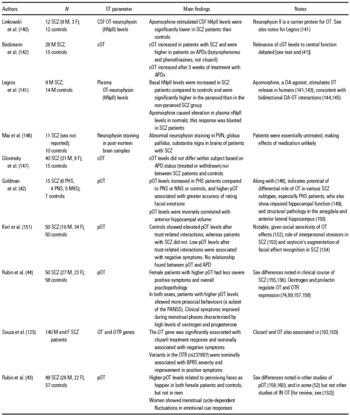
A variety of studies, dating back several decades, have examined different aspects of the OT system in patients with schizophrenia (Table 2). Aspects of the system that have been studied include (a) levels of OT and OT-related molecules (i.e. the OT carrier protein neurophysin) in the CSF and blood, (b) levels of cellular activity in the brain areas (PVN, SON) where OT is synthesised and (c) the relationship of OT levels to clinical symptoms or abilities. Each of these experiments should be seen in the light of abovementioned controversies regarding the relationship and function of the central and peripheral OT systems (vide supra section on Oxytocin fundamentals), as well as the heterogeny of symptoms in patients with the illness. Although each of the parameters these researchers have studied is an indirect measure of central OT activity, it should be remembered that until the widespread use of functional imaging, there was no way to measure the central activity of OT in humans.
Studies of the OT system in patients with schizophrenia

APD, antipsychotic drug; BPRS, brief psychotic rating scale; cOT, cerebrospinal fluid oxytocin level; DA, dopamine; NNS, normonatremic nonpolydipsic schizophrenia; PHS, polydipsic hyponatremic schizophrenia; PNS, polydipsic normonatremic schizophrenia; pOT, plasma oxytocin level; SCZ, schizophrenia.
Most early studies of central OT levels and their relation to schizophrenia found evidence for a perturbation of the OT system in this disorder, although the specific direction of change has not always been consistent. For example, though Beckman et al. (Reference Beckmann, Lang and Gattaz142) found increased baseline levels of CSF OT in patients with schizophrenia (levels were further increased with haloperidol treatment) (Reference Beckmann, Lang and Gattaz142), and Linkowski et al. found higher CSF levels of the OT carrier protein neurophysin in schizophrenia patients (Reference Linkowski, Geenen, Kerkhofs, Mendlewicz and Legros140), a later study showed no change in CSF OT based on illness or treatment (Reference Glovinsky, Kalogeras, Kirch, Suddath and Wyatt147). Post-mortem studies of OT-rich areas in the brains of unmedicated schizophrenia patients have shown morphometric differences in the PVN, internal palladium and substantia nigra (Reference Mai, Berger and Sofroniew146), and studies of hypothalamic regions associated with OT release (PVN) have shown reduced cell density in patients with schizophrenia (Reference Bernstein, Stanarius and Baumann161). Most recently, as part of a multifaceted set of experiments in patients with schizophrenia and polydipsia, Goldman et al. found deformations in brain areas involved with the modulation of neuroendocrine responses (anterior lateral hippocampus, amygdala) in certain subsets of such patients (Reference Goldman, Gomes, Carter and Lee148,Reference Goldman, Wang and Wachi150).
Aside from these assays of the central OT system, early researchers have also examined peripheral OT levels in patients with schizophrenia, finding lower baseline levels of OT carrier proteins (neurophysins) compared to normal controls, with levels in the schizophrenia group inversely associated with the level of paranoia (Reference Legros, Gazzotti and Carvelli141). A group of subsequent studies by Goldman et al. have shown lower levels of plasma OT in patients with polydipsia and schizophrenia (Reference Goldman, Marlow-O'Connor, Torres and Carter42), and found these levels to be inversely correlated with anterior hippocampal volume (Reference Goldman, Torres, Keedy, Marlow-O'Connor, Beenken and Pilla162), positively correlated with hippocampal-mediated hypothalamic-pituitary-adrenal axis (HPA) feedback (Reference Goldman, Wood and Gavin149) and predictive of patients' ability to correctly identify facial emotions (Reference Goldman, Marlow-O'Connor, Torres and Carter42). This latter finding of a correlation between social cognition and plasma OT in patients with schizophrenia has since been replicated (Reference Rubin, Carter and Drogos43), and extended in treatment trials showing OT enhancement of social cognition (Reference Averbeck, Bobin, Evans and Shergill154,Reference Pedersen, Rau, Salimi, Gibson, Leserman and Penn163, vide infra). In addition, the aforementioned findings around the role of OT and the HPA axis in schizophrenia again point to the role of OT in the stress-diathesis aspect of the illness (Reference Van Os, Kenis and Rutten112), and raise the possibility that OT function may distinguish between some of the clinical subtypes (i.e. polydipsia) within the broad schizophrenia heading.
Further studies have also found correlations between pOT and schizophrenia. Following seminal studies in normal subjects indicating OT's role in trust (Reference Kosfeld, Heinrichs, Zak, Fischbacher and Fehr164), and a correlation of pOT levels with trustworthiness (Reference Zak, Kurzban and Matzner165), Keri et al. examined whether OT played a role in trust in patients with schizophrenia. In this study, patients with schizophrenia had lower pOT levels following a trust-related social interaction than normal controls, who showed increased levels following these interactions (Reference Keri, Kiss and Kelemen151). Non-trust-related OT levels were also lower in patients (although not significantly so) and low trust-related pOT levels predicted the negative symptoms of schizophrenia (Reference Keri, Kiss and Kelemen151). These findings relating to trust are of interest with regard to the schizophrenia symptom of paranoia, and highlight the role of OT in the amygdala, a brain structure shown in normals to be important in interpersonal trust assessments (Reference Engell, Haxby and Todorov166,Reference Koscik and Tranel167), and responsive to OT in trust-related situations (Reference Baumgartner, Heinrichs, Vonlanthen, Fischbacher and Fehr50).
Biological sex (chromosomal maleness or femaleness) is a critical variable influencing OT's function, and an awareness of the sex-specificity of many of its actions informs a review of the OT literature. We note that although the term ‘gender' is still often used in the OT literature to refer to this important factor, following the National Academy of Sciences recommendation (Reference Wizemann and Pardue168), we use the term ‘sex' throughout to refer to biological maleness or femaleness. Shedding light on a potential sex-specific role of OT in schizophrenia, Rubin et al. described that female patients with higher pOT levels had attenuated positive symptoms and psychopathology, and that in both males and females, higher OT levels were associated with more prosocial behaviours (Reference Rubin, Carter, Drogos, Pournajafi- Nazarloo, Sweeney and Maki44). In a follow-up study, this group also reported that although OT levels did not fluctuate across the menstrual phase, higher pOT levels in women were associated with increased sensitivity to happy facial emotion, less severe positive symptoms and less overall psychopathology (Reference Rubin, Carter and Drogos43). On the topic of sex and OT, it is worth noting that several studies have shown that OT levels can fluctuate throughout the menstrual cycle [(Reference Liedman, Hansson and Howe169,Reference Salonia, Nappi and Pontillo170), but see (Reference Shukovski, Healy and Findlay171,Reference Stock, Bremme and Uvnas-Moberg172)], and that oral contraceptive use [which was exclusionary in (Reference Rubin, Carter and Drogos43,Reference Rubin, Carter, Drogos, Pournajafi- Nazarloo, Sweeney and Maki44)] may increase OT levels in healthy women [(Reference Silber, Almkvist, Larsson, Stock and Uvnas-Moberg173,Reference Stock, Karlsson and von Schoultz174), but see (Reference Salonia, Nappi and Pontillo170)]. Furthermore, the issues around OT and sex raised by these experiments are especially salient given that (a) oestrogen upregulates OTRs (Reference Patisaul, Scordalakes, Young and Rissman89), plays a role in OT's activity in the amygdala (Reference Choleris, Devidze, Kavaliers and Pfaff88) and appears to influence the course of psychotic symptoms in women (Reference Bergemann, Parzer, Runnebaum, Resch and Mundt175) (vide supra section on Introduction); (b) other sex-specific hormones (i.e. testosterone) may moderate OT's effects (Reference Van Anders, Goldey and Kuo176); (c) sex is an important factor in the natural history of schizophrenia (Reference Tandon, Keshavan and Nasrallah177) and (d) studies indicate that sex moderates OT levels (Reference Holt-Lunstad, Birmingham and Light160,Reference Salonia, Nappi and Pontillo170), stress-based (Reference Grewen, Girdler, Amico and Light178,Reference Taylor, Klein, Lewis, Gruenewald, Gurung and Updegraff179) and behavioural aspects of OT (Reference Gordon159), the effect of OT on the brain in face processing tasks (Reference Domes, Heinrichs, Glascher, Buchel, Braus and Herpertz51,Reference Domes, Lischke and Berger52), as well as some of the effects of treatment with exogenous OT (Reference Bartz, Zaki, Bolger and Ochsner152). To whit, the role of sex in OT's baseline and dynamic activity – as well as the impact of sex and gonadal hormones on OT treatment of patients with schizophrenia – requires much further study (Box 1).
Clinical trials using oxytocin in patients with schizophrenia
Surprisingly, perhaps, the first documented report of the use of OT in schizophrenia predates the animal research discussed earlier by more than a decade (Reference Bujanow9) (Table 3). In several early reports, investigators in the Soviet Union reported that 6–10 treatments of between 10 and 25 IU OT given IV or IM induced rapid therapeutic effects and prevented hospitalization in patients with schizophrenia (Reference Bujanow9), potentially by acting as a ‘psychic energiser' reversing energy, apathy and depression (Reference Bakharev, Tikhomirov and Lozhkina180). In spite of their prescience, these early reports describe case series (Reference Bujanow9) or did not use standardised diagnostic or outcome scales (Reference Bakharev, Tikhomirov and Lozhkina180). Only recently, more than 30 years later, have rigorously designed and executed clinical trials of exogenous OT been conducted in patients with schizophrenia.
OT treatment of patients with schizophrenia

APD, antipsychotic drug; F, female; M, male; SCZ, schizophrenia.
In the first of these, Feifel et al. treated 15 outpatients with residual symptoms of schizophrenia with 3 weeks of adjunctive intranasal OT (40 IU twice daily) in a randomised, double-blind cross-over study (Reference Feifel, Macdonald and Nguyen12). In this experiment, OT produced significantly greater therapeutic effects across a broad spectrum of symptoms including both positive and negative symptom clusters based on changes in the Positive and Negative Syndrome Scale (PANSS), though improvement in positive symptoms appeared more robust. Supporting the clinical salience of these effects, Clinical Global Impression (CGI) scores also improved significantly with OT. Importantly, given the paucity of chronic treatment trials, is that OT was well tolerated from the perspective of reported side effects, vital signs and blood chemistry studies. Finally, it was found that in contrast to single administration studies of OT in normal subjects, which tended to produce amnestic effects on verbal memory (Reference Bruins, Hijman and Van Ree182,Reference Fehm-Wolfsdorf, Born, Voigt and Fehm183), schizophrenia patients exhibited improved verbal memory after 3 weeks of daily intranasal OT (Reference Feifel, Cobb, MacDonald, Nguyen, Minassian and Perry184).
Replicating and extending these findings, Pedersen et al. recently conducted a randomised, placebo-controlled, 2-week trial in which outpatients and inpatients with schizophrenia received either intranasal placebo or 24 IU twice daily. Similar to Feifel et al. (Reference Feifel, Macdonald and Nguyen12), this study reported significant, global decreases in PANSS scores with OT compared to placebo. In addition, this group found significant improvements in several social cognition measures (theory of mind, facial trustworthiness) in the OT group compared to the placebo group, extending OT's well-documented prosocial effects in normal subjects (Reference Macdonald and Macdonald185) into a clinical population with impairments in this arena (Reference Averbeck, Bobin, Evans and Shergill154,Reference Tremeau186), and providing support for OT's ability to ameliorate some of the social cognitive deficits in schizophrenia. These social deficits, which have more association with the community function of schizophrenia patients than neurocognition (Reference Fett, Viechtbauer, Dominguez, Penn, Van Os and Krabbendam187), are poorly treated with current medications (Reference Penn, Keefe, Davis, Meyer, Perkins and Losardo188). Interestingly, Pedersen et al. found significant separation between OT and placebo in PANSS scores after the second week of treatment, whereas the study by Feifel et al. (Reference Feifel, Macdonald and Nguyen12) did not observe an OT advantage until the third week of treatment. In considering this difference, it is notable that though magnitude of symptoms was similar between these studies, there were differences in dosing, setting (inpatient vs. outpatient) and patient characteristics (average age, years of illness).
Besides these chronic treatment trials, several recent, single-dose studies of interest have extended OT's well-documented ability to alter responses to socially salient stimuli in normals (Reference Riem, Bakermans-Kranenburg and Pieper56,Reference Macdonald and Macdonald185) to patients with schizophrenia, replicating the abovementioned prosocial findings by Pedersen et al. (Reference Pedersen, Gibson and Rau13). In one such study, Averbeck et al. first showed that patients with schizophrenia performed worse than normals on a specific emotion recognition task, and subsequently showed – using the same task – that double-blind OT treatment improved patient's recognition of emotions (Reference Averbeck, Bobin, Evans and Shergill154). A second, similar study by Goldman et al. examined the effect of two doses of IN OT (10 and 20 IU) and placebo on emotion recognition in three groups: schizophrenia patients with (PS) and without polydipsia (NPS) and normals (Reference Goldman, Gomes, Carter and Lee148). Besides showing a differential effect of these two doses in patients (10 IU worsened performance, 20 IU improved performance), this experiment showed a differential benefit of the 20 IU dose in PS versus NPS. In addition to demonstrating a dose effect of OT, these findings raise the potential of OT to have differential effects in subsets of patients with schizophrenia. Together, these single-application experiments highlight the unique potential of OT to target the social cognitive and emotion-processing impairments that are such a disabling component of schizophrenia (Reference Fett, Viechtbauer, Dominguez, Penn, Van Os and Krabbendam187,Reference Ursu, Kring and Gard189).
In reviewing the extant clinical research using IN OT in patients with schizophrenia, several practical issues deserve special mention. On the positive side, the extant research around the safety and tolerability of OT indicates that both short term [see (Reference Macdonald, Dadds, Brennan, Williams, Levy and Cauchi190) for recent review] and chronic use are both safe and tolerable in the populations and doses studied to date. Chronic trials supporting OT's safety and tolerability include the 2- and 3-week schizophrenia trials cited above (Reference Feifel, Macdonald and Nguyen12,Reference Pedersen, Gibson and Rau13), as well as a 13-week study of 40 IU BID in women with constipation (Reference Ohlsson, Truedsson and Bengtsson191). These findings are encouraging, given the often morbid side effects of current pharmacologic treatments for schizophrenia (Reference Rummel-Kluge, Komossa and Schwarz192). Until more research accrues in vulnerable populations (i.e. patients with polydipsia) and with different dosing, however, we recommend ongoing vigalence, given OT's potential cross-reactivity with vasopressin (Reference Li, Wang and Summer24), and the subsequent possibility of hyponatraemia and water intoxication [(Reference Seifer, Sandberg, Ueland and Sladen22,Reference Stratton, Stronge and Boylan23,Reference Liggins25), but see (Reference Rasmussen, Simonsen, Sandgaard, Hoilund-Carlsen and Bie193)].
Although intranasal OT appears quite safe and tolerable, there are several practical barriers to its therapeutic drug development in humans. These include the lack of intellectual property ownership of the actual hormone, lack of US Food and Drug Administration (US FDA) approval for any psychiatric indication and challenges around the actual availability of the drug (Reference Kubzansky, Mendes, Appleton, Block and Adler194). These practical challenges to the use of OT exist in addition to the many outstanding scientific questions around its therapeutic profile (Box 1), and require novel solutions (i.e. OT analogues, new delivery systems).
Conclusions, questions and future directions
En toto, the above set of convergent findings – from preclinical work with OT, from studies of the OT system in patients with schizophrenia and from several randomised, placebo-controlled trials – strongly support that OT holds promise as a novel treatment for schizophrenia. That said, our knowledge around the clinical use of OT is limited, and considerable work needs to be done to address a host of outstanding questions regarding the use of OT in psychotic illness (Box 1). Fortunately for the field – and for the patients who may benefit from OT therapy – ongoing study of the therapeutic potential of this ancient system will likely continue at its current feverish pace, and several large trials studying OT in schizophrenia are in process. We anticipate these trials will furnish critical data to address some of these important questions.
Box 1. Pending Questions Around the Use of OT in Schizophrenia
1. Dosing and delivery: What are the optimal dose and frequency of treatment, in the context of several studies indicating a dose effect of OT (Reference Uvnas-Moberg, Alster and Svensson102,Reference Goldman, Gomes, Carter and Lee148), as well as the finding of sustained levels after a single treatment (Reference Burri, Heinrichs, Schedlowski and Kruger36). Is the intranasal route the optimal one or might less onerous routes (i.e. patch) be more practical or effective?
2. Adjunctive or primary: Does OT have a clinical impact as monotherapy? How does adjunctive OT impact the effect of currently prescribed antipsychotics? In women, do oral contraceptives or hormonal status impact these effects? Would co-administration of oestrogen with OT augment its effects?
3. Subpopulations and symptom clusters: Given the clinical heterogeny of schizophrenia, are there subpopulations (i.e. females, patients with negative symptoms) that are more prone to benefit from OT? Might some patient groups experience additional side effects from OT (i.e. patients with polydipsia)? Are there symptom clusters (positive, negative, social cognition) that show particular benefit?
4. Biomarkers: Noting that several studies show single-dose effects of OT (Reference Goldman, Gomes, Carter and Lee148,Reference Averbeck, Bobin, Evans and Shergill154), are there clinical biomarkers which may be early predictors of a therapeutic response (i.e. social cognition measures, EEG, eye tracking)?
5. Receptors: What roles do the known, consequential OTR polymorphisms (Reference Inoue, Yamasue and Tochigi66–Reference Thompson, Parker, Hallmayer, Waugh and Gotlib70) or variations in regional OTR density have in OT's therapeutic effects or in syndromic variations of schizophrenia?
6. Levels: Does an individual's OT level (salivary, plasma, urinary, cerebrospinal fluid) have any predictive value in terms of a patient's therapeutic response to OT? Which is more important, baseline or dynamic levels (i.e. in response to stressors, social stimuli or treatment)?
7. Context: Given the context-dependent effects of OT (Reference Bartz, Zaki, Bolger and Ochsner152), and the suggestion of OT augmentation of aspects of a helping relationship (Reference Bryant, Hung, Guastella and Mitchell195), are there particular treatment settings or psychosocial interventions [social skills training (Reference Roberts and Penn196)] that may work synergistically with OT?
8. Neurodevelopment/plasticity: Noting the neurodevelopmental and stress-diathesis aspects of schizophrenia (Reference Van Os, Kenis and Rutten112), and given the suggestion that OT may serve a plasticity-enhancing or neuroprotective function (Reference Ceanga, Spataru and Zagrean197–Reference Windle, Kershaw, Shanks, Wood, Lightman and Ingram201), might OT have a particular role in ‘psychosis-prone' individuals?
Acknowledgement
Thanks to Melissa Fleischauer and Tina MacDonald for their editorial support. The research in this review and Dr. Feifel's lab is supported by the NIMH (R34 MH091285).