English pianist Charles Salaman (1814–1901) wrote in his recollections that of the many musicians he had known during his long professional life, Bennett was ‘our greatest English composer of instrumental music’.Footnote 1 A New York Times obituary asserted that he was ‘one of the most prominent English musicians of this epoch, and had earned during his career a worldwide reputation’.Footnote 2 Such assessments were frequently repeated in late nineteenth-century accounts of Bennett. This study explores the worldwide aspect of Bennett’s reputation to 1914 by beginning with a look at the performance history in London. The Bennett catalogue by Rosemary Williamson has been invaluable for this endeavour.Footnote 3 Next follows a consideration of performances in Germany where Bennett’s close associations with the Mendelssohn circle provided him with substantial encouragement during his formative years as well as a lifelong network of friends and colleagues. A survey of Australia and New Zealand provides information about the transmission of his works within the British Empire. Finally, an exploration of performances in the United States contributes to our knowledge of transmission of the composer’s transatlantic influences.
Details of more than 1,000 performances have been collected but clearly will represent only a partial list of what actually occurred. Yet such a sampling can indicate trends and provide knowledge regarding which works achieved popularity, who performed them, in what cities they were heard and at what concert types they appeared. Sources consulted comprise contemporary press accounts, journal reports, programme archives as well as biographies, reminiscences and histories of the period (see the Appendix for a listing of compositions with documented performances in London, Germany, Australia, New Zealand and the United States).
London: ‘Our Greatest English Composer of Instrumental Music’
The Naiades overture, a work inspired by the composer’s visit to the Rhine River in 1836, received over one hundred performances, making it the most performed of his instrumental works. Its premiere took place in 1837 at a Philharmonic Society (PS) trial evening and remained in the Society repertoire until 1910. In 1880 when The Naiades appeared at a Covent Garden Promenade Concert, a reviewer contended there was probably not one orchestra player ‘to whom every phrase is not more or less familiar’.Footnote 4 An early contribution to the concert overture by a British composer, the work made an attractive addition to programmes at diverse concert types and venues. The Royal Academy of Music (RAM) and Society of British Musicians included the overture by one of its distinguished students and members. Ignaz Moscheles selected it for his farewell concert (1846) when he left London to join the faculty at the Leipzig Conservatory. The New Philharmonic Society, John Hullah’s orchestral concerts and August Mann’s Crystal Palace concerts added The Naiades to their repertoire. Paradise and the Peri, The Wood Nymphs and Parisina overtures also found favour at London concerts, chiefly at the Philharmonic Society and Crystal Palace Concerts. Arrangements of the overtures for piano solo or chamber ensemble suggest these works made their way into domestic music-making as well.
Most frequently performed after The Naiades was the Piano Concerto No. 4 in F minor. One quarter of appearances featured Bennett as soloist, first at RAM student concerts then later as a professional pianist with the PS, at his annual benefit concerts and even an appearance at Buckingham Palace. The pianist responsible for most performances aside from the composer was Arabella Goddard (1836–1922). Three years after Bennett retired from public performance she took up the mantle, playing the concerto chiefly at PS and Crystal Palace concerts. Other soloists comprised RAM students at school recitals and British pianists. William G. Cusins has the distinction of not only performing the concerto but also, on other occasions, serving as its conductor.Footnote 5 The concerto’s slow movement, Barcarole, appeared in an arrangement for piano four-hands by Bennett and for organ by Charles Steggall, a Bennett student. The organ arrangement became quite popular from the 1880s in Australia, New Zealand and the United States, and will be discussed below.
London audiences had fewer opportunities to hear the remaining compositions for piano and orchestra. Bennett’s student concertos, Nos 1, 2 and 3, presented the composer as pianist on most occasions. He played every performance for Concerto No. 1 except when Harold Thomas offered it at the PS in 1864. Bennett conducted that concert, which marked the concerto’s premiere on a Society programme. Concerto No. 2 attracted a greater variety of soloists. The composer played one-half of its known performances. Soloists for the remaining performances came from the ranks of British musicians: Goddard, Walter Macfarren, William Dorrell and Miss Calkin. Although Bennett again was the primary soloist for the Concerto No. 3, Arabella Goddard equalled the number of his appearances (seven). Two further performers of the Third Concerto were Agnes Zimmermann, whose family settled in England from Germany when she was a child, and Fanny Davies, a Clara Schumann student.Footnote 6
The Caprice Op. 22 for piano and orchestra offered an alternative to soloists who preferred a shorter display piece. Peter Horton has remarked on certain of its features that anticipate the music of Rachmaninoff.Footnote 7 Not surprisingly, the work attracted a number of pianists. Goddard, Zimmermann and Davies added the work to repertoire they performed at the PS. Kate Loder, Robert Beringer and Marie Krebs offered performances at the PS and Crystal Palace Concerts. Caroline Montigny-Rémaury, a French pianist new to Britain, programmed ‘this beautiful work as a testimony to her respect for English art’ at a Covent Garden Promenade Concert in 1878.Footnote 8 Of particular interest is the performance by Dora Bright at a concert of RAM students in 1888. The event was part of a ceremony that Liszt himself attended to inaugurate a scholarship in his name at the Academy. In addition to music by Liszt, students performed works by British composers who had been associated with the school. Bennett had not only been a student and teacher there but also served as its principal from 1866 to 1874.Footnote 9 Bennett dedicated the Caprice to Louise Dulcken, a German émigrée to London, for whom there is but one known public performance.Footnote 10
The Symphony in G minor enjoyed a number of performances, most of them within a decade of its date of composition. Bennett conducted the premiere at the PS and it remained chiefly linked with that orchestra. Other venues where London concertgoers could hear the work were the Crystal Palace Concerts, a Stock Exchange Orchestral Concert (1891) and its apparent final presentation at a Trinity College concert at Queen’s Hall (1900). Two further symphonies, No. 4 in A major (WO 28) and No. 5 in G minor (WO 31), found an audience only at Society of British Musicians concerts at the time of their composition in the 1850s.Footnote 11
Most appreciated among the chamber compositions was the Trio in A Op. 26, deemed by a contemporary critic to be one of his ‘most genuine inspirations – pure tone-poetry’.Footnote 12 With the development of the chamber concert series beginning in the 1840s, new opportunities proliferated for trio performances, and Bennett was an early proponent with his Classical Chamber Concerts series.Footnote 13 Taking all London performances of the Trio into account, the composer presided at the piano nearly 40 per cent of the time. Next, Arabella Goddard was the pianist most often associated with the work. But a variety of soloists also presented it. Most illustrious were Clara Schumann, Joseph Joachim and Alfredo Piatti, its dedicatee, who treated the Saturday Popular Concert audience to this work in 1867. Alexandre Billet, a pianist whose concerts were renowned for their wide-ranging repertoire, programmed the Trio in 1850. Other celebrated musicians such as Marie Krebs, Walter Macfarren and Charles Hallé helped to keep the work at London concerts for over forty years.
Bennett’s earliest foray into chamber composition, the Sextet Op. 8, was heard by audiences until the late 1840s, including the composer’s appearance with it at the prestigious Musical Union series run by John Ella. It reappeared in 1876 on a Monday Popular Concert programme in a performance with pianist Marie Krebs.Footnote 14 When the Popular Concerts again programmed it for their Saturday series in 1882, a reviewer declared that ‘musicians and cultured amateurs’ acknowledged the work to be a masterpiece and regretted it was not more frequently performed.Footnote 15 Sonata Duo Op. 32 public performances occurred during the 1850s, typically with Bennett at the piano. Occasional other performances featured Brinley Richards, Goddard and lastly Emily Laurence in 1893.
Several of the solo piano pieces regularly appeared on concert programmes while others rarely did so after Bennett retired from public performance. Three Musical Sketches Op. 10 was especially admired and performed numerous times by pianists already discussed. After Bennett himself, Goddard and Zimmermann most often programmed the work. Zimmermann earned a commendation from one critic as one ‘who never misses an opportunity of reminding her audience of the existence of the musical treasures bestowed upon the nation by Sterndale Bennett’.Footnote 16 Noteworthy among other soloists were Charles Hallé (1865), Max Pauer (1887) and British pianists Brinley Richards (1853) and Lindsay Sloper (1860). Rondo Piacevole Op. 25, equally popular, also received numerous performances by Bennett prior to 1856 but then appeared only occasionally, most often once again with Goddard or Zimmermann.
The next most performed solo work was a more serious and difficult composition. Bennett completed ‘The Maid of Orleans’ Sonata, a four-movement programmatic piano sonata, two years before his death. Reviewers welcomed it. One declared that ‘anything from the pen of our representative English composer – the author of The Naiades overture, of the Pianoforte Concerto in F minor, and of The Woman of Samaria – demands more than ordinary attention’, suggesting that ‘what the appearance of a new book by Dickens or Thackeray was to the literary world, such, in point of interest, is the advent of a new sonata by Sir W. Sterndale Bennett to the musical public’.Footnote 17 Its dedicatee was the pianist whom the composer called ‘my Joan of Arc’, the champion of so many of his works, Arabella Goddard.Footnote 18 But she had recently embarked on a worldwide tour. As a consequence, the distinction of giving the sonata’s premiere fell to Agnes A. Channell, a student ‘of great promise’ at the RAM. The occasion was a concert on 31 May 1873 sponsored by singer Rebecca Jewell. A ‘large and brilliant audience, comprising a considerable proportion of the élite of the musical world’ attended to hear a new work by Bennett.Footnote 19 The composer sat in a private box with Ferdinand Hiller, a colleague from early visits to Germany. Did Bennett coach or at least advise Channell as she prepared for the performance? There is no direct evidence to support this notion but given his position as principal of the RAM at the time, it seems likely that she would have benefited from his guidance.
Bennett played his new sonata on two occasions, in Oxford and Cambridge, but London audiences only heard it from other pianists. Eight weeks after its premiere, Jessie Morison played the sonata at a concert of W. H. Holmes’s pupils.Footnote 20 The sonata attracted many soloists, including some who had played other Bennett compositions at earlier concerts. In each case, with one important exception, British pianists were the interpreters.Footnote 21 When Franklin Taylor performed the sonata at a Crystal Palace Saturday Concert on 29 November 1873, a reviewer remarked that he did so ‘from memory as is the fashion’, a practice apparently still worthy of note.Footnote 22 After Goddard returned to England in the spring of 1876, she delayed making her first London appearance with ‘The Maid of Orleans’ until her recital on 23 March 1877. ‘Better late than never’ commented one critic, who nevertheless praised her performance of the entire programme as that of a ‘distinguished artist … one who, when she chooses to play her best, is the greatest of living pianists’.Footnote 23 The single foreign artist known to have performed the sonata in London was Hans von Bülow (1873).Footnote 24 This was not his first, nor would it be his last, appearance with ‘The Maid of Orleans’. His German performances will be discussed below. After just over twenty performances in the 1870s, interest in the composition waned. By the time Dora Bright included it in her recital of 16 April 1892, the reviewer observed that the sonata had been ‘generally neglected by pianists for fully a decade’.Footnote 25
Several of Bennett’s finest solo compositions received only minimal, if any, exposure at London concerts. Three Impromptus Op. 12 and the Piano Sonata in F minor Op. 13 with one performance each, did not appear even at his own Classical Chamber Series.Footnote 26 No public performances are known for Three Romances Op. 14. Six Studies in the Form of Capriccios Op. 11 fared better with four appearances at Bennett concerts and thirty years later at Emanuel Aguilar’s 1884 concert. The Op. 16 Fantasia occurred once in London at a Billet concert in 1851. Allegro Grazioso Op. 18 and Suite de Pièces Op. 24 were performed exclusively by Bennett.
Students would know Bennett from their preparations for the Associated Board of Royal Schools of Music examinations. A Bennett work first appeared on the syllabus in 1890 when Six Studies Op. 11 No. 6 was an option for the senior level category. Between then and 1914 compositions were added for other levels: Preludes and Lessons Op. 33 Nos 11, 19, 20, 23, 25; Six Studies Op. 11 Nos 1, 2, 3; Op. 28 Nos 1 and 2; Rondo à la Polonaise; and Menuetto Espressivo.Footnote 27
Germany: ‘Citizens of the Same Musical Country’
At the time of Bennett’s death, a writer for The Pall Mall Gazette declared that ‘no composer of instrumental music can be said to have made his mark until he has been heard and adopted in Germany’. Certainly Bennett did so at the beginning of his career. His associations with Mendelssohn and Schumann established his reputation there while elevating his status in England. Indeed, the writer continues, Bennett together with Niels Gade were regarded by Germans ‘as distinguished citizens of the same musical country as themselves’. The author adds that Bennett had by 1875 ‘penetrated into German houses – an advantage no composer can well obtain who does not write specially for the pianoforte’. Had he lived in Germany, he would have been appreciated ‘much more widely, than he is at this moment in England’.Footnote 28
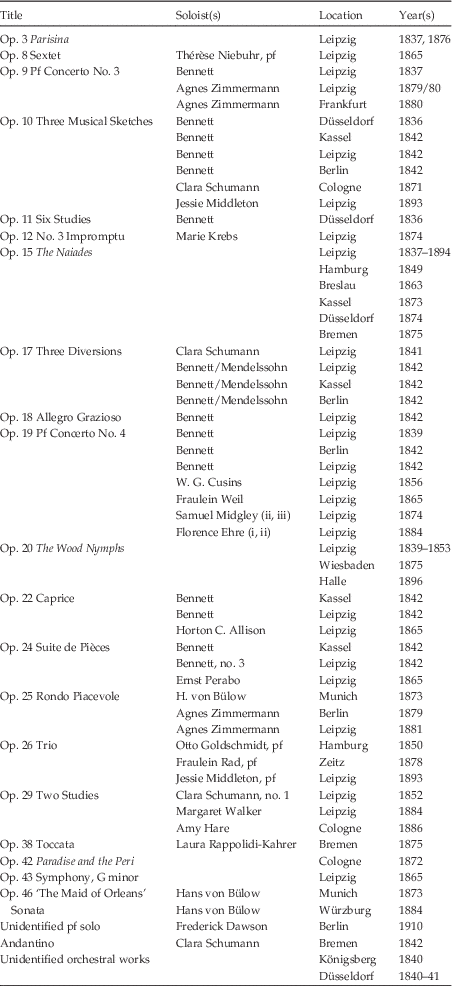
Bennett visited Germany seven times and on each occasion but two (1863, 1871) he performed or conducted his compositions (see Table 1). In May 1836 he played at a private recital before Mendelssohn and ‘musical friends’ the first performances of his Three Musical Sketches and Six Studies in the Form of Capriccios.Footnote 29 Bennett’s next visit occurred shortly after (October 1836 to June 1837), during which he performed the Piano Concerto No. 3 and conducted The Naiades at Gewandhaus Orchestra concerts. The Parisina overture received a hearing at Henriette Grabau’s concert also at the Gewandhaus. He stayed again in Leipzig (October 1838 to March 1839) where he gave the premiere of the revised Fourth Piano Concerto, conducted a performance of The Naiades and attended the premiere of The Wood Nymphs with Mendelssohn conducting. An even fuller schedule occurred during his fourth trip (January to March 1842). He played two premieres – Three Diversions and Allegro Grazioso – at private parties, then partnered with Mendelssohn for Three Diversions, and performed Three Musical Sketches, Piano Concerto No. 4, Caprice and Suite de Pièces at either private gatherings in Berlin and Kassel or at public concerts in Leipzig. Bennett declined appearances during a holiday trip to the Rhine in 1863, the year following his wife’s death. But when he returned to Leipzig in 1865, he conducted his new Symphony in G minor Op. 43 at the Gewandhaus. His final visit took place in August 1871 when he attended the Beethoven Festival in Bonn.
Performances in Germany of instrumental music by Bennett

Turning to performances where Bennett was not a participant, we learn that Leipzig, an important intellectual and cultural centre, remained the city that hosted more than any other location in Germany. Of the nearly eighty documented performances of his instrumental works, just under 50 per cent took place in Leipzig. These occurred most frequently in the Gewandhaus, either at subscription concerts of the Gewandhaus Orchestra or at events sponsored by individual performers at that venue. His overtures became the most popular choice for Leipzig audiences with fourteen appearances: The Wood Nymphs (7), The Naiades (6) and Parisina (1).
Bennett’s concerted works with piano received eight performances when the composer was not the soloist. Englishman William G. Cusins presented a concerto in 1856 at the Gewandhaus. A student of Bennett’s at the RAM and in the early stages of his career, Cusins judiciously chose a work by his teacher at a venue where Bennett had achieved success.Footnote 30 Bennett’s visit to Leipzig in 1865 prompted the Conservatory to organize a student concert in his honour. The large audience comprised both professors and students of the Conservatory, Gewandhaus directors, as well as music patrons from that city. For the occasion, Thérèse Nieburh was pianist in the Sextet, Fraulein Weil performed the Fourth Concerto and Horton C. Allison, an RAM graduate from London, played the Caprice.Footnote 31 When Leipzig again heard a Bennett concerto (1874), it featured another British soloist, Samuel Midgley, who rendered the Fourth Concerto at a Conservatory public examination.Footnote 32 Agnes Zimmermann appeared at a Gewandhaus concert (1880), where she performed solo works by J. S. Bach, Chopin and Brahms but selected for her concerto Bennett’s No. 3 in C minor.Footnote 33 A Leipzig Conservatory examination performance in 1884 featured another British student, Florence Ehre from Portsmouth, who played the first and second movements of the Fourth Concerto.Footnote 34 Australian pianist Jessie Middleton played the Chamber Trio in 1893 at a Sterndale Bennett Society concert.Footnote 35
Solo piano works heard by Leipzig concertgoers were chosen by a variety of pianists in addition to Bennett. Clara Schumann performed Three Diversions in 1841. Her partner for this four-hand piece is not identified, and it may be that she played her arrangement for solo piano. She appeared at a Robert and Clara Schumann concert (1852) with an unnamed piano solo referred to as ‘Etude–Andantino’.Footnote 36 Marie Krebs performed ‘Impromptu in F minor’ (1874), likely the third Impromptu Op. 12 in F sharp minor, a work seldom performed even in England.Footnote 37 Suite de Pièces occurred at the 1865 Conservatory concert discussed above with Ernst Perabo at the keyboard. Perabo emigrated to the United States and figured in Boston performances of the Fourth Concerto that will be discussed below. Agnes Zimmermann made another appearance with Rondo Piacevole at a Gewandhaus concert (1881).Footnote 38 Margaret Walker from Birmingham performed ‘Rondo Brillant, op. 29’ at a Leipzig Conservatory examination (1884).Footnote 39 And Jessie Middleton played Three Musical Sketches at the Sterndale Bennett Society concert where she participated in the Trio.Footnote 40 That close associations were maintained between Britain and Leipzig is evident from the founding in 1893 of the Society by British musicians that included Arthur Sullivan and Cusins. Its purpose was threefold: 1) to promote English music by giving concerts of works by British composers, 2) to assist British and Colonial musicians to obtain concert engagements and positions in the profession, and 3) to help music students pursuing their studies in Leipzig.Footnote 41
Performances occurred in numerous cities in addition to Leipzig, although none boasted as many. Laura Rappoldi-Kahrer’s interpretation of the Toccata, a rarity on the concert stage, occurred at private concert in Bremen.Footnote 42 Clara Schumann included the first of the Three Musical Sketches at a Gürzenich Orchestra Concert in Cologne and an unspecified ‘Andantino’ in Bremen.Footnote 43 Hans von Bülow presented ‘The Maid of Orleans’ Sonata on at least two occasions, at Munich and Würzburg, and Rondo Piacevole at the Munich concert.Footnote 44 Otto Goldschmidt, a von Bülow pupil when he attended the Leipzig Conservatory, played the Trio in A major in Hamburg.Footnote 45
At the time of Bennett’s death, the Neue Zeitschrift für Musik claimed that his compositions – symphonies, overtures, especially The Naiades – were well known in Germany.Footnote 46 A New York Times correspondent in 1875 remarked that ‘one often meets with an overture or pianoforte concerto by Bennett in a German concert programme’. Furthermore, he reports, a number of important towns, for example Düsseldorf, Cologne and Bonn, had excellent concert societies providing opportunities for Bennett’s instrumental repertoire. In addition, he had discovered a surprising familiarity among amateurs with the composer’s minor piano works.Footnote 47 Hermann Ritter in 1880 remarked that Bennett’s especially familiar works were The Naiades and The Wood Nymphs overtures, The May-Queen cantata and some unspecified chamber music.Footnote 48 A writer in 1881 declared that Bennett’s glory was no less great in Germany than in England and reminded readers that German companies had published the scores of all his major works.Footnote 49
European performances of Bennett’s music occurred in Holland, Vienna, Prague, Switzerland and Russia, but his most extensive network of associations and greatest popularity prevailed in Germany. The composer maintained his relationships with German colleagues throughout his life and, according to his son, ‘he was never happier than when a letter of introduction from Germany brought to his door some young foreigner, to whom he could render service’.Footnote 50
Australia and New Zealand: ‘The Greatest of Our Modern English Composers’
During the 1840s and 1850s while Bennett was establishing his reputation as a composer-pianist in England and receiving the encouragement of the Mendelssohn circle in Germany, the people of Australia and New Zealand learned of him chiefly through newspaper accounts that reported London concerts as early as the 1840s. Later, descriptions of his Classical Concerts kept interested readers current on his new works. Obituaries appeared for months after his death in 1875. Bennett’s association with the Bach Society of London was of particular interest in 1880 when the St Matthew Passion was performed for first time in Sydney. Although the performance of a Bennett composition was yet to be announced, scores of his music were available at least from the 1850s.Footnote 51
Some residents learned of Bennett from his former students who had made their way to the colonies. Many used their connection to Bennett in advertisements for students as they established themselves professionally. ‘A Lady recently from England, pupil of William Sterndale Bennett, English Professor of Music, wishes to give Lessons on the Pianoforte at her own residence’ read one notice.Footnote 52 Mrs Maxey in Tasmania advertised for ‘pupils in Italian, French, Music, Singing, and English’, claiming Bennett as her master in music.Footnote 53 Madame [A. E.] Winter’s notice in 1869 of her first concert in Auckland advertised her status as a former Bennett student.Footnote 54 Another émigrée, Mrs George Blandford, won the Sterndale Bennett prize at the RAM in 1875 then settled in Dunedin and established a career as a piano teacher. Miss Midgley travelled from Bradford, England to take up residence with her brother-in-law, J. West, an Auckland Music Seller, and become a piano teacher in that city.Footnote 55 Alfred Anderson, a native of Australia, studied with Bennett at the RAM and returned home to begin a career as a performer and teacher. In 1866, Anderson advertised he would begin giving lessons on the pianoforte ‘at the request of many influential families’.Footnote 56 J. L. Phillips, appointed a local representative in Queensland of the RAM, was another pupil of Bennett at the Academy. He had settled in Brisbane as a music teacher in 1904 with the intention of ‘giving pianoforte recitals in various towns’.Footnote 57 Evidence exists that some of these musicians performed compositions by Bennett, and we might reasonably conjecture that others taught his piano works to their students.
There were few opportunities to hear Bennett’s music, at least publicly, until the 1860s and then the earliest performances featured his vocal works. The distances between communities and the small population of many towns resulted in musical lives that depended upon amateur performances of their own making. Bennett’s instrumental music, the orchestral and chamber repertoire in particular, required professional or advanced amateur players and, thus, were programmed most frequently in the principal musical centres of that period.
In Australia, those centres encompassed Melbourne, Sydney, Adelaide, Brisbane and Hobart. Foremost was Melbourne, which became a wealthy city after the gold rush of the 1850s, a circumstance that contributed to its ability to support a growing concert life with professional musicians and to employ music teachers. Consequently, orchestral pieces received more hearings there than anywhere else. Most significant was the Centennial International Exhibition of 1888 marking 100 years of European settlement in Australia. English composer and conductor Frederick H. Cowen was engaged to direct the musical offerings. He brought with him fifteen musicians from England to bolster the native resources in Australia.Footnote 58 During the six months of the Exhibition (August 1888–January 1889), Cowen conducted 211 orchestral concerts, thirty choral concerts and twenty-two ‘Popular’ or ‘Miscellaneous’ events.Footnote 59 The Naiades appeared three times on its programmes and The Wood Nymphs on two occasions. These were judicious selections as Cowen and his imported musicians would have been well acquainted with the music, and the overtures offered a sampling of music by a recent and respected British composer. These concerts gave impetus to the notion of a permanent orchestra in Melbourne. Cowen communicated with Hubert Parry about undertaking direction of the new group, called the Victorian Orchestra. After Parry declined, Hamilton Clarke, the English conductor who had directed the D’Oyly Carte and Carl Rosa Opera companies, accepted the position. Due to an economic downturn, the initial enterprise lasted only one year. But during that short period, The Naiades appeared on programmes five times and The Wood Nymphs at four concerts. Familiarity with the music by the performers undoubtedly contributed to their many appearances, yet the overtures must also have achieved some popularity with Melbourne audiences to have been repeated so often. Both Cowen and Clarke returned to England after completing their contractual obligations in Australia.
Several solo piano works featured at Melbourne concerts. Rondo à la Polonaise appeared on a Melbourne Musical Artists’ Society concert (1882).Footnote 60 Mme Houyet-Howard performed Three Musical Sketches at a Melbourne Popular Concert (1891) and Rondo Piacevole at the same series in 1902.Footnote 61 Of special interest are two performances by Carlotta Tasca of ‘The Maid of Orleans’ Sonata. An English pianist and Bennett student, she first appeared in Melbourne in 1878 then presented a series of six chamber concerts the following season. At the fifth event, she played the Melbourne premiere of the sonata and likely its first hearing in Australia. The Argus reviewer praised it as ‘an elaborate work’ that ‘displays the genius of its author, in a strong and favourable light’.Footnote 62 Apparently, the audience agreed as Tasca repeated the sonata at her next concert.Footnote 63 Five years later, when she performed Bennett’s Barcarole from the Fourth Concerto as a solo piano piece, a critic regretted that ‘the name of Sterndale Bennett as a composer is too seldom heard, and too few occasions are afforded of hearing his music, although as a writer for the piano he takes high rank, and there are numerous symphonies and concert pieces from his pen, besides choral works’. Tasca was praised for her ‘highly finished and artistic’ reading, ‘as might be expected from one who has had the advantage of studying it with the composer himself’.Footnote 64
Fewer opportunities to hear music by Bennett occurred in Sydney. The first performance there of The Wood Nymphs took place at a Grand Orchestral and Vocal Concert in 1880. Sponsored by Hector R. M’Lean, the event enjoyed the patronage of Lord Augustus Loftus, the recently appointed British governor of New South Wales.Footnote 65 Piano solos for which we have information took place at private or semi-private gatherings. Mr C. Robinson performed Three Musical Sketches at the Countess of Jersey’s Musical Evening (1892). That same year, Gordon Burnside played Rondo à la Polonaise at a ‘charming musical “At Home”’ given by Mrs J. W. Flood at her residence.Footnote 66
Adelaide boasted a Choral Society and a Town Band as early as the 1840s and a Philharmonic Society founded in 1862. George Loder arrived in Adelaide four years later and developed a plan for a Monthly Popular Concert series.Footnote 67 Loder came from a family of musicians in Bath, England. A conductor and composer, he made two journeys to Australia (1856–1857, 1862–1868) and died in Adelaide in 1868. Although he conducted Bennett overtures during his time in the United States, which will be discussed below, his musical activities in Australia appear to have focused more on vocal music. Despite the existence of several flourishing concert organizations in Adelaide, few instances of Bennett’s instrumental music are to be found in press accounts. The city’s most significant publicized Bennett offering took place in 1881when the Adelaide String Quartet Club presented the Trio Op. 26.Footnote 68 Arrangements for keyboard provided another access to Bennett’s music. For example, the Minuetto and Trio from Symphony in G minor Op. 43 achieved limited popularity at organ concerts. An early performance took place in Adelaide (1885) and continued to appear on programmes until 1914. Likewise, an organ arrangement of the Barcarole from Piano Concerto No. 4 became an audience favourite. Other piano solos appeared at student recitals in Adelaide.
Brisbane, like Adelaide, featured chamber and solo piano compositions or organ arrangements rather than orchestral works. The Trio in A major was performed in 1891 by G. B. Allen at the piano in a ‘very nice little concert hall’ in the upper room of the H. J. Pollard piano store, made available for professors of music.Footnote 69 Keyboard soloists repeated Three Musical Sketches, Rondo à la Polonaise and the organ arrangements of the Minuetto and Trio from Symphony in G minor and the Barcarole. Hobart was the site of one of the few performances anywhere of Sonata Op. 13, a more ambitious work than the Bennett piano solos that were generally found in programmes. Arthur J. Mills selected this significant work for an appearance at the Tasmanian International Exhibition (1895).Footnote 70 Another source of dissemination of Bennett’s music occurred through the Australian Music Examinations. Students in Grade III could choose ‘The Mill Stream’ or ‘The Fountain’ from the Three Musical Sketches.Footnote 71
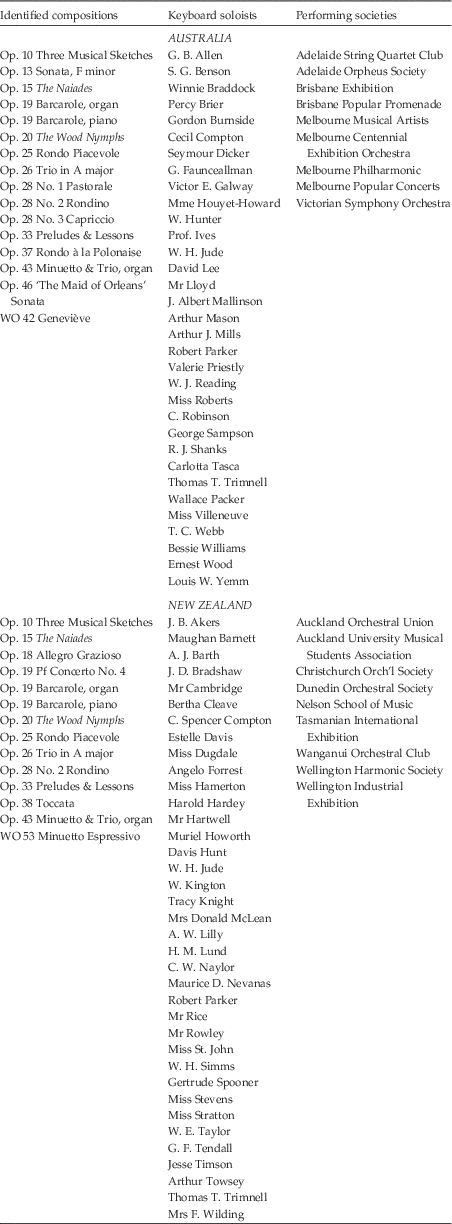
The work that tops the list for a number of performances in Australia is the organ arrangement of Barcarole from the Fourth Piano Concerto. A review from 1881 represents the general response to the piece: ‘[it has] a wonderful charm in it, which deepens upon every repetition. It is a most impressive instance of the depth, the tenderness, and the vigour of the mind of the greatest of our modern English composers’.Footnote 72 Celebrated organists performed this arrangement, generally in the major cities, for example, S. G. Benson and George Sampson in Brisbane, David Lee and Ernest Wood in Melbourne, as well as Auguste Wiegand and Arthur Mason in Sydney (see Table 2).
Instrumental music by Bennett performed in Australia and New Zealand

The Barcarole also became the most performed Bennett instrumental composition by far in New Zealand. In most cases it appeared as an organ solo. Robert Parker, Thomas Tallis Trimnell, Maughan Barnett, Arthur Barth, A. W. Lilly, and J. D. Bradshaw were among the colony’s important organists who included the work at their church and civic concerts. Barcarole also appeared in other guises – as a piano solo and a chamber work for piano with reduced instrumental accompaniment – but rarely in its original form for piano and orchestra. The work also acquired diverse titles such as ‘Venetian Gondola Song’ and ‘On the Adriatic’.Footnote 73
The Naiades received more performances than any other of Bennett’s orchestral works, although it too could be adapted to fit available musical resources. In Auckland (1889), Trimnell scored it for piano duet, two violins, flute and cello.Footnote 74 The Auckland Orchestra programmed the overture soon after, presumably with its original scoring. Wellington concertgoers heard the piece delivered by the Wellington Harmonic Society (1893) and as an organ solo (1897), arranged also by Trimnell.Footnote 75 The Dunedin Orchestral Society presented The Naiades (1895) as did the Wanganui Orchestra (1898, 1908).Footnote 76 Less popular was The Wood Nymphs with just one performance mentioned in newspaper notices when the Dunedin Orchestral Society programmed it in 1908.Footnote 77 Likewise, New Zealanders heard the Symphony in G minor only in an organ arrangement of its Minuet and Trio. Organists Robert Parker and W. Kington were the performers most associated with that work.Footnote 78 Parker became one of New Zealand’s most renowned musicians. Born and trained in England, he moved to take up an organist and choirmaster position in Christchurch in 1869. Eventually he settled in Wellington, the colony’s capital from 1865, where he directed the Wellington Orchestral Society and other performing groups. When Bennett’s Trio Op. 26 appeared on programmes in Wellington, it was under his aegis.Footnote 79 A further Trio performance occurred at the Auckland University Musical Students’ Association (1901), indicating that students in training were being introduced to his works.Footnote 80
Evidence from concert notices and reviews indicates that the solo piano compositions by Bennett occasionally appeared at student recitals but seldom on concert programmes. The titles were not always specific but those that we can identify are listed in Table 2. Three Musical Sketches appeared at the Wellington Industrial Exhibition (1896) with Miss Dugdale at the piano.Footnote 81 The one documented performance of the Toccata in Australia or New Zealand occurred in 1893 when Maughan Barnett played it at his concert series in Napier soon after settling there. Barnett, like Parker, was born in England and received his music training there before emigrating to New Zealand (c1890). He held positions in Napier, went on to became Wellington’s first city organist and conductor of the Wellington Musical Union, then to Auckland to become city organist.
Musicians who programmed works by Bennett in Australia and New Zealand frequently had a connection with the composer either as a former student or as a colleague in England. Performing a Bennett piece offered several advantages: many performers already knew his compositions from time spent in England, his piano compositions avoided the excessive virtuosity that at times produced critical disapproval of other composers, and his works contributed a quasi-novelty element to a programme yet did not stray far from a generally ‘classical’ style that audiences found agreeable.
The United States: ‘Pouring Ingredients into the American Furnace’
By 1914, the United States had grown from twenty-six states in 1840 to its forty-eight contiguous states while its population surged to 99 million people, a nearly sixfold increase. Music critic and writer Joseph Bennett observed during his tour of the country in 1885 that ‘the whole civilized world is pouring ingredients into the American furnace’.Footnote 82 Musical ingredients included touring artists, emigrating musicians and individuals who received musical training in England and Germany. Many influenced the founding of amateur music clubs in small and large towns across America as well as the establishment of professional orchestras in leading cities of the nation.
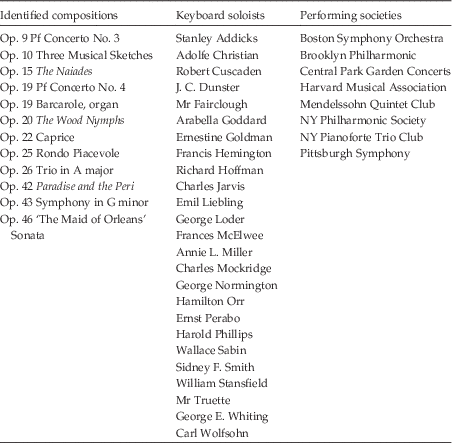
The earliest known performance of an instrumental work by Bennett occurred when The Naiades overture appeared on a New York Philharmonic Society (NYPS) programme during its third season in 1845.Footnote 83 (See Table 3.) Conducted by Louis Wiegers just eight years after its London premiere, a reviewer of the event introduced Bennett to New Yorkers as a ‘protégé and a worthy one too of Mendelssohn’ and praised the work for its ‘poetry of feeling, freshness of idea’ and ‘skillful instrumentation’.Footnote 84 The NYPS offered six further performances of Bennett compositions through 1914. The American premiere of The Wood Nymphs overture took place there in 1848, this time with Englishman George Loder at the podium. Loder’s first travels outside of Britain were to the United States where he settled initially on the East Coast (1836–1852) then moved to California (1852–1856).Footnote 85 The Wood Nymphs apparently enjoyed some success as it was programmed again in 1852 and 1856. For the latter, one critic described the work, as an ‘exquisitely imaginative overture’.Footnote 86 Loder’s association with the Philharmonic from its founding likely exerted an influence on the selection of Bennett repertoire. The final three concerts of the NYPS that contained a Bennett instrumental work featured Carl Bergmann conducting. Bergmann was one of many Germans who settled in America as a result of political upheavals in their country in 1848. He conducted two overtures, The Wood Nymphs (1856) and the orchestra’s only performance of Paradise and the Peri (1875), as well as the single appearance of a Bennett concerto with that orchestra (1871). The soloist for the event was Richard Hoffman who played Piano Concerto No. 4 but only movement two, the very popular Barcarole. His primary solo effort on that programme was Concerto No. 3 by Beethoven, which may account for his selecting only one movement of the Bennett concerto. With Hoffmann we see another soloist with connections to Britain. Born in Manchester, he settled in the United States in 1847 where he remained as a pianist, composer and teacher.
Instrumental music by Bennett performed in the United States

When not being played by the NYPS, overtures by Bennett were most frequently performed at the other major American cultural centre, Boston.Footnote 87 The Boston Symphony Orchestra (BSO), founded in 1882, programmed a Bennett instrumental work only during its early years (1883–1890). George Henschel, a German-born conductor who moved to Britain, led the BSO during its first three seasons. He programmed The Naiades at a weekend series of three concerts in 1883. The next year saw an appearance by Ernst Perabo at a pair of concerts with the Fourth Piano Concerto. After Perabo’s graduation from the Leipzig Conservatory in 1865 where he had performed for Bennett (see above), he settled in Boston and became a celebrated soloist and teacher, most famously of Amy Beach. The final appearance on a BSO programme before 1914 occurred when Arthur Nikisch conducted The Naiades at a weekend series in 1890. Programme notes by George H. Wilson reveal the prevailing attitude towards the composer by that date: Bennett is ‘a much loved and lovable English composer and conductor of the past generation’, a friend of Mendelssohn and Schumann. At the same time, Wilson confirms the notion that the composer was by 1890 best known through two choral works, The Woman of Samaria and The-May Queen.Footnote 88
Bennett performances in New York and Boston were not restricted to the NYPS and BSO. In New York, of special interest is an early rendering of the Trio Op. 26 when George Loder, G. F. Bristow and Alfred Boucher played it at a debut recital for a Loder student.Footnote 89 Five decades later, Richard Hoffmann played the Trio with Gustav Dannreuther and Emil Schenck, both of whom are further examples of first-generation Americans of German heritage.Footnote 90 Hoffmann appeared in 1885 in Brooklyn, now a borough of New York City, with their Philharmonic Society conducted by the prominent German-American musician Theodore Thomas in ‘a somewhat antiquated romance’ with orchestral accompaniment, likely the middle movement of the Third Concerto.Footnote 91 Thomas chose what appears to be the sole performance of the Symphony in G minor for one of his Central Park Summer Concerts (1875).Footnote 92
Additional performances in Boston occurred at the Harvard Musical Association. Paradise and the Peri (1871) was ‘a pleasing bit of variety and novelty, a delicate, refined, poetic, charming piece of instrumental art’, remarked one critic. His comments took a negative turn as he continued ‘albeit with no more of originality or decided force of genius in it than one is wont to expect from the gentle, graceful muse of the composer of the The Naiades and The Wood Nymph Overtures’.Footnote 93 Shortly after, the Association offered a complete performance of Piano Concerto No. 4 with Perabo as soloist and German émigré Carl Zerrahn conducting (1873). John Sullivan Dwight offered a mixed critique of the concerto. ‘Nowhere in the whole Concerto is there any eye to bravura … only the composition is to show itself, the virtuosity of the player is … a thing supposed’. Nevertheless, ‘like so many things by Bennett, it begins to pall somewhat upon repeated hearings’.Footnote 94 Boston concertgoers first heard The Wood Nymphs twenty years after its New York premiere at a symphony concert in 1868. ‘A delicate tone-poem, and romantic in the best sense’, described one critic. Yet he was concerned that ‘as it has not the qualities that smite and take by storm, its quiet beauties may not have been so generally appreciated as they would be upon more acquaintance’.Footnote 95
The soloist most closely associated with Caprice Op. 22 was the celebrated Boston pianist Benjamin J. Lang. He performed it on at least two occasions with string quintet accompaniment, first with the Mendelssohn Quintet Club (1859) and later at one of his chamber concerts (1871). A critic for the 1859 concert described the piano part as ‘very brilliant and sparkling, full of arpeggio and taxing execution’ but considered the quintet accompaniments ‘empty and uninteresting’.Footnote 96 He would have been pleased with Lang’s next appearance with the Caprice when the pianist delivered its first American performance with full accompaniment (1874) at a Harvard Musical Association concert.Footnote 97
Outside of New York and Boston, the performance record is thinner for Bennett’s orchestral or chamber compositions. The Pittsburgh Symphony programmed Piano Concerto No. 3 (1879).Footnote 98 Noted Philadelphia pianist and teacher Charles Jarvis performed the Piano Trio (1892).Footnote 99 The Naiades overture occurred several times at Peabody Conservatory concerts in Baltimore as well as in an unusual setting as an organ solo played by Percy Starnes in Atlanta in 1910.Footnote 100
As was the case in Australia and New Zealand, one of Bennett’s most popular works was the Barcarole from Piano Concerto No. 4, chiefly due to its wide appeal as an organ piece. Soloists performed it at church services and organ concerts across the country. A sampling of towns includes Minneapolis, Chicago, Indianapolis, Detroit, Omaha and Washington, DC. Even audiences at the 1904 World’s Fair in St Louis were treated to a hearing.Footnote 101 Renowned organists such as George E. Whiting in Boston, Harold D. Phillips at Peabody and William Stansfield in Washington included the piece their repertoire.
Documented performances exist for at least three of Bennett’s solo piano works: his popular Three Musical Sketches, Rondo Piacevole and ‘The Maid of Orleans’ Sonata. The diversity of venues for Three Musical Sketches reflects the variety of possibilities for Bennett’s less difficult piano pieces. Richard Hoffman included it in his New York Pianoforte Trio Club appearance in 1893. Annie Miller played ‘The Lake’ and ‘The Fountain’ at a ‘Musical Matinee’ in Lincoln, Nebraska. George Normington included ‘The Lake’ at a Lenten organ recital in Minneapolis, and Hamilton Orr performed it at a piano recital at the National Library for the Blind in Washington, DC. The situation is similar for Rondo Piacevole: two piano recitals in Chicago, a student performance at the music conservatory in Philadelphia and a San Francisco Musical Club performance on a programme of works by English composers.Footnote 102
The performance history of the ‘The Maid of Orleans’ offers a different story. The sonata was performed three times, all by professional soloists and within five years of its London premiere. B. J. Lang delivered its American premiere at his concert in Boston on 29 April 1875, perhaps as a tribute to the composer who had died two months earlier. Arabella Goddard played the sonata in public for the first time in August 1875 in San Francisco.Footnote 103 Why had she, the sonata’s dedicatee, not performed it earlier? Her travels from Ceylon to New Zealand (1873–1874) may have left little time to rehearse it to a performance standard. Perhaps she considered the piece not well suited for her audiences. Regardless, the five months she resided in California before bringing the sonata before the public provided her adequate preparation time, and perhaps the audience, she required. When Goddard arrived on the East Coast, one critic expressed the hope that audiences would hear more William Sterndale Bennett from her, but for reasons unknown she did not perform his music again in America.Footnote 104 When the sonata appeared a final time on a programme (1878), Alfred George Robyn’s performance in Boston was deemed merely ‘an acceptable reading’.Footnote 105
Summary
Bennett’s most enduring legacy as a composer rests with his instrumental output, in particular his works for piano. A history of that music in five locations across three continents brings to light not only an inventory of performances but also expands our knowledge of transnational networks made possible by advances in travel and increasing globalism. Connections operated in many directions: emigration from England and Germany to America and British colonies, travel to Europe for professional training and intersecting these lines were touring artists who criss-crossed the globe. Tracing performances of music by this important nineteenth-century composer-pianist broadens our understanding of developments in modern concert life as well as the transmission of British music within the Empire and beyond.
APPENDIX
Instrumental compositions by Bennett with documented performances in London, Germany, Australia, New Zealand or the United States