Introduction
Intestinal helminths are metazoan parasites, including cestodes, trematodes and nematodes. Intestinal nematodes comprise the largest group of intestinal helminths causing human diseases. Of the helminths that infect humans, the most important species include Ascaris lumbricoides, Ancylostoma duodenale, Necator americanus, Trichuris trichiura and Enterobius vermicularis. More than 2 billion people worldwide are infected with these gastrointestinal nematode species (Hotez et al., Reference Hotez, Brindley, Bethony, King, Pearce and Jacobson2008). Helminth infections, in particular soil-transmitted helminth (STH) infections, are common among people living in developing countries where there is increased population density, urbanization and poverty, inadequate sanitation and poor health awareness (Cairncross et al., Reference Cairncross, Bartram, Cumming and Brocklehurst2010). Pre-school and schoolchildren, and pregnant women are at risk of contracting these infections (Bethony et al., Reference Bethony, Brooker, Albonico, Geiger, Loukas, Diemert and Hotez2006).
These parasites are transmitted through ingestion of food or water contaminated with infective eggs, as a result of poor sanitation and hygiene (Quihui-Cota et al., Reference Quihui-Cota, Valencia, Crompton, Phillips, Hagan, Diaz-Camacho and Triana-Tejas2004; Engels & Savioli, Reference Engels and Savioli2006). Hookworm infection is transmitted via skin penetration by infective larval stages living in the moist soil (Kliegman et al., Reference Kliegman, Behrman, Jenson and Stanton2007). Intestinal helminth infections have been identified as an important cause of growth retardation (Stephenson et al., Reference Stephenson, Latham, Adams, Kinoti and Pertet1993), lactose intolerance (Gendrel et al., Reference Gendrel, Treluyer and Richard-Lenoble2003), protein energy malnutrition, iron-deficiency anaemia (WHO/WER, 2006) and reduced psychomotor development and cognition (Callender et al., Reference Callender, MacGregor, Walker and Cooper1994; Sakti et al., Reference Sakti, Nokes, Hertanto, Hendranto, Hall, Bandy and Satoto1999) in children.
Growth measurement is an important tool used in the assessment of adequate nutrition, health and development of individual children (Asfaw et al., Reference Asfaw, Wondaferash, Taha and Dube2015). Pre-school children need proper nutrition for their rapid growth and development (Birch et al., Reference Birch, Savage and Ventura2007). The upper-arm composition can provide a better assessment of muscularity and adiposity than other anthropometric measurements, as arm muscle and subcutaneous fat are major factors of endurance in malnourishment (Friedl et al., Reference Friedl, Westphal, Marchitelli, Patton, Chumlea and Guo2001). In children aged 6–60 months, mid-upper-arm circumference (MUAC) is as predictive of death as weight-for-length z-score (WFLz). In infants aged less than 6 months MUAC is not used because of its lack of reliability in practice and predictive value for death (Kerac et al., Reference Kerac, Mwangome, McGrath, Haider and Berkley2015). However, a study conducted in Kenya documented greater interobserver reliability compared to that of WFL (Mwangome et al., Reference Mwangome, Fegan, Mbunya, Prentice and Berkley2012). Reduced food intake, subcutaneous fat and muscle mass in human arms have a tendency to decrease MUAC (Fernández et al., Reference Fernández, Delchevalerie and Van Herp2010). Compared to other anthropometric measurements, MUAC can be taken by minimally trained health workers with low intra-observer errors (Alam & Rahaman, Reference Alam and Rahaman1989; Bradley et al., Reference Bradley, Brown and Himes2001). Thus, MUAC is a better anthropometric measurement to identify children in need of treatment. In developing countries where there is a high prevalence of undernutrition, MUAC is a better indicator than other anthropometric indices, since it is less affected by accumulation of fluid, such as oedema and ascites (Kennedy & Brouwer, Reference Kennedy and Brouwer2006).
A previous study in Sri Lanka showed that the prevalence of Ascaris and Trichuris infections were significantly higher in urban than rural areas, and this was associated with poor living conditions and personal hygiene (Athukorala & Lanarolle, Reference Athukorala and Lanarolle1999). Similarly, previous studies in Sri Lanka have reported that intestinal helminth infections are still a major health problem associated with poor sanitation and personal hygiene, low socio-economic status, overcrowding and lack of, or inadequately treated, drinking water (De Silva et al., Reference De Silva, De Silva and Jayapani1993; Sorensen et al., Reference Sorensen, Amarasinghe, Hettiarachchi and Dassanayake1996; Gunawardena et al., Reference Gunawardena, Karunaweera and Ismail2004, Reference Gunawardena, Kumarendran, Ebenezer, Gunasinghe, Pathmaswaran and De Silva2011; Galgamuwa et al., Reference Galgamuwa, Iddawela and Dharmaratne2015, Reference Galgamuwa, Iddawela and Dharmaratne2016). Information regarding MUAC of children and its association with parasitic infections is scarce in Sri Lanka. The purpose of this study was to determine the prevalence and association between intestinal helminth infections and MUAC among children in a rural community in Sri Lanka.
Materials and methods
Study setting and design
A cross-sectional study was conducted in a low socio-economic community close to Kandy municipal area in Sri Lanka from September to December 2014. The majority of the study population were farmers involved in agriculture and animal husbandry, while others were employed in public or private sectors as daily paid labourers. Unprotected spring wells were the main source of drinking water in this community. The majority of the adult population had completed ordinary-level education. Sanitary facilities of the study area were fairly good. Houses were made of brick and cement, and a power supply was available for every house.
Study participants
All children aged between 12 and 60 months in the study area were included in this study. The sample size was calculated using a formula of n = Z 2Pd/d 2, with a 5% margin of error (d) and 95% confidence interval. The prevalence (P) of intestinal parasitic infections among children in the plantation sector in Kandy was considered to be 21% (De Silva et al., Reference De Silva, De Silva and Jayapani1993). The calculated sample size was 255. Out of the total number of children aged between 12 and 60 months, 255 were selected, using a simple random sampling method. Children below 12 months of age and those who had recently received anthelmintic treatment were excluded from the study, since MUAC is not a reliable measurement for these children.
Collection of data
Before the beginning of the study, informed written consent was obtained from parents or legal guardians. Birth certificates were used to calculate each participant's age. A pre-tested standard questionnaire was used to obtain information such as gender, age, sanitary and drinking water facilities, education level of parents and family income. To get reliable data, children and their parents were interviewed in their native languages. For the MUAC, the mid-point between the tips of the shoulder and elbow of the left upper arm was measured to the nearest 1 mm using Shakir's tape. An MUAC less than 115 mm was classified as severe acute undernutrition (SAU), between 115 and 125 mm as moderate acute undernutrition (MAU) and more than 125 mm was considered as normal, according to WHO standard criteria (WHO, 2006). All measurements were taken by two different research members to minimize intra-observer errors and the mean was taken as the MUAC measurement. Oedema was examined by pressing the thumb on both feet for 3 s; if the skin depression remained on both feet, the child was considered having bilateral pitting oedema.
Faecal sample collection and analysis
A wide-mouth, screw-capped. clean plastic container coded with a unique identification number was distributed to each child a day prior to sample collection. Parents and guardians of selected children were given clear instructions regarding collection of the faecal specimen, avoiding contamination of faeces with urine or soil. Faecal samples were collected from their homes on the morning of the following day, and were immediately transported to the Department of Parasitology, Faculty of Medicine, University of Peradeniya. In the laboratory, direct faecal examination, using saline and iodine, was performed by experienced medical laboratory technologists within 2 h of faecal-sample collection. After direct stool examination, a small portion of each faecal sample was used to perform the formaldehyde–ethyl acetate concentration technique, to enhance the sensitivity of parasite detection. Kato–Katz thick smears were performed according to WHO guidelines, to determine the intensity of helminth infections (Ash et al., Reference Ash, Orihel, Savioli, Sin, Montresor and Renganathan1998). Ascaris lumbricoides infections were categorized as light, moderate and heavy if there were fewer than 5000, 5000–49,999 and 50,000 or over epg, respectively. Trichuris trichiura and hookworm infections were categorized as light infections if there were fewer than 1000 and 2000 epg, respectively; while moderate infections were regarded as those with 1000–9999 and 2000–3999 epg, respectively; and heavy infections as those with 10,000 or over and 4000 or over epg, respectively (WHO, 1987).
Statistical analysis
All statistical analyses were performed using SPSS version 17 (SPSS, Chicago, Illinois, USA). A reliability test was done to assess whether the MUAC values were consistent between research members. Descriptive statistical tests were applied to calculate the prevalence of intestinal helminth infections. An independent-sample t-test was used to compare means of MUAC values between infected and non-infected groups, and the intensity of infections. The chi-squared test was used to identify risk factors associated with MUAC and to determine the association between intestinal helminth infections and MUAC. A statistically significant difference was declared if the P value was less than 0.05.
Results
Prevalence of intestinal helminth infections
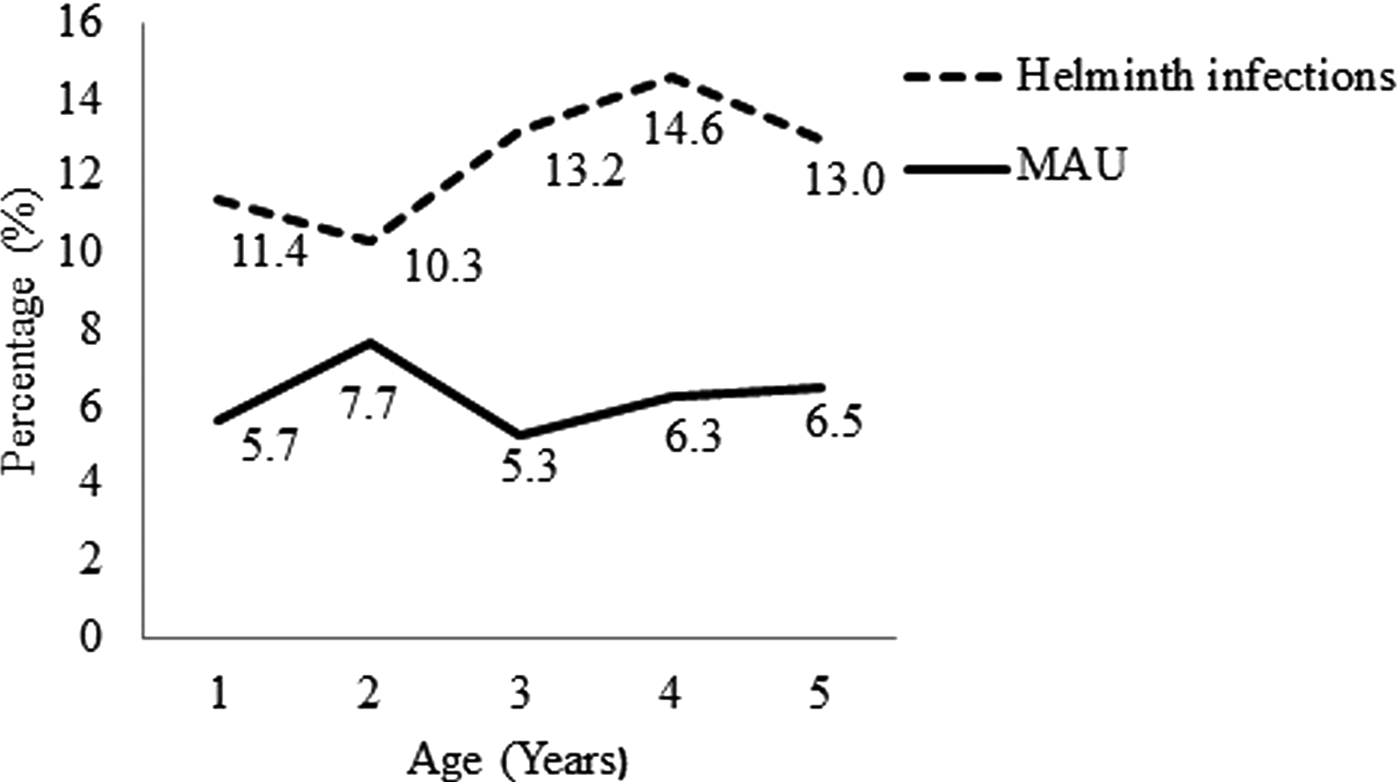
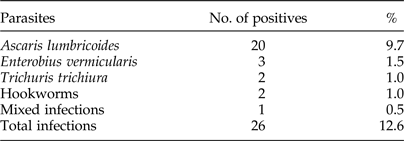
A total of 206 children (response rate: 81%) aged between 12 and 60 months, with a mean age of 2.9 (SD ± 1.0) years, participated in the study, of whom 51% were boys. The overall prevalence of helminth infection in the study group was 12.6% (26/206). Ascaris lumbricoides (9.7%) was the predominant helminth parasite in the study area, followed by E. vermicularis (1.5%), T. trichiura (1.0%) and hookworms (1.0%). Only one child had a mixed infection (table 1). Boys and girls showed a similar prevalence of helminth infection (13 and 12.2%, respectively). The highest prevalence of intestinal nematode infection was observed in children aged between 36 and 48 months (fig. 1). However, there was no statistically significant association of intestinal helminth infections with age and gender (P = 0.976 and 0.874, respectively). Out of the total infected, 20 (76.9%) had light infections while the rest had infections of moderate intensity; heavy infection was not detected among these children.
Prevalence of helminth infection and moderate acute undernutrition (MAU) in relation to age.

Prevalence of intestinal helminth parasites in the study group.

Determinants of MUAC
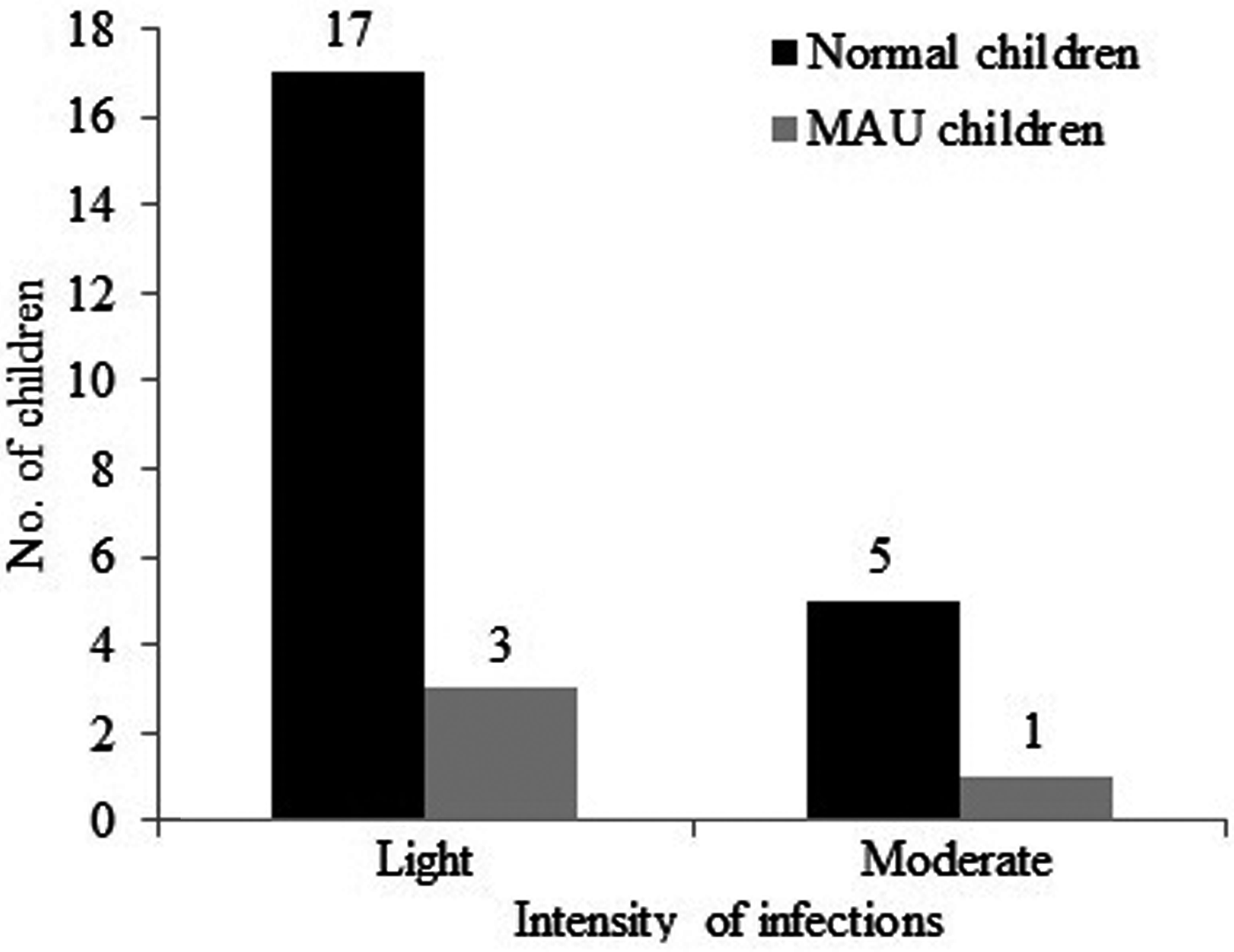
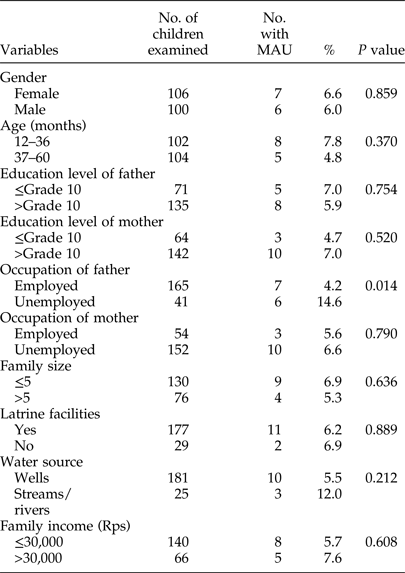
The reliability coefficient of MUAC was 0.948 and the mean value of MUAC was 147 ± 12.8 mm. Of the total study population, the MUAC of 13 (6.3%) children was less than 125 mm, all of whom were in the category of moderate acute undernutrition (MAU). Children with severe acute undernutrition (SAU) were not observed in the study group. The majority of undernourished children were not infected with intestinal helminths, while four of them were identified with intestinal helminth infections (fig. 2). Boys and girls showed similar prevalence rates of MAU. Compared to children aged more than 36 months, those aged less than that showed a slightly higher prevalence of MAU. A comparatively higher number of children with MAU was observed in those who lived in attached houses, with a lower family income, river/stream water usage and lack of latrine facilities. Interestingly, children whose mothers had a higher education level showed a higher prevalence of MAU than those with a low level of parental education. However, none of these factors showed a statistically significant association with MAU in this study population (table 2).
Number of children with moderate acute undernutrition (MAU) and intensity of intestinal helminth infections.

Socio-demographic characteristics and undernutrition among children. MAU, moderate acute undernutrition.

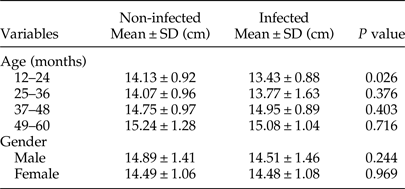
Children with intestinal helminth infection had a lower mean MUAC than non-infected children. A statistically significant higher mean MUAC was observed in non-infected children aged between 12 and 24 months (table 3).
MUAC and intestinal helminth infections among children.

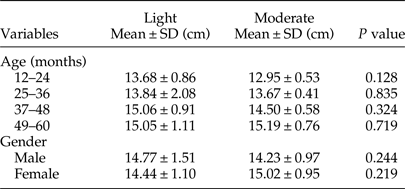
Moderately infected boys showed a lower mean MUAC than those with light infection. Girls with light infections showed lower mean MUAC than those with moderate infections. However, the intensity of intestinal helminth infections did not show any statistically significant association with the MUAC measurements (table 4).
MUAC and the intensity of intestinal helminth infections among children.

Discussion
The present study revealed that 6.3% of pre-school children in this study group had moderate acute malnutrition. Prevalence of intestinal helminth infection was 12.6%, with the majority having light infection. A study carried out in Nepal revealed a much higher prevalence of helminth infection (65.8%) and malnutrition (61%) among schoolchildren (Moock & Leslie, Reference Moock and Leslie1986). In our society, especially in rural areas, the very young child is better cared for and generally looked after inside the house. Our study revealed a statistically significant low MUAC measurement among infected children aged 1–2 years. A positive association of intestinal helminth infection with malnutrition in children has been documented by several researchers (Quihui-Cota et al., Reference Quihui-Cota, Valencia, Crompton, Phillips, Hagan, Diaz-Camacho and Triana-Tejas2004; Ulukanligil & Seyrek, Reference Ulukanligil and Seyrek2004).
Helminth infections generally cause gastrointestinal symptoms such as nausea, anorexia, vomiting and mechanical obstruction of the absorption of nutrients, thus causing reduced food intake and nutrient absorption from ingested food. At the same time, parasites also compete with the host for nutrients. All these facts could contribute to malnutrition, particularly in children in whom the nutritional demands are high. Children in this study had moderate acute undernutrition, and the majority of them had a light intensity of infection. We were unable to prove a statistically significant association of helminth infection with the MAU. This explains the fact that there is a minor influence of infection by intestinal helminths on the nutrition of children when they have low parasite burden. The present study revealed a significantly low MUAC measurement in infected children aged 1–2 years. Undernutrition in children under 5 years of age is usually the result of the interaction between insufficient dietary consumption and infectious diseases (Pelletier et al., Reference Pelletier, Frongillo, Schroeder and Habicht1994). Mostly during this period children are introduced to semi-solid food, therefore there could be less intake of nutritional food. This could be the reason for the low MUAC measurement observed in infected children.
The present study identified that undernutrition is still high among children. This is much lower than the Demographic and Health Survey (DHS) in Sri Lanka, which recorded that 10% of children under 5 years of age were wasted (DHS, 2007). The considerably high prevalence of low MUAC measurements and undernutrition among children can probably be attributed to the interaction between insufficient dietary consumption and infectious disease, which plays an important role in half of the deaths of children under 5 years of age in developing countries (Nandy et al., Reference Nandy, Irving, Gordon, Subramanian and Smith2005; Sen et al., Reference Sen, Bose, Shaikh and Mahalanabis2010). In addition, low parental education level, poor health-seeking behaviour, lack of healthcare services and poor infrastructure might be contributing factors of malnutrition among this population.
According to table 2, children aged more than 36 months showed a slightly lower prevalence of undernutrition compared to younger children. Similarly, Qureshi et al. (Reference Qureshi, Qureshi, Syed and Kokku2014) reported that MAU among children aged 6–23 months was significantly higher compared to those aged 24–59 months (22% and 4.8% respectively). The present study was unable to document any statistically significant association of MAU with parental education; however, many other studies have shown that parental education has a direct relationship with the nutrition of children (Arya & Devi, Reference Arya and Devi1991; Kunwar & Pillai, Reference Kunwar and Pillai2002).
When considering the employment of parents, fathers’ occupation level was identified as a risk factor for MAU in this community. Fathers are the breadwinners in many Asian communities. Employed fathers can provide better food and healthier surroundings that benefit their children. The present study revealed that the arm circumference of boys was greater than that of girls in both infected and uninfected groups. Our results were in contrast to studies in Uganda and Rwanda, which reported that boys were more susceptible to MAU compared to girls (Mupfasoni et al., Reference Mupfasoni, Karibushi, Koukounari, Ruberanziza, Kaberuka, Kramer, Mukabayire, Kabera, Nizeyimana, Deville, Ruxin, Webster and Fenwick2009; Lwanga et al., Reference Lwanga, Kirunda and Orach2012). However, age, gender, number of members in the family, sanitary and water sources were not significantly associated with MAU in the present study.
Intensity of infection was not an important factor for MAU in the present study. Therefore, feeding practices may be the main contributing factor to MAU in this community. Several studies have recorded that dietary food intake and subcutaneous fat and muscle mass in human arms tend to correspond to the MUAC measurement (Fernández et al., Reference Fernández, Delchevalerie and Van Herp2010). Lower immunity in undernourished children is a major determinant of intestinal helminth infections, compared to well-nourished children (Rodríguez et al., Reference Rodríguez, Cervantes and Ortiz2011). The functioning of T-lymphocyte cells and IgA-producing cells in the intestinal mucosa are greatly reduced in children with acute undernutrition (Reddy et al., Reference Reddy, Raghutamulu and Bhaskaram1976; Scrimshaw & San Giovanni, Reference Scrimshaw and San Giovanni1997), increasing the pathogenicity of intestinal parasites by allowing their adherence to the intestinal mucosa (Gendrel et al., Reference Gendrel, Treluyer and Richard-Lenoble2003). A longer duration of parasitic infection is therefore associated with high undernutrion risk in children and adults. Generally A. lumbricoides infections are associated with growth retardation and reduced protein–calorie reserves in children and adolescents. The educational level of parents and socio-economic conditions might be other factors influencing the growth and development of children in this community. Overall, the present study showed no significantly different MUAC values between non-infected and infected children. This suggests that helminth infections may not play a significant role in MUAC in this study group. Therefore, the effect of intestinal helminth infections on nutritional status is low.
In conclusion, intestinal helminth infections are a major public health concern in this community. However, intestinal infections are not a major contributing factor to MAU in our study population. Integrated control programmes based on chemotherapy in combination with sanitation and health education, together with strong community involvement, must be considered in order to ensure the positive long-term effect of such programmes. In addition, future detailed studies are required to determine the factors affecting the nutritional status of children in this study area.
Acknowledgements
We would like to express our deepest gratitude to the children, their parents and guardians who participated in this study. It is our pleasure to thank the medical authorities, welfare officers and other healthcare workers for their cooperation. Our sincere thanks also go to the academic and non-academic staff of the Department of Parasitology, Faculty of Medicine, University of Peradeniya for their continued support.
Financial support
This research received no specific grant from any funding agency, commercial or not-for-profit sectors.
Conflict of interest
None.
Ethical standards
This study was approved by the Ethical Review Committee, Faculty of Allied Health Sciences, University of Peradeniya, Sri Lanka. All parents were informed regarding voluntary participation and they were advised that they could withdraw from the study at any time. Informed written consent was obtained from parents or guardians for the participation of their children in the study. All data were kept confidential.