Introduction
Fresh market produce is an economically important component of Florida’s agricultural economy. The estimated 2017 production values for strawberries [Fragaria × ananassa (Weston) Duchesne ex Rozier (pro sp.) [chiloensis × virginiana]], tomatoes (Solanum lycopersicum L.), bell peppers (Capsicum annum L.), and cucurbits—including watermelon [Citrullus lanatus (Thunb.) Matsum. and Nakai], cucumber (Cucumis sativus L.), and cantaloupe (Cucumis melo var. cantalupo Ser.)—were $336 million, $262 million, $206 million, and $283 million, respectively (USDA-NASS 2018). The aforementioned crops are produced using a raised-bed, fumigated, drip-irrigated, plasticulture system. Multiple production cycles occur across the state between August and June for various crops.
Challenges for weed management within plasticulture production include limitations around herbicide use, crop rotations, intercropping, and cultivation during production (Boranno Reference Boranno1996). Plastic mulch restricts weed emergence to the planting holes and between the rows (row middles). Fumigants such as chloropicrin reduce the viability of some annual weed seed such as common purslane (Portulaca oleracea L.) (Haar et al. Reference Haar, Fennimore, Ajwa and Winterbottom2003). Row middles are generally treated early season with residual PRE and broad-spectrum POST herbicides. When early PRE herbicide efficacy wanes, additional PRE and POST herbicides are (re)applied to later-emerging vegetation, often resulting in multiple applications per season. Row middles have a wide spectrum of available products with varying efficacy, including flumioxazin, S-metolachlor, paraquat, oxyfluorfen, metribuzin, pendimethalin, carfentrazone, and clethodim (Freeman et al. Reference Freeman, McAvoy, Boyd, Kinessary, Ozores-Hampton, Smith, Noling, Vallad, Vallad, Smith, Dittmar and Freeman2017; Whitaker et al. Reference Whitaker, Boyd, Peres, Noling, Renkem, Vallad, Smith, Dittmar and Freeman2017). PRE and POST tank mixes are typically more effective than POST products alone. A previous study suggests that the most reliable tank mixes evaluated for vegetable plasticulture production are paraquat + flumioxazin, S-metolachlor + flumioxazin, or S-metolachlor + oxyfluorfen (Boyd Reference Boyd2016).
Row-middle weeds may impact crop yield (Gilreath and Santos Reference Gilreath and Santos2004), and uncontrolled populations may interfere with other pest management strategies. For example, species such as vetch (Vicia spp.) and horseweed (Erigeron canadensis L.) have been shown to be an inoculum source for strawberry anthracnose fruit rot (Colletotrichum acutatum J.H. Simmonds) (Freeman et al. Reference Freeman, Horowitz and Sharon2001). In Canada, black medic (Medicago lupulina L.), P. oleracea, and 53 other species were found to contain nematode lesions [Pratylenchus penetrans (Cobb) Filipjev and Schuurmans Stekhoven] (Townshend and Davidson Reference Townshend and Davidson1960). Weeds also increase production costs at the end of the growing season by physically disrupting plastic mulch removal. Furthermore, posttransplant herbicide applications risk drifting to the crop, and repeated applications of the same mechanism of action risk herbicide resistance. Paraquat resistance cases in Florida tomato production have been reported for American black nightshade (Solanum americanum Mill.) (Bewick et al. Reference Bewick, Kostewicz, Stall, Shilling and Smith1990) and E. indica (Buker et al. Reference Buker, Steed and Stall2002), primarily due to heavy reliance on paraquat for row-middle weed control.
Four troublesome weeds within Florida vegetable production are: Carolina geranium (Geranium carolinianum L.), carpetweed (Mollugo verticillata L.), goosegrass [Eleusine indica (L.) Gaertn.], and eclipta [Eclipta prostrata (L.) L.]. Mollugo verticillata is a short-lived, self-fertilizing annual that completes its life cycle under brief windows of favorable environmental conditions (Hereford et al. Reference Hereford, Schmitt and Ackerly2017). Mollugo verticillata is not a strong resource competitor in open fields (Kitajima and Tilman Reference Kitajima and Tilman1996), but populations will increase when left uncontrolled, especially when the crop is stressed (Norsworthy Reference Norsworthy2008). Therefore, M. verticillata likely thrives in plasticulture systems due to the high availability of fertilizer and low light competition. If plants survive herbicide applications due to misaligned application timings, persistent seedbanks may become an issue due to low emergence following seed rain (Cheplick Reference Cheplick2006).
Geranium carolinianum is a serious concern in strawberry fields. Populations tend to be patchy, but where they occur they are very competitive with the crop. Initial field emergence occurs during crop establishment, but the type and timing of POST control measures are variable. Chemical control may be delayed, because clopyralid, the only registered broadleaf POST herbicide for use atop the bed in strawberry production, has a 7-d preharvest interval, and growers harvest berries biweekly. This is a concern, because growers typically apply POST herbicides later in the season (mid-January), when yield prices are reduced and weeds have grown larger, as was noted for M. lupulina (Sharpe et al. Reference Sharpe, Boyd, Dittmar, MacDonald, Darnell and Ferrell2018). Emergence models based on seed ecology would help predict emergence timing and aid in predicting a timely POST herbicide application for G. carolinianum control. Geranium carolinianum seed dormancy characteristics have been studied extensively (Baskin and Baskin Reference Baskin and Baskin1974; Gama-Arachchige et al. Reference Gama-Arachchige, Baskin, Geneve and Baskin2010, Reference Gama-Arachchige, Baskin, Geneve and Baskin2011), but ecology-based germination studies have been limited.
Eleusine indica is a problematic Poaceae weed in both strawberry and vegetable production. Herbicide resistance to paraquat, which is a common POST option in a number of plasticulture systems, has been found in an E. indica population in tomato production (Buker et al. Reference Buker, Steed and Stall2002). Due to widespread distribution and a propensity for weedy infestations, E. indica seed ecology has been studied in the Philippines (Chauhan and Johnson Reference Chauhan and Johnson2008a), Hawaii (Nishimoto and McCarty Reference Nishimoto and McCarty1997), and Malaysia (Ismail et al. Reference Ismail, Chuah, Salmijah, Teng and Schumacher2002). Previous studies have shown variability in E. indica seed germination in response to temperature and light (Fulwider and Engel Reference Fulwider and Engel1959; Ismail et al. Reference Ismail, Chuah, Salmijah, Teng and Schumacher2002), and consequently, the results may not be directly transferable to Florida ecotypes.
Eclipta prostrata is a problematic Asteraeceae species in Florida vegetable production. Lack of control may be attributed to increased use of flumioxazin, which only provides limited E. prostrata control (Jordan et al. Reference Jordan, Lancaster, Lanier, Lassiter and Johnson2009). A tropical Filipino population and a temperate Oklahoman population have both demonstrated complete positive photoblasticity and germination across a range of temperatures (Altom and Murray Reference Altom and Murray1996; Chauhan and Johnson Reference Chauhan and Johnson2008b). Confirmation of similar seed ecology for subtropical populations can produce widely applicable E. prostrata growing degree-days (GDD) accounting restrictions across many climates.
Coordinating row-middle POST applications with seedling emergence, growth, and development would align herbicide applications with susceptible weed growth stages. GDD and hydrothermal emergence models are emergence prediction tools that use accumulated temperature units and available water as inputs. These models have been widely employed to predict the emergence of a variety of annual broadleaf and grass species in temperate climates (Martinson et al. Reference Martinson, Durgan, Forcella, Wiersma, Spokas and Archer2007; Royo-Esnal et al. Reference Royo-Esnal, Torra, Conesa, Forcella and Recasens2010; Werle et al. Reference Werle, Sandell, Buhler, Hartzler and Lindquist2014). Unfortunately, GDD-based field-emergence models are not easily adapted to subtropical climates such as Florida. Their adoption requires reductionist considerations for emergence (Grundy Reference Grundy2003; Vleeshouwers and Kropff Reference Vleeshouwers and Kropff2000), specifically, ecologically derived, dormancy- and germination-based GDD accounting restrictions to deal with GDD inflation due to high temperatures (Sharpe and Boyd Reference Sharpe and Boyd2019a, Reference Sharpe and Boyd2019b).
GDD accumulation restrictions were previously developed for M. lupulina using reductionist considerations toward dormancy and germination ecology (Sharpe and Boyd Reference Sharpe and Boyd2019a, Reference Sharpe and Boyd2019b). Successful development was conditional upon understanding the underlying germination and dormancy ecology for subtropical populations. Once the Florida population’s seed ecology is identified, GDD accounting restrictions can be produced that may be applicable to a wider range of climates. Therefore, the study objective was to study the impact of temperatures and osmotic potential on seed germination of troublesome weeds (G. carolinianum, M. verticillata, E. indica, and E. prostrata) to assess the applicability of ecologically derived, dormancy- and germination-based GDD accounting restrictions for use in empirically derived field-emergence modeling in plasticulture row middles.
Materials and methods
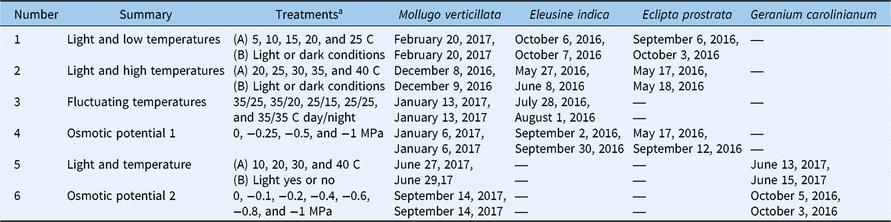
Weed seeds were collected at the Gulf Coast Research and Education Center (27.75°N, 82.22°W) at Balm, FL, in 2015 for G. carolinianum, E. prostrata, and M. verticillata and in 2010 for E. indica. Seeds were stored dry at 4 C within a refrigerator until trial initiation (Table 1). In 2016, experiments studying germination ecology of three troublesome weeds (E. prostrata, M. verticillata, and E. indica) in Florida strawberry and vegetable production were initiated. Four experiments were conducted examining the range and impact of osmotic potentials and temperatures potentially experienced in subtropical Florida on seed germination. These experiments included studying the influence light and a range of low constant temperatures (Experiment 1), light and a range of high constant temperatures (Experiment 2), fluctuating temperatures (Experiment 3), and osmotic potential (Experiment 4) on seed germination. In 2017, due to space limitations, the collective experimental set was refined by consolidating the light and constant temperature studies (Experiment 5) and expanding the osmotic potential study to include additional treatments (Experiment 6). Supplemental studies on M. verticillata were conducted based on initial results, and G. carolinianum was added as an additional test species. Dates for experiment initiation for each species are recorded in Table 1.
Seed ecology experiment initiation dates for four weed species in Florida strawberry and vegetable plasticulture production conducted in Balm, FL

a Treatments listed with letters indicate factor groupings.
All germination studies were conducted in petri dishes assembled in the following manner. Two pieces of filter paper (Fisherbrand™, Thermo Fisher Scientific, Waltham, MA) were placed within each petri dish (Fisherbrand™, Thermo Fisher Scientific). Seeds (25 dish−1) were deposited on the filter paper, and petri dishes were moistened with distilled water (5 ml) and then sealed with Parafilm M® (Bemis, Neenah WI). Each dish was an experimental unit, and dishes were randomly assigned to treatments. Dishes were placed in incubators (model I30BLLC8, Percival Scientific, Perry IA) with light levels between 89 and 114 µmol m−2 s−1. Lights were set to a 12-h photoperiod. Unless otherwise noted, the experimental design was a randomized complete block with four blocks, and experiments were conducted twice. The blocking factor was proximity to the incubator door. Dark treatments were wrapped in aluminum foil to impede light. Germination was counted at 4 wk after initiation of the experiment. A seed was considered germinated when the radical protruded from the seed coat.
Experiment 1 studied the impact of light and a range of constant low temperatures potentially encountered in subtropical Florida on seed germination, referred to as the light and low temperatures experiment hereafter. The experimental design was a two-factor factorial randomized complete block. The first factor was incubator temperature at 5, 10, 15, 20, and 25 C. The second factor was the presence or absence of light. Experiment 1 was conducted on M. verticillata, E. indica, and E. prostrata.
Experiment 2 studied the impact of light and a higher temperature range potentially encountered in subtropical Florida on seed germination (light and high temperatures experiment). The experimental design was a two-factor factorial randomized complete block. The first factor was the presence or absence of light. The second factor was a constant temperature with treatment levels of 20, 25, 30, 35, and 40 C. Experiment 2 was conducted on M. verticillata, E. indica, and E. prostrata.
Experiment 3 studied the impact of fluctuating temperatures on seed germination (fluctuating temperatures). Incubation temperature regime was the treatment factor with five levels: 35/25, 35/20, and 25/15 C day/night temperatures and controls of constant 25 and 35 C temperatures. Experiment 3 was conducted on M. verticillata and E. indica.
Experiment 4 studied the impact of osmotic potential on seed germination (osmotic potential 1). Osmotic potential was the main factor with four levels: 0, −0.25, −0.5, and −1 MPa. Polyethylene glycol (PEG) was added to water at 0.1325 g ml−1, 0.195 g ml−1, and 0.283 g ml−1 to produce −0.25, −0.5, and −1 MPa, respectively (Michel Reference Michel1983). Incubation temperature was set to constant 25 C. Experiment 4 was conducted on M. verticillata, E. indica, and E. prostrata.
Experiment 5 studied the impact of light and temperature on seed germination (light and temperature). The experimental design was a two-factor factorial randomized complete block design. The first factor was temperature at 10, 20, 30, and 40 C. The second factor was either the presence or absence of light. Experiment 5 was conducted on M. verticillata and G. carolinianum.
Experiment 6 studied the impact of osmotic potential on seed germination (osmotic potential 2). The experimental design was a randomized complete block. Osmotic potential was the main factor with seven levels: 0, −0.1, −0.2, −0.4, −0.6, −0.8, and −1 MPa. This corresponded to 0.08, 0.12, 0.175, 0.129, 0.255, and 0.287 g PEG ml−1 of water (Michel Reference Michel1983). Incubators were maintained at 30/20 day/night temperatures. Experiment 6 was conducted on M. verticillata and G. carolinianum.
ANOVA was conducted using the GLIMMIX procedure in SAS v. 9.4 (SAS Institute, Cary, NC). Block and experimental runs were considered random variables using the RANDOM statement. Model assumptions of normality and constant variance were verified by specifying for the student panel diagnostic plot in PROC GLIMMIX. Generated plots included a residual versus predictor graph to assess constant variance and a normal probability plot to assess deviations from normality. Means comparison was conducted using Tukey’s honest significant difference test (α = 0.05). For M. verticillata, the light and low-temperature data were zero-laden and not analyzed. The light and temperature data were also zero-laden, and the first two treatments were removed to permit analysis.
Results and discussion
Mollugo verticillata
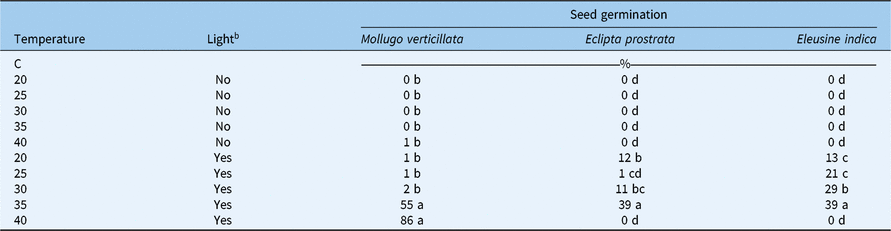
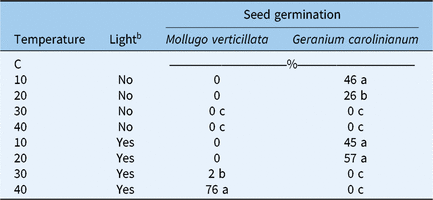
No germination of seeds was observed for Experiment 1 (light and low temperatures), so statistical analysis was not possible. Germination of M. verticillata seeds was influenced by an interaction between temperature and light (P < 0.0001) for both Experiment 2 (light and high temperatures) and Experiment 5 (light and temperature), respectively. For Experiment 2, the interaction was characterized by nearly no germination in the dark and 55% to 86% germination within light treatments (positive photoblastic germination) at temperatures ≥35 C (Table 2). In Experiment 5, the same trends were observed (Table 3). Results help define the minimum germination temperature, but further study is required to identify the maximum germination temperature.
Impact of temperature and light on seed germination of weed species occurring in Florida strawberry and vegetable production row middles, conducted at Balm, FL, in 2016/2017.a

a Studies were conducted in petri dishes in incubators. Germination was counted at 4 wk after trial initiation. Values for M. vertcillata and E. prostrata are back-transformed least-square estimates. Values for E. indica are untransformed least-square estimates. Different lowercase letters within columns signify a significant difference using Tukey’s honest significant difference test (α = 0.05).
b Light refers to the availability of light with a 12-h photoperiod and light levels between 89 and 114 µmol m−2 s−1.
Impact of temperature and light on seed germination of weed species occurring in Florida strawberry and vegetable production row middles, conducted at Balm, FL, in 2017.a

a Studies were conducted in petri dishes in incubators. Germination was counted at 4 wk after trial initiation. Values are back-transformed least-square estimates. Different lowercase letters within columns signify a significant difference using Tukey’s honest significant difference test (α = 0.05).
b Light refers to the availability of light with a 12-h photoperiod and light levels between 89 and 114 µmol m−2 s−1.
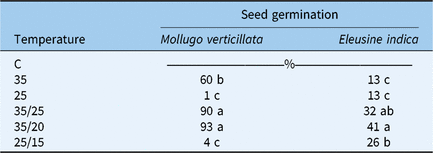
Germination of M. verticillata seeds was influenced by the fluctuating temperature regimes (P < 0.0001) in Experiment 3 (fluctuating temperatures). Peak germination occurred at fluctuating temperatures of 35/25 and 35/20 C, which were significantly greater than germination at a constant 35 C (Table 4). Although statistical comparison was not possible, this degree of germination was also greater than germination observed in the light and temperature experiments with constant temperatures. Fluctuating low temperatures stimulated lower germination than the constant 35 C treatment; therefore, it was not the fluctuation itself, but the high temperature fluctuations that maximized seed germination. Previous research regarding germination of M. verticillata seeds has been limited. Results contrasted with previous research conducted with a Michigan population, in which M. verticillata seeds germinated rapidly under 25/15 C fluctuating temperatures conditions with a 14-h photoperiod (Gross Reference Gross1990). Differences may be due to cold stratification or climatic adaptations of the Michigan population.
Impact of fluctuating temperatures on seed germination of weed species occurring in Florida strawberry and vegetable production row middles, conducted at Balm, FL, in 2016/2017.a

a Studies were conducted in petri dishes in incubators. Light was available at levels between 89 and 114 µmol m−2 s−1 with a 12-h photoperiod. Germination was counted at 4 wk after trial initiation. Values for E. indica are untransformed least-square estimates. Values for M. vertcillata are back-transformed least-square estimates. Different lowercase letters within columns signify a significant difference using Tukey’s honest significant difference test (α = 0.05).
Mollugo verticillata field observations in strawberry production suggest that this species occurs in row middles either early or late season (September or March). Crop establishment during the cooler season (November to December) may limit M. verticillata establishment within the bed. Mollugo verticillata is also commonly observed in summer vegetable production when temperatures are higher, which appears consistent with the results. Mollugo verticillata seeds germinated at lower temperatures (≤25 C), which does explain observations in a coastal beach region in New York, where spring emergence was only 1% of the fall seed rain (Cheplick Reference Cheplick2006). Because fluctuating temperatures stimulate dormancy release, dormancy-based restrictions for GDD accounting similar to those for M. lupulina may be suitable (Sharpe and Boyd Reference Sharpe and Boyd2019a).
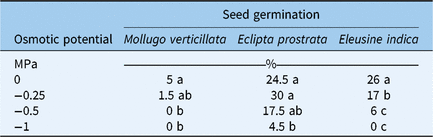
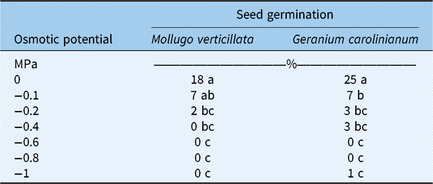
Germination of M. verticillata seeds was also affected by the osmotic potential treatments in both Experiment 4 (osmotic potential 1) (P = 0.0145) and Experiment 6 (osmotic potential 2)(P < 0.0001). Germination was negatively impacted as osmotic potential decreased and completely ceased by −0.5 MPa (Table 5) (Experiment 4). Further experimentation demonstrated that germination dropped rapidly as osmotic potential decreased and ceased entirely at −0.4 MPa (Table 6) (Experiment 6). Mollugo verticillata seeds were susceptible to water stress, therefore, it is advisable that hydrothermal models be developed for row-middle emergence monitoring.
Impact of osmotic potential on seed germination of species occurring in Florida strawberry and vegetable production row middles, conducted at Balm, FL, in 2016/2017.a

a Studies were conducted in petri dishes in incubators. Light was available at levels between 89 and 114 µmol m−2 s−1 with a 12-h photoperiod. The incubator was maintained at a constant 25 C. Germination was counted at 4 wk after trial initiation. Values are least-square estimates. Different lowercase letters within columns signify a significant difference using Tukey’s honest significant difference test (α = 0.05).
Impact of osmotic potential on seed germination of species occurring in Florida strawberry and vegetable production row middles, conducted at Balm, FL, in 2016/2017.a

a Studies were conducted in petri dishes in incubators. Light was available at levels between 89 and 114 µmol m−2 s−1 with a 12-h photoperiod. The incubator was maintained at 30/20 C day/night temperature. Germination was counted at 4 wk after trial initiation. Values are back-transformed least-square estimates. Different lowercase letters within columns signify a significant difference using Tukey’s honest significant difference test (α = 0.05).
Overall, germination of M. verticillata seeds was strongly driven by high constant temperatures (≥35 C), more so with high fluctuating temperatures that possibly mimicked diurnal temperature changes (35/25 and 35/20 C), demonstrated a positive photoblastic response, and was intolerant to reductions in available water. The results provide the necessary information to construct a temperature-mediated, germination-based GDD accounting restriction. The results also demonstrate the physiological impact of temperature and light on M. verticillata seed dormancy and subsequent germination (Tables 2–4). Further study is required to determine the impact of burial depth and temperature on M. verticillata emergence to assess the necessity of a PRE–growth based GDD accounting restriction. Further study is also required to construct the dormancy, germination, and PRE–growth based GDD accounting restrictions and assess their usefulness in predicting M. verticillata field emergence using GDDs in subtropical climates.
Eclipta prostrata
Germination of E. prostrata seeds was affected by an interaction between temperature and light (P < 0.0001) in Experiment 1 (light and low temperatures) and Experiment 2 (light and high temperatures). Eclipta prostrata seeds were strongly positively photoblastic with no germination in the dark and maximal germination between 20 and 35 C (Table 2). When exposed to light, E. prostrata seeds germinated between 20 and 35 C, with a maximum germination at 35 C. Further study will be required to determine the upper limit for E. prostrata seed germination between 35 and 40 C. Germination across this range is consistent with previous research (Altom and Murray Reference Altom and Murray1996).
Eclipta prostrata positive photoblastic germination was consistent with the previous literature (Altom and Murray Reference Altom and Murray1996; Chauhan and Johnson Reference Chauhan and Johnson2008b). Eclipta prostrata emerges primarily from the soil surface, and emergence declines sharply with seed burial depth (Chauhan and Johnson Reference Chauhan and Johnson2008b), likely due to the positive photoblastic effect. Even 5% of full light can stimulate 62% germination (Altom and Murray Reference Altom and Murray1996). Plastic mulch likely impedes seed germination at the surface, as it blocks light, although this requires further study. Using tillage to bury seed may be a potential control measure, although E. prostrata seed decay requires further study. Unfortunately, seed burial via tillage may not be a reliable control measure for Florida vegetable production, because the system relies on substantial tillage.
Germination of E. prostrata seeds was affected by osmotic potential (P = 0.0006) in Experiment 4 (osmotic potential 1). Eclipta prostrata seeds germinated in an osmotic potential as low as −1 MPa (Table 5). An Oklahoman population germinated in an osmotic potential of −0.8 MPa (Altom and Murray Reference Altom and Murray1996). This indicates E. prostrata is more tolerant to drying than M. verticillata. Hydrothermal considerations may not be necessary for E. prostrata, both due to its relatively high tolerance to water stress and its lack of tolerance to burial, the latter likely due to positive photoblasticity.
Overall, germination of E. prostrata seeds demonstrated a strong positive photoblastic response with tolerance to reductions in available water, and seeds germinated primarily in warmer temperatures (≥20 C). These results produce a strong foundation to build temperature-related GDD accounting restrictions for E. prostrata germination. They also give insight into the influence of temperature and light availability on E. prostrata seed dormancy and should aid in the construction of dormancy-based GDD accounting restrictions. Further study is required to identify the necessity of a PRE–growth based GDD accounting restriction. Further study is also required to construct and field-test germination, dormancy, and PRE–growth based GDD accounting restrictions for their effectiveness in predicting E. prostrata field emergence in subtropical climates.
Geranium carolinianum
Germination of G. carolinianum seeds was affected by an interaction between light and temperature (P = 0.0004) in Experiment 5 (light and temperature). Geranium carolinianum germinated in both light and darkness. Germination was inhibited at 20 versus 10 C in darkness but not in the light (Table 3). Freshly matured and scarified G. carolinianum seed germination was higher in darkness than light, but as the seed aged (1.5 mo), this difference diminished (Baskin and Baskin Reference Baskin and Baskin1974). Seeds in the current study had matured and aged, yet the negatively photoblastic effect had not diminished entirely.
Geranium carolinianum seed germination was affected by osmotic potential (P < 0.0001) in Experiment 6 (osmotic potential 2). Germination of G. carolinianum seeds was heavily impacted by any reductions in osmotic potential (Table 6). Minimal germination occurred as low as −0.4 MPa. Geranium carolinianum has been noted elsewhere as a non–drought tolerant species (Baskin and Baskin Reference Baskin and Baskin1974).
High temperatures impeded G. carolinianum seeds from germinating (Table 3). Germination inhibition in high temperatures is typical for seeds demonstrating conditional dormancy, due primarily to non-deep physiological dormancy, which has been noted for Geraniaceae and Malvaceae species (Baskin and Baskin Reference Baskin and Baskin1974, Reference Baskin and Baskin2004; Van Assche and Vandelook Reference Van Assche and Vandelook2006). High temperatures facilitate eruption of the “hinged valve” component of the water gap in the seed coat, which facilitates water imbibition (Gama-Arachchige et al. Reference Gama-Arachchige, Baskin, Geneve and Baskin2010). Non-deep physiological dormancy is necessary to avoid nonoptimal germination in hot and dry periods, such as reported in Tennessee (Baskin and Baskin Reference Baskin and Baskin1974). While Florida summers are generally hot and wet, G. carolinianum in strawberry production typically demonstrates an emergence pattern similar to that of M. lupulina, which occurred during a cool period between early November to late December (Sharpe and Boyd Reference Sharpe and Boyd2019a). This may be due to a similar combinational seed dormancy between M. lupulina (Sharpe and Boyd Reference Sharpe and Boyd2019b; Uzun and Aydin Reference Uzun and Aydin2004; Van Assche and Vandelook Reference Van Assche and Vandelook2010) and G. carolinianum (Baskin and Baskin Reference Baskin and Baskin1974; Gama-Arachchige et al. Reference Gama-Arachchige, Baskin, Geneve and Baskin2011). Geranium carolinianum combinational dormancy includes physical dormancy from the freshly matured hard seed coat and non-deep physiological dormancy (Baskin and Baskin Reference Baskin and Baskin1974, Reference Baskin and Baskin2004). Because current results for light sensitivity and temperature (Table 3) appear consistent with previous research (Baskin and Baskin Reference Baskin and Baskin1974), adaptation of GDD accounting restrictions for dormancy and germination to predict emergence in subtropical climates developed for M. lupulina (Sharpe and Boyd Reference Sharpe and Boyd2019a, Reference Sharpe and Boyd2019b) should be possible. However, it may be necessary to develop an emergence model with hydrothermal considerations for row middles, given how susceptible G. carolinianum is to reductions in osmotic potential (Table 6).
It was believed that high temperatures mediated seed softening for G. carolinianum (Baskin and Baskin Reference Baskin and Baskin1974). Fluctuating temperatures did affect germination, with reduced germination at 30/15 and 35/20 C compared with 20/10 C and constant temperatures between 5 and 25 C (Baskin and Baskin Reference Baskin and Baskin1974). These conditions combined with current results should form a solid foundation to build GDD accounting restrictions for subtropical Florida.
Overall, germination of G. carolinianum seeds demonstrated a positive photoblastic response, high temperature inhibition, and intolerance to reductions in available water and were unimpacted by fluctuating temperatures. Further study is required to elucidate how temperature impacts G. carolinianum emergence with burial depth to determine the necessity of a PRE–growth based GDD accounting restriction. Further study is also required to construct all GDD accounting restrictions (dormancy, germination, and PRE growth) and assess their utility in predicting field emergence using GDDs in subtropical climates.
Eleusine indica
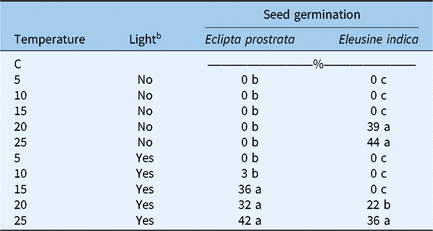
Germination of E. indica seeds was affected by an interaction between light and temperature for both Experiment 2 (light and high temperatures) (P < 0.0001) and Experiment 5 (light and temperature) (P = 0.0001). With low-temperature treatments, E. indica seeds only germinated at 20 and 25 C (Table 7). The E. indica base germination temperature was between 15 and 20 C, which contrasts with previous research (12.6 C) (Masin et al. Reference Masin, Zuin, Archer, Forcella and Zanin2005). Results were consistent with previous research examining dark germination within this constant temperature range (Fulwider and Engel Reference Fulwider and Engel1959). Similar results were demonstrated for germination between total darkness and alternating light at lower temperatures (25/15 C) (Chauhan and Johnson Reference Chauhan and Johnson2008a). For 1-yr-old E. indica seeds, germination increased from 21% to 40% under a 12-h photoperiod (Hawton and Drennan Reference Hawton and Drennan1980).
Impact of temperature and light on seed germination of weed species occurring in Florida strawberry and vegetable production row middles, conducted at Balm, FL, in 2016/2017.a

a Studies were conducted in petri dishes in incubators. Germination was counted at 4 wk after trial initiation. Values are back-transformed least-square estimates. Different lowercase letters within columns signify a significant difference using Tukey’s honest significant difference test (α = 0.05).
b Light refers to the availability of light with a 12-h photoperiod and light levels between 89 and 114 µmol m−2 s−1.
For the high-temperature range, E. indica seeds did not germinate in the dark (positive photoblasticity), and maximal germination occurred at 35 C for the high-temperature treatments (Table 2). Previous results in this temperature range have been variable. One study demonstrated that constant temperatures resulted in minimal germination (<3%) in light or dark, except for the 30 C with a 16-h photoperiod treatment (96% germination) (Fulwider and Engel Reference Fulwider and Engel1959). Alternatively, E. indica germination under constant temperatures (20, 25, 30, and 35 C) in total darkness has been noted (41% to 91% germination) (Ismail et al. Reference Ismail, Chuah, Salmijah, Teng and Schumacher2002). These vast differences may be due to afterripening, which has been shown to increase germination under darkness conditions to levels similar to those produced under a photoperiod with fluctuating temperatures (Chauhan and Johnson Reference Chauhan and Johnson2008a).
Germination of E. indica seeds was affected by fluctuating temperatures (P < 0.0001) in Experiment 3 (fluctuating temperatures). Fluctuating temperatures increased germination of seeds compared with constant temperatures, and germination under warmer fluctuations (35/20 C) increased further (Table 4). Fluctuating-temperature results were consistent with previous research (Chauhan and Johnson Reference Chauhan and Johnson2008a). Those authors found maximal germination with light exposure at high fluctuating temperatures (35/25, 35/20 C), and this difference diminished at lower temperatures (25/15 C). Optimal germination was found to be 30/25 and 35/25 C, 12-h photoperiod (Ismail et al. Reference Ismail, Chuah, Salmijah, Teng and Schumacher2002). Germination of E. indica seeds was minimal (<7%) at 20, 35, and 30 C, but E. indica seeds demonstrated 99% germination at 35/20 C, 8-h photoperiod (Nishimoto and McCarty Reference Nishimoto and McCarty1997). Those authors noted that E. indica seeds had imbibed and appeared to require fluctuating temperatures for germination and that germination would cease upon cessation of fluctuating temperatures. Treatment responses were consistent with previous research in which 35/20 C stimulated optimal germination in the presence or absence of light (Fulwider and Engel Reference Fulwider and Engel1959).
Germination of E. indica seeds was impacted by osmotic potential (P = 0.002) in Experiment 4 (osmotic potential 1). Germination ceased between −0.5 and −1 MPa (Table 5). The E. indica base germination osmotic potential was estimated at −1.21 MPa (Masin et al. Reference Masin, Zuin, Archer, Forcella and Zanin2005). Germination ceased when osmotic stress reached −0.80 MPa (Chauhan and Johnson Reference Chauhan and Johnson2008a; Ismail et al. Reference Ismail, Chuah, Salmijah, Teng and Schumacher2002). Eleusine indica appears sensitive to water stress. Hydrothermal models may be necessary, as irrigation does not occur in row middles. An exception is strawberry production, in which overhead irrigation is used for evaporative cooling and during crop establishment, keeping beds near field capacity before drip-irrigation initiation (Reed et al. Reference Reed, Boyd, Wilson, Dittmar and Sharpe2018). Additional study is necessary to understand soil–water dynamics during the strawberry establishment period to facilitate hydrothermal weed emergence models in row middles. Overall, the Florida E. indica population results were consistent with previous research from Malaysia, the Philippines, and Hawaii and shows physiological seed dormancy with positively photoblastic, fluctuating, and mean temperature components (Tables 2, 4, and 7) (Chauhan and Johnson Reference Chauhan and Johnson2008a; Ismail et al. Reference Ismail, Chuah, Salmijah, Teng and Schumacher2002; Nishimoto and McCarty Reference Nishimoto and McCarty1997). The photoblastic component of the physiological dormancy appears the shallowest dormancy element and is overcome by afterripening (Chauhan and Johnson Reference Chauhan and Johnson2008a). Seeds buried more than 4 cm below the soil surface for approximately 1,200 d did maintain 60% germinability, indicating other factors associated with burial depth had imposed dormancy (Masin et al. Reference Masin, Zuin, Otto and Zanin2006).
Overall, germination of E. indica seeds demonstrated positive photoblasticity, a base temperature between 15 and 20 C, and a maximal temperature of 35 C. Furthermore, warmer fluctuating temperatures increased germination of E. indica seeds (35/25 and 35/20 C), and germination ceased between −0.5 and −1 MPa. These results provide a foundation to construct temperature-related GDD accounting restrictions for E. indica emergence modeling. Eleusine indica emergence models likely will not require a hydro component, given this weed’s relative tolerance to reductions in available water. Dormancy components for E. indica emergence models appear to be primarily influenced by light (Table 2), temperature (Tables 2, 4, and 7) (Chauhan and Johnson Reference Chauhan and Johnson2008a; Ismail et al. Reference Ismail, Chuah, Salmijah, Teng and Schumacher2002; Nishimoto and McCarty Reference Nishimoto and McCarty1997), and burial depth (Masin et al. Reference Masin, Zuin, Otto and Zanin2006). Further study is required to determine the impact of temperature on the PRE growth component for field emergence, for E. indica seed burial <4 cm. Further study is also required to construct all GDD accounting restrictions (germination, dormancy, and PRE growth) and evaluate their effectiveness in limiting GDD for E. indica field emergence in subtropical climates.
In conclusion, E. indica, G. carolinianum, E. prostrata, and M. verticillata all demonstrated positive photoblastic germination. Germination of M. verticillata and E. prostrata seeds was strongly driven by high temperatures, whereas G. carolinianum seeds were inhibited by high temperatures. Germination of seeds was affected by fluctuating temperatures for E. indica and M. verticillata, but not G. carolinianum. Mollugo verticillata and G. carolinianum were very intolerant to reductions in available water (germination ceasing after −0.25 and −0.4 MPa, respectively), E. prostrata was more tolerant (−0.5 MPa), and E. indica was very tolerant (−1 MPa). The impact of temperature and osmotic potential for the selected species provides context for developing GDD accounting restrictions. Species with sensitivity to reductions in available water, such as M. verticillata and G. carolinianum, may require hydrothermal emergence models, particularly to predict emergence in row middles. Further research is required to build all GDD accounting restrictions for the selected species. Further research is also required to test the effectiveness of the GDD accounting restrictions in field-emergence scenarios and the feasibility of using restricted GDD emergence modeling for the selected species within subtropical climates such as Florida.
Author ORCID
Shaun Michael Sharpe https://orcid.org/0000-0002-7683-703X.
Acknowledgments
No conflicts of interest have been declared. This research received no specific grant from any funding agency or the commercial or not-for-profit sectors.