Introduction
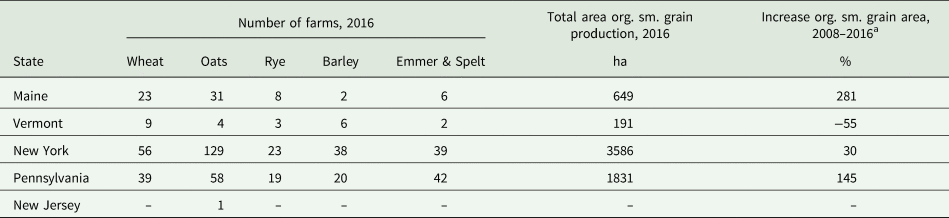
The recent rise in consumer demand for organic small grain products in the Northeastern U.S. has created a significant economic opportunity for organic growers to produce small grains (Reaves and Rosenblum, Reference Reaves and Rosenblum2014). In response, organic small grain production in this region has steadily risen in the last decade (Table 1, National Agricultural Statistics Service, 2008–2016). The sustained success of this emerging organic sector relies on the existence of affordable sources of nitrogen (N) and N-building practices that are compatible with small grain-based cropping systems. Nitrogen management can present a formidable challenge for organic producers, who are restricted from using chemical fertilizers in their production and must instead rely on animal manures, legumes, soil organic matter and organically-approved fertilizer blends to supply N to their crops (Watson et al., Reference Watson, Atkinson, Gosling, Jackson and Rayns2002). N is yield-limiting in most organic systems (Berry et al., Reference Berry, Sylvester-Bradley, Philipps, Hatch, Cuttle, Rayns and Gosling2002) and, as such, failing to successfully manage N can result in economic consequences. In this study, we investigate the N management practices of organic small grain producers using a qualitative approach, with the goal of identifying major challenges and optimizing future research and programming.
Total number of farms producing organic small grains by state in 2016, total area of organic small grain production by state in 2016 and percent increase in the area of organic small grain production from 2008 to 2016 (National Agricultural Statistics Service, 2008–2016)

Most data for New Jersey was not available, likely due to the small production area in this state.
a Emmer and spelt data not reported in 2008 census.
Prior research regarding N management in organic small grain systems has focused primarily on assessing agronomic performance of small grains under various nitrogen management regimes (Dawson et al., Reference Dawson, Huggins and Jones2008; Olesen et al., Reference Olesen, Askegaard and Rasmussen2009; Mallory and Darby, Reference Mallory and Darby2013) including the use of legume green manures (LGMs) (Vaisman et al., Reference Vaisman, Entz, Flaten and Gulden2011; Tamm et al., Reference Tamm, Tamm, Ingver, Koppel, Tupits, Bender, Tamm, Narits and Koppel2016). LGMs are leguminous plants established primarily to amend soil and provide nutrients to subsequent crops (Cherr et al., Reference Cherr, Scholberg and McSorley2006). The atmospheric N fixed by LGMs is released in an inorganic form into the soil when the plant tissues degrade. The recent decline in livestock operations throughout the U.S. has led to a geographical concentration of animal manure, a valuable source of N for small grain growers (MacDonald and McBride, Reference MacDonald and McBride2009). In regions where access to manure is limited, LGMs can provide an affordable, alternative N supply for organic small grain crops. For example, a review of research in northern climates revealed that spring-seeded red clover intercropped with barley contained 10–108 kg N ha−1 at fall termination (Gaudin et al., Reference Gaudin, Westra, Loucks, Janovicek, Martin and Deen2013). Similar N content was determined for interseeded red clover in New York (84–196 kg N ha−1; Ketterings et al., 2011) and hairy vetch in Maine (46–127 kg N ha−1; Jannick et al., Reference Jannick, Merrick, Liebman, Dyck and Corson1997). The use of LGMs is associated with multiple ecosystem services, including weed control (Amossé et al., Reference Amossé, Jeuffroy, Celette and David2013), pest and disease suppression (Gaudin et al., Reference Gaudin, Westra, Loucks, Janovicek, Martin and Deen2013) and building soil organic matter (Cherr et al., Reference Cherr, Scholberg and McSorley2006). Success in LGM use, however, can be compromised by management-related challenges, including failure to establish even LGM stands (Muñoz et al., Reference Muñoz, Steibel, Snapp and Kravchenko2014) and issues with termination (Creamer et al., Reference Creamer, Plassman, Bennett, Wood, Stinner and Cardina1995; Clark, Reference Clark2007). Economic concerns, such as the opportunity cost of using field space for an unharvested crop, may also present a challenge for farmers (Roesch-McNally et al., Reference Roesch-McNally, Basche, Arbuckle, Tyndall, Miguez, Bowman and Clay2017).
As organic small grain production continues to expand in the Northeast, it is essential for agricultural advisors to tailor future programming and research to meet the needs of organic small grain producers with regard to N management. A key area in need of investigation is the adoption and the use of LGMs by growers. Past studies focused on adoption of agroecological practices have identified factors such as ecological awareness (Blesh and Wolf, Reference Blesh and Wolf2014; Wilson et al., Reference Wilson, Howard and Burnett2014) and past experiences (Corselius et al., Reference Corselius, Simmons and Flora2003; Chongtham et al., Reference Chongtham, Bergkvist, Watson, Sandström, Bengtsson and Öborn2016) as influential in predicting the use of such practices among farmers. However, meta-analyses of literature on the adoption of agricultural innovations have failed to identify variables that successfully, and universally, predict use or disuse (Knowler and Bradshaw, Reference Knowler and Bradshaw2007; Carlisle, Reference Carlisle2016), largely due to the lack of homogeneity across farming communities. Research has also highlighted the importance of identifying structural challenges, such as those related to market diversity and economics, that might inhibit practice adoption (Carlisle, Reference Carlisle2016; Roesch-McNally et al., Reference Roesch-McNally, Basche, Arbuckle, Tyndall, Miguez, Bowman and Clay2017).
In this study, we use interviews to identify current challenges encountered by organic small grain producers in the Northeastern U.S. with regard to N management, and highlight successful grower strategies, from the perspectives of farmers and their advisors. In particular, we assess the role of LGMs in N management, and uncover potential barriers faced by growers wishing to increase their usage of legume-based N on-farm. We conclude with suggestions for future research and programming.
Methods
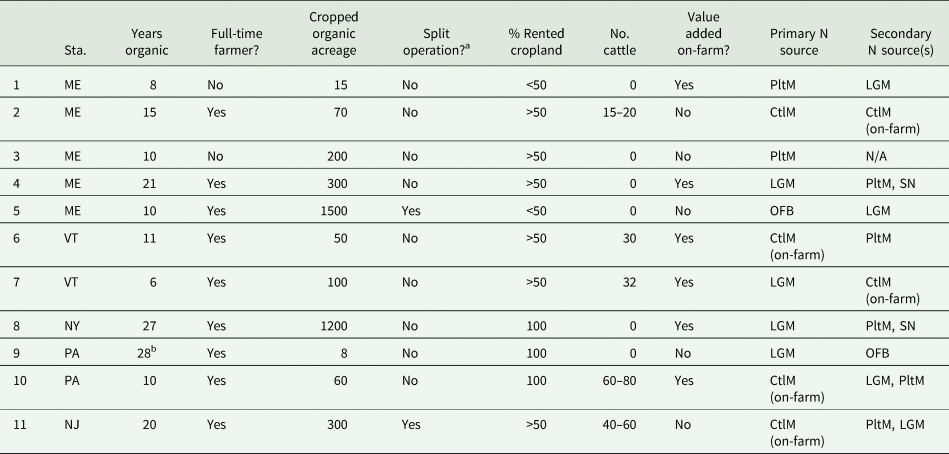
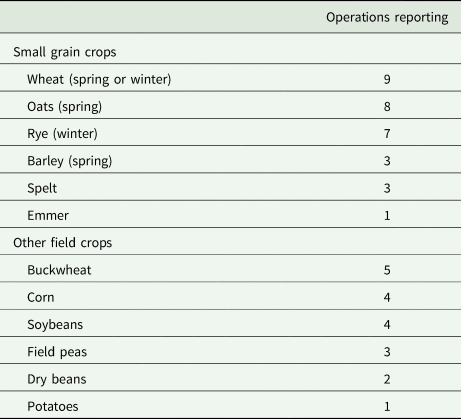
Both farmers and agricultural advisors were interviewed for this study. Farmer interviewees (ten male and two female) from 11 individual operations were selected based on the recommendations of advisor participants, who were asked to identify experienced, successful organic small grain growers in their region. Two of the farmer participants were co-owners of the same operation and were interviewed together; this interview is treated as a single sample. Farmers' operations were located in Maine (n = 5), Vermont (n = 2), New York (n = 1), New Jersey (n = 1) and Pennsylvania (n = 2), and varied in acreage (Table 2) and types of crops grown (Table 3). With one exception, all operations were certified organic, though the non-certified farmer described using strictly organic growing methods. Five of 11 operations owned cattle (participants were not asked about other livestock), and six of 11 had the capacity to add value to their organic small grain product on-farm by milling or grinding. Growers varied in their choice of primary and supplementary sources of N fertility, with a majority (63%) using a combination of animal manure and LGMs.
Farmer interviewees and operation characteristics

LGM, legume green manure; CtlM, cattle manure; PltM, poultry manure; SN, sodium nitrate; OFB, organic fertilizer blend.
Note: All poultry and cattle manure generated off-farm unless otherwise indicated.
a Refers to an operation that produces both conventional and certified organic crops.
b This grower is not certified organic, but describes using strictly organic growing practices.
Crops grown by farmer participants

Advisor participants (six male and two female) were selected based on their expertise in the field of soil fertility and organic small grain systems in the Northeastern U.S., and included Cooperative Extension personnel, university faculty members, and crop advisors from non-profit organizations. Some, but not all, are certified crop advisors. Individuals from Maine (n = 2), Vermont (n = 1), Massachusetts (n = 1), New York (n = 1), New Jersey (n = 1) and Pennsylvania (n = 2) participated. All but two had contributed to formal research and/or outreach efforts focused on the enhancement of organic small grain systems. In one interview, an advisor was accompanied by his graduate student, who is also an organic grain farmer.
Following approval from the University of Maine Institutional Review Board for the Protection of Human Subjects, eighteen telephone interviews, with 20 total participants, were conducted between December 2017 and March 2018. Questions for farmers focused on their experience using LGMs and other N sources, as well as the challenges they faced with N fertility management in general. Advisors questions were similar, based on their experience working with the growers in their region. In addition, advisors were asked about the level of success of any previous programming and outreach efforts in N management they had been involved in producing.
Interviews were typically 60 min in duration and were semi-structured, allowing for occasional follow-up questions from the interviewer (Bernard, Reference Bernard2011). With participant permission, interviews were digitally recorded, and audio recordings were transcribed verbatim and checked for accuracy by one of the authors. Analysis was performed using MAXQDA (VERBI Software, 2018). An initial round of open coding was performed on all transcripts, followed by subsequent, targeted coding to identify major challenges, strategies and needs regarding N fertility (Corbin and Strauss, Reference Corbin and Strauss2008).
Results
Description of nitrogen management systems
Farmer participants employed a range of materials and practices for supplying N fertility to their small grain crops (Table 2). At the time of the interviews, six operations used animal manure as their primary N source, with three using cattle manure generated on their own farms and three importing poultry or cattle manure from off-farm. Raw manures were typically broadcast and incorporated prior to small grain planting, or applied to a cover crop preceding a small grain. Pelletized and granulated poultry manure products were also used by growers, and were typically banded in-row at planting. One farmer used an organic fertilizer blend (NatureSafe, 10-2-8) as the primary N source for his small grain crop, which he applied at planting using a standard grain drill. This practice was considered by Maine advisors to be too costly for most organic small grain operations in the region.
The remaining four farmers used LGMs to supply the majority of their crops' N needs. Participants provided descriptions of their crop rotations to demonstrate how LGMs were used on their farms (Table 4). Most growers who utilized LGMs favored red clover (Trifolium pratense, L.), a short-lived perennial that overwinters in most of the Northeastern U.S. In most cases, red clover was established as an intercrop by planting between the rows of small grains. Clover establishment was achieved through frost-seeding in winter grains, or broadcasting at or following crop planting for spring grains. In addition to red clover, two farmers grew yellow sweet clover (Melilotus officinalis, (L.) Lam.), one grew crimson clover (Trifolium incarnatum, L.), one grew white clover (Trifolium repens L.), one grew field peas (Pisum sativum subsp. arvense (L.) Asch.), one grew hairy vetch (Vicia villosa Roth) and three grew alfalfa (Medicago sativa, L.). Farmers described growing LGMs for as little as several months, or up to several years, before incorporation. All but one used a moldboard plow to terminate the green manure, with the remaining grower using a heavy disk.
Crop rotations that include LGMs, as described by three farmer interviewees

WW, winter wheat; RC, red clover; WR, winter rye; SW, spring wheat.
Note: Forward slash indicates intercropping.
a Frost seeded in early spring.
Two growers, both of whom used LGMs as their predominant N source, reported using sodium nitrate as a supplementary N source. These farmers described broadcasting the product onto spring and winter wheat at tillering or flag-leaf stage for yield or grain protein enhancement, respectively. Sodium nitrate, a mined product containing high soluble N, is currently permitted by National Organic Program regulations, though its use in organic production is prohibited in several countries (McEvoy, Reference McEvoy2012).
Challenges in nitrogen management
Nitrogen management was considered a major challenge to six of the eleven farmers interviewed. Other top challenges mentioned included weed management (seven farmers), weather-related issues (three farmers), timing and efficiency of field tasks (two farmers) and challenges with equipment and infrastructure (two farmers).
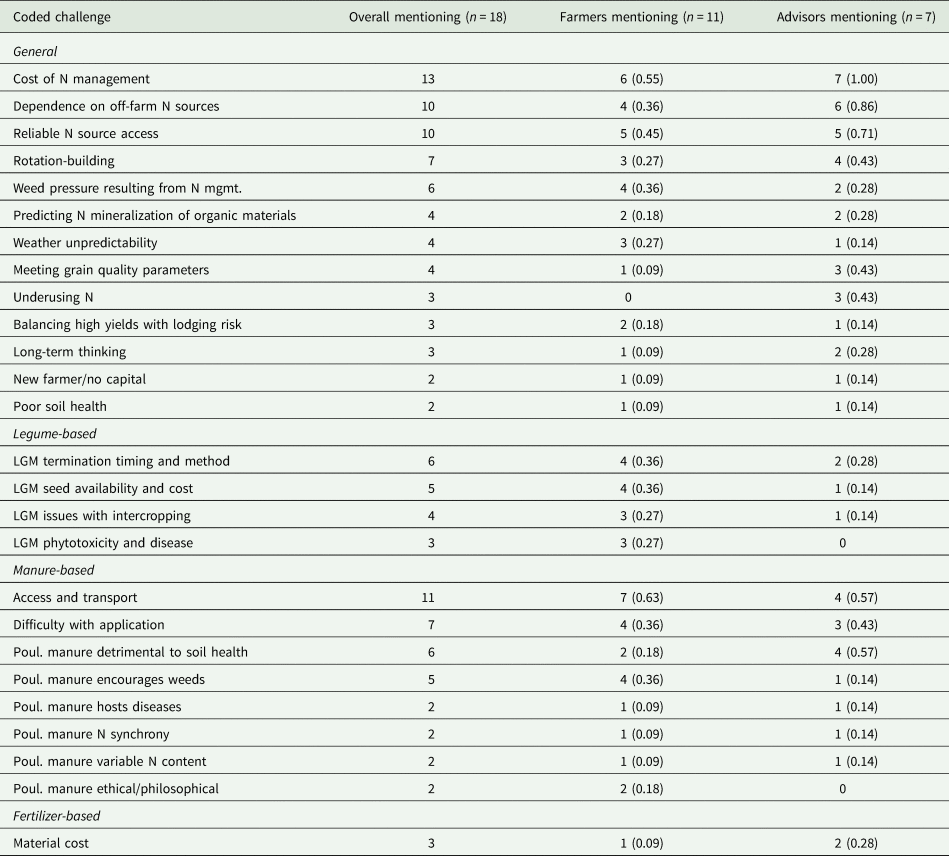
Farmers and advisors identified a range of challenges regarding N management for organic small grains (Table 5). Significant overlap existed between the major challenges identified by farmers and advisors, suggesting a high level of communication between these two groups.
Major challenges in nitrogen management, as identified by farmers and advisors, and number (fraction) of interviews in which challenge is mentioned for each participant group

Cost of nitrogen management
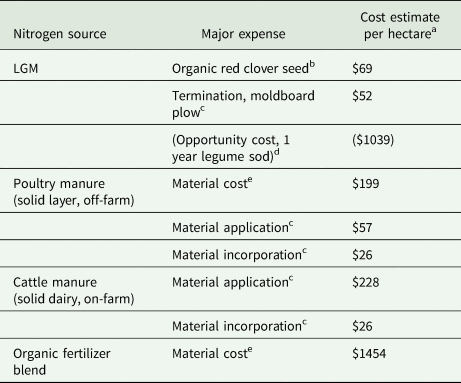
The most commonly cited challenge was the cost of N management, which was mentioned in six of the eleven farmer interviews and all advisor interviews. Cost estimates for major expenses mentioned are shown in Table 6. Farmers and advisors cited the cost of high-quality LGM seed, time-consuming field management tasks (e.g., termination) and the opportunity cost of growing a LGM rather than a cash crop, as major expenses in legume-based systems. Costs incurred in material purchase, transportation and application were identified as the greatest expenses associated with manure-based systems, while upfront material cost was reported as a formidable expense in the one fertilizer-based system in this study.
Cost estimates for major expenses associated with different organic N sources, as identified by farmer participants

a Target N rate was not collected from farmers; all estimates are based on a target N rate of 67 kg N ha−1.
b Estimate for organic red clover seed based on estimated price ($6.20 kg−1) provided by advisor participant and a seeding rate of 11.2 kg ha−1.
c Estimates based on Michigan State University 2019 Custom Work Rate Estimates (Battel, Reference Battel2019). Time required for application of manures estimated based on relative N content and volume of material needed to reach the target N rate.
d Opportunity cost was estimated using USDA-Agricultural Marketing Service average price for hard red spring wheat ($12.37 bu−1, Agricultural Marketing Service, 2018) and an average yield of 84 bu ha−1.
e Cost of poultry manure ($39.00 ha−1) and organic fertilizer blend (Nature Safe® 10-2-8 All Season Fertilizer, $1411 Mg−1) provided by organic grain farmers in Maine in a separate budget study. Cost estimates based on an application rate of 5.2 Mg ha−1 for poultry manure, assuming 18.5 kg N Mg−1 and 75% N availability (Beegle, Reference Beegle2017), and an application rate of 1.0 Mg ha−1 for organic fertilizer blend, assuming 100 kg N Mg−1 and 65% N availability (Hoskins, unpublished).
In general, farmers described N fertility as costly, but worthy of investment. One farmer described how his willingness and ability to invest in N fertility for his crops grew as his farm business accrued capital through expansion and diversification:
Only in recent years have we been able to start adding wood ash, chicken litter and compost[ed manure]. Now the yields are coming up, the quality is improving, because now we have the money to actually put some fertility and inputs in a serious way back onto our land. (Farmer, Vermont)
Farmers often paired their acknowledgement that N management was expensive with a justification for that cost. For example, several described a strong link between their investment in fertility and heightened crop yield and quality:
You buy some of these cheaper nitrogen sources, and it's a hit or miss if you put the right amount of nitrogen on per acre. The more expensive nitrogen sources can be calibrated pretty much 100%. And to get maximum yields, you need that exact right amount of nitrogen. (Farmer, Maine)
Advisors perceived that farmers' N management decisions were highly dependent on cost. Several advisors described N fertility as ‘a major out-of-pocket expense’ each year for organic small grain growers. Two advisors suspected that, as a result, many growers regularly under-applied N, to the detriment of crop yield and quality. This was compounded, they said, by the difficultly of identifying nitrogen deficiency as a yield-limiting factor in complex organic systems. One advisor observed that growers with whom he worked tended to prioritize addressing more ‘visible’ issues on-farm, such as weeds:
Nitrogen could be a major yield-limiting factor, but you wouldn't necessarily know that, [whereas] if you drive by a field and it's loaded with weeds, you can say, “I've got a major weed problem that's limiting my yield.” (Advisor, Maine)
Three advisors, in Maine and Pennsylvania, said that raw poultry manure was favored by the majority of growers in their states because of its high N content and affordability relative to other available N sources (Table 6). The advisors in Maine explained that growers in their state had recently and abruptly lost access to their main supply of the manure due to a market shift, leaving many without a viable substitute for the coming season and presenting a pressing need to identify alternative solutions.
Dependence on off-farm nitrogen sources
Four farmers and six advisors presented dependence on external N sources as a challenge. Farmers described that overreliance on off-farm N made their operations vulnerable to unreliable N source access. Growers without their own livestock appeared to encounter difficulty accessing locally produced animal manures, and three of the five interviews with Maine farmers included references to the impending loss of a major poultry manure source. Two farmers and four advisors referred to the dearth or decline, of animal agriculture operations within grain growing regions, indicating that market forces were not currently supportive of growth in those industries, and presenting a barrier to regional livestock integration.
Only one farmer in this study described using exclusively on-farm sources of N, though three others expressed a desire to eliminate their use of external N sources in the future. They cited economic considerations, such as high transportation costs and difficulty with application (Table 6), and philosophical reasons, such as reducing the use of conventional byproducts (see Nowak et al., Reference Nowak, Nesme, David and Pellerin2013) in favor of long-term soil building:
I'm not trying to make my organic farm mimic a conventional farm. I want to build a soil that can feed a crop year after year with minimal inputs. (Farmer, Maine)
Like farmers, advisors expressed that relying heavily on off-farm N sources left growers vulnerable to abrupt changes in access: ‘That's a terrible trap to run into, because those supplies are not inexhaustible, just as they're finding out’ (Advisor, New York). Indeed, reliable access to N sources was cited in five advisor interviews as a major challenge, and one not limited to the Northeastern US:
When I was in Sweden, it was a yeast [byproduct]. So that whole region was really reliant on this source of nitrogen. What happens if that yeast factory goes away? (Advisor, Maine)
Advisors also observed that importing nutrients cheaply had encouraged growers to decouple their N management from soil-building practices that they saw as fundamental to lasting success in organic agriculture, such as the use of LGMs and periods of fallow. Additionally, in three advisor interviews and one farmer interview, participants expressed that the long-term use of poultry manure led to negative environmental consequences, namely the buildup of excess soil phosphorus, suggesting that the sustained use of this material was untenable.
Diversifying rotations
Three farmers and three advisors cited rotational diversity, in the context of efficient and economical N management, as a challenge. The farmers indicated that they wished to improve their crop rotation by increasing or diversifying their use of legume crops and LGMs, but felt they lacked information about how to do so in a way that made sense economically:
We're hoping for a rotation that's good for soil-building and nitrogen accumulation, and also profitable…We're thinking of maybe trying to introduce soy[beans] into the system, but we're not sure yet if there would be a market for it. [And] there isn't that large of a market for peas. (Farmer, Maine)
An advisor in Maine noted that the region lacked markets for profitable, short-season crops like field peas, which Midwestern farmers rely upon to add diversity to grain-based crop rotations.
Weed pressure resulting from nitrogen management
All farmer participants described issues with weed pressure in their production, and four farmers linked past or current weed issues to their management of N, particularly the use of poultry manure. One farmer described a past experience in which he'd applied poultry manure too aggressively:
I thought, “I have some chicken litter, let's put this on.” And the weeds grew like crazy! I never had weeds like that in wheat. (Farmer, New Jersey)
Negative experiences encouraged some farmers to alter their N management, such that their use of raw poultry manure was greatly limited or completely eliminated.
Four farmers cited weed control as a significant benefit to undersowing a LGM into the understory of a small grain. An advisor from Maine, however, noted that the threat of perennial weeds developing in a long-term LGM sod could dissuade farmers from establishing LGMs in their rotation:
If [the land] has been in [Conservation Resource Protection], and you can't use glyphosate, you're dealing with a perennial weed problem for a while. I think [growers are] sometimes reluctant to go back into a perennial system, which would allow those weeds to build back up. (Advisor, Maine)
Predicting nitrogen mineralization from organic residues
The prediction of N mineralization from organic materials, such as LGM residues, was identified as a challenge by three farmers and two advisors. Farmers without significant prior experience in legume-based N management expressed uncertainty that LGMs could adequately supply their crop with N:
I've had some really good stands of [red and white] clover. I'm sure it's doing something good, but I don't really count on it [as a nitrogen source] for my next crop… I think it helps, but I don't know that I can necessarily quantify exactly how much it helps. (Farmer, Maine)
Farmers growing bread wheat tended to be more concerned about the timing of N release from incorporated residues, citing that this was likely to affect the protein content of their grain: ‘Where we've had problems is during certain periods of plant development [in winter wheat] when we don't have good mineralization [of red clover residues] in the soil, when the soil is cold…when the soil microbes aren't doing much for me’ (Farmer, New York). In response to this, several wheat growers described employing sodium nitrate as a supplemental N source.
Advisors described how uncertainty was inherent in legume-based N management, and that farmers yearning for straightforward guidance regarding the expected N contribution of LGMs were often disappointed. An advisor explained that bolstering farmers' understanding of biological concepts could enable them to make more informed decisions, minimizing risk in their unique operation and helping them to better cope with variability:
People are still asking the same question: how much nitrogen do you get from this or that. And the answer is “it depends”… If it's a good stand, it can be as good as this, and if it's a bad stand, it can be as low as this. [Growers] need basic information on [N] mineralization, so that they understand the process and make decisions for their farm. It's never going to be perfect. (Advisor, Vermont)
Another advisor suggested that harnessing grower innovation through on-farm, participatory research could help increase grower confidence in using legume sources of N:
I'd like to see some of this [research] done on-farm in very simplified systems. Getting farmers to work these legumes into their systems. A lot of innovation can come from the growers themselves. (Advisor, Maine)
Overcoming challenges associated with legume green manures
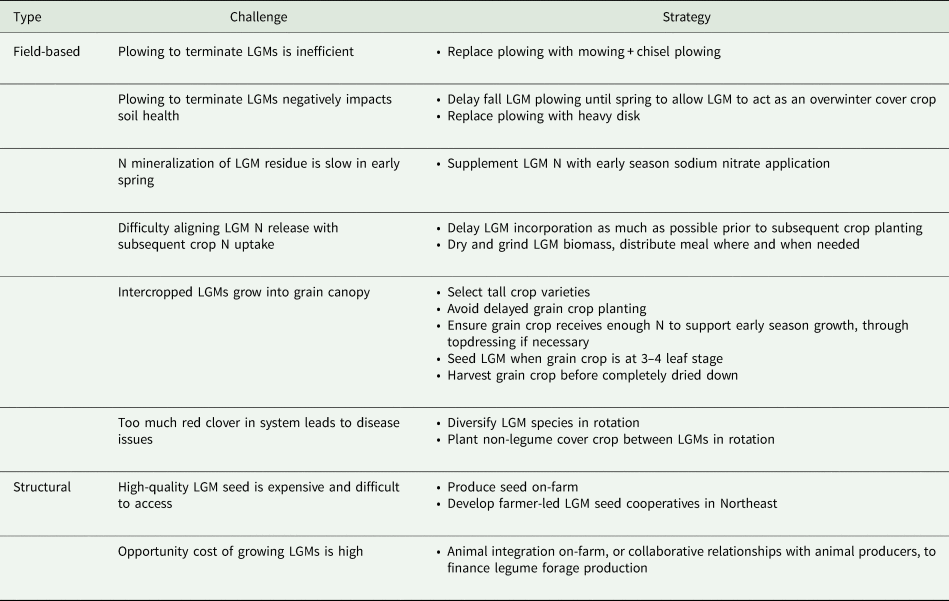
Farmer and advisor participants presented strategies for the successful management of LGMs (Table 7), including methods for overcoming field-based and structural challenges associated with the practice.
Challenges associated with LGMs, and corresponding strategies, as identified by participants

Four farmers expressed wanting to increase their usage of LGMs as a way to enhance their supply of on-farm N, but identified field-based challenges, such as intercropping issues, as potential barriers:
We've gone in and done some frost-seeding, or mud-seeding really, because it's not too many years that you can consistently get out there on ground that is frozen without snow on it. (Farmer, Maine)
We've had years where the [intercropped] clover has grown [up] through the wheat, and we've either lost the wheat crop or it was kind of a mess. That is definitely a risk. (Farmer, New York)
Other participants offered solutions for intercropping issues, such as selecting tall grain varieties or seeding the LGM when the grain crop is at 3-leaf stage to avoid the LGM interfering in crop growth or harvest.
To allay the cost of seed, five farmers described successfully growing their own LGM seed on-farm, including red clover, crimson clover, sweet clover, hairy vetch and field peas. One advisor described that the development of farmer-led LGM seed cooperatives could provide control over seed costs and an additional market to which farmers could sell their excess seed as a cash crop. Several of the farmers who owned their own livestock described how having animals not only provided a direct source of N-rich manure for their crops, but also helped to offset the opportunity costs of growing long-term LGMs, which they could harvest as supplemental feed for their animals or sell to neighboring farms:
We might get a cut of hay off of [the red clover green manure] before we have to roll it back down for grains in the fall. And we're not losing those nutrients. We'll just put them back on in the form of manure. (Farmer, Vermont)
Discussion
The objectives of this study were to investigate major challenges in N management encountered by Northeastern U.S. organic small grain growers, and to identify ways in which advisors could provide targeted support to growers on this topic, with particular focus on legume-based N sources. In this study, the cost of N management was the most cited challenge by both farmer and advisor participants. Traditional economic theory suggests that individuals make decisions based on what they expect will maximize profit or utility (Edwards-Jones, Reference Edwards-Jones2006), and may discount future benefits in favor of immediate gains (Frederick et al., Reference Frederick, Loewenstein and O'Donoghue2002). It is unsurprising, then, that many growers in Maine and Pennsylvania have relied on raw poultry manure as an N source for their small grain crops given the relatively low upfront cost and high available N content of the material (Table 6). Our results suggest, however, that some farmers factor in the long-term effects of their N management, often relying on past experiences, when choosing what they perceive to be the most cost-effective N source for their system, similar to findings by Bergtold et al. (Reference Bergtold, Duffy, Hite and Raper2012) and Chongtham et al. (Reference Chongtham, Bergkvist, Watson, Sandström, Bengtsson and Öborn2016). For example, several farmers were dissuaded from using raw poultry manure due to experiences with increased weed pressure, perceived risk of soil health decline and risk of inconsistent access. While cost-effectiveness presented itself as a key component of successful N management, our data suggest that growers consider factors beyond upfront cost and short-term N supply in choosing an N source, particularly if they believe investing more in N management will reduce risk and benefit their farm in other ways. Soil health improvement, reliable access to N and the ability to take cuttings of LGMs as supplemental livestock feed were seen as major, long-term benefits to practicing legume-based N management. Further research is needed to determine how long-term costs and benefits compare between legume- and manure-based systems in this region.
Advisors suggested that farmers preferentially address easily ‘visible’ issues, such as weeds, over N fertility, suggesting that N fertility management, as a practice, may suffer from a lack of what Rogers (Reference Rogers2003), within the Diffusion of Innovation Theory, termed ‘observability.’ Studies of conservation practices reveal that the more observable the benefits of a practice, the more likely farmers are to adopt it (Reimer et al., Reference Reimer, Weinkauf and Prokopy2012; Liu et al., Reference Liu, Bruins and Heberling2018). Advisors also described how farmers' perception of complexity, particularly regarding the use of LGMs and other legume sources of N, presented a potentially formidable barrier to adoption of sustainable N practices. Larger, more in-depth investigations, possibly using on-farm participatory research methods, are needed to understand the N management decision-making of organic small grain growers more robustly. Nevertheless, this study provides evidence that decision-making in this arena is more nuanced than a simple, short-term, cost accounting equation.
Supporting growers transitioning to legume-based nitrogen management
The myriad benefits to using LGMs are well documented, though this study identifies a number of potential barriers that may be anticipated as growers prepare to shift to legume-based N management. Similar to previous studies investigating barriers to agroecological practices (Blesh and Wolf, Reference Blesh and Wolf2014; Roesch-McNally et al., Reference Roesch-McNally, Basche, Arbuckle, Tyndall, Miguez, Bowman and Clay2017), our data suggest that major barriers to LGM practice extend beyond these field-based challenges. Interviewees expressed that growers' embrace of LGM-based rotations may be limited by what Roesch-McNally et al. (Reference Roesch-McNally, Basche, Arbuckle, Tyndall, Miguez, Bowman and Clay2017) describe as ‘structural challenges,’ or those influenced by market forces. In our study, structural challenges include the cost of high-quality LGM seed, a dearth of livestock operations that might provide a market for clover and alfalfa hay, and a lack of diverse cash crop markets that could provide ample windows for LGMs in growers' rotations. Structural challenges are market-driven and therefore require solutions beyond the scope of individual farmer actions or those of extension personnel. However, opportunities may exist for leveraging farmer and advisor action to help lessen or circumvent major barriers. Farmers producing their own LGM seed on-farm provide a good example of this, as does the establishment of farmer-owned seed cooperatives and livestock integration on the local scale.
Livestock integration, of individual farms and wider grain-growing regions, was discussed as a way to lessen the opportunity costs associated with using arable land to grow LGMs rather than cash crops. Study participants who owned their own livestock, or who farmed within proximity to livestock operations, explained that taking cuttings of their red clover or alfalfa as hay helped to allay the opportunity costs of growing an LGM, encouraging the use of long-term legume sods. Several studies have described this complementary relationship between animal integration and the use of cover crops and legume sods (Franzluebbers, Reference Franzluebbers2007; Sulc and Tracy, Reference Sulc and Tracy2007; Clark, Reference Clark2008). Many participants in this study, however, observed that animal agriculture was generally in decline in the Northeastern US, or that animal operations were no longer proximal to crop-producing regions, consistent with the national trend (MacDonald and McBride, Reference MacDonald and McBride2009). As such, future large-scale animal integration would be feasible only given a certain degree of reversal of this market-driven trend.
Finally, the results of this study indicate that supporting growers in a shift to legume-based N management must include bolstering their confidence in this practice's ability to adequately meet the fertility needs of small grain crops. Wheat growers may be especially concerned with the timing of N release and its effect on grain protein concentration, an important quality parameter (Mallory and Darby, Reference Mallory and Darby2013). The link between the farmer confidence level and practice adoption has been demonstrated in previous research on cover crop adoption (Arbuckle and Roesch-McNally, Reference Arbuckle and Roesch-McNally2015), as has the negative relationship between perceived risk and the adoption of agroecological practices by farmers (Constance and Choi, Reference Constance and Choi2010; Wilson et al., Reference Wilson, Howard and Burnett2014). Our interviews revealed that predicting N mineralization from LGM residues was a top challenge, and that growers new to using LGMs had reservations about the efficacy and potential risk of substituting legume-derived N for animal manures and fertilizers. This issue was documented in Denmark by Oelofse et al. (Reference Oelofse, Stoumann Jensen and Magid2013), as the country prepared to phase out conventional nutrients from organic agriculture.
While advisors in the present study described LGM systems as an inherently complex, they proposed several strategies for addressing grower uncertainty. These focused on training growers to expect, and respond to, a certain level of variability within legume-based systems, using knowledge of their unique operation and the scientific principles surrounding LGM residue breakdown and N mineralization. On-farm LGM trials and participatory research (e.g., estimating and quantifying available N present in LGM residue, working with different types of LGMs and assessing the long-term effects of legume-based crop rotations) were suggested by advisors in the present study as ways to harness grower innovation, boost confidence in the LGM practice and demonstrate its benefits. Participatory research, in which farmers are part of research design and execution, has been shown to be useful in addressing on-farm challenges (Kroma, Reference Kroma2006; Lefèvre et al., Reference Lefèvre, Capitaine, Peigné and Roger-Estrade2014). Research on cover crop adoption has also demonstrated farmers' willingness to tolerate a certain level of risk associated with a new technology if they can identify clear benefits to its use (Mallory et al., Reference Mallory, Posner and Baldock1998; Bergtold et al., Reference Bergtold, Duffy, Hite and Raper2012; Wayman et al., Reference Wayman, Kucek, Mirsky, Ackroyd, Cordeau and Ryan2016), providing additional support for participatory or demonstrative-style learning.
Conclusions
In this study, cost of N management was considered a top challenge among farmers and advisors. Detailed, long-term economic analysis is needed to compare different N management strategies of organic small grain farmers, taking into account the opportunity costs, as well as soil health benefits, of LGM-based systems over time. We demonstrated that growers' decision-making regarding N management takes into account factors beyond upfront cost, and that LGM adoption can be impacted by both field-based and market-related challenges. Future programming should frame the use of LGMs as a long-term investment in soil fertility, and a strategy to reduce the risk inherent in relying heavily on external sources of N. Cooperative Extension personnel and other agricultural advisors can bolster grower confidence in this practice by communicating concrete strategies growers can use to anticipate and respond to year-to-year variability, perhaps through participatory learning and on-farm trials.
Acknowledgements
We gratefully acknowledge the farmers and advisors who participated in this study, and Sonja Birthisel for her feedback on an early draft of this manuscript.
Financial support
This work is based on research supported by the USDA National Institute of Food and Agriculture Organic Agriculture Research and Extension Initiative under Agreement no. 2015-51300-24153, ‘Innovative Sowing, Cultivation, and Rotation Strategies to Address Weed, Fertility and Disease Challenges in Organic Food and Feed Grains.’