

Introduction
Suckler bull beef production usually involves a post-weaning indoor feeding period based on conserved forage supplemented with concentrates or concentrates offered ad libitum (Dieguez Cameroni et al., Reference Dieguez Cameroni, Hornick, Cabaraux, Istasse and Dufrasne2006; O’Riordan et al., Reference O’Riordan, Crosson and McGee2011). Slaughter is usually between 12 and 16 months of age, with adequate carcass fat cover being the primary market requirement. As grazed grass is considerably cheaper than conserved forages and concentrate feeds in temperate climates (Finneran et al., Reference Finneran, Crosson, O’Kiely, Shalloo, Forristal and Wallace2012), finishing cattle from pasture is less costly. Incorporating a grazing period before finishing on a high-concentrate diet has been shown to increase profitability of suckler bull production (O’Riordan et al., Reference O’Riordan, Crosson and McGee2011) but also increases age at slaughter to achieve the same target weights (Dieguez Cameroni et al., Reference Dieguez Cameroni, Hornick, Cabaraux, Istasse and Dufrasne2006; O’Riordan et al., Reference O’Riordan, McGee, Moloney and Crosson2012). For seasonal, spring-calving grass-based systems, bulls must be slaughtered before the indoor winter period for the main herd (October/November), due to housing facility constraints; this corresponds to an age of approximately 19 months. In suckler bull production systems, grazing periods are typically followed by an indoor finishing period in order to achieve sufficient carcass fatness (O’Riordan et al., Reference O’Riordan, Crosson and McGee2011). Carcass fat cover (Moloney and Richardson, Reference Moloney and Richardson2013), fat colour (Dunne et al., Reference Dunne, Monahan, O’Mara and Moloney2009) and muscle colour (Dunne et al., Reference Dunne, Monahan and Moloney2011) are important considerations for the beef industry as they influence the quality and consumer acceptability of beef.
Energy intake, the principle limiting factor affecting growth and fat deposition, is typically lower for grazing cattle compared with those offered concentrate-based diets (French et al., Reference French, O’Riordan, O’Kiely, Caffrey and Moloney2001). Concentrate supplements can be offered to grazing cattle to overcome potential energy deficits and increase performance (French et al., Reference French, O’Riordan, O’Kiely, Caffrey and Moloney2001). Supplementation at pasture may eliminate or reduce the need for expensive indoor finishing regimes. Therefore, the objective of this study was to evaluate the effect of concentrate supplementation on performance and carcass traits of spring-born Aberdeen Angus-sired suckler bulls finished at pasture at two different ages.
Material and methods
Animals, experimental design and management
The study was conducted at Teagasc, Grange Research Centre (Longitude 6° 40' W; Latitude 53° 30' N; Elevation 92 m asl) in 2015. The soil type was a moderately well-drained Brown Earth with gleying and of clay loam texture. Total annual rainfall and mean temperature at a 50 mm soil depth in 2015 was 982 mm and 9.9°C, respectively. Corresponding 10-year averages were 892 mm and 9.6°C. All animal procedures performed in this study were conducted under experimental license in accordance with the Cruelty to Animals Act 1876 and the European Communities (Amendment of Cruelty to Animals Act 1876) Regulation 2002 and 2005 (www.dohc.ie/other_health_issues/pausp).
In total, 60 Aberdeen Angus-sired ‘weanling’ bulls sourced directly from commercial beef suckler herds in Ireland were used. Following arrival (October/November) at Grange they were treated for the control of internal and external parasites, and vaccinated against Clostridial and respiratory diseases. During the winter, bulls were housed indoors and offered grass silage to appetite, supplemented with 1.6 kg dry matter (DM) daily of one of two concentrates as described by Lenehan et al. (Reference Lenehan, Moloney, O’Riordan, Kelly and McGee2016). At the end of this period, they were weighed on 2 consecutive days, blocked by previous winter supplement type and weight, and from within block, randomly assigned to a two (slaughter age (SA): 15 (S15) or 19 (S19) months)×two (finishing strategies (FS): grass only (G0) or grass+3.2 kg DM barley-based concentrate daily (GC)) factorial arrangement. They were turned out to pasture on 7 April. For the supplemented treatments, concentrates were introduced immediately post-turnout for S15 and 97 days later for S19; the daily allowance was increased gradually over 7 days. Concentrates were offered in one feed each morning in linear plastic troughs (0.5 m feed space per animal). The concentrate ration was prepared as a coarse mixture and comprised of 862 g/kg rolled barley, 60 g/kg soya bean, 50 g/kg cane molasses and 28 g/kg minerals and vitamins. Bulls rotationally grazed Lolium perenne-dominant swards (ca. 6.5 bulls/ha). Total grazing area was split into four equal farmlets. Each farmlet consisted of paddocks, which were divided into sub-paddocks to facilitate grassland management. To avoid confounding with variances in herbage nutritive value, G0 and GC sub-paddocks differed in area (ca. 0.29 v. 0.36 ha) and were managed such that residency time and pre- and post-grazing herbage mass (HM) were relatively similar for both. Un-grazed areas were removed as baled silage immediately once paddocks were vacated. Mean residency time per sub-paddock was 3.25 days and upon completion of each grazing rotation bulls were moved to a different farmlet to ensure that performance responses were not confounded with farmlet location. Bulls had free access to clean drinking water at all times. Slaughter occurred 63 and 193 days post-turnout for S15 and S19, respectively.
Herbage and concentrate feed measurements
Pre- and post-grazing sward heights (rising plate meter with a metal plate – 0.1 m2 and 4.97 kg/m2 – Jenquip, New Zealand), HM above a 4 cm horizon (lawnmower cuts) and estimated herbage dry matter intake (DMI) (disappearance method) were measured as described by Lawrence et al. (Reference Lawrence, Kenny, Earley and McGee2012). Representative samples of herbage and concentrates were collected for DM determination (Lawrence et al., Reference Lawrence, Kenny, Earley and McGee2012).
Animal live weight and body composition
Bulls were weighed at turnout to pasture, 48-h post-turnout and pre-slaughter, and regularly throughout. Animals were ultrasonically scanned using an automatic real-time scanner (HS-2000, with a HLV-4212 2.0 MHz linear ultrasonic probe; Honda Electronics Co. Ltd, Aichi Pred, Japan) at the beginning and end of the experiment. On the animal’s right side, M. longissimus depth was measured at the 3rd lumbar vertebra from the interface with the back fat layer to the bone, and back fat depth was measured at the 3rd lumbar vertebra, the 13th thoracic rib and the rump (P8 site) as described by Conroy et al. (Reference Conroy, Drennan, Kenny and McGee2010).
Carcass measurements
Bulls were transported ~25 km to a commercial slaughter plant and slaughtered within 1 h of arrival. Cold carcass weight was estimated as 0.98 of the hot carcass and kill-out proportion was calculated as cold carcass weight expressed as a proportion of slaughter weight. Carcasses were graded mechanically for conformation and fat score according to the EU beef carcass classification scheme on a continuous 15-point scale (Conroy et al., Reference Conroy, Drennan, Kenny and McGee2010). The right side of each carcass was cut between the 5th and 6th ribs after 48 h in the chill at ~0oC to 1oC, exposing the M. longissimus muscle. Ultimate pH and temperature of the M. longissimus were measured at a depth of 2.5 cm using a portable pH meter and thermometer with automatic temperature compensation. After 90 min of exposure, a Miniscan EZ portable spectrophotometer (Hunter Lab, Reston, VA, USA) was used to measure lightness (L), redness (a) and yellowness (b) of the M. longissimus at the 5th rib, and also of the subcutaneous fat on the lumbar and rump regions. The spectrophotometer was used in L, a, b mode and standardised using a white tile. Illuminant D65 was used with a 50 mm measuring area. Hue and saturation were calculated as tan−1 (b/a) and √(a 2+b 2), respectively, for both fat and muscle. Final conversion of hue from radians to degrees was achieved by multiplying tan−1 (b/a) by 180/π. The right side of each carcass was quartered between the 5th and 6th ribs into an 8-rib hind-quarter without the flank (pistola) and fore-quarter that included the flank (Keane and Allen, Reference Keane and Allen1998). The ribs joint (ribs 6 to 10) was removed from the pistola by cutting between 10th and 11th ribs. The M. longissimus perimeter was obtained at the 10th rib using translucent paper and the area was subsequently measured using a digital planimeter. The ribs joint was weighed and separated into M. longissimus, other muscle, lean trim, fat and bone (including the ligamentum nuchae), which were also weighed.
Statistical analysis
Data were statistically analysed using the GLMs procedure (PROC GLM) of Statistical Analysis Software (2011). The models contained the fixed effects of SA and FS, and their interactions, and block. Differences between treatment means were tested for significance using the PDIFF statement. Least square means are reported with standard errors.
Results
Mean pre-grazing sward heights for G0, GC, S15 and S19 were 7.1, 7.0, 9.1 and 9.3 cm, respectively. Corresponding post-grazing values were 4.3, 4.2, 4.3 and 4.5 cm. Estimated HM pre-grazing were 1316, 1174, 1509 and 1528, and post-grazing were 410, 374, 480 and 544 kg DM/ha, respectively. Estimated daily herbage DMI (kg/head) for S15, G0 and GC bulls were 6.4 and 4.5. Corresponding values for S19 G0 and GC over the first 97 days were 6.8 and 6.2, and for the remaining duration, 8.7 and 7.2. Concentrate supplementation accounted for ca. 0.42 and 0.31 of dietary DMI and reduced daily herbage DMI (during the respective periods) by 0.60 and 0.47 kg/kg DM of concentrates for S15 and S19, respectively.
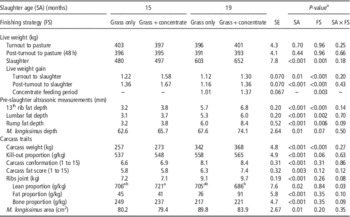
There were no (P>0.05) SA×FS interactions for growth and carcass traits, except for ribs joint lean proportion (P<0.05) whereby there was no effect of SA on leanness for G0 but it declined with age for GC (Table 1). Increasing SA significantly increased all ultrasonic measures of body composition, slaughter weight, carcass weight, kill-out proportion, carcass conformation and fat scores, ribs joint weight and M longissimus area (Table 1). Ribs joint bone proportion decreased and fat proportion increased with increasing SA (P<0.001). Supplementation significantly increased average daily gain (ADG), ultrasonic measures of body fat, slaughter and carcass weight.
Effect of slaughter age and finishing strategy at pasture on growth and body composition of suckler bulls

a Least squares means within a row without a common superscript letter differ (P<0.05).
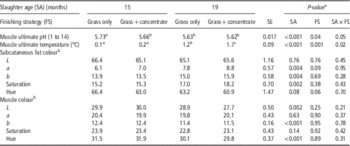
There was a SA×FS interaction for ultimate pH of muscle (P=0.05) and muscle temperature (P<0.05) (Table 2). Ultimate pH of muscle was higher for G0 than GC at S15, whereas there was no difference between G0 and GC for S19. Muscle temperature did not differ between G0 and GC for S15 but was lower for G0 than GC for S19. Subcutaneous fat redness, yellowness and saturation increased, and muscle lightness, redness and hue decreased with increased SA (P<0.01 to P<0.001). There was no effect (P>0.05) of FS on subcutaneous fat and muscle colour.
Effect of slaughter age and finishing strategy at pasture on muscle and subcutaneous fat characteristics of suckler bulls

a Least squares means within a row without a common superscript letter differ (P<0.05).
b L=lightness; a=redness; b=yellowness.
Discussion
During the supplementation periods, estimated herbage DMI of G0 for S15 was 14.6 g/kg live weight and S19 was 15.4 g/kg live weight. These values (g/kg live weight) are comparable with reports for late-maturing breed bulls (15.0, Lenehan et al., Reference Lenehan, Moloney, O’Riordan, Kelly and McGee2015) and steers (14.0, French et al., Reference French, O’Riordan, O’Kiely, Caffrey and Moloney2001; 15.7, Clarke et al., Reference Clarke, Drennan, McGee, Kenny, Evans and Berry2009), and early-maturing breed steers (18.4, Pavan and Duckett, Reference Pavan and Duckett2008) grazing temperate pastures. The substitution rates (kg herbage DM/kg concentrate DM) obtained are intermediate to values reported in studies where low-to-moderate levels of concentrate supplementation (0.17 to 0.48 dietary DMI) were offered to grazing cattle (0.13 and 0.19, French et al., Reference French, O’Riordan, O’Kiely, Caffrey and Moloney2001; 0.73, Pavan and Duckett, Reference Pavan and Duckett2008; 0.67 and 0.90, Lenehan et al., Reference Lenehan, Moloney, O’Riordan, Kelly and McGee2015). Among other factors, substitution rate is directly related to herbage quality, which varies across studies.
The ADG post-turnout to slaughter for S15 G0 was intermediate to values (1.28 to 1.49 kg) reported in studies where late-maturing breed suckler bulls grazed spring pasture having previously been offered grass silage and supplementary concentrates during the winter (McMenamin et al., Reference McMenamin, Marren, McGee, Moloney, Kelly and O’Riordan2014, Reference McMenamin, McGee, Moloney, Kelly and O’Riordan2015a and 2015b). These growth rates are higher than those (1.03 to 1.09 kg) attained by Dieguez Cameroni et al. (Reference Dieguez Cameroni, Hornick, Cabaraux, Istasse and Dufrasne2006) for grazing Belgian Blue bulls offered ca. 1.0 kg concentrate DM daily. Likewise, ADG for S19 G0 in the latter part of the grazing season was in accord with that (0.82 kg) reported by Marren et al. (Reference Marren, McGee, Moloney, Kelly, Vilaseca and O’Riordan2015) for suckler bulls. The live weight response to concentrate supplementation for S15 and S19 was 97 g/kg DM. The former is higher than responses obtained by McMenamin et al. (Reference McMenamin, Marren, McGee, Moloney, Kelly and O’Riordan2014, 39 g and 2015b, 73 g) for late-maturing breed suckler bulls, and Rosa et al. (Reference Rosa, Rego, Silva, Alves, Alfaia, Prates and Bessa2014) (61 g) for Holstein bulls grazing spring pasture and offered ca. 4.2 and 3.4 kg concentrate DM daily, respectively. The corresponding response for S19 was 113 g, which is lower than that obtained by Marren et al. (Reference Marren, McGee, Moloney, Kelly, Vilaseca and O’Riordan2015) (156 g) for suckler bulls grazing autumn pasture and offered ca. 3.2 kg concentrate DM daily. Due to potentially large influences of gut fill, carcass weight rather than live weight is a more accurate estimate of animal performance in pasture-based finishing systems. The carcass weight response to supplementation for S15 of 84 g/kg DM is higher than the non-statistically significant responses (37 g) reported by McMenamin et al. (Reference McMenamin, Marren, McGee, Moloney, Kelly and O’Riordan2015b) and Rosa et al. (Reference Rosa, Rego, Silva, Alves, Alfaia, Prates and Bessa2014) (48 g). The corresponding response for S19 was 88 g/kg DM, which is similar to that (82 g) found by Marren et al. (Reference Marren, McGee, Moloney, Kelly, Vilaseca and O’Riordan2015). Disparities across studies in growth responses are likely to be multifaceted, reflecting differences in herbage supply and nutritive value, concentrate supplementation level and duration, and animal growth potential.
Although increases in ultrasonic measures of body fat were evident in response to concentrates, this was not reflected in carcass fatness confirming that the relationship between ultrasonic fat depth and carcass fat score is only modest (Conroy et al., Reference Conroy, Drennan, Kenny and McGee2010). Despite the fact that the bulls in this study were progeny from Aberdeen Angus sires, a breed that is genetically predisposed towards fat deposition, none of the grazing treatments achieved the minimum commercially acceptable carcass fat score (6.0 on a scale 1 to 15) for S15. Similarly, carcass fat scores in studies with spring-born late-maturing breed suckler bulls slaughtered under-16 months of age directly from pasture have been inadequate, with or without concentrate supplementation (McMenamin et al., Reference McMenamin, Marren, McGee, Moloney, Kelly and O’Riordan2015b; McMenamin et al., Reference McMenamin, McGee, Moloney, Kelly and O’Riordan2016); indeed even lower (3.6 to 5.2) than found in this study. However, carcass fat score for S19 was acceptable for both G0 and GC. In the study of Marren et al. (Reference Marren, McGee, Moloney, Kelly, Vilaseca and O’Riordan2015), spring-born late-maturing breed suckler bulls slaughtered in autumn at 20 months of age were below the target fat score when offered pasture-only (4.8) and pasture plus 1.6 kg concentrate DM daily (5.2), but exceeded the target when supplemented with 3.2 kg concentrate DM daily (6.8), over 130 days. Collectively, these findings suggest that spring-born suckler bulls finished at pasture under-16 months of age are unlikely to meet market-specific requirements in terms of carcass fat cover, even with moderate concentrate supplementation. However, this carcass fat target is achievable from pasture at ca. 19 to 20 months of age without concentrate supplementation for early-maturing breeds, and with moderate levels of concentrate supplementation for late-maturing breeds.
Compared with cattle reared indoors on concentrate-based diets, those reared outdoors on extensive grass-based production systems are generally reported to have darker muscle, purportedly partly due to greater physical activity (Dunne et al., Reference Dunne, Monahan and Moloney2011), and yellower carcass fat, due to consumption of carotenoids in green forage (Dunne et al., Reference Dunne, Monahan, O’Mara and Moloney2009). Under the conditions of this study, FS had no significant effect on these variables. However, the older bulls had darker muscle and yellower subcutaneous fat, in accord with the aforementioned findings. Although bulls are often associated with dark-coloured meat, no individual carcasses in the present study were rejected as excessively dark and differences between treatments in ultimate muscle pH were small and values were within the desired pH range of 5.5 to 5.8 (Tarrant, Reference Tarrant1989). The higher ultimate muscle temperature for GC for S19 was likely due to the increased insulation effect of higher body fatness slowing the carcass chilling process.
Conclusion
Carcasses of spring-born Angus-sired suckler bulls were adequately finished from pasture, with or without concentrates at 19 months of age, but not at 15 months. Supplementation had no effects, and age had relatively minor effects, on subcutaneous fat and muscle colour.
Acknowledgements
The authors gratefully acknowledge support from the Department of Agriculture, Food and the Marine under the Research Stimulus Fund (Project 11/S/322), and assistance from staff at Teagasc Animal & Grassland Research and Innovation Centre, Grange.