Introduction
Germplasm cryobanking has great importance for the preservation of biological material from endangered animal species (Swanson, Reference Swanson2006; Santos et al., Reference Santos, Amorim, Cecconi, Fassbender, Imhoff, Lornage, Paris, Schoenfeldt and Martinez-Madrid2010). Domestic animals still make the best models to develop techniques for the preservation of somatic and gamete cells from wild animals. The domestic cat is a suitable model for wild felids (Kunkitti et al., Reference Kunkitti, Chatdarong, Suwimonteerabutr, Nedumpun, Johannisson, Bergqvist, Sjunnesson and Axnér2017) due to their phylogenetic proximity (Swanson et al., Reference Swanson, Bateman and Vansandt2017) and because somatic and gamete cells can be easily obtained during routine castration (Vizuete et al., Reference Vizuete, Jiménez, Aguera and Pérez-Marín2014; Prochowska et al., Reference Prochowska, Niżański, Ochota and Partyka2015; Swanson et al., Reference Swanson, Bateman and Vansandt2017).
The techniques for obtaining feline epididymal sperm are slicing (Vizuete et al., Reference Vizuete, Jiménez, Aguera and Pérez-Marín2014), compression (Luvoni, Reference Luvoni2006; Martins et al., Reference Martins, Villaverde, Lima, Steagall, Ferreira, Taconeli and Lopes2009; Macente et al., Reference Macente, Gutierrez, Apparício, Balieiro, Mansano, Pereira, Borges-Silva, Pires-Buttler, Galvão, Toniollo, Luvoni, Morselli and Vicente2018) or flushing (Bogliolo et al., Reference Bogliolo, Leoni, Ledda, Naitana, Zedda, Carluccio and Pau2001; Siemieniuch and Dubiel, Reference Siemieniuch and Dubiel2007) of the epididymis caudal portion. For these methods, buffer solutions for epididymal fluid expansion and sperm release are used (Vizuete et al., Reference Vizuete, Jiménez, Aguera and Pérez-Marín2014; Prochowska et al., Reference Prochowska, Niżański, Ochota and Partyka2015; Lima et al., Reference Lima, Silva, Aquino-Cortez, Pinto, Magalhães, Caldini and Silva2016). However, such procedures may result in a decreased concentration of natural antioxidants (Sringnam et al., Reference Sringnam, Kitlyanant, Lewin and Saikhun2011; Macente et al., Reference Macente, Gutierrez, Apparício, Balieiro, Mansano, Pereira, Borges-Silva, Pires-Buttler, Galvão, Toniollo, Luvoni, Morselli and Vicente2018; Martin-Hidalgo et al., Reference Martin-Hidalgo, Bragado, Batista, Oliveira and Alves2019) and removal of plasma membrane proteins (Zhou et al., Reference Zhou, De Iuliis, Dun and Nixon2018), affecting sperm–zona pellucida recognition and interaction, acrosome reaction and fertilization (Sullivan and Saez, Reference Sullivan and Saez2013). To avoid this, the maintenance of sperm cells in the epididymal tail lumen during the cryopreservation process appears to be a good alternative (Chatdarong et al., Reference Chatdarong, Thuwanut, Suksamai, Patanatiradaj and Sangwornrachasup2009; Toyonaga et al., Reference Toyonaga, Sato, Morita, Watanabe, Oba, Mizutani, Hori and Tsutsui2010; Ringleb et al., Reference Ringleb, Waurich, Wibbelt, Streich and Jewgenow2011).
Epididymal cells are capable of maintaining basal sperm metabolism, preventing early activation, and maintaining sperm viability (Kedam et al., Reference Kedam, Katepogu and Beeram2016) for future fertilization (Tsutsui et al., Reference Tsutsui, Wada, Anzai and Hori2003). Therefore, we hypothesized that vitrifying the entire tail of the feline epididymis will efficiently protect the sperm cells during the cryopreservation process. The epididymal wall and its intraluminal content will act as a protective barrier between sperm and intracellular cryoprotectants, as well as maintain the spermatozoa in an epididymal environment, without the need for more physical manipulation throughout the procedure.
Cryostorage of sperm in liquid nitrogen can be achieved using conventional freezing, which employs low concentrations of cryoprotectant and slow controlled cooling in programmable freezers (Karthikeyan et al., Reference Karthikeyan, Arakkal, Mangalaraj and Kamath2019), or using vitrification (Swanson et al., Reference Swanson, Bateman and Vansandt2017). Vitrification is used widely in whole organs, tissues, embryos and oocytes, and requires high concentrations of intracellular cryoprotectant agents (CPA) in vitrification solutions to achieve vitreous status (Fahy and Rall, Reference Fahy, Rall, Tucker and Liebermann2007). Glycerol (GLY) is the most frequently used permeable CPA for domestic cat sperm cryopreservation (Chatdarong et al., Reference Chatdarong, Thuwanut, Suksamai, Patanatiradaj and Sangwornrachasup2009; Jiménez et al., Reference Jiménez, Pérez-Marín, Vizuete, Millán and Aguera2013). However, ethylene glycol (EG) has shown better results than GLY as a cryoprotectant agent, probably because GLY is more prone to fracturing during the warming process than EG (Ali and Shelton, Reference Ali, Shelton, Tucker and Liebermann2007).
The purpose of this study was to determine the effect of vitrification of epididymal cauda by comparing two permeable CPA, GLY and EG, on epididymal sperm velocity parameters, membrane and acrosome integrity, and sperm morphology post vitrification as a measurement of overall sperm health.
Materials and methods
Chemicals
Unless stated otherwise, chemicals and media used in this study were purchased from Sigma-Aldrich Chemical Co. (St. Louis, MO, USA).
Animals and epididymal tail manipulation
Ten (n = 10) mixed breed cats, from 1 year to 3 years old and weighing between 2.5 and 4.0 kg, were subjected to routine castration at the Veterinary Hospital of the Federal University of Pará. None of the animals presented any known reproductive pathologies.
The collected testis–epididymis complexes were transferred to a Petri dish and washed with saline solution (0.9 % NaCl, 20°C) to remove any traces of blood. The parietal vaginal tunic covering the testis–epididymis complex was sectioned with a scalpel blade for visualization of the epididymal tail. Two simple suture ligatures (Nylon 3.0, TECHNOFIO®, Goiás, Brazil) were performed using a needle holder (Mayo Hegar, 15 cm); the first ligature was between the body and tail of the epididymis and the second ligature was between the tail of the epididymis and vas deferens to avoid both epididymal fluid overflow and contact of the spermatozoa with the vitrification solutions. The vaginal tunic was then sectioned for the whole separation of the epididymis tail from the testis. Epididymal tails were then punctured with a syringe (1 ml) coupled to a 27.5 gauge needle (13 ml × 0.38 mm) to obtain fresh epididymal fluid samples and to perform sperm analysis before vitrification (Fig. 1, Step 1).
Experimental design of the manipulation (Step 1), vitrification (Step 2) and warming (Step 3) of the tail of the domestic cat epididymis. Data from five (n = 10) different tomcats; (EG) ethylene glycol, (GL) glycerol, (BM) base medium, (SUC) sucrose, (ES) equilibrium solution, (VS) vitrification solution, (SSV) solid-surface vitrification, (W1) MB + 0.05 M SUC, (W2) MB + 0.025 M SUC, (W3) MB, and (CASA) computer-system analysis.

Vitrification and warming
Vitrification was performed using RPMI as a base medium (BM) (0.2 g RPMI + 0.04 g sodium bicarbonate + 133 μl HCl + 20 ml ultrapure water) + 0.1 M sucrose (SUC) with the permeable cryoprotectants EG 40% (ISOFAR, Rio de Janeiro, RJ, Brazil) or GLY 40%. Vitrification followed a two-step process in which the first exposure was performed for 3 min at 20°C in equilibrium solution containing 20% of EG or 20% GLY, and the second exposure was performed for 2 min at 20°C in vitrification solution (VS), i.e. 40% EG or 40% GLY.
The vitrification technique used was solid-surface vitrification (SSV), as described by Santos et al. (Reference Santos, Tharasanit, Van Haeften, Figueiredo, Silva and Van den Hurk2007). The epididymal tails were placed on a cold surface consisting of a hollow cube of aluminium foil that was partially immersed in liquid nitrogen. The vitrified epididymal tails were transferred into cryovials, using liquid nitrogen-cooled forceps, and stored in the liquid phase of a liquid nitrogen tank. Vitrified epididymal tails were stored for 1 week in liquid nitrogen (−196°C) (Fig. 1, Step 2). For warming, cryovials were exposed to room temperature (c. 25°C) for 30 s and fragments were separately submitted to cryoprotectant removal, followed by immersion in a water bath (37°C) for 30 s. After warming, the intracellular cryoprotectants were removed by three-step washing solutions in a water bath (37°C). For this, epididymal tails were immersed in three devitrification solutions containing decreasing sucrose (SUC) concentrations, as follows: (W1) RPMI + SUC (0.05 M) (3 min), (W2) RPMI + SUC (0.025 M) (5 min), and (W3) RPMI (7 min) (Fig. 1, Step 3).
After vitrification and warming of the epididymal cauda, spermatozoa were harvested using a slicing technique that consisted of cutting the epididymal cauda in 1 ml pre-warmed (37ºC) RPMI medium. The epididymal fluid diluted with RPMI was recovered and transferred to a 1 ml microtube for spermatozoa analysis.
Sperm evaluation
Analyses of motility, vigour, morphology, and both plasma and acrosomal membrane integrity, were performed before and after vitrification. Sperm concentration was determined only after epididymal cauda devitrification and sperm recovery.
Motility and vigour were subjectively evaluated using an optical microscope (Leica E400, Nikon, Tokyo, Japan). A heated (37°C) coverslip was prepared with 5 μl of extended epididymal fluid in RPMI medium. Motility was reported as the percentage of motile sperm and vigour was evaluated on a scale of 0 to 5. Sperm vigour was evaluated subjectively on a scale of 0 to 5. Briefly, no motility was considered 0, slight movement with greater than 75% of sperm showing vibration only was represented by 1, moderate forward movement in c. >50% of sperm was represented by 2, forward movement in c. 70% of sperm was represented by 3, and when 90% or >95% of sperm presented very active forward movement, scales 4 and 5 were used (Villaverde et al., Reference Villaverde, Mello-Martins, Basto-Castro and Lopes2006).
Plasma and acrosomal membrane integrity were assessed using trypan blue staining and Giemsa stain (Didion et al., Reference Didion, Dobrinsky, Giles and Graves1989). Here, 200 cells were counted under an optical microscope at ×100 magnification. The sperm were classified into four categories: (1) live sperm with intact acrosome (LIA) – pink stained acrosome using Giemsa and white post-acrosomal region; (2) dead sperm with intact acrosome (DIA) – pink stained acrosome and dark blue stained post-acrosomal region using trypan blue; (3) live sperm with detached acrosome (TAR) – white acrosome and white post-acrosome region; and (4) dead sperm with detached acrosome (FAR) – white acrosome and dark blue stained post-acrosomal region.
Sperm morphology was evaluated using a smear prepared by adding 5 μl eosin 1% (Vetec, Rio de Janeiro, Brazil) and 5 μl nigrosin 1% (Vetec, Rio de Janeiro, Brazil) to 5 μl sperm suspension on a pre-warmed (37ºC) glass slide. Morphologic defects detected in the spermatozoa were classified as primary or secondary. Total sperm concentration was calculated using a Neubauer chamber (Hirschmann EM techcolor, Eberstadt, Germany), after diluting the 1 μl of sperm mass in 99 μl of saline formaldehyde (10 %).
To assess the sperm plasma membrane integrity, conjugated fluorescent dyes Hoechst 33342 (Molecular Probes, Oregon, USA) associated with propidium iodide (500 μg/ml; P-4170; Sigma Chemical Co.) were used in accordance with the protocol described by Celeghini et al. (Reference Celeghini, Arruda, Andrade, Nascimento and Raphael2007). An aliquot of sperm (50 μl) was added to 3 μl H3342 (40 μg/ml DPBS) and 3 µl of propidium iodide (2 mg/ml DPBS) and incubated in the dark for 8 min at room temperature (37°C). After incubation, a 5-μl drop was placed on a coverslip slide and evaluated using a fluorescence phase-contrast microscope (Model Eclipse Ni, Nikon, Tokyo, Japan). A count of 200 sperm cells at ×100 magnification under immersion was performed, and the proportion of live/dead sperm cells was determined.
For sperm motility parameters obtained using a computer-system analysis (CASA), 10 μl of the epididymal fluid extended was evaluated under a phase-contrast microscope connected to a video camera adapted to the CASA. The following spermatic parameters were analyzed: percentage of mobile cells (MOT), percentage of mobile progressive cells (PMOT), fast speed sperm, medium speed sperm, slow speed sperm, path speed (VCL), average path speed (VAP), progressive speed (VSL), progressive displacement (VSL), lateral head displacement (ALH), straightness (STR) and linearity (LIN), wobble coefficient (WOOB), and beating frequency (BFC).
Statistical analysis
All data were expressed as means ± standard deviation (SD) and analyzed using the StatView 5.0 program (SAS Institute Inc., Cary, NC, USA), except vigour, which was expressed as mode. The effect of vitrification on sperm motility, vigour, plasma membrane integrity and morphology was compared using the Kruskal–Wallis test (Statview 5.0, SAS Institute Inc., Cary, NY, USA). A P-value < 0.05 was considered as statistically significant.
Results
The average sperm concentration after vitrification, warming, and recovery of spermatozoa from epididymal cauda was 10.6 × 10⁶ ± 9.1 sptz/ml (n = 10), with no statistical differences observed between treatments.
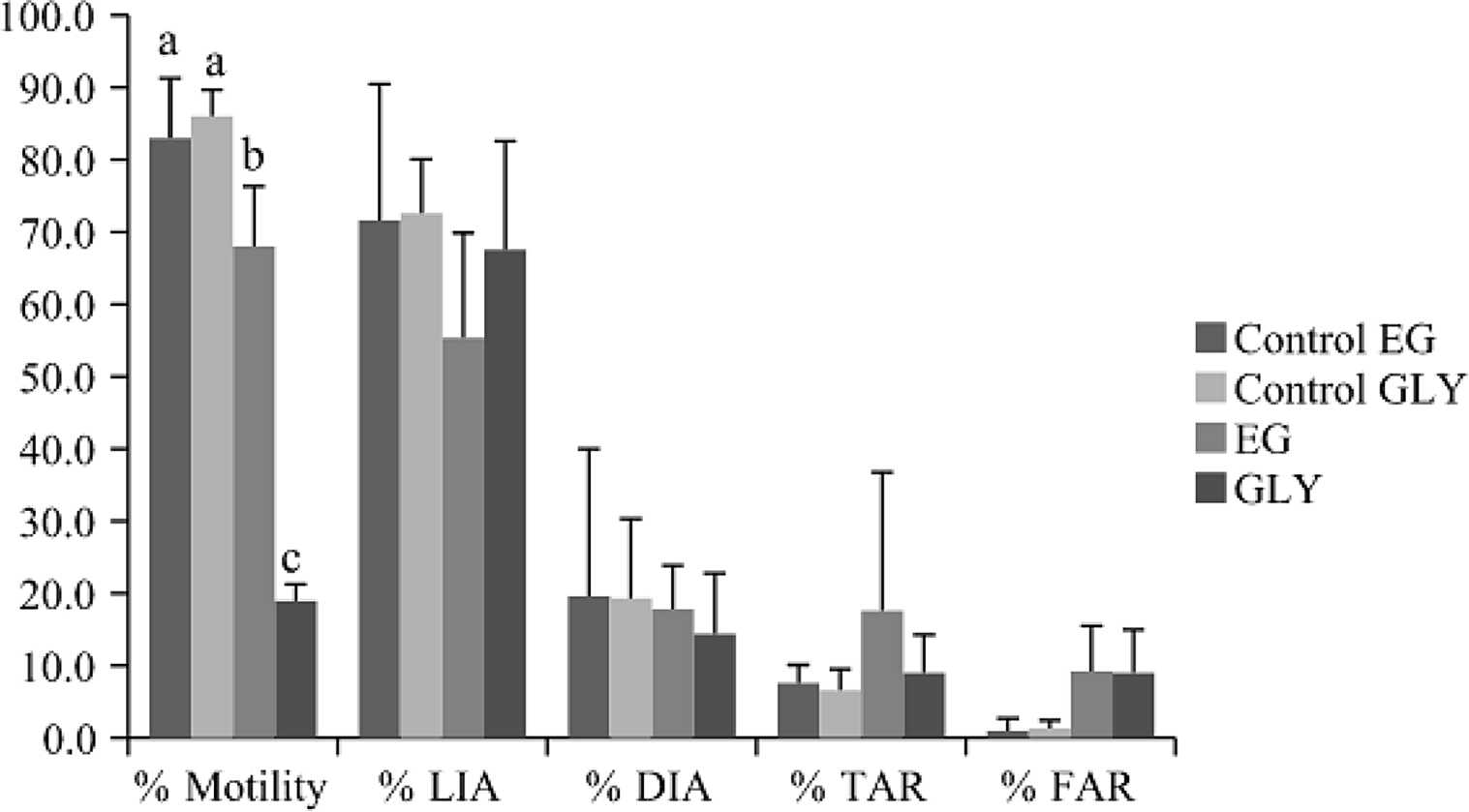
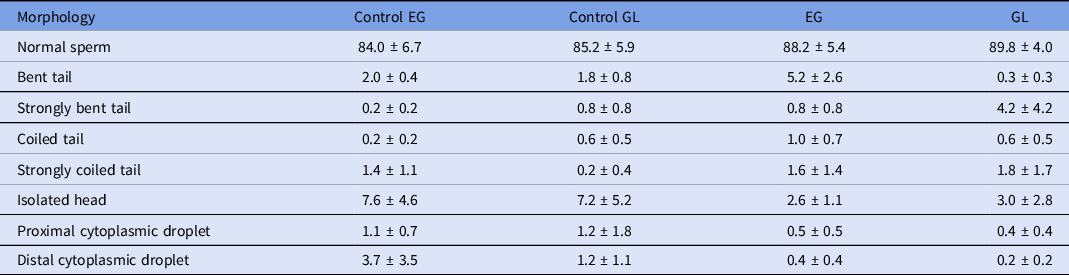
The epididymal sperm motility, plasma, and acrosomal membrane integrity before and after vitrification are shown in Fig. 2. Vitrification negatively affected sperm motility regardless of the cryoprotectant used, i.e. EG (P = 0.029) or GLY (P = 0.0001), when compared with sperm from the fresh epididymal fluid (82.0 ± 8.3) (Fig. 2). However, EG treatment resulted in better sperm motility parameters compared with glycerol (68.0 ± 8.3 versus 19.0 ± 2.2, P = 0.0001). Plasma and acrosome membrane integrity and sperm morphology (Table 1) were not affected by vitrification, regardless of the treatment. Additionally, the modes of vigour for the control, EG and GLY groups were 5, 5 and 3, respectively. The EG-treated sperm had a similar vigour evaluation when compared with the control (P = 0.34).
Mean and standard deviation of motility, plasma and acrosomal membrane integrity of cat epididymal sperm before (control) and after vitrification with ethylene glycol and glycerol; Data from five (n = 5) distinct tomcats; (% LIA) live sperm with intact acrosome, (% DIA) dead sperm with intact acrosome, (% TAR) live sperm with detached acrosome, (% FAR) dead sperm with detached acrosome; (TAR) true and (FAR) false acrosome reactions. a,b,cValues indicated differences between treatments at P < 0.05.

Mean (± SD) percentages of normal sperm and sperm morphology (with major and minor pathologic defects) of epididymal sperm post vitrification with ethylene glycol (EG) and glycerol (GL)

Data from five (n = 5) distinct tomcats.
There were no differences among treatments P < 0.05.
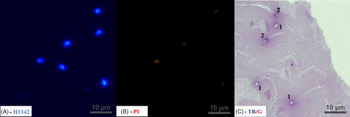
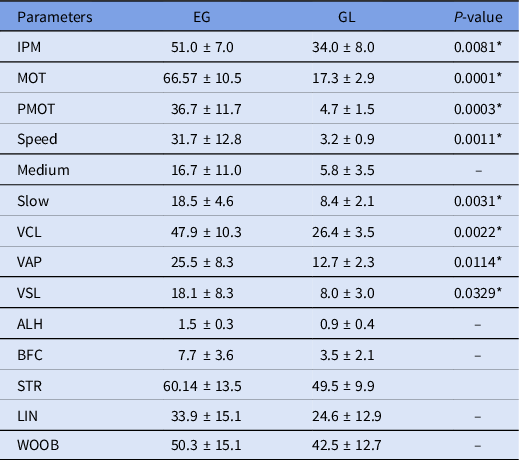
The results of live/dead fluorescence of sperm cells (Fig. 3A, B) and CASA analysis are summarized in Table 2. The mean of live/dead sperm cells, motility, and velocity CASA parameters (MOT, PMOT, SPEED, VCL, VAP, and VSL) was better for the EG group when compared with glycerol (P < 0.05) post warming.
Assessment of plasma membrane and acrosome integrity using fluorescent probes (H3342/PI) and trypan blue/Giemsa staining from post-vitrified epididymal cat spermatozoa. (A) Sperm cells emitting fluorescence by H3342 stain. (B) Same field emitting fluorescence by PI staining. (C) (1) Spermatozoa with intact plasma membrane and acrosome and (2) spermatozoa with damaged plasma membrane and intact acrosome at ×100 magnification.

Mean and standard deviation of intact plasma membrane (Hoechst/propidium iodine) and motility parameters assessed by CASA after devitrification with ethylene glycol and glycerol

The parameters: Intact plasma membrane (PMI), percentage of mobile cells (MOT), percentage of mobile progressive cells (PMOT), fast speed sperm, medium speed sperm, slow speed sperm, path speed (VCL), average path speed (VAP), progressive speed (VSL), progressive displacement (VSL), lateral head displacement (ALH), straightness (STR) and linearity (LIN), wobble coefficient (WOOB), and beating frequency (BFC).
Data from five (n = 5) distinct tomcats.
* Mean significant differences were considered at P < 0.05.
Discussion
The conventional recovery and cryopreservation of epididymal sperm immediately after animal death or castration require trained staff, specific media and equipment, designated space, and time to recover and freeze the epididymal spermatozoa (Kashiwazaki et al., Reference Kashiwazaki, Yamaguchi, Uesugi, Hishiyama, Kim, Nakatsukasa, Kojima, Okuda, Hisamatsu, Inomata and Shino2005; Prochowska et al., Reference Prochowska, Niżański and Partyka2016). Due to these requirements, maintaining epididymides at controlled temperatures for transport to specialized laboratories should be considered. However, keeping epididymides at temperatures ranging from 4 to 5°C for 12 h (Hay and Goodrowe, Reference Hay and Goodrowe1993), 24 h (Ganan et al., Reference Ganan, Gomendio and Roldan2009; Toyonaga et al., Reference Toyonaga, Sato, Morita, Watanabe, Oba, Mizutani, Hori and Tsutsui2010) or 4 days (Chatdarong et al., Reference Chatdarong, Thuwanut, Suksamai, Patanatiradaj and Sangwornrachasup2009) had a negative effect on motility, viability and normal morphology of epididymal sperm before freezing and consequently post thaw. Epididymal tail vitrification, however, can be performed under field conditions and showed promising results in this study, with both high sperm motility and high sperm vigour rates, as well as maintaining plasma and acrosomal membrane integrity compared with the control.
Sperm cells are extremely sensitive to oxidative stress as well as osmotic, pH and luminal epididymal protein changes (Zhou et al., Reference Zhou, De Iuliis, Dun and Nixon2018). In an attempt to give more protection to the sperm cells during the vitrification process, the structure and intraluminal environment of the epididymis tail were maintained as much as possible. Epididymal epithelial cells are responsible for the creation of a highly specialized luminal microenvironment. Analysis of the composition of epididymal luminal fluids revealed a complex and wide variety of ions, non-coding microRNAs, soluble proteins, non-pathological amyloid matrix, and exosome vesicles called epididymosomes, which are important in the process of sperm storage (Zhou et al., Reference Zhou, De Iuliis, Dun and Nixon2018) and maturation (Rowlison et al., Reference Rowlison, Ottinger and Comizzoli2018).
Studies on epididymal sperm cryopreservation in tomcats usually first perform spermatozoa retrieval from the epididymal microenvironment by means of techniques that structurally disrupt the epididymis (Luvoni, Reference Luvoni2006; Martins et al., Reference Martins, Villaverde, Lima, Steagall, Ferreira, Taconeli and Lopes2009; Vizuete et al., Reference Vizuete, Jiménez, Aguera and Pérez-Marín2014; Prochowska et al., Reference Prochowska, Niżański and Partyka2016). These approaches also use extenders (Bogliolo et al., Reference Bogliolo, Leoni, Ledda, Naitana, Zedda, Carluccio and Pau2001; Siemieniuch and Dubiel, Reference Siemieniuch and Dubiel2007; Buranaamnuay, Reference Buranaamnuay2015; Prochowska et al., Reference Prochowska, Niżański and Partyka2016) that alter the ionic and protein composition of the epididymal fluid. These extenders were developed for total semen, and it is not taken into account that the epididymal microenvironment presents a different composition from the seminal fluid (Jiménez et al., Reference Jiménez, Pérez-Marín, Vizuete, Millán and Aguera2013).
The two media used for epididymal cauda vitrification in this study were efficient for the preservation of both the plasma membrane and acrosome integrity. The role of the epididymal environment in protecting acrosomal integrity has not been clarified in the cat, but the importance of epididymosomes in maintaining higher and sustained motility of immature sperm cells throughout 3 h of incubation has been reported (Rowlison et al., Reference Rowlison, Ottinger and Comizzoli2018), and may corroborate the importance of keeping the epididymal environment intact for cryopreservation.
For epididymal sperm, vitrification techniques are still under development and have been described for cats (Vizuete et al., Reference Vizuete, Jiménez, Aguera and Pérez-Marín2014), mice (Horta et al., Reference Horta, Alzobi, Jitanantawittaya, Catt, Chen, Pangestu and Temple-Smith2017), ibex (Capra pyrenaica) (Pradieé et al., Reference Pradieé, Sánchez-Calabuig, Castaño, O’Brien, Esteso, Beltran-Brenã, Maillo, Santiago-Moreno and Rizos2018), and humans (Spis et al., Reference Spis, Bushkovskaia, Isachenko, Todorov, Sanchez, Skopets and Isachenko2019). In all studies, sperm were removed from the epididymis before the vitrification process, and media containing only extracellular cryoprotectants were used. The vitrification techniques used had a negative effect on all sperm parameters, however successful birth after ICSI in humans (Spis et al., Reference Spis, Bushkovskaia, Isachenko, Todorov, Sanchez, Skopets and Isachenko2019), as well as successful IVF in mice (Horta et al., Reference Horta, Alzobi, Jitanantawittaya, Catt, Chen, Pangestu and Temple-Smith2017) and heterologous (Pradieé et al., Reference Pradieé, Sánchez-Calabuig, Castaño, O’Brien, Esteso, Beltran-Brenã, Maillo, Santiago-Moreno and Rizos2018) and homologous (Pradieé et al., Reference Pradieé, Sánchez-Calabuig, Castaño, O’Brien, Esteso, Beltran-Brenã, Maillo, Santiago-Moreno and Rizos2018) in vitro fertilization in ibexes have been achieved. These previous studies confirmed the potential for long-term storage of epididymal spermatozoa for in vitro embryo production. However, in these studies, just a small sample of spermatozoa from epididymal cauda was recovered and there were many steps for spermatozoa processing before and after vitrification. The cryopreservation of whole epididymal cauda might result in increased maintenance of spermatozoa quantity without the necessity for complex procedures for sperm processing, resulting in sperm that may be more suitable for downstream use in other assisted reproductive technologies.
In this study, even with the use of highly permeable cryoprotectant concentrations, as in protocols used for ovarian tissue (Brito et al., Reference Brito, Domingues, Rodrigues, Maside, Lunardi, Wu, Figueiredo, Pieczarka and Santos2018) and testicular tissue (Lima et al., Reference Lima, Silva, Aquino-Cortez, Leiva-Revilla and Silva2018), epididymis tail vitrification enabled the recovery of viable sperm cells after devitrification at similar rates compared with the control group (fresh sample). Therefore, it is possible that the tail wall of the epididymis prevents direct contact of the sperm with the highly permeable cryoprotectant concentrations, and acts to maintain the epididymal fluid, which is beneficial to the sperm cell.
According to Isachenko et al. (Reference Isachenko, Isachenko, Katkov, Dessole and Nawroth2003), the sperm cell can be successfully vitrified in the absence of intracellular cryoprotectants, because it is a small cell with high compartmentalization and has a high concentration of endogenous natural cryoprotectants such as polymers, sugars and nucleotides in relation to the small amount of water, and is responsible for its high intracellular viscosity. Therefore, other advantages of vitrification of complete epididymal cauda are the possibility to avoid direct contact of spermatic cells with liquid nitrogen during freezing. Despite the methods used for cryopreservation or devices used to plug the samples in liquid nitrogen, the epididymal wall and its environment may give an additional layer of protection for the spermatozoa.
An advantage of epididymal sperm vitrification over ovarian and testicular tissues is that the gametes recovered from these tissues are not yet mature and ready for fertilization, whereas epididymal sperm are almost completely prepared for use in assisted reproduction techniques immediately post recovery (Zhou et al., Reference Zhou, De Iuliis, Dun and Nixon2018).
In this study, we used a combination of one permeating and one non-permeating cryoprotectant. The two vitrification solutions were tested before the experiments to determine if they were able to achieve the vitreous state. The best results for sperm quality were obtained with EG, possibly because of the ability of EG to vitrify more efficiently and in a more stable way compared with GLY (Ali and Shelton, Reference Ali, Shelton, Tucker and Liebermann2007).
Epididymis tail vitrification is a simple and less expensive procedure compared with slow freezing. It does not require a highly specialized laboratory for its execution and can be carried out under field conditions. Therefore, epididymis tail vitrification of felines found dead or obtained through orchiectomies can be easily performed, and helps to safeguard irreplaceable genetic material for conservation in germplasm banks, as well as contribute to the possibility of returning endangered feline specimens to their natural environment, after the downstream use of assisted reproduction techniques. With these results, it was possible to achieve success with the balanced vitrification technique of the entire tail of the domestic cat epididymis using EG with sucrose, as this method preserved the sperm parameters evaluated even after vitrification.
Acknowledgements
This study was supported by the Conselho Nacional de Desenvolvimento Científico e Tecnológico, Cnpq, Brazil. The authors thank the Universidade Federal do Pará.
Conflict of interest
The authors declare that there is no conflict of interest that can be perceived as prejudicing the impartiality of the research reported.
Financial support
This research received no specific grant from any funding agency, commercial or not-for-profit sectors.
Ethical aspects
This study was approved by the Ethical Committee in Animal Research (no. 1650060516/CEUA/UFPA). The use of the removed epididymis and animal handling procedures during the surgical procedure were allowed by the owners of the animals that were submitted to castration.