



Contemporary medical practice is grounded in a patient-centred approach that emphasises the importance of healthcare professionals being equipped with skills that foster patient engagement, self-determination and shared decision-making (Grover Reference Grover, Fitzpatrick and Azim2022). Among these, medical communication skills are widely recognised as central to effective clinical practice. These skills have been associated with higher patient satisfaction, improved patient-related outcomes and overall better healthcare quality (Alves-Nogueira Reference Alves-Nogueira, Góis and Pereira2024). Medical communication extends beyond the transmission of clinical information to patients and families (e.g. discussing symptoms, diagnoses or treatments), to include relational skills such as empathy, sensitivity and sympathy, which are crucial for building therapeutic relationships (King Reference King and Hoppe2013). Notably, the ability of physicians to influence patients’ emotional states through communication – a core aspect of interpersonal emotion regulation in the physician–patient dyad – plays a key role in helping patients cope with bad news and in managing emotional and aggressive reactions. Equally essential are physicians’ self-awareness and intrapersonal emotion regulation, which enable them to remain calm, empathetic and attuned to the patient’s needs. These skills also help physicians in regulating their own emotional responses to challenging situations, thereby enhancing their emotional resilience and overall well-being (Lange Reference Lange, Bonvin and Guttormsen Schär2024).
However, research indicates that medical communication skills tend to decline over the course of a physician’s career in the absence of sustained training (Neumann Reference Neumann, Edelhäuser and Tauschel2011). The World Medical Association defines three key stages in physician training where communication skills must be fostered: undergraduate, postgraduate and continuing medical education (CME).Footnote a Undergraduate education sets the foundational knowledge, skills and professional behaviours necessary for future medical practice, combining theoretical instruction with supervised clinical work. Postgraduate education (or residency) offers advanced training to further refine these clinical abilities, including medical communication skills, in a specific medical field. CME, in turn, offers ongoing opportunities for physicians to maintain and expand their knowledge and skills throughout their professional life, namely to update information about medical advancements, best practice and emerging techniques, as well as to sustain their ability to manage challenging patient interactions.
Notably, despite established guidelines across all stages of the medical curriculum, important gaps have persisted between recommended communication competencies and their implementation in medical training, with a particular shortcoming in the teaching of emotion regulation skills (Lange Reference Lange, Bonvin and Guttormsen Schär2024). In this clinical reflection we aim to briefly overview how emotion regulation has been integrated into medical communication curricula in Western Europe at undergraduate, postgraduate and CME levels, highlighting current gaps and suggesting strategies to address them. Additionally, we present two recent emotion regulation-based communication training programmes – Emoty-Com and RE.COMMUNICATION – and discusses implications and directions for future emotion regulation-based medical communication education.
What has been done so far?
Undergraduate education
The European Association for Communication in Healthcare (EACH; Bensing Reference Bensing, van Dulmen and Kallerup2001) developed the Health Professions Core Communication Curriculum (HPCCC) to establish a consensus for the objectives of undergraduate communication education in Europe. These included managing difficult communication scenarios with sensitivity and professionalism, as well as regulating one’s own emotions effectively to maintain performance in challenging situations (Bachmann et al. Reference Bachmann, Abramovitch and Barbu2013). In the same line of thought, several European guidelines, such as those in the UK and Switzerland, have been implemented to enhance communication skills within undergraduate medical curricula, while increasingly integrating emotion regulation skills training to foster empathy and manage patients’ challenging emotional states. Also, the American COMSKIL programme (Memorial Sloan Kettering Cancer Center, New York) has been adapted for German medical schools and includes modules related to (a) interactions with patients and families, (b) addressing patients’ emotions such as frustration and anger and (c) dealing with patients’ defensiveness and avoidance (Gebhardt Reference Gebhardt, Mehnert-Theuerkauf and Hartung2021). Nevertheless, existing medical communication skills programmes still fall short by emphasising the regulation of patients’ emotions while neglecting the development of physicians’ intrapersonal regulation skills and not addressing their challenges in regulating their own emotions during the communication process. This omission is critical because, without early training, medical students may be ill-prepared for the emotional challenges they will face in clinical practice, which can have an impact on patient care and their own emotional resilience and quality of life as future professionals.
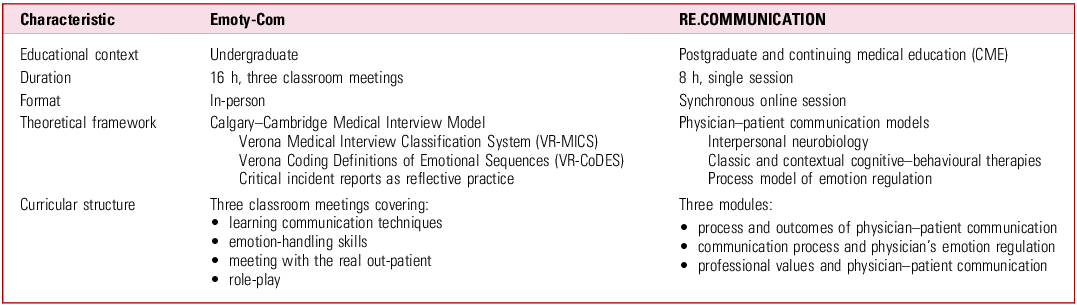
One notable exception is the Emoty-Com training programme, developed in Italy, aiming to enhance communication skills in undergraduate medical students and focusing on addressing not only interpersonal emotion regulation issues, but also physicians’ intrapersonal regulation processes. This programme was primarily implemented with second-year medical students at the Universities of Verona and Milan-Bicocca and combined theoretical sessions with practical exercises. It aimed to teach undergraduate students how to collect clinical information effectively, build caring relationships with patients, manage emotionally challenging situations, and promote reflection on their practice to develop personal awareness and self-knowledge. Emoty-Com has demonstrated a significant positive impact, reducing students’ concerns about managing emotional encounters and increasing their perceived self-efficacy in handling these challenges (Donisi Reference Donisi, Perlini and Mazzi2022). Further details about this training programme are presented in Table 1.
Characteristics of the Emoty-Com (Italy) and the RE.COMMUNICATION (Portugal) communication skills training programmes

TABLE 1 Long description
The table compares the characteristics of the Emoty-Com and RE.COMMUNICATION communication skills training programs across four categories: Educational context, Duration, Format, Theoretical framework, and Curricular structure. It has five rows and three columns. The columns are labeled Emoty-Com, RE.COMMUNICATION, and Characteristic. Row 1: Educational context, Undergraduate, Postgraduate and continuing medical education (CME). Row 2: Duration, 16 h, three classroom meetings, 8 h, single session. Row 3: Format, In-person, Synchronous online session. Row 4: Theoretical framework, Calgary-Cambridge Medical Interview Model, Verona Medical Interview Classification System (VR-MICS), Verona Coding Definitions of Emotional Sequences (VR-CoDES), Critical incident reports as reflective practice, Physician-patient communication models, Interpersonal neurobiology, Classic and contextual cognitive-behavioural therapies, Process model of emotion regulation. Row 5: Curricular structure, Three classroom meetings covering learning communication techniques, emotion-handling skills, meeting with the real out-patient, role-play, Three modules: process and outcomes of physician-patient communication, communication process and physician's emotion regulation, professional values and physician-patient communication.
Postgraduate education and CME
In the transition to postgraduate training, communication skills remain essential for further development, particularly because interns and residents assume greater autonomy in clinical practice and are required to engage more independently with patients. Accordingly, some Western European residency programmes have included communication training focused on enhancing the expression of empathy and on learning how to manage challenging emotional reactions from patients (e.g. Tan Reference Tan, Foo and Lim2021). The situation is similar for CME, as the number of interventions aimed at specialist physicians to improve communications skills – including emotion regulation – has also increased in recent years (Tan Reference Tan, Foo and Lim2021).
However, just as in undergraduate education, postgraduate education and CME programmes have been more commonly focused on patients’ emotion regulation, rather than on physicians’ own intrapersonal regulation in clinical encounters. One possible explanation for this phenomenon could be the socially prescribed expectations of ‘psychological hardiness’ among physicians, who are presumed to be resilient and resourceful in dealing with various professional challenges, including long hours, emotional toll and patient demands. Furthermore, physicians may be regarded as a hard-to-reach professional group in research, owing to their difficulty in carving out time to participate in those initiatives and reluctance to approach their emotional issues in the context of research. Another possible explanation for this tendency could be its alignment with the broader shift towards patient-centred medicine, which redirected attention from the physician to the patient and informed the development of the ‘Triple Aim’ in healthcare – enhancing patient experience, improving population health and reducing costs (Bodenheimer Reference Bodenheimer and Sinsky2014). More recently, in response to the rising rates of physician burnout and a renewed emphasis on clinicians’ well-being, a fourth aim has been added – improving the work life of healthcare professionals – resulting in the ‘Quadruple Aim’ (Bodenheimer Reference Bodenheimer and Sinsky2014).
This evolution may help explain the historically limited emphasis on physicians’ own emotion regulation as a target for intervention. In this context, we (A.C.A.-N., C.M., M.C.C. and C.C.) have recently developed the RE.COMMUNICATION training programme to address this gap. This programme targets practising physicians across medical specialties and experience levels. Structured into three modules, the programme integrates theoretical content and experiential exercises aiming to: (a) update physicians’ knowledge about the components, process and outcomes of clinical communication; (b) increase emotional self-awareness and foster flexible self-regulation strategies during clinical interactions; and (c) facilitate self-reflection about the alignment between professional values and communication competence (Table 1). RE.COMMUNICATION has demonstrated preliminary effectiveness in improving physicians’ medical communication skills and emotion self-regulation skills based on cognitive reframing. Physicians also perceived a positive impact of the training on their clinical practice, well-being, self-awareness and self-efficacy (Alves-Nogueira Reference Alves-Nogueira, Melo and Canavarro2025).
Where do we go from here?
Medical communication skills are essential for patient-centred care, and there has been a growing effort to recognise the need to develop emotion regulation skills within communication training across different stages of medical education. Despite the established curricular guidelines, important gaps remain between recommended competencies and actual educational practices. First, at the undergraduate level, many curricula still do not adequately address the development of inter- and intrapersonal emotion regulation processes, despite evidence suggesting that improving these competencies is longitudinally associated with higher levels of preparedness and self-efficacy among medical students transitioning into professional clinical practice (Moura Reference Moura, Costa and Pereira2022). Integrating dedicated courses on medical communication skills into medical curricula across Europe, with a particular emphasis on emotion regulation, could help address this shortfall.
Second, at the postgraduate and CME levels, further efforts are needed to ensure that training in emotion regulation skills, as a core component of medical communication skills, is systematically included and supported. Although promising programmes like Emoty-Com and RE.COMMUNICATION offer encouraging results, the field lacks a broad array of theory-driven and empirically validated emotion regulation-based communication training programmes. In today’s increasingly multicultural societies, physicians often interact with patients from diverse cultural, linguistic and religious backgrounds. Such diversity can introduce additional challenges to the process of emotion regulation within clinical encounters, particularly in cases involving language barriers (e.g. migrants with limited fluency in their new country’s language) and distinct social dynamics (e.g. patients with minoritised gender and sexual identities). These challenges underscore the need for emotion regulation-based communication training programmes to also incorporate the development of intercultural competencies, such as cultural sensitivity, in order to better address the complexities of contemporary healthcare settings (Schouten Reference Schouten, Manthey and Scarvaglieri2023).
Finally, a particular challenge in implementing emotion regulation-based communication training, especially at the postgraduate and CME levels, is that it is often voluntary for physicians, competing with high workload demands and challenging work schedules. Embedding such training within medical services as routine practice could help mitigate some of the barriers that physicians identify as preventing them from attending this type of training. In fact, some European medical services have implemented this strategy in specialties such as family medicine, internal medicine, oncology and psychiatry. However, in a universe of around 50 medical specialties, there is still substantial work to be done to expand this best practice.
Conclusions
Continuously integrating medical communication skills and emotion regulation throughout the medical education continuum is critical to provide medical students and physicians with the opportunity to improve and update the necessary skills to communicate effectively and to manage their patients’ and their own emotions. This would contribute to increasing their self-efficacy, emotional resilience and overall quality of professional life, which could ultimately improve patient care. Such an approach also aligns with the goals of quaternary prevention, aimed at preventing harm to both healthcare professionals and patients, and could help achieve the ‘Quadruple Aim’ – caring for the provider to better care for the patient (Bodenheimer Reference Bodenheimer and Sinsky2014).
Acknowledgements
C.C. thanks Professor Dr Maria Paula Paixão for many important discussions shared on the topic of health communication.
Author contributions
Conceptualisation: A.C.A.-N., C.C.; writing – original draft: A.C.A.-N.; writing – review and editing: all authors. All authors read, critically revised and approved the final manuscript.
Funding
This work was supported by the Center for Research in Neuropsychology and Cognitive and Behavioral Intervention (CINEICC), University of Coimbra (https://doi.org/10.54499/UIDP/00730/2020). A.C.A.-N. was supported with a publicly funded PhD grant awarded by the Portuguese Foundation for Science and Technology (https://doi.org/10.54499/2020.06779.BD).
Declaration of interest
C.C. is a member of the BJPsych Advances editorial board and did not take part in the review or decision-making process of this article. The authors developed the RE.COMMUNICATION training programme and were responsible for conducting the respective feasibility study.



eLetters
No eLetters have been published for this article.