INTRODUCTION
The use of fibre-rich diets for poultry is expected to increase in the future, particularly in organic poultry production (Sundrum et al. Reference Sundrum, Schneider and Richter2005; Van de Weerd et al. Reference Van de Weerd, Keatinge and Roderick2009). Dietary non-starch polysaccharides (NSP) are the major part of dietary fibre, and are not susceptible to the endogenous enzymes of monogastric animals. Thus, depending on the complexity of their cell wall building blocks, they are variably fermentatively degraded in the distal sections of the gastrointestinal tract (Englyst, Reference Englyst1989; Schneeman, Reference Schneeman1999; Bach Knudsen, Reference Bach Knudsen2001). Apart from certain anti-nutritive effects of NSP that are mainly associated with increased digesta viscosity (Daenicke et al. Reference Daenicke, Dusel, Jeroch and Kluge1999; Francesch and Brufau, Reference Francesch and Brufau2004), dietary NSP may support welfare and health of chickens. Van Krimpen et al. (Reference Van Krimpen, Kwakkel, Van Der Peet-Schwering, Den Hartog and Verstegen2008) reported that hens fed diets high in insoluble NSP increased the time spent for eating and reduced aggressive pecking behaviours. Inulin, a readily fermentable NSP, is known for its prebiotic effect (Schneeman, Reference Schneeman1999) and inulin-dependent stimulation of metabolic activity of beneficial intestinal bacteria has been reported for turkeys (Juskiewicz et al. Reference Juskiewicz, Jankowski, Zdunczyk, Biedrzycka and Koncicki2005) and chickens (Rehman et al. Reference Rehman, Vahjen, Awad and Zentek2007, Reference Rehman, Hellweg, Taras and Zentek2008a).
Similar to some other EU countries the number of chickens kept in floor husbandry is increasing in Germany (ZMP, 2008), but in these systems the birds are in close contact with their feces allowing nematodes to complete their life cycles. As a consequence, the prevalence as well as worm burden of animals with common poultry nematodes are high in outdoor/floor husbandry systems (Permin et al. Reference Permin, Bisgaard, Frandsen, Pearman, Nansen and Kold1999; Kaufmann et al. Reference Kaufmann, Daş, Sohnrey and Gauly2011). The common fowl parasite, Ascaridia galli is a widespread nematode of chickens that resides in the small intestines. There is evidence that dietary NSP interact with parasites of the host animals in different ways. In pigs, readily fermentable NSP have been shown to induce a profound deworming effect on common nematodes (Petkevičius et al. Reference Petkevičius, Knudsen, Murrel and Wachmann2003, Reference Petkevičius, Thomsen, Knudsen, Murrell, Roepstorff and Boes2007), whereas establishment and fecundity of the nematodes are shown to be favoured by the less or non fermentable NSP (Petkevičius et al. Reference Petkevičius, Knudsen, Nansen, Roepstorff, Skjøth and Jensen1997, Reference Petkevičius, Knudsen, Nansen and Murrel2001). Daenicke et al. (Reference Daenicke, Moors, Beineke and Gauly2009) showed that feeding viscous NSP favours development of A. galli. The effects of NSP on nematode infections are mainly attributable to alterations of digesta characteristics and intestinal microbial fermentation. We have recently shown that the establishment of Heterakis gallinarum, a caecal nematode that serves as a vector for transmission of Histomonas meleagridis, is positively influenced in growing chicks fed either low or highly fermentable NSP- supplemented diets (Daş et al. Reference Daş, Abel, Rautenschlein, Humburg, Schwarz, Breves and Gauly2011a), and the latter diet additionally alters interactions between H. gallinarum and H. meleagridis (Daş et al. Reference Daş, Abel, Humburg, Schwarz, Rautenschlein, Breves and Gauly2011b).
In this study, it was hypothesized that the establishment and fecundity of A. galli in chicken is affected by dietary NSP. The objective of the present study was to investigate the effects of low or highly fermentable NSP on the establishment and fecundity of the nematode as well as on the performance of grower layers experimentally infected with A. galli in order to examine whether the nematode infection can be controlled by dietary NSP.
MATERIALS AND METHODS
Animals, experimental structure, diets and management of the birds
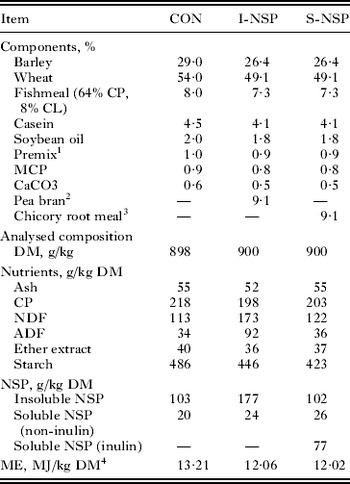
In 3 consecutive repetitions, 604 female Lohmann Selected Leghorn (LSL) chicks were used. The chicks were purchased from a commercial hatchery as 1-day-old birds. Within each repetition, the chicks were weighed together and randomly divided into 3 feeding groups. Each feeding group was fed one of the 3 following pelleted diets ad libitum until 11weeks of life: (1) basal diet (CON), (2) CON plus insoluble NSP (I-NSP), and (3) CON plus soluble NSP (S-NSP) (Table 1). Insoluble NSP were supplied by mixing 1 kg CON in mash form with 100 g pea bran on air dry-basis (Exafine 500, Socode, Belgium). For S-NSP, 1 kg CON in mash form was mixed with 100 g chicory root meal (Fibrofos 60, Socode, Belgium). The final mixtures were then pelleted. Daily feed consumption was determined per group throughout the experimental weeks. Drinking water was offered ad libitum.
Until week 3, each feeding group was kept in a pen scattered with wood shavings. The litter was replaced once (weeks 1–3) or twice (weeks 4–11) a week. Room temperature was gradually decreased from 34°C on the first day to 26°C in week 3 and thereafter decreased by 2–3°C per week, ending at 18–20°C from week 6 onwards. A 24 h lighting period was maintained for the first 2 days and then reduced to 16 h/day at the end of the first week. By week 8, it was reduced to 12 h/day and subsequently maintained until the end of the experiment. At the end of week 3, the birds were marked with wing tags and individual body weights (BW) were taken for the first time and thereafter at weekly intervals.
Infection material and experimental A. galli infections
The infection material was prepared at the Department of Animal Sciences, University of Göttingen, Germany. Adult female A. galli worms harvested from the intestines of naturally infected chickens were used as the source of eggs. Preparation techniques for the infection material (egg harvest, embryonation procedures etc.) have previously been described in detail (Daş et al. Reference Daş, Kaufmann, Abel and Gauly2010). On the infection day, the number of eggs/ml of suspension was determined and the infection dose was adjusted to 250 eggs/0·2 ml of final suspension. Only the eggs in the vermiform and infective larval stages were classed and counted as embryonated. Three subgroups of birds, each for one feeding group, were infected at an age of 3 weeks using a 5-cm oesophageal cannula. The remaining 3 groups of uninfected control birds were given 0·2 ml of an aqueous 0·1% solution (w/v) of potassium dichromate as placebo. The average number of birds inoculated with eggs per each feeding group in each repetition ranged from 30 to 35.
In the second and third repetitions, mixed batches of eggs from female worms harvested in the preceding repetition as well as eggs from worms of naturally infected field chickens were used as the infection material and prepared in the same way. The average age of the eggs (after embryonation) on infection days was around 3, 5 and 1 month in the first, second and third repetition, respectively.
After inoculation of the eggs, birds of 3 uninfected control groups were left in their previous pens, whereas birds of each infected group were placed in new pens within the same experimental stable equipped with 6 pens. The birds did not get any vaccination or anthelmintic treatment throughout the experimental period. The stable was thoroughly cleaned and disinfected at least 2 weeks before introducing the birds.
Slaughter process, fecal samples and post-mortem examinations
All the birds were slaughtered after electrical stunning 8 weeks post-infection (p.i.) at an age of 11 weeks. Individual fecal samples were collected during the slaughter process either as freshly dropped feces or – if available – directly from the colon. The individual fecal samples were examined for estimating number of eggs per gramme of feces (EPG) using a modified McMaster counting technique with a sensitivity of 50 eggs/g feces (MAFF, 1986).
Immediately after slaughtering, the gastrointestinal tracts were removed and the visceral organs separated. The small intestines of the infected birds were opened longitudinally with scissors. The contents were flushed with tap water through a sieve with a mesh aperture of 100 μm, and then transferred into 1 or more Petri dishes, depending on the amount of content. Thereafter, the number of adult worms and larvae were determined using a stereomicroscope. The adults were sexed and a maximum (range 1–10) number of 10 female and 10 male worms per bird were randomly selected and measured for length (Gauly et al. Reference Gauly, Bauer, Preisinger and Erhardt2002). Small intestines from uninfected control birds (15–20% of each group) were also processed to verify the infection-free status of these groups. The remaining small intestines from the uninfected control birds were opened and macroscopically checked for the presence of adult worms.
Weights of liver (+gall bladder), pancreas, full caeca as well as length of small intestine and each caecum were measured. In the last 2 repetitions, caeca from 10 birds per group (60 per repetition) were weighed and stored at −18°C until analysed for volatile fatty acids (VFA). Methods used for pH and VFA analyses have been described previously (Daş et al. Reference Daş, Abel, Rautenschlein, Humburg, Schwarz, Breves and Gauly2011a). In the last repetition, the remaining caecal contents after sampling for VFA were used to determine dry matter and crude ash contents in order to calculate the proportions of the organic matter in caeca samples (Naumann and Bassler, Reference Naumann and Bassler1997).
Chemical analyses of the diets
Feed samples, regularly taken throughout each experimental repetition, were analysed for dry matter (DM), crude ash (CA), crude protein (CP), sugar, starch, and ether extract (EE) using standard methods (Naumann and Bassler, Reference Naumann and Bassler1997). Neutral and acid detergent fibre (NDF and ADF, respectively) contents of the feed samples were analysed according to Van Soest et al. (Reference Van Soest, Robertson and Lewis1991). The metabolizable energy concentration of the diets (MJ ME/kg DM) was calculated (FMVO, 2008). Insoluble NSP and the non-inulin fraction of soluble NSP were measured using an enzymatic test (Megazyme, 2007). Soluble NSP in the form of inulin was determined according to the method of Naumann and Bassler (Reference Naumann and Bassler1997). The composition and analysed nutrient contents of the experimental diets are given in Table 1.
Composition and analysis of the experimental diets

1 Per kg of premix: 360 mg retinol, 8·75 mg cholecalciferol, 4·000 mg thiamine, 800 mg riboflavin, 600 mg pyridoxine, 3·200 mg cyanocobalamin, 450 mg menadione, 4·500 mg nicotinic acid, 1·500 mg ca-pantothenate, 120 mg folic acid, 5·000 mg biotin, 55·000 mg choline chloride, 3·200 mg Fe, 3·200 mg Fe-(II)-sulphate, 1·200 mg Cu, 1·200 mg Cu-(II)-sulfate pentahydrate, 10·000 mg Mn-(II)-oxide, 8·000 mg Zn-oxide, 160 mg iodine, 160 mg Ca-iodine-hexahydrate, 40 mg Na-selenite, 64 mg cobalt, 64 mg basic Co-(II)-carbonate-monohydrate, 10·000 mg BHT (Product code: 77046, Vilomix, Germany).
2 Pea bran: Contained 86·9% crude fibre. Product name: Exafine 500, Socode, Belgium.
3 Chicory root meal: contained 60% inulin (on DM). Product name: Fibrofos 60, Socode, Belgium. Polymerization degree (DP) of inulin was 9 on average.
4 The metabolizable energy of the diets: calculated according to the formula given by the German regulations for complete poultry feed mixtures (FMVO, 2008). ME, MJ/kg DM=[(g CP×0·01551)+(g CL×0·03431)+(g starch×0·01669)+(g sugar×0·01301)]. Sugar contents of the diets were estimated based on sugar contents of the components.
Data management and statistical analyses
Parameter definitions, transformations and restrictions
Because the data of the infection variables positively skewed (Skewness>0) and showed non-normal (Kolmogorow-Smirnow, P<0·05) distributions, log-transformations were employed. For this, individual infection parameters that described worm counts (establishment rate, number of males, females, larvae, and total worm burden), number of eggs per gramme of feces (EPG) and female worm fecundity parameters were transformed by using a natural logarithm (ln) function [ln (y)=Log (y+1)] to correct for heterogeneity of variance and to produce an approximately normally distributed data set. Establishment rate was defined as the number of worms per bird in relation to infection dose. Fecal egg count (FEC) was quantified as the number of eggs per gramme of feces (EPG) in birds. Fecundity of adult female worms was defined as EPG per female worm. Lengths of male and female worms and sex ratio (number of females/males) were left untransformed.
Because the experimental repetitions were performed at different periods of time and we used different batches of worm eggs, the effect of repetition was included in the models as a random factor to ensure safe generalization for the effects of the main experimental factors and to avoid any possible confounding effect of time, in which the repetitions were performed, with any of the main factors.
Statistics
The effects of the diets on the prevalence of A. galli infection (proportion of worm-harbouring birds to the experimentally infected birds) were analysed using the GENMOD procedure of SAS (2010) with a logit link function. The GENMOD procedure fits the generalized linear models and suited for responses with binary outcomes (Kaps and Lamberson, Reference Kaps and Lamberson2004). The model included effects of diets and repetitions. Because there was no significant interaction effect between diets and repetitions the following reduced model was used (I).

where i represents diets (CON, I-NSP, S-NSP); j is repetitions (1, 2, 3); p ij is the proportion of infected birds on diet i and repetition j; m is the overall mean of the proportion on the logarithmic scale; τ i is the effect of diet i and r j is the effect of repetition j.
Body weight (BW) and feed utilization (feed:gain) data were analysed both for pre-infectional (1–3 weeks) and for the entire period (1–11 weeks). The model for the performance parameters in the pre-infectional period included fixed effect of diets, random effect of repetitions and the residual error (II). This model was also used to analyse establishment rate, worm counts, worm length and egg excretion data:

where Yijk is the observation; μ is the overall mean; α i is the effect of diet (i=1,2,3); aj is the random effect of repetition (j=1,2,3) and ε ijk is the residual random error.
Organ measurements and VFA data were analysed with the following mixed model (III):

where Yijkl is the observation; μ is the overall mean; α i is the effect of diet (i=1,2,3); β j is the effect of infection (j=0,1); (αβ)ij is the interaction effect between diet and infection (ij=1–6); ak is random effect of repetition (k=1,2,3); ε ijkl is the residual random error. Number of repetitions for the VFA data was (k=1,2).
The model for the repeatedly measured performance variables (BW, feed:gain) in the entire period included fixed effects of diet, infection, experimental weeks (as age of birds) as well as all possible interactions among these factors. The effect of experimental repetitions was included in the model as a random factor. Furthermore, the individual random effect of the birds as the repeated subject within a repetition over the experimental weeks, was also included in the model presented below (IV):

where Yijklm is the observation; μ is the overall mean; α i is the effect of diet (i=1,2,3); β j is the effect of infection (j=0,1); γ k is the effect of experimental weeks (k=3–11 weeks); (αβ)ij is the interaction effect between diet and infection; (αγ)ik is the interaction effect between diet and experimental weeks; (βγ)jk is the interaction effect between infection and experimental weeks; (αβγ)ijk is the interaction effect among diet, infection and experimental weeks; al is random effect of repetition (l=1,2,3); bk(l) is the random effect of individual bird within repetition over the experimental weeks, the variance between repeated measurements of the birds (subject) within a repetition; ε ijklm is the residual random error.
Presentation of the results
After infection at the end of week 3, groups of uninfected and infected chickens were kept according to a 3×2 factorial arrangement of treatments with diet and infection as the main factors. Therefore, unless significant interactions between the effects of diet and infection were encountered, the data are presented as the main effects of diet and infection. In case of significant interactions between diet and infection, the results for the 6 single treatments are stated in the text. Tukey adjusted post-hoc comparisons (alpha<0·05) were performed to either partition effects of the main factors, or to determine single group differences when a non-interactive significant main effect or when a significant interaction effect of the main factors was encountered, respectively. For the effects of the main experimental factors, the results are presented as least square means (LSMEANS) with common pooled standard error (PSE). Because the numbers of observations in the groups were not always balanced for certain data, the most conservative (the largest) standard error of LSMEANS is represented as the pooled S.E.
Ethical consideration
The experimental procedures followed the animal welfare rules. The infection dose given to each bird (250 eggs) was within the range of the worm burdens that can be observed in natural subclinical infections. The procedures for experimental infections followed the guidelines suggested by the World Association for the Advancement of Veterinary Parasitology for evaluating the effectiveness of anthelmintics in chickens and turkeys (Yazwinski et al. Reference Yazwinski, Chapman, Davis, Letonja, Pote, Maes, Vercruysse and Jacobs2003).
RESULTS
Mortality, feed consumption and growth performance
Infected birds did not show clinical signs of infection and the overall mortality rate was low. Because the pre-infectional mortality rate was low (1·2%), no statistical comparison among the feeding groups was done for this period. Birds consuming S-NSP had a slightly higher mortality (2·1%) than those on the CON (0·9%) or on the I-NSP diet (0·6%). In the post-inoculation period (weeks 4–11), infected and uninfected birds had similar low mortality rates (3%).
During the pre-infection period, birds receiving I-NSP and S-NSP consumed roughly 4·5% and 1·7% more feed, respectively, than those being fed CON (Table 2). The coefficients of variation (CV) for feed consumption, calculated within each feeding group over 3 repetitions in the pre-infectional period, were smaller than 6%. Birds consuming I-NSP had a higher feed:gain ratio in comparison to CON and S-SNP fed birds (P<0·05). Both NSP-diets reduced the BW of birds in comparison to CON (P<0·001).
Effects of diet and Ascaidia galli infection on feed consumption, body weight development (BW), and feed:gain ratio (N=581)

[(abc) or (AB)]: Different letters within each factor on the same line indicate differences (Tukey, P<0·05).
no: no infection effect in the pre-infection period.
1 CON=basal diet; I-NSP=1000 g CON+100 g pea bran; S-NSP=1000 g CON+100 g chicory root meal.
2 Uninfected controls or infected with 250 eggs of A. galli.
3 Pooled SE.
4 Estimated from daily group consumptions.
5 Body weight at the end of week 3 of life.
6 Body weight at the end of week 11 (i.e., 8 week p.i).
In the entire experimental period, birds on the I-NSP and S-NSP diets consumed 8% and 2% more feed than the CON-fed birds. The CVs within each feeding group were smaller than 5%. Compared to CON, birds on the NSP-diets consumed more feed per unit body weight gain (BWG, P<0·001) and I-NSP caused higher feed intake than S-NSP. Both NSP diets led to retarded body weight development (P<0·001) with S-NSP entailing a stronger negative effect than I-NSP (P<0·05). Within feeding groups, infected birds consumed almost the same amount of feed as the uninfected birds whereas body weights of the infected birds were impaired irrespective of diet type (P<0·001) resulting in lowered efficiency of feed utilization (P=0·013).
Prevalence of infection, worm burden and fecundity
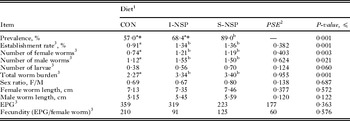
Uninfected control birds were free of infection as confirmed by microscopic and macroscopic examination of the small intestines. There was a significant effect of diet on the prevalence of infection (P<0·001). As shown in Table 3, it was higher with S-NSP than with CON and I-NSP (P<0·05). Feeding I-NSP also tended to increase prevalence of infection when compared with CON (P=0·078). Birds on the NSP-diets had higher establishment rates (P<0·001), higher numbers of female (P=0·003) and male worms (P=0·021) as well as higher total worm burdens (P<0·001) than those receiving CON. The number of larvae tended to be higher in S-NSP than in CON-fed birds (P=0·060). Sex ratio, worm length, EPG and female worm fecundity remained unaffected by type of diet (P>0·05).
Effect of diet on establishment rate, average number of worms per bird, sex ratio, worm length and fecal egg counts in birds infected with Ascaridia galli (250 eggs/bird)

ab: Values with no common letters within rows differ (Tukey, P<0·05).
* Values sharing the sign tend to differ (P=0·078).
1 CON=basal diet; I-NSP=1000 g CON +100 g pea bran; S-NSP=1000 g CON +100 g chicory root meal.
2 PSE, Pooled standard error.
3 LSMEANS and PSE represent untransformed data; P-values are based on the transformed data.
Visceral organ development
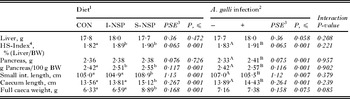
No significant interaction effect was observed between diet and infection on any of the organ measurements (P>0·05). The absolute weights of liver and pancreas were not affected by the type of diet (P>0·05; Table 4), but the NSP diets increased the relative weights of both organs (P<0·05). The small intestine length, the caecum length and the full caeca weight were increased by S-NSP (P<0·05).
Effects of diet and Ascaridia galli infection on the size of visceral organs (N=567)

[(abc) or (AB)]: Different letters within each factor on the same line indicate differences (Tukey, P<0·05).
1 CON=basal diet; I-NSP=1000 g CON +100 g pea bran; S-NSP=1000 g CON +100 g chicory root meal.
2 Uninfected controls (−) or infected with 250 eggs of A. galli (+).
3 Pooled SE.
4 HS-Index, Hepato-somatic index=liver/BW*100.
A. galli infection increased the absolute pancreas weight, the length and weight of caeca as well as the relative liver and pancreas weights (P<0·05). The liver weight tended to be higher in the infected birds (P=0·058). Infected birds had shorter small intestines than their uninfected counterparts receiving the same diets (P=0·007).
Biochemical parameters of the caecal content
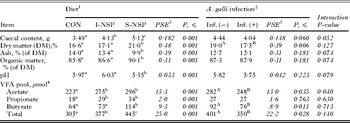
As shown in Table 5, both NSP diets increased the amount of caecal content (P<0·001) with S-NSP exerting a greater effect than I-NSP (P<0·05). Feeding S-NSP increased the proportions of dry matter in the caecal contents (P<0·05). The proportion of organic matter was increased (P<0·05) at the expense of crude ash (P<0·05) in the caecal content of S-NSP fed birds. Infection did not influence the proportions of organic matter and ash (P>0·05). The intracaecal pH was lower with feeding S-NSP (P<0·05) and remained unaffected by the infection (P>0·05).
Effects of diet and Ascaridia galli infection on biochemical parameters of caecal content*

* N=120 for pH and VFA data, for the remaining variables N=60.
[(abc) or (AB)]: Different letters within each factor on the same line indicate significant differences (Tukey, P<0·05).
1 CON: Basal diet; I-NSP: Insoluble non-starch polysaccharide supplemented diet; S-NSP: Soluble non-starch polysaccharide supplemented diet.
2 Uninfected controls (−) or infected (+) with 250 eggs of A. galli.
3 Pooled SE.
4 Calculated as multiplication of VFA concentration by the total amount caecal digesta.
The pool size of acetate was influenced by the interaction between effects of diet and infection (P=0·040). This interaction indicated that infected birds on CON had a smaller pool size of acetate than all the other infected or uninfected birds on any diet (P<0·05; data not shown). The pool size of propionate was increased by NSP diets (P<0·05; Table 5) and remained unaffected by infection (P=0·763). The butyrate pool size was increased with S-NSP (P<0·05) and decreased by A. galli infection (P=0·011). Both NSP-supplemented diets increased the total VFA pool size (P<0·001), S-NSP exerting a greater effect than I-NSP (P<0·05). Infected birds had a smaller total VFA pool size than the uninfected birds consuming the corresponding diets (P=0·028).
DISCUSSION
In accordance with the observations of others (Forbes and Shariatmadari, Reference Forbes and Shariatmadari1994; Halle, Reference Halle2002; Van Krimpen et al. Reference Van Krimpen, Kwakkel, André, Van Der Peet-Schwering, Den Hartog and Verstegen2007), birds receiving the NSP diets increased feed intake compared to those on the CON diet. These results are in agreement with our previous studies reporting the effects of the same experimental diets on either mono-infection with Heterakis gallinarum or on concomitant Histomonas meleagridis and H. gallinarum infection in growing hens (Daş et al. Reference Daş, Abel, Rautenschlein, Humburg, Schwarz, Breves and Gauly2011a, Reference Daş, Abel, Humburg, Schwarz, Rautenschlein, Breves and Gaulyb). In the present study, birds on the I-NSP diet increased feed intake by 8%, which roughly corresponded to the supplemented proportion of pea bran. The S-NSP-supplied birds consumed 2% more feed than the CON-fed animals. Their proportionate lower intake of basal diet might, to some extent, have interfered with the effect of soluble NSP supplied with chicory root meal. However, insoluble and soluble NSP can definitely be considered as the dominant dietary factors in this study.
In spite of almost compensatory feed intake, I-NSP fed birds had lower final BW than those on the pure CON diet, indicating that consumption of I-NSP may have been associated with additional metabolic costs. In S-NSP fed birds, the reduced final BW may have partially resulted from the lower total energy and nutrient intake. Inulin, which was fed as a source of soluble NSP, is known to increase digesta bulk (Schneeman, Reference Schneeman1999) and intake of S-NSP fed birds might have been limited by the capacity of the gastrointestinal tract. On the other hand, fermentation of NSP may increase heat production which may negatively influence feed intake of the birds. Jørgensen et al. (Reference Jørgensen, Zhao, Knudsen and Eggum1996) showed that fermentation of pea fibre-supplemented diets increased heat production of broilers relative to ME by 3–6%. As shown by the lowered intracaecal pH and elevated pool size of VFA in the present investigation, the inulin-supplemented S-NSP diet intensified intestinal fermentation more than the I-NSP diet. Therefore, it may be assumed that intestinal fermentation increased heat production, which might have contributed to the lower feed intake of the S-NSP-fed birds.
It can be assumed that the insoluble and soluble NSP-supplemented diets altered the gastrointestinal environment in the birds. This favoured A. galli infection in terms of higher prevalence and worm burdens. The absence of clinical signs of Ascaridiosis and low mortality may be explained by the relatively low infection dose that resulted in low worm burdens. The average worm burden of the infected birds was, however, in the range observed by others applying similar or the same infection doses (Riedel and Ackert, Reference Riedel and Ackert1951; Gauly et al. Reference Gauly, Bauer, Mertens and Erhardt2001; Marcos-Atxutegi et al. Reference Marcos-Atxutegi, Gandolfi, Arangüena, Sepúlveda, Arévalo and Simón2009; Daenicke et al. Reference Daenicke, Moors, Beineke and Gauly2009; Daş et al. Reference Daş, Kaufmann, Abel and Gauly2010; Schwarz et al. Reference Schwarz, Gauly, Abel, Daş, Humburg, Rohn, Breves and Rautenschlein2011). A. galli infection did not influence feed intake of the birds, but caused a less efficient feed utilization for BWG. This indicates an altered allocation of nutrients from growth to defence reactions against the parasite infection (Kyriazakis and Houdijk, Reference Kyriazakis and Houdijk2006). Diverted allocation of nutrients may include repair of damaged mucosal tissues during the histotropic phase of the nematode (Herd and Mcnaught, Reference Herd and Mcnaught1975) and the acquisition as well as the development of immunity (Marcos-Atxutegi et al. Reference Marcos-Atxutegi, Gandolfi, Arangüena, Sepúlveda, Arévalo and Simón2009; Schwarz et al. Reference Schwarz, Gauly, Abel, Daş, Humburg, Rohn, Breves and Rautenschlein2011), which may require high metabolic inputs (Colditz, Reference Colditz2008). A. galli infection may also influence digestion and absorption of nutrients by reducing proteolytic enzyme activity in the jejunum (Hurwitz et al. Reference Hurwitz, Shamir and Bar1972a) being associated with an increased recycling of nitrogen (Hurwitz et al. Reference Hurwitz, Shamir and Bar1972b). Reduced metabolizability of energy and lowered nitrogen retention have been reported for A. galli-infected chickens (Walker and Farrell, Reference Walker and Farrell1976). Recent data suggest that A. galli infection impairs electrogenic transport of alanin and glucose in the intestinal epithelial tissues of growing chicks (Schwarz et al. Reference Schwarz, Gauly, Abel, Daş, Humburg, Rohn, Breves and Rautenschlein2011). This also contributes to explaining the impaired utilization of feed for BWG in the infected birds.
Both NSP-supplemented diets increased prevalence of infection and worm burdens of the birds but the development (length) and fecundity of the nematode remained unaffected, suggesting that the dietary NSP support larval establishment. The average female worm lengths measured in the present study are in agreement with earlier reports (Abdelqader et al. Reference Abdelqader, Gauly and Wollny2007; Daenicke et al. Reference Daenicke, Moors, Beineke and Gauly2009; Marcos-Atxutegi et al. Reference Marcos-Atxutegi, Gandolfi, Arangüena, Sepúlveda, Arévalo and Simón2009). The average worm fecundity (EPG/female) was slightly lower for the worms of the NSP- fed birds and this may have resulted from an increased amount of feces, as has been reported for chickens submitted to NSP feeding (Van der Klis et al. Reference Van Der Klis, Van Voorst and Van Cruyningen1993; Jørgensen et al. Reference Jørgensen, Zhao, Knudsen and Eggum1996). It was earlier shown that the NSP-fed birds increase the daily amount of feces by roughly one-third compared to birds on the control diet (Daş et al. Reference Daş, Abel, Rautenschlein, Humburg, Schwarz, Breves and Gauly2011a). Such an increase dilutes the number of nematode eggs in each gramme of feces and thus results in an underestimation of EPG-based fecundity (Daş et al. Reference Daş, Abel, Rautenschlein, Humburg, Schwarz, Breves and Gauly2011a). In the present investigation, no difference between EPG in CON- and NSP-fed birds was observed, because the latter presumably excreted larger daily amounts of feces. A more accurate and precise evaluation of female worm fecundity could be achieved by referring fecal egg counts based on total daily feces excretion of the birds as suggested by Daş et al. (Reference Daş, Savaş, Kaufmann, Idris, Abel and Gauly2011c).
Soluble NSP occurring in certain cereals like rye, barley, triticale and wheat may exert anti-nutritive effects in poultry through increased intestinal viscosity (Francesch and Brufau, Reference Francesch and Brufau2004; Józefiak et al. Reference Józefiak, Rutkowski and Martin2004; Daenicke et al. Reference Daenicke, Moors, Beineke and Gauly2009). Daenicke et al. (Reference Daenicke, Moors, Beineke and Gauly2009) showed that soluble NSP-induced increased viscosity favoured the development of A. galli and elevated fecal egg counts. Soluble NSP in the form of inulin do not affect digesta viscosity (Schneeman, Reference Schneeman1999) but, as observed in the present study, and in agreement with others (Montagne et al. Reference Montagne, Pluske and Hampson2003), lead to elevated weights of splanchnic tissues as well as increased sizes of gastrointestinal tract sections. The enlarged caeca can be related to increased microbial activity. The pre-caecal section was obviously also exposed to stimulated fermentation, as indicated by increased small intestine size in S-NSP-fed birds. The lowered pH and the greater pools of VFA in caecal contents are further indications for an inulin-induced stimulation of intestinal fermentative activity. Consistent with previous observations (Marounek et al. Reference Marounek, Suchorska and Savka1999; Rehman et al. Reference Rehman, Hellweg, Taras and Zentek2008a, Reference Rehman, Böhm and Zentekb), fermentation of inulin was associated with high proportions of butyrate, which in turn can be used by colonocytes as a source of energy for epithelial cell proliferation, thus supporting the enlargement of intestinal tract sections (Montagne et al. Reference Montagne, Pluske and Hampson2003).
Apart from greater effects of S-NSP than I-NSP on the enlargement of the gastrointestinal organs and caecal VFA pool size, A. galli infection also increased caecal size and the relative proportions of liver and pancreas. An increased proportion of liver has been reported in A. galli-infected birds, and it may indicate liver dysfunction and disturbance in carbohydrate metabolism in the infected birds (Ramadan and Abou Znada, Reference Ramadan and Abou Znada1991).
Energy-diluted diets have been suggested for laying hens in order to benefit from compensatorily increased feed intake, thereby balancing nutrient intake of the animals under the condition of organic farming (Sundrum et al. Reference Sundrum, Schneider and Richter2005; Van de Weerd et al. Reference Van de Weerd, Keatinge and Roderick2009). Considering the availability of organic feedstuffs, such energy dilutions will primarily be achieved by fibre, i.e. NSP-rich feed components. The results of the present investigation, showing infection-supporting effects of dietary NSP, and the inherently increased risk of obligatory outdoor systems for parasitic infections (Permin et al. Reference Permin, Bisgaard, Frandsen, Pearman, Nansen and Kold1999; Thamsborg et al. Reference Thamsborg, Roepstorff and Larsen1999; Fossum et al. Reference Fossum, Jansson, Etterlin and Vågsholm2009; Kaufmann et al. Reference Kaufmann, Daş, Sohnrey and Gauly2011) suggest particular measures of precaution for organic poultry husbandry in order to protect animals against nematode-related health risks.
It is concluded that diets supplemented with either insoluble or soluble NSP retard growth performance, alter gastrointestinal environment and lead to higher weights of splanchnic tissues being associated with an elevated establishment of A. galli in grower laying hens. These results may be particularly relevant for poultry husbandry in organic farming, where relatively fibre-rich, i.e. NSP-rich feeding is recommended and where animals with obligatory outdoor access are inherently exposed to high nematode infection risks.
ACKNOWLEDGEMENTS
The authors thank Dr Eva Moors, Ms. Birgit Sohnrey, Dr Falko Kaufmann and Dr Ahmad Idris for their assistance during the parasitological examinations.
FINANCIAL SUPPORT
This study was performed through financial support of the German Research Foundation (Grant number AB 30/8-1, BR 780/14-1) and the H. Wilhelm Schaumann Foundation.