The rapidly changing status of women in American society ensures that gender bias in electoral politics is an elusive target for scholars. The bad old days are over; a male candidate cannot win an election simply by running an ad featuring his opponent's husband urging, “Coya, come home.”Footnote 1 Yet political institutions in the U.S. remain deeply gendered in how they structure the parameters of electoral competition.Footnote 2 This confluence of gender and structure carries profound theoretical and methodological implications for scholarship on women and politics. It demands that researchers disentangle systemic effects associated with the masculinized ethos of the political environment from the sex of an individual candidate or voter. Moreover, it requires that scholars conducting empirical analyses recognize that statistically significant coefficients for sex differences tell only part of the story with respect to gender's role in the political arena.
Evidence of the complex interplay of gender and institutions emerges in many ways. Perhaps most notably, it manifests itself in terms of the discrepancy between women candidates' experiences on the campaign trail and their success at the ballot box. Overt prejudice on the part of voters seems to have disappeared, at least in legislative elections.Footnote 3 And obvious bias toward female candidates in the media, so pronounced when women first began contesting elections to high-level office, has diminished.Footnote 4 Nevertheless, not only do women continue to be severely under-represented numerically in public office throughout the United States, but women who have lost bids for higher office also continue to criticize the media's treatment of their candidacies as a major obstacle to victory. Certainly, supporters of Democratic presidential contender Hillary Clinton and Republican vice presidential nominee Sarah Palin question whether women have achieved parity in the type of coverage they receive.
Women who ran for governor in the 1990s serve as excellent cases through which to address the complex relationship between candidate sex and gendered institutions, particularly the media. First, the position of governor is highly visible and serves as a stepping stone to the Senate and the White House. Yet women have fared poorly in winning gubernatorial races.Footnote 5 Second, the 1990s witnessed a period of rapid and significant change for women's electoral fortunes. In effect, the watershed election of 1992 represents a natural experiment to examine structural changes in the electoral environment. Third, the media exert a powerful influence over the type of political information that reaches voters. Although researchers have uncovered only modest gender differences in how the media handled statewide candidates during the 1990s, female gubernatorial candidates often recount bias in campaign press coverage.Footnote 6 Consequently, many speculate that something about executive offices, compared to legislative positions, makes them less accessible to women.Footnote 7 The mismatch between women gubernatorial candidates' lived experiences and the findings emerging from conventional studies, then, provides fertile ground for theorizing about how gender continues to affect the playing field for male and female candidates and for determining how best to evaluate empirical evidence.
We disentangle the relationship between candidate sex, newspaper content, and political context through analysis of fine-grained coding of more than 1,300 newspaper articles for 27 gubernatorial races between 1990 and 1997 in which a female candidate held a major party nomination. We then evaluate the combined impact of these factors on the baseline vote for male and female candidates. We replicate some findings in the literature, but also chart new directions by introducing political statements with respect to position taking and action claims as a way to assess gender differences in media coverage. Our inclusion of variables that gauge gendered political structures and institutions, along with statistical methods appropriate for dealing with count data, provides empirical validation for the importance of considering contextual effects when studying women and politics.
Briefly stated, we uncover evidence of different types of media coverage for male and female gubernatorial candidates when we look in a new place. On the campaign trail, women seem to emphasize position taking, while men tend to make claims about actions they have taken—or at least that is how reporters depict them. The disparities in position coverage are particularly pronounced for inexperienced women and men. In addition, male candidates appear to pay more attention than their female opponents to so-called “women's issues” of health, education, and child welfare. The differences are not major predictors of electoral success, but women—as a group—suffer a substantial electoral deficit compared to their male opponents. This powerful baseline effect favoring male candidates appears to be rooted in the environment in which candidates compete. The results support the emerging consensus among feminist theorists that greater focus on the political context is likely to produce bigger scholarly payoffs than continued attention to observable differences between male and female candidates. Paradoxically, the better analysts become at capturing the indirect effects of gendered institutions, the less likely their research will produce significant coefficients on a variable for candidate sex.
Background and Hypotheses: Gender, Content, and Context
U.S. elections are contests between individuals and their supporting party coalitions, but they occur within institutional parameters that have evolved through statute and convention. The rules of the game reflect the values of the men who created them and consequently affect the construction of gender in the political arena.Footnote 8 As Duerst-Lahti observes, “Gender always occurs in context.”Footnote 9 Focusing on conventional sex differences, therefore, may not adequately shed light on the gendered institutions, processes, and practices of U.S. politics.Footnote 10 An appreciation for context thus poses theoretical and empirical challenges for scholarly endeavors.
From a theoretical perspective, context promotes confusion. Indeed, a growing body of literature points to the complexity of pinning down the elusive nature of gender's role in electoral politics. Voters, for example, continue to rely on stereotypical conceptions of women's and men's traits, issue expertise, and policy positions when evaluating candidates, and the media often reinforce such conventional views of women.Footnote 11 Yet, given the multiple sources of political information, stereotypical imagery is unlikely to disappear even when the press is “gender neutral.” Further, numerous studies suggest that women must be better than men as candidates to fare equally. In congressional elections, for instance, women face more primary competition than do their male counterparts;Footnote 12 and they have to raise more money to perform as well as men at the polls.Footnote 13 Similarly, female candidates are more likely than men to report having been recruited to run for office, suggesting that without outside encouragement and support for a candidacy, they will be less likely than men with comparable backgrounds to emerge in the electoral arena.Footnote 14 In addition, geographic differences facilitate women's election in some congressional districts, but lessen their chances of success in others.Footnote 15 As women have achieved parity on some dimensions, then, other barriers remain deeply embedded in the institutions that shape political competition.
From an empirical perspective, context raises issues about measurement error. Many contextual effects are subtle, difficult to quantify, or not directly observable; and they tend to reinforce each other. Complicating research endeavors even further is the fact that controlling for contextual factors can obscure the presence of sex differences and result in statistically insignificant coefficients on sex; the “independent effect” of being a woman candidate, for instance, washes away when we account for the gendered nature of the political institutions women and men navigate. In sum, when analysts control properly for context, they may not fully capture the elusive effects of gender.
Obviously, we cannot address all of these issues, but through careful research design, extensive data collection and analysis, and appropriate methods, we can make a start. We focus on one institution—the press—and one level of office—governor—to shed light on the interplay among gender, contextual factors, and measurable bias in the political sphere. By drawing on the literatures on conventional sex differences in press content, patterns of communication, and electoral context, we derive a set of hypotheses that address the nuances of gendered media content, as well as female gubernatorial candidates' success—or lack thereof—on Election Day. Ultimately, by estimating the magnitude of influences that continue to evade direct observation, our analysis allows us to capture the manner in which gendered institutions buttress each other and affect gubernatorial candidates' electoral fortunes.
Gender and Media Content
Scholars have long recognized that the media's use of stereotypes can reproduce and reinforce gender differences in campaigns and elections. Citizens' inattention to politics, after all, leads them to depend on the media to assess candidates through a myriad of heuristics, including candidate sex.Footnote 16 Indeed, story frames, references to “women's issues,” and horse race coverage have all received scholarly analysis as possible indicators of bias.Footnote 17
We expect that the press actively perpetuates, either consciously or unconsciously, sex-based coverage of gubernatorial candidates.Footnote 18 The coverage of women, therefore, is likely to emphasize their appearance, personality, roles as mother and wife, political viability and experience, and advocacy for “women's issues.”Footnote 19 Men, on the other hand, will be more likely than women to receive press attention that focuses on their professional backgrounds, credentials, and prior office-holding experiences.
Beyond descriptive characteristics, though, we expect that coverage of women will emphasize relational language, while coverage of men will include more action-oriented speech. Political scientists generally have not taken account of how candidates' patterns of communication factor into media depictions of men and women, but scholars in other disciplines provide relevant evidence about gender differences in how men and women present themselves.Footnote 20 Years of socialization have conditioned women to use relational language to establish connections with listeners and men to speak in ways that establish their autonomy and competence.Footnote 21 As a result, men tend to use direct, fact-oriented assertions, while women tend to stress connection and empathy. We expect, therefore, that candidates' presentation of themselves will become manifest in the type of political statements they make about policies and platforms. Women will use the relational strategy of position taking, while men will focus on credit claiming for action.
Overall, reports in the press of candidates' political statements and campaign messages, as well as their traits, backgrounds, and issue priorities can reproduce and reinforce differences that may prove harmful to women at the polls. The result is the same regardless of whether the press coverage faithfully reflects male-female patterns of candidate presentation or selectively conveys gendered cues.
Gender and the Context of the Contest
Whether the media systematically hinder women's attainment of public office is an unsettled question, largely because the literature has not adequately addressed the problem of political context. More specifically, most studies fail to account adequately for the highly variable electoral circumstances in which male and female candidates compete. This is particularly important because contextual factors may appear to be neutral on their face, but nevertheless introduce gender effects to the electoral environment. A candidate's party affiliation, for example, often reflects the receptivity of party activists to women,Footnote 22 with Democrats more likely to recruit and nominate female governors. Similarly, women's newcomer status to electoral politics in the 1970s and 1980s, when scholars conducted much of the research on media bias, made it difficult for female candidates to acquire politically relevant credentials. The lack of prior experience, in turn, made it more difficult to obtain nominations in winnable races. The fact that women often served as sacrificial lambs afforded reporters an opportunity to focus on their maternal roles, appearance, or lack of political experience, while reporters' inclination to ignore noncompetitive races further marginalized them.Footnote 23 Thus, women who met conventional expectations of a “good” candidate—probably a Democrat with electoral experience in an open seat—would be likely to enjoy press coverage and votes comparable to men, while those lacking such credentials would receive differential treatment.
In addition, the timing of an election also has the potential to introduce differences in press treatment of female and male candidates. The media dubbed 1992 the “Year of the Woman” in recognition of the large number of women running in congressional elections. Indeed, the early 1990s marked a threshold in the types of offices women were likely to contest.Footnote 24 The 1992 election cycle, therefore, should have been a watershed, cueing reporters to offer more equitable coverage of female candidates.Footnote 25
Finally, the primary schedule is a feature of a contest that may carry implications for the press treatment women receive. Two possibilities require consideration: differences in the coverage of women and men after they win their primaries, and the timing of the primary itself. At least one study suggests that primary coverage is more likely to be biased against women than is general election coverage.Footnote 26 If this pattern is pervasive, then evidence of conventional sex differences should be more pronounced immediately following the primary as reporters size up the woman who won the nomination. When the primary is late, female nominees have less time to shift reporters' attention away from personal traits to the campaign message. Hence, sex differences in coverage may be more pronounced for late nominees.
Gender and the Political Context of the State
A state's political context also contains underlying structural biases that can generate variation in the coverage of female candidates. Women are more likely to compete in states with an existing tradition of electing women.Footnote 27 When women are more prevalent in state legislatures, therefore, sex stereotypes in the press should diminish and electoral margins for female candidates should increase. In a similar vein, given the greater receptivity of the Democratic Party to women, an increase in the normal vote for Democrats in the state should decrease the likelihood of gender differences in media coverage and increase female Democrats' vote share.Footnote 28 Such factors are particularly important for any analysis that spans the end of Democratic Party dominance and the Republican rise in the early-mid 1990s.
Gender and Newspaper Characteristics
Newspapers are also part of the campaign context, as they introduce their own set of contextual effects in the way they cover campaigns and the amount of coverage they devote to politics. Seemingly neutral variations in size and quantity of political coverage, for instance, may in fact lead to differential treatment of female and male candidates. Indeed, in some cases, disparities in the quantity of coverage about female statewide candidates disappear after controlling for a newspaper's circulation,Footnote 29 although large papers are more likely than small papers to emphasize a candidate's sex.Footnote 30 Moreover, space constraints may affect the frequency of gendered coverage. Newspapers have more room to cover statewide races in non-presidential election years, and newspapers differ widely in attention to politics generally.Footnote 31 Short articles have little room for discussion of the traits and issues that are conventional markers for bias against women, but a long profile piece provides ample opportunity for a reporter to indulge in stereotyping. Thus, the length of the article can influence the frequency of distinctions between male and female candidates.
Gender and Baseline Effects on Vote Share
If candidate sex and a gendered political context affect the content of newspaper coverage that male and female candidates receive, then their combined influence may very well influence election outcomes and lead to women's underperformance at the polls. After all, voters and the media deem “masculine” characteristics more important than “feminine” traits in politics, regardless of the level of office at stake.Footnote 32 Further, while empathy and relational language can sometimes be a benefit, they can also be liabilities, perhaps more so in gubernatorial races, when voters want a clear, decisive CEO.Footnote 33 Male and female stereotypes in newspaper content, therefore, can undermine women's campaign themes and policy proposals, as well as focus voters' attention on group-based cues rather than individual accomplishments. Similarly, evidence of measurable, significant contextual effects can reveal bias in the opportunity structures that women face.Footnote 34
In sum, gender, media content, and political context are deeply intertwined in electoral politics. Many of the seemingly neutral contextual factors that structure gubernatorial competition may, in effect, tilt the playing field against women. Even the way that newspapers approach gender is, itself, an artifact of the way in which other institutions in the state buttress differential treatment of women and men. By analyzing new types of media content and examining contextual influences with a fresh perspective on the masculinized ethos of political institutions, we provide an opportunity to explain why women's reported experiences as candidates for governor are so often at odds with scholarly findings of a gender-neutral playing field.
The Dataset
The small number of women seeking gubernatorial office, as well as the tendency to focus on a single election cycle, has constrained the extent to which scholars can study gender, media content, contextual effects, and election outcomes. In an effort to overcome these limitations, we developed a dataset of press coverage in 27 races between 1990 and 1997 in which a female candidate held a major party nomination for governor.Footnote 35 Fourteen of these races were open seats, three involved female incumbents, and six produced female governors. None of the contests involved two women opposing each other. The data come from each state's most widely distributed newspaper, accessed through Lexis-Nexus, Dialog, and microfiche.Footnote 36 The dataset includes all news articles and news analyses two weeks immediately following the primary and two weeks prior to the general election.Footnote 37 The dataset does not include editorials, op-ed columns, or letters to the editor, since strong partisan overtones are not the focus of the study, and it omits passing references to the candidates in articles that do not pertain to the election. We coded a total of 1,365 articles, which contain an average of 20 paragraphs each. Many articles contain mentions of both candidates, while some refer to only one candidate. Consequently, the dataset is organized by candidate rather than article, for a total of 2,730 observations. For each observation, there are three sets of variables: the characteristics of the candidate; the characteristics of the contest, state, and newspaper; and the content in the newspaper article. The six content variables include the new measures of relational and action-oriented statements, as well as more conventional indicators of sex stereotyping described earlier.
Action mentions include two types of claims. A reporter or source may credit the candidate with having done something specific or quote the candidate's assertion to have undertaken a particular task or accomplished an identifiable goal. Such statements often involve claims by candidates regarding their behavior as incumbents or as office-holders prior to their gubernatorial candidacy. For example, in his 1990 bid for governor of California, Republican Senator Pete Wilson emphasized his opposition to affirmative action by publicizing his vote in the U.S. Senate against legislation regulating business hiring practices.Footnote 38 Statements about actions may also refer to specific programs a candidate promises to implement when elected, or noteworthy achievements in private life. Dianne Feinstein, Wilson's Democratic opponent, promised to implement environmental protection provisions in a way that would minimize disruption to the state's agricultural businesses.Footnote 39 Expressions of action, therefore, can include sponsoring a bill, balancing the budget, reducing crime by some percentage, presenting a five-point plan to lower taxes, or starting a successful business.
Statements about positions pertain to candidates' opinions about issues or critiques of their opponents' beliefs. Often empathetic or relational in tone, position statements range from support or opposition to a general set of values, such as favoring a healthy environment, supporting strong families, improving economic opportunity, or expressing solidarity with a particular group. The Wilson-Feinstein contest again provides telling examples of relational language by both candidates. Wilson, for instance, stressed his background as a farmer, and Feinstein stressed her support for women's reproductive freedom.Footnote 40
In addition to distinctions in the political statements of men and women, the content variables include conventional measures of sex differences on four dimensions. The first tracks references to personal traits that tend to be gendered, such as appearance, mannerisms, personality, and marital and parental status. The second taps references to “women's issues,” which in the 1990s tended to focus on health, education, child welfare, and family policy. The third content code captures references to personal background attributes (professional, economic, and family connections, such as politically relevant relatives). The fourth counts mentions of political background and prior office-holding experience.Footnote 41
The six content variables function in the analysis first as dependent variables in which the frequency of each mention in the article is the measurement unit. We expect that, all else equal, women will receive more attention to their positions, personal traits, and women's issues. In contrast, we anticipate that women will be less likely than men to receive media coverage of action statements, economic and professional attributes, and political background. Subsequently, the differences in content mentions between a man and a woman in the same race assume the role of independent variables that predict the difference in the percentage of the two-party vote per race. The Appendix contains complete descriptions of the coding and descriptive statistics for the content and contextual variables.
Findings and Analysis
Sex Differences in Gubernatorial Press Content
We begin the analysis with an assessment of the types of content men and women garner. The data presented in figure 1 summarize the total number of mentions of each type of newspaper content during the transitional decade of the 1990s. Overall, men received a total of 49.2 percent of the coverage we tracked, and women received 50.8 percent. The majority of the coverage tends to focus on the candidates' positions, but political background, personal background, “women's issues,” personal traits, and candidates' actions also received regular attention.Footnote 42
Number of mentions of each type of press coverage garnered by male and female gubernatorial candidates, 1990–1997

In terms of the conventional indicators of gender stereotyping in newspaper content, few differences emerge in the coverage of male and female candidates. At the aggregate level, female gubernatorial candidates received 47 percent of the total coverage devoted to political background, personal background, and “women's issues.” The one traditional gauge of gender stereotyping that remains prevalent is attention to personal traits: women received 64 percent of coverage regarding appearance, mannerisms, personality, and marital and parental status. Put somewhat differently, women received nearly 81 percent more coverage than men of personal traits.
Comparing action and position coverage, however, reveals a dramatic gender difference. Women received slightly more press coverage than men for their positions (53 percent of the position coverage goes to female candidates), whereas men were nearly twice as likely as women to receive coverage devoted to their actions (63 percent of the action coverage goes to men). Perhaps reporters selectively screened out women's past and proposed actions in favor of a more passive portrayal of their issue positions. Or perhaps men running for governor highlighted their actions more aggressively through advertising and public statements. Regardless of the reason for the gender gaps in position and action coverage, the data suggest that, at least at the aggregate level, male gubernatorial candidates were more likely than women to be portrayed as “doers.”
Although the bivariate analysis provides some degree of support for the hypothesis that sex differences in coverage persist, a closer investigation indicates that, as far as gubernatorial candidate newspaper coverage is concerned, candidate sex, in and of itself, exerts only a modest influence on most types of content. Many of the contextual variables that tap gender effects indirectly, however, are significant. Table 1 presents the coefficients and robust standard errors for candidate characteristics and contextual features from a series of negative binomial regression equations that predict different types of newspaper content.Footnote 43 In each of these equations, the dependent variable is a count of the number of mentions of each type of content coverage a candidate received.Footnote 44 Although our hypotheses are directional, we follow the widely accepted practice of using two-tailed tests of significance as the more rigorous standard.Footnote 45
Types of press coverage gubernatorial candidates receive, 1990–1997
Negative binomial regression coefficients (and robust standard errors)

Significance Levels: **p < .05; ***p < .01.
The most striking finding to emerge from the analysis is that, after controlling for the characteristics of the contest, state, and newspaper, a candidate's sex does not predict the majority of the measures of newspaper content. It is not at all significant in predicting coverage of conventional indicators of personal traits, personal background, and political background; nor does it figure in action coverage. Moreover, candidate sex operates in the reverse of the hypothesized direction in terms of “women's issues.” The models do indicate, however, that women garner more position coverage, although the association with position coverage is strongly linked to political experience.
Turning first to the statistically significant manner in which a candidate's sex affects the types of issues for which he or she receive press coverage, the models predict that female gubernatorial candidates are 4 percentage points less likely than their male counterparts to receive attention to “women's issues.”Footnote 46 Perhaps women appealed to voter stereotypes about particular competency in such issues, but the press did not transmit the signal to the electorate. More likely, men adjusted to the presence of female candidates by calibrating their attention to “women's issues” to match or exceed their opponents—or at least that is how the press reported it.Footnote 47 The fact that men put greater emphasis on health, education, or children does not mean they embraced a feminist agenda; support for school vouchers, for instance, is quite different from increasing resources for education. Nevertheless, the result is striking and any advantage women may traditionally have gained from focusing on these issues seems largely to have disappeared.Footnote 48
The second main finding related to the sex of the candidate that emerges from table 1 pertains to position coverage. Although sex is a statistically significant predictor of position coverage—women were more likely to receive it—it interacts very significantly with candidate quality. Thus, the substantive effect of sex on position coverage must be considered at the various levels of political experience a candidate holds. Figure 2 presents the predicted probability that a male and female candidate will receive position coverage based on political experience. Among candidates with no previous political experience, the model predicts that women are 13 percentage points more likely than men to receive attention devoted to their positions. As women become quality candidates, however, the gender gap in position coverage lessens. Among candidates of “average” quality, men and women are equally likely to receive position coverage (the predicted probability is 0.53). And among the most highly qualified candidates (incumbent governors), women are actually 3.7 percentage points less likely than men to garner any mention of their positions. If observed differences in newspaper content are primarily the result of differences in presentation style between inexperienced male and female candidates, as our results suggest, then they should disappear as more politically-seasoned women seek executive office.
The effect of candidate quality of men and women's position coverage

Being female, in and of itself, may exert only a modest effect on media content, but the pattern of results for the contextual variables suggests that sex operates indirectly on media content through the environment in which men and women compete. Candidate quality, for example, is significant in four of the six equations, and a fifth when interacted with sex. When candidates are inexperienced, they garner more attention to their personal traits, women's issues, and personal background. On the other hand, when they have office-holding credentials, they obtain more action coverage. These findings suggest that the institutional pull of incumbency has a powerful, albeit indirect, effect not only on the number of open seats for women to contest, but also on the manner in which newspapers present their candidacies.
In a related vein, longer articles include more of all types of content coverage. As a practical matter, this means not only more action coverage and attention to candidates' backgrounds, but also more opportunities to focus on personal traits, positions, and women's issues.Footnote 49 Again, this relationship does not provide direct evidence of gender bias, but it does have consequences for its measurement by scholars. After all, when reporters have greater opportunity to flesh out a candidate's political persona, they also have more discretion to focus on attributes that play to sex stereotypes.
Granted, not all of the contextual variables with indirect links to sex differences in newspaper content operate in the hypothesized direction. The receptivity of the state to female politicians did not consistently influence newspaper content. The control for post-Year of the Woman elections was not significant where we expected the strongest gender effects: personal traits and position taking.Footnote 50 And a state's normal vote did not predict content in five of the six models. This may reflect the fact that southern states are under-represented in the dataset because few women seek or obtain nominations for governor in the South.
The overall pattern of news coverage of races involving male and female gubernatorial candidates, however, reveals at least modest direct and indirect gender disparities. The question remaining is whether candidate sex, or the small differences in coverage we uncovered, carries implications for political success.
Gendered Press Coverage and Electoral Success
At the aggregate level, there is wide variation in the vote share garnered by female gubernatorial candidates. In some cases, they defeated their male opponents by margins as large as 48 percentage points. In other cases, women lost to men by more than 59 percentage points. Overall, men outperformed their female opponents by roughly 6.4 percentage points (difference of means significant at p < .05). Given the small disparities in press coverage between male and female candidates, though, it is not altogether surprising that the content variables associated with gender bias do not affect election outcomes. Still, the analysis reveals the impact of gendered contextual effects on vote share, as well as powerful evidence that the gubernatorial election playing field disadvantages women overall.
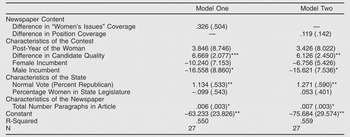
Table 2 presents the coefficients and standard errors from two least squares regression equations, weighted by turnout. In each equation, the contest is the unit of analysis and the dependent variable is the difference in the percent of the two-party vote the female and male candidate received. Negative values of the dependent variable indicate that a man won the race, whereas positive values reflect that a woman won. Each equation includes the difference in the measures of the newspaper content that were statistically significant in the analysis above. More specifically, the first model includes as an explanatory variable the difference in the amount of “women's issues” coverage the female and male candidate received in each race. The second model includes a measure of the difference in position coverage between the female and male candidate. Again, negative values indicate that the male candidate received more of each type of coverage. Each equation also includes contextual controls.Footnote 51
Predicting the difference between women's and men's vote share, 1990–1997
Ordinary least squares regression coefficients (and robust standard errors)

Notes: The dependent variable is the percentage of the two-party vote share the woman received minus the percentage of the two-party vote share the man received for a given race. Differences in newspaper content reflect the amount of coverage the woman received minus the amount of coverage the man received in each race. The difference in candidate quality reflects whether the woman has more experience (+1), the same amount of experience (0), or less experience (−1) than her male opponent. Significance Levels: *p < .10; **p < .05; ***p < .01.
Notably, the regression results reveal that neither the amount of coverage devoted to a candidate's positions, nor to the candidate's priorities for women's issues, affects the difference in the two-party vote. Action coverage, as well as mentions of personal traits, or family and political background, also do not affect vote share (results not shown). Perhaps these null findings result from the fact that newspaper coverage constitutes only a relatively small part of the information environment in gubernatorial campaigns.Footnote 52 Of equal importance, the gendered contextual effects that predict many types of newspaper content also predict the difference in the two-party vote share. Candidate quality, incumbency status, the normal vote, and the length of the article all achieve levels of statistical significance in the models of the two-party vote share.
Most important, however, is the fact that, after controlling for press coverage and contextual effects, female gubernatorial candidates consistently fare worse than men. Given the way we structured the model, the intercept term captures the difference in the percent of the two-party vote after controlling for and setting equal to zero the gauges of newspaper content and context. In other words, the intercept picks up the effects of sex or any unobserved variables associated with the vote; a statistically significant negative value indicates that a woman lost the race, whereas a positive value reflects her victory.
Turning first to open seat contests, the regression equations in table 2 predict that, all else equal, a woman will lose the election to her male opponent, on average, by 6.9 (Model 1) or 9.8 (Model 2) percentage points.Footnote 53 For races with an incumbent, the results are even more disadvantageous for women. Model 1 predicts that a female incumbent competing against a man with less experience, all else equal, will suffer from a vote share deficit of 10.4 percentage points; Model 2 predicts an 11.1 percentage point loss (although we take these results with a grain of salt because of the small N). Conversely, a woman challenging a male incumbent can expect to lose the race by at least 30.1 percentage points. Regardless of the amount and type of media coverage a woman receives, or the characteristics of her challenger, contest, state, or newspaper, her sex remains a serious liability.Footnote 54
The predictions generated by the models comport well with the actual election outcomes we observe. But in order to ensure that the results are not an artifact of some important, but unobserved variable, we ran the same models to predict the difference in the two-party vote of Democrats and Republicans. At the aggregate level, Republicans outperform Democrats by less than half of a percentage point. Table 3 presents the coefficients and standard errors of two weighted least squares regression equations. In each, the dependent variable is the difference in Republican and Democratic vote share for each race; positive values indicate a Republican victor, whereas negative values indicate that a Democrat won the race. The content variables and controls are comparable to those included in Table 2, but the comparisons are all by party, not sex. If Republicans or Democrats were systematically advantaged and the sex of the candidates correlated with party, then we would expect a statistically significant intercept term in the direction of the advantaged party. The intercepts in table 3, however, do not achieve conventional levels of statistical significance. Just as a candidate's party affiliation did not affect newspaper content in table 1, a candidate's party also does not affect election outcome, all else equal. Once candidate quality, incumbency, and contextual effects are accounted for, there is no discernible systematic difference reflected in the intercept in the performance of Republican versus Democratic gubernatorial candidates.
Predicting the difference between Republican and Democrat vote share, 1990–1997
Ordinary least squares regression coefficients (and robust standard errors)

Notes: The dependent variable is the percentage of the two-party vote share the Republican received minus the percentage of the two-party vote share the Democrat received for a given race. Differences in newspaper content reflect the amount of coverage the Republican received minus the amount of coverage the Democrat received in each race. The difference in candidate quality reflects whether the Republican has more experience (+1), the same amount of experience (0), or less experience (−1) than his/her Democratic opponent. Significance Levels: *p < .10; **p < .05; ***p < .01.
Granted, these models are parsimonious and include only 27 elections. With so few degrees of freedom, however, the bar for achieving statistical significance is very high. This makes the results even more striking; a candidate's sex affects the election outcome. Barriers against female candidates who seek state legislative or congressional seats may have diminished, but women vying to be governor in the 1990s faced a very different environment. Non-observable influences related to a candidate's sex clearly play a role in gubernatorial election performance and outcome.
Discussion and Conclusion
This paper began with a puzzle regarding the interaction of gender, media content, and political context in gubernatorial campaigns and how these factors mutually reinforce each other with respect to women's under-representation in the nation's statehouses. We examined two different, but complementary approaches: one focused on sex differences in press coverage, notably candidates' political statements, which scholars have not considered previously; the other addressed methodological and substantive issues regarding the masculinized institutions that shape gubernatorial campaigns. The analysis confirms the importance of both types of consideration. First, press coverage of women emphasized position taking, while it depicted men as more active. We cannot conclude whether such differences arise from how men and women present themselves or reflect subtle bias among reporters. But we do know that these differences are most pronounced for inexperienced women. Second, contextual characteristics of the race, state, and newspaper reduce the direct effect of candidate sex on content, but link indirectly to the gendered undertones prevalent in press coverage. Finally, gendered content does not predict differences in male and female candidates' performance at the polls, but estimates of the disparity in votes at the aggregate level indicate the influence of gendered institutions. More importantly, unobservable differences between the sexes remain a factor in women's success in seeking governorships; women still face an uneven playing field.
Together, these findings raise immediate methodological and substantive questions about gender and electoral politics. In methodological terms, it is important for scholars who undertake content analysis—not just on gender and campaigns, but on many different types of political behaviors—to recognize how space constraints and editorial decisions about the type of article can affect the frequency of observations. Paradoxically, longer stories appear to give more play to content that is potentially detrimental or discriminatory. Every candidate wants to garner media attention, but the irony is that the more attention a candidate receives, the more gendered it might be. This is particularly the case for inexperienced candidates.
Moreover, it seems likely that the states in which women obtain a major party nomination are more likely to have newspapers that avoid obviously stereotypical coverage. In effect, our analysis addresses the potentially best-case scenarios for women. But even in these races, the glass is both half-full and half-empty for female candidates; while conventional stereotyping is not systematic, distinctions between men and women are present in position taking, especially among less experienced candidates. More importantly, even in states where voters have proved willing to nominate women, sex remains a major obstacle to success, although it operates indirectly through mechanisms as yet unknown. For future research designs, the absence, so far, of appropriate instruments to control for such selection effects remains a pressing issue.
Finally, the number of women obtaining nominations to run for governor remains small, and the sources on which we relied to gauge media content are somewhat narrow. Although our analysis is more extensive in terms of the number of observations and range of variables of any previous investigation, the fact remains that the number of cases is limited and time bound. On the one hand, the robust aggregate results in estimating baseline differences with a relatively small number of elections suggests that unobservable effects associated with sex differences are quite powerful. On the other hand, they are vulnerable to the influence of a few cases, such as the few women incumbents. Clearly, more data would increase confidence in the estimated relationships, despite the Herculean task of collecting it. In the same vein, the fact that gender differences continue to appear in newspapers, a relatively impersonal medium, suggests that scholars may find more fruitful ground with other types of coverage. After all, in an age of visual images and the internet, media effects other than newspaper coverage may be relevant as omitted variables that could explain, at least in part, the significant gender gap in aggregate election outcomes. Determining how to examine a broader range of media effects, however, is quite complicated. Not only are the data not readily and systematically available for analysis, but they are also much more difficult to code accurately.
Overall, the results suggest how persistent and elusive gender effects in politics can be. Indeed, some scholars argue that statistical analysis cannot pin down such effects—regardless of how thoroughly and competently the analyses are conducted—because they are too deeply embedded in political processes to be directly observable. Our analysis of both newspaper content and election outcomes provides considerable support to this perspective. Yet, introducing appropriate institutional and contextual controls can mask direct effects, so finding sex differences is always going to be difficult when the analysis is done correctly.
Where do scholars go from here in light of our findings and conclusions? Rather than collect massive amounts of new data, fine-tune coding schemes still further, or abandon the possibility of fully understanding the way that sex affects gubernatorial elections, we believe that the path to progress lies in uncovering the structural roots of gender differences. After all, considering the magnitude of the disadvantage women encounter at the polls, it is unlikely that we will find a new variable that will account for a six to nine percentage point gender gap in vote totals. Many smart people have looked for ways of capturing sex differences in elections, and we are not sanguine about the chances of finding new suspects. Instead, scholars can focus their efforts on new and emerging lines of research and the gender dynamics therein. Work on political ambition, for instance, indicates that self-selection exerts a powerful effect on the pool of women interested in seeking public office and willing to pay the personal costs of running. Some of this work is qualitative and some quantitative, suggesting that multiple methods will be necessary for future progress. In addition to self-selection, recruitment processes continue to warrant additional inquiry. Various types of political actors exercise gate-keeping functions, yet scholars still know relatively little about them and the calculus they employ in encouraging or discouraging individuals to seek nominations. We also know very little about the extent to which the individualistic, entrepreneurial systems of candidate emergence and campaign finance in the U.S. intersect with political ambition and the gendered structure of social networks. In sum, our research suggests the importance of continuing to look for sex differences and gendered processes in new places.
Appendix: Variable Description