Introduction
This paper analyses to what extent attitudes towards government intervention and redistribution are affected by institutional change, by using the division and reunification of Germany as a key case to analyse contested issues in institutionalist theories. Within comparative political–sociological research, there has been a growing interest in the feedback effects of institutions (Pierson, Reference Pierson1993; Mettler and Soss, Reference Mettler and Soss2004; Svallfors, Reference Svallfors2007; Soss et al., Reference Soss, Hacker and Mettler2007). It is argued that, once in place, institutions create feedback effects on the society from which they have arisen. Most often, such feedback effects have been studied at the level of political elites in order to explain how institutional frameworks limit or enhance the development of different interests, and how they affect strategic choices (Skocpol, Reference Skocpol1992; Steinmo et al., Reference Steinmo, Thelen and Longstreth1992; Steinmo, Reference Steinmo1993).
Lately, there have been increasing calls to study such feedback effects also at the level of mass publics, which ‘have yet to receive sufficient attention’ (Pierson, Reference Pierson1993: 597; cf. Mettler and Soss, Reference Mettler and Soss2004; Weakliem, Reference Weakliem2005; for a summary, see Campbell, Reference Campbell2008). Pierson (Reference Pierson1993) summarizes such effects under the headings of resource and incentive effects and interpretive effects. He argues that when feedback effects on mass publics are the focus, the resource and incentive effects are mainly manifested as ‘lock-in’ effects, where previous institutional choices and pathways affect material interests so as to make changes difficult, whereas the interpretive effects are manifested as different degrees of visibility and traceability of policies. To this should be added a normative feedback mechanism (Svallfors, Reference Svallfors2007: 267–268). A normative feedback mechanism is present where public policies provide citizens with a sense, not only of what their material interests are and who is responsible for different political decisions, but also of the desirable state of affairs. Such normative effects work through the evaluative aspects of policies: What do institutions tell citizens about what the world ought to look like?
Feedback effects from institutions and public policiesFootnote 1 are fundamental in forging a particular moral economy, in which conceptions of the mutual rights and obligations in a society are condensed (Kohli, Reference Kohli1987; Svallfors, Reference Svallfors1996; Mau, Reference Mau2003). Public policies and political institutions ‘influence the ways individuals understand their rights and responsibilities as members of a political community’ (Mettler and Soss, Reference Mettler and Soss2004: 61). The notion of a ‘moral economy’ pinpoints that people’s notions of social relations are guided by normative ideas of reciprocity, justice, obligation, and responsibility, and not only by their narrow self-interest.
In analysing the feedback effects and the association between institutional and attitudinal changes, research is marred by problems of deciding the causal order. Is it really the case that institutional change drives attitudinal change, as people adjust their normative expectations to new institutional conditions? Or is it rather attitudinal change that drives institutional change, as institutions need to be adjusted and updated in light of new value patterns and attitudinal change? Since survey time-series analyses tend to have completely arbitrary starting points, it could always be argued that what from a specific time-frame slice looks like attitudinal adaptation to new institutional conditions is really reflecting institutional adaptation to previous attitudinal change. Attitudinal differences between countries can also, in a similar way, be attributed either to institutions exerting a causal force on attitudes, or as institutions being politically adapted to fit existing attitudinal patterns (stemming from whatever other source).
In light of such problems, analysts have often resorted to a vision of institutional and attitudinal changes as taking place in tandem and in mutual adjustment, subject to a never-ending endogenous feedback loop. Even if convenient, such a theorization glosses over important issues of causality that social and political sciences should be able to address.
A possible solution to the problem would be to establish truly longitudinal data, where individuals are followed over a long stretch in time, and changes can be ordered in time and related to institutional change. Even without taking into account the practical problems of implementing a long-term longitudinal database, it is not clear that such a design would be able to cast light on the problem. Institutional change is mostly occurring through gradual and piecemeal processes, which makes it hard to firmly pin down the relation between attitudinal and institutional changes.
This paper takes a different route in focusing something of a ‘natural experiment’ in institutional rupture. It takes advantage of the unique experience of Eastern Germany, in being twice the receiver of externally imposed institutions (Jacoby, Reference Jacoby2000; Goedecke, Reference Goedecke2006). Hence, the paper follows in a venerable historical-institutionalist tradition of analysing formative moments (see, e.g., the various contributions in Steinmo et al., Reference Steinmo, Thelen and Longstreth1992), only this time with a focus on mass publics rather than political elites.
The political and social sciences rarely encounter true natural experiments; strictly speaking they can probably never occur in social life. However, the division and reunification of Germany 1945–90 probably comes as close as one ever gets to a natural experiment in political sociology (Offe, Reference Offe1992; Marshall, Reference Marshall1996; Rosenfeld et al., Reference Rosenfeld, Trappe and Gornick2004; Alesina and Fuchs-Schündeln, Reference Alesina and Fuchs-Schündeln2007). Take a country, invade it, split it into two parts, impose foreign political institutions with completely new rules in one part of the country (the East), but leave a substantial institutional continuity in the other (the West). Let things take their course for several decades, then suddenly reunite the two parts, with existing institutions in the West now imposed in the East. Check how things differ between the East and the West immediately after reunification, and follow what happens as time passes.
It could be plausibly argued that in this particular case the time order of institutional and attitudinal changes can be firmly decided. Neither the imposition of Soviet-style institutions in the late 1940s nor the transfer of West German institutions (including senior staff) beginning in 1990 were the result of institutional adaptation to gradually changing attitude patterns. They were the result of political decisions and their implementation, and the endogeneity problem is therefore of much less importance here.Footnote 2 Furthermore, before the division of the country, differences between Eastern and Western Germany in living standards and economic structure were small, as were the political differences (Alesina and Fuchs-Schündeln, Reference Alesina and Fuchs-Schündeln2007: 1510). Any existing differences between East and West Germany at the point of reunification could therefore plausibly be attributed to the division 1945–90.
What were the main differences between the East and the West German systems of social protection, and how should we expect those to impact redistributive attitudes? The East German system included a far-reaching (although ultimately severely flawed) attempt by the state to take responsibility for the social security of citizens through all walks of life. The undemocratic and repressive nature of the country’s political system was legitimized by claims to guarantees of social and economic security – although at a modest level. In comparison, the West German system was built around a much more circumscribed view of the social responsibilities of the state. The notion of the ‘social market economy’ became deeply embedded in the West German institutions. This implied that competition and performance in the market was the cornerstone for citizens’ welfare, but that the welfare state had a key responsibility in ameliorating adverse outcomes of market competition (Hancock, Reference Hancock1989; Schmidt, Reference Schmidt1989; Stjernø, Reference Stjernø1995; Clasen, Reference Clasen2005).
Although a full description of the differences between the East and the West German systems of social protection lies beyond the scope of the paper, a few stylized facts should bring out the main contours.Footnote 3 Perhaps the most fundamental difference was that employment was both a right and a duty in East Germany. An extensive set of welfare policies were tied to employment and the workplace, including things such as subsidized housing and child care. On the other hand, no unemployment insurance existed since employment was guaranteed through ‘labour hoarding’ at the workplaces.
In West Germany, employment was neither a right nor an obligation. Citizens were supposed to take significant responsibility for their own and their families’ well-being at the same time as the welfare state provided an extensive non-market support. Welfare policies were directed towards status preservation in which stronger labour market positions were translated into better welfare outcomes through a system of income-related benefits. Family policies in the West were used as supports for the ‘male bread-winner’ family, in which tax rebates were used to increase the economic feasibility of families with stay-at-home mothers at the same time as child care facilities were limited.
In summary, the main difference between the West and the East German welfare policies was that the East German system took purported responsibility for the welfare of its citizens in all walks of life: ‘Das sozialistische Modell der Sozialpolitik übernimmt dagegen im Unterschied zum westlichen Sozialstaats-Modell eine Verantwortung in nahezu allen Lebenbereichen’ (Roller, Reference Roller1997: 118). The East German system of social protection was in the long run an economically unsustainable way to prop up a system based on repression and lack of ideological legitimacy. In comparison with the West, living standards were lower but social security higher; inequality was lower but individual choice limited; life was less free but economic sustenance less uncertain. From an institutionalist perspective, one would expect such fundamental differences to be translated into deep differences in the West and East Germany’s collective psyches, in their respective moral economies.
Since the West German institutions were exported wholesale to former East Germany (Jacoby, Reference Jacoby2000; Goedecke, Reference Goedecke2006), an institutionalist perspective would predict Eastern German attitudes to slowly converge on the Western German pattern. From an initially much more encompassing view of government’s responsibilities for living conditions and redistribution, we should expect Eastern German attitudes to become more similar to those found in Western Germany as time passes.
Someone less persuaded by institutionalist arguments would point out that since adverse social conditions and economic hardship are still more prevalent in Eastern Germany, we should not necessarily expect any convergence at all. It might even be possible that once frames of reference were changed in Eastern Germany, so that conditions in Western Germany became the point of comparison, Eastern Germans would ask for more redistribution than they previously did. Such a ‘relative deprivation’ argument thus stands in stark contrast to the ‘normative adjustment’ argument conveyed by institutional theory.
Furthermore, we should ask to what extent institutional transformation affects attitudes among members of different birth cohorts differently. The key argument here is that people whose life course transitions into adult life had already been fully accomplished at the time of institutional rupture had to reconsider their expectations and worldviews, which may make them resistant to attitudinal change. Cohorts who entered adult life after the institutional transformation had no previous institutional experience against which to match new rules. Therefore, we should expect them to be more affected by the new institutional rules and less by the previous ones. So a combination of institutional and socialization theories would in our case predict that among younger cohorts we would find much smaller differences in attitude between Eastern and Western Germans than among older cohorts.
But again, explanations that put more emphasis on distributive outcomes than on institutional conditions would not expect processes to necessarily play out differently among different cohorts. Important here would rather be whether differences in material circumstances are larger among older or among younger cohorts. Where such differences are larger, we should expect larger attitudinal differences in issues related to state intervention and (re)distribution.
Redistributive attitudes in the two Germanys: previous research
Given the peculiarities of the German case, it is not surprising that a large degree of research interest has been directed at post-unification comparisons of Eastern and Western Germany (for summaries, see, e.g., Buhlmann, Reference Buhlmann1998; Gabriel, Reference Gabriel2007; Thumfart, Reference Thumfart2007). Comparisons have included both actual living conditions and life chances, and subjective experiences/attitudes.
For this paper it is worth noting the extensive comparisons of conceptions of distributive justice and of the subjective evaluation of life chances and living conditions (Roller, Reference Roller1994; Marshall, Reference Marshall1996; Meulemann, Reference Meulemann1997, Reference Meulemann2003; Wegener and Liebig, Reference Wegener and Liebig2000; Wegener et al., Reference Wegener, Lippl and Christoph2000; Wegener, Reference Wegener2003; Lippl and Wegener, Reference Lippl and Wegener2004). In a nutshell, these comparisons of attitudes and subjective evaluations show overall similarities between Western and Eastern Germany in basic conceptions of social justice, seeing merit as the key principle for just rewards. At the same time, Eastern Germans are considerably less satisfied with living conditions and with the practical application of social justice. They also tend to be more egalitarian in their views about (re)distribution. In the short-to-medium term (early to mid/late 1990s), these similarities and differences show large stability.
Of more immediate relevance for this paper are comparisons of attitudes towards state intervention and public policies. At the point of unification, there were substantial differences between people in Eastern and Western Germany regarding their views about state intervention and responsibilities. Eastern Germans asked for a much more wide-ranging state responsibility and intervention than Western Germans. In the short-term, no clear tendencies in this regard can be observed (Braun and Kolosi, Reference Braun and Kolosi1994; Roller, Reference Roller1994, Reference Roller1997).
However, in a recent paper, Alesina and Fuchs-Schündeln (Reference Alesina and Fuchs-Schündeln2007) point to substantial convergence between people who lived in the two parts of Germany before the unification in their views about state vs. private forces’ responsibilities for financial security. Using a panel data set from 1997 and 2002, they find that attitudinal differences between the East and the West are substantial, but tend to become smaller between the two measurement points. They also find that the attitudinal differences between the East and the West are smaller among younger cohorts than among older ones. Furthermore, they find that a large number of controls for material factors have rather little effect on the East–West differences, which they therefore plausibly attribute to factors in the divided Germany rather than current economic circumstances.
Alesinas and Fuchs-Schündeln’s analysis has its first measurement point several years after reunification. Therefore, it is still not absolutely clear that the differences between the East and the West that they document are results of factors before reunification, and not of traumatic experiences in the difficult unification process itself. By using data collected much closer to reunification, this paper adds something important in this respect.
This paper also contributes to the research on the issue by focussing how attitudes towards government responsibilities and intervention have been affected in a longer-time perspective. The question is whether conclusions about inter-German differences in views about state intervention will hold over a longer-time period than previously measured. Adaptation to new institutional conditions is a slow process, since ingrained attitudes and expectations need to be reconsidered. I also ask to what extent developments in these respects affect different birth cohorts differently, as they are differently related to the process of institutional change and attitudinal adaptation.
Data and methods
The analysis builds on data from the International Social Survey Program (ISSP). The ISSP represents an attempt to create a truly comparative data set with which to analyse attitudes and values among the populations of industrialized countries. A wide variety of topics have been surveyed, and from 1990 previous modules have been replicated allowing comparison both between nations and over time. These data are uniquely well suited to the task at hand, since the ISSP module on ‘The Role of Government’ was implemented in 1990 – right after German unification – in 1996, and in 2006.Footnote 4 As presented in detail below, the module contains a battery of questions related to attitudes towards government responsibilities. These items will make up the dependent variable in the analysis, charting changing attitudes towards state intervention in the ‘two Germanys’ from reunification and 16 years onwards.
Since the ISSP is conducted in a large and growing number of countries, these data also allow us to put changes in Eastern and Western Germany in a comparative perspective. For this paper, data are chosen from nine countries that have conducted the 1990, the 1996, and the 2006 surveys. These countries, although they were simply chosen on availability grounds, represent a strategic selection of advanced political economies. They include countries from the ‘social democratic’ (Norway), ‘conservative’ (Germany), and different varieties of the ‘liberal’ (Australia, Britain, Ireland, and the United States) worlds of welfare (Esping-Andersen, Reference Esping-Andersen1990), but also a former communist country (Hungary) and Israel. Hence, the full gamut of institutional variation among the advanced Western political economies is represented. In combination, these countries form a suitable background against which to evaluate attitudinal change in the two Germanys.
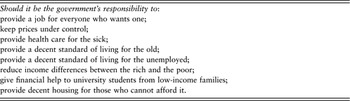
In choosing suitable indicators of attitudes to state intervention, the ISSP surveys offer a substantial variety.Footnote 5 The item battery that will be used for the comparison is one that asks about government responsibilities for various redistributive and risk-reducing measures (as presented in Table 1 below). By asking about respondents’ principled support for government responsibility in different respects, it avoids some of the comparative problems involved in asking about ‘more’ or ‘less’ intervention or spending.
Government’s responsibilities. List of items

Absolutely (3); Probably (2); Probably not (1); Absolutely not (0).
Source: ISSP 1990; 1996; 2006.
The ISSP data are relatively sparse when it comes to indicators of living conditions. Since such controls are essential to include in the analysis, ISSP data have been merged with data from the German ALLBUS (of which ISSP form one part). The ALLBUS data include a richer set of background variables than the ones included in the ISSP, and so allows for a larger group of control variables to be included in the analysis.
The paper uses a summary index to measure attitudes to state intervention, the construction of which is described below. Variations within and between Eastern and Western Germany on this index then constitutes the explanandum for the paper. The choice of this manifest and fairly simple measure – and not any latent construct – is based in choosing intuitive interpretability and effective presentation before sophisticated measurement. Given the unidimensional character and high reliability of the index, results are likely to be stable regardless of measurement construction.
Values on the index are first used in descriptive plots to give an overview of time trends across countries, and then entered in regression (ordinary least squares) models to decide to what extent overall and cohort differences between Eastern and Western Germany are affected by differences in demographic and economic circumstances. Regression results are presented in graphical form in order to increase immediate interpretation, as presented in adjunction to figures.
Eastern and Western Germany in comparative perspective
In tapping attitudes towards state intervention and government responsibilities, an item battery as displayed in Table 1 was used.Footnote 6 As shown, it covers a broad set of policies related to the provision of social protection and achieving redistribution. The answer scale and coding is provided at the bottom of the table. Since all items load on a single factor and show high intercorrelations, it makes sense to include them all in a summary measure of attitudes towards state intervention.Footnote 7 This measure is constructed by summing all items, dividing the scale with its (theoretical) maximum value and multiplying it with 100. The new summary measure – ‘Government Intervention Index’ – can thus vary between 0 and 100 with higher values indicating stronger support for state intervention and extensive government responsibilities.
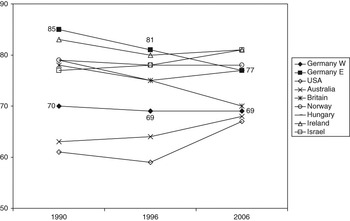
In Figure 1, scale means are provided for all countries that conducted all three surveys. There are a number of observations one could make about the index values displayed in the figure. However, in this paper, the sole purpose of this figure is to put the intra-German attitudinal differences and changes in perspective. Hence, the most important observation that should be made here is the clear and steady convergence of the Eastern German attitudes towards those in Western Germany. While index values are eminently stable in Western Germany 1990–2006, Eastern German values decline by eight points. In 1990, there was a difference of 15 index points between Eastern and Western Germany, a larger difference than between Western Germany and any other country included in the 1990 survey. In 2006, the distance had shrunk to eight points, and there are several other countries that now display higher values than Eastern Germany.Footnote 8
Government Intervention Index 1990–2006.

The decline in support for extensive state intervention in Eastern Germany applies more or less across the board of items. It is particularly large in case of support for employment policies and for providing decent living standards for the unemployed. The only item that does not display a downward trend is the one for reducing income differences between rich and poor, which shows complete stability (for details, see web appendix [http://journals.cambridge.org/epr], Table W1).
Convergence within and across cohorts: a closer look
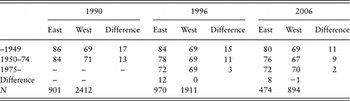
Have the convergence tendencies between Eastern and Western Germany displayed in Figure 1 affected cohorts similarly? In order to analyse this, a simple threefold cohort categorization has been applied. Those who were already fully established in adult life at reunification (that is, born before 1950) will be compared to a middle cohort (born between 1950 and 1975), and to one consisting of those who were still children at reunification (that is, born after 1975).Footnote 9
In Table 2, we find the index values displayed for the three cohorts in Eastern and Western Germany, at the three points in time. Several observations could be made. Most importantly, we find that in the youngest cohort, among those who entered adult life after the fall of the wall, differences between Eastern and Western Germany are virtually nil. In the oldest cohort, among those born before 1950, we still find a substantial East–West difference in 2006. It should be noted, however, that even in this cohort, Eastern Germans are converging on the Western German level. All cohorts in Eastern Germany are gradually moving closer to their Western counterparts. But, the main mechanism behind the Eastern–Western convergence seems to be generational replacement, in which later cohorts in Eastern Germany are closer to their Western contemporaries than the earlier cohorts are. Attitudes among Western Germans are the epitome of stability; there are no differences between cohorts nor any change over time. Cohort and survey time-point differences in combination provide a quite dramatic attitudinal convergence between East and West: from 17 index value points in the oldest cohort in 1990 to an insignificant 2 point difference among the youngest cohort in 2006.
Government Intervention Index in Eastern and Western Germany, by generation and survey year

To what extent are these differences and changes dependent on differences in material circumstances between the East and the West? In order to test this, a number of controls for demographic factors and material circumstances were included in the analyses. In order to obtain a wider set of background variables than the one found in the ISSP surveys, ISSP data were merged with data from the German ALLBUS (in which ISSP is run as a separate module). These were regressed onto the attitude index alongside dummy variables for each part-by-cohort-by-time combination. This analysis serves a dual purpose: we obtain a formal test of the statistical significance of the differences between cohorts in Eastern and Western Germany at different points in time, and we are able to estimate to what extent these differences are affected by the controls.
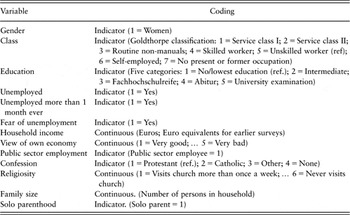
Regressions were run in two steps. In a first step, only the part-by-cohort-by-time variables were included – basically putting Table 2 in regression format. In a second step, all available and possibly relevant indicators were included in the regression. The included variables are intended to cover potentially relevant factors that could explain differences between Eastern and Western Germany. They cover both a set of variables related to individual risks and resources (such as class, education, income, economic problems, current and previous unemployment, and household composition), and a set of variables related to other demographic aspects (such as gender, religiosity, confession, etc.). A detailed list of variables and codings are displayed in Appendix (Table A1).
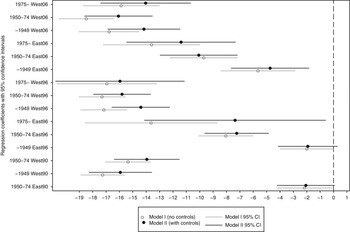
In order to focus on the most central aspect for this paper, estimates for the part-by-cohort-by-time variables are graphically displayed pre- and post-controls, in relation to the reference category.Footnote 10 The precision of the estimates are shown as the 95% confidence intervals (CIs), allowing us to judge which differences between estimates that are statistically significant.
Results are displayed in Figure 2. Estimates and CIs for the first model – without controls – are shown as hollow circles with grey bars; results for the model with controls are shown as black dots and bars. All estimates are shown relative to the reference category: Eastern Germans born before 1949 at the 1990 survey.
Government Intervention Index, by generation and survey year.

A number of observations can be made in the figure. The most important is that even though estimates change somewhat between the models, it is clearly not the case that most of the differences between the Eastern and the Western Germans, or most of the cohort differences in Eastern Germany, are due to differences in material and demographic factors. Significant attitudinal differences remain, both between the eastern and western older cohorts at all survey time points, and between the oldest and the youngest cohorts in the East.Footnote 11
We should also note the confirmation of the impression from Table 2 that cohort differences are substantial in Eastern Germany, but negligible in Western Germany. One should also note, however, that after controls are introduced in the model, differences between cohorts in Eastern Germany are no longer statistically significant in 2006 (as shown by the overlapping CIs). So, there is clearly some impact from the introduced controls, even though they are limited. But, in summary, much of the cohort differences across and within the both parts of Germany remain after taking potentially relevant controls into account.
Conclusion
In conclusion, the results presented in this paper supply strong support for one of the key tenets of institutional theories: that mass publics are affected by institutional design so that major institutional changes will lead to attitudinal adaptation and change. It was shown that overall attitudes in Eastern Germany have steadily converged on the pattern found in Western Germany. This implies a more circumscribed notion of the responsibilities that should be held by government in order to redistribute resources and take responsibility for the material security of citizens.
The paper has also pointed to generational replacement as a key mechanism through which institutional change affects attitudes. It was shown that for cohorts who had fully entered adult life already at the point of reunification, attitudinal differences between the West and the East are substantial – even at the 2006 survey – while they are virtually non-existent among those who had not yet reached adulthood in 1990.
Differences in all these respects are affected by differences in material and demographic circumstances between the eastern and the western parts of the country. However, most of the attitudinal differences between country parts and cohorts remain even after taking into account a host of control variables. Hence, the ‘normative adjustment’ argument derived from institutional theory received considerable backing from the results in the paper, emanating from the German ‘natural experiment’ in institutional change. New institutions create new normative expectations that lead to new attitudes towards public policies. New generations are particularly susceptible to new institutional conditions, as they have no previous formative experiences that need to be reconsidered.
Caveats apply (as always) to the current analysis. One is that we cannot be certain about how many of the respondents who at the time point of the later surveys happened to live in Eastern or Western Germany actually have their formative experiences in that particular part of the country. Because of internal migration, people could live well now in a different part of the country from where they grew up and became established as adults. However, because of labour market conditions, most of the migration flows within Germany have been going from the East to the West.Footnote 12 The key results of the paper could therefore scarcely be affected to any considerable extent. It is hardly the case that the convergence of the Eastern German attitudes on the Western German pattern could be the result of a large number of western-socialized citizens flowing into the eastern parts of the country. In fact, if there are any effects at all they should work in the opposite direction and hence strengthen the arguments of the paper.
It is also reassuring to find that Alesina and Fuchs-Schündeln (Reference Alesina and Fuchs-Schündeln2007), using a different data set with different attitude items, collected in a different time frame, and applying a different (and wider) set of controls draw essentially the same conclusions as of this paper. This testifies to the basic robustness of the empirical results.
A more general point relates to the status of Eastern Germany as a ‘natural experiment’. Needless to say, there is nothing approaching a laboratory situation in open social systems. Too many things happen at once for there to be anything closely similar to a fully randomized experiment. To give but one example, there is no way to be absolutely certain that the attitudes displayed in Eastern Germany in 1990 is not to some degree the effect of uncertainties related to the unification process itself, rather than inherited from the communist past. Since we will probably never know the attitudes of the East German population before unification, there is no way to offer proof beyond doubt on this point. Still, I argue that the fact that we have been able to measure attitudes to state intervention so soon after reunification, and the distinct cohort differences that appear in the analysis, offer a large degree of support for the interpretations presented in this paper (cf. Alesina and Fuchs-Schündeln, Reference Alesina and Fuchs-Schündeln2007).
Another issue related to the status of the case in question is how far the findings can be extrapolated to other instances of institutional change. The dramatic institutional rupture, amounting to a complete system collapse, involved in the transformation of East Germany is unlikely to be replicated in many other advanced industrial societies. So, one should be clear that the results of this paper do not imply that institutional adaptation to extrainstitutionally induced attitudinal change never takes place, or that all or most attitudinal change has institutional roots. There is no doubt that attitudes are affected by and may change due to, for example, changes in family patterns or stratification outcomes. There is also no doubt that actors sometimes implement changes to better adapt institutions to changing attitude patterns. But, the results from the unique German ‘institutional experiment’ do indicate that normative feedback effects from policy change are present, and that institutions in this way have a causal impact on attitudes among mass publics.
Finally, and offering openings for further research, the type of analysis conducted here has not allowed illumination of the exact mechanisms through which institutional change is translated into attitudinal change. At the individual level, we could ask to what extent beliefs about the possibilities for redistributive action were affected compared to norms about the fairness of such state intervention. Is it because younger generations in Eastern Germany are less convinced about what the state can do that they are different in their attitudes from older generations, or is it because they have different norms about what the state ought to do?
At the level of institutions and organized social actors, we could ask if the mechanisms behind attitudinal change should be sought in the institutional rules themselves, or rather in the public discourse surrounding the institutional transformation. The specificities of the collapse of East Germany were such that it became very hard to argue in favour of any aspects of the old system. The political debate in the early years after reunification was almost unanimous in its denouncement of everything related to the old East German system, and its embracing of the extension of the West German institutions to the East. The debate between institutional defenders and contenders that usually takes place in ‘normal’ democratic circumstances was more or less absent. It is not clear how important these peculiar aspects of the debate have been in affecting attitudes, compared to changed everyday life experiences related to new institutional rules. So the German institutional rupture offers yet further opportunities for comparative political research.
Acknowledgement
The research has been funded by the Swedish Research Council, the Bank of Sweden Tercentenary Foundation, and the Swedish Council for Social and Working Life Research. It was finalized under the European Science Foundation’s Human Values, Institutions and Behaviour (HumVIB) program Welfare Attitudes in a Changing Europe. Thanks to Roger Andersson, Martin Hällsten, Eduardo Leoni, Markus Quandt, Annette Schnabel, and, in particular, Michael Terwey for invaluable help with methods and data sets. Helpful comments were provided by Erik Bihagen, Clem Brooks, Ingvar Johansson, Staffan Kumlin, Steffen Mau, Ingrid Schild, Annette Schnabel, Ryszard Szulkin, three anonymous referees, and several other participants in the different sessions where the paper has been presented.
Appendix
Control variables in the models