Introduction
Palliative care is a multi-professional and interdisciplinary approach, in which teamwork is a central component. Along with physicians, nurses have the opportunity to initiate end-of-life discussions during the cancer trajectory. End-of-life discussions are one of the most challenging communication tasks for healthcare professionals (Belanger et al., Reference Belanger, Rodriguez and Groleau2011; Rietze and Stajduhar, Reference Rietze and Stajduhar2015; Neergaard et al., Reference Neergaard, Skorstengaard and Brogaard2020).
Nurses are among the healthcare professionals who spend the most time with patients and their families (Butler et al., Reference Butler, Monsalve and Thomas2018). In 2019, a Swedish study investigated crucial aspects of nursing in end-of-life communication and concluded that nurses are important to the entire process of communicating with patients and their families about and during end-of-life discussions (Rylander et al., Reference Rylander, Stenwall E and Gustafsson2019). The nurse is often a central person in the patient's treatment and has the opportunity to facilitate discussions on end-of-life issues in a timely manner (Rylander et al., Reference Rylander, Stenwall E and Gustafsson2019). Increased knowledge about nurses’ perspectives about the complexity of end-of-life discussions with incurable ill cancer patients and their family caregivers may improve care for patients and family members (Rylander et al., Reference Rylander, Stenwall E and Gustafsson2019).
Our initial literature search did not identify any reviews focusing on nursing involvement in end-of-life discussions with incurable cancer patients and their family caregivers. Previous reviews have primarily focused on advance care planning (ACP) conversations in acute and home care settings and on nurses’ involvement in decision making during cancer treatment (Rietze and Stajduhar, Reference Rietze and Stajduhar2015; Blackwood et al., Reference Blackwood, Walker and Mythen2019). An integrative review explored nurses' involvement in ACP conversations in acute care and concluded that nurses have only limited engagement in ACP conversations (Rietze and Stajduhar, Reference Rietze and Stajduhar2015). In a systematic review, the two primary barriers to the engagement of nurses and other healthcare professionals in ACP conversations in acute and home care settings were lack of education and insufficient time (Blackwood et al., Reference Blackwood, Walker and Mythen2019). A second systematic review from 2015 found that nurses’ involvement in decision making about cancer treatment is important in both curative and palliative care, but the review focused on curative treatment decisions (Tariman and Szubski, Reference Tariman and Szubski2015). To improve end-of-life care for patients with incurable cancer and their families, a need exists to understand current evidence related to nurses’ involvement in end-of-life discussions. The guiding question for this integrative review was: What are nurses’ perspectives on their involvement in end-of-life discussions — including barriers and facilitators — with patients with incurable cancer and their family caregivers?
Concepts
End-of-life discussion
Several concepts appear in the literature related to end-of-life discussions, including end-of life-conversations, end-of-life communication, and end-of-life decisions. Shared decision making and ACP are also well-known related concepts. Shared decision making pertains to conversations about treatment decisions; however, nurses often have discussions with patients' treatment decisions during chemotherapy (Belanger et al., Reference Belanger, Rodriguez and Groleau2011). ACP is often described as a systematic and structured approach following a guide, during which a patient and his or her family make decisions about future healthcare and end-of-life decisions, in case the patient becomes incapable or dies (Skorstengaard et al., Reference Skorstengaard, Brogaard and Jensen2019). In this systematic integrative review, end-of-life discussions will refer to a broad concept of discussions between nurses, patients, and their family caregivers that may cover treatment decisions, prognosis, preferences, and wishes for daily life with a life-threatening disease.
Nurses
Both hematological and oncological nurses will be referred to simply as nurses. Both types of nurses are responsible for administering chemotherapy and talking to patients with incurable cancer and their families about end-of-life issues.
Family caregivers
In this paper, family caregivers are defined by the patient and can be both blood-related relatives and/or close friends (Holstein and Gubrium, Reference Holstein and Gubrium1999).
Methods
Design
An integrative review was selected to search, assess, and synthesize different types of research (Whittemore and Knafl, Reference Whittemore and Knafl2005). The search protocol was developed based on methods for finding and reviewing research evidence in the literature (Beck, Reference Beck2014) and integrative review methods (Whittemore and Knafl, Reference Whittemore and Knafl2005). The latter guided the study selection process and data analysis (Whittemore and Knafl, Reference Whittemore and Knafl2005), and the study quality assessment was based on a framework by Hawker et al. (Reference Hawker, Payne and Kerr2002). Findings are reported in accordance with Preferred Reporting Items for Systematic Reviews and Meta-Analyses (PRISMA) guidelines where applicable (Moher et al., Reference Moher, Liberati and Tetzlaff2009). The review protocol was registered in PROSPERO (CRD42020186204, https://www.crd.york.ac.uk/prospero/display_record.php?RecordID=186204).
Search strategy and screening
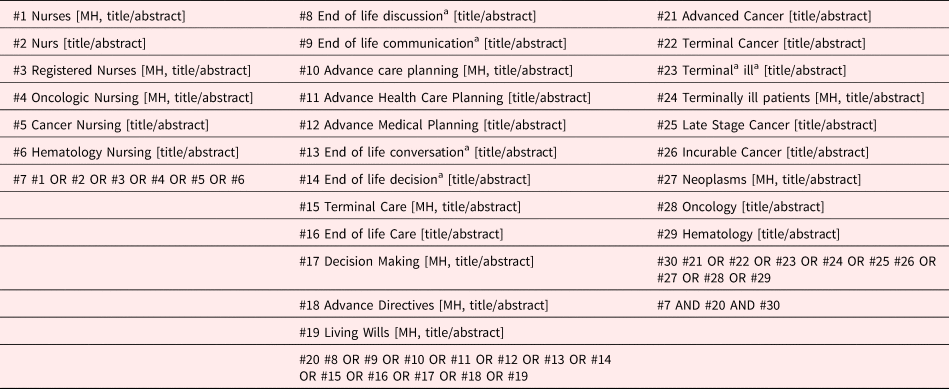
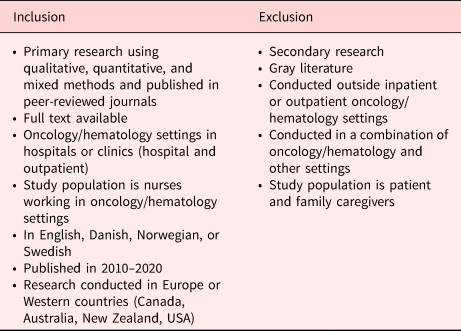
Four databases were searched: CINAHL, Medline, Embase, and PsycInfo on 17 June 2020. The initial search was carried out in CINAHL, where keywords and the thesaurus were identified (Table 1). An experienced librarian supervised the testing of new keywords and combinations. The search was then adapted to the remaining databases. T.I. and K.B.D. screened articles for eligibility, first screening titles, and abstract for relevance, inclusion/exclusion criteria (Table 2), and research questions, and then screening full articles. Finally, reference lists of included studies were reviewed.
Search strategy in CINAHL — search terma

a Due to inconsistent definitions for the concept of end-of-life discussions, the literature review included alternative search terms such as ACP and end-of-life decisions.
Inclusion and exclusion criteria

Quality appraisal
Quality assessment inspired by Hawker et al. (Reference Hawker, Payne and Kerr2002) was performed by T.I. The framework is appropriate for assessing varying study designs and based on ten criteria: (1) title and abstract, (2) introduction and aims, (3) methods and data, (4) sampling, (5) data analysis, (6) ethics, (7) bias, (8) results, (9) transferability or generalizability, and (10) implications and usefulness (Hawker et al., Reference Hawker, Payne and Kerr2002). Scores for each criterion range from 1 (low quality) to 4 (high quality), and the total possible score range for each study was 10-40 points.
Data analysis
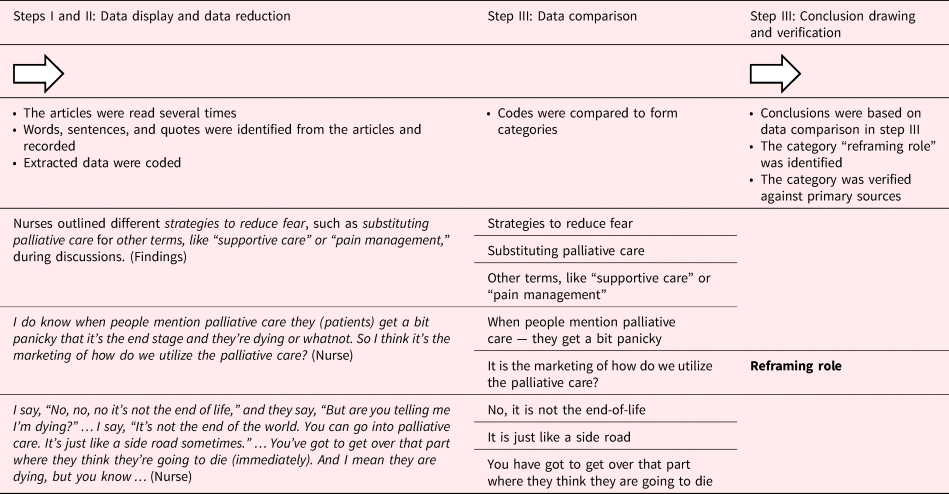
Data analysis was based on four steps: (1) data reduction, (2) data display, (3) data comparison, and (4) conclusion and verification (Whittemore and Knafl, Reference Whittemore and Knafl2005). The articles were first read several times with the research question in mind. Words, sentences, and quotes were extracted, recorded in a spreadsheet, and coded. The codes were then compared to form themes, after which the primary sources were reread and compared against the themes to ensure accuracy and confirmability (Whittemore and Knafl, Reference Whittemore and Knafl2005). See Table 3 for an example of the analysis.
Simplified example of data analysis, the reframing role

Results
Included studies
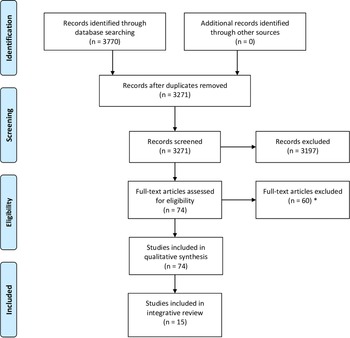
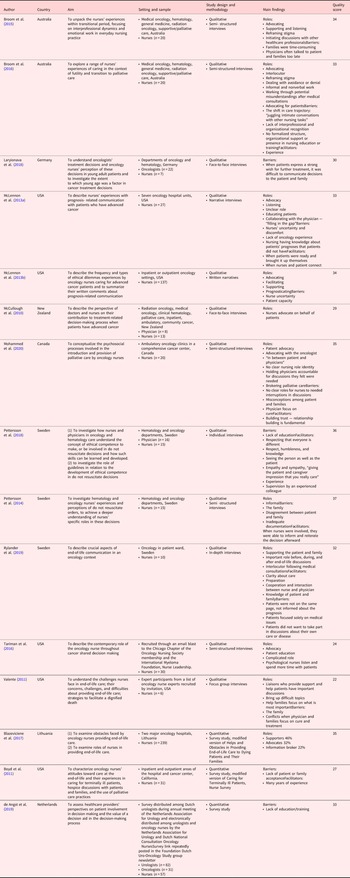
After removing duplicates, 3,271 studies remained (Figure 1). Of these, 3,197 were excluded after screening titles and abstracts, and 74 studies were read in full. The 15 studies remaining after full-text review comprised 3 quantitative reports and 12 qualitative reports that collectively included 867 nurses caring for patients with incurable cancer. Included studies are summarized in Table 4. Three sets of two articles report results from a single study (McLennon et al., Reference McLennon, Lasiter and Miller2013a, Reference McLennon, Uhrich and Lasiter2013b; Pettersson et al., Reference Pettersson, Hedstrom and Hoglund2014, Reference Pettersson, Hedstrom and Hoglund2018; Broom et al., Reference Broom, Kirby and Good2015, Reference Broom, Kirby and Good2016).
PRISMA flow chart.

Summary of 15 studies included in a review investigating nurses’ involvement in end-of-life discussions with terminal patients and their family caregivers

The quantitative studies were cross-sectional surveys (Boyd et al., Reference Boyd, Merkh and Rutledge2011; Blazeviciene et al., Reference Blazeviciene, Newland and Civinskiene2017; de Angst et al., Reference de Angst, Kil and Bangma2019). All qualitative studies used data from interviews and different analytical methods, including thematic content analysis (McCullough et al., Reference McCullough, McKinlay and Barthow2010; Valente, Reference Valente2011; McLennon et al., Reference McLennon, Lasiter and Miller2013a, Reference McLennon, Uhrich and Lasiter2013b; Pettersson et al., Reference Pettersson, Hedstrom and Hoglund2014, Reference Pettersson, Hedstrom and Hoglund2018; Tariman et al., Reference Tariman, Mehmeti and Spawn2016; Rylander et al., Reference Rylander, Stenwall E and Gustafsson2019) and grounded theory (Broom et al., Reference Broom, Kirby and Good2015, Reference Broom, Kirby and Good2016; Laryionava et al., Reference Laryionava, Heussner and Hiddemann2018; Mohammed et al., Reference Mohammed, Savage and Kevork2020).
The 15 studies were conducted in the following countries: US (n = 5) (Boyd et al., Reference Boyd, Merkh and Rutledge2011; Valente, Reference Valente2011; McLennon et al., Reference McLennon, Lasiter and Miller2013a, Reference McLennon, Uhrich and Lasiter2013b; Tariman et al., Reference Tariman, Mehmeti and Spawn2016), Canada (n = 1) (Mohammed et al., Reference Mohammed, Savage and Kevork2020), Lithuania (n = 1) (Blazeviciene et al., Reference Blazeviciene, Newland and Civinskiene2017), Sweden (n = 3) (Pettersson et al., Reference Pettersson, Hedstrom and Hoglund2014, Reference Pettersson, Hedstrom and Hoglund2018; Rylander et al., Reference Rylander, Stenwall E and Gustafsson2019), Netherland (n = 1) (de Angst et al., Reference de Angst, Kil and Bangma2019), Germany (n = 1) (Laryionava et al., Reference Laryionava, Heussner and Hiddemann2018), Australia (n = 2) (Broom et al., Reference Broom, Kirby and Good2015, Reference Broom, Kirby and Good2016), and New Zealand (n = 1) (McCullough et al., Reference McCullough, McKinlay and Barthow2010).
Included studies reported findings related to various types of discussions: treatment discussions (n = 4) (McCullough et al., Reference McCullough, McKinlay and Barthow2010; Tariman et al., Reference Tariman, Mehmeti and Spawn2016; Laryionava et al., Reference Laryionava, Heussner and Hiddemann2018; de Angst et al., Reference de Angst, Kil and Bangma2019), care discussions (n = 3) (Boyd et al., Reference Boyd, Merkh and Rutledge2011; Valente, Reference Valente2011; Blazeviciene et al., Reference Blazeviciene, Newland and Civinskiene2017), do not resuscitate discussions (n = 2) (Pettersson et al., Reference Pettersson, Hedstrom and Hoglund2014, Reference Pettersson, Hedstrom and Hoglund2018), prognosis-related discussions (n = 2) (McLennon et al., Reference McLennon, Lasiter and Miller2013a, Reference McLennon, Uhrich and Lasiter2013b), discussions about transitions to palliative care (n = 3) (Broom et al., Reference Broom, Kirby and Good2015, Reference Broom, Kirby and Good2016; Mohammed et al., Reference Mohammed, Savage and Kevork2020), and treatment and end-of-life care discussions (n = 1) (Rylander et al., Reference Rylander, Stenwall E and Gustafsson2019). During quality appraisal, included studies received 22–37 points, with a mean of 33.9 points (Table 4). We did not exclude any studies on the basis of the quality appraisal.
Four overall themes were identified as related to nurses’ roles, barriers, and facilitators in end-of-life discussions:
• Nursing roles
• Trust building
• Nurse competence
• Medical issues
Nursing roles
Analysis revealed three defined nursing roles — advocating, supporting, and reframing — and also the lack of a defined task or role in some situations, for example, medical consultations.
Eleven included studies addressed nurses’ roles in end-of-life discussions, and the results consistently emphasized the varying nature of the roles (McCullough et al., Reference McCullough, McKinlay and Barthow2010; Valente, Reference Valente2011; McLennon et al., Reference McLennon, Lasiter and Miller2013a, Reference McLennon, Uhrich and Lasiter2013b; Pettersson et al., Reference Pettersson, Hedstrom and Hoglund2014; Broom et al., Reference Broom, Kirby and Good2015, Reference Broom, Kirby and Good2016; Tariman et al., Reference Tariman, Mehmeti and Spawn2016; Blazeviciene et al., Reference Blazeviciene, Newland and Civinskiene2017; Rylander et al., Reference Rylander, Stenwall E and Gustafsson2019; Mohammed et al., Reference Mohammed, Savage and Kevork2020). In the advocacy role, nurses acted as an intermediary between families and physicians. This was the most commonly reported role, described in seven studies (Valente, Reference Valente2011; McLennon et al., Reference McLennon, Lasiter and Miller2013a, Reference McLennon, Uhrich and Lasiter2013b; Broom et al., Reference Broom, Kirby and Good2015, Reference Broom, Kirby and Good2016; Tariman et al., Reference Tariman, Mehmeti and Spawn2016; Mohammed et al., Reference Mohammed, Savage and Kevork2020). Blazeviciene et al. (Reference Blazeviciene, Newland and Civinskiene2017) reported that n = 77/239 (32%) of the nurses saw themselves acting in an advocating role. Tariman et al. (Reference Tariman, Mehmeti and Spawn2016) described nurses as advocating for patients about treatment options or when patients and oncologists disagreed about future treatment. Two studies (McLennon et al., Reference McLennon, Lasiter and Miller2013a, Reference McLennon, Uhrich and Lasiter2013b) found that nurses would act as advocates about care plans and prognosis. Mohammed et al. (Reference Mohammed, Savage and Kevork2020) reported nurses advocating to promote early palliative care and negotiating with oncologists. Two studies (Valente, Reference Valente2011; Mohammed et al., Reference Mohammed, Savage and Kevork2020) described nurses holding oncologists accountable for end-of-life discussions. Broom et al. (Reference Broom, Kirby and Good2015) found that nurses felt that bringing up end-of-life discussions was their responsibility because they often knew patients better than physicians did. Valente et al. (Reference Valente2011) and McLennon et al. (Reference McLennon, Lasiter and Miller2013a) described nurses as being good at bringing up difficult questions. For example, they helped patients initiate discussions with healthcare teams and their families and supported and facilitated patients and families in bringing up difficult treatment-related questions during medical consultations or among family members (Valente, Reference Valente2011).
Blazeviciene et al. (Reference Blazeviciene, Newland and Civinskiene2017) reported that n = 109/239 (46%) nurses saw themselves as supporters. Eight studies identified the supporting role of nurses (McCullough et al., Reference McCullough, McKinlay and Barthow2010; Valente, Reference Valente2011; McLennon et al., Reference McLennon, Lasiter and Miller2013a; Pettersson et al., Reference Pettersson, Hedstrom and Hoglund2014; Broom et al., Reference Broom, Kirby and Good2015, Reference Broom, Kirby and Good2016; Blazeviciene et al., Reference Blazeviciene, Newland and Civinskiene2017; Rylander et al., Reference Rylander, Stenwall E and Gustafsson2019). However, the supporting role was identified differently across studies. Two reports (Pettersson et al., Reference Pettersson, Hedstrom and Hoglund2014; Broom et al., Reference Broom, Kirby and Good2016) identified nurses as supporting when patients had difficult discussions with physicians; nurses were “bringing a tissue” or “holding a hand.” Three studies identified nurses as supporting when they followed up with patients after medical consultations and helped them work through potential misunderstandings (Broom et al., Reference Broom, Kirby and Good2016; Rylander et al., Reference Rylander, Stenwall E and Gustafsson2019). These studies also identified nurses as supporting when they listening carefully (Broom et al., Reference Broom, Kirby and Good2016; Rylander et al., Reference Rylander, Stenwall E and Gustafsson2019).
Three studies defined a third role of reframing (Broom et al., Reference Broom, Kirby and Good2015, Reference Broom, Kirby and Good2016; Mohammed et al., Reference Mohammed, Savage and Kevork2020). Nurses clarified the stigma around palliative care. Patients often perceived palliative care as synonymous with “failed curative treatment,” “giving up,” or “having lost their fight.” Broom et al. (Reference Broom, Kirby and Good2016) focused on nurses clarifying misunderstandings about the concept of palliative care, being very careful about how they talked about it.
Most studies reported that nurses have a role in end-of-life discussions. However, two studies (McLennon et al., Reference McLennon, Lasiter and Miller2013a; Mohammed et al., Reference Mohammed, Savage and Kevork2020) reported that the task of nurses was unclear, and it was also somewhat unclear who should facilitate the discussions. Rylander et al. (Reference Rylander, Stenwall E and Gustafsson2019) also reported that nurses were present but did not take part in the discussions because physicians controlled the conversation. A nurse described herself as “just listening” throughout the discussion; although she knew the patient well, she would not interrupt (Rylander et al., Reference Rylander, Stenwall E and Gustafsson2019).
Trust building
Eight studies reported factors facilitating nurses’ involvement and trust building in end-of-life discussions (McLennon et al., Reference McLennon, Lasiter and Miller2013a, Reference McLennon, Uhrich and Lasiter2013b; Pettersson et al., Reference Pettersson, Hedstrom and Hoglund2014, Reference Pettersson, Hedstrom and Hoglund2018; Broom et al., Reference Broom, Kirby and Good2015, Reference Broom, Kirby and Good2016; Rylander et al., Reference Rylander, Stenwall E and Gustafsson2019; Mohammed et al., Reference Mohammed, Savage and Kevork2020). It was important to nurses that they knew patients and families well enough to initiate end-of-life discussions. Two studies (Rylander et al., Reference Rylander, Stenwall E and Gustafsson2019; Mohammed et al., Reference Mohammed, Savage and Kevork2020) reported that when nurses knew the patient and family, they could be more supportive. Mohammed et al. (Reference Mohammed, Savage and Kevork2020) described building trust as an important factor during discussions, and McLennon et al. (Reference McLennon, Lasiter and Miller2013a) pointed out that a connection between patient and nurse was an important factor when initiating end-of-life discussions. In addition, Pettersson et al. (Reference Pettersson, Hedstrom and Hoglund2018) described the importance of being interested in the person, to see the person behind the patient and respect that every patient is unique even though they may have the same diagnosis as others. Included studies also noted other factors facilitating such as being clear about care and well prepared by, for example, reading the patient's medical record (Rylander et al., Reference Rylander, Stenwall E and Gustafsson2019). McLennon et al. (Reference Mohammed, Savage and Kevork2013a) also found that it was easier for nurses to talk to patients who had invited them to join the conversation themselves.
Ten studies addressed barriers to building trust in end-of-life discussions (Boyd et al., Reference Boyd, Merkh and Rutledge2011; Valente, Reference Valente2011; McLennon et al., Reference McLennon, Lasiter and Miller2013a, Reference McLennon, Uhrich and Lasiter2013b; Broom et al., Reference Broom, Kirby and Good2015, Reference Broom, Kirby and Good2016; Laryionava et al., Reference Laryionava, Heussner and Hiddemann2018; Pettersson et al., Reference Pettersson, Hedstrom and Hoglund2018; Rylander et al., Reference Rylander, Stenwall E and Gustafsson2019; Mohammed et al., Reference Mohammed, Savage and Kevork2020). Nine studies identified that the family could be a barrier to nurses engaging in end-of-life discussions (Boyd et al., Reference Boyd, Merkh and Rutledge2011; Valente, Reference Valente2011; McLennon et al., Reference McLennon, Lasiter and Miller2013a, Reference McLennon, Uhrich and Lasiter2013b; Pettersson et al., Reference Pettersson, Hedstrom and Hoglund2014; Broom et al., Reference Broom, Kirby and Good2015; Laryionava et al., Reference Laryionava, Heussner and Hiddemann2018; Rylander et al., Reference Rylander, Stenwall E and Gustafsson2019; Mohammed et al., Reference Mohammed, Savage and Kevork2020). Broom et al. (Reference Broom, Kirby and Good2015) reported that nurses considered families as the most time-consuming and challenging aspects of nursing during the transition to palliative care, due to varying levels of understanding within families. In addition, families were a challenge when they wanted different treatment options (Valente, Reference Valente2011), when misconceptions or disagreements existed between patients and families (Pettersson et al., Reference Pettersson, Hedstrom and Hoglund2014; Mohammed et al., Reference Mohammed, Savage and Kevork2020), or when patients or families did not want to know or accept the prognosis (Boyd et al., Reference Boyd, Merkh and Rutledge2011; McLennon et al., Reference McLennon, Uhrich and Lasiter2013b). Family involvement had the potential for improvement (Pettersson et al., Reference Pettersson, Hedstrom and Hoglund2014). Laryionava et al. (Reference Laryionava, Heussner and Hiddemann2018) noted that some younger patients have a stronger desire for active treatment and may find it difficult to talk about end-of-life issues. Furthermore, it was difficult for nurses to initiate discussions when nurses had knowledge about patients’ prognoses that patients lacked (McLennon et al., Reference McLennon, Lasiter and Miller2013a) or when patients did not want to take part in discussions (Rylander et al., Reference Rylander, Stenwall E and Gustafsson2019).
Nurse competences
Education, experience, and competences were important factors for nurses to engage in end-of-life discussions.
Six studies described competence as both a barrier to and a facilitator of nurses being involved in end-of-life discussions (Boyd et al., Reference Boyd, Merkh and Rutledge2011; McLennon et al., Reference McLennon, Lasiter and Miller2013a, Reference McLennon, Uhrich and Lasiter2013b; Broom et al., Reference Broom, Kirby and Good2016; Pettersson et al., Reference Pettersson, Hedstrom and Hoglund2018; Rylander et al., Reference Rylander, Stenwall E and Gustafsson2019). Three studies reported that lack of education and training was a barrier to nurses’ involvement in end-of-life discussions with patients and families (Broom et al., Reference Broom, Kirby and Good2016; Pettersson et al., Reference Pettersson, Hedstrom and Hoglund2018) or nursing experience (McLennon et al., Reference McLennon, Lasiter and Miller2013a; Pettersson et al., Reference Pettersson, Hedstrom and Hoglund2018). McLennon et al. (Reference McLennon, Uhrich and Lasiter2013b) described education and training as a critical area requiring attention, and even experienced nurses reported they lacked information about initiating end-of-life discussions about prognosis.
Lack of education among patients was described as a barrier to their engagement in end-of-life discussions (McLennon et al., Reference McLennon, Uhrich and Lasiter2013b). Some patients did not have the capacity to understand their situation. Four studies described nurses’ uncertainty about involving patients in end-of-life discussions and identified a barrier to honest communication as uncertainty on the part of either patient or nurse about the patient's prognosis (McLennon et al., Reference McLennon, Lasiter and Miller2013a, Reference McLennon, Uhrich and Lasiter2013b; Rylander et al., Reference Rylander, Stenwall E and Gustafsson2019). McLennon et al. (Reference McLennon, Lasiter and Miller2013a) described in addition that nurses' own feelings about the topic was a barrier to engage in end-of-life discussions. Boyd et al. (Reference Boyd, Merkh and Rutledge2011) reported that n = 8/28 (29%) nurses felt uncomfortable discussing referral to hospice with patients.
In three studies, work experience or competence also facilitated engaging in end-of-life discussions (Boyd et al., Reference Boyd, Merkh and Rutledge2011; Broom et al., Reference Broom, Kirby and Good2016; Pettersson et al., Reference Pettersson, Hedstrom and Hoglund2018). Two studies noted that ethics related to engaging in difficult discussions cannot be learned during education or training; they can only be developed through work experience, learning from colleagues, practice, and time (Broom et al., Reference Broom, Kirby and Good2016; Pettersson et al., Reference Pettersson, Hedstrom and Hoglund2018). “Sensitive” nursing work is developed over time (Broom et al., Reference Broom, Kirby and Good2016).
Medical issues
When patients, families, or physicians focused exclusively on medical issues during conversations, end-of-life discussions were heavily influenced.
Four studies noted that a barrier to initiating end-of-life discussions was a predominant focus by a patient, family, or physician on medical issues or treatments (Valente, Reference Valente2011; Broom et al., Reference Broom, Kirby and Good2015; Rylander et al., Reference Rylander, Stenwall E and Gustafsson2019; Mohammed et al., Reference Mohammed, Savage and Kevork2020). Mohammed et al. (Reference Mohammed, Savage and Kevork2020) reported that nurses experienced physicians as not wanting to talk with patients about the transition to palliative care, focusing discussions on medical treatment instead. Similarly, Rylander et al. (Reference Rylander, Stenwall E and Gustafsson2019) reported that a barrier to planning for future life, care, and death was patients focusing solely on medical issues, which led to discussions being initiated too late. Valente (Reference Valente2011) also reported a barrier arising when families focused only on cure and treatment; nurses had a complex role in advocating for patients who may wish to stop treatment and receive palliative care.
Discussion
Our findings suggest that nurses have some defined roles related to end-of-life discussions but lack a clear role in certain situations. In addition, lack of competences is a barrier to nurse engagement, while it was challenging to involve families in end-of-life discussions. In the following discussion, the findings will be discussed with role theory, theory of competence development, and existing literature.
Lauvås (Reference Lauvås2006) stated that a role can be defined as an expectation linked to a specific function that influences the way the role is performed. Role expectations can be both created by environmental factors and be self-determined (Lauvås, Reference Lauvås2006). Our findings indicate that nurses had three defined roles and one unclear task — who should initiate the end-of-life discussions. This finding is in line with a systematic review, investigating ACP conversations in acute care settings. The study reported that the nurses felt unsure if their engagement in end-of-life discussions was a part of their role and responsibility (Rietze and Stajduhar, Reference Rietze and Stajduhar2015). Nurses and physicians should be aware of their roles and have a shared understanding and distribution of their roles and tasks, for example, restrictions and specific work tasks different roles entail (Lauvås, Reference Lauvås2006; Klarare et al., Reference Klarare, Hagelin and Furst2013). Role clarification between nurses and physicians may be an important factor to ensure end-of-life discussions are carried out (Lauvås, Reference Lauvås2006). Studies have reported that nurses’ roles vary substantially throughout the cancer decision making and palliative care trajectory (Wiencek and Coyne, Reference Wiencek and Coyne2014; Tariman and Szubski, Reference Tariman and Szubski2015), and the roles of the nurses continue to evolve (Tariman and Szubski, Reference Tariman and Szubski2015). In response to the shift in treatment paradigms, it is now expected that patients take active part in the decision-making process, which also affect the role of the nurse (Tariman and Szubski, Reference Tariman and Szubski2015). The nurse's role and task it entails related to end-of-life discussions must, therefore, continuously be clarified and discussed within the collaborating team to ensure that end-of-life discussions are carried out (Lauvås, Reference Lauvås2006).
Our findings also indicate that lack of competences was a barrier to nurses’ involvement in end-of-life discussions with patients and family caregivers. A systematic review investigating healthcare professionals’ involvement in ACP conversations reported similar that a lack of nursing competence as practical training and education was a main barrier for them to be involved in ACP conversations (Blackwood et al., Reference Blackwood, Walker and Mythen2019). The European Association for Palliative Care (EAPC) states that it is important to continually develop competence after nursing licensure, such as through postgraduate education (De Vlieger et al., Reference De Vlieger, Gorchs and Larkin2003). Fukada (Reference Fukada2018) also describes professional guidance, for example, how to reflect and improve practice and clinical judgment, is a significant but overlooked factor in developing nursing competences. The EAPC report states that nursing competence has several components, including knowledge, skills, attitudes, thinking ability, and values (De Vlieger et al., Reference De Vlieger, Gorchs and Larkin2003). Reflecting on nurses' competences within the context of palliative care is necessary (De Vlieger et al., Reference De Vlieger, Gorchs and Larkin2003). Thus, it is vital to explore how to improve the advocating, supporting, and reframing roles — and to examine the unclear nursing role. The advocating role may be improved through strategies such as education on cancer types and their typical treatment modalities and trajectories (De Vlieger et al., Reference De Vlieger, Gorchs and Larkin2003). The supporting role may be improved through professional guidance related to reflecting on clinical practice with more experienced colleagues or members of the palliative care team (De Vlieger et al., Reference De Vlieger, Gorchs and Larkin2003). To develop the reframing role, one must start with the awareness that nurses do not have adequate knowledge of the palliative care pathway (Al Qadire, Reference Al Qadire2014). Professional guidance from the palliative care team and education about the palliative care pathway may provide nurses with competences to introduce palliative care in a timely manner (De Vlieger et al., Reference De Vlieger, Gorchs and Larkin2003). The unclear role may be clarified and developed by discussing roles and role expectations among collaborating healthcare professionals within and beyond the palliative care team (Lauvås, Reference Lauvås2006). Continual reflection on how to improve end-of-life care is needed and can be supported through competence development (De Vlieger et al., Reference De Vlieger, Gorchs and Larkin2003; Al Qadire, Reference Al Qadire2014). A qualitative study exploring nurses’ views of competences found that the ability to gain new competences was affected by both individual characteristics and the degree to which the environment supports (Khomeiran et al., Reference Khomeiran, Yekta and Kiger2006).
Another finding of this study was that the nurses found it challenging to involve the families. This finding was also reported in a survey study from 2012, where dealing with family members was seen as an obstacle in providing end-of-life care (Beckstrand et al., Reference Beckstrand, Collette and Callister2012). In this study, we found that it was challenging to involve the families, especially when families, for example, disagreed with the patient regarding treatment options. In a newly published study investigating expectations of palliative chemotherapy, we found a discrepancy between patients' and families' expectations. 20% of patients and 36% of the family caregivers expected a cure (Ikander et al., Reference Ikander, Jeppesen and Hansen2021). This discrepancy shows the importance of including both patients and family caregivers in end-of-life discussions and adjust expectations. Adjusting expectations is important for creating a common ground for cooperation and ongoing realistic decisions during the course of treatment. It is important to include families and give them as much or even more comfort than patients, acknowledging that it can be a burden and exhausting to be a primary caregiver (Duhamel and Dupuis, Reference Duhamel and Dupuis2003). The World Health Organization states that palliative care should improve the quality of life for both patients and families (WHO, 2002); focusing on families is essential, but nurses lack necessary knowledge to assess families (Coyne and Dieperink, Reference Coyne and Dieperink2017). A Danish study recently found that well-educated nurses are the most positive toward family involvement and this are pointing toward a need for a promotion of education in family involvement (Ostergaard et al., Reference Ostergaard, Clausen and Agerskov2020). A 2017 systematic review investigated the evidence for conducting family meetings (Cahill et al., Reference Cahill, Lobb and Sanderson2017). However, only limited evidence supported family meetings in the palliative care context, and more research is needed. In contrast, a 2020 cluster-randomized trial indicates that family meetings in a hospital setting for patients with advanced cancer may be helpful to reduce distress for family members (Hudson et al., Reference Hudson, Girgis and Thomas2020). It is essential that nurses take care of the family, as well as the patient, and involve them in discussions. While there is still a lack of research involving the family (Coyne et al., Reference Coyne, Heynsbergh and Dieperink2020), clinical practice and future research must continue to focus on effective ways to improve family involvement.
Strengths and limitations
More than 3,000 studies were screened for relevance and eligibility following a search guided by an experienced librarian. The studies were conducted within the last 10 years, providing up-to-date knowledge. This information is highly relevant and has the potential to support the development of new interventions and improve clinical practice for nurses working with patients with incurable cancer and their families. The study followed guidelines for integrative reviews and included quantitative and qualitative studies providing complementary knowledge although it can be a challenge when analyzing data. A study limitation is that the concept of end-of-life discussions lacks a consistent definition; due to conceptual discrepancies, we may have missed some studies.
Conclusion
Nurses have defined roles, as well as unclear tasks, in end-of-life discussions with patients and their families. However, it is likely that nurses have insufficient competencies to engage in end-of-life discussions, while families could pose barriers to end-of-life discussions in some situations.
The findings implicate an educational need among the nurses, to initiate and perform end-of-life discussions. However, it also points toward an organizational change in the outpatient clinics, for example that end-of-life discussions follow a more structured approach, that the conversations are offered in a scheduled manner, and that nurses invite the family caregivers to attend.
Acknowledgment
We thank Jennifer Green for language editing and research librarian Mette Brandt for guiding the literature search.
Funding
The study was funded by The Danish Cancer Society [Grant Number R156-A9971-10226982], The Region of Southern Denmark [17/33611], Aage Theodor Larsen fund of Cancer Research, Academy of Geriatric Cancer Research (Age Care) http://www.agecare.org/, and the Department of Oncology, Odense University Hospital, Denmark.
Conflicts of interest
There are no conflicts of interest.