Introduction
The range of geographic and environmental distribution of plants is closely related to their capacity to maintain morphological and physiological variation at the infraspecific level as a response to their interaction with differential biotic and abiotic conditions (Paiaro et al., Reference Paiaro, Oliva, Cocucci and Sérsic2012). Particularly in lineages with broad geographic distribution, it has been reported that diverse environmental factors, both biotic and abiotic, can habilitate new niches by which they increase phenotypic differentiation among populations or individuals throughout the entire distribution area (Nattero et al., Reference Nattero, Sérsic and Cocucci2011; Paiaro et al., Reference Paiaro, Oliva, Cocucci and Sérsic2012). When there is a high correlation between the plant phenotype and the geographic distribution of a particular environmental factor, this relationship is known as ‘a geographic pattern of phenotypic variation’ (Paiaro et al., Reference Paiaro, Oliva, Cocucci and Sérsic2012).
In general, within the expression of geographic patterns of phenotypic variation, it has been observed that abiotic factors mainly affect vegetative structures such as leaves. In reproductive or floral structures, the phenotypic variation is associated with qualitative (shape) or quantitative (size) modifications promoted by biotic factors, such as interaction with pollinizers (Bateman and Rudall, Reference Bateman and Rudall2011; Essenberg, Reference Essenberg2021).
In some angiosperms, however, the abiotic environment can also have a major effect on the morphology of floral traits (Carroll et al., Reference Carroll, Dingle, Famula and Fox2001; Strauss and Whittall, Reference Strauss, Whittall, Harder and Barrett2006; Toji et al., Reference Toji, Ishimoto, Egawa, Nakase, Hattori and Itino2021). Specifically, in environments that are extremely limited in terms of resources, resource allotment for floral display can involve a very high energy cost that may compromise the growth and survival of the individuals (Galen, Reference Galen1999). Thus, when the shape or size of the flower that optimizes pollinator attraction differs from the shape and size that optimize the consumption of plant resources, the selection pressures in conflict favour the divergence of flower shapes adequate to the available abiotic resources (soil, light and moisture) among microhabitats or over environmental gradients (Galen, Reference Galen1999). For example, a reduction of approximately 33% in flower size and flowering in Epilobium angustifolium L. (Onagraceae) has been described in populations subjected to soil drought conditions (Carroll et al., Reference Carroll, Dingle, Famula and Fox2001; Essenberg, Reference Essenberg2021; Westerband et al., Reference Westerband, Funk and Barton2021). In flowers of Tolumnia variegata (Sw.) Braem. (Orchidaceae) modifications in total flower length, labellum length and petal length: width ratio were identified, determining variation in morphotypes associated with availability of water between sites (spatial) and years (temporal) (Morales et al., Reference Morales, Ackerman and Tremblay2010). In the case of Vanilla planifolia Andrews, variations in the shape of the labellum have been reported in Oaxaca where the morphotypes were associated with different environmental conditions (Hernández-Ruiz et al., Reference Hernández-Ruiz, Delgado-Alvarado, Salazar-Rojas and Herrera-Cabrera2020). In the Huasteca of Hidalgo (Maceda et al., Reference Maceda, Delgado-Alvarado, Salazar-Rojas and Herrera-Cabrera2023) and San Luis Potosí (Lima-Morales et al., Reference Lima-Morales, Herrera-Cabrera and Delgado-Alvarado2021), the morphotypes were distributed heterogeneously in the different habitats, for which reason the variation could be associated with pollinators.
Given that some models describe a clinal effect of environmental and geographic factors, such as water availability or elevation, on the structure of floral morphological variation among populations; the objective of this work was to identify the variation in the morphology of the labellum of V. insignis in different environmental conditions in Quintana Roo, Mexico.
Materials and methods
Study species
Vanilla insignis Ames. (Orchidaceae, Vanilloideae, Xanata) is distributed in the Caribbean basin of Central America (Soto-Arenas and Dressler, Reference Soto-Arenas and Dressler2010). In Mexico is distributed in the states of Campeche, Chiapas, Quintana Roo, Oaxaca, Puebla, Tabasco, Veracruz and Yucatán, in elevations ranging from sea level to 900 m asl, with diverse climate and moisture conditions (1000 to 4000 mm mean annual precipitation). Vanilla insignis is hemiepiphyte and vegetatively abundant, flowering in April and May and with a system of pollination by deceit (Lubinsky et al., Reference Lubinsky, Van Dam and Van Dam2006; Soto-Arenas and Dressler, Reference Soto-Arenas and Dressler2010; Pansarin, Reference Pansarin2021).In the Yucatan peninsula, V. insignis is common to find associated with seasonally dry environments, for this reason, it has finely wrinkled stems (Rodríguez-López and Martínez-Castillo, Reference Rodríguez-López and Martínez-Castillo2019).
Biological material
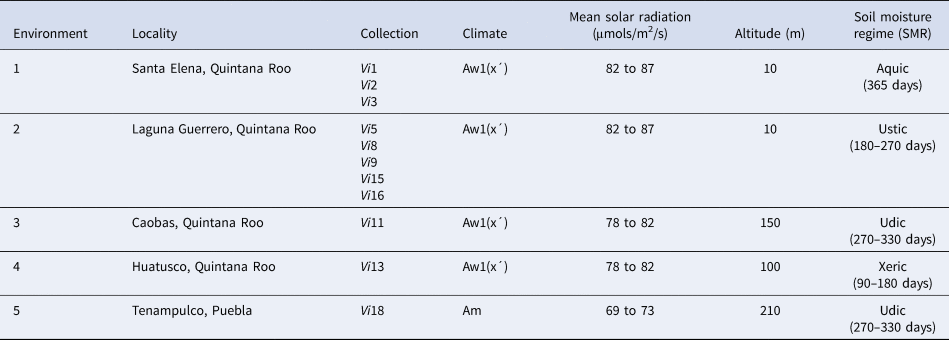
During 2017, flowers were collected from different V. insignis plants, three flowers were taken from each plant, giving a total of 141 flowers from 47 plants. The collections were made in the localities of Santa Elena (fifteen plants), Laguna Guerrero (nineteen plants), Caobas (four plants) and Huatusco (three plants) in the state of Quintana Roo. In addition, samples from Tenampulco (six plants), in the state of Puebla, Mexico were collected to have an external group to verify that the shape of the labellum corresponded to environmental factors. The collection sites had a mean annual temperature of 22°C, similar climate conditions and mean solar radiation. The differences between localities were the elevation and the soil moisture regime, which were considered environmental gradient criteria (Table 1). The species were identified during the plant collection with the key of Soto-Arenas and Dressler (Reference Soto-Arenas and Dressler2010).
Main characteristics of the five environmental conditions where the V. insignis populations analysed are located

Constructed with data from CONABIO (2021).
The flowers collected in the field were vigorous and free of visible damage. The cut was made at the base of the peduncle and the flowers were stored in 125 ml glass recipients with a preservative solution (ethanol 27%, lactic acid 4%, benzoic acid 3%, glycerine 3%, and distilled water 63%) until dissection and measurement (Salazar-Rojas et al., Reference Salazar-Rojas, Herrera-Cabrera, Soto-Arenas and Castillo-Gonzalez2010; Lima-Morales et al., Reference Lima-Morales, Herrera-Cabrera and Delgado-Alvarado2021).
Evaluated traits
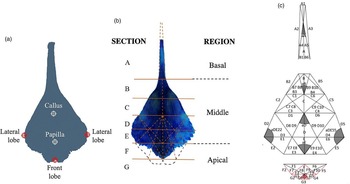
To characterize the shape of the labellum, morphometric analysis was performed based on the methods proposed by Catling (Reference Catling1990) and modified by Salazar-Rojas et al. (Reference Salazar-Rojas, Herrera-Cabrera, Soto-Arenas and Castillo-Gonzalez2010) with some modifications. The labellum was used to identify the infraspecific variation due to it was useful to identify variation in different populations of V. planifolia (Hernández-Ruiz et al., Reference Hernández-Ruiz, Delgado-Alvarado, Salazar-Rojas and Herrera-Cabrera2020; Lima-Morales et al., Reference Lima-Morales, Herrera-Cabrera and Delgado-Alvarado2021; Maceda et al., Reference Maceda, Delgado-Alvarado, Salazar-Rojas and Herrera-Cabrera2023). First, the flower column, sepals, petals and labellum were dissected, then the labellum was expanded on an anti-reflective glass plate, and the labellum was stained with methylene blue (0.08%) to contrast the contour. Finally, the image was digitized with a Sony Alfa 65v reflex camera equipped with a Sony DT 30 mm F/2.8 SAM macro lens. The digital image of the labellum was vectorized in Corel Draw Graphics Suite X4 with a grid composed of 69 lines, seven angles and one index obtained from the variables A, B, C, D and E to evaluate the proportion of the labellum length using the formula index = (ΣB,C,D)/A. The 76 traits were grouped into three regions (Fig. 1): basal region (7 traits), middle region (49 traits) and apical region (21 traits).
(a) Characterization of the V. insignis labellum. (b) Grid used to mark seven sections (A, B, C, D, E, F and G) and three regions (Basal, Middle and Apical). (c) The diagram illustrates the position of 69 lines and seven angles used as morphological traits.

Statistical analysis
Two sources of variation were considered in the analysis of the labellum morphology of V. insignis: The first one was analysing the environmental condition in which the populations were distributed, so there were five treatments (environments) with different numbers of repetitions. The second was with the original population, so 11 collects with different numbers of repetitions were considered. The data were analysed under a completely randomized design model (PROC GLM, SAS 2011). Means of environments and collections were compared with ANOVA with unequal sample size and Tukey tests (SAS, 2011).
Numerical analysis
Two multivariate analyses were performed to characterize the variation of the labellum of V. insignis: principal components analysis (PC) and conglomerate clustering with Euclidean distance and average linkage as the measure of distance and method of grouping (Sneath and Sokal, Reference Sneath, Sokal, Sneath and Sokal1973). The numerical analysis considered the means of each of the 77 traits analysed for all the collects using the program SAS v 9.3 (SAS, 2011).
Results
The effect of the environment and the total population on the morphology of V. insignis labellum was analysed and statistically significant differences were obtained between the accessions (P ⩽ 0.01–0.001) and the environmental conditions (P ⩽ 0.01–0.001) for 72 of 77 variables analysed (Table S1). The five variables that were not significantly different (B5, B9, D, E7, E10) corresponded to variables of the middle region of the labellum.
In the case of the coefficient of variation (CV), three groups of variables were distinguished based on their CVs (Table S1). The first group with CV values less than 10% was made up of 56% of the total variables. The variables of this group form 90% of the basal region of the labellum, 59% of the middle region of the labellum and 38% of the apical region (Table S1). The second group with a CV of 10 to 17% was compounded by 34% of the total variables. These variables make up 41% of the middle region of the labellum, 10% of the basal region and 24% of the apical region. The third group with CVs greater than 17% were obtained only in the variables of the apical region, mainly those that form the apical lobes.
Distribution and grouping of V. insignis populations
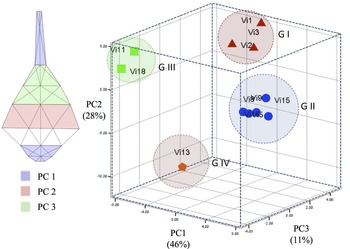
Dispersion of V. insignis populations represented in space was determined by the first three principal components, which together explained 85% of the accumulated variation for the 77 analysed variables (Table S2).
PC1 explained 46% of the total variation, the main variables that determine the variation of PC1 are related to the size and shape of the middle region of the labellum and callus (sections B and C). PC2 explained 28% of the variation and the variables that mainly influenced the separations of the groups were the sections D and E that form the regions of the median labellum adjacent to the papilla and the size of the lateral lobes. PC3 explained 11% of the variation and the variables that separate the groups were sections A, E and G, which delimit the size of the basal region and the shape and size of the apical region and the apical lobes of the labellum.
According to the spatial distribution of the first three principal components, four groups of studied populations of V. insignis were obtained. Figure 2 shows that populations located on the positive side of the PC1 axis presented a labellum with a middle region that gives a larger tubular shape (GII) (Fig. 2), while on the negative side were populations with smaller tubular spaces in the labellum. For PC2, the populations with the largest papilla in the middle region (GI and GII) were located on the positive side (Fig. 2). In the centre of the axis, populations with the middle region of the papilla of rectangular shape and medium size were observed, while populations with a trapezoidal shape and smaller size were grouped on the negative side of PC2 (GIV) (Fig. 2).
Dispersion of 11 V. insignis collections in the space determined by the first three principal components.

In PC3, on the positive side near the centre were the populations that presented a pronounced basal region and ornamentation of the apical lobes (GI) (Fig. 2), while on the negative side were the populations without apical lobes (GIII) (Fig. 2). Therefore, the following groups of V. insignis populations were identified: Group I (Vi1, Vi2 and Vi3), Group II (Vi5, Vi8, Vi9, Vi15, Vi16), Group III (Vi11, Vi18) and Group IV (Vi13) (Fig. 2).
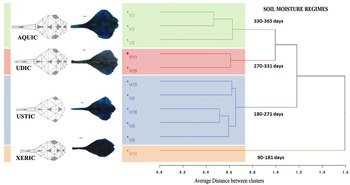
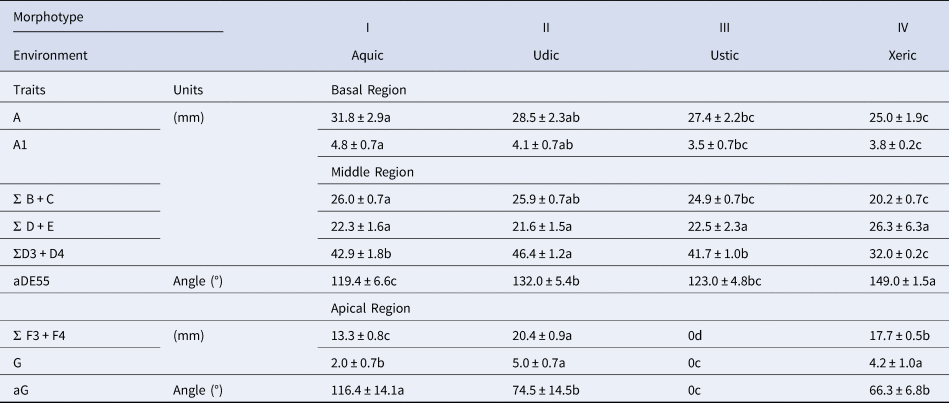
Using the cluster analysis, a grouping pattern similar to that obtained with the PC analysis was observed. Figure 3 shows the identification of four morphological groups based on the labellum of V. insignis populations at a Euclidean distance of 0.8. The grouping of the populations coincides with the SMR in which they are located. Table 2 shows that in most of the variables, there are significant differences between the different SMRs, therefore the separations of the groups in the PCs and cluster analysis are due to the SMR conditions as confirmed in Table 2.
Cluster analysis by hierarchical grouping, constructed with the average of 77 variables analysed in 11 collections V. insignis. The scale bar of all the photographs of the labellum is 1 cm.

Synthesis of the nine principal traits of the four morphological groups used to describe the infraspecific variation of V. insignis in different environmental conditions

Different letters in each column indicate significant differences (P < 0.05). Mean ± standard deviation (SD).
Discussion
The shape of the labellum of V. insignis had significant differences between the populations in general and between the populations that were located in different environmental conditions. The five variables that did not have significant differences and that represent the middle region of the labellum are possibly stable (conserved traits) between populations and different environments and would serve as morphological markers for the definition of morphospecies in the V. planifolia complex of the section Xanata, within the subgenus Xanata (sensu) (Soto-Arenas and Cribb, Reference Soto-Arenas and Cribb2010).
An important point to understand the behaviour of the labellum variables is the values of the coefficient of variation (CV). In studies with Phlox cuspidata (Polemoniaceae), Schlichting and Levin (Reference Schlichting and Levin1984) defined low CVs as those that were below 10%, intermediate those that were between 10 to 20% and that associated with floral structures, and high CVs (greater than 20%) were associated with vegetative structures. In V. insignis, three groups of CVs were identified, most of the variables had CV values less than 10%, while only 10% of the collected individuals has CV values above 17%. The Cvs less than 10% have less dispersion in the data, while the CVs above 10% have a greater dispersion of the values and therefore a greater standard deviation that reflects the variation between the collects (Bedeian and Mossholder, Reference Bedeian and Mossholder2000). CV values above 17% are reported for orchid floral structures (Bateman and Rudall, Reference Bateman and Rudall2006; Reference Bateman and Rudall2011; Morales et al., Reference Morales, Ackerman and Tremblay2010; Ackerman et al., Reference Ackerman, Cuevas and Hof2011). The results of this work are consistent with previous work in L. anceps subsp. dawsonii f. chilapensis L. (Orchidaceae) that recorded very similar values (16–20%) in the CV of the variables that define the morphology of the apical lobes between morphotypes (Salazar-Rojas et al., Reference Salazar-Rojas, Herrera-Cabrera, Soto-Arenas and Castillo-Gonzalez2010).
In the Orchidaceae family, it has been reported that the CV is higher in vegetative structures (15.3–38%) than in reproductive structures (8.7–12.4%); most of the CVs identified in floral structures between populations are in an average range of 12–17% (Pellissier et al., Reference Pellissier, Vittoz, Internicola and Gigord2010; Bunpha et al., Reference Bunpha, Pedersen and Sridith2014). The biological interpretation of high CVs in the floral structures of orchids is associated with the expression of plasticity of plants (Morales et al., Reference Morales, Ackerman and Tremblay2010). Variables with CV values >20% correspond to traits that are less heritable and more susceptible to the effects of environmental or geographic heterogeneity (Borba et al., Reference Borba, Funch, Ribeiro, Smidt and Silva-Pereira2007; Morales et al., Reference Morales, Ackerman and Tremblay2010; Bateman and Rudall, Reference Bateman and Rudall2011; Bunpha et al., Reference Bunpha, Pedersen and Sridith2014). Therefore, the results obtained in V. insignis showed that most of the traits with CV values >20% were concentrated in the apical region of the labellum, and presented highly significant differences (P ⩽ 0.001) between environments (Table S1).
Distribution and grouping of V. insignis populations
With the information obtained in the principal components and cluster analyses, a grouping pattern was identified in labellum morphology that is probably associated with the soil moisture regime (SMR) in which V. insignis populations are located. Climate, solar radiation and altitude did not affect the structure of labellum variation. A reduction in size and modification in the shape of the middle region of the labellum (mainly in the papilla area) as an effect of decreased availability of soil moisture was observed (Fig. 3). This agrees with what has been reported for other plant species that decrease the size of the petals due to the dry conditions where they grow (Glenny et al., Reference Glenny, Runyon and Burkle2018). Halpern et al. (Reference Halpern, Adler and Wink2010) mentioned that the decrease in the size of the flower in dry conditions could improve the water status of the plants, improve their photosynthetic capacity and increase the capacity to produce seeds.
At the population level, plants can decrease their adaptation and affect both their reproduction and mortality rates (Edwards et al., Reference Edwards, Ewers, McClung, Lou and Weinig2012), so water availability works as a major selection factor that affects the evolution of morphological traits (Edwards et al., Reference Edwards, Ewers, McClung, Lou and Weinig2012). In the case of V. insignis, there are no data on the reproductive success of each morphotype. However, morphological variation among populations reveals gradual adaptation observed in very specific traits of the labellum. Such adaptations were from conditions with high water availability, as is the case of the Aquic SMR, to a dry environment with fewer than 181 days of moisture in the Xeric SMR. In this way, it was possible to identify floral traits of V. insignis that are affected by the reduction of soil moisture and that represent possible adaptations to these environmental conditions.
Some authors mention that the morphological variation may be due to the great geographical distances between populations (Hodgins and Barret, Reference Hodgins and Barret2008). However, it is not the only factor involved in the morphological variation and sometimes there are no differences between distant populations (Rech et al., Reference Rech, Jorge, Ollerton and Sazima2018; Rodríguez-Peña and Wolfe, Reference Rodríguez-Peña and Wolfe2023). This was similar to what we obtained in this work between the populations of Tenampulco, Puebla and Caobas, Quintana Roo, which were grouped in the analysis of PCs and the dendrogram because they share similar Udic conditions. On the other hand, the populations may have cross-pollinations and genetic recombinations, which promotes the flower variation (Rodrigues et al., Reference Rodrigues, Turchetto, Callegari-Jacques SM and Freitas2018), however, the separations of the groups in the PCs and the dendrogram is associated with the SMR conditions, so possibly this is the factor that delimits the distribution of the morphotypes.
Soil moisture availability (SMR) has a determining effect on the morphology of floral traits of V. insignis. This has been reported for other orchids, especially those with a pollination system by deceit, such as T. variegata (Sw.) Braem. In addition, it has been recorded that species present high rates of floral morphological variation associated with abiotic factors such as light and water availability, which suggests floral plasticity phenomena that have been little recognized in orchids (Ackerman and Galarza-Pérez, Reference Ackerman and Galarza-Pérez1991; Harder and Johnson, Reference Harder and Johnson2005; Morales et al., Reference Morales, Ackerman and Tremblay2010; Hemborg and Després, Reference Hemborg and Després2011; Blinova, Reference Blinova2012; Gratani, Reference Gratani2014).
The floral structures of V. insignis imply a high expenditure of resources (carbon, nutrients and water) extracted from the vegetative portion of the plants during the life of the flower. The colonization of environments with limited resources, such as the xeric SMR, and the high ecophysiological cost of displaying the flower have generated in V. insignis adjustments in the basic structure of the flower. These changes optimize the consumption of plant resources and favour the divergence of four floral morphotypes related to the availability of water availability in the different habitats. However, the floral variation of V. insignis can also be related to the populations of pollinators that inhabit these conditions (Glenny et al., Reference Glenny, Runyon and Burkle2018), since it has been proposed that environmental conditions can influence the presence and shape of pollinators (Weber et al., Reference Weber, Nuismer and Espíndola2020), so they are also a key factor in understanding the interrelationships between environment, flower and pollinator, so it is important in the future to carry out studies on the morphology of possible pollinators and their relationship with V. insignis morphotypes.
The labellum variables are expressions of genetic variation that can be used for the development of productive models through the genetic improvement of both V. insignis and V. planifolia. This last species presents problems of genetic erosion, which is why genetic improvement projects have been developed (Hasing et al., Reference Hasing, Tang, Brym, Khazi, Huang and Chambers2020; Ramos-Castellá and Iglesias-Andreu, Reference Ramos-Castellá and Iglesias-Andreu2022) and possible compatible hybridizations (Ellestad et al., Reference Ellestad, Pérez-Farrera, Forest and Buerki2022a, Reference Ellestad, Pérez-Farrera and Buerki2022b). Currently, few improvement works have been carried out on vanilla due to a lack of understanding of the genetic and phenotypic diversity that exists in the species and compatible species (Hammer and Khoshbakht, Reference Hammer and Khoshbakht2015; Chambers, Reference Chambers, Al-Khayri, Jain and Johnson2019). Therefore, by identifying the variation of the floral structure of V. planifolia in different environments of Quintana Roo, it will serve for the development of strategies for the conservation of this species, as well as for the improvement of commercial species such as V. planifolia that allow the capitalization and preservation of the genetic resource of vanilla.
Conclusions
There is variation in the shape of the labellum due to environmental differences in which the analysed populations of V. insignis live, therefore they were grouped into four morphotypes, which suggests that there is floral plasticity. Soil moisture regimes (SMR) are one of the possible factors determining the morphology of the labellum of V. insignis. The identification of the morphological variation of the labellum of V. insignis contributes to the knowledge of the germplasm of the species to develop strategies for the conservation and use of vanilla.
Supplementary material
The supplementary material for this article can be found at https://doi.org/10.1017/S147926212300062X.
Acknowledgements
Thanks to the inhabitants of Quintana Roo for their invaluable support.
Authors’ contributions
B.E. H.-C. and N. H.-S. designed the research. B.E. H.-C., N. H.-S. A. D.-A. and A. M. analysed the data and wrote the manuscript. All authors reviewed and edited the manuscript.
Financial support
This research was funded by the CONAHCYT master's scholarship (352293). Financial support from Fondo Sectorial CONAHCYT-SAGARPA (SADER): Project 2012-04-190442. Financial support from Sistema Nacional de Recursos Fitogenéticos (SINAREFI): Clave: BEI-VAI-12-4
Competing interests
None.