




No CrossRef data available.
The Southern Imposition: Congress and Labor in the New Deal and Fair Deal
Published online by Cambridge University Press: 17 August 2005
Extract
In this article, we will probe two distinct historical questions. First, we explore why congressional representatives from the South, who had generally supported the Democratic Party on labor issues during the 1930s, joined with Republicans to oppose the party's pro-labor orientation in the 1940s. We also examine why the class-based union movement that mobilized so assertively after the passage of the Wagner Act in 1935 became so cramped and pragmatic by the early 1950s. These puzzles, we believe, are closely related. Our explanation for why labor's horizons, topography, and prospects constricted to workplace issues, to some segments of the working population, and to limited geographic areas by the end of the Truman years points to how southern Democrats shaped the main institutions produced by New Deal and Fair Deal labor legislation.
Information
- Type
- Research Article
- Information
- Copyright
- © 2005 Cambridge University Press
Acknowledgements
This article was written within the framework of the American Institutions Project (AIP) of the Institute for Social and Economic Research and Policy (ISERP) at Columbia University. For advice, intellectual stimulation, and help with roll call coding, we warmly thank Project colleagues Melanie Springer and Christina Greer at Columbia, and Matt Glassman, John Lapinski, and Rose Razaghian at Yale.
In this article, we will probe two distinct historical questions. First, we explore why congressional representatives from the South, who had generally supported the Democratic Party on labor issues during the 1930s, joined with Republicans to oppose the party's pro-labor orientation in the 1940s. We also examine why the class-based union movement that mobilized so assertively after the passage of the Wagner Act in 1935 became so cramped and pragmatic by the early 1950s. These puzzles, we believe, are closely related. Our explanation for why labor's horizons, topography, and prospects constricted to workplace issues, to some segments of the working population, and to limited geographic areas by the end of the Truman years points to how southern Democrats shaped the main institutions produced by New Deal and Fair Deal labor legislation.
The preferences of the congressional delegations from the seventeen states that mandated racial segregation proved decisive.1
In our designation of the “South” we include seventeen states: the 11 ex-Confederate states of Alabama, Arkansas, Florida, Georgia, Louisiana, Mississippi, North Carolina, South Carolina, Tennessee, Texas, and Virginia, plus the other six states – Delaware, Kentucky, Maryland, Missouri, Oklahoma, and West Virginia – that mandated segregation in schools before the Brown decision in 1954. Three others states – Arizona, Kansas, and New Mexico – permitted local jurisdictions to practice racial segregation in their schools, but, unlike the 17, did not require it. With the exceptions of Oklahoma, which was not yet a state, and West Virginia, which still was joined to Virginia, these were the states (alongside the District of Columbia) that possessed state codes legalizing slavery at the start of the Civil War. Together, these states constituted a distinct racial and political order. We realize that by defining the South this way, rather than either the 11 states that seceded from the Union or the 13 states (these plus Kentucky and Oklahoma) conventionally designated as the South in most congressional studies, we risk seeming to exaggerate the structural advantages of the region in Congress while, reciprocally, underestimating “core” southern preferences by including border states often placed in other regional groupings. Still, we could find no persuasive warrant for not treating all the ex-slave and Jim Crow states as defining the South in Congress. Better, we believe, to define the South objectively and independently of roll call behavior.
Ira Katznelson, Kim Geiger, and Daniel Kryder, “Limiting Liberalism: The Southern Veto in Congress, 1933–1950,” Political Science Quarterly 108 (1993): 284.
This line of reasoning entails a series of claims both about the efficacy of labor law, stressing the powers of institutions, and about the pivotal place of the southern minority faction within the (mostly) majority party of the period, highlighting shifts in the ordering of their preferences under conditions of growing uncertainty. We focus on the policy history of labor law in Congress in the 1930s and 1940s because, contrary to critics of the arrangements fashioned by the National Industrial Recovery Act (NIRA), the National Labor Relations Act (NLRA; the Wagner Act), and the Fair Labor Standards Act (FLSA) who see the New Deal labor regime as using public authority to canalize and limit the economic power of an organized working class, these institutions provided the most hospitable climate ever fashioned in American history for trade unions and for decent enforceable conditions of employment. Within this framework, social class was placed at the center of American politics and at least some of the traditional organizational advantages of business were overcome, if temporarily.3
For a treatment of such advantages that avoids a too-simple portrait of the powers of business as a class, see Colin Gordon, New Deals: Business, Labor, and Politics in America, 1920–1935 (New York: Cambridge University Press, 1994). We differ from his view of the Wagner Act, which he argues was mostly a reflection of long-standing patterns in industrial relations and thus had a probusiness tilt.
To be sure, southern representatives composed a heterogeneous group. Some were urbane and broadly liberal; others either were virulently racist or conservative on almost every issue. But with the exception of Texas' Maury Maverick and Florida's Claude Pepper, who enjoyed active union support, virtually all the southern politicians in Congress shared a broadly common position on labor despite their various differences. Further, to a person, including the liberals, they all supported racial segregation. Without support from these representatives, the 1930s labor order could not have been fashioned; without a big shift in southern behavior in Congress in the 1940s, it could not have been changed decisively.
Although the South, in short, must be situated at the center of any meaningful story about labor and class in these decades, its role is either absent or treated as a side story in the massive literature on these subjects. By contrast, we underscore two related developments. We observe, first, how, regarding labor, the dominant left-right dimensional structure of American politics dividing Democrats, regardless of region, from Republicans was joined by a second dimension based on region and race. In the 1930s, union and labor market issues were arrayed primarily on the ideology-party dimension, while, in the 1940s, southern Democrats came to understand labor questions mainly as issues that concerned the durability of Jim Crow, while Republicans and nonsouthern Democrats continued to think and act about labor as matters of ideology and party, treating as secondary the questions that had come to obsess their colleagues from the South. Second, we can discern how, at the microlevel, these southern members, who possessed orderings of preferences in both dimensions, switched their rankings of preferences regarding questions of social class and labor, thus altering the axis of preferences that dictated their roll-call behavior.4
This formulation draws on the landmark article by Amartya K. Sen, “Rational Fools: A Critique of the Behavioral Foundations of Economic Theory,” Philosophy and Public Affairs 6 (1977).
By decisively shaping the legal framework within which organized labor could make choices and deploy resources, the South affected the contours and limits of social class in postwar America. Having gingerly supported efforts that enhanced and coordinated working class action, it soon collaborated with Republicans to disorganize the working class. In successfully doing so, it also transformed the long-term character of movements for black rights, effectively detaching them from class- and labor-based movements for economic justice. While it is hard not to be elegiac about these lost opportunities, we do resist the temptation. Rather, we seek to understand how, within the charged and anxious context of the Roosevelt-Truman years, issues of class, and their overlap with questions of race, were presented and adjudicated within Congress primarily by the “strange bedfellows” coalition that characterized the Democratic party of the period, a hybrid of an immigrant, labor-oriented, big-city machine, nonsouthern wing that looked very much like a social democratic party and a native, mostly rural, white supremacist southern wing that represented almost no African Americans and only a minority of the region's white population.
There were, we show, three distinct periods. In the first, characterized by the New Deal's efforts to grapple with the Great Depression, southern members joined their Democratic Party brethren, most often against the opposition of Republicans, to support pro-labor legislation on conditions they understood would protect Jim Crow. In the second, marked by wartime mobilization, southern Democrats, pressed by harbingers of wartime social change, including very tight labor markets and union forcefulness that, together, seemed to threaten the labor market underpinnings of the racial order, shifted positions, moving to limit the effect of the labor regime they had helped install. Finally, in the postwar years, as the country reverted to a peacetime economy, southern Democrats allied with Republicans to remake this framework in a far-reaching manner. Some of the most important consequences for class and race that we identify, in closing, have proved durable.
I.
It had been, J. David Greenstone observed of the Roosevelt-Truman years, a “working-class interlude in American labor history.”5
J. David Greenstone, Labor in American Politics (New York: Knopf, 1969), 71.
Irving Bernstein, “The Growth of American Unions,” American Economic Review 44 (1954): 303.
For considerations of the “split” character of working-class dispositions, institutions, and patterns of collective action in the United States, distinguishing work from home, see Ira Katznelson, City Trenches: Urban Politics and the Patterning of Class in the United States (New York: Pantheon Books, 1981); and the essays by Amy Bridges and Martin Shefter in Ira Katznelson and Aristide Zolberg, eds., Working Class Formation: Nineteenth-Century Patterns in Western Europe and North America (Princeton, NJ: Princeton University Press, 1986).
On the trumping of ethnicity by class, see Gary Gerstle, Working Class Americanism: The Politics of Labor in a Textile City, 1914–1960 (New York: Cambridge University Press, 1989); and Gary Gerstle, American Crucible: Race and Nation in the Twentieth Century (Princeton, NJ: Princeton University Press, 2001). For an argument that the solidarities of ethnicity in residential communities undergirded class-based activity in the workplace, see J. David Greenstone, “Ethnicity, Class, and Discontent: The Case of Polish Peasant Immigrants,” Ethnicity 2 (1975).
Useful discussions of the social democratic potential of this period's labor movement can be found in Steven Fraser and Gary Gerstle, eds., The Rise and Fall of the New Deal Order (Princeton, NJ: Princeton University Press, 1989); Nelson Lichtenstein, Walter Reuther: The Most Dangerous Man in Detroit (Urbana: University of Illinois Press, 1997); Nelson Lichtenstein, State of the Union: A Century of American Labor (Princeton, NJ: Princeton University Press, 2002); Robert H. Zieger, American Workers, American Unions, 1920–1985 (Baltimore, MD: Johns Hopkins University Press, 1986); and Robert H. Zieger, The CIO, 1935–1955 (Chapel Hill: University of North Carolina Press, 1995). Reuther, of course, is an emblematic figure both for the ambition to combine a corporatist orientation to state action with collective bargaining and, later, for the abandonment of the former for the security and effectiveness of the latter.
Union power came to be widely acknowledged by supporters and opponents alike. Contributing to a distinguished collection of essays assessing “civilization in the United States” in 1938 (including chapters by Jacques Barzun on race, John Cowles on journalism, and Karl Menninger on psychiatry), Louis Stark concluded on a remarkably upbeat note, finding that:10
Louis Stark, “The New Labor Movement,” in America Now: An Inquiry into Civilization in the United States, ed. Harold E. Stearns (New York: Charles Scribner's Sons, 1938), 145.
Whether the A.F. of L. makes its peace with the C.I.O. or not, the principle of industrial unionism has won out. This victory has brought with it possibilities for the future that are boundless. Not only may it well stimulate organization on a scale hitherto undreamt of even by the most optimistic but it may also sow the seed for the formation of a new political orientation of labor and agriculture.
By the late 1940s, not just leaders of business mounting an assertive counterattack on class-based union capacity,11
For what remains the most thorough discussion, see Howell John Harris, The Right to Manage: Industrial Relations Policies of American Business in the 1940s (Madison: University of Wisconsin Press, 1982), who traces the range of business responses which stretched from attempts to achieve a working harmony with labor to fierce efforts to destroy unions.
C. Wright Mills, The New Men of Power: America's Labor Leaders (New York: Harcourt Brace and Company, 1948), 9; Charles Lindblom, Unions and Capitalism (New Haven, CT: Yale University Press, 1949).
Sumner H. Slichter, “The Taft-Hartley Act,” The Quarterly Journal of Economics 63 (1949).
Yet at just the moment when a mix of exultation and anxiety characterized responses to the heightened capabilities of the labor movement, some observers rightly understood that the working-class interlude, though not labor union facility, was swiftly passing. Fortune's book-length study of the country's “permanent revolution” noted that labor militancy, which continued at the workplace and which was achieving secure contracts, escalating real wages, and generous fringe benefit agreements most notably in the core manufacturing industries like steel and automobiles, should not be confused, despite recent experiences, with class-based politics.
American labor is not “working-class conscious”; it is not “proletarian” and does not believe in class war . . . today's successful, strong, and militant labor movement is as little “proletarian” or “socialist” as the small and unsuccessful labor movement of twenty years ago.14
Editors of Fortune in collaboration with Russell W. Davenport, U.S.A.: The Permanent Revolution (New York: Prentice Hall, 1951).
The “strong whiff of class warfare” that had characterized the moment when trade-unionism had moved from the periphery to the center of American capitalism, Daniel Bell likewise observed in a chapter excised from all but the first edition of The End of Ideology, had been replaced by circumstances in which organized labor, with “a middle-class stake in the country” acted as “a specific interest group concerned with its own needs first, rather than a broad social-reform movement seeking wholesale change in the nature of society.”15
Daniel Bell, “Interest and Ideology: On the Role of Public Opinion in Industrial Disputes,” in Bell, The End of Ideology: On the Exhaustion of Political Ideas in the Fifties (Glencoe, IL: Free Press, 1960), 205.
Broadly speaking, two strands of work have been constitutive of this trope of disenchantment, the dominant orientation among disappointed historians and social scientists interested in the fate of labor and class in the United States.16
For an overview not just of American but of this aspect of western labor history more generally, see Ira Katznelson, “The ‘Bourgeois’ Dimension: A Provocation About Institutions, Politics, and the Future of Labor History,” International Labor and Working Class History 46 (1994).
In the approach of exceptionalism, the behavior of American workers and their leaders is deemed deficient when measured against either a theoretical counterfactual (Marxist theory leads us to expect that the more developed capitalism becomes, as in the American case, the more class conscious and prone to collective action the working class should be) or an empirical one (Why has there been no labor party in the United States or a strong socialist politics, sites of working class agency found in other capitalist democracies?). Within the exceptionalist rubric, there tend to be two strands of argumentation. The first transcends specific historical moments to focus on enduring features of politics, economics, or society in the United States. It is the country's absence of feudalism and liberal hegemony, constitutionalism marked by federalism and separation of powers, individualist values, business culture, uncommon prosperity, ethnic and racial diversity, recurrent immigration, agrarian domination, or quite a lengthy list of other candidates that are thought to impede the “natural” state of affairs marked by self-aware working class agency.17
Eric Foner, “Why is there no Socialism in the United States?,” History Workshop 17 (1984); Sean Wilentz, “Against Exceptionalism: Class Consciousness and the American Labor Movement, 1790–1920,” International Labor and Working Class History 26 (1984).
Victoria Hattam, Labor Visions and State Power: The Origins of Business Unionism in the United States (Princeton, NJ: Princeton University Press, 1993); Joshua Freeman, Working-Class New York: Life and Labor Since World War II (New York: New Press, 2000).
From the vantage of exceptionalism, the outcome of a sometimes militant and laborist union movement confined to the workplace and largely lacking in broad class analysis or political impulses by the end of the Truman years hardly is a surprise. It is simply understood to be the most robust possible outcome when considered within the conditions of American life. This is a story of persistence. In post-New Deal, post-Fair Deal America, unions have been confined largely to the workplace, and to bargaining about wages, work rules and conditions, and fringe benefit packages. Although the national labor federations have sought to influence public policy in Washington and have been, in the main, bulwarks of Democratic Party support, their policy goals have been geared mainly to underpin high-wage, good working condition, and generous benefit collective bargains with employers. This “business unionism” has been confined in the second half of the twentieth century geographically as well, as unions have continued to be relatively contained within enclaves in the northeast, midwest, and far west, with rather low union density in areas – the south and the area between the Mississippi River and the states on the west coast – that overwhelmingly were agrarian until recent times. From this perspective, in respect both to the spatial limitation of union activity and the contraction of union attention to the workplace the story at first glance seems to be one of continuity. Long-existent features of working class life in America, whether understood as enduring regime features or in more historicized path-dependent terms, continue to constitute and define the character as well as the limits of working-class orientations and actions.
Manifestly, however, this perspective stressing the homologous situations before and after the 1930s and 1940s is forced to downplay the remarkable shifts in possibility and achievement that occurred in this era, and fails to understand that labor relations pluralism was more a result settled for than the outcome intended by organized labor within the framework of New Deal labor law. A certain similarity of before and after thus composes an illusion of continuity. During these two decades, after all, there was a real rupture to prior patterns. At minimum, this break, and with it a far-reaching new openness, was constituted by the following constellation of elements: the hegemony of a political party for which both industrial and craft workers composed a key electoral basis of support, especially in the most contested large American states; support, if grudging at times, by national administrations both fearful of working class radicalism and desirous of working-class votes and access to the mobilizing capacities of organized labor; the growing appearance and resonance of a language of class outside as well as within the workplace under conditions of economic duress; a deep-seated delegitimation of business as a class and traditional capitalism as a system in consequence of the Depression; permissive public opinion; more accommodating Supreme Court jurisprudence; the closure of the immigration gate in 1924 that, perhaps ironically, advanced a process of ethnic integration and the development of multiracial as well as multiethnic workplaces; and, as a key catalyst, the passage of legislation in the 1930s that provided a framework empowering and legalizing trade unions, encouraging their expansion, as well as legislation that put a floor under wages and defined maximum working hours, long basic concerns of the union movement.
A second strand of the trope of disappointment looks precisely to this labor regime as the source of the decline of a class-based labor movement. Among others, Mike Davis, Colin Gordon, Rhonda Levine, Joel Rogers, Katherine Stone, Christopher Tomlins, and Stanley Vittoz have argued that the very framework of labor law and regulation created by the Roosevelt administration, most notably the NLRA, contained and limited labor possibilities by hedging working class power and providing incentives and legitimacy for a business-oriented system of collective bargaining premised on managerial prerogatives.19
Mike Davis, “The Barren Marriage of American Labour and the Democratic Party,” New Left Review 124 (1980); Gordon, New Deals; Rhonda F. Levine, Class Struggle and the New Deal: Industrial Labor, Industrial Capitalism, and the State (Lawrence: University of Kansas Press, 1988); Joel Rogers, “Divide and Conquer: Further Reflections on the Distinctive Character of American Labor Laws,” Wisconsin Law Review 1 (1990); Katherine Stone, “The Post-War Paradigm in American Labor Law,” Yale Law Journal 90 (1981); Christopher L. Tomlins, The State and the Unions: Labor Relations, Law, and the Organized Labor Movement in America, 1880–1960 (New York: Cambridge University Press, 1985); and Stanley Vittoz, New Deal Labor Policy and the American Industrial Economy (Chapel Hill: University of North Carolina Press, 1987). There is a not entirely different critical literature on the right, albeit with a different normative torque, that also views the NLRB system as undue and deleterious interference in the free market of labor relations. Examples include Howard Dickman, Industrial Democracy in America: Ideological Origins of National Labor Relations Policy (Lasalle, IL: Open Court, 1987); and Richard A. Epstein, Bargaining with the State (Princeton, NJ: Princeton University Press, 1993).
We find this line of reasoning quite unconvincing when situated inside the actual history of American labor before the New Deal. Only with the NLRA did industrial unionizing take off in the United States; only under this regime did labor density more generally start to robustly expand; and only under this regime did the labor movement move into a position of influence as the leading interest group inside the Democratic party. “Given the American labour movement's pre-New Deal weakness – its ideological subordination, political dependence, marginal legal status, organizational impotence,” Howell Harris, hardly a wide-eyed innocent regarding New Deal labor law, has noted, “. . . it is scarcely possible to conceive of the creation and entrenchment of what was, for all its glaring deficiencies, the nearest thing to a dynamic, inclusive, mass movement that the American industrial working class has ever managed to put together, without the transformation of public policy after 1932.”20
Howell Harris, “The Snares of Liberalism? Politicians, Bureaucrats, and the Shaping of Federal Labour Relations Policy in the United States, ca. 1915–47,” in Shop Floor Bargaining and the State: Historical and Comparative Perspectives, ed. Steven Tolliday and Jonathan Zeitlin (New York: Cambridge University Press, 1985), 184–85.
In more than the very short run, these “realistic” possibilities were not realized. A different kind of labor movement developed. It is this outcome we wish to explain. Like the critics of the New Deal labor regime, we are institutionalists who credit the power of legal codes to shape behavior; yet we think their line of attack has things quite backwards. The Wagner Act (and the NIRA before it and the Fair Labor Standards Act and the actions of the National Labor Relations Board after it) pushed the limits of American possibilities very hard, opening space for class contestation that otherwise simply would not have existed.21
Our views here are quite close to those found in David Brody, In Labor's Cause: Main Themes on the History of the American Worker (New York: Oxford University Press, 1993).
But this regime had a short life. Within a decade of FLSA's passage in 1938, changes to labor law radically altered the possibilities of the labor movement. It was this end result, we argue, that was decisively shaped by the Jim Crow South. At first a partner, if only under certain conditions, with nonsouthern Democrats in crafting working-class friendly labor codes, southern Democrats in the 1940s exercised a decisive role in revising these institutional conditions within which the labor movement had developed. We will see how the South, which collectively occupied the role of pivotal voter in the quasi-three party system characterizing Congress in this period, and whose members, free from the constraints of a conventional reelection imperative, placed the highest value on their preference for preserving their region's “way of life,” was in position to play a switchboard role. Where southern members approved of policies in tandem with their nonsouthern Democratic colleagues, these policies became law; where they dissented, they could exercise a veto rejecting the modal policy positions of the Democratic Party.22
Southern Democrats were veto players in the sense identified by George Tsebelis in Veto Players: How Political Insitutions Work (Princeton, NJ: Princeton University Press, 2002).
During the 1930s and 1940s, in short, it was the southern shift with regard to labor law that drastically changed the rules of the game that had been established, in part, to reproduce their region's organization of race and class. In these circumstances that white southern representatives crucially authored, the situation of union leaders as strategic actors also changed drastically in ways that led them to take decisions that led to a delimited labor movement. In these circumstances, too, a young civil rights movement took flight in ways that focused on legal rights rather than economic possibilities.
The confined post-1950 orientation of the labor movement, in short, must be assessed and explained neither as if all roads in American history led to it nor as the inevitable result of the full panoply of New Deal labor regulations. Our alternative account moves in three steps. First, we offer reminders of the empowering effects of the pre-war New Deal labor legislation while noting the racial adjustments that were made to secure a winning coalition for this legislation that would include southern members of Congress. Second, turning to the close of the period, we show how the two main achievements of the early period, the NLRA and the FLSA, were altered to the detriment of labor by a coalition now led in considerable measure by southern Democrats. Wishing to understand why the South defected from the modal position of their presidents and their party, we then set sights on key intervening legislative moments to argue that wartime labor successes in the South and a growing threat of federal intervention in southern labor markets caused the region's representatives to alter their understanding of labor questions, and thus realign their preferences as they feared for the increasingly close interconnections joining issues of race to the organization of labor unions and markets.
At each of these moments, we treat the character and impact of significant legislation, probe the histories of key legislative debates while noting the character of southern discourse, and scrutinize roll call behavior to identify key patterns in southern political behavior. In short, we offer a fresh reading of the period's labor policy history in order to make better sense of fateful changes to the period's institutional context for labor relations and the manner in which the least unionized, least industrialized, and least urban part of the country imposed its wishes on the character of these rules.
In 1933 and 1935, we show, southerners joined their nonsouthern congressional colleagues to support a new state-sponsored labor regime friendly to labor organizing but unfriendly to the majority of African-Americans who lived below the Mason-Dixon line. Their support was not unbridled. In light of their racialized, low-wage, mostly agrarian political economy, they insisted on occupational exclusions, leaving agricultural and domestic labor, the most widespread black categories of employment, outside the ken of legislative protection and empowerment. Their regional development strategy dependent on luring investment capital by paying low wages and their desire to guard the bastions of Jim Crow coalesced in their understanding that they must secure the region's labor markets for domestic and farm workers. During 1937 and 1938, we can see the South struggling to stay within this paradigm while deepening its insistence on categorical exclusions and now raising a demand for administration by discretionary regional decentralization to protect sectional differences as they grappled with the threats they perceived in the effort to set national minimum wages and maximum hours.
In 1940, 1943, 1946, and especially 1947, the South moved decisively away from the pattern that had prevailed in the 1930s and that, less heartily, was still subscribed to in 1938. Now, large majorities of southern Democrats began to join Republicans to form a winning coalition that sharply delimited the organizational capacities of unions and curtailed some of the favorable conditions of work secured by the FLSA. As a result of this transformation in behavior, the strategic terrain for the labor movement and for civil rights efforts was altered in fundamental ways.
The tight labor market of World War II, we argue, by facilitating the penetration of unions, some of which were racially integrated, within the South, was the most fundamental cause of this southern readjustment. In wartime, successful organizing by both the AFL and more threateningly by the CIO, which often directly confronted regional racial mores, drove up the proportions of unionized southern workers. Emboldened by these successes, as the war was nearing its end, both labor federations announced large-scale organizing drives. Further, at the start of the postwar period, nonsouthern Democrats moved to consolidate and extend the considerable penetration of national administrative authority into labor markets that had been accomplished in the course of wartime mobilization, authority that the national government had wielded in contravention of race discrimination in employment. Now, increasingly anxious southern members were less and less willing to sign on to pro-labor legislation, even when occupational exclusions and administrative decentralization were built-in. Rather, endeavoring to defend their “way of life,” southern Democrats in Congress shifted to an unambiguous antilabor stance, now joining with Republicans to form a labor-specific conservative coalition.
The result of these moves was a deep-seated change in conditions confronting the labor movement. Under the rules advanced by Taft-Hartley, it no longer seemed possible to extend organizing efforts across the country. Labor no longer could hope to become, as most of its leaders had wished, a genuinely national political class capable of entering into systematic patterns of bargaining with government and business or fighting for such social democratic legislation as national health insurance. Instead, labor opted to go into battle only where it had real strength and to reorient its social policy demands to seek private, rather than public, benefits like generous pensions and decent health insurance, incorporating these gains for their constituents into labor contracts. One result was a new, more limited labor movement, one that could ally with the South to support most Democratic party policy initiatives, including expansive fiscal policies which were good both for the (relatively poor) South and (comparatively rich) labor. In the short-term, this outcome left labor as a still-growing and important political force. But its constrained position soon made unions terribly vulnerable to shifts in investment and technology. By 1954, a yet to be arrested decline set in. Concurrently, issues of race and questions of labor markets came to be sundered, thus helping to produce a soon powerful civil rights movement that transformed jurisprudence and shaped landmark legislation without possessing instruments with which to redress economic harms.
II.
After decades of legislative indifference or hostility to trade unions, Congress, sometimes prompted and sometimes supported by the Roosevelt Administration, enacted sweeping changes to labor-management relations and labor markets during the first half-decade of the New Deal, most notably by mandating that employers recognize unions and by regulating wages and hours in massive segments of the economy. The 1920s had proved an especially grim and demoralizing time for organized labor, which gave back virtually all the gains it had made in organizing mass production industries during World War I. The Supreme Court's 1917 decision in Hitchman Coal & Coke v. Mitchell made the legal climate for unions particularly inhospitable by sanctioning yellow-dog contracts that authorized employers to insist on pledges by their workers not to join a union as a condition of employment, thus making it impossible to organize without the consent of its target firms. Side by side with yellow-dog restraints on union organizing lay efforts by some of the country's largest and vigorously antiunion corporations to undermine labor organizing efforts by creating company unions as a substitute for adversarial collective bargaining.
In the context of working class anger during the Depression, Congress, even before the New Deal, in 1932, took a small but significant step by passing the country's first positively-oriented labor law, the Norris-LaGuardia Anti-Injunction Act that sought to free labor from the Anti-Trust Act of 1890 by prohibiting federal courts from issuing injunctions to enforce yellow dog contracts. This legislation was a move supported by President Herbert Hoover and by large majorities of both parties to eliminate the period's most conspicuous and much resented antilabor activities, but this measure still left organized labor without effective proactive instruments. With the enactment of the NIRA in June 1933, at the close of the Hundred Days Congress, the institutional context for unions began to change far more substantially. Company union paternalism was rendered nugatory by Section 7(a) of Title I providing that “employees shall have the right to organize and bargain collectively through representatives of their own choosing, and shall be free from the interference, restraint, or coercion of employers . . . in the designation of such representatives.”23
The text of the act is reprinted in Leverett S. Lyon, The National Recovery Administration: An Analysis and Appraisal (Washington, DC: Brookings Institution, 1935).
Milton Derber, “Growth and Expansion,” in Labor and the New Deal, ed. Milton Derber and Edwin Young (Madison: University of Wisconsin Press, 1961), 9238–39.
Two months after the Supreme Court struck down the NIRA as unconstitutional in May 1935, Congress enacted the NLRA, a far more robust and detailed regime that empowered efforts to organize unions.25
ALA Schecter Poultry Corp. v. United States, 295 U.S. 495 (1935).
National Labor Relations Act of 1935, §§ 7–9; repr. (as passed) in Legislative History of the National Labor Relations Act, 1935, compiled by the NLRB (Washington, DC: Government Printing Office, 1959); House Report no. 1147, 74th Cong., 1st sess., 15–23; William B. Gould, A Primer on American Labor Law (Cambridge, MA: MIT Press, 1993), 45–46. The standard history is James A. Gross, The Making of the National Labor Relations Board: A Study in Economics, Politics, and Law, Volume I (1933–1937) (Albany: State University of New York Press, 1974). His discussion of implementation is James A. Gross, The Reshaping of the National Labor Relations Board: National Labor Policy in Transition, 1937–1947 (Albany: State University of New York Press, 1981). Also see Murray Edelman, “New Deal Sensitivity to Labor Interests,” in Derber and Young, Labor; David Plotke, “The Wagner Act, Again: Politics and Labor, 1935–1937,” Studies in American Political Development 3 (1989); Michael Goldfield, “Worker Insurgency, Radical Organization, and New Deal Labor Legislation,” American Political Science Review 83 (1989); Mark Barenberg, “The Political Economy of the Wagner Act: Power, Symbol, and Workplace Cooperation,” Harvard Law Review 106 (1993).
National Labor Relations Act of 1935, §§ 7–9; repr. (as passed) in Legislative History of the National Labor Relations Act, 1935; House Report no. 1147, 74th Cong., 1st sess., 17–19; Gould, A Primer on American Labor Law, 47.
National Labor Relations Act of 1935, §§ 3–6, 10–12; repr. (as passed) in Legislative History of the National Labor Relations Act, 1935; House Report No. 1147, 74th Cong., 1st sess., 11–15; 23–25. See Frank W. McCulloch and Tim Bornstein, The National Labor Relations Board (New York: Praeger Publishers, 1974). Gross, Reshaping of the National Labor Relations Board, 132–36, discusses the relatively greater power and independence of the NLRB under the NLRA than previous labor boards.
Legal hostility to organizing thus was turned on its head, as the federal government offered unions a broad legal umbrella under which to shelter. Almost immediately, they began to expand at a rapid rate. Both the AFL and the breakaway CIO quickly thrived, exhibiting notable growth. In 1929, the labor movement possessed fewer than 4 million members. A decade later, despite continuing mass unemployment (more than 9 million Americans still were out of work in 1939), the new CIO alone matched this membership, the AFL had grown to more than four million members, and more than one million other workers had joined independent unions. Even before the wave of union expansion made possible by World War II, the NLRA labor regime conduced dramatic union growth, altering the balance of power between labor and management.29
Despite their focus on the relationship of price changes and union growth, Ashenfelter and Pencavel acknowledge the importance of what they rather blandly refer to as “a favorable political environment” (Orley Ashenfelter and John H. Pencavel, “American Trade Union Growth: 1900–1960,” The Quarterly Journal of Economics 83 [1969], 446).
Leo Wolman, “Concentration of Union Membership,” Proceedings of Fifth Annual Meeting of the Industrial Relations Research Association (Madison: University of Wisconsin Press, 1952); cited in Derber, “Growth and Expansion,”
Bernstein, “Growth.”
The New Deal also transformed conditions of work. Prodded by President Franklin Roosevelt, Congress returned to consider the issue of minimum labor standards in 1937, and, enacted the landmark FLSA in 1938 to eradicate “labor conditions detrimental to the maintenance of the minimum standards of living necessary for health, efficiency and well-being of workers.”32
Fair Labor Standards Act of 1938, § 2 (Findings and Declaration of Policy), repr. (as passed) in Irving J. Sloan, ed., American Landmark Legislation: The Fair Labor Standards Act of 1938 (Dobbs Ferry, NY: Oceana, 1984).
Fair Labor Standards Act of 1938, § 6; repr. in Sloan, American Landmark Legislation.
Ibid., § 7. Rather than actually setting maximum allowable work hours, these “maximum” hours provisions established a threshold above which overtime wages (time and one half) had to be paid.
Ibid., § 12.
Not without reservations, to be sure, and not always with the same keenness of support offered by other members of their party, southern Democrats in the main supported this New Deal system of law that was well-disposed to labor unions, secured decent conditions of employment, and enhanced working class power. All the key labor-related legislation in this package of legislative accomplishment, including, ultimately, the Fair Labor Standards Act, long considered the first moment of appearance of a Republican-southern Democrat conservative coalition, was enacted only with, or after securing sufficient support of southern members.36
James T. Patterson, Congressional Conservatism and the New Deal: The Growth of the Conservative Coalition in Congress, 1933–1939 (Lexington: University of Kentucky Press, 1967), esp. 149–54, 182–83, 193–98, 242–46.
Here, we leave aside differences in southern behavior in the House and Senate, where, we believe, differences in constituency characteristics are primarily responsible for the somewhat more liberal tilt in most policy areas of Senate members from the South.
This measure was first proposed in Stuart A. Rice, “The Behavior of Legislative Groups: A Method of Measurement,” Political Science Quarterly 40 (1925) and elaborated in Rice's Quantitative Methods in Politics (New York: Knopf, 1928). Likeness scores are not without problems. This measurement simultaneously may be gauging individual member preferences, constituency preferences, the effects of party, and the policy agenda of votes, thus leaving analysts without means to sort these out into a causal hierarchy, inviting faulty inferences. Still, as compared to other, more sophisticated, approaches to measurement, likeness scores (and their first cousin, cohesion scores measuring the degree to which a voting bloc is unified) possess two considerable advantages: accessible clarity and a close mapping of experience as understood not just by analysts but by the actors themselves. Further, here at least, we are less concerned to discern whether southern voting behavior was shaped by the individual wishes of members or those of their constituents, for example, or how the pressures of their party membership reinforced or contravened these dispositions to behave. Rather, at a time when southern members were elected from a distinguishing electoral system based on highly distinct rules for voting and membership in a region practicing a version of legalized racial apartheid, and at a moment when these representatives articulated high self-consciousness as belonging to a common group protecting this social, political, economic, and legal order, it makes sense to ask how alike the voting patterns of other members of their party were to their roll call behavior regarding a particular cluster of issues vital to the period's policy disputes. In proceeding, we assume, first, that there was a very close mapping of personal and voting constituency preferences in the South in this era, and, second, that all else being equal southern members preferred to align with their party in order to maximize the chance of the majority position of the Democratic Party, a status necessary to secure their legislative capacity. It thus is newsworthy when constituency and personal preferences force a departure from the norm of party voting. In this (quasi) three-party era, likeness (and cohesion) scores, we believe, thus are particularly well-suited instruments for capturing legislative behavior (Keith Krehbiel, “Party Discipline and Measures of Partisanship,” American Journal of Political Science 44 [2000]).
This legislation to extend the NIRA was introduced after the Supreme Court struck the law in Schecter. Democrats argued that Schecter only ruled unconstitutional the delegation of enforcement authority to the president, and that the president could still be given the authority to approve codes voluntarily entered into under Title I. While legislators disagreed about whether the wage and hour and collective bargaining provisions would provide meaningful protection to labor without presidential enforcement authority, Congressional Record, 74th Cong., 1st sess., 1935, 79:8866–907, northern and southern Democrats voted together against Republicans. The likeness score for southern Democrats and Republicans was 26, and for northern Democrats and Republicans was 17, as compared with the likeness score of 91 for southern and northern Democrats, indicating that the legislators did, in fact, recognize the vote as a substantive one on labor despite disagreement over the likely efficacy of the law in the absence of presidential enforcement authority.


This predominant pattern characterized by labor votes being defined as party issues in support of a labor-friendly legal climate was made possible, it is important to note, by what might be called a southern tilt in the details of these public policies. Southern participation in the New Deal coalition on labor issues had a price, and in extracting it from fellow Democrats southerners shaped and limited the emerging labor law in important ways, especially by excluding agricultural and domestic workers from coverage by federal labor regulation.40
Since maids did not constitute an “industry,” their exclusion usually was tacit; what they did was not named as eligible. By contrast, agricultural workers were excluded explicitly. To be sure, southerners were not alone in seeking to circumscribe labor legislation so as to keep agricultural labor unregulated by the central state. In what has been called the “marriage of corn and cotton,” during the New Deal period, “[t]he impact of the southern bloc in Congress was augmented considerably by the implementation of a strategic voting alliance with midwesterners” (Edward L. Schapsmeier and Frederick H. Schapsmeier, “Farm Policy from FDR to Eisenhower: Southern Democrats and the Politics of Agriculture,” Agricultural History 53 [1979]: 352, 355).
Robert Lieberman has underscored how occupational exclusions made race constitutive of the welfare state created by the Social Security Act of 1935, arguing that they were inserted at southern insistence. Gareth Davies and Martha Derthick have criticized this inference, arguing that there are other reasons why farm workers and maids might have been excluded. Our research strongly supports Lieberman by demonstrating a common pattern across the entire range of key New Deal legislation. Robert C. Lieberman, Shifting the Color Line: Race and the American Welfare State (Cambridge, MA: Harvard University Press, 1998); Gareth Davies and Martha Derthick, “Race and Social Welfare Policy: The Social Security Act of 1935,” Political Science Quarterly 112 (1997).
While the NIRA had no express statutory exclusion of agricultural or domestic labor, its application in these areas was contested and rather ambiguous. In the floor debate over the NIRA, southern and midwestern legislators voiced apprehension that the labor provisions of the act might govern agricultural labor. In a colloquy between Democratic Senators Huey Long of Louisiana and Joel Clark of Missouri, both complained that the act failed to define “industry” (the category of activity regulated by the act), and expressed concern that the term could be construed to apply to agriculture.41
Congressional Record, 73rd Cong., 1st sess., 1933, 77:5241.
Congressional Record, 73rd Cong., 1st sess., 1933, 77:5243.
Congressional Record, 73rd Cong., 1st sess., 1933, 77:5179–80.
If we can do this, we can do anything we want with regard to goods that are to be shipped in interstate commerce. We can say to the cotton farmer, “Neither you nor anyone for you, shall work more than 3 hours, or 5 hours, or 6 hours a day; you shall not pay your hired hand less than $3 per day – if you do, it will be a crime to transport the cotton you raise in interstate commerce.44
Congressional Record, 73rd Cong., 1st sess., 1933, 77:4226.
Senator Robert Wagner, the New York Democrat who was the bill's principal congressional author, responded to such criticism by simply stating that “in the act itself agriculture is specifically excluded.”45
Congressional Record, 73rd Cong., 1st sess., 1933, 77:5241.
Marc Linder, “Farm Workers and the Fair Labor Standards Act: Racial Discrimination in the New Deal,” Texas Law Review 65 (1987), 1356.
The NIRA, however, had been amended on the floor so as to make clear that it applied to industries “engaged in the handling of any agricultural commodity or product thereof.”47
Congressional Record, 73rd Cong., 1st sess., 1933, 77:5258 (emphasis added).
National Industrial Recovery Act, §8(b), repr. in Lyon, The National Recovery Administration.
Linder, “Farm Workers,” 1357–58.
An explicit legislative exclusion of agricultural and domestic workers from New Deal labor legislation first appeared in the NLRA. The original draft of the bill (S. 2926) introduced in the 73rd Congress by Senator Wagner contained no such exclusion, and some evidence in the legislative history indicates that legislators and participants in the Senate hearings on the bill understood it to apply to agricultural labor.50
S. 2926, 73rd Cong., 2nd sess., as introduced in the Senate on February 28 (calendar day, March 1), and referred to the Committee on Education and Labor (Congressional Record, 73rd Cong., 2nd sess., 1934, 78:3444).
James R. Wason, “Legislative History of the Exclusion of Agricultural Employees” from the National Labor Relations Act, 1935 and the Fair Labor Standards Act of 1938 (Congressional Research Service, Library of Congress), 3.
The recognition of this possibility triggered discussion of the issue when the bill was referred to the Committee on Education and Labor. Hugo Black of Alabama and Park Trammell of Florida worked closely with three nonsouthern Democrats representing rural states to report a bill containing the exemption of agricultural and domestic labor.52
Richard Murphy of Iowa, Elbert Duncan Thomas of Utah, and John Erickson of Montana.
S. 2926, 73rd Cong., 2nd sess., as reported on May 10 (calendar day, May 26), 1934, by Senator Walsh (Congressional Record, 73rd Cong., 2nd sess., 1934, 78:9607).
Senate Report no. 1184, 73rd Cong., 2nd ssess., 1.
National Labor Relations Act of 1935, § 2(3); repr. in Legislative History of the National Labor Relations Act, 1935. Seven decades later, agricultural and domestic laborers remain outside the ambit of NLRA protection. For a discussion of efforts to organize southern agricultural workers during the New Deal, see F. Ray Marshall, Labor in the South (Cambridge, MA: Harvard University Press, 1967), chap. 6.
The introduction of the original Black-Connery FLSA bill of 1937 in Congress was accompanied by a message to Congress from the President unequivocally calling for minimum wages and maximum hours for industrial and agricultural workers.56
Paul H. Douglas and Joseph Hackman, “The Fair Labor Standards Act of 1938 I,” Political Science Quarterly 53 (1938): 493.
Wason, “Legislative History of the Exclusion”; Douglas and Hackman, “The Fair Labor Standards Act of 1938 I,” 499.
Suzanne Mettler, Dividing Citizens: Gender and Federalism in New Deal Public Policy (Ithaca: Cornell University Press, 1998), 185, 204, 209.
Congressional Record, 75th Cong., 3rd sess., 1938, 83:9257.
Wason, “Legislative History of Exclusion,” 11.
No purpose will be served by beating around the bush. You, Mr. Chairman, and all your associates on this Committee know as well as I do that agricultural laborers have been explicitly excluded from participation in any of the benefits of New Deal legislation, from the late (but not greatly lamented) N.R.A., down through the A.A.A., the Wagner-Connery Labor Relations Act and the Social Security Act, for the simple and effective reason that it has been deemed politically certain that their inclusion would have spelled death of the legislation in Congress. And now, in this proposed Black-Connery wages and hours bill, agricultural laborers are again explicitly excluded.
In the course of congressional consideration of FLSA, southern members in coalition with other farm state legislators aggressively expanded the scope of the agricultural exemption and elaborated its reach in detail.61
Congressional Record, 75th Cong., 2nd sess., 1937, 81:7648–49, 7652–54, 7656–61, 7784–85, 7788–89, 7872–74, 7876–77, 7883–87, 7927–29, and 82:1772–86, 1800; George Paulsen, A Living Wage for the Forgotten Man: The Quest for Fair Labor Standards, 1933–1941 (London: Associated University Presses, 1996), 111, 140–43.
Douglas and Hackman, “Fair Labor Standards Act,” 503–4.
Ibid., 505.
Fair Labor Standards Act of 1938, § 3(f), reproduced in Sloan, American Landmark Legislation.
For a treatment of the FSLA as a law balancing between labor demands and southern hesitations, see Ronnie Steinberg, Wages and Hours: Labor and Reform in Twentieth-Century America (New Brunswick, NJ: Rutgers University Press, 1982).
The status of subaltern black labor in agriculture was a consistent concern for southern members during the construction of the New Deal labor regime in the 1930s, peaking that decade when FLSA was being considered. By setting a floor on wages, it necessarily would have leveling effects that would cut across racial lines in the lowest wage sectors of the South, where there existed wide wage disparities between African American and white wage workers.66
Linder, “Farm Workers,” 1347.
[T]here is another matter of great importance in the South, and that is the problem of our Negro labor. There has always been a difference in the wage scale of white and colored labor. So long as Florida people are permitted to handle the matter, the delicate and perplexing problem can be adjusted; but the Federal Government knows no color line and of necessity it cannot make any distinction between the races. We may rest assured, therefore, that when we turn over to a federal bureau or board the power to fix wages, it will prescribe the same wage for the Negro that it prescribes for the white man. Now, such a plan might work in some sections of the United States but those of us who know the true situation know that it just will not work in the South. You cannot put the Negro and the white man on the same basis and get away with it.67
Congressional Record, 75th Cong., 2nd sess., 1937, 82:1404.
Representative Martin Dies, a Texas Democrat, articulated the same concern, stating that a “racial question” was implicated by the FLSA because under its minimum wage provisions “what is prescribed for one race must be prescribed for the others, and you cannot prescribe the same wages for the black man as for the white man.”68
Patterson, Congressional Conservatism, 195.
organized Negro groups of the country are supporting [the FLSA] because it will . . . render easier the elimination and disappearance of racial and social distinctions, and . . . throw into the political field the determination of the standards and the customs which shall determine the relationship of our various groups of people in the South.69
Congressional Record, 75th Cong., 2nd sess., 1937, 82:442 (appendix).
Yet other southern legislators condemned the FLSA as racial legislation aimed at the South, claiming it was comparable to antilynching legislation.70
Senator Smith (D-NC), Congressional Record, 75th Cong., 1st sess., 1937, 81:7881–82; Representative Dies (D-TX), Congressional Record, 75th Cong., 2nd sess., 1937, 82:1388 (1937).
Congressional Record, 75th Cong., 1st sess., 1937, 81:7881–82.
It should come as no surprise that, in the 1930s, southern members would focus far less on the racial implications of unions in nonagricultural pursuits than on the preservation of agrarian arrangements that constituted the core of the South's political economy. Farm labor dominated the economy of the South as in no other region of the country. Of all people engaged in agricultural labor nationwide, 57 percent worked in the South in 1930, and 55 percent in 1940.72
Bureau of the Census, U.S. Department of Commerce, Fifteenth Census of the United States: 1930, Vol. IV, Table 11 (with state by state occupational data) (1933); Bureau of the Census, U.S. Department of Commerce, Sixteenth Census of the United States: 1940, Vol. III, Table 13 (with state by state occupational data) (1943).
Bureau of the Census, U.S. Department of Commerce, Historical Statistics of the United States, Colonial Times to 1970, Series K 17–81(1975).
Sixteenth Census of the United States: 1940, Vol. II, Pt. I, Table 22 (characteristics of the population).
Sixteenth Census of the United States: 1940, Vol. III, Table 13 (with state by state occupational data). We believe that this figure slightly understates the percentage of agricultural wage labor represented by black workers. The census category from which the 51 percent figure was calculated included foremen along with wage workers. We know from the 1930 census (the figures cannot be derived for 1940) that within the category of agricultural wage workers, foremen and managers, only 2 percent were foremen and managers, and of those about 95 percent were white (Fifteenth Census of the United States: 1930, Vol. IV, Table 11 [with state by state occupational data]).
Historical Statistics of the United States, Colonial Times to 1970, Series K 109–153. This figure is based upon the United States Census definition of the South, which differs from ours only in that it does not include Missouri. The Census data does not allow us to calculate this particular figure for a South that includes Missouri.
the average tenant family received an income of only $73 per person for a year's work. Earnings of sharecroppers ranged from $38 to $87 per person; an income of $38 annually means only a little more than 10 cents a day.77
Gordon S. Watkins and Paul A. Dodd, Labor Problems (New York: Thomas Y. Crowell, 1940), 477. A useful discussion of black labor can be found on 507–21. Gunnar Myrdal reported that the average tenant family in 1937 had a net cash income of $300 (Gunnar Myrdal, An American Dilemma [New York: Harper and Brothers, 1944], 257).
“The most abject of America's rural people . . . were the African Americans who farmed in the South; they lived in the poorest region of the United States and were the poorest people living there.”78
James R. McGovern, And a Time for Hope: Americans in the Great Depression (Westport, CT: Praeger, 2000), 119.
Fifteenth Census of the United States: 1930, Vol. IV, Table 11 (with state by state occupational data) (the figure is based upon the subcategory “Servants” under “Domestic and personal service”); Sixteenth Census of the United States: 1940, Vol. III, Table 13 (with state by state occupational data) (the figure is based upon the category “Domestic service workers”).
Southern black workers were overwhelmingly concentrated in agricultural and domestic labor. Approximately 58 percent of the South's black workforce labored in the agricultural and domestic sectors in 1930, a figure that had declined to 41 percent by 1940 due to the mechanization of agriculture and the out-migration of poor blacks from the South over the course of the decade.80
Ibid.
African-Americans were confronted with a Hobson's choice. Unregulated hours and wages for farm workers meant peonage; regulation to raise wages and limit hours often meant the loss of employment and deep poverty.
In short, three features from the first half-decade of New Deal labor legislation stand out. First, within a short compass of time, there was a fundamental shift to federal policy that tilted strongly in the direction of working class capacity.82
Useful contemporaneous detailed summaries of the relevant provisions of this labor regime can be found in Lois MacDonald, “The National Labor Relations Act,” The American Economic Review 26 (1936); and Harold W. Metz, Labor Policy of the Federal Government (Washington, DC: Brookings Institution, 1945). For a discussion of the work of the NLRB in particular, see Howard S. Kaltenborn, Governmental Adjustment of Labor Disputes (Chicago: Foundation Press), 1943.
Later, southern concern about growing federal administrative authority over the employment relationship during World War II was an important cause of its defection from the New Deal coalition on labor. However, during the construction of the early New Deal labor regime most southerners did not appear to regard this as a threat. Although a few southern legislators expressed apprehension over the growing central bureaucracy during debates over the NIRA, Congressional Record, 73rd Cong., 1st Sess., 1933, 77:4222, 4225–26, 5175, 5178, no significant efforts were made by southerners to weaken or shape the broad administrative authority over the employment relationship and labor-management relations created in either the NIRA or the NLRA. In the case of the FLSA, the original bill included an administrative apparatus with an independent board given substantial discretion to set wages and hours that was analogous to the NLRB. The principal southern response during the legislative process was not so much to seek to undercut the board's power as to advance southern interests by ensuring strong southern representation among board members, and requiring the board to consider regional economic conditions when setting minimum wages. The weakening and ultimate elimination of the proposed board under the FLSA in favor of an administrator in the Department of Labor was chiefly a response to demands of the AFL, which was concerned that too much administrative discretion in setting wages and hours could diminish their power and effectiveness in the collective bargaining process. See Paulsen, A Living Wage for the Forgotten Man, 75–79, 83–91, 99, 105–19, 151–52; Douglas and Hackman, “Fair Labor Standards Act.”
It should be noted that many unions themselves, especially in the AFL, imposed or tolerated racial exclusions within the categories of work protected by New Deal legislation. Writing in 1944, Herbert Northrup identified 32 unions that discriminated against blacks either by excluding them or by confining them to segregated auxiliary status (Herbert R. Northrup, Organized Labor and the Negro [New York: Harper and Brothers, 1944], 923–25). An argument stressing that the very creation of a labor regime enhancing union power disadvantaged blacks by underwriting discrimination can be found in David E. Bernstein, Only One Place of Redress: African Americans, Labor Regulations, and the Courts from Reconstruction to the New Deal (Durham, NC: Duke University Press, 2001). Also see David E. Bernstein, “Roots of the American ‘Underclass’: The Decline of Laissez-Faire Jurisprudence and the Rise of Racist Labor Legislation,” American University Law Review 43 (1993).
III.
This equilibrium – sponsored by the Democratic party, favorable to organized labor, meaningful for improving conditions of work, but of only limited assistance to African Americans (and other farm workers and maids) – was not sustained. By 1947, it had been superceded by new arrangements, equally doleful for black workers and now much less friendly to unions and a good deal less protective of workers. Following an unprecedented strike wave in 1945 and 1946, the 1946 election of a Republican 80th Congress placed labor law reform, intended to weaken unions and their organizing potential, at the top of the domestic policy agenda. “No domestic issue,” the economist Orme Phelps observed in 1947 as major changes to the Wagner Act were being debated, “exceeds in importance and no issue, domestic of foreign, has received more attention since the close of World War II than that of the proper policy to be observed in labor disputes.”84
Orme W. Phelps, “Public Policy in Labor Disputes: The Crisis of 1946,” Journal of Political Economy 55 (1947). Also see Arthur F. McClure, The Truman Administration and the Problems of Postwar Labor, 1945–1948 (Rutherford, NJ: Fairleigh Dickinson University Press, 1969).
With Harry Truman in the White House, the veto threat on contentious labor issues meant that the Republicans needed a substantial number of Democrats to join with them if they were to secure labor law retrenchment. Concurrently, the now-minority Democratic party had grown more dependent on the fidelity of its southern members, who represented a greater proportion of the party in the 80th Congress than they had in a quarter century.85
Richard Bensel, Sectionalism and American Political Development, 1880 to 1980 (Madison: University of Wisconsin Press, 1982), 381–85.
The most far-reaching antilabor measures in Taft-Hartley concerned limitations upon the right of unions to negotiate collective bargaining agreements providing for closed shops and union shops. The act banned closed shop provisions that outright require union membership as a condition of being hired. Further, it authorized states to pass “right-to-work” laws prohibiting agreements under which unions obtain a “union security clause” obliging all employees to pay union dues as a requirement of employment.86
Labor Management Relations Act of 1947, §§ 8(a)(3), 8(b)(3), 9(e)(1), 14(b); repr. in Legislative History of the Labor Management Relations Act, 1947, compiled by the National Labor Relations Board (Washington, DC: Government Printing Office, 1948); House Conference Report on the Labor-Management Relations Act, 1947, Report no. 510, 80th Cong., 1st sess., 41, 51, 60. Southern states moved rapidly and disproportionately to adopt right-to-work laws. Of seven states to enact right-to-work laws in the year Taft-Hartley passed, five were southern: Georgia, North Carolina, Tennessee, Texas, and Virginia (Arkansas and Florida had pioneered by passing the first right-to-work laws by public referenda in 1944, and Louisiana had adopted such a statute in 1946). See Gilbert J. Gall, The Politics of Right to Work: The Labor Federations as Special Interests, 1943–1979 (New York: Greenwood Press, 1988); Keith Lumsden and Craig Peterson, “The Impact of Right-to-Work Laws on Unionization in the United States,” Journal of Political Economy 83 (1975); and David T. Ellwood and Glenn Fine, “The Impact of Right-to-Work Laws on Union Organizing,” Journal of Political Economy 95 (1987).
Mancur Olson famously devoted a chapter to this question in The Logic of Collective Action (Cambridge, MA: Harvard University Press, 1971).
The act also substantially empowered employers to aggressively work to defeat organizing drives with a so-called free speech clause that stipulated that an employer's dissemination of antiunion views in the course of campaigning against a union could not constitute, or even be evidence of, a violation of the act absent a threat of reprisal or force or the promise of a benefit.88
Labor Management Relations Act of 1947, § 8(c); repr. in Legislative History of the Labor Management Relations Act, 1947.
Harry A. Mills and Emily Clark Brown, from the Wagner Act to Taft-Hartley: A Study of National Labor Policy and Labor Relations (Chicago: University of Chicago Press, 1950), 423.
Labor Management Relations Act of 1947, § 8(b); repr. in Legislative History of the Labor Management Relations Act, 1947; House Report no. 510, 80th Cong., 1st sess., 42–45, 58–59; Gould, A Primer on American Labor Law, 50–51.
In the case both of prohibited strikes and picketing, the NLRB was required under the act to seek an injunction to prevent or end such activity.91
Labor Management Relations Act of 1947, § 10(k)(1); repr. in Legislative History of the Labor Management Relations Act, 1947; House Report no. 510, 80th Cong., 1st sess., 57.
Labor Management Relations Act of 1947, §§ 206–10; repr. in Legislative History of the Labor Management Relations Act, 1947; House Report no. 510, 80th Cong., 1st sess., 63–65.
Labor Management Relations Act of 1947, § 301; repr. in Legislative History of the Labor Management Relations Act, 1947; House Report no. 510, 80th Cong., 1st sess., 65–66.
At the same time that Taft-Hartley increased the NLRB's power to issue injunctions against collective action by unions, it diluted the Board's authority in respects harmful to labor. Most significantly, the NLRB was turned into a purely quasi-judicial institution, as its investigative and prosecutorial functions were segregated and delegated to a newly created General Counsel separate from the Board.94
Labor Management Relations Act of 1947, § 3; repr. in Legislative History of the Labor Management Relations Act, 1947; House Report no. 510, 80th Cong., 1st sess., 36–38.
House Report no. 245, 80th Cong., 1st sess., 68–69; Senate Report no. 105, 80th Cong., 1st sess., 19; Gould, A Primer on American Labor Law, 30.
This restructuring of NLRB authority was taken from amendments previously proposed unsuccessfully by the Smith Committee (led by Representative Howard Smith (D-VA), a vociferous opponent of the Board) after its investigation of the NLRB in 1940 (Gross, Reshaping of the National Labor Relations Board, 253–54, 264).
Gross, Reshaping of the National Labor Relations Board, 264.
Labor Management Relations Act of 1947, § 4(a); repr. in Legislative History of the Labor Management Relations Act, 1947.
Labor Management Relations Act of 1947, § 9(c)(5); repr. in Legislative History of the Labor Management Relations Act, 1947.
Labor Management Relations Act of 1947, § 9(b)(2); repr. in Legislative History of the Labor Management Relations Act, 1947; House Conference Report no. 510, 80th Cong., 1st sess., 47; Gould, American Labor Law, 41.
Further, in a limitation on the Board's authority and an attack upon unions as presumptively suspect and corrupt, certain reporting requirements were imposed upon unions as a precondition to the Board recognizing and adjudicating their claims. To qualify for the protections offered by the NLRA, union leaders were compelled to submit affidavits to the Labor Department swearing that they were not members of, or affiliated with, the Communist Party, and they had to file reports disclosing a wide array of information about internal operating procedures, including the election of officials and compensation paid to them, as well as comprehensive financial statements.101
Labor Management Relations Act of 1947, § 9(f)–(h); repr. in Legislative History of the Labor Management Relations Act, 1947.
Labor Management Relations Act of 1947, § 2(3); repr. in Legislative History of the Labor Management Relations Act, 1947.
Over time the ranks of the “supervisor” (which has a very low threshold) have swelled, making increasingly large numbers of workers ineligible to organize (Lichtenstein, State of the Union, 118–20). With respect to independent contractors, their numbers too have grown dramatically over time. In a 2001 study, the Bureau of Labor Statistics found that independent contractors comprised roughly 8.6 million workers, or 6.4 percent of total employment (Bureau of Labor Statistics, Feb. 2001 [http://www.bls.gov/opub/working/page15b.htm]).
While the NLRA's exclusion of agricultural workers remained unchanged by Taft-Hartley, both the Taft and Hartley bills reported out of committee had included detailed and expanded agricultural exclusions meant to place workers in processing and handling activities ancillary to agriculture outside the scope of the NLRA.104
House Report no. 245, 80th Cong., 1st sess., 68–69; Senate Report no. 105, 80th Cong., 1st sess., 19.
House Conference Report no. 510, 80th Cong., 1st sess., 33.
House Minority Report no. 245, 80th Cong., 1st sess.; Senate Minority Report no. 105, pt. 2, 80th Cong., 1st sess.
Writing lead editorials about the passage of Taft-Hartley in June 1947, the New York Times chastised President Truman for having vetoed the bill in light of the administration's “record of labor-management strife [that] has been far and away the worst in the nation's history,” and exulted at the “new chapter . . . in labor-management relations” promising a more “balanced society in which everyone at all times enjoys his rights and everyone at all times fulfills his obligation.” The newspaper especially celebrated how the veto had been rejected with bipartisan support, as an overwhelming number of southern Democrats had joined Republicans to defy their party's leader.107
“Up to the Senate,” New York Times, June 21, 1947, 18; “The Labor Bill Becomes Law,” New York Times, June 24, 1947, 22.
In addition to labor voting in the 1940s, the only other big exception, not surprisingly, concerned civil rights (Katznelson, Geiger, and Kryder, “Liberalism”).
Likewise with the effort to modify the FLSA. The Portal to Portal Act also stood on southern shoulders, eliciting southern Democratic-Republican likeness scores on passage of 79 in the Senate and 99 in the House. Precipitated by the “portal to portal” pay disputes of the 1940s in which suits were brought under provisions of the FLSA to recover payment for “off the clock” time which, by custom or practice, was not compensated. These cases principally involved demands for compensation for time spent walking from a factory gate or time-clock to a work station such as a steel furnace, which could be substantial in large industrial or mining facilities, as well as some work-related preliminary and postliminary activities, such as on-site after work showers for employees who worked with chemicals.109
Marc Linder, “Moments are the Elements of Profit”: Overtime and the Deregulation of Working Hours Under the Fair Labor Standards Act (Iowa City, IA: Fanpìhuà Press, 2000), 268–71, 284.
Ibid., 280–85.
Senate Report no. 48, 80th Cong., 1st sess., 1–5, 12–25.
With respect to past claims, the bill provided that any custom or practice of not paying for certain time, even during the middle of the workday, would be sufficient to defeat portal suits. With respect to future claims, while certain activities “preliminary” and “postliminary” to the employee's “principal activity” would not be compensated (unless they were made explicitly compensable by contract), the amendments clarified that time spent doing tasks “integral” to the principal activity was covered by the FLSA, as was time that an employee was required to spend idly between tasks during the workday, regardless of an employer's past custom or practice.112
Congressional Record, 80th Cong., 1st sess., 1947, 93:2376; Senate Report no. 48, 80th Cong., 1st sess., 44–48; House Conference Report no. 326, 80th Cong., 1st sess., 3–13. 93
As a number opponents of the Portal to Portal Act noted at the time, most of the act went beyond the portal issue and cut into unrelated FLSA rights.113
Congressional Record, 80th Cong., 1st sess., 1947, 93:1503, 1509.
House Conference Report no. 326, 80th Cong., 1st sess., 5, 13–14; Senate Report no. 48, 80th Cong., 1st sess., 49–51.
Congressional Record, 80th Cong., 1st sess., 1947, 93:1557–59. The two-year period enacted as the federal standard approximated that which already prevailed in southern states, which had the shortest limitations period of any region in the country for wage and hour claims.
Fair Labor Standards Act of 1938, § 16(b); repr. in Sloan, American Landmark Legislation; Congressional Record, 80th Cong., 1st sess., 1947, 93:1495, 1500.
House Conference Report no. 326, 80th Cong., 1st sess., 7, 17.
Speaking against the House version of this amendment, Representative Emmanuel Celler, a Brooklyn Democrat, asked: [I]f we pass this act as it is worded now we practically take away the so-called liquidated damages, which is the incentive for an employer to abide by the law. If a man violates a law, all he will be responsible for, despite his violation, is the amount of wages he would have had to pay in the first instance. What kind of penalty do you have then? What kind of incentive is there in the act so that the law will be obeyed? (Congressional Record, 80th Cong., 1st sess., 1947, 93:1495)
Another important change wrought by Portal to Portal was a significant restriction on class actions that had been facilitated by FLSA's section 16(b), which provided that some named employees could sue on behalf of themselves and other “similarly situated” workers who did not have to be named or consent to the suit. The Portal amendments changed section 16(b) to require that each employee individually file written consent to participate in such a suit.119
House Conference Report no. 326, 80th Cong., 1st sess., 5, 13; Senate Report no. 48, 80th Cong., 1st sess., 49.
IV.
This institutional (counter-) revolution, business and labor immediately understood, fundamentally changed the status of unions in national life, having altered the milieu within which they could operate, the tools they could deploy, and the degree to which they could appeal to new members. “Management has grounds,” a spokesperson for the National Association of Manufacturers (NAM) put it, shortly after the passage of Taft-Hartley, “sufficient under the LMRA to swamp our courts with requests for injunctions, suits for violation of contract and damages, and prosecution for unfair labor practices, to appear as a tidal wave compared to labor's portal-to-portal suits.” But such action was not necessary, NAM counseled, because a “go-slow” policy should prove more effective by holding these powers in reserve.120
Bureau of National Affairs, Inc, “The Taft-Hartley Act . . . after One Year,” 1948, 1.
Editors, “Developments in the Law: The Taft-Hartley Act,” Harvard Law Review 64 (1951): 781; Emily Clark Brown, “National Labor Policy: Taft-Hartley after Three Years, and the Next Steps,” Public Affairs Institute (1950): 22. Also see, Edwin Witte, “An Appraisal of the Taft-Hartley Act,” American Economic Review, 38 (May 1948).
The AFL's United Textile Workers of America immediately published a warning to its members that “it DID happen here” in “this anti-union Congress” with a result that “threatens the strength, financial security and freedom of Unions to operate under free collective bargaining.”122
Research Department, United Textile Workers of America, “Danger! Watch Out! What You Should Know about the Taft-Hartley Law,” July 1947, inside cover.
International Association of Machinists, “TheTruth about the Taft-Hartley Law and its Consequences to the Labor Movement,” April 1948.
International Typographical Union, “The Taft Hartley Law IS a Slave Labor Law,” pamphlet, February 10, 1949, 1, 5–15. The ITU, it might be noted, refused to sign Taft-Hartley's non-Communist affidavit as a matter of principle (Zieger, CIO, 279). Similar reasoning can be found in American Federation of Labor, “What's Wrong with the Taft-Hartley Law?,” 1948.
Bell, “Interest and Ideology,” 203.
To be sure, Taft-Hartley did not eliminate or totally transform the prior regime. When the National Foremen's Institute explained to its members that “supervisors are a part of management,” it cautioned that “the supervisor who wishes to avoid trouble for his company should observe two rules: 1) Keep his opinions about unions to himself. 2) Deal impartially with rival unions,” and stay within the letter of the law which continues to confer important rights to unions.126
National Foremen's Institute, “The Supervisor's Guide to the Taft-Hartley Act,” 1947, 3, 5.
Slichter, “Taft-Hartley,” 12, 16–17.
Notwithstanding the continuing clout and ability of organized labor, its capabilities had been very much hedged, as the unions came to experience. We can see this learning at work in the more analytical and nonpolemical publications published ten years on by the AFL-CIO's Industrial Union Department chaired by Walter Reuther to assess the impact of the act. A synoptic overview convincingly showed how “If Taft-Hartley has been a problem to unions in organized industries, it has been a disaster to those unions whose major organizing job is yet to be done.” A carefully-written case study of the American Federation of Hosiery Workers demonstrated how the new law had helped frustrate that union's organizing efforts in the South. The union had won the large majority of its certification elections under NLRB jurisdiction prior to Taft-Hartley, almost all producing contracts. By contrast, “in the 10 years following Taft-Hartley, the union was able to sign only 23 new agreements” out of “a total of 117 NLRB representation elections.”128
Industrial Union Department, AFL-CIO, “Taft-Hartley, A Case Study: What has Happened to the American Federation of Hosiery Workers,” 1947, 8; Industrial Union Department, “Unfair: Industrial Unions and Taft-Hartley,” 1947, 9.
Indeed, even in the early years of Taft-Hartley a clear change had taken place in the climate of labor relations, shifting the weight of expectations, that especially had a deleterious impact on union efforts in low-density areas. As a 1951 study observed,129
Brown, “National Labor Policy,” 33–34.
Unions testify almost universally that organizing became more difficult under Taft-Hartley. The “climate” has changed, resistance by employers is more overt and active, organization of whole communities against the union is even less restrained than before. A stimulus and new weapons have been given to antiunion employers. In the South, the long slow process has been slowed up by which Southern industry gradually moves and must move away from its old paternalistic, sometimes sub-standard, and often bitterly antiunion practices. . . . Most important, in the South and elsewhere, has been the increased use of the “right of free speech” by employers to intervene frankly in elections. When collective bargaining elections are lost, significantly it is said that “the company won.” . . . [T]his antiunion campaign is inevitably coercive upon the employees. All this goes much further than was permitted even during the last days of the Wagner Act.130
For a discussion of how political pressures had already induced the National Labor Relations Board to “soften up” and “unmistakably move to the ‘right’” in the 1940s before Taft-Hartley in its interpretations and enforcement of the Wagner Act, see Julius Cohen and Lillian Cohen, “The National Labor Relations Board in Retrospect,” Industrial and Labor Relations Review 1 (1948).
By such means, with labor “constantly thrown on the defensive,” as Senator Paul Douglas put it in his memoirs, unions in the South “found it hard to get a foothold in these states, and . . . could not establish themselves in such industries as textiles, tobacco, and chemicals.”131
Paul H. Douglas, In the Fullness of Time (New York: Harcourt Brace Jovanovich, 1972), 373. The result was a situation [that] operated as a restraining force upon both unionism and Northern wage scales.”
Likewise, the changes Portal to Portal wrought to the FLSA diminished the ability of organized labor to utilize legal resources to protect worker rights, and is something of a lesson in the considerable difference seemingly modest procedural changes to public policy can make. 1947, the last year before Portal to Portal rules came into effect, stands out for the high number of enforcement actions filed in federal court (3,772), the most in any single year before or since. This peak reflected a steady rise in such judicial interventionism in the labor market under the aegis of FLSA during the prior three years. Once Congress enacted its amendments making such proceedings more difficult, the number of enforcement actions plummeted, in 1948, by 72 percent to 1,062. During the decade following enactment the average annual number of suits filed was 754, a number representing a decline of some 80 percent from the high water mark of 1947.132
Administrative Office of the U.S. Courts, Judicial Business of the United States Courts, Table C-2 (multiple years).
Virginia G. Cook, “State Cooperation in Enforcement of the Federal Wage-Hour Law,” American Political Science Review 48 (1954).
V.
Why did southern members of Congress abandon their position of support for the New Deal labor regime, which, after all, had been adjusted to suit their preferences? At the core of their near-universal shift to positions geared to make union organizing more difficult and to restrict federal intervention in labor markets was a transformation in the way in which they understood labor issues. Once domestic and agricultural exclusions had been made integral to labor legislation in the 1930s, they had viewed these votes primarily as choices about party loyalty and ideological conviction; that is, as an integral part of the New Deal they broadly supported as Democrats. By contrast, in the 1940s labor roll calls became referenda on the durability of Jim Crow. A combination of striking labor union gains in the South and growing national administrative responsibilities for labor markets made southern representatives more keenly aware of the racial issues at stake.
As labor unions began to enjoy increasing, and unexpected, success in the South, and as nonsouthern New Deal liberals pressed to create a more expansive federal administrative regime to control labor, without relenting where race intersected with labor, southerners in the House and Senate closed ranks to consider labor questions first and foremost defensively as problems to be addressed in terms of their perception of regional interests. From their standpoint, labor matters no longer were a minor sideshow where they could compromise with other members of the Democratic Party in exchange for regional favors. They now had reason to fear that labor organizing might fuel civil rights activism, that close enforcement of the Fair Labor Standards Act would cause wage leveling along racial lines, that the creation of a fluid national labor market under the auspices of the Department of Labor would induce poor black rural labor to leave the region, that efforts to increase national administrative authority over unemployment compensation would diminish incentives that had been counted upon to keep these workers in the fields, and that zealous bureaucrats would use their administrative discretion, reinforced by wartime anti-discrimination efforts, to confront racially discriminatory practices by state government officials. Having merged indissolubly with race, labor votes now evoked preferences in southern members geared more to guard Jim Crow than distinguish Democrats from Republicans.
When southerners had voted for the Wagner Act, unions were a trivial force in the South. During the prewar period, the unionization movement had been concentrated in large urban areas in the northeast and midwest where mass production industries were situated and in isolated “total” work environments like lumber camps and mining communities. With the exception of union momentum on New Orleans's docks and Birmingham's packing houses and steel mills, the South was largely left out of the union surge of the 1930s. And not just for reasons of industrial location. After all, lumber unionized on the West Coast, as did textiles in New England, but neither had succeeded in the South, where they were undermined by employer resistance, the absence of union traditions, and a widespread fear that unions, as part of a national movement controlled by leaders from outside the region, would disrupt the political economy of race and harm the low-wage strategy of economic development. Thus despite some gains, “the union movement of the South in 1939 . . . lagged markedly behind the Northeast, Midwest, and West coast in reacting to the stimulus of the New Deal.”134
Derber, “Growth,” 28.
Labor organizing in the South faced high hurdles. The region was less industrialized than the rest of the country, and its factories, by comparison to other areas, were widely dispersed in small- and middle-sized towns where resistance, often relentless, was more intense. Further, the huge supply of dreadfully poor persons in the South both depressed wages and made union efforts very difficult. Most important, the region's racial order partitioned workers by race, making divide and conquer strategies by employers a ready tool with which to defeat union drives. Many efforts before the New Deal to build southern unions, including a large organizing drive conducted by the AFL in the teeth of the depression, came to naught.135
There is a good compact discussion in George Brown Tindall, The Emergence of the New South: 1913–1945 (Baton Rouge: Louisiana State University Press, 1967), chap. 10.
Yet even before World War II, a period of very significant labor organizing gains in the South, the growth of the CIO, shielded by the NLRB, had begun to concern the South. Some of its national unions quickly developed a presence in such major industries as steel, rubber, automobiles, oil, and mining that included a growing southern, often multiracial, membership. During the war, both the AFL and CIO secured unforeseen gains and planned major campaigns to build on these successes in peacetime. The tight labor market induced by wartime industrial expansion fueled by large federal investments, by urbanization, and by the substantial development of military bases, facilitated aggressive union efforts to take advantage of the legal climate that had been created by the Wagner Act but which previously had had little effect in the South. In just two years, from Pearl Harbor to late 1943, industrial employment in the South grew from 1.6 million to 2.3 million workers. Many farmers and sharecroppers who experienced the military or worked at war centers were not prepared to tolerate a return to prewar conditions (during the war, 25 percent of farm workers left the land).136
For an overview of these changes, see Numan Bartley, The New South: 1945–1980 (Baton Rouge: Louisiana State University Press, 1995), 1–12.
All in all, southern trends were brought more in line with national developments. Between 1938 and 1948, the two data points studied by Frank De Vyver, the region's rate of increase in membership, marked by more than a doubling to more than one million, exceeded the growth of 88 percent for the country as a whole. Likewise, Leo Troy's survey of union membership in the South between 1939 and 1953 found that “For the entire period . . . union membership increased more rapidly in the South than in the rest of the country,” noting that most of the growth had come in wartime.137
Frank Traver De Vyver, “The Present Status of Labor Unions in the South,” Southern Economic Journal 5 (1939); Frank T. De Vyver, “The Present Status of Labor Unions in the South – 1948,” Southern Economic Journal 16 (1949); and Leo Troy, “The Growth of Union Membership in the South, 1939–1953,” Southern Economic Journal 24 (1958). Also see, Derber, “Growth,” 34.
These achievements were pregnant with deep-seated implications for southern race relations. Because “the Negro constitutes a relatively large and permanent part of the southern industrial labor force in such industries as tobacco, lumber, and iron and steel,” Douty noted, “successful unionization of such industries require[s] the organization of colored workers,” adding that, based on wartime experiences, including experiments with multiracial union locals, there “is evidence to the effect that workers among both races are beginning to realize that economic cooperation is not only possible, but desirable.”138
H. M. Douty, “Development of Trade-Unionism in the South,” Monthly Labor Review 63 (1946): 581. There is a very large literature debating the character and extent of union multiracialism in the South; however, there can be no doubt that measured against then-current practices, the labor movement, and especially the CIO, despite lingering racist practices, constituted the most widespread and effective popular force across racial lines in the 1940s.
Douty, “Development,” 576–79.
Seeking to secure their dramatic wartime gains in the South, both the AFL and the CIO (with the dramatic title of Operation Dixie) announced major organizing campaigns in spring 1946, based in part on the understanding, as a CIO prospectus had declared in 1939, that a relatively unorganized South is “a menace to our organized movement in the north and likewise to northern industries.”140
Cited in Zieger, CIO, 230.
Marshall, South, 246.
Bartley, New South, 47. In 1946, the national convention of the AFL voted against supporting continuation of the Fair Employment Practices Committee.
“Congressional enactment of the Taft-Hartley Labor Management Relations Act in June, 1947, was a blow to the southern campaigns of the CIO and AFL alike,” Numan Bartley concluded, “. . . and one of its immediate purposes was to impede unionization in the South” (Bartley, New South, 49).
The CIO's Operation Dixie did not formally end until 1953.
Throughout this period of initial concern over the prewar incursions of the CIO to the hearty labor efforts during and following World War II, southern legislators moved vigorously to alter the institutional rules within which unions could operate. Three such efforts stand out: the 1939 Smith Committee investigation of the NLRB and the bill it produced that passed the House but failed to get to the floor in the Senate; the War Labor Disputes Act (WLDA; the Smith-Connolly Act) of 1943; and the Case Bill of 1946 that passed both houses but was vetoed by President Truman. Although only Smith-Connolly became law, each legislative event demonstrated the new preferences and pattern of behavior of the South regarding unions, and provided important trial heats for Taft-Hartley“
Voting with Republicans with a likeness score of 73, southern members were instrumental in establishing a committee in the House led by Howard Smith, an antiunion Virginia Democrat, whose main aim would be to investigate
[w]hether the National Labor Relations Board had been fair and impartial in its conduct, in its decisions, in its interpretation of the law . . . , and in its dealings between different labor organizations and its dealings between employer and employee.145
Congressional Record, 76th Cong., 1st sess.,1939, 84:9582.
The primary target was the CIO and the help it had received from the Board in jurisdictional disputes with the AFL. During the brief debate, themes soon to be more prominent in southern discourse were articulated by Representative Edward Cox, a Georgia Democrat:146
Congressional Record, 76th Cong., 1st sess., 1939, 84:9591.
I have no desire to conceal the opinion that I hold with respect to the [Wagner] act itself. I think it is a vicious law that is wrapped up in high-sounding language to conceal its wicked intent. It is one-sided and has been administered in a one-sided way. The Labor Board has construed it as a mandate to unionize industry and has missed no opportunity in the use of compulsion to bring this about. In its zeal to serve certain labor leaders and to direct the labor movement according to its own notion and its own social and economic theories, the Board has brought itself and the law into thorough disrepute. . . . Preaching economic democracy, the Board has moved steadily toward compulsory unionization in unions chosen by the board. . . . The first mistake that the Board made was in the selection of its personnel. It turned loose upon the country an army of wild young men who proceeded against employers as if their business was to destroy the institution of private property. . . . It has sought to terrorize business and to promote radical labor organizations.
Aspiring to allay the NLRB's putative pro-CIO bias, the bill proposed by the committee, and supported on the House floor with an average southern Democratic-Republican likeness score of 86, adopted the expansive Social Security Act definition of agricultural workers, denied the Board power to reinstate workers convicted of violence or destruction of property during a strike and included provisions separating the prosecutorial and judicial functions of the NLRB while increasing judicial review of board decisions and requiring that it apply rules of evidence applicable in federal courts.147
Congressional Record, 76th Cong., 3rd sess.,1940, 86:7712–16, 7772–75.
As sponsors, Howard Smith in partnership with Senator Tom Connolly of Texas also gave the War Labor Disputes Act a southern pedigree. To bring unions under control, they and their southern colleagues supported increasing federal administrative authority over the labor relationship by giving statutory authority to a War Labor Board, authorizing the President to seize and operate struck plants, requiring a thirty-day notice to the NLRB prior to striking in a labor dispute which might interrupt war production, mandating a secret strike ballot on the thirtieth day, if the dispute had not been resolved, and prohibiting labor organizations from making national election political contributions.148
Mills and Brown, From the Wagner Act to Taft-Hartley, 354–56.
The language utilized by southerners was charged, anxious, and inflammatory. Referring to wartime strikes, especially by the CIO and the Mineworkers (who had recently left the CIO), southern members characterized union leaders as criminally corrupt (“racketeers,” “goon squads”), lacking in patriotism under conditions of war crisis, and as communistic, fascistic, and dictatorial.149
E.g., Representatives Smith (D-VA), Congressional Record, 78th Cong., 1st sess., 1943, 89:5225; Gore (D-TN), Congressional Record, 78th Cong., 1st sess., 1943, 89:5229; Whitten (D-MS), Congressional Record, 78th Cong., 1st sess., 1943, 89:5309; Gibson (D-GA), Congressional Record, 78th Cong., 1st sess., 1943, 89:5311–12; Whittington (D-MS), Congressional Record, 78th Cong., 1st sess., 1943, 89:5326.
Congressional Record, 78th Cong., 1st sess., 1943, 89:5312.
There was not a Senate roll call on passage.
Like Smith-Connolly, the Case bill, sponsored by New Jersey Republican Clifford Case, was directed primarily at strikes, heralding Taft-Hartley by proposing, among other provisions, a 60-day cooling off period, a prohibition against violence or conspiracy that interferes with the movement of goods in interstate commerce, monetary damages against unions for contract violations, and the proscription of secondary boycotts, amending Norris-LaGuardia to allow for injunctions in such cases.152
Mills and Brown, From the Wagner Act to Taft-Hartley, 360–62.
Representative Smith (D-VA), Congressional Record, 79th Cong., 2nd sess., 1946, 92:667; Senator Stewart (D-TN), Congressional Record, 79th Cong., 2nd sess., 1946, 92:921–22; Representative Randolph (D-WV), Congressional Record, 79th Cong., 2nd sess., 1946, 92:923; Senator Byrd (D-VA), Congressional Record, 79th Cong., 2nd sess., 1946, 92:4894; Senator Overton (D-LA), Congressional Record, 79th Cong., 2nd sess., 1946, 92:5181–82.
Senator Stewart (D-TN), Congressional Record, 79th Cong., 2nd sess., 1946, 92:922, 993; Representative Jennings (R-TN), Congressional Record, 79th Cong., 2nd sess., 1946, 92:938; Senator Byrd (D-VA), Congressional Record, 79th Cong., 2nd sess., 1946, 92:4894.
Representative Barden (D-NC), Congressional Record, 79th Cong., 2nd sess., 1946, 92:843; Representative Smith (D-VA), Congressional Record, 79th Cong., 2nd sess., 1946, 92:920; Senator Eastland (D-MS), Congressional Record, 79th Cong., 2nd sess., 1946, 92:4891.
In all, the legislative record is clear. The coalition that southern members had begun to fashion with Republicans on labor union issues in 1939 grew to near-unanimous solidarity during and especially just after World War II. The articulated motivations for this dramatic shift were deep concern about union power, its growing role in their region, and its potential impact on the racial order. Further, at the start of the postwar period, Democrats outside the South sought to continue and deepen the far-reaching extension of national authority in labor markets that had been a hallmark of wartime public administration, an effort that intensified the apprehensions of southern representatives.
VI.
Shortly after the United States entered World War II, the federal government extended its regulation of the employment relationship and labor markets by federalizing the operation of the United States Employment Service (USES), which previously had been run by the states, and, pressured by an incipient civil rights movement, by creating the Fair Employment Practices Committee (FEPC) to investigate complaints about racial discrimination in defense industries and government.
The Wagner-Peyser Act of 1933 had established the USES to create a “national employment system” with the purpose of linking employers with individuals looking for work. The legislation provided federal matching funds to state-level employment service offices, which were required to coordinate with one another to create a nationwide system that would facilitate the flow of labor both within states and across state lines. The USES was joined to the administration of unemployment compensation. Applicants for unemployment benefits could be referred to a USES office to determine whether there were “suitable” employment opportunities that could avert an individual's need for compensation, which, in turn, could be denied to individuals who declined a suitable work referral.156
For a discussion of USES, see Ira Katznelson and Bruce Pietrykowski, “Rebuilding the American State: Evidence from the 1940s,” Studies in American Political Development 5 (1991): 327–32.
In early 1942, in response to pressing manpower needs, the federal government took over the administration of these state employment offices under the national administrative authority of the War Manpower Commission, which, by and large, continued to give state offices the leeway to discriminate against African-American clients. During the war, USES offices in many southern cities ran segregated, sometimes entirely separate, offices to serve whites and blacks, made referrals in accordance with employer requests for “whites only” skilled and clerical positions, and “blacks only” positions for laborers, janitors, and maids, and often did not refer skilled African-American workers to available and suitable skilled jobs in war industries. Further, following the war, some southern USES offices began working in conjunction with state unemployment compensation offices to deny skilled African Americans unemployment compensation if they refused to accept referrals to unskilled jobs. These and other discriminatory practices brought southern USES administrators into conflict with the FEPC.157
Merl E. Reed, “FEPC and the Federal Agencies in the South,” Journal of Negro History 65 (1980): 43–56.
In June 1941, President Roosevelt had created the FEPC as a wartime agency by an Executive Order prohibiting the federal government from discriminating in its hiring practices based upon race, color, creed, or national origin, and further requiring federal agencies to negotiate contracts with private employers certifying they would abjure bias on any of those grounds. The FEPC was charged to probe and find remedies for complaints of hiring prejudice.158
An excellent treatment of the FEPC and the manner in which it carried out its tasks can be found in Daniel Kryder, Divided Arsenal: Race and the American State During World War II (New York: Cambridge University Press, 2000). The standard treatment is Louis Coleridge Kesselman, The Social Politics of FEPC: A Study in Reform Pressure Movements (Chapel Hill: University of North Carolina Press, 1948).
Reed, “FEPC and the Federal Agencies in the South.” The practice of discriminatory job referrals by southern USES offices continued, however, as did cooperation between southern USES and unemployment offices to compel skilled African-American laborers to take unskilled and poorly paid jobs or be denied unemployment compensation. As a result of the FEPC's efforts to redress these and other discriminatory practices by the USES, the two bodies remained in administrative conflict, sometimes heated, for the duration of the war. The FEPC's efficacy in this battle was significantly weakened after the summer of 1944, when southerners in Congress successfully led an assault on its funding, which was cut by approximately one-half (ibid.).
Following the war's end, President Truman advocated a “permanent” FEPC to continue in peacetime. In January 1946, Democratic Senator Dennis Chavez of New Mexico introduced an FEPC bill that, compared with the wartime version, proposed a radical extension of national intervention in labor markets and race relations. Whereas Franklin Roosevelt's FEPC had only covered the federal government and businesses choosing to contract with it, Chavez's bill covered all private firms, and labor unions, with six or more employees, a scope of private sector coverage more extensive even than Title VII of the Civil Rights Act of 1964. During the successful filibuster burying the bill, Georgia Democrat Richard Russell, arguably the Senate's most powerful southern member, characterized the difference between the wartime and the proposed FEPC as the disparity between a rat and an elephant.160
Congressional Record, 79th Cong., 2nd sess., 1946, 92:251. For other references to the more expansive scope of the 1946 FEPC bill as compared to the wartime FEPC, see Senators Maybank (D-SC), ibid.; Bankhead (D-AL), Congressional Record, 79th Cong., 2nd sess., 1946, 92:330. Both proponents and opponents of the bill agreed that but for the filibuster, the bill would have easily passed in the Senate. Senators Chavez (D-NM), Congressional Record, 79th Cong., 2nd sess., 1946, 92:646; Bilbo (D-MS), Congressional Record, 79th Cong., 2nd sess., 1946, 92:646.
A principal argument southerners advanced in opposition to the FEPC bill was that it represented a menacing expansion of national administrative authority, and, more specifically, the “nationalization” of the employment relationship. The administrative enforcement apparatus in the FEPC bill was broadly similar to that of the NLRB. The five-member committee was granted wide authority to appoint investigators/trial examiners, who in turn were given the right to demand business records without obtaining a warrant, and a highly deferential standard of review was applied to federal court review of committee fact-finding, thus vesting the FEPC with the ultimate authority to determine the validity of an allegation of discrimination in most cases. Although southerners had voted to enact this type of administrative machinery in the NLRA of 1935, they attacked the FEPC's administrative authority under the bill as excessive, foreshadowing some aspects of Taft-Hartley's curtailment of NLRB powers in the 80th Congress.161
Senators Russell (D-GA), Congressional Record, 79th Cong., 2nd sess., 1946, 92:182, 503; McClellan (D-AR), Congressional Record, 79th Cong., 2nd sess., 1946, 92:340; Maybank (D-SC), Congressional Record, 79th Cong., 2nd sess., 1946, 92:244; Eastland (D-MS), Congressional Record, 79th Cong., 2nd sess., 1946, 92:252; Bankhead (D-AL), Congressional Record, 79th Cong., 2nd sess., 1946, 92:321; Johnston (D-SC), Congressional Record, 79th Cong., 2nd sess., 1946, 92:406.
In decrying the growth of federal administrative power, southerners expressed antagonism toward the “snoopers,” “inquisitors,” “busybodies,” and “troublemakers” that would proliferate under the aegis of the FEPC, and would “harass,” “annoy,” “invade,” and “intimidate” citizens and businesses.162
Senators Russell (D-GA), Congressional Record, 79th Cong., 2nd sess., 1946, 92:182, 185, 187; Hoey (D-NC), Congressional Record, 79th Cong., 2nd sess., 1946, 92:238–39; McClellan (D-AR), Congressional Record, 79th Cong., 2nd sess., 1946, 92:340; Byrd (D-VA), Congressional Record, 79th Cong., 2nd sess., 1946, 92:723; Stewart (D-TN), Congressional Record, 79th Cong., 2nd sess., 1946, 92:808.
Senators Bailey (D-NC), Congressional Record, 79th Cong., 2nd sess., 1946, 92:156–58; Russell (D-GA), Congressional Record, 79th Cong., 2nd sess., 1946, 92:158–60, 179, 182–84, 188–89, 201, 704–5; Hoey (D-NC), Congressional Record, 79th Cong., 2nd sess., 1946, 92:237; Eastland (D-MS), Congressional Record, 79th Cong., 2nd sess., 1946, 92:247, 400, 822; Johnston (D-SC), Congressional Record, 79th Cong., 2nd sess., 1946, 92:391, 400, 403–4, 560, 567, 807; Hill (D-AL), Congressional Record, 79th Cong., 2nd sess., 1946, 92:455; George (D-GA), Congressional Record, 79th Cong., 2nd sess., 1946, 92:491, 493; Byrd (D-VA), Congressional Record, 79th Cong., 2nd sess., 1946, 92:720, 723.
Congressional Record, 79th Cong., 2nd sess., 1946, 92:156.
Congressional Record, 79th Cong., 2nd sess., 1946, 92:179, 247.
Congressional Record, 79th Cong., 2nd sess., 1946, 92:567.
Senators Hoey (D-NC), Congressional Record, 79th Cong., 2nd sess., 1946, 92:237–39; Eastland (D-MS), Congressional Record, 79th Cong., 2nd sess., 1946, 92:400; Johnston (D-SC), Congressional Record, 79th Cong., 2nd sess., 1946, 92:391, 404; Hill (D-AL), Congressional Record, 79th Cong., 2nd sess., 1946, 92:457.
[a] little bureaucrat, clothed with all the power and majesty of the Federal Government, would come out of Washington and would walk into a man's castle – his business – and there would assume to tell him and to dictate to him whom he could employ and whom he could not employ.168
Congressional Record, 79th Cong., 2nd sess., 1946, 92:457.
The FEPC proposal was the first major piece of New Deal labor legislation to emerge from the committee phase since the NIRA without an agricultural exclusion. Although it is not entirely evident what prompted Democrats to disregard what had become a standard part of the labor compromise between nonsouthern and southern Democrats, we hypothesize that the absence of the agricultural exclusion indicates that now that southern members had defected from the prolabor orientation of the party other Democrats were now free to exert pressure to expand the embrace of New Deal labor law to include farm workers. In earlier floor debates on the NLRA and FLSA, each reported to the floor with agricultural exclusions, Democratic members irrespective of region had been virtually silent on this issue, codifying a then-tacit arrangement. By contrast, throughout FEPC debates southern expressions of displeasure were copious. “A farmer,” Senator Russell observed, “could not put more than five individuals in his field to pick cotton at any one time without subjecting himself to the provisions of the bill.”169
Congressional Record, 79th Cong., 2nd sess., 1946, 92:252
One of the striking features of these colloquies about fair employment was the central role southerners assigned to organized labor, especially the CIO which was vilified most for supporting the bill, as Russell put it, “in and out of season, and with every means and method at their command.”170
Congressional Record, 79th Cong., 2nd sess., 1946, 92:194.
Congressional Record, 79th Cong., 2nd sess., 1946, 92:326.
[t]he Capitol Building has been teeming with Negro lobbyists and with the heads of left-wing groups whose activities threaten our way of life. The CIO and the PAC are issuing their blasts against those who oppose the measure and their threats to defeat all who do not support it.172
Congressional Record, 79th Cong., 2nd sess., 1946, 92:408.
The CIO's braiding of labor and race politics in important ways represented to southerners the impossibility of keeping the two issues separate.173
In one memorable exchange, Senators Burnett Maybank (D-SC) and James Eastland (D-MS) compared the CIO's organizing and activism in the South to carpetbaggers during Reconstruction:
Maybank: [W]ell do most of us remember, from history and from the experience of our parents, what happened under the circumstances existing during the days of Reconstruction, when the carpetbaggers and the scalawags, protected by Federal law, disrupted our civilization and economy by inciting the colored people and by controlling our Government through a minority of self-appointed white northerners and southern white turncoats. . . .
Eastland: [D]oes not the Senator think that the policies of its [the CIO's] present leaders, as evidenced, for instance, by the bill which the Senator is now opposing, are aimed at southern institutions, and that the organization is a carpetbagging organization because of the policies of it is leaders?
Maybank: With the statement the Senator from Mississippi has made I agree – namely that there are certain troublemakers in the CIO who have stirred up this trouble. . . . I think the leaders of the CIO mainly are against the things for which the southern people stand. . . .
Eastland: Does not the Senator think that today those leaders are going into the South and are attempting to destroy its institutions?
Maybank: I think that some persons in their organization are attempting to do that.
(Congressional Record, 79th Cong., 2nd sess., 1946, 92:242–43)
Southern legislators clearly understood that racial equality, not just a strong union movement, had been embraced as a key goal by the CIO, and they protested that the bill's passage would compel the racial integration of unions.174
Senators Maybank (D-SC), Congressional Record, 79th Cong., 2nd sess., 1946, 92:120; Overton (D-LA), Congressional Record, 79th Cong., 2nd sess., 1946, 92:120; Russell (D-GA), Congressional Record, 79th Cong., 2nd sess., 1946, 92:185–86, 194.
Congressional Record, 79th Cong., 2nd sess., 1946, 92:575–79, 625.
Senator Russell (D-GA), Congressional Record, 79th Cong., 2nd sess., 1946, 92:194.
Senator Johnston (D-SC), Congressional Record, 79th Cong., 2nd sess., 1946, 92:565. See also Senators Russell (D, GA), Congressional Record, 79th Cong., 2nd sess., 1946, 92:194; Hoey (D, NC), Congressional Record, 79th Cong., 2nd sess., 1946, 92:235-36; Eastland (D, MS), Congressional Record, 79th Cong., 2nd sess., 1946, 92:247; Maybank (D, SC), Congressional Record, 79th Cong., 2nd sess., 1946, 92:247, 252, 256.
Looking ahead to the most significant antilabor provisions of Taft-Hartley, the prohibition of closed shops and authorization of so-called right-to-work laws, Senators Russell, Eastland, and Maryland Democrat Millard Tydings complained that the FEPC bill failed to prohibit discrimination against non-union members caused by closed or union shops.178
Senators Russell (D, GA), Congressional Record, 79th Cong., 2nd sess., 1946, 92:190; Tydings (D, MD), Congressional Record, 79th Cong., 2nd sess., 1946, 92:202-06; Eastland (D, MS), Congressional Record, 79th Cong., 2nd sess., 1946, 92:243.
Congressional Record, 79th Cong., 2nd sess., 1946, 92:190. Tydings noted that he had offered a right-to-work amendment to the Wagner Act that had been defeated. Congressional Record, 79th Cong., 2nd sess., 1946, 92:205. After the FEPC was filibustered in the 79th Senate, in the Taft-Hartley debates in the following Congress southerners were successful advocates of illegalizing closed shops and permitting states to illegalize union shops. On this, see statements of Representatives Barden (D-NC), Meade (D-MD), and Smith (D-VA), and Senators Ellender (D-LA) and O'Daniel (D-TX), Legislative History of the Labor Management Relations Act, 1947, 633, 866–67, 906, 1061–62, 1068, 1436–37.
[T]he bill fails to deal with the case of labor unions and closed shops, where discrimination in employment exists. I say it is almost a fraud on its face to give us a bill which seeks to regulate discrimination in employment and to call it a fair employment practice bill, when it does not even deal with a question as far-reaching and sweeping as the discrimination which has been practiced against hundreds of thousands of American citizens because they have not been members of a certain labor union.
Just as the Senate was debating FEPC, some Democrats in the House were unsuccessfully attempting to permanently increase federal authority over the administration of the United States Employment Service as part of the debate about a bill introduced by Democrat Robert Ramspeck of Georgia to amend Wagner-Peyser during the period of reconversion before USES offices had been returned to state operation. A “recapture clause” they advanced would have empowered the Secretary of Labor to take over operation of state employment offices if no state system of public employment service existed, or if the state was ineligible for federal funds because of noncompliance with provisions of the act, or with the rules and regulations promulgated by the Secretary.180
Congressional Record, 79th Cong., 2nd sess., 1946, 92:489; see also Congressional Record, 79th Cong., 2nd sess., 1946, 92:474, 480.
Congressional Record, 79th Cong., 2nd sess., 1946, 92:473.
The bill also provided that states must maintain “reasonable referral standards” according to which workers are sent to “jobs at wages and under working conditions which are not less favorable to the individual than those prevailing for similar work in the community,”182
Congressional Record, 79th Cong., 2nd sess., 1946, 92:470, 473.
Congressional Record, 79th Cong., 2nd sess., 1946, 92:473, 540.
Congressional Record, 79th Cong., 2nd sess., 1946, 92:477, 481, 488.
Congressional Record, 79th Cong., 2nd sess., 1946, 92:479, 487.
Jennings Randolph, a Democratic member of the House Labor Committee that reported out the Ramspeck bill, stated that “[t]here was sentiment in our committee for . . . the permanent Federal operation of public employment offices,”186
Congressional Record, 79th Cong., 2nd sess., 1946, 92:471.
Representatives Hook (D-MI), Congressional Record, 79th Cong., 2nd sess., 1946, 92:477; Geelan (D-CT), Congressional Record, 79th Cong., 2nd sess., 1946, 92:479; Kelley (D-PA), Congressional Record, 79th Cong., 2nd sess., 1946, 92:486.
Representatives Celler (D-NY), Congressional Record, 79th Cong., 2nd sess., 1946, 92:533; Harless (D-AZ), Congressional Record, 79th Cong., 2nd sess., 1946, 92:538; Kelley (D-PA), Congressional Record, 79th Cong., 2nd sess., 1946, 92:486, 536; Hook (D-MI), Congressional Record, 79th Cong., 2nd sess., 1946, 92:477-78.
Congressional Record, 79th Cong., 2nd sess., 1946, 92:540.
Concern about the implications of such federal authority for Jim Crow was a feature of the debate. The fluid national labor markets that had prevailed during wartime when the employment service was in federal hands had encouraged agricultural labor to leave the South. Gathings thus noted that “[w]e have not forgotten that our labor has been taken away from the agricultural sections of the country and transplanted in the metropolitan areas, leaving farm houses empty and an inadequate supply of labor to harvest the crops.” He complained that during the war the USES ran advertisements in southern newspapers attracting labor out of the South to northern industry with promises of housing and a forty-eight–hour work week conferring overtime pay, with the result that “[o]ne-fourth to one-third of the cotton produced in 1945 in Arkansas remains in the field unpicked.”190
Ibid.
Gathings further suggested that federal control of the employment services had caused unemployment compensation to be paid in a manner that had diminished the incentive for poor workers who remained in the South to participate in agricultural labor: “[w]hat little labor we have in the South available for farm work has stopped working and are drawing allotment checks, unemployment compensation or other Federal benefits, “191
Ibid.
Ibid.
Congressional Record, 79th Cong., 2nd sess., 1946, 92:487–88.
Congressional Record, 79th Cong., 2nd sess., 1946, 92:473; see also Congressional Record, 79th Cong., 2nd sess., 1946, 92:488.
Congressional Record, 79th Cong., 2nd sess., 1946, 92:477. Although southerners succeeded in defeating these amendments, events later in 1946 confirmed their suspicions about the Secretary of Labor's inclination to impose antidiscrimination principles on USES operations. In September 1946, after the Ramspeck bill had been defeated in the House, and the operation of USES offices had been returned to the states without new federal standards and controls, the Secretary promulgated the following policy statement: “It is a policy of the USES to service all orders by referring workers on the basis of occupational qualifications, without regard to discriminatory qualifications concerning race, creed, color, national origin or citizenship (unless citizenship is a legal requirement) when such workers are available.” The southern states strenuously objected to this provision and succeeded in pressuring the Secretary to rescind it. Senator Elbert Duncan Thomas (D-UT), in a debate over a reorganization plan, read into the record a letter from both the Texas Manufacturers Association and the South Carolina Chamber of Commerce, which contained this information. Congressional Record, 80th Cong., 2nd sess., 1948, 94:2904.
Much like the nonsouthern Democrats in the 79th House who sought in the proposed amendments to Wagner-Peyser to gain indirect federal leverage over the administration of unemployment compensation, their colleagues in the 79th Senate made more direct efforts toward this end. As part of the War Mobilization and Reconversion Act, New York Democrat Robert Wagner led an effort to create certain uniform and, as compared to many state systems, more generous standards to govern unemployment compensation. Key provisions he proposed would have increased the maximum allowable benefits, added supplemental federal payments to meet the elevated benefit levels, administered the program through “Federal machinery,” and extended the duration of benefits to be paid.196
Congressional Record, 79th Cong., 1st sess., 1945, 91:8735.
Ibid.
Congressional Record, 79th Cong., 1st sess., 1945, 91:8737; see also Congressional Record, 79th Cong., 1st sess., 1945, 91:8743.
The bill was referred to the Senate Finance Committee dominated by southern Democrats; half of the twelve Democrats were southern, including five of the six most senior. Working with the nine Republicans, they gutted the bill with respect to the provisions creating new federal standards for unemployment compensation and extending coverage to agricultural processing employees.199
Congressional Record, 79th Cong., 1st sess., 1945, 91:8735.
Congressional Record, 79th Cong., 1st sess., 1945, 91:8742; Congressional Record, 79th Cong., 1st sess., 1945, 91:8751–52.
VII.
Writing in 1954, the year labor union density peaked at some 34 percent of wage and salary employees in non-farm workplaces, Irving Bernstein projected continuous growth to come. The unionized labor force, he argued, would continue to grow. The steady dissolution of discrimination against Catholic and Jewish immigrants and “the gradual improvement in the status of the Negro [that] has permitted his growing participation in all our institutions, including the trade union” had produced a work force less likely to be exploited by employers wishing to use ascriptive differences to thwart union organization. During the Second World War and the Korean War, organized labor had achieved unprecedented access to the federal government. “If the forces we have emphasized continue to work in the future,” he concluded, “unionism will grow steadily in the long run, will suffer little or no loss in bad times, and will expand sharply if we are so unfortunate as to engage in wars or to sustain severe depressions.”201
Bernstein, “Growth,” 313–18. Bernstein was responding to Daniel Bell's pessimism regarding union growth in “The Next American Labor Movement,” Fortune 47 (1953). Also see Irving Bernstein, “Union Growth and Structural Cycles,” in Labor and Trade Unionism, ed. Walter Galenson and Seymour Martin Lipset (New York: John Wiley & Sons, 1960), also predicting that “If present tendencies continue in a context of peace and social stability we may anticipate a gradual rise in the membership of the labor movement with further consolidation of union and employer structural forms” (89).
In a rejoinder, Daniel Bell pointed out that union growth had effectively been brought to a stop by Taft-Hartley. Between 1947 and 1952, labor density actually had declined slightly. Now, labor's future looked dim. In mining, rail transport, and manufacturing apart from textile and chemical production, labor already had achieved union organization of between 80 and 100 percent of the workforce. Moreover, most large firms had been unionized with the exception of supervisory employees, now ruled out by Taft-Hartley, and white collar workers, who had little incentive to unionize since their wages were tied to union contracts. Most unorganized workers were in plants of fewer than 250 members, where employer resistance was likely to be most effective under Taft-Hartley rules. A large proportion of “these plants,” he stressed, “are located . . . in the South where the atmosphere is distinctly hostile. Many,” Bell further observed, “live on their ability to cut union wage corners. The political atmosphere in these towns makes organizing more troublesome.” Further, post-Taft-Hartley, “government, on the national and state levels, is no longer favorable to unions.” As a result, he forecast, “the tide of unionism has reached a high-water mark and . . . in the next five years – as in the last five – unionism will not advance significantly.”202
Daniel Bell, “Discussion,” in Galenson and Lipset, Labor, 89–93.
Bell, rather than Bernstein, proved the better seer. As the impact of more limited possibilities became clear to the leaders of organized labor, they opted to make three fateful moves, all rational in this new context and all successful in the short-term. First, they reined in their once-ambitious efforts, focused on the South, to make the labor movement a genuinely national force. This strategy now had become prohibitively costly. Instead, they opted to deepen their capacities where their strength already was considerable. Second, they thus concentrated on making collective bargaining a settled, orderly, and productive process, trading off management prerogatives for generous, secure wage settlements indexed to inflation, and they experimented with long-term contracts (such as the UAW-General Motors five year agreement in 1950), while limiting their scope of attention almost exclusively to the workplace. Third, rather than continue to fight for a more advanced national welfare state for all Americans, they concentrated their energy, with considerable accomplishment, on flourishing efforts to secure private pension and health insurance provisions for their members that would be financed mainly by employers and began an attempt that first bore fruit in a UAW-Ford agreement in 1955, to have employers provide supplemental unemployment insurance.203
For discussions, see H. M. Douty, “Post-War Wage Bargaining in the United States,” in Galenson and Lipset, Labor, 192–202; Neil W. Chamberlain, Labor (New York: McGraw-Hill, 1958), esp. chaps. 1–3; Joel Seidman, Jack London, Bernard Karsh, and Daisy L. Tagliacozzo, The Workers Views His Union (Chicago: University of Chicago Press, 1958); Beth Stevens, “Labor Unions, Employee Benefits, and the Privatization of the American Welfare State,” Journal of Policy History 2 (1990); Frank Dobbin, “The Origins of Private Social Insurance: Public Policy and Fringe Benefits in America, 1920–1950,” American Journal of Sociology 97 (1992); and Marie Gottschalk, The Shadow Welfare State: Labor, Business, and the Politics of Health-Care in the United States (Ithaca, NY: ILR Press, 1990). Stevens rightly concludes that the decisions taken by labor leaders to “negotiate with corporations for employee benefits rather than engage in political mobilization to force the government to expand the welfare state” was not the result of their abandonment of social welfare goals or bureaucratic conservatism, but, after Taft-Hartley, “they were encouraged by political and economic forces to turn their attention elsewhere” (254).
See David L. Stebenne, “The Postwar ‘New Deal’,” in International Labor and Working Class History 50 (1996): 140–47. For a nuanced set of essays on this theme, placing current dilemmas in the context of the ’social contracts' of the late 1940s in France, Japan, and the United States, see Olivier Zunz, Leonard Schoppa, and Nobuhiro Hiwatari, eds., Postwar Social Contracts Under Stress: The Middle Classes of America, Europe, and Japan at the Turn of the Century (New York: Russell Sage Foundation, 2002).
In these circumstances, the rotten-borough political system of the South and its structure of racial domination largely remained unchallenged by organized labor, the one national force that had seemed best poised to do so in the 1940s. In consequence, both the emerging judicial strategy to secure black enfranchisement and challenge Jim Crow as well as the still nascent mass movement for civil rights that gained force after the 1956 Montgomery bus boycott developed independently of a labor movement that more and more had come to look inward. The result, in this domain, was a civil rights impulse that rarely tackled the economic conundrums of southern blacks directly, focusing instead mainly on civic and political, rather than economic, inclusion.205
This, despite the first preference of black leaders to refuse this choice. See Dona C. Hamilton and Charles V. Hamilton, The Dual Agenda: Race and Social Welfare Policies of Civil Rights Organizations (New York: Columbia University Press, 1997).
These linked outcomes, we have been arguing, were the direct result of a shift in the axis of southern preferences about labor during the 1940s. Faced with the surprising rise of labor in the region and a continuing attempt by members of the New Deal coalition to create a more expansive federal administrative regime to control labor that might not yield where issues of race intersected with those of employment, southern members of Congress no longer could afford to treat labor issues within a ‘first-dimension’ issue space dividing Republicans on the right from Democrats on the left. Labor organizing, they now feared with good reason, would blend inexorably with, and fuel, civil rights activism, while governmental activism both on questions of labor and racial discrimination would level wages across racial lines, create a national labor market, including unemployment policies, that would encourage blacks to leave the South and diminish the southern establishment's control over those who stayed, and directly challenge Jim Crow practices. Further, even the older 1930s deal that had excluded the occupations in which the majority of southern blacks worked from federal protective legislation now seemed precarious at best. Once tacit and widely assumed to be permanent, this arrangement now grew tense, threatening to give way. Agricultural workers were included in the FEPC, and some were incorporated within Senator Wagner's proposed unemployment compensation amendments. The unified nonsouthern Democratic attack upon the proposed expansion of the NLRA's agricultural exemption in the Taft-Hartley debate is further evidence of this pressure. Distressed by these developments, keenly aware of what was at stake, and thus anxious to find means to maintain control of their racial order, the “solid South” in Congress closed ranks to join Republican members to reshape the institutional regime within which unions and the labor market would operate. For their Republican partners, labor remained an issue of party and ideology. In the mind of the southern legislator, by contrast, labor had become race.

Table 1a. Likeness Scores For Roll Call Votes On Laws Governing Labor Unions and Labor Markets
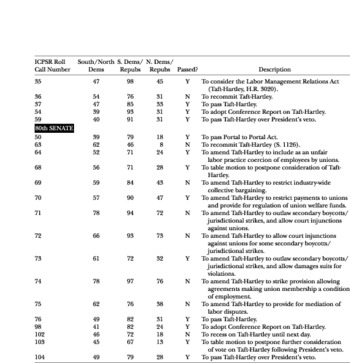
Table 1b. Continued
 You have
Access
- 92
- Cited by