Although numerals form the word class that is most resistant to diachronic change (Pagel, Atkinson, & Meade, Reference Pagel, Atkinson and Meade2007), two important changes have taken place in the history of Germanic number words from 21 to 99—the fixing of word or morpheme order and the reversal of tens and units. Old High German and Old Norse allowed variable order of the tens and units, as exemplified by Old Norse tottogo ok einn versus einn ok tottogo ‘twenty-one’ (see Braune, Reference Braune1967:235; Noreen, Reference Noreen1903:270).Footnote 1 This internal variability has been abolished in Modern German and the Scandinavian languages of today.Footnote 2
In light of this historical variation, it is perhaps to be expected that different modern languages of Germanic origin have settled on different orders within numerals. Whereas Icelandic and Swedish exhibit the ten-before-unit order, Danish and Faroese show the inverse order.Footnote 3 Less variation characterizes the modern West Germanic languages. As far as the historical record goes, Old English,Footnote 4 Old Frisian, and Middle DutchFootnote 5 had a consistent unit-before-ten order (see Bremmer, Reference Bremmer2009; van Kerckvoorde, Reference van Kerckvoorde1993; Wülfing, Reference Wülfing1894).
English is unique among the West Germanic languages in having veered toward the ten-before-unit order. Relatively little is known about this diachronic reversal beyond the mere fact that it actually happened. There are the big unanswered questions of why some languages stood firm and others gave way and whether the constraints on a change from unit-before-ten to ten-before-unit order are identical to those on a change in the opposite direction. Previous work has not tried to quantify the change of the frequency of the alternative orders over time. Therefore, we know hardly anything about the diffusion of the order change through the numeral system. It is the major aim of the present paper to chart the historical course of this change in English number words.
The best known and most pervasive principle of lexical diffusion is undoubtedly frequency (e.g., Bybee, Reference Bybee2001, on phonology; Hooper, Reference Hooper and Christie1976, on morphology; Tottie, Reference Tottie and Kastovsky1991, on syntax). Phillips (Reference Phillips1984) came to the notable conclusion that there is a double relationship between word frequency and order of change in the lexicon. High-frequency words may be the first or the last to change. Although changes involving no more than surface phonetic representations affect the most frequent words first, changes occurring at a more abstract level affect the least frequent words first (see also Phillips, Reference Phillips2006). Applying this insight to the numerals, we may predict that the change from unit-before-ten to ten-before-unit order is sensitive to frequency. To be precise, given the fact that word or morpheme order is largely unrelated to phonetic factors, it may be predicted that low-frequency number words should undergo order change faster than their high-frequency counterparts should.
Another prediction starts from the morphological structure of number words. Old English (OE) numerals from 20 to 99 fell into two classes—one from 20 to 69 and the other from 70 to 99 (see Rosenfeld, Reference Rosenfeld1956/57, for a wider perspective). The multiples of 20 up to 60 were bimorphemic words consisting of the respective units and the suffix -tig ‘-ty’. In contrast, the numerals from 70 to 99 (and beyond) were additionally prefaced by hund- ‘hundred’Footnote 6 (e.g., Brunner, Reference Brunner1953; Campbell, Reference Campbell1959; Quirk & Wrenn, Reference Quirk and Wrenn1957). Thus, when a unit was added, the morpheme hund- separated the unit from the ten, as illustrated in OE twa & hundseofonti ‘seventy-two’ (from the Peterborough Chronicle). This morphological structure allows us to advance the following argument. As the middle morpheme, hund- increases the linear distance between the units and the tens. As an increased linear distance generally discourages the interaction of linguistic units (see MacKay, Reference MacKay1970), number words augmented by hund- may be expected to resist the order change more strongly than those without hund-. Specifically, the order change is predicted to begin with the numerals from 21 to 69 and end with the numerals from 71 to 99.Footnote 7
In the remainder of this paper, these predictions will be put to the test. The next section provides a sketch of what is known about the historical development of English number words from 21 to 99.
BACKGROUND
The constituents of complex numerals may be simply juxtaposed or linked up with a coordinating element, usually the conjunction and (or ampersand). Limiting ourselves to tens and units, this gives us the following four logical possibilities. According to standard sources, three of these are attested in the history of the English language. We illustrate these options on the basis of the number 22.
(1) unit before ten, with and: for example, two and twenty (Early Modern English)
(2) ten before unit, with and: for example, twenty and two (Late Modern English)
(3) unit before ten, without and: for example, *two twenty (unattested)
(4) ten before unit, without and: for example, twenty-two (Modern English)
The data in (1) through to (4) suggest that there is an interaction between the ordering options and the use of the connector. The conjunction is optional in the ten-before-unit order but mandatory in the inverse order. This effect has some cross-linguistic validity and is not even confined to the ordering of tens and units (see Greenberg, Reference Greenberg, Greenberg, Ferguson and Moravcsik1978, universal 33Footnote 8; Seiler, Reference Seiler, Croft, Denning and Kemmer1990:197; Stampe, Reference Stampe, Mufwene, Walker and Steever1976:603). In an attempt to account for this asymmetry, we start from the generalization that the higher-before-lower order occurs more frequently in the languages of the world than the lower-before-higher order (e.g., Gil, Reference Gil, Haspelmath, König, Österreicher and Raible2001; Greenberg, Reference Greenberg, Greenberg, Ferguson and Moravcsik1978). Hence, the former order may be regarded as less markedFootnote 9 or more natural than the latter. From this perspective, the conjunction may be argued to provide an additional clue for the listener to correctly interpret the number value of the more marked structure. This account comes close to Rohdenburg's (Reference Rohdenburg1996) complexity principle whereby the more explicit variant (i.e., the string augmented with and indicating addition) is chosen in the cognitively more costly environment. Note that, strictly speaking, the conjunction is redundant as the different values of, let us say, 45 and 54 are signaled by the morphological structure (i.e., the tens [the higher number] have a higher number of morphemes than the units [the lower number]) in addition to occasional morphophonological adjustment (e.g., ModE /faɪv/ → /fɪfti/).
A diachronic implication of this interaction of morpheme order and the use of and is that a change in the former may have repercussions on the latter. In particular, a change from the unit-before-ten order to the inverse order may be accompanied by the loss of the conjunction. Because language changes step by step, it is to be expected that the use of and will persist beyond the order change and only later be abandoned.
The basic facts may be summarized as follows. The change from unit-and-ten to ten-before-unit order began in Early Middle English and did not reach completion until the 20th century. In Old English, the unit-and-ten order was apparently the only permissible one (e.g., Wülfing, Reference Wülfing1894; see also note 4). Early Middle English saw the emergence of the ten-before-unit order with retention of the conjunction (Öfverberg, Reference Öfverberg1924). The loss of the conjunction did not occur until the end of the Middle English period (Mustanoja, Reference Mustanoja1960; Nohara, Reference Nohara1995; Tietjens, Reference Tietjens1922). As literary examples of the remarkable persistence of the OE order, mention may be made of Jane Austin's Pride and Prejudice (1813), Elizabeth Gaskell's Mary Barton—A Tale of Manchester Life (1848), and H. G. Wells's The New Machiavelli (1910), to name but a few sources. Even though the attestation of the OE order in relatively recent works does not say much about how widespread it was, it is worth pointing out that the OE order did not appear in the mouth of characters but was rather frequently used in narrative passages. For example, a sample from narrative passages in Charles Dickens's Hard Times (1854) contains 14 cases of unit-before-ten order alongside 7 cases of ten-before-unit order.
Middle English shows traces of a vigesimal system in using score for 20 and its multiples for larger numbers, for example, four score and ten for 90. It is important to note that score was not used as a lexical item designating “roughly twenty” but fully integrated into the numeral system. As the just-mentioned example indicates, it could be combined with other numbers and had a very precise meaning. It was accordingly treated like the other number words.
The rendition of 90 as four score and ten reveals a structural pattern that is also found with measure nouns. The tens could be separated from the units by measure nouns such as degree and mile, for example, twenty degrees and oon ‘21 degrees’. These structures always have the higher number precede the lower one. Examples with the inverted order are not attested (e.g., *seuene days and fourty). They thus seem to presuppose the availability of the higher-before-lower order at that point in time.
Finally, we may note for completeness that hybrid forms combining algebraic and linguistic symbols are also found. For instance, the number 30 is rendered as XXXti (see Means, Reference Means1992, for pertinent cases).
METHOD
In the Middle Ages, numbers were normally written as numeric symbols, not as numeral words. This is especially true of higher numbers. Obviously, the Hindu-Arabic representation of numbers in written texts provides no clue as to the order in which the tens and units were pronounced. We therefore have to content ourselves with the less common cases of numbers being rendered as strings of words and morphemes. It stands to reason that this written representation reflects the spoken language faithfully.
The focus of this study is on cardinal numerals, which are certainly more common than ordinal numerals (see Greenberg, Reference Greenberg1966:42). Because the former are basic and the latter derived, it makes sense to confine the analysis to the cardinals. Besides, because the ordinal morpheme is realized as a suffix that invariably attaches to the end of the cardinal numeral irrespective of the unit/ten order, no major differences are expected in the diachronic development of cardinal and ordinal numerals.
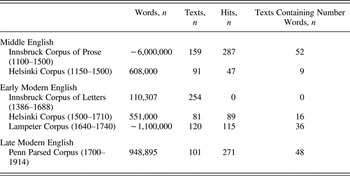
In an effort to document the order change as accurately as possible, recourse was made to several electronic databases. For Middle English (ME), the Innsbruck Corpus of Middle English Prose and the Middle English section of the Helsinki Corpus were selected. The Innsbruck Corpus is by far the largest one. Its focus on prose is particularly appropriate as prose may be expected to generate a larger number of numerals than poetry. Note that there is a certain overlap between the Innsbruck and the Helsinki corpora. Number words occurring in texts found in both corpora were counted only once.
For Early Modern English, the Innsbruck Corpus of Letters, the Early Modern English section of the Helsinki Corpus, and the Lampeter Corpus were drawn upon. The Corpus of Early English Correspondence Sampler was inspected, but because all of the few hits were dated between 1631 and 1651, these were not considered representative of the entire Early Modern English period and consequently were discarded.
The Penn Parsed Corpus of Modern British English served as the empirical basis for the analysis of Late Modern English. This corpus was an obvious choice as it largely takes up where the Helsinki Corpus leaves off. Pertinent details on the corpora used for the present study are provided in Table 1.
Survey of corpora used and initial results

The corpora listed in Table 1 are relatively similar in terms of text genre. Many text types (e.g., law, sermon/religion, science) are represented in all corpora. The comparability of the corpora may therefore be taken for granted.
Occasionally, the electronic corpora contain different copies of the same original. This is true of “Hali Maidenhad” and “Ancrene Riwle” with a total of 3 types and 7 tokens. It might be held that these data points should be counted only once because they are nonindependent. However, it is notable that some scribes took the liberty of modifying the original text as they deemed appropriate, and, in some cases, we even encounter different number values in the different copies of the same original. We thus assume a certain independence between the various copies and consequently included the 3 types and 7 tokens in our analysis. In any event, the elimination of these few instances would not have altered our results.
As regards the ME corpora, the distribution of data points across the different dialect areas is uneven. The East Midland dialect contributes almost twice as many data points as all other dialects taken together. It cannot be ruled out that this imbalance distorted the database. We therefore opted to make no major theoretical point of the regional factor.
ME words are notorious for their variable spelling. This variability poses a particular challenge for defining the search terms used for extracting the relevant data from the electronic corpora. A list was compiled of all spelling forms for the tens from 20 to 90 found in standard ME reference works, in particular Brunner (Reference Brunner1967). To make sure that no data from Early Middle English escaped our notice, the OE spellings noted in Brunner (Reference Brunner1953) were also taken into account. Thus, number words beginning with hund- (see introductory section) were included. This list contains 40 spelling variants for the 8 tens. The record holder is 40 with nine variants, closely followed by 30 with eight variants. There is no guarantee that this list is exhaustive, but it certainly includes all common spelling variants.
The compilation of spelling variants formed the basis for defining the terms for the electronic search, which was carried out by means of the concordancing program MonoConc (Athelstan, Houston, Texas). All search terms began and ended with wild cards. The use of wild cards in the final position enabled us to find additional items that were not on the list of spelling variants. It also solved the problem of dealing with variation brought about by inflectional suffixes. Wild cards in the morpheme-initial position helped us to locate sequences of tens and units as well as units and tens that were written in one word.
MonoConc returned 809 hits, which makes for a respectable corpus size.
DATA ANALYSIS
Classification
In slight contrast to the previous literature (see (1) to (4) above), we found relevant instances in all four logically possible categories. Consider (5) to (8) in which we number the first three categories chronologically: category 1 represents the OE pattern, category 2 the ME innovation, and category 3 the Early Modern English (EModE) innovation. Category 4 has apparently not been recognized as an option in the standard handbooks of the history of the English language. The question of whether it should be regarded as a category in its own right will be addressed in the results.
(5) Category 1 (unit-and-ten): for example, two & twenty ‘twenty-two’
(6) Category 2 (ten-and-unit): for example, sixti and fyue ‘sixty-five’
(7) Category 3 (ten before unit): for example, fifty-three
(8) Category 4 (unit before ten): for example, þrie twenti ‘twenty-three’
Not all number words exhibit the simple structure unit-(and)-ten in either order. We also find nouns inserted right after the tens. These cases come in two subgroups illustrated in (9) and (10), respectively.
(9) fourty days and seuene ‘forty-seven days’
(10) foure score and nyne ‘eighty-nine’
In cases like (9), for example, the noun day separates the tens from the units. Because the tens precede the units, these cases were assigned to category 2. Although superficially dissimilar, there is reason to treat cases such as (10) likewise. Unlike the first subgroup, these number words begin with a unit that serves as a multiplier for the following noun score. Thus, foure score is 4 × 20 = 80. The outcome of the implicit multiplication justifies regarding these cases as belonging to category 2 because the tens appear before the units.
Sometimes, there occur hybrid number words beginning with a written-out number and ending in a Roman numeral (n = 5, both type and token). Because the order of tens and units is always clear in these cases, the assignment to the different types presented no difficulty. These instances were therefore included in the empirical analysis.
Finally, it needs mentioning that not all numbers can be neatly divided into tens and units, as the preceding discussion may have implied. Specifically, the constituents following the tens are not always units but may also be teens, occupying the range from 10 to 19, as shown in (11) and (12).
(11) sixty mile & fourteen ‘seventy-four miles’
(12) þre score & twelue ‘seventy-two’
Examples (11) and (12) are typical in the sense that the majority of these cases occur in structures with an intervening noun. Even though, strictly speaking, these are not tens preceding units, we decided to classify them as category 2 because they follow the higher-before-lower principle. This loosening does not affect the ordering problem at issue because “higher before lower” competes with “lower before higher” in much the same way as “ten before unit” competes with “unit before ten.” Noun phrases such as (11) and (12) suggest that the major cut in the historical development of English number words might not be between the tens and the units but rather between 1 through 19 and the larger numbers. Note that the numbers between 10 and 19 may also be written with Roman numerals.
Results
Frequencies of numeral categories over time
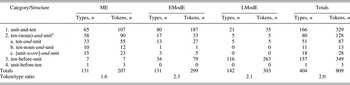
Table 2 reports the type and token frequencies of the categories 1 to 4 in ME, EModE, and Late Modern English (LModE). This table provides a second survey of the database. The diachronic dimension will be discussed shortly. Category 2 numerals are subdivided according to whether they include a noun, and if so, whether it is score or any other noun.
Type and token frequency of the different numeral categories in ME, EModE, and LModE

aNote: The term “unit” also includes (a small number of) values below 21.
The first observation to be made about Table 2 is the extreme infrequency of category 4. In view of the fact that this pattern has not been reported before, this rarity is unsurprising. There is the singleton type þrie twenti, ‘twenty-three’, which occurs once in three different Early ME texts. As these texts represent three different copies of the manuscript “Hali Maidenhad,” it is quite possible that this type occurred in the original and was faithfully reproduced by different scribes. In such a scenario, this form may be regarded as an idiosyncratic usage of a single author. Thus, it was decided to exclude this type from the subsequent analysis.
The number of types in the corpus is relatively large (see Table 2: n = 131 in ME; n = 131 in EModE; n = 142 in LModE). In fact, virtually all number words with the lone exception of the value ninety-three are attested in at least one category. This wide distribution puts the analysis on a solid empirical footing. It ensures that the conclusions to be drawn are based not on a fraction of numbers but hold good for number words in general.
The overall token/type ratio in the corpus is 2:1. This means that each type is documented twice on average. This ratio is lower for the ME data but somewhat higher for the EModE and LModE data. It may be inferred from this ratio that the danger of basing one's conclusions on idiosyncratic hapax legomena is fairly small.
The next observation opens up the diachronic perspective. The modern order (category 3) is a relatively recent innovation. Only 7 relevant occurrences found their way into the ME samples. The frequency patterns of categories 2 and 3 reverse from ME to EModE. Whereas category 2 is more frequent than category 3 in ME, category 3 outnumbers category 2 in EModE and more strongly so in LModE. At the same time, the old order (category 1) is remarkably persistent. It is reasonably well represented even in LModE.
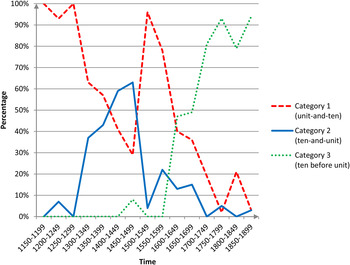
To obtain a more precise idea of the historical development, the data in Table 2 were broken down into time slices of 50 years and transformed into percentages to make up for the unequal number of items per time slice. Although the assignment of the ModE texts to 50-year periods caused no problems, the dating of the ME texts was less precise. Some datings in the ME corpora spanned a full century, a few others even two entire centuries. In an attempt to deal with these imprecisions, a conservative strategy was adopted according to which all the imprecise cases were assigned to the latest possible time slice. For instance, a text that was dated between 1250 and 1350 in the Helsinki Corpus was classified as belonging in the period from 1300 to 1349. This strategy guaranteed that no data point was claimed to have occurred earlier than is warranted by the historical record. Figure 1 presents the highest temporal resolution of the data that seems justifiable.
Rate of categories 1, 2, and 3 as a function of time.

Figure 1 discloses some clear trends. The OE order remains the preferred pattern up to the 15th century. Its only competitor is category 2, which comes into existence in the 13th century and represents the dominant choice in the 15th century. At the onset of the EModE period, the curve drops sharply and stays at a rather low level. The final decline of category 2 begins in the 18th century. Though still attested, this order reaches insignificance in LModE.
It is a notable fact that the ME innovation had a shorter life span than the OE order. Even in LModE, the period of its eventual demise, the old order played a quantitatively larger role than the category 2 order. This finding seems to suggest that category 1 enjoys a certain independence from category 2.
Figure 1 further reveals that the category 2 order antedates the modern order by more than two centuries. Simultaneously with the decline of category 2, the modern order arises apparently out of nowhere in the 17th century. Immediately upon its emergence, it comes to be the majority pattern, or so the data suggest. However, as Figure 1 shows, there is a prelude to the spike of category 3 in EModE. Individual forerunners are found in the 15th century. These early attestations of category 3 cast some doubt on the zeroes in the two subsequent time slices. These zeroes should not be interpreted as evidence for the complete disappearance of category 3. A more realistic view seems to be that the new order originated in the 15th century, remained a minor option for one century and could therefore not be reliably picked up, and swiftly made it to the top in the 17th century.
The length of time it took to replace the old with the new order deserves special emphasis. Whereas the OE order saw its first rivals in the 13th century, it did not diminish into a minor pattern until the 18th century and did not completely disappear until the 20th century. Altogether, the order change may be presumed to have taken 700 years to complete. This protracted period of vacillation suggests that the old order was deeply entrenched and hence hard to overcome with a new order.
A multifactorial approach
We now turn to the multifactorial analysis. In view of the three different categories of numerals, there were two dependent binary variables—the preservation or otherwise of the OE order (± category 1) and the preservation or otherwise of the ME innovation (± category 2). Each data point was coded as ± category 1, ± category 2, and ± category 3. This allowed us to test the different steps separately. The independent variables included period (50-year intervals), region, and frequency. The latter two factors will be explained immediately below.
The inclusion of region was motivated by the possibility of areal diffusion. For example, the change may have started in the north and from there spread southward. According to the dialectal map of ME and the information provided on the provenance of the texts, a regional distinction was made among Northern, East Midland, Midland (South Central Midland), West Midland, London, Kentish, and Southern. Thus, region has eight values in the multifactorial analysis. Region 0 covers items from texts of unknown origin, regions 1 to 7 cover the seven dialect areas just noted.
The relatively low number of tokens per type prevented us from determining the frequency for individual number values. It was therefore decided to pool frequency into blocks of tens (the twenties, the thirties, the forties, etc.). Each block received its frequency value on the basis of the summed frequency of all number tokens belonging to it. This is a rather crude measure but apparently the only way of taking frequency into account. This factor will henceforth be called “block frequency.”
The multifactorial analysis was run on both raw frequency and log frequency. Because this had no effect on the significance of any of the predictor variables and their interactions, we report only the results for log frequency.
The data were also coded for numerical magnitude, to address the question of whether the numerals above 70 behaved differently from those below 70. However, this factor was not entered into the statistical analysis because numerical magnitude is not a linguistically meaningful variable. Number value is a purely logical concept that does not link up naturally with linguistic factors. Numerical magnitude is fraught with an additional problem, being strongly correlated with block frequency (Pearson's r = .74). To avoid collinearity, it is advisable to remove one of the two factors. Because frequency is certainly the more relevant of the two, it was retained, but numerical magnitude was ignored in the multifactorial design.
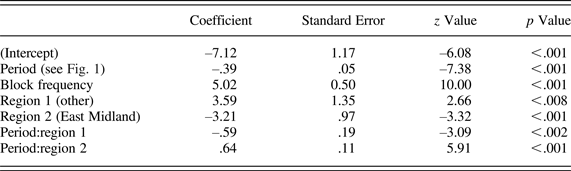
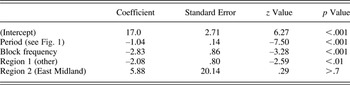
We begin with the change from category 1 to categories 2 and 3. The entire data set was fed into a regression analysis. We found 332 + category 1 items (the OE order) and 477 – category 1 items (all others). Table 3 reports the minimal adequate model for this change.
Regression analysis for the change away from category 1 (from unit-before-ten to ten-before-unit) (n = 809)
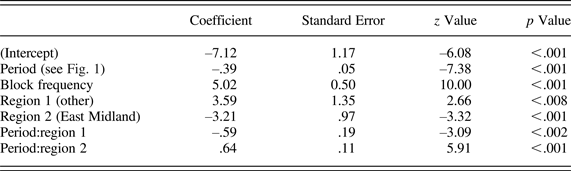
Table 3 reveals a significant main effect of period, block frequency, and region, as well as a significant interaction between period and region. The estimated coefficient provides a measure of the effect a predictor variable has on the outcome of the model. The baseline of the statistical model is a no-response, that is, a noncategory 1, form. A positive coefficient means that the probability of a yes-response (category 1 form) increases, and a negative coefficient means that the probability of a category 1 item decreases. The fact that period has a negative coefficient indicates that the more recent the period of time, the lower the incidence of the OE order. This outcome might seem like a foregone conclusion, for the gradual disappearance of the old pattern was known beforehand. However, what we provide here is statistical support for this observation, which strengthens our confidence in our database. Note that there was no guarantee that we would obtain this result because the database could have been too small to yield significant effects.
The positive coefficient for block frequency shows that the higher the frequency of a numeral, the higher the number of occurrences of the OE order. Differently put, the innovative forms (categories 2 and 3) are more likely to be found in the low-frequency range. From a more temporal perspective, it may be argued that the order change began earlier in the low-frequency items. It is worth adding that period and block frequency do not interact in the regression analysis. This means that the effect of frequency (i.e., low frequency promotes change) is constant across the period of time under study.
We now turn to region. The maximum model tested all seven ME dialects separately. As it turned out, all regions but one failed to reach standard levels of significance, which is perhaps not surprising in the light of the limitations mentioned before. The only region to show an effect was the East Midland dialect. Therefore, the statistical model was reduced to two values for region—defined as region 2 for the East Midland and region 1 for all other dialect areas. As can be gleaned from Table 3, the East Midland dialect turned out to be innovative, whereas the other areas turned out to be conservative.
The interactions of period and region 1 as well as period and region 2 proved significant. This outcome implies that with time the East Midland dialect gradually reduced its change rate while the other dialects increased it, that is, while the other dialects were catching up.
The predictive success of the minimal adequate model is moderately high. It accounts for 54% of the variance in the data (Nagelkerke R 2 = .542). From the perspective of historical linguistics, this is a satisfactory result.
We proceed to an examination of the change from category 2 to category 3, that is, the loss of the conjunction. Unlike the previous change, this development cannot be investigated on the basis of the entire data set because it is nonsensical to allow for the possibility of a reverse change, that is, from category 2 to category 1. Although reverse changes have occasionally been reported in the diachronic literature (e.g., Fischer, Reference Fischer, Fischer, Rosenbach and Stein2000), there is not a shred of evidence to suggest that this has happened in the case of the English numerals. However, it should be borne in mind that the OE pattern lingered on while the change from the ME pattern to the ModE pattern was underway.
The ensuing analysis starts from category 2 (with category 1 excluded). It is based on 477 tokens, of which 128 belong to category 2 and 349 to category 3. The results of the regression analysis of the change from category 2 to category 3 are supplied in Table 4, which discloses a significant main effect of period, block frequency, and region 1. No interaction of factors attained significance.
Regression analysis for the change from category 2 to category 3 (loss of the conjunction and) (n = 477)

The interpretation of period (with a negative coefficient) is as before. As our analysis moves closer to the present time, the frequency of category 2 dwindles. The comparison between Tables 3 and 4 reveals a striking disparity in the behavior of block frequency. In contrast to the change away from the OE order, the coefficient for frequency is negative in the change from category 2 to category 3. The implication is that the higher the frequency of the numeral, the greater its receptiveness to the ModE order. Put another way, the change tends to affect the high-frequency numerals before the low-frequency ones.
A further difference between Tables 3 and 4 pertains to region. Whereas all regions except the East Midland dialect were conservative in the earlier change, they were innovative in the later change. The East Midland dialect also shows variation, albeit less clearly so. Whereas it was innovative in the prior development, no such effect emerged in the later development. To a certain extent, then, the two changes statistically analyzed in Tables 3 and 4 are mirror images of each other. The absence of an interaction of period and region might be partly attributable to the nonsignificance of region 2 (East Midland). It suggests that the neutral behavior of the East Midland and the progressive behavior of the other dialect areas did not change appreciably over time.
Finally, it is worth drawing attention to the success of the statistical model. With R 2 = .757, the model fit is quite good. In fact, the model outperforms the modeling attempt for the change from category 1 to categories 2 and 3. Note also that this success is achieved with fewer factors and interactions than in the previous minimal adequate model.
To summarize, we have traced the change from the OE to the ModE forms of the numerals from 21 to 99 in as much detail as the historical corpora permit. The protracted nature of this change allowed us to study the temporal variable thoroughly. Block frequency exhibits a seemingly paradoxical behavior in generating two diametrically opposite effects. Low-frequency numerals are more receptive to the order change than are high-frequency numerals, whereas high-frequency items are more subject to the loss of the conjunction than are low-frequency items.
Numerical magnitude
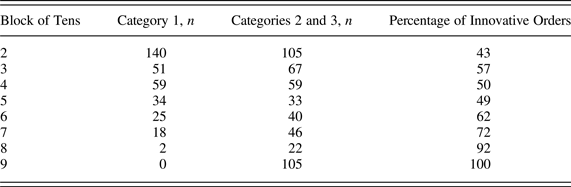
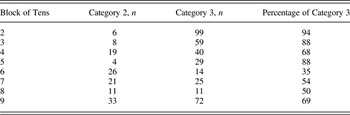
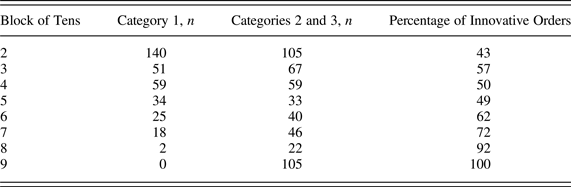
In the final part of the empirical analysis, we briefly bring numerical magnitude into the picture. Like frequency, we coded numerical magnitude in blocks of ten and pooled all numerals from 21 to 29, from 31 to 39, and so on, mainly because the test of interest pertains to the decades rather than the units. In particular, our focus is on whether the decades from 70 to 90 can be distinguished from those from 20 to 60. Table 5 deals with the change in morpheme/word order, Table 6 with the loss of the conjunction (2 = twenties, 3 = thirties, etc.).
Rate of category 1 versus categories 2 and 3 as a function of numerical magnitude (n = 809)
Rate of category 2 versus category 3 as a function of numerical magnitude (n = 477)

If the presence of the prefix (or partial circumfix) hund- played a role in the numeral change, we would expect a major break point between the sixties and the seventies. However, no such break point emerges in Tables 5 and 6.Footnote 10, Footnote 11 What we observe instead is a relatively steady increase in the percentage of new orders as we climb up the blocks of tens in Table 5 and a (less orderly) downward trend in the percentage of the ModE pattern in Table 6. We may therefore conclude that the numeral change was not affected, however indirectly, by the morphological structure of the OE number words.
THEORETICAL DISCUSSION
The role of frequency in the numeral change
In diachronic studies, we repeatedly encounter the seemingly contradictory effects of some changes starting in high-frequency items and others in low-frequency items (see Phillips, Reference Phillips2006, for a survey). Precisely the same result emerged from our own analysis with the additional twist that both effects were observed in the change of English numerals. Our methodological decision in the empirical analysis was to split the change into two parts—the switch of the constituent morphemes and the loss of the linking element. One similarity between the two parts is that both are abstract in the sense that they involve a change in mental programming—a reordering of constituents and the nonproduction of a unit that used to be produced. However, there is also a crucial difference to be noted. The reordering operation is largely confined to the high-level stages of language generation. Whether a given string is produced in one or the other order has few repercussions on the low-level aspects of speech. To be more specific, articulatory complexity is largely unaffected by alternative orders of the same planning units. Different orders may generate differences in the transitional probability of phonemes straddling the word or morpheme boundary, but these effects may be considered minor as probabilistic phonotactic constraints may be strong within words but are weak across word boundaries.
Unlike the reordering operation, the deletion of a word affects not only mental programming but also articulation. That the phonetic representation is involved in the loss of the conjunction can be seen in a series of weakening processes such as vowel reduction and consonant deletion that this change typically involves. These processes create a succession of increasingly reduced output patterns that might have taken the following form: [ænd] → [ənd] → [ən] → [n] → ø. Thus, the disappearance of the connector involves phonetic aspects to a much greater extent than does the reordering of the tens and units.
We suggest that this disparity is at the heart of the puzzling role of frequency in the numeral change. As was noted in the introductory section, Phillips (Reference Phillips2006) argued that the major basis for predicting which of the routes of lexical diffusion will be chosen is the requisite level of analysis. If the change targets the phonetic representation, the most frequent words are the first to innovate; if, however, the change targets more abstract representations, the least frequent words are the first to innovate. This distinction predicts the results of the present study quite well. The order change of tens and units clearly implicates high-level (e.g., morphological) representations. Therefore, this change manifests itself earlier in the less common than in the more common number words. By contrast, the loss of the connector clearly implicates articulatory processes. This phonetic orientation is responsible for the faster involvement of high-frequency words in this change.
There is one remaining concern that needs to be addressed although it cannot be entirely put to rest. Due to the scantiness of the diachronic evidence, frequency had to be operationalized in a less than optimal manner in this study: The data were pooled into blocks of tens. This methodological decision may have introduced an inaccuracy in assessing the impact of frequency in the multifactorial analysis. In particular, it may have underestimated the role of frequency because the pooling of data necessarily involves a loss of information. It is therefore desirable to supplement the block frequency analysis with a frequency analysis of individual numbers.
Although nothing can be done to substantially increase the size of the historical database, there is an indirect way of obtaining more detailed information on frequency profiles at earlier stages of a language. We can achieve this by determining the frequency of number words in the current language. Given the vast data resources that are nowadays available, this can be reliably done for each number value. The next step involves extrapolating from the modern to the historical data and conjecturing that the frequency profile of numerals has not dramatically changed over time.
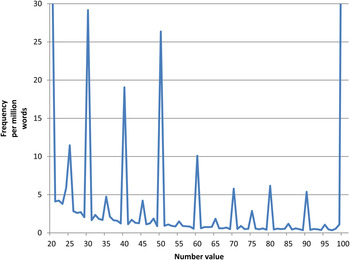
The following frequency analysis is based on the huge Corpus of Contemporary American English (1990–2012). It is restricted to the numerals from 20 to 100. The results of this search are graphically represented in Figure 2.
Frequency of Modern English numbers from 20 to 100.

The empirical picture displayed in Figure 2 is amazingly orderly. There is a general downward drift in frequency with numerical magnitude (Kendall's tau = –.68). Although there are local peaks at the full tens and the fives, the downward trend can be observed in all three domains—the tens, the fives, and the other numbers. Hence, this downward trend applies not just to the decades (as tested in the empirical analysis) but also to the units.
These results dovetail with the study of Dehaene and Mehler (Reference Dehaene and Mehler1992) who found a similar effect in a number of languages other than English, although their analysis was limited to testing the tens (among the domains of interest here). Dehaene and Mehler's (Reference Dehaene and Mehler1992) work is important in the present context because it testifies to the cross-linguistic validity of the decrease in frequency with increasing number value (see also Greenberg, Reference Greenberg1966:44). If we reject a principled difference between different languages and different historical stages of the same language, the cross-linguistic validity of the downward drift justifies generalizing from Modern English to its earlier stages. We may therefore hypothesize that the downward drift shown in Figure 2 is a historical constant.Footnote 12 If this is true, it may be assumed that the multifactorial analysis reported herein underestimated the real strength of frequency.
Toward an account of the numeral change
For the statistical analyses of the historical evolution of English numerals we reported, we broke down this evolution into the change from category 1 to categories 2 and 3 and the change from category 2 to category 3. In so doing, we remained as neutral as possible with respect to the relationship among the three categories of numerals.
On the basis of the data analysis, we may now begin to inquire into the nature of the change in the numeral system. Are we dealing with a unitary change or two independent changes? What is the relationship between the order change and the decline of the linking element? To be more specific, is category 2 a necessary stage during the transition from the OE to the ModE order? Moreover, is category 3 a necessary completion of the change or could it have stopped with category 2? While the investigation of a single language does not allow us to provide general answers, it is possible to draw some preliminary conclusions.
The empirical analysis revealed significant differences in the characteristic features of the order change and the loss of and. Category 2 occurred much earlier than category 3. Frequency and region behave in almost opposite ways. These disparities suggest that, at the observational level, the two changes have a largely independent status.
However, from a more theoretical perspective, the two changes may be argued to be related. As noted in the introduction, the typological literature argues for a strong link between the lower-before-higher order and the connecting element but a weak link between the higher-before-lower order and the connector. Category 2 may therefore be regarded as a disfavored structure. It is probably the outcome of a general desire to keep change to a minimum. Change tends to be local; that is, it affects only one aspect of a linguistic structure at a time. This is for the obvious reason that even during ongoing change, the linguistic system must fulfill its communicative function. A radical change would put this function at risk. It is therefore to be expected that the numeral change was initially restricted to reversing the order of morphemes while leaving the connector intact. Hence, the locality of change entailed a marked pattern (category 2). On the commonplace assumption that language change is more likely to reduce than to increase markedness (e.g., Mayerthaler, Reference Mayerthaler1981), it is understandable that category 2 evolved into category 3. A marked structure is replaced by a less marked one. However, this change is not a logical necessity because marked structures are not necessarily eradicated.Footnote 13 It seems appropriate to regard this change as a natural one. We therefore conclude that category 2 results from the locality constraint on language change and that category 3 is an expected, though not a necessary sequel to category 2. A direct change from category 1 to category 3 would consequently be rather unlikely.
This leads us straight to a discussion of the causes of the change in the numeral system. Language contact with Norman French, which wields such a powerful influence on the ME lexicon (e.g., Burnley, Reference Burnley and Blake1992), also seems to have played a major role in bringing about the order change. Old French placed the tens before the units and made use of a connecting element (e.g., vint et trois ‘twenty-three’; Kibler, Reference Kibler1984:193). Category 2 in ME may accordingly be seen as a direct copy of the French pattern. Notably, the order change appeared just at the time (13th century) when the French influence made itself felt most strongly. A further argument in support of the contact hypothesis is the emergence of the vigesimal strategy in ME, which was completely unknown to the Anglo-Saxons. The multiplication by score was in all likelihood modeled on French vingt as in quatre-vingt (four × twenty) ‘eighty’ and quatre-vingt-dix (four × twenty + ten) ‘ninety’ (see Menninger, Reference Menninger1958:79).Footnote 14 There is an interesting interaction between the use of score and numerical magnitude. The larger the number, the more common the use of score. Although score is not used at all in the forties and fifties, it has a share of 9% in the sixties, 19% in the seventies, 90% in the eighties, and 50% in the nineties in our data. So it is precisely in the numerical region where French makes use of the vigesimal system where we find the strongest use of score in ME. It may therefore be concluded that language contact is a decisive influence even though we view it as one influence among others.Footnote 15
We suggest that the Norman French impact was aided by internal linguistic constraints, especially the weakness of the unit-before-ten order. In the following, we will discuss several (potential and real) problems besetting this order.
The unit-before-ten order engenders a palpable mismatch between the Roman (as well as the Hindu-Arabic) and the linguistic representation of numbers (and consequently between speaking and writing). This order, which is assumed to reflect spoken OE, conflicts with the order in which units and tens are written as numbers. In both Roman and Hindu-Arabic notation, the tens precede the units.Footnote 16 The relative position of the digits is the only piece of information to convey ten or unit status (compare 45 to 54). This conflict creates a problem only for literate people. Illiterate people are not bothered. Herein lies the germ of a potential explanation. An increase in literacy would cause a difficulty that did not exist before and therefore encourage the elimination of this mismatch.
This hypothesis does not accord well with the historical facts, however. The order change began in the 13th century, long before we witness a general increase in literacy (roughly the 17th and 19th centuries). This disparity precludes us from giving credence to this idea.
A more convincing proposal was put forward by Greenberg (Reference Greenberg, Greenberg, Ferguson and Moravcsik1978:274) who invokes the listener's perspective. In multidigit numbers, a consistent lower-before-higher order delays comprehension until the very end of the number word, whereas a consistent higher-before-lower order allows the listener to derive a reasonable approximation to the actual number value on the basis of the beginning of the number word. In a nutshell, the higher-before-lower order is more efficient.Footnote 17
The unit-before-ten order is fraught with a further problem. It creates a local inconsistency because it is typically embedded in a higher-before-lower frame. Take the spoken representation of the number 4263 as an illustration. Although the thousands and hundreds are ordered according to the higher-before-lower principle, this principle is violated by the unit-before-ten order. A change from the unit-before-ten to the inverse order would thus eliminate this inconsistency. We take it that inconsistency is generally more difficult to process than consistency (e.g., Christiansen & Devlin, Reference Christiansen, Devlin and Shafto1997, on word order patterns).
Stampe (Reference Stampe, Mufwene, Walker and Steever1976:603) added another explanation that also revolves around consistency. He contended that in the number range from 21 to 99, the tens provide old and the units new information. Because languages such as English ordinarily place old before new information, the ten-before-unit order is consistent with this pragmatic principle, but the unit-before-ten order is not. Even though Stampe developed this point in an attempt to account for the typological asymmetry between the two orders, his argument can be easily extended to diachronic change. In this view, the change from the unit-before-ten to the ten-before-unit order contributed to making the linguistic system more consistent.
Another line of evidence derives from a look at languages that have the unit-before-ten order. German is a case in point. If this is really a dispreferred pattern, its cracks should be discernible. As a matter of fact, the difficulty surrounding this order can be noticed in the number errors committed by an aphasic speaker of German. Blanken, Dorn, and Sinn (Reference Blanken, Dorn and Sinn1997) reported that most of the errors made by this patient are inversions involving the units and the tens.Footnote 18
All these arguments lead to the conclusion that the unit-before-ten order is more difficult to process than the inverse order is.Footnote 19 The change from the unit-before-ten to the ten-before-unit order in the history of English may therefore be argued to have incurred a reduction in processing cost. This claim should not be misconstrued as stating that the decrease in processing effort provides a full explanation of the order change. We rather prefer to say that the decrease in mental cost has facilitated the order change (to an unspecified degree). Thus, it may be the combination of language contact, the processing advantage, and doubtlessly other factors that brought about the numeral change in the history of English.
It remains for us to explain why languages such as German and Dutch did not follow in the footsteps of English and why Old English had a disfavored unit-before-ten order in the first place. Clearly, there must be a factor (or set of factors) that strengthens the unit-before-ten order and thus contributes to its diachronic stability. The main factor we see at work is the time-honored short-before-long principle (e.g., Behaghel, Reference Behaghel1909; Cooper & Ross, Reference Cooper, Ross, Grossman, James San and Vance1975; Hawkins, Reference Hawkins1994) to which the unit-before-ten order conforms. Because the tens are morphologically more complex than the units (compare, e.g., sixty to six), the former are phonologically longer than the latter. Hence, the unit-before-ten order receives support from the short-before-long principle. It might be objected that this advantage is nullified by the fact that the unit-before-ten order requires a connector. However, this objection is invalid because we are not concerned with the overall length of the numeral but rather with the relative ordering of the tens and the units.
CONCLUSION
Perhaps the most significant aspect of the numeral change is its seemingly paradoxical sensitivity to frequency. We may assume that even though this change has only recently reached its current outcome, it is highly likely that it is in its final stage. From this viewpoint, the number change may be considered a unitary phenomenon that proceeded in two steps. Although these two steps are part of a larger process and may therefore be expected to exhibit a similar behavior, they follow their own rules. Because they differ in their function (nonreductive vs. reductive), they can also differ in their sensitivity to frequency (and possibly in their areal diffusion): The first step—the nonreductive change—diffuses from lower to higher frequency items, and the second—involving phonetic reduction—diffuses from higher to lower frequency items. This shows that a logical link between two diachronic steps does not imply that they must behave in like fashion.