Introduction
Supracricoid partial laryngectomy with cricohyoidoepiglottopexy or cricohyoidopexy is a reliable laryngeal preservation procedure for tumour stage (T) 2 and well selected T3 and T4 laryngeal cancers.Reference Laccourreye, Laccourreye, Weinstein, Menard and Brasnu1–Reference Nakayama, Okamoto, Miyamoto, Yokobori, Takeda and Masaki3 By removing approximately three-quarters of the larynx, including both vocal folds except for one or two arytenoids, supracricoid partial laryngectomy achieves three principal goals of function-preservation surgery: (1) stable oncological result; (2) life without tracheostoma; and (3) acceptable vocal and swallowing function. The cricoarytenoid unit plays a major role in the post-supracricoid partial laryngectomy neoglottis;Reference Nakayama, Hirose, Miyamoto, Yokobori, Takeda and Seino4 laryngeal functions are supported by interaction between the remaining arytenoid and epiglottis.Reference Weinstein, Laccourreye, Ruiz, Dooley, Chalian and Mirza5 To obtain the optimal functional result, proper surgical technique must be observed.
Various post-operative complications of this procedure have been reported.Reference Naudo, Laccourreye, Weinstein, Jouffre, Laccourreye and Brasnu6 Prompt detection and management of such complications are crucial to the success of the procedure.Reference Makeieff, Venegoni, Mercante, Crampette and Guerrier7
Of 70 patients who underwent supracricoid partial laryngectomy, we encountered two patients (3 per cent) with redundant mucosa at the inner edge of the arytenoid, which ‘fluttered’ over and intermittently obstructed the neoglottis. We termed this complication ‘flaccid neoglottis’.
In this report, we present the clinical features of flaccid neoglottis, and we discuss its mechanism, risk factors and management.
Patients and methods
Between 1997 and 2010, 70 patients with laryngeal tumours (i.e. 67 cases of squamous cell carcinoma and one case each of mucoepidermoid carcinoma, sarcoma and leiomyoma) underwent supracricoid partial laryngectomy in our department. There were 67 males and three females, with a mean patient age of 61 years (age range, 15–76 years; 16 patients were aged above 65 years). Supracricoid partial laryngectomy with cricohyoidoepiglottopexy was performed in 66 patients, and supracricoid partial laryngectomy with cricohyoidopexy in four.
Of this group, two patients were identified with flaccid neoglottis. Because of the altered features of the post-supracricoid partial laryngectomy neoglottis, a navigation system (BrainLAB, Munich, Germany) was used to assist surgical treatment of the complication. The utility, and difficulty, of introducing a navigation system into the laryngeal cavity are discussed below.
In order to quantitatively assess the spatial alteration of the neoglottis before and after the revision, the minimum cross-sectional area of the neoglottis during inspiration was assessed using three-dimensional computed tomography (CT) images. Computed tomography images were processed as Digital Imaging and Communication in Medicine (DICOM) files and analysed using Intage Realia and Volume Player software (Cybernet Systems; Tokyo, Japan) installed on a Windows personal computer. The neoglottal cross-sectional area was defined based on the inferior horizontal plane of the cricoid cartilage. The minimum cross-sectional area in case one was compared with those of 17 post-supracricoid partial laryngectomy patients without flaccid neoglottis, whose CT data were available for analysis.
We investigated the voice status of cases one and two, three months after revision surgery, using the following types of analysis: acoustic (i.e. fundamental frequency, jitter and shimmer), aerodynamic (i.e. maximum phonation time and mean air flow), perceptual (i.e. the grade-roughness-breathiness-asthenia-strain scale) and psychological (i.e. the Voice Handicap Index 30 (the 30 question version)).
Results
The clinical symptoms and management of our two patients with flaccid neoglottis are detailed in the following case presentations. Inspiratory stridor and delayed stomal closure were the main symptoms.
In case one, the minimum cross-sectional neoglottal area was 18.9 mm2 before revision and 49.4 mm2 after revision. By comparison, the mean ± standard deviation minimum cross-sectional neoglottal area in 17 patients without flaccid neoglottis was 78.4 ± 49.4 mm2 (range, 30.7–231.1 mm2).
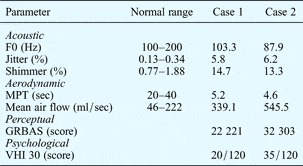
The voice evaluation results of cases one and two, three months after revision, are shown in Table I. Although these two patients had relatively rough and breathy voices, both seem to have adapted well to these vocal features, as indicated by their relatively low Vocal Handicap Index scores.
Voice evaluation results*

* Cases one and two, three months after revision. F0 = fundamental frequency; MPT = maximum phonation time; sec = second; GRBAS = grade-roughness-breathiness-asthenia-strain scale; VHI 30 = Vocal Handicap Index 30
Case reports
Case one
In December 2009, a 69-year-old man with glottic squamous cell carcinoma involving the bilateral glottis and anterior commissure (tumour-node-metastasis (TNM) staging T3 N0 M0) underwent supracricoid partial laryngectomy with cricohyoidoepiglottopexy, sparing the left arytenoid and right corniculate cartilages. The post-operative course was uneventful.
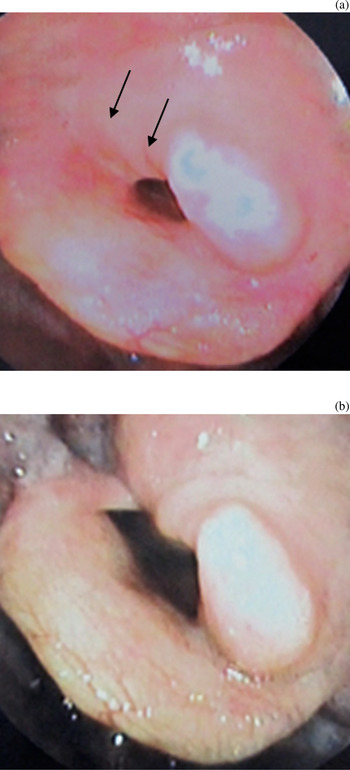
However, three months later the patient was still experiencing stridor upon closure of the tracheal stoma. Laryngoscopy demonstrated redundant mucosa which fluttered over and intermittently obstructed the neoglottis (Figure 1). Because of delayed stomal closure, a laryngoscopic revision was planned.
Laryngoscopic views of the neoglottis in case one, before and after revision. (a) Before revision, redundant mucosa (arrows) was observed to flutter over and intermittently obstruct the neoglottis. (b) After revision, spatial enlargement of the neoglottis is seen.

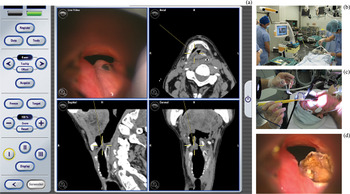
A surgical navigation system was used during the revision procedure, to help confirm which section of neoglottal mucosa was responsible for the problem, and to help calculate the extent of resection required (Figure 2). Pre-operatively, a CT scan of the larynx was obtained with the patient's neck in a hyperextended position, simulating the posture required for laryngoscopic suspension. A reference antenna was fixed to the suspension table and incorporated for paired point matching registration. A star link attached laryngoscopic levator was calibrated via a matrix device; this was used for confirmation of surgical position. Positioning error did not appear to be a problem in this case. After confirmation, the redundant mucosa was retracted using Steiner's forceps (Karl Storz, Tuttlingen, Germany) and resected using extended electric cautery.
(a) Screengrab showing use of the BrainLAB navigation system to assist confirmation of the responsible mucosa in the altered neoglottis of case one. Photographs show (b) registration, (c) revision and (d) resection processes in case one.

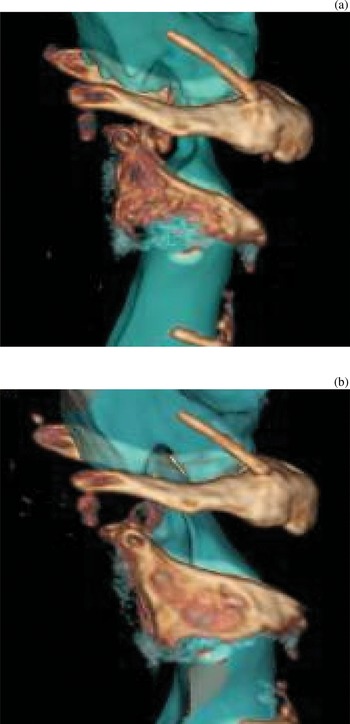
Three-dimensional CT images of the larynx before and after revision are presented in Figure 3. Spatial enlargement of the neoglottis can be seen.
Sagittal, three-dimensional computed tomography larynx scans (a) before and (b) after case one revision. Airway configuration is shown in translucent blue and bony structures in white. Post-operative spatial enlargement of the neoglottis can be seen.

Shortly after revision, stridor disappeared and the tracheal stoma successfully closed.
Case two
In December 2009, a 70-year-old man with glottic mucoepidermoid carcinoma involving the bilateral glottis and anterior commissure (T2 N0 M0) underwent supracricoid partial laryngectomy with cricohyoidoepiglottopexy, sparing the right arytenoid and left corniculate cartilages. The post-operative course was uneventful.
However, three months later the patient was still experiencing stridor upon closure of the tracheal stoma. Laryngoscopy demonstrated redundant mucosa which fluttered over and intermittently obstructed the neoglottis.
As in case one, a surgical navigation system was used to assist confirmation of the responsible mucosa, and to help establish the extent of resection required. The redundant mucosa was resected using the same manoeuvre as in case one.
After revision, spatial improvement of the neoglottis was observed on three-dimensional CT, and the tracheal stoma was successfully closed.
Discussion
As supracricoid partial laryngectomy gains increasing acceptance, due to its superior degree of laryngeal preservation, and is consequently used more frequently, it is inevitable that more surgical complications will be encountered. Prompt detection and management of post-operative complications is crucial.Reference Naudo, Laccourreye, Weinstein, Jouffre, Laccourreye and Brasnu6, Reference Makeieff, Venegoni, Mercante, Crampette and Guerrier7 However, it is essential that the incidence of such post-operative complications is minimised by the use of appropriate, contemporary surgical techniques.Reference Laccourreye, Brasnu, Laccourreye and Weinstein8, Reference Holsinger, Laccourreye, Weinstein, Diaz and McWhorter9
Non-tumoural laryngeal stenosis after supracricoid partial laryngectomy is a rare complication. Diaz et al. Reference Diaz, Laccourreye, Veivers, Garcia, Brasnu and Laccourreye10 were the first to describe laryngeal stenosis after supracricoid partial laryngectomy, and reported an incidence of 3.7 per cent in their series of 376 supracricoid partial laryngectomy patients. In patients with early onset of laryngeal stenosis, the complication was found to be due to relapse of the epiglottis, synechiae, ruptured pexis or excessive granulation. Laryngeal stenosis of late onset was mainly the result of excessive scar tissue formation at the cricohyoid junction.
Laccourreye and colleagues have emphasised the technical importance of correct alignment of the hyoid bone and cricoid cartilage.Reference Laccourreye, Brasnu, Laccourreye and Weinstein8, Reference Holsinger, Laccourreye, Weinstein, Diaz and McWhorter9 In our two patients, laryngeal stenosis was not due to any of the causes described above, and cricohyoid alignment was correct. Rather, neoglottal stenosis was caused by redundant laryngeal mucosa, and clinical symptoms were characterised by intermittent neoglottal obstruction and delayed stomal closure.
Based on these observations, we propose the term flaccid neoglottis to describe this type of post-supracricoid partial laryngectomy complication. We believe that the main pathogenetic mechanisms of this complication are (1) excessive anterior retraction of residual mucosa, and (2) excessive mucosal pliability due to advanced age. Both our reported patients were approximately 70 years old. Anterior retraction is one of the standard techniques used during the supracricoid partial laryngectomy procedure to prevent future aspiration; however, surgeons should be aware of the risk of excessive retraction of the remaining arytenoid mucosa when operating on patients over the age of 70 years.
We used a surgical navigation system to assist confirmation of the redundant mucosa within the altered neoglottis. Laser registration, a new technique utilising a laser marker and facial surface recognition, is not suitable for the laryngeal and neck regions because of their obscure surface features. Instead, we used a paired point registration technique based on four pre-registered anatomical points. Anatomical points were selected based on their accessibility and proximity to the surgical field. In the presented two patients, the following four points were selected: the right and left edges of the tracheal stoma, the anterior mid-point of the cricoid cartilage surface, and the anterior mid-point of the hyoid bone surface. A laryngeal CT scan was obtained with the neck in a hyperextended position, simulating the posture of laryngoscopic suspension. The positioning error between the CT images and the laryngoscopic suspension was minimal in both our patients. A reference antenna was fixed to the suspension table adjacent to the surgical field, and extra care was paid to minimise movement between the surgical field and the antenna after registration. A star link attached laryngoscopic levator was calibrated via a matrix device and used for confirmation. Virtually any type of pointer can be utilised for confirmation. We encountered no difficulty during the calibration process. However, we recommend that any patient manipulation required during the revision procedure should be conducted very gently.
• In this study, two of 70 supracricoid partial laryngectomy cases had a post-operative ‘flaccid neoglottis’: redundant arytenoid mucosa intermittently obstructing the neoglottis
• Inspiratory stridor and delayed stomal closure were the main symptoms
• Likely causes were excessive anterior retraction of residual laryngeal mucosa and excessive mucosal pliability with age
• Three-dimensional computed tomography and a navigation system were useful in planning revision surgery
We found the surgical navigation system helpful when identifying the area of mucosa responsible for neoglottal obstruction, and when determining the extent of resection. However, the use of navigation systems in the laryngeal cavity is still preliminary, and further investigation is required.
In the two presented patients, revision of flaccid neoglottis was satisfactory in terms of successful stomal closure and acquisition of acceptable laryngeal function. Although both patients had relatively rough and breathy voices, they appeared to have adapted well to these vocal features, as shown by their relatively low Vocal Handicap Index scores.
Thus, we suggest that flaccid neoglottis is a treatable complication of supracricoid partial laryngectomy, and that laryngeal function can be improved by surgical revision.
Acknowledgements
This study was supported by a Grant-in-Aid for Scientific Research (C) from the Ministry of Education, Culture, Sports, Science, and Technology of Japan (grant number 20592028: 2008-2011). The authors thank Mr Satoru Kato from BrainLAB Co for valuable technical advice.