1. Introduction
The Severnaya Zemlya Archipelago is located in the Arctic Ocean north of the Tajmyr Peninsula, between the Kara (in the west) and the Laptev (in the east) seas (Fig. 1). The archipelago, with a total area up to 36 000 km2 (45% covered by continental glaciers) consists of four large islands: October Revolution, Bol'shevik, Komsomolets and Pioneer, and up to 70 smaller ones. Six islands (Srednij, Golomyannyj, Domashnij, Figurnyj, Vostochnyj and Samojlovich) form the Sedov Archipelago located just SW of Pioneer Island. There is very sparse vegetation cover and the rocks on the islands are well exposed. Numerous continuous sections of highly fossiliferous lower and middle Palaeozoic strata occur, making these archipelagos among the key areas for geological studies in the Arctic region.
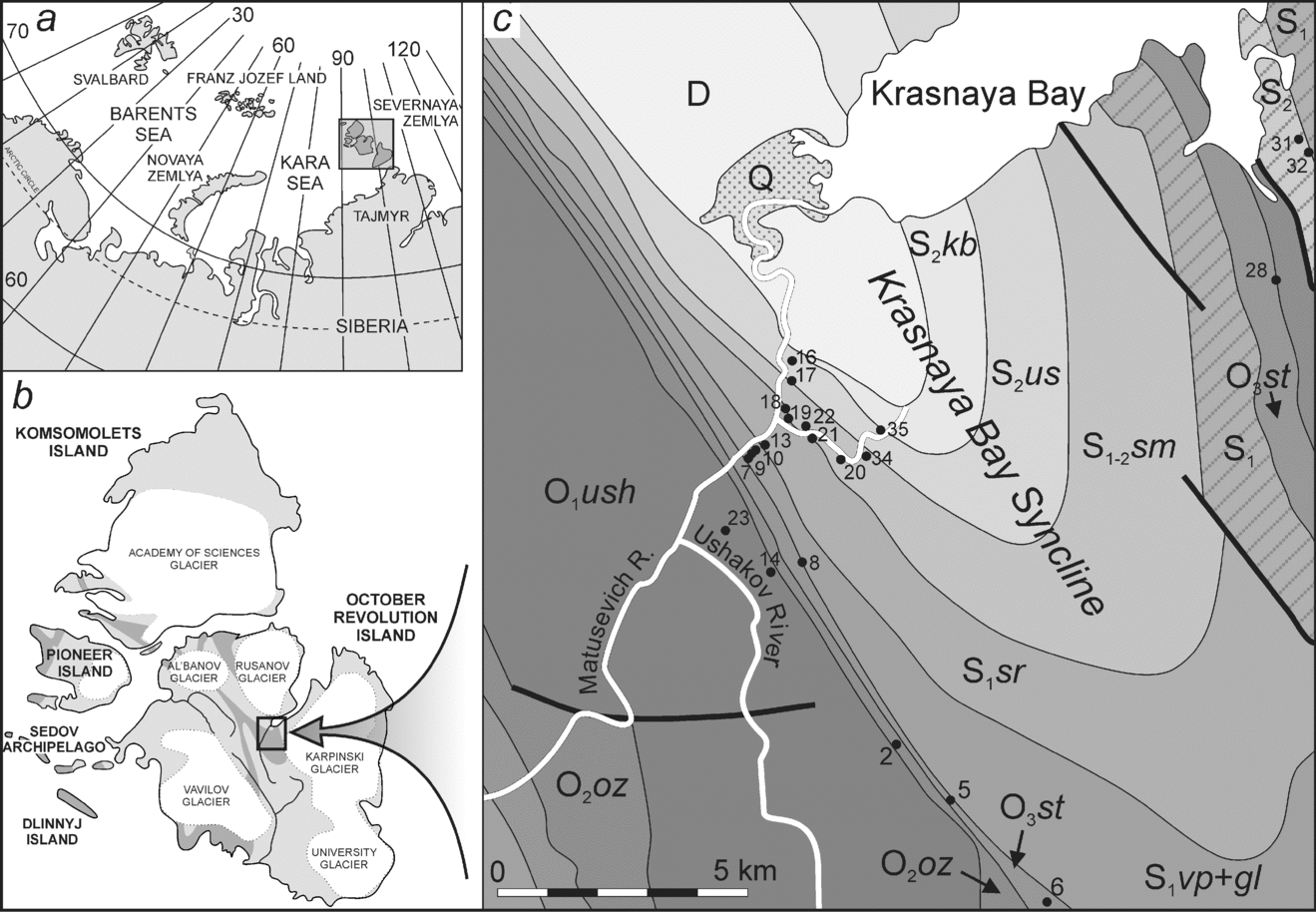
Location of study area (a, b) and sections (c). In (b), dark shaded areas correspond to the Silurian outcrops. A geological sketch map of the Severnaya Zemlya Archipelago (c) is based on Markovskij et al. (Reference Markovskij, Kulyasheva, Makar'ev, Makar'eva, Khapilin, Makeev and Bol'shiyanov1984). Dots with numbers in (c) indicate locations of the sections referred to in the text. Abbreviations: O1 – Lower Ordovician, O2 – Middle Ordovician, O3 – Upper Ordovician, S1 – lower Silurian, S2 – upper Silurian, S1–2 – lower to upper Silurian, D – Devonian, Q – Quaternary, ush – Ushakov Formation, oz – Ozernaya Formation, st – Strojnaya Formation, vp + gl – Vodopad and Golomyannyj formations, sr – Srednij Formation, sm – Samojlovich Formation, us – Ust'-Spokojnaya Formation, kb – Krasnaya Bukhta Formation.

The Severnaya Zemlya Archipelago was discovered in 1913, but the geology of the region has only been studied since the early 1930s. During the first expedition to the archipelago in 1930–1932 (led by G. A. Ushakov), N. N. Urvantsev described several sections and collected faunas of Palaeozoic age. Detailed palaeontological and stratigraphical studies in the region started in the early 1970s, initiated by a state program of geological mapping on a scale of 1:200 000. During this work, special expeditions to study the lithology, palaeontology and stratigraphy of the Ordovician–Devonian strata in several key sections were organized in 1974, 1978 and 1979. As a result of these expeditions the first data on the Silurian and Devonian conodonts in the region were published (Klubov, Kachanov & Karatajūtė-Talimaa, Reference Klubov, Kachanov and Karatajūtė-talimaa1980). Detailed studies of Palaeozoic conodonts from the Severnaya Zemlya and Sedov archipelagos in subsequent years have been based on the samples collected during these expeditions (Sobolev, Reference Sobolev, Matukhin and Menner1999; Männik, Reference Männik, Matukhin and Menner1999, Reference Männik2002).
A number of additional early Palaeozoic sections were described and sampled during the SWEDARCTIC international expeditions to Severnaya Zemlya in 1999, 2002 and 2003 (Gee et al. Reference Gee, Pease, Bogolepova, Eriksson, Gubanov, Kireev, Metelkin, Vernikovskaya, Vernikovsky, Nilsson, Proskurnin and Tagesson1999, Reference Gee, Bax, Lorenz, Golubkova and Larionov2002, Reference Gee, Lorenz, Eriksson, Golubkova and Larionov2003). Although these expeditions were mainly focused on regional tectonics, the work also included studies of stratigraphy and palaeontology. During the expedition in 1999, several sections on the middle and lower reaches of the Ushakov River (Central October Revolution Island) and just SW of the central part of Krasnaya Bay, exposing Lower Ordovician to Lower Devonian strata, were described and sampled by O. Bogolepova and A. Gubanov (Figs 1, 2; Appendix 1, available as supplementary material online at http://multimediafluids.uam.elogim.com/journals/geo). A summary of the litho- and biostratigraphy of the Ordovician strata has recently been published (Bogolepova, Gubanov & Pease, Reference Bogolepova, Gubanov and Pease2006), and several Silurian (Telychian) faunas with their palaeogeographical implications have been discussed (Bogolepova, Gubanov & Loydell, Reference Bogolepova, Gubanov and Loydell2000; Högström, Bogolepova & Gubanov, Reference Högström, Bogolepova and Gubanov2002; Bogolepova, Gubanov & Pease, Reference Bogolepova, Gubanov and Pease2005; Siveter & Bogolepova, Reference Siveter and Bogolepova2006). The aim of the present paper is to give an overview of the conodonts discovered after processing the samples from the sections studied in 1999 and to discuss the stratigraphy of the region based on these new data.
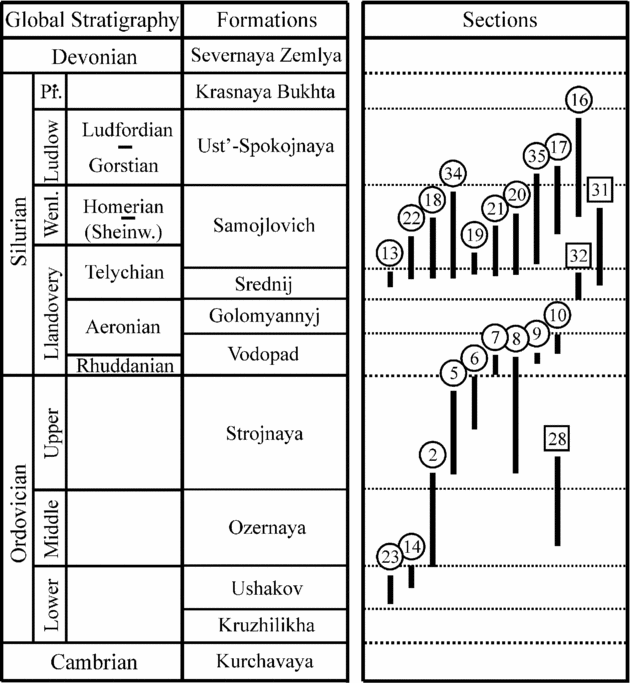
The Ordovician (according to Markovskij & Makar'ev, Reference Markovskij, Makar'ev, Kaban'kov and Lazarenko1982) and Silurian (based on Matukhin & Menner, Reference Matukhin and Menner1999) stratigraphy of Severnaya Zemlya, and general stratigraphical position of the sections studied. In the Silurian only the boundaries of global stages recognizable in the faunal succession (e.g. Matukhin & Menner, Reference Matukhin and Menner1999; Männik et al. Reference Männik, Menner, Matukhin and Kuršs2002) are indicated. Abbreviations: Př. – Přidoli, Sheinw. – Sheinwoodian; parentheses indicate that on Severnaya Zemlya this interval (most of it?) corresponds to a gap. Ordovician stages cannot be identified on Severnaya Zemlya yet. Numbers in circles indicate sections in the middle and lower reaches of the Ushakov River (on the SW limb of the Krasnaya Bay Syncline; Fig. 1); those in squares indicate sections located just south from the central Krasnaya Bay (on the eastern limb of the Krasnaya Bay Syncline).

2. General geology
In the Severnaya Zemlya Archipelago, the sedimentary succession comprises strata of Neoproterozoic to late Palaeozoic age. Together with North Tajmyr, Severnaya Zemlya constitutes the main land-area of the North Kara Terrain, which, according to some geologists, is considered to have existed as an integrated part of the Timanide margin of Baltica at least since the Vendian (Gee, Bogolepova & Lorenz, Reference Gee, Bogolepova, Lorenz, Gee and Stephenson2006; Lorenz, Gee & Bogolepova, Reference Lorenz, Gee, Bogolepova, Scott and Thurston2006). According to other interpretations, the present-day Severnaya Zemlya and Sedov archipelagos were located on the so-called Kara Plate which evolved separately (Bogdanov et al. Reference Bogdanov, Khain, Rozen, Shipilov, Vernikovsky, Drachev, Kostyushenko, Kuzmichev and Sekretov1998, pp. 64–70; Cocks & Torsvik, Reference Cocks and Torsvik2005; Metelkin et al. Reference Metelkin, Vernikovsky, Kazansky, Bogolepova and Gubanov2005). The oldest, Neoproterozoic sedimentary rocks are exposed in the eastern part of the archipelago (on Bol'shevik and easternmost October Revolution islands) and are covered by younger (Cambrian to Devonian) strata towards the west. Carboniferous and Permian strata are located in limited areas only (Shul'ga, Reference Shul'ga, Gramberg and Ushakov2000). The structure in the archipelago is dominated by a major NW-trending anticline (named the Al'banov Glacier Anticline by Lorenz et al. Reference Lorenz, Männik, Gee and Proskurnin2008) through central October Revolution Island. In the core of the anticline, Lower and Middle Ordovician disharmonically folded evaporite-bearing strata are exposed, with Upper Ordovician to Silurian terrigeneous and calcareous strata on its limbs. The main structures just northeast and southwest of the Al'banov Glacier Anticline are the Krasnaya Bay and Pioneer Island synclines, respectively (Lorenz et al. Reference Lorenz, Männik, Gee and Proskurnin2008). In both of these structures Silurian to Middle Devonian (in the Pioneer Island Syncline also the Upper Devonian) strata are exposed.
The Ordovician sequence on Severnaya Zemlya is up to 1700 m thick and is represented by coastal and shallow marine deposits (Markovskij & Makar'ev, Reference Markovskij, Makar'ev, Kaban'kov and Lazarenko1982; Bogolepova, Gubanov & Pease, Reference Bogolepova, Gubanov and Pease2006). Four formations (Kruzhilikha, Ushakov, Ozernaya and Strojnaya) have been recognized. The lowermost, the Kruzhilikha Formation, was not sampled for conodonts for this study.
(1) The Ushakov Formation (300–1200 m) is subdivided into three parts. In southernmost October Revolution Island, the lower part of the formation is mostly composed of red and green quartz sandstones with ripple marks. Few beds (up to 5 m thick) of rhyolites and tuff are present in this succession. The upper beds of the lower part consist of several intervals (up to 1.5 m in thickness) of stromatolitic limestone. Towards the north, variegated siltstone and marlstone replace the sandstone in the lower part of the formation. Here, interbeds of argillaceous dolostone are quite common. The middle part of the Ushakov Formation is represented by variegated (cherry, red, green, ash-grey) marlstones, siltstones, sandy dolostones with interbeds and lenses (with thickness between 0.01 to 0.8 m) of orange and white gypsum. On some surfaces mud-cracks occur. Red and green quartz sandstones with ripple marks dominate the upper part of the formation. Close to the top of the formation, sandstones intercalate with marlstones, siltstones, dolostones and argillaceous limestones. Marine faunas in the formation are represented by rare brachiopods and gastropods, suggesting a late Early Ordovician age for these rocks (Markovskij & Makar'ev, Reference Markovskij, Makar'ev, Kaban'kov and Lazarenko1982).
(2) The Ozernaya Formation (100–300 m) is characterized by dark-grey argillaceous limestones and dolostones, often gypsiferous. Bryozoans, nautiloids and ostracods identified from the formation indicate a Middle Ordovician age for these strata (Markovskij & Makar'ev, Reference Markovskij, Makar'ev, Kaban'kov and Lazarenko1982).
(3) The Strojnaya Formation (10–200 m) consists of variegated, mainly light-coloured feldspathic and quartz sandstones, dolostones, and subordinate limestones and marlstones. Sandstones, often with cross-bedding structures, ripple marks and trace fossils, are predominant in the upper and lower parts of the unit, while silty and bioclastic limestones, dolostones and marlstones are common in the middle part. A Late Ordovician age has been suggested on the basis of tabulate corals (Markovskij & Makar'ev, Reference Markovskij, Makar'ev, Kaban'kov and Lazarenko1982).
In the Silurian, six formations (in total thickness up to 1500 m) have been identified (Matukhin & Menner, Reference Matukhin and Menner1999; Männik et al. Reference Männik, Menner, Matukhin and Kuršs2002; Fig. 2). At the lower boundary of the lowermost unit, the Vodopad Formation, calcareous rocks replace the mainly siliciclastic beds of the Strojnaya Formation.
(1) The Vodopad Formation (240–360 m) is dominated by grey to dark grey bioclastic and dolomitic limestones, and is divided into two parts by an interval of argillaceous stromatolitic limestones. In the formation, particularly in its upper part, tabulate and rugose corals, stromatoporoids, pentamerid brachiopods, ostracods and echinoderms are present, indicating a Llandovery age. Previous conodont work (Männik, Reference Männik2002) indicates late Rhuddanian to early Aeronian. These strata formed under open shelf conditions during a major transgression.
(2) The Golomyannyj Formation (60–120 m) consists mainly of thin-bedded argillaceous limestones with interbeds of sandstone, stromatolitic limestone and subordinate dolostone. Mud cracks occur in many beds. Ostracods, gastropods, small brachiopods and echinoderm fragments are common, whereas corals and stromatoporoids are very rare. The fauna indicates an Aeronian age for the formation. The strata of the Golomyannyj Formation were deposited during a major regression (Männik et al. Reference Männik, Menner, Matukhin and Kuršs2002).
(3) The Srednij Formation (290–500 m) consists of an intercalation of horizontal-bedded, sometimes silicified, limestones with tabulate-stromatoporoid biostromes and bioherms, with massive fossiliferous brownish-grey limestones containing ostracods, gastropods, echinoderms, cephalopods and rare tabulate corals. Interbeds of greenish-grey dolomitic limestones with ostracods occur at some levels. Here, stromatolites and mud cracks can be found. In the Krasnaya Bay region (October Revolution Island), beds of black shale with graptolites occur in the formation. Conodonts suggest a late Llandovery (Telychian) age for the Srednij Formation. The Srednij Formation corresponds to a major transgression (Männik et al. Reference Männik, Menner, Matukhin and Kuršs2002).
(4) In the Samojlovich Formation (240–400 m), stromatolitic, oolitic, oncolitic and argillaceous limestones with abundant gastropods, brachiopods, ostracods and trilobites are intercalated with almost unfossiliferous dolomitic limestones and argillaceous dolostones. Rare corals have been found only in the upper part of the formation. In the dolomitic rocks, mud cracks are common; stromatolitic structures, often associated with lenses of calcareous conglomerate, occur throughout the formation. Conodonts indicate a Llandovery (late Telychian) age for the lower part and a middle to late Wenlock age for the upper part of the formation. These strata formed under conditions of continuous shallowing in a shallow-water rimmed shelf basin (Männik et al. Reference Männik, Menner, Matukhin and Kuršs2002).
(5) The Ust'-Spokojnaya Formation (60–340 m) is dominated by multi-coloured marlstones, which contain thin lenses of argillaceous limestone with ostracods, bivalves, gastropods and vertebrate remains. In the lower part of the formation, interbeds of fine-grained oolitic limestone with bivalves, ostracods, cephalopods, stromatolites and oncolites are common. Vertebrate remains suggest a Ludlow age for the formation. These strata formed in even shallower water conditions than the underlying Samojlovich Formation (Männik et al. Reference Männik, Menner, Matukhin and Kuršs2002), with increasing input of terrigenous material.
(6) The uppermost Silurian corresponds to the mainly terrigenous Krasnaya Bukhta Formation. The thickness of the formation is largest in northeastern October Revolution Island but decreases rapidly towards the west. In the central part of the island, where the topmost Silurian beds have been eroded prior to the deposition of Devonian strata, the youngest Silurian strata correspond to the Ust'-Spokojnaya Formation.
3. Sections studied
The SWEDARCTIC international expedition to Severnaya Zemlya in 1999 examined the central part of October Revolution Island, concentrating on structure, palaeontology (Cambrian to Devonian) and palaeomagnetic studies (Gee et al. Reference Gee, Pease, Bogolepova, Eriksson, Gubanov, Kireev, Metelkin, Vernikovskaya, Vernikovsky, Nilsson, Proskurnin and Tagesson1999). The sections studied are located in the middle and lower reaches of the Ushakov River (Central October Revolution Island), on the SW limb of the Krasnaya Bay Syncline sensu Lorenz et al. (Reference Lorenz, Männik, Gee and Proskurnin2008) (Fig. 1). Another set of samples comes from three sections just south from the central Krasnaya Bay. These sections are located on the eastern limb of the same syncline (Fig. 1). The details of the location of sections and characteristics of lithologies exposed in the sections sampled for conodonts are presented, respectively, in Appendix 1 and Appendix 2 (available as supplementary material online at http://multimediafluids.uam.elogim.com/journals/geo). The sampled sections represent a stratigraphic interval from the Ushakov Formation to the Ust'-Spokojnaya Formation (Fig. 2).
4. Conodonts
4.a. Previous studies
The first data about conodonts from Severnaya Zemlya were published by Klubov, Kachanov & Karatajūtė-Talimaa (Reference Klubov, Kachanov and Karatajūtė-talimaa1980), in a paper dealing with the Silurian and Devonian stratigraphy on Pioneer Island. Identification of conodonts and, accordingly, the dating of the strata in that paper are highly problematic (for the results of a restudy of these collections of conodonts, and an updated stratigraphy of the Silurian succession on Pioneer Island, see Männik, Reference Männik2002).
Two years later, Markovskij & Makar'ev (Reference Markovskij, Makar'ev, Kaban'kov and Lazarenko1982) reported a relatively rich assemblage of conodonts from the Lower Ordovician Kruzhilikha Formation. Based on these faunas (identified by G. Abaimova), the strata were dated as early Ordovician and correlated with the Latorp (= Hunneberg and Billingen stages according to the modern scheme, see Raukas & Teedumäe, Reference Raukas and Teedumäe1997) and Volkhov stages in the Baltic region.
During the SWEDARCTIC international expedition to Severnaya Zemlya in 2002, samples were collected from the upper part of the Kruzhilikha Formation exposed along the Kan'on River in the central part of October Revolution Island. Sandy and bioclastic limestones yielded the conodonts Drepanoistodus sp., Prioniodus sp. and Scalpellodus sp. (T. Tolmacheva, pers. comm.).
Detailed studies of Silurian and, to a lesser extent, Middle and Upper Ordovician conodonts on the Severnaya Zemlya and Sedov archipelagos started in late 1979, after an expedition to the region in the summer of that year organized by SEVMORGEO. Several sections on Srednij and October Revolution islands were described and sampled by P. Männik. Additionally, a number of samples collected during expeditions to the region in earlier years and provided by E. Mark-Kurik, V. Karatajūtė-Talimaa, V. Vl. Menner and A. F. Khapilin were processed for conodonts. Conodont taxonomy and biostratigraphy, based on these studies, was summarized in several papers (Männik, Reference Männik1983, Reference Männik, Matukhin and Menner1999, Reference Männik2002; Männik et al. Reference Männik, Menner, Matukhin and Kuršs2002).
From the Devonian strata only a few scattered samples (collected at different times by E. Kachanov, E. Mark-Kurik and P. Männik) have been available for studies of conodonts. The fauna has been identified and the data summarized by N. Sobolev (Reference Sobolev, Matukhin and Menner1999).
4.b. New material
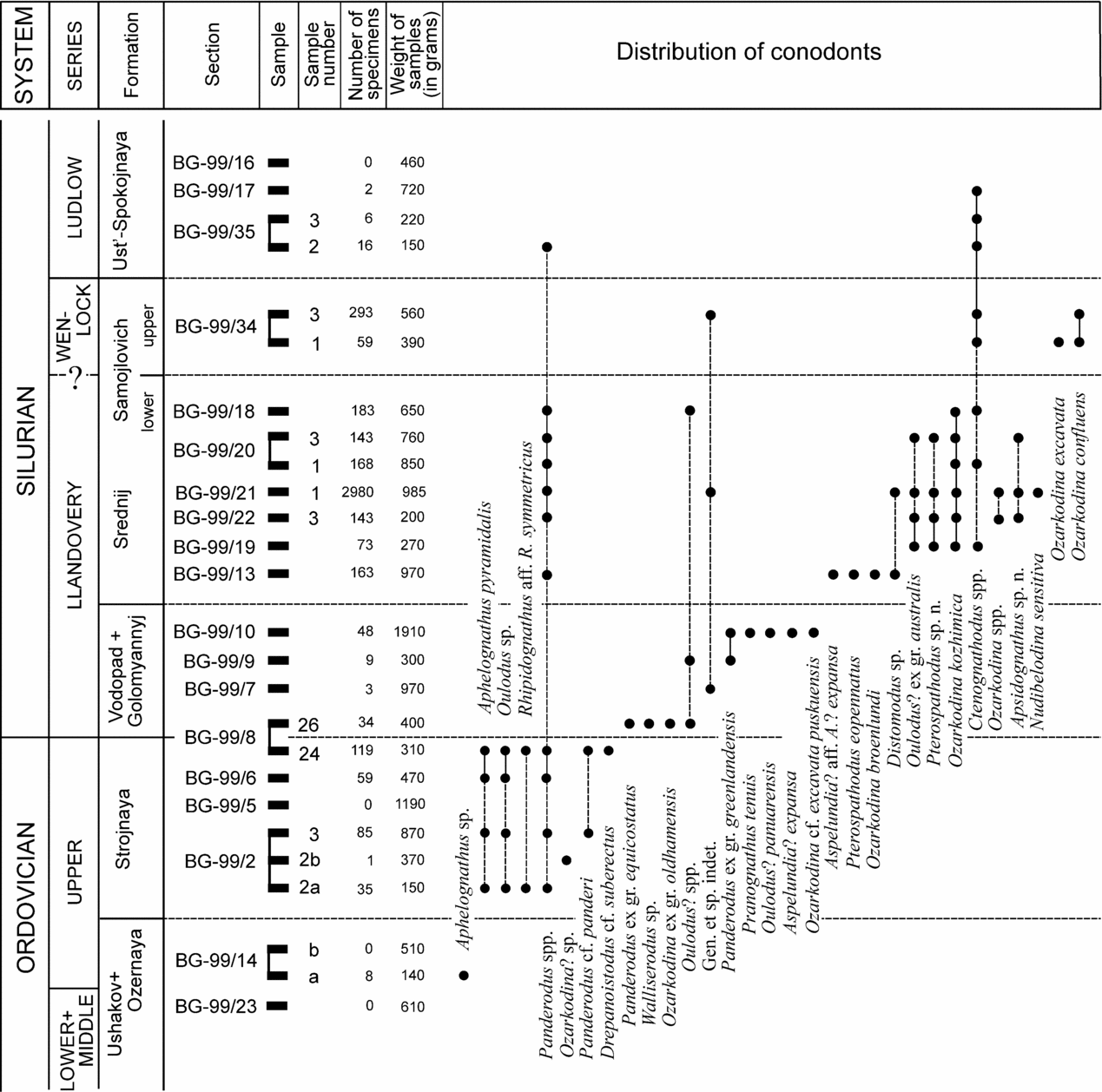
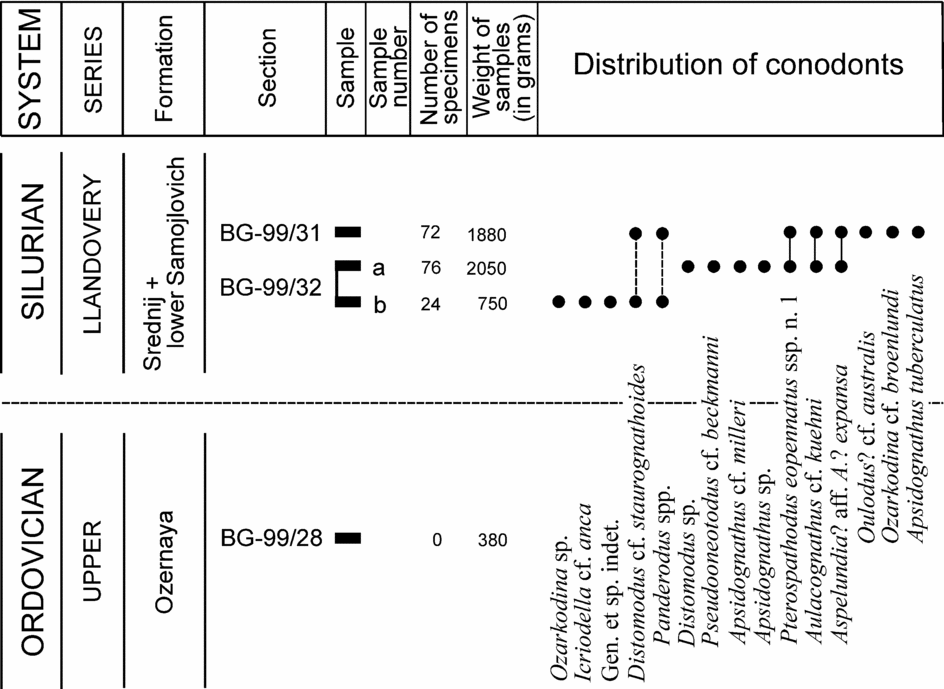
In total, 30 samples collected from 22 sections (above) were processed in the Institute of Geology at Tallinn University of Technology (Estonia) to extract conodonts. Sample BG-99/2-2 contained two pieces of rock of clearly different lithologies (limestone and sandstone; Appendix 2, available as supplementary material online at http://multimediafluids.uam.elogim.com/journals/geo), which were dealt with as different samples because they evidently come from different beds. In Figure 3 these samples are indicated separately and labelled accordingly as BG-99/2-2a and BG-99/2-2b. Samples BG-99/14 and BG-99/32 were also represented by two lithologically different pieces of rock (Appendix 2). All these pieces were processed individually and they appeared to yield distinct conodont faunas (Figs 3, 4; the samples are labelled as BG-99/14-a, BG-99/14-b, BG-99/32-a and BG-99/32-b).
Distribution of conodonts in sections from the Ushakov River region (see Fig. 1). The samples are arranged in their probable stratigraphic order considering the geographical location of sections, characteristic lithologies in the sections, and composition of the conodont faunas. Ranges of taxa: solid line – continuous occurrence of a taxon; dotted line – sporadic occurrence of a taxon. Only those boundaries of stratigraphic units which were possible to locate (based on lithological or faunal succession) are indicated.


All but five samples contained conodonts; in total more than 4600 identifiable specimens were found. In samples from the Ushakov River region, the conodont elements from the Ordovician strata are dark brown in colour and become lighter in the lowermost Silurian. Those from the Srednij Formation, and higher in the sequence, are almost amber in colour. The specimens from the oldest strata studied have a CAI of about 3, reflecting diagenetic temperatures up to 200 °C. Higher in the section CAI decreases gradually and is 1–1.5 in most of the Silurian, indicating diagenetic temperatures less than 90 °C. Samples from the Krasnaya Bay region indicate a different burial history of the strata. Here, conodonts from the Srednij Formation are also dark brown, in sample BG-99/32-b almost black (CAI 3–4), indicating diagenetic temperatures up to 300 °C.
All illustrated specimens are housed in the Institute of Geology at Tallinn University of Technology, Estonia (collection number GIT 551).
4.c. Faunas and stratigraphy
The samples in Figures 3 and 4 are arranged in their probable stratigraphic order, considering the geographical location of sections, characteristic lithologies in the sections and composition of the conodont faunas. In most cases the succession of samples is quite obvious, but sometimes, as for samples from sections BG-99/19, BG-99/20, BG-99/21 and BG-99/22, which come from the same outcrop belt but are located in different parallel valleys, their correlation is not precisely established.
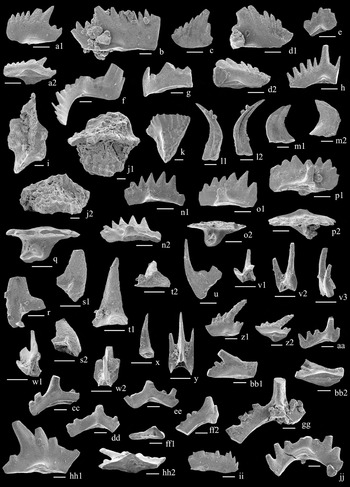
The Ordovician strata are represented by ten samples from seven sections (Figs 3, 4). Four of these samples did not yield conodonts: BG-99/28 from the Ozernaya Formation; BG-99/5 from the Strojnaya Formation; BG-99/14-b and BG-99/23 from the Ushakov Formation (brief lithological characteristics of samples processed are given in Appendix 2, available as supplementary material online at http://multimediafluids.uam.elogim.com/journals/geo). Another sample from the last section, BG-99/14-a, yielded a few poorly preserved specimens of Aphelognathus (Fig. 5f, g, i, j). This is the only taxon in this sample, but poor preservation and the small number of specimens do not allow a firm identification.
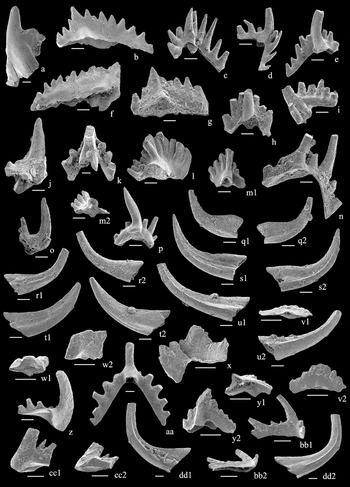
Conodonts from the Ordovician and lowermost Silurian strata. (a–e, h, k) Aphelognathus pyramidalis (Branson, Mehl and Branson); (a) GIT 551-1, outer lateral view of sinistral Pb element, sample BG-99/8-24; (b) GIT 551-2, outer lateral view of dextral Pa element, sample BG-99/8-24; (c) GIT 551-3, posterior view of dextral Sb(b) element, sample BG-99/8-24; (d) GIT 551-4, inner lateral view of sinistral Sc element, sample BG-99/8-24; (e) GIT 551-5, inner lateral view of dextral M(?) element, sample BG-99/8-24; (h) GIT 551-6, posterior view of sinistral Sb(a) element, sample BG-99/6; (k) GIT 551-7, posterior view of Sa element, sample BG-99/8-24. (f, g, i, j) Aphelognathus sp.; (f) GIT 551-8, inner lateral view of dextral Pa element, sample BG-99/14-a; (g) GIT 551-9, outer lateral view of dextral Pa element, sample BG-99/14-a; (i) GIT 551-10, inner lateral view of dextral Sc element, sample BG-99/14-a; (j) GIT 551-11, inner lateral view of sinistral Pb element, sample BG-99/14-a. (l, m) Rhipidognathus aff. R. symmetricus Branson, Mehl and Branson; (l) GIT 551-12, posterior view of sinistral asymmetrical element, sample BG-99/8-24; (m) GIT 551-13, posterior (m1) and lower (m2) views of symmetrical(?) element, sample BG-99/2-2a. (n–p) Oulodus sp.; (n) GIT 551-14, inner lateral view of dextral Pa(?) element, sample BG-99/8-24; (o) GIT 551-15, inner lateral view of sinistral Sc element, sample BG-99/8-24; (p) GIT 551-16, inner lateral view of sinistral Pb(?) element, sample BG-99/8-24. (q–u) Panderodus spp.; (q) GIT 551-17, unfurrowed (q1) and furrowed (q2) faces of dextral falciform element, sample BG-99/8-24; (r) GIT 551-18, furrowed (r1) and unfurrowed (r2) faces of dextral tortiform element, sample BG-99/8-24; (s) GIT 551-19, furrowed (s1) and unfurrowed (s2) faces of sinistral truncatiform(?) element, sample BG-99/8-24; (t) GIT 551-20, furrowed (t1) and unfurrowed (t2) faces of dextral arcuatiform element, sample BG-99/8-24; (u) GIT 551-21, furrowed (u1) and unfurrowed (u2) faces of sinistral high-based symmetrical graciliform element, sample BG-99/8-24. (v–x) Ozarkodina ex gr. oldhamensis (Rexroad); (v) GIT 551-22, lower (v1) and outer lateral (v2) views of sinistral Pb element, sample BG-99/8-26; (w) GIT 551-23, lower (w1) and outer lateral (w2) views of sinistral Pa element, sample BG-99/8-26; (x) GIT 551-24, inner lateral view of dextral Sc element, sample BG-99/8-26. (y) Pranognathus tenuis (Aldridge); GIT 551-25, lower (y1) and outer lateral (y2) views of sinistral Pb element, sample BG-99/10. (z–aa) Oulodus? panuarensis Bischoff; (z) GIT 551-26, inner lateral view of sinistral M element, sample BG-99/10; (aa) GIT 551-27, posterior view of Sa element, sample BG-99/10. (bb, cc) Aspelundia? expansa Armstrong; (bb) GIT 551-28, inner lateral (bb1) and lower (bb2) views of sinistral Sc element, sample BG-99/10; (cc) GIT 551-29, inner lateral (cc1) and lower (cc2) views of dextral M element, sample BG-99/10. (dd) Panderodus ex gr. greenlandensis Armstrong; GIT 551-30, furrowed (dd1) and unfurrowed (dd2) faces of sinistral low-based asymmetrical graciliform element, sample BG-99/10.

Four of the six samples from the Strojnaya Formation are dominated by A. pyramidalis (Branson, Mehl and Branson) (Figs 3, 5a–e, h, k). In sample BG-99/2-2b, from a sandstone bed (Appendix 2), only a single fragment identified as Ozarkodina? sp. was found (Fig. 3). In the samples from this formation, Panderodus and Oulodus are also quite common. In two samples (BG-99/2-2a and BG-99/8-24), Rhipidognathus aff. R. symmetricus Branson, Mehl & Branson has been identified (Figs 3, 5l, m). Similar faunas, dominated by Aphelognathus but without Rhipidognathus, have been reported earlier from several sections from October Revolution Island (Männik, Reference Männik, Matukhin and Menner1999). The uppermost sample with Ordovician conodonts, BG-99/8-24, yielded the richest fauna, dominated by A. pyramidalis and Panderodus. In this sample, probable specimens of P. panderi (Stauffer) and Drepanoistodus suberectus (Branson & Mehl) were also identified (Fig. 3).
In North America, A. pyramidalis and R. symmetricus appear in the Trenton Group of middle Caradoc age (= Sandbian to Katian of modern stratigraphy) (Sweet & Bergström, Reference Sweet, Bergström and Bassett1976; Barnes, Telford & Tarrant, Reference Barnes, Telford and Tarrant1978). On the Siberian Platform, A. pyramidalis has been reported from the Burian Stage and, based on the distribution of this taxon, an A. pyramidalis Assemblage Zone has been defined in the region (Moskalenko, Reference Moskalenko1983). The Burian Stage is considered to correspond to the Ashgill (Tesakov et al. Reference Tesakov, Kanygin, Yadrenkina, Simonov, Sychev, Abaimova, Divina and Moskalenko2003). In the Kozhym River sequence (Subpolar Urals), the oldest specimens of Aphelognathus have been reported from the Middle Caradoc Ust'-Zyb Stage (Mel'nikov, Reference Mel'nikov1999).
The data above indicate that the Ordovician strata studied in 1999 on Severnaya Zemlya are of Late Ordovician age. Previously, the strata of the Ushakov Formation were considered to correspond to the upper Lower Ordovician, based on the occurrence of Angarella, Ophileta and Moyeronia in some sections in southern October Revolution Island (Markovskij & Makar'ev, Reference Markovskij, Makar'ev, Kaban'kov and Lazarenko1982). However, Aphelognathus sp. in sample BG-99/14-a from the upper Ushakov Formation indicates that at least in the lower reaches of the Ushakov River, the top of this formation is considerably younger than considered earlier: the sampled strata are Late, not Early, Ordovician in age.
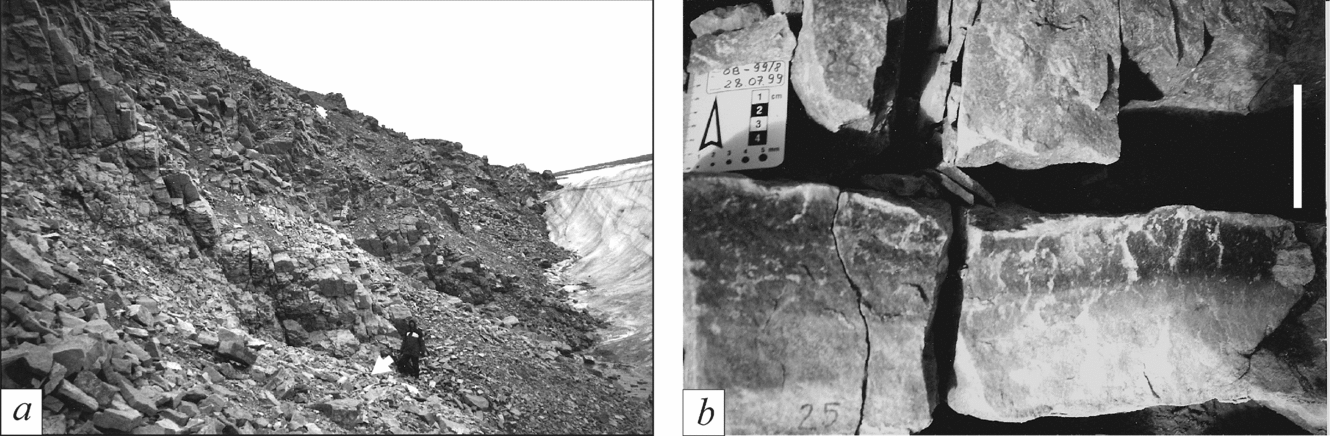
A continuous succession across the Ordovician–Silurian boundary was studied in section BG-99/8 (Fig. 6). Lithologically, the boundary corresponds to the contact between sandstones of the Strojnaya Formation and limestones of the Vodopad Formation, but can also be recognized by changes in the conodont fauna (Fig. 3). The typical Upper Ordovician Aphelognathus-fauna in sample BG-99/8-24 is replaced in the next sample (BG-99/8-26) from the same section by an association of conodonts comprising Panderodus ex gr. equicostatus (Rhodes), rare specimens of Ozarkodina ex gr. oldhamensis (Rexroad) (Fig. 5v–x), and a probable specimen each of Oulodus? sp. and Walliserodus sp., characteristic of the Silurian.
The Ordovician–Silurian boundary in section BG-99/8. For geographical location of the section refer to Figure 1. (a) general view of the section, the position of the boundary is indicated by white arrow; (b) a close-up view of the boundary which lies between beds 25 and 26 (white vertical line is 10 cm long).

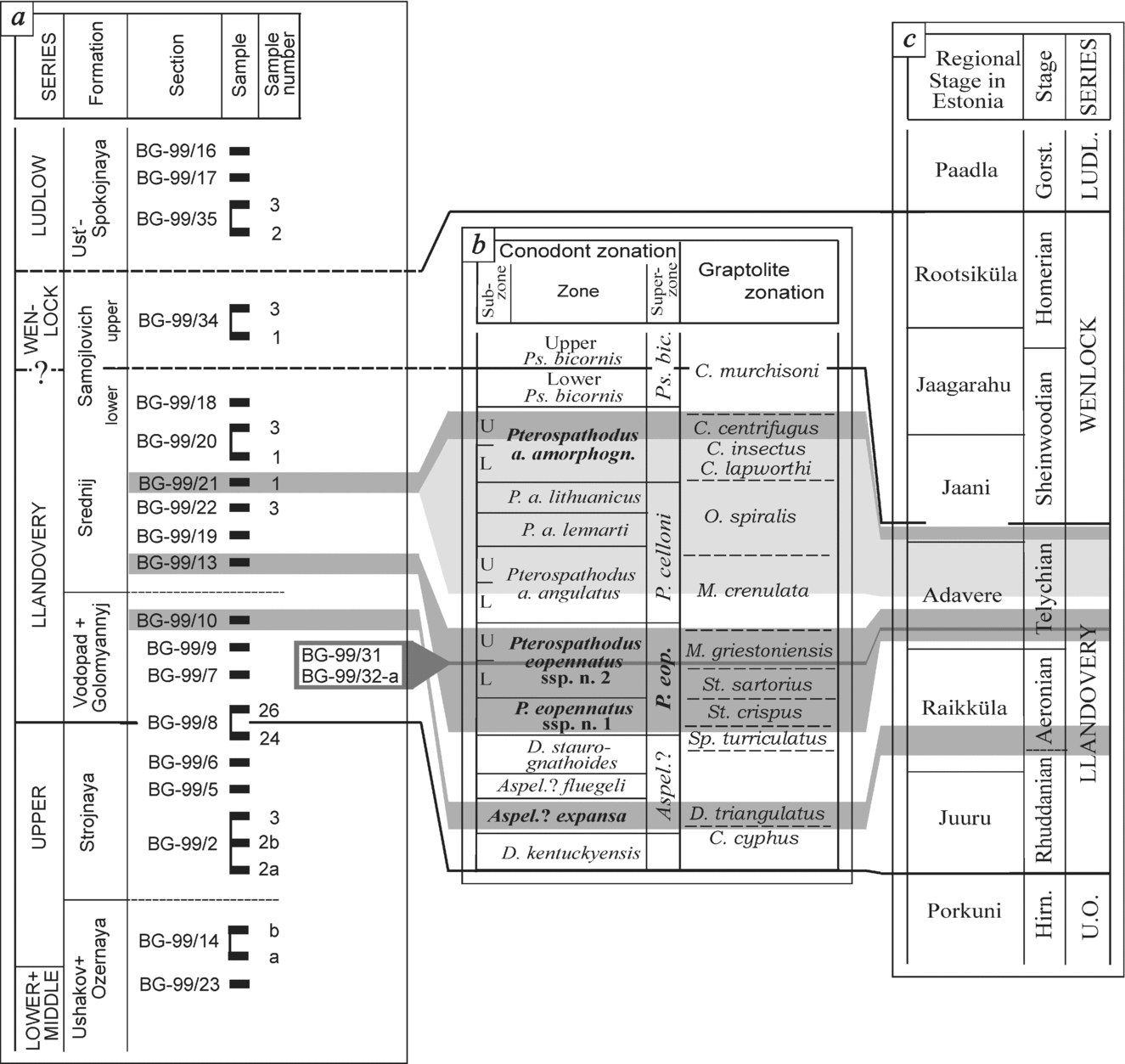
Pranognathus tenuis (Aldridge) (Fig. 5y), Oulodus? panuarensis Bischoff (Fig. 5z, aa) and Aspelundia? expansa Armstrong (Fig. 5bb, cc) occur together with Panderodus ex gr. greenlandensis Armstrong (Fig. 5dd) in sample BG-99/10 (Fig. 3), indicating an Aeronian age for this level. The sample evidently comes from the upper Vodopad Formation. A similar fauna has been identified from the upper Vodopad Formation in section 159, located about 20 km NW from BG-99/10 (Männik, Reference Männik, Matukhin and Menner1999). The fauna in BG-99/10 allows correlation of this level with the Asp.? expansa Zone sensu Männik (Reference Männik2007a) and with the lower Raikküla Stage in Estonia (Fig. 7). Asp.? expansa is also abundant in the Northern Urals, in section 125V (‘Tatarskaya Vichka’) on the right bank of the Ilych River (P. Männik, pers. obs. in the collection of A. Antoshkina).
Correlation of some sections studied on Severnaya Zemlya (a) with conodont and graptolite zonations (b), and with the stratigraphical sequence in Estonia (c). Conodont zonation modified from Männik (Reference Männik2007a, Reference Männikb). Correlation between conodont and graptolite zonations in part (b) of the figure is based on data by Loydell, Kaljo & Männik (Reference Loydell, Kaljo and Männik1998) and Loydell, Männik & Nestor (Reference Loydell, Männik and Nestor2003). Abbreviations: U – Upper, L – Lower, U.O. – Upper Ordovician; Hirn. – Hirnantian; Ludl. – Ludlow; Gorst. – Gorstian.

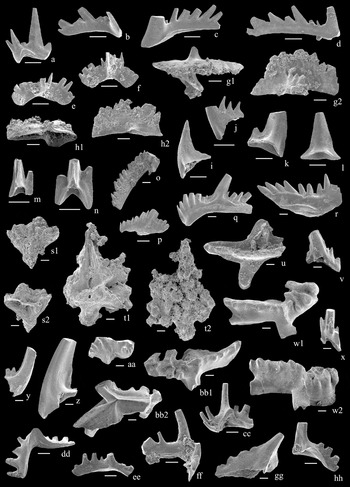
Faunas from section BG-99/13 have been discussed in several previous papers (Bogolepova, Gubanov & Loydell, Reference Bogolepova, Gubanov and Loydell2000; Högström, Bogolepova & Gubanov, Reference Högström, Bogolepova and Gubanov2002; Bogolepova, Gubanov & Pease, Reference Bogolepova, Gubanov and Pease2005; Siveter & Bogolepova, Reference Siveter and Bogolepova2006). This is the only section known so far from Severnaya Zemlya where graptolites have been found. Nodules of dark finely crystalline limestone (Appendix 2) from the graptolite-bearing black mudstones contain rich and variable conodont faunas (Fig. 3). The association of conodonts is dominated by Asp.? aff. expansa (Fig. 8a–f). The next commonest conodont, not previously identified on Severnaya Zemlya, is Pterospathodus eopennatus Männik. Two subspecies were described in the evolutionary lineage of Pt. eopennatus (Männik, Reference Männik1998). Unfortunately, the preservation of Pt. eopennatus elements in sample BG-99/13 is not good enough to allow identification of its subspecies here.
Conodonts from the Silurian strata. (a–f) Aspelundia? aff. A.? expansa Armstrong; (a) GIT 551-31, inner lateral view of sinistral Pa element, sample BG-99/13; (b) GIT 551-32, inner lateral view of sinistral Pb(?) element, sample BG-99/13; (c) GIT 551-33, inner lateral view of dextral M element, sample BG-99/13; (d) GIT 551-34, inner lateral view of sinistral Sc element, sample BG-99/13; (e) GIT 551-35, posterior view of sinistral Sb element, sample BG-99/13; (f) GIT 551-36, posterior view of Sa element, sample BG-99/13. (g–h) Pterospathodus eopennatus ssp. n. 1 Männik; (g) GIT 551-37, upper (g1) and inner lateral (g2) views of sinistral Pa element, sample BG-99/32-a; (h) GIT 551-38, lower (h1) and outer lateral (h2) views of sinistral Pa element, sample BG-99/31. (i–n) Pterospathodus eopennatus Männik; (i) GIT 551-39, outer lateral view of sinistral Pc element, sample BG-99/13; (j) GIT 551-40, outer lateral view of sinistral Sc2 element, sample BG-99/13; (k) GIT 551-41, inner lateral view of sinistral M element, sample BG-99/13; (l) GIT 551-42, inner lateral view of sinistral carniciform element, sample BG-99/13; (m) GIT 551-43, posterior view of dextral Sb1 element, sample BG-99/13; (n) GIT 551-44, posterior view of Sa element, sample BG-99/13. (o–r) Ozarkodina broenlundi Aldridge; (o) GIT 551-45, inner lateral view of sinistral M element, sample BG-99/31; (p) GIT 551-46, inner lateral view of dextral Pb element, sample BG-99/13; (q) GIT 551-47, inner lateral view of dextral Sc element, sample BG-99/13; (r) GIT 551-48, inner lateral view of sinistral Pa element, sample BG-99/13. (s, t) Apsidognathus cf. milleri (Over and Chatterton); (s) GIT 551-49, upper (s1) and lower (s2) views of sinistral Pa2(?) element, sample BG-99/32-a; (t) GIT 551-50, lower (t1) and upper (t2) views of sinistral Pa1 element, sample BG-99/32-a. (u) Aulacognathus cf. kuehni Mostler; GIT 551-51, upper view of sinistral Pb element, sample BG-99/31. (v–x, bb, gg) Icriodella cf. anca Mel'nikov; (v) GIT 551-52, outer lateral view of dextral Pb element, sample BG-99/32-b; (w) GIT 551-53, upper (w1) and oblique outer lateral (w2) view of dextral Pa element, sample BG-99/32-b; (x) GIT 551-54, posterior view of dextral Sb element, sample BG-99/32-b; (bb) GIT 551-55, upper (bb1) and lower (bb2) views of sinistral Pa element, sample BG-99/32-b; (gg) GIT 551-56, outer lateral view of sinistral Pb element, sample BG-99/32-b. (y–z, aa) Distomodus cf. staurognathoides (Walliser); (y) GIT 551-57, inner lateral view of sinistral Sc element, sample BG-99/31; (z) GIT 551-58, inner lateral view of dextral M element, sample BG-99/13; (aa) GIT 551-59, upper view of a fragment of Pa element, sample BG-99/13. (cc–ff, hh) Oluodus? ex gr. australis Bischoff; (cc) GIT 551-60, posterior view of sinistral Sb element, sample BG-99/19; (dd) GIT 551-61, inner lateral view of sinistral Pa element, sample BG-99/19; (ee) GIT 551-62, outer lateral view of dextral Pb(?) element, sample BG-99/19; (ff) GIT 551-63, inner lateral view of sinistral Sc element, sample BG-99/20-3; (hh) GIT 551-64, inner lateral view of dextral M element, sample BG-99/19.

Similar faunas resulted from processing of analogous nodules from sections BG-99/31 and BG-99/32 (sample BG-99/32-a), located just south from Krasnaya Bay (about 10 km to the NE from section BG-99/13; Figs 1, 4). In these samples, typical Pa elements of Pt. eopennatus ssp. n. 1 (Fig. 8g, h) have been found. Moreover, morphotype 5 of the Pa element (Fig. 8g; Männik, Reference Männik1998) occurring here indicates that these samples, most probably, come from an interval corresponding to the upper part of the Pt. eopennatus ssp. n. 1 range. In both regions, Oz. broenlundi Aldridge (Fig. 8o–r) is also common. The occurrence of Pt. eopennatus ssp. n. 1 and Oz. broenlundi together with Aulacognathus cf. kuehni Mostler (Fig. 8u) and Apsidognathus cf. milleri (Over and Chatterton) (Fig. 8s, t) in samples BG-99/31 and BG-99/32-a indicates that both of them come from the uppermost Pt. eopennatus ssp. n. 1 Zone sensu Männik (Reference Männik2007b). These datings fit well with those based on graptolites. Graptolites from section BG-99/13 indicate a mid-Telychian (late crispus to griestoniensis Zone) age for the strata with nodules (Bogolepova, Gubanov & Loydell, Reference Bogolepova, Gubanov and Loydell2000). Based on data from the Baltic region, the Pt. eopennatus ssp. n. 1 Zone corresponds to the crispus and the Pt. eopennatus ssp. n. 2 Zone the sartorius to lower crenulata graptolite zones (Loydell, Männik & Nestor, Reference Loydell, Männik and Nestor2003; Männik, Reference Männik2007b; Fig. 7).
Another sample, sample ‘b’ from section BG-99/32, yielded an almost completely different conodont fauna (Fig. 4) dominated by Icriodella, morphologically quite similar to I. anca Mel'nikov and identified in this paper, due to the mainly broken specimens of the taxon, as I. cf. anca (Fig. 8v–x, bb, gg). Originally, I. anca was described from sections on the Kanin Peninsula, Russia (Mel'nikov, Reference Mel'nikov1999). The type material of I. anca comes from strata of problematic age that correspond to an interval between beds containing unequivocal Aeronian faunas (including Pr. tenuis) below and with Telychian faunas (with Apsidognathus) above (Mel'nikov, Reference Mel'nikov1999, fig. 6). Together with I. cf. anca in sample BG-99/32-b, unidentified fragments of Ozarkodina have been found; probable elements of Distomodus staurognathoides Walliser and some elements of Panderodus sp. are also present, but these do not allow precise dating of the level.
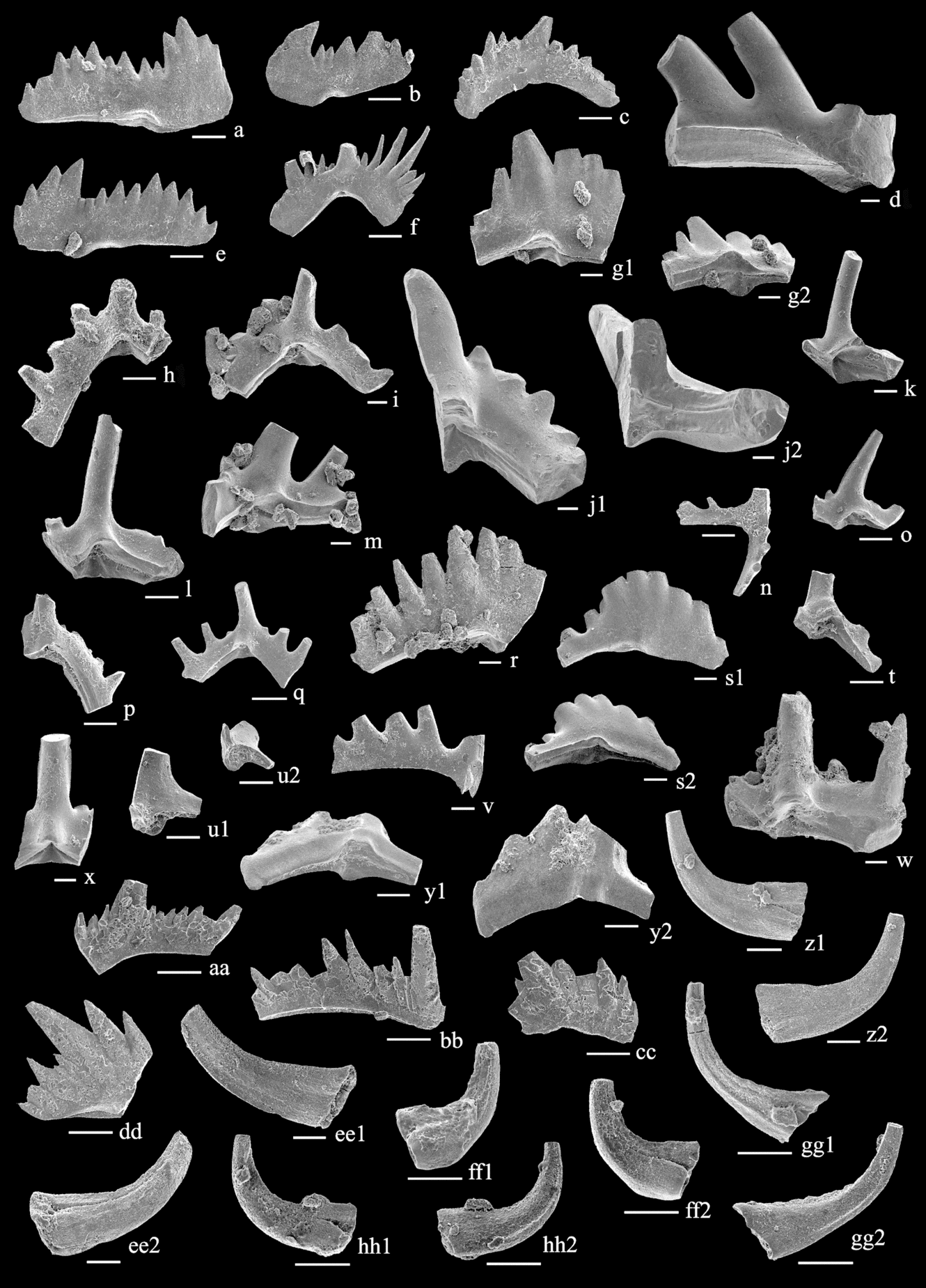
Sections BG-99/19, BG-99/20, BG-99/21 and BG-99/22 all expose strata transitional between the Srednij and Samojlovich formations (Fig. 2). The samples from these sections yield almost identical conodont faunas (Fig. 3). Common in all samples studied from these sections (excluding sample BG-99/20-1) is Oulodus? ex gr. australis Bischoff (Fig. 8cc–ff, hh), originally described from Telychian strata in New South Wales, Australia (Bischoff, Reference Bischoff1986). Also characteristic is Ozarkodina ex gr. kozhimica Mel'nikov (Fig. 9a–h). In the Subpolar Urals, Oz. kozhimica occurs together with Oul.? ex gr. australis (identified in that region as Oulodus? sp. 1 by Mel'nikov) in the Ust'-Durnayu Formation, which is transitional from Llandovery to Wenlock in age (Mel'nikov, Reference Mel'nikov1999; Männik, pers. obs.). However, the occurrence of Apsidognathus sp. n. (Figs 3, 9j, k) indicates that all these samples from Severnaya Zemlya come from strata of Llandovery age. Pterospathodus sp. n. (Fig. 9n–y), which is quite common on Severnaya Zemlya, was previously identified as Pt. cf. pennatus (Männik, Reference Männik1983, fig. 4W) or referred to as Coryssognathus? sp. n. P (Männik, Reference Männik, Matukhin and Menner1999). This taxon is also known from eastern Canada (Gaspé Peninsula), where its possible Pa elements are represented by three different morphologies identified as Pt. pennatus (Pa element with simple lateral process), Pterospathodus n. sp. A (Pa element with bifurcated lateral process) and Pterospathodus n. sp. B (lateral process on Pa element has three branches) by Nowlan (Reference Nowlan1983). Two morphologies (Pt. pennatus and Pterospathodus n. sp. A sensu Nowlan, Reference Nowlan1983; Fig. 9n–q) were also found in our samples, where they occur together. Elements of the third type, Pterospathodus n. sp. B, have not been recorded from Severnaya Zemlya. Pterospathodus sp. n. is the only known species of Pterospathodus in the Kozhym River region of the Subpolar Urals (Männik, pers. obs.). In the Subpolar Urals it occurs in the Marshrut Formation and in the lower part of the Ust'-Durnayu Formation, lithologically identical to the Srednij Formation and to the lower part of the Samojlovich Formation on Severnaya Zemlya. In both regions this interval was once considered to correspond to the Wenlock (e.g. Antsygin, Popov & Chuvasov, Reference Antsygin, Popov and Chuvashov1993) but appears to be of Telychian in age based on conodonts (e.g. Männik, Antoshkina & Beznosova, Reference Männik, Antoshkina and Beznosova2000; Beznosova & Männik, Reference Beznosova and Männik2005).
Conodonts from the Silurian strata. (a–h) Ozarkodina kozhimica Mel'nikov; (a) GIT 551-65, outer lateral (a1) and lower (a2) views of sinistral Pa element, sample BG-99/18; (b) GIT 551-66, outer lateral view of dextral Pa element, sample BG-99/18; (c) GIT 551-67, inner lateral view of dextral Pb element, sample BG-99/18; (d) GIT 551-68, outer lateral (d1) and lower (d2) views of dextral Pb element, sample BG-99/18; (e) GIT 551-69, inner lateral view of sinistral M element, sample BG-99/18; (f) GIT 551-70, posterior view of sinistral Sb element, sample BG-99/18; (g) GIT 551-71, inner lateral view of dextral Sc element, sample BG-99/18; (h) GIT 551-72, posterior view of Sa element, sample BG-99/18. (i) Apsidognathus tuberculatus Walliser; GIT 551-73, upper view of dextral Pa1 element, sample BG-99/31. (j, k) Apsidognathus sp. n.; (j) GIT 551-74, upper (j1) and inner lateral (j2) views of dextral Pa1 element, sample BG-99/22-3; (k) GIT 551-75, upper view of dextral Pa2(?) element, sample BG-99/21-1. (l, m) Nudibelodina sensitiva Jeppsson; (l) GIT 551-76, furrowed (l1) and unfurrowed (l2) faces of dextral long smoothly curved element, sample BG-99/21-1; (m) GIT 551-77, furrowed (m1) and unfurrowed (m2) faces of sinistral strongly compressed element, sample BG-99/21-1. (n–y) Pterospathodus sp. n.; (n) GIT 551-78, inner lateral (n1) and lower (n2) views of dextral Pa element, sample BG-99/19; (o) GIT 551-79, inner lateral (o1) and upper (o2) views of dextral Pa element, sample BG-99/19; (p) GIT 551-80, inner lateral (p1) and upper (p2) views of sinistral Pa element, sample BG-99/19; (q) GIT 551-81, upper view of dextral Pa element, sample BG-99/19; (r) GIT 551-82, outer lateral view of sinistral Pc element, sample BG-99/21-1; (s) GIT 551-83, outer lateral (s1) and lower (s2) views of dextral Pc element, sample BG-99/22-3; (t) GIT 551-84, inner lateral (t1) and lower (t2) views of dextral M element, sample BG-99/21-1; (u) GIT 551-85, inner lateral view of dextral Sc2 element, sample BG-99/21-1; (v) GIT 551-86, lower (v1), posterior (v2) and outer lateral (v3) views of sinistral Sb1 element, sample BG-99/20-3; (w) GIT 551-87, lower (w1) and posterior (w2) views of sinistral Sb2 element, sample BG-99/20-3; (x) GIT 551- 88, inner lateral view of sinistral carniciform(?) element, sample BG-99/20-3; (y) GIT 551-89, posterior view of Sa element, sample BG-99/20-3. (z–hh, jj) Ctenognathodus spp.; (z) GIT 551-90, inner lateral (z1) and lower (z2) views of dextral Pb element, sample BG-99/20-1; (aa) GIT 551-91, inner lateral view of sinistral M element, sample BG-99/20-1; (bb) GIT 551-92, inner lateral (bb1) and lower (bb2) views of sinistral Pb(?) element, sample BG-99/20-1; (cc) GIT 551-93, inner lateral view of dextral Sc element, sample BG-99/20-1; (dd) GIT 551-94, posterior view of Sa element, sample BG-99/20-1; (ee) GIT 551-95, posterior view of dextral Sb element, sample BG-99/20-1; (ff) GIT 551-96, lower (ff1) and inner lateral (ff2) views of sinistral M element, sample BG-99/18; (gg) GIT 551-97, posterior view of Sa element, sample BG-99/20-1; (hh) GIT 551-98, inner lateral (hh1) and lower (hh2) views of sinistral Pb? element, sample BG-99/18; (jj) GIT 551-99, posterior view of sinistral Sb element, sample BG-99/18. (ii) Ozarkodina excavata (Branson and Mehl); GIT 551-100, inner lateral view of sinistral Pa element, sample BG-99/34-1.

Sample BG-99/21-1 yielded Nudibelodina sensitiva Jeppsson (Fig. 9l, m). These are the first specimens of this taxon found outside the Baltic region, where N. sensitiva occurs in the interval from the Pt. amorphognathoides angulatus Zone below up to the Pt. a. amorphognathoides Zone above but is continuously present only in the uppermost part (in the Upper Pt. a. amorphognathoides Subzone) of its range (Männik, Reference Männik2007b). Below this level the taxon is very rare and only occurs sporadically. It is possible that the level with N. sensitiva on Severnaya Zemlya correlates with the Upper Pt. a. amorphognathoides Subzone of the Baltic. N. sensitiva became extinct at Datum 1 of the Ireviken Event (Jeppsson, Reference Jeppsson, Landing and Johnson1998).
Sample 1 from section BG-99/20 and that from section BG-99/18 are strongly dominated by Oz. ex gr. kozhimica. In both samples elements of Ctenognathodus (Fig. 9z–hh, jj) and Panderodus occur (Fig. 3). As noted above, in the Subpolar Urals Oz. kozhimica is known from the strata below and above(?) the Llandovery–Wenlock boundary, which in that region, as on Sevrenaya Zemlya, is drawn just above the level of the last occurrence of Apsidognathus in the sequence (Männik et al. Reference Männik, Antoshkina and Beznosova2000). In sample 3 from section BG-99/20, from a bed higher than sample 1, a typical Telychian conodont fauna occurs (including Apsidognathus sp. n.; Fig. 3), so it is evident that both samples in this section come from strata of Telychian age. However, the age of sample BG-99/18 is problematic. As it is the only sample from this section, which is considered to expose almost the same interval as section BG-99/20 (Fig. 2), and as the fauna in it is very similar to that from sample BG-99/20-1 (Fig. 3), it cannot be excluded that sample BG-99/18 also comes from strata of Telychian age (in Figs 3 and 7 the series boundary is tentatively drawn above this sample). The similarity of the faunas in these samples may be a result of ecology. The strong dominance of one taxon, considerable decrease in number of taxa and appearance of Ctenognathodus in both samples, BG-99/18 and BG-99/20-1, probably relate to specific environmental conditions. Both samples come from quite similar lithologies (Appendix 2, available as supplementary material online at http://multimediafluids.uam.elogim.com/journals/geo). Sample BG-99/20-3 is bioclastic limestone yielding abundant fragments of various fossils.
Both samples, 1 and 3, from section BG-99/34 (Fig. 3), come from the uppermost part of the Samojlovich Formation and are dominated by Oz. confluens (Branson and Mehl) (Fig. 10a–c, e, f), and Ctenognathodus spp. (Fig. 10d, g–s, v–x) is common. From sample BG-99/34-1, a few small specimens of Oz. excavata (Fig. 9ii), the first specimens of this taxon ever found on Severnaya Zemlya, have been identified. The age of these faunas, based on comparison with data from other sections on Severnaya Zemlya (e.g. Männik, Reference Männik, Matukhin and Menner1999, Reference Männik2002; Männik et al. Reference Männik, Menner, Matukhin and Kuršs2002), is most probably Homerian (Fig. 7).
Conodonts from the Silurian strata. (a–c, e, f) Ozarkodina confluens (Branson and Mehl); (a) GIT 551-101, outer lateral view of dextral Pa element, sample BG-99/34-1; (b) GIT 551-102, inner lateral view of dextral bucerus-type Pa element, sample BG-99/34-3; (c) GIT 551-103, inner lateral view of dextral Pb element, sample BG-99/34-3; (e) GIT 551-104, inner lateral view of dextral Pa element, sample BG-99/34-3; (f) GIT 551-105, posterior view of sinistral Sb element, sample BG-99/34-3. (d, g–y) Ctenognathodus spp. (d) GIT 551-106, outer lateral view of dextral Sc? element, sample BG-99/34-1; (g) GIT 551-107, outer lateral (g1) and lower (g2) views of dextral Pa element, sample BG-99/34-1; (h) GIT 551-108, posterior view of Sa element, sample BG-99/34-1; (i) GIT 551-109, inner lateral view of dextral Pb(?) element, sample BG-99/34-1; (j) GIT 551-110, inner lateral (j1) and lower (j2) views of Pb element, sample BG-99/34-3; (k) GIT 551-111, posterior view of dextral Sb(?) element, sample BG-99/34-3; (l) GIT 551-112, inner lateral view of dextral Pb element, sample BG-99/34-1; (m) GIT 551-113, inner lateral view of dextral Sc(?) element, sample BG-99/34-1; (n) GIT 551-114, inner lateral view of sinistral Sc element, sample BG-99/34-3; (o) GIT 551-115, inner lateral view of dextral Pb element, sample BG-99/34-3; (p) GIT 551-116, inner lateral view of dextral M element, sample BG-99/34-3; (q) GIT 551-117, posterior view of sinistral Sb element, sample BG-99/34-3; (r) GIT 551-118, inner lateral view of sinistral Pa element, sample BG-99/34-3; (s) GIT 551-119, outer lateral (s1) and lower (s2) views of dextral Pa element, sample BG-99/34-3; (t) GIT 551-120, inner lateral view of dextral M element, sample BG-99/35-2; (u) GIT 551-121, inner lateral (u1) and lower (u2) views of dextral Sc element, sample BG-99/35-2; (v) GIT 551-122, inner lateral view of sinistral Sc element, sample BG-99/34-3; (w) GIT 551-123, posterior view of Sa element, sample BG-99/34-3; (x) GIT 551-124, posterior view of Sa element, sample BG-99/34-3; (y) GIT 551-125, lower (y1) and outer lateral (y2) views of dextral P element, sample BG-99/35-2. (z, ee–hh) Panderodus spp.; (z) GIT 551-126, furrowed (z1) and unfurrowed (z2) faces of sinistral falciform element, sample BG-99/22-3; (ee) GIT 551-127, unfurrowed (ee1) and furrowed (ee2) faces of dextral tortiform element, sample BG-99/22-3; (ff) GIT 551-128, lateral faces of the aequaliform (symmetrical, bifurrowed) element, sample BG-99/22-3; (gg) GIT 551-129, furrowed (gg1) and unfurrowed (gg2) faces of sinistral low-based asymmetrical graciliform element, sample BG-99/22-3; (hh) GIT 551-130, furrowed (hh1) and unfurrowed (hh2) faces of sinistral truncatiform element, sample GB-99/22-3. (aa–dd) Ozarkodina cf. excavata puskuensis Männik; (aa) GIT 551-131, inner lateral view of dextral Sc element, sample BG-99/10; (bb) GIT 551-132, inner lateral view of sinistral M element, sample BG-99/10; (cc) GIT 551-133, lateral view of P element, sample BG-99/10; (dd) GIT 551-134, inner lateral view of sinistral Pa element, sample BG-99/10.

The stratigraphically youngest samples studied (BG-99/16, BG-99/17, BG-99/35-2 and BG-99/35-3) come from the Ust'-Spokojnaya Formation (Fig. 3). All these samples (excluding BG-99/35-3) are lithologically similar (Appendix 2, available as supplementary material online at http://multimediafluids.uam.elogim.com/journals/geo). Conodonts are most common in the lowermost of these samples, BG-99/35-2, although represented here mainly by Ctenognathodus sp. (Fig. 10t, u, y). Otherwise, only one fragment of Panderodus has been found in this sample. Higher in the section, in BG-99/35-3 and BG-99/17, only a few specimens of Ctenognathodus have been found. Sample BG-99/16 was barren. Conodonts in these three samples do not allow dating of the strata, but based on earlier datings (e.g. Matukhin & Menner, Reference Matukhin and Menner1999) the Ust'-Spokojnaya Formation, most probably, corresponds to the Ludlow (Figs 3, 7).
5. Discussion
New data support earlier conclusions (Männik, Reference Männik, Matukhin and Menner1999; Bogolepova, Gubanov & Pease, Reference Bogolepova, Gubanov and Pease2006) that the Upper Ordovician conodont fauna from Severnaya Zemlya is closest to that characteristic of the Midcontinent Province sensu Barnes, Rexroad & Miller (Reference Barnes, Rexroad and Miller1973). Domination of faunas in this interval by Aphelognathus, and also the occurrence of Oulodus, indicates that the strata of the Ozernaya and Strojnaya formations formed in shallow-water environments. This agrees with the lithological data. Further, the occurrence of Rhipidognathus aff. R. symmetricus (found at two levels; Fig. 3) suggests extreme shallowing episodes and indicates that sub-aerial exposure in some intervals of the Strojnaya Formation cannot be excluded.
Almost identical latest Ordovician faunas (dominated by Aphelognathus and including Oulodus) have been described from several sections in the Timan–northern Ural region, Russia (Mel'nikov, Reference Mel'nikov1999). In that region, the Upper Ordovician sequence is mainly dominated by various calcareous sediments of shallow-water origin deposited, in general, in a ramp environment (up to early Ashgill) or on a wide, in some time-intervals semi-restricted, carbonate platform (starting from middle Ashgill; M. A. Shishkin, unpub. Ph.D. thesis, Institute of Geology, Syktyvkar, 2003). Terrigenous sediments are not recorded, but evaporitic strata of middle to late Ashgill age are known from the western part of the Timan–northern Ural region. The Aphelognathus-dominated conodont fauna comes from the strata formed in the semi-restricted shallow-water environments on the carbonate platform, such as in the modern Subpolar Urals. In the easternmost sections studied in the Timan–northern Ural region, in strata formed in the peripheral part of the platform (in the environments transitional from restricted-shelf to open-shelf or basinal), several taxa (e.g. Amorphognathus, Protopanderodus, Periodon, etc.) known also from the Baltic region, and considered to be characteristic of the North-Atlantic Province faunas, appear (Mel'nikov, Reference Mel'nikov1999).
Based on the similarities in faunas from the Subpolar Urals and Severnaya Zemlya, it seems possible that analogous semi-restricted environments dominated in the late Ordovician in the region of modern Severnaya Zemlya. In contrast to the eastern part of the Timan–northern Ural region (modern Subpolar Urals), where the Upper Ordovician strata are mainly represented by pure limestones or dolostones, in the Severnaya Zemlya basin the Ordovician was characterized by considerable input of terrigenous material (Markovskij & Makar'ev, Reference Markovskij, Makar'ev, Kaban'kov and Lazarenko1982).
Similarities in the evolution of parts of the Timan–northern Ural and Severnaya Zemlya sedimentary basins became particularly evident in the early Silurian. Lithological successions described from the Subpolar Urals and Severnaya Zemlya from the Llandovery–Wenlock interval are easy to correlate (Männik, Antoshkina & Beznosova, Reference Männik, Antoshkina and Beznosova2000, and references therein). In both regions, shallow-water, often semi-restricted, environmental conditions dominated. The associations of early Silurian, particularly Telychian, conodonts from Severnaya Zemlya also have their closest analogues in the Timan–northern Ural region. In both regions, the Silurian conodont faunas include a number of evidently endemic taxa. Typically, the faunas from the Timan–northern Ural region and Severnaya Zemlya lack taxa of the Pterospathodus eopennatus–Pt. amorphognathoides lineage, which characterizes Telychian associations of conodonts in the Baltic as well as in many other regions in the world. Instead, they contain several poorly studied representatives of Ozarkodina, Ctenognathodus, etc. (e.g. Männik, Reference Männik2002). However, several taxa characteristic of these regions can be found in the collections described from South China (Zhou, Zhai & Xian, Reference Zhou, Zhai and Xian1981; Wang & Aldridge, Reference Wang, Aldridge, Xu and Jia-Yu1996) and New South Wales, Australia (Bischoff, Reference Bischoff1986). In the Telychian conodont faunas from New South Wales, several taxa (e.g. Gamachignathus? macroexcavatus (Zhou, Zhai and Xian), Ozarkodina waugoolaensis Bischoff, Oulodus? australis Bischoff) recognized in Severnaya Zemlya and the Timan–northern Ural region occur together with those common in the Baltic region, allowing correlation between the regions.
Several taxa (Pterospathodus eopennatus, Distomodus cf. staurognathoides, Aulacognathus cf. kuehni and Apsidognathus cf. milleri) that enhance precise correlation with the conodont successions in other regions, such as Estonia, are reported from Severnaya Zemlya for the first time. In section BG-99/13, Pt. eopennatus occurs together with graptolites (Bogolepova, Gubanov & Loydell, Reference Bogolepova, Gubanov and Loydell2000). Dates for these strata based on graptolites and conodonts match very well (see Section 4.c). In two sections (BG-99/13 and BG-99/31; Figs 3, 4) Ozarkodina broenlundi Aldridge (Fig. 8o–r), originally described from Peary Land (eastern North Greenland) (Aldridge, Reference Aldridge1979), occurs with Pt. eopennatus. Oz. broenlundi also occurs with Pt. eopennatus in Peary Land. Moreover, in both regions these faunas contain Aspelundia? aff. A.? expansa, a form morphologically transitional between Asp.? expansa and Asp.? fluegeli (Fig. 8a–f; Aldridge, Reference Aldridge1979, pl. 2, figs 6–11). Similarities of the faunas on Severnaya Zemlya and in North Greenland seem to indicate that, at least in the Telychian, basins in these two regions had good connections.
The appearance of these ‘normal-marine’ faunas in the Severnaya Zemlya sequence evidently indicates a transgressive event. A global transgression corresponding to the crispus–griestoniensis interval, and one of the strongest in the Telychian, has been described by Loydell (Reference Loydell1998). As the graptolitic interval containing ‘normal-marine’ conodont faunas has been recognized only in one short interval and only in one section, the easternmost studied on Severnaya Zemlya, it is evident that (1) the open sea was, in general, located to the east (according to modern coordinates) of the studied region and (2) the crispus–griestoniensis transgression sensu Loydell (Reference Loydell1998) was probably the strongest in the Telychian. The sea-level rose high enough to allow open-sea faunas to reach the periphery(?) of the shallow-water semi-restricted Severnaya Zemlya early Silurian carbonate platform.
Strata exposed in section BG-99/21 (Fig. 3) probably formed during a similar transgression that allowed open-sea conodonts to reach the studied region. In sample BG-99/21-1, typical Severnaya Zemlya Telychian conodont faunas (dating of this level is based mainly on the occurrence of Apsidognathus here) are joined by several specimens of Nudibelodina sensitiva (Fig. 9l, m). N. sensitiva has previously been recorded only from middle to late Telychian strata of the Baltic region, where its disappearance is one of the most distinctive markers of Datum 1 of the Ireviken Event (Jeppsson, Reference Jeppsson1997; Männik, Reference Männik2007b).
6. Conclusions
The occurrence of Aphelognathus pyramidalis and Rhipidognathus aff. R. symmetricus in the Strojnaya Formation fits well with previous dating of these strata as latest Ordovician. Aphelognathus sp. in sample BG-99/14-a from the upper Ushakov Formation indicates that in the lower reaches of the Ushakov River, the top of this formation is evidently of Late Ordovician age.
The Upper Ordovician strata on Severnaya Zemlya are characterized by shallow marine warm-water conodont faunas of Midcontinent Province type. Occurrence of Riphidognathus aff. R. symmetricus at some levels suggests extreme shallowing episodes in the basin.
During the Silurian, the present-day Severnaya Zemlya region was dominated by an extensive shallow-water, mainly semi-restricted basin with distinctive faunas. The lower Silurian conodont assemblages in the studied sections (in the interval from the Vodopad Formation up to the Samojlovich Formation) are most similar to those described from the eastern Timan–northern Ural region.
On Severanaya Zemlya, ‘normal-marine’ faunas (including Pterospathodus eopennatus) invaded the distal peripheral regions of the wide shallow-water platform(?) in times of maximum sea-level rise only.
The occurrence of Ozarkodina broenlundi and Nudibelodina sensitiva indicates that in the early Silurian the Severnaya Zemlya basin was quite well connected to the basin over modern North Greenland as well as to the Baltic palaeobasin.
7. Some comments on taxonomy
Short comments on some taxa are given below. Detailed descriptions of the taxa identified will be included in another paper. Most of the taxa found in our collection are illustrated in Figures 5, 8, 9 and 10.
Genus Aphelognathus Branson, Mehl & Branson, Reference Branson, Mehl and Branson1951
Aphelognathus sp.
Figure 5f, g, i, j
Remarks. All eight conodont specimens found in sample BG-99/14-a belong to Aphelognathus sp. They possess some similarity to the elements of A. shoshonensis Sweet (Reference Sweet1979, fig. 913–17, 19) but are too poorly preserved to be identified properly.
Genus Apsidognathus Walliser, Reference Walliser1964
Apsidognathus sp. n.
Figure 9j, k
Remarks. This apparatus, earlier referred to as Apsidognathus sp. B (Männik, Reference Männik1983) or A. aff. tuberculatus (Männik, Reference Männik, Matukhin and Menner1999), is the most common type of Apsidognathus on Severnaya Zemlya. Morphologically, the most distinct element in the Apsidognathus sp. n. apparatus is its Pa1 (Fig. 9j). The element is almost rounded in oral view, and possesses a dominant straight (Männik, Reference Männik1983, fig. 5Y), or almost straight (Fig. 9j) ridge or blade which continues across the whole platform. Pa1 elements in other species of Apsidognathus (e.g. A. tuberculatus: Fig. 9i) are distinctly more elongated anteriorly and posteriorly or, if almost rounded (e.g. in A. walmsleyi; Aldridge, Reference Aldridge1974, fig. 1A, B), the free blade is limited to the anterior part of the platform only. Apsidognathus sp. n. also occurs in the Timan–northern Ural region (Männik, pers. obs.; Mel'nikov, Reference Mel'nikov1999; pl. 20: 1–1, 14–15, 16–17; identified by Melnikov as A. tuberculatus).
Genus Aspelundia Savage, Reference Savage1985
Aspelundia? aff. A.? expansa Armstrong, Reference Armstrong1990
Figure 8a–f
Remarks. Morphologically, this taxon seems to lie between typical Asp.? expansa and Asp.? fluegeli (Walliser). Characteristic of elements of Asp.? expansa are laterally compressed robust denticles and broad, shallowly excavated basal cavities, whereas elements of Asp.? fluegeli possess narrowly expanded basal cavities (Armstrong, Reference Armstrong1990). Elements identified here as Aspelundia? aff. A.? expansa are laterally more compressed than those of typical Asp.? expansa (e.g. compare Sc elements in Fig. 8d and Fig. 5bb), but their basal cavities, particularly in some elements (e.g. M, Fig. 8c) are wider than typical of Asp.? fluegeli (e.g. Männik, Reference Männik2007b, fig. 8). The general denticulation of the elements of Aspelundia? aff. A.? expansa differs from that of Asp.? fluegeli by being more robust, denticles being distinctly separated, whereas on Asp.? fluegeli they are closely packed and fused, as a rule, up to their middle height.
Genus Ctenognathodus Fay, Reference Fay1959
Ctenognathodus spp.
Figures 9z–hh, jj; 10d, g–y
Remarks. Ctenognathodus spp. includes conodonts with an apparatus consisting of spathognathodiform Pa (Fig. 10g, r, s?), ozarkodiniform Pb (Figs 9z, hh?; 10j, y?), and M and S elements bearing more or less laterally compressed peg-like denticles, separated by U-shaped gaps. Elements are highly variable in size due to different growth stages. Juveniles are more strongly compressed laterally than mature specimens; with increasing size the elements become more robust. Ctenognathodus is considered to be characteristic of specific shallow-water environments (e.g. Viira, Reference Viira, Kaljo and Klaamann1982). This fits well with data from Severnaya Zemlya: Ctenognathodus is most common in the upper Samojlovich and Ust'-Spokojnaya formations (Fig. 3), both of which formed during continuous shallowing of the basin in the region (Männik et al. Reference Männik, Menner, Matukhin and Kuršs2002). The genus is also well represented in the Timan–northern Ural region (Mel'nikov, Reference Mel'nikov1999). Due to poor preservation of specimens, and their morphological variation (even in a single sample), it is not possible to determine in the current state of studies how many different species of Ctenognathodus we have.
Genus Icriodella Rhodes, Reference Rhodes1953
Icriodella cf. anca Mel'nikov, Reference Mel'nikov1999
Figure 8v–x, bb, gg
Remarks. I. anca was described from the Timan–northern Ural region and until now has not been identified outside that region. In our collections, several broken Pa elements (Fig. 8w, bb) morphologically similar to those described by Mel'nikov (Reference Mel'nikov1999, pl. 19) occur. Characteristic of the Pa elements of I. anca are: (1) a free blade which is considerably longer than the platform and almost evenly denticulated with the highest denticles in the middle part of it, (2) a cusp which, as a rule, is the same size as adjacent denticle(s) on the blade and (3) well-developed lateral lobes below the cusp, particularly the outer one, which may be developed into a short process bearing up to three denticles. In our collections, I. cf. anca occurs only in sample BG-99/32 (Fig. 4), where it dominates the fauna.
Genus Ozarkodina Branson & Mehl, Reference Branson and Mehl1933
Ozarkodina ex gr. kozhimica Mel'nikov, Reference Mel'nikov1999
Figure 9a–h
Remarks. This species has previously been known only from the Timan–northern Ural region, from strata transitional between the Llandovery and Wenlock. Morphologically, it is highly variable (Mel'nikov, Reference Mel'nikov1999, pl. 24, figs 1–21) and its Pa element possesses some similarity to that of Oz. waugoolaensis Bischoff (Bischoff, Reference Bischoff1986, pl. 23, figs 23, 29–40). Stratigraphically, Oz. waugoolaensis is characteristic of lower Telychian strata (Bischoff, Reference Bischoff1986), whereas Oz. kozhimica appears in the uppermost Llandovery (Mel'nikov, Reference Mel'nikov1999). Our specimens (Fig. 9a–h) seem to be closest to Oz. kozhimica, although some of them might be assigned to Oz. waugoolaensis. It cannot be excluded that Oz. waugoolaensis and Oz. kozhimica represent, respectively, earlier and later forms of the same lineage. In the Subpolar Urals these two taxa follow each other stratigraphically, and their identified ranges partially overlap (Mel'nikov & Zhemchugova, Reference Mel'nikov and Zhemchugova2000).
Genus Pterospathodus Walliser, Reference Walliser1964
Remarks. In many regions Pterospathodus is one of the dominant taxa in Telychian conodont faunas. The Pterospathodus apparatus is complicated and contains at least 14 morphologically different elements (Männik, Reference Männik1998). Detailed studies of the genus in Estonia revealed that at least two different ecologically restricted evolutionary lineages of Pterospathodus existed. One lineage (Pt. amorphognathoides angulatus–Pt. a. lennarti–Pt. a. lithuanicus–Pt. a. amorphognathoides) dominated open-shelf carbonate-terrigeneous environments and the other (Pt. pennatus pennatus–Pt. p. procerus) the deeper basinal, graptolite-bearing facies. Taxa of these lineages can be recognized all over the world. However, until recently, they were not known from Severnaya Zemlya. Instead, a peculiar form of Pterospathodus (named here as Pterospathodus sp. n.) was found, and is the only known representative of the genus in the Timan–northern Ural region (P. Männik, pers. obs.). Now, Pt. eopennatus has also been identified on Severnaya Zemlya (in samples BG-99/13, BG-99/32-a and BG-99/31; Figs 3, 4).
Pterospathodus sp. n.
Figure 9n–y
Remarks. Previously, mainly the Pa elements of this taxon were known from Severnaya Zemlya and the taxonomic assignment of at least some of them caused problems (hence, the reference to these elements as belonging to Coryssognathus? sp. n. P; Männik, Reference Männik, Matukhin and Menner1999). Our new collection includes a number of additional elements of the apparatus (Fig. 9r–y), indicating that it definitely belongs to the genus Pterospathodus. However, several elements of the apparatus (e.g. Pb, Sc1) still remain to be found.
The set of S elements of Pterospathodus sp. n. (Fig. 9u– w, y) is morphologically closest to those in the P. eopennatus and P. celloni apparatuses (see Männik, Reference Männik1998). The M element of Pterospathodus sp. n. lacks a costa, characteristic of this element in other species of Pterospathodus, on the inner lateral side of the element (Fig. 9t). Also, its basal cavity seems to be considerably shallower. The Pc element of the new species is more compressed than in previously described species of Pterospathodus, and possesses a distinct short ridge in the basal part of its outer side (Fig. 9r, s). The Pa element is the most distinctive in the apparatus of Pterospathodus sp. n. (Fig. 9n–q). The element is relatively small, short and high. Its denticulation, as a rule, is regular. The basal cavity is widely open below the central and posterior parts of the element. As discussed above, on Severnaya Zemlya the Pa element of Pterospathodus sp. n. is represented by two different morphologies: one of them, with a simple, pennatus-type lateral process (Fig. 9n–p), is dominant, whereas the other, with a bifurcated lateral process (Fig. 9q), is usually very rare. However, no stratigraphical succession was noted in the occurrence of these two types of Pa element.
Genus Rhipidognathus Branson, Mehl & Branson, Reference Branson, Mehl and Branson1951
Rhipidognathus aff. R. symmetricus Branson, Mehl & Branson, Reference Branson, Mehl and Branson1951
Figure 5l, m
Remarks. Probable specimens of Rhipidognathus in our collection differ from elements of typical R. symmetricus by having a less compressed cusp, almost round in cross-section, and by a deeper and considerably more expanded (to the inner side on the asymmetrical and posteriorly on the symmetrical element) basal cavity. Only two types of element (symmetrical and asymmetrical) of the apparatus have been found.
Acknowledgements
Field work on October Revolution Island in 1999 was funded by the Swedish Polar Research Secretariat. The authors acknowledge the Swedish Institute (SI) Visby Programme for financial support for the Arctic Paleonet Project, allowing travel, sample preparation and discussions of the paper. Constructive reviews were provided by two anonymous referees. We are grateful to Dr Melise Harland (Cambridge), who kindly corrected the English, and to Dr Valdek Mikli (Tallinn) for SEM assistance. The study of P. Männik was supported by the Estonian Science Foundation (grant no. 7138).