Introduction
Following the national identity argument (NIA) (Miller, Reference Miller2002, Reference Miller, Banting and Kymlicka2017; Miller and Ali, Reference Miller and Ali2014), a strong identification with one’s country will lead to more social cohesion and solidarity. Especially in times of crisis, solidarity is a necessary means to keep societies together and make it work. The recent COVID-19 pandemic, for example, showed that countries encouraged feelings of national belonging to create more social cohesion within the population. Yet, researchers have shown that feelings of belonging can be too strong and exhibit opposite effects than hypothesized by the NIA (Pehrson et al., Reference Pehrson, Brown and Zagefka2009; Shayo, Reference Shayo2009; Gustavsson, Reference Gustavsson, Gustavsson and Miller2020). Some see an explanation in the rising influence of right-wing populist movements in Europe that continuously try to activate chauvinistic nationalist sentiments that draw a clear line between who belongs and who does not belong to the nation. Others argue that national identity entails multiple dimensions that relate differently to social cohesion, solidarity, and support (Miller and Ali, Reference Miller and Ali2014). Hence, to fully analyse the assumptions of the NIA, this paper clarifies how different forms of national identity empirically relate to different forms of redistributive solidarity in three different countries.
The paper follows Miller’s claim (Reference Miller2002, Reference Miller, Banting and Kymlicka2017) that prior research failed to see national identity as a multidimensional concept. National identity can be divided into feelings of national belonging, national pride, patriotism, national boundaries, and nationalistic chauvinism (Blank and Schmidt, Reference Blank and Schmidt2003; Miller and Ali, Reference Miller and Ali2014; Osborne et al., Reference Osborne, Milojev and Sibley2017; Gustavsson and Stendahl, Reference Gustavsson and Stendahl2020; Rapp, Reference Rapp2020). Miller and Ali (Reference Miller and Ali2014: 7) propose that the NIA is best tested on the background of the national belonging dimension of national identity. For example, Gustavsson (Reference Gustavsson, Gustavsson and Miller2020) argues and tests that there is no single NIA but multiple versions depending on which dimension of national identity is taken into account. Theoretically, the paper follows the general direction of studies testing the consequences of national identification on attitudes and behaviour (Mummendey et al., Reference Mummendey, Klink and Brown2001; Coenders and Scheepers, Reference Coenders and Scheepers2003; Pehrson et al., Reference Pehrson, Brown and Zagefka2009; Green et al., Reference Green, Sarrasin, Fasel and Staerklé2011; Soroka et al., Reference Soroka, Wright, Johnston, Citrin, Banting and Kymlicka2017; Huddy and Ponte, Reference Huddy, Ponte, Gustavsson and Miller2020; Rapp, Reference Rapp2020). Yet, the NIA lies at the heart of the paper (Miller, Reference Miller2002; Miller and Ali, Reference Miller and Ali2014). While it finds numerous support theoretically, empirical evidence directly addressing it is both scarce and mixed (Miller and Ali, Reference Miller and Ali2014), with some exceptions (see, e.g., newer publications by Gustavsson, Reference Gustavsson, Gustavsson and Miller2020 and Gustavsson and Stendahl, Reference Gustavsson and Stendahl2020). Findings by Johnston et al. (Reference Johnston, Banting, Kymlicka and Soroka2010), Schildkraut (Reference Schildkraut2011), and Theiss-Morse (Reference Theiss-Morse2009) support Miller’s idea of the link between national identity and pro-social behaviour. At the same time, Shayo (Reference Shayo2009) and Johnston et al. (Reference Johnston, Wright, Soroka, Citrin, Banting and Kymlicka2017) challenge Miller’s intuition. An explanation for the mixed support lies, on the one hand, in the failure of researchers to analyse national identity as a multidimensional concept. On the other hand, Johnston et al. (Reference Johnston, Wright, Soroka, Citrin, Banting and Kymlicka2017: 156) point out that ‘different national narratives may shift the balance between identity’s exclusionary and inclusionary components’, claiming that the national context may condition the effect of national identity (Huddy and Ponte, Reference Huddy, Ponte, Gustavsson and Miller2020). Further, prior findings also differ depending on what kind of redistributive solidarity is considered (Johnston et al., Reference Johnston, Wright, Soroka, Citrin, Banting and Kymlicka2017; Gustavsson, Reference Gustavsson, Gustavsson and Miller2020).
This paper builds upon these prior studies and adds new nuances to the existing knowledge by asking how different forms of national identity relate to different dimensions of redistributive solidarity in three different countries, Germany, the UK, and the USA. The data stems from the International Social Survey Programme −2013 and partly 2003 (ISSP Research Group, 2012, 2015), which is supplemented by country-specific survey data collected in addition to the ISSP questionnaire: the US General Social Survey (GSS), the British Social Attitudes Survey (BSAS), and the German Social Survey (ALLBUS). These three data sets include detailed measures of the different dimensions of national identity as well as measures of redistributive solidarity. Here, redistributive solidarity represents the support for equality and equal access to welfare goods. In more detail, it ranges from social justice (Rawls, Reference Rawls2009) to social policy preferences (Cavaillé and Trump, Reference Cavaillé and Trump2015) and welfare chauvinism (van der Waal et al. Reference van der Waal, de Koster and van Oorschot2013; Kymlicka, Reference Kymlicka2015). The paper considers all dimensions. For example, it is possible to support social justice while denying support for specifically targeted groups (e.g., older people or socially marginalized groups) (Sniderman and Carmines, Reference Sniderman and Carmines1997; van der Waal et al., Reference van der Waal, de Koster and van Oorschot2013; Johnston et al., Reference Johnston, Wright, Soroka, Citrin, Banting and Kymlicka2017). The findings, based on multiple linear regression analyses in the three countries reveal that the NIA finds some support when looking at national belonging – as suggested by Miller and Ali (Reference Miller and Ali2014) – whereas forms that include a notion of outgroup demarcation diminish general redistributive solidarity. At the same time, there are considerable differences between the three countries that hint that the understanding of the different dimensions of national identity and redistributive solidarity varies depending on the country’s context. Moreover, the results differ to some extent from what prior studies have found in other countries, for example, Gustavsson (Reference Gustavsson, Gustavsson and Miller2020) for the case of the Netherlands.
The paper aims to contribute to the ongoing discussion about the consequences of different forms of national identity and how this may contribute to a stronger social commitment. In detail, the paper adds three important insights to existing research (in particular to Gustavsson, Reference Gustavsson, Gustavsson and Miller2020): First, it makes a thorough test of the NIA, which finds multiple theoretical support. Moreover, it takes the multidimensionality of national identity into account. While there is emerging empirical literature testing the NIA, there is less evidence of how dimensions of national identity relate to social cohesion and solidarity (see in particular Gustavsson, Reference Gustavsson, Gustavsson and Miller2020; Gustavsson and Stendahl, Reference Gustavsson and Stendahl2020). Secondly, by looking at three different countries, the paper adds a comparative perspective to the research. Most studies are limited to single-country analysis – mainly due to data availability of national identity measures. And lastly, the paper takes different dimensions of redistributive solidarity into account. Following Banting and Kymlicka (Reference Banting, Kymlicka, Banting and Kymlicka2017), there are three distinct dimensions of solidarity: social (e.g., social trust), political (e.g., political tolerance), and redistributive (e.g., distribution of benefits) solidarity. While prior research addressed the link between national identity and social solidarity, this paper engages with the latter as this form is particularly challenged by differences between countries.
The different dimensions of national identity and redistributive solidarity
The NIA claims that a sense of national belonging is necessary to create a sense of community and support within democracies (Miller and Ali, Reference Miller and Ali2014). Yet, research has shown that the effect of such national commitment on social cohesion and welfare support is not universally positive (Shayo, Reference Shayo2009; Gustavsson, Reference Gustavsson, Gustavsson and Miller2020; Gustavsson and Stendahl, Reference Gustavsson and Stendahl2020). Therefore, according to Miller and Ali (Reference Miller and Ali2014: 239), as well as supporters of the idea of ‘liberal nationalism’, identities should be ‘“thin” enough to avoid being ethnically exclusive, but “thick” enough to bind people together and motivate them to support social justice’. In other words, identities, such as national identity, are divided into different dimensions that can either foster more inclusion or result in more exclusionary attitudes and behaviour.
Following the recent publications by Gustavsson and Stendahl (Reference Gustavsson and Stendahl2020) as well as Gustavsson (Reference Gustavsson, Gustavsson and Miller2020) that follow the general idea initiated by Miller and Ali (Reference Miller and Ali2014), this paper distinguishes five forms of national identity: (1) national belonging; (2) national pride; (3) patriotism; (4) national chauvinism; and (5) normative boundaries of the nation. The first captures the simple feeling of being part of a community and does not entail evaluating this sense of belonging (Huddy and Khatib, Reference Huddy and Khatib2007; Rapp, Reference Rapp2020). National pride incorporates a slightly stronger affection towards one’s nation in the form of a positive evaluation of the nation. Patriotism goes one step further by incorporating the general love and devotion for one’s country and, in particular, its achievements and its institutions.Footnote 1 Both these forms of nationalism focus exclusively on how individuals are connected to their nation and the meaning of this connection. In contrast, national chauvinism and national boundaries incorporate a distinct form of outgroup demarcation. National chauvinism emphasizes one’s nation’s superiority over other nations (Huddy and Khatib, Reference Huddy and Khatib2007; Miller and Ali, Reference Miller and Ali2014; Rapp, Reference Rapp2020). It symbolized unconditional love towards the nation without reflecting on the potential shortcomings of the nation. Individual perceptions of normative national boundaries (national boundaries in the following) characterize an individual’s idea about what it takes to be part of the national community. The literature distinguishes ethnic, civic, and cultural boundaries (Hjerm, Reference Hjerm1998; Shulman, Reference Shulman2002; Theiss-Morse, Reference Theiss-Morse2009; Reeskens and Hooghe, Reference Reeskens and Hooghe2010; Wright, Reference Wright2011; Wright and Reeskens, Reference Wright and Reeskens2013), which range from limiting the access to the national community, from ancestry, to language skills, and to respect of the national institutions (achievable vs. unachievable attributes).
Another explanation of the variation of support for the NIA is the multidimensional character of redistributive solidarity. Several publications addressed the relationship between national identity and redistributive solidarity, whereby there is a large variation in what kind of redistributive attitudes and behaviours researchers are looking at. For example, a large part focuses on feelings of social justice or egalitarianism (Huo et al., Reference Huo, Smith, Tyler and Lind1996; Shayo, Reference Shayo2009; Gustavsson, Reference Gustavsson, Gustavsson and Miller2020), whereas others mainly look into support for redistribution towards vulnerable and minority groups, also known as welfare chauvinism (Marcus et al., Reference Marcus, Sullivan, Theiss-Morse and Wood1995; Theiss-Morse, Reference Theiss-Morse2009; Wright and Reeskens, Reference Wright and Reeskens2013; Johnston et al., Reference Johnston, Wright, Soroka, Citrin, Banting and Kymlicka2017; Soroka et al., Reference Soroka, Wright, Johnston, Citrin, Banting and Kymlicka2017; Theiss-Morse et al., Reference Theiss-Morse, Gonzalez, O’Toole, Gustavsson and Miller2020). According to Banting and Kymlicka (Reference Banting, Kymlicka, Banting and Kymlicka2017: 4), redistributive solidarity ‘is characterised by support for redistribution towards the poor and vulnerable; support for the full access of people of all backgrounds to core social programmes; support for programmes that recognize and accommodate the distinctive needs and identities of different ethnocultural groups’. In that sense, redistributive solidarity comprises of different dimensions ranging from feelings of social justice (Rawls, Reference Rawls2009) to social policy preferences, general attitudes towards the welfare state (Cavaillé and Trump, Reference Cavaillé and Trump2015), and welfare chauvinism (Johnston et al., Reference Johnston, Wright, Soroka, Citrin, Banting and Kymlicka2017). Therefore, it is thinkable that the relationship between national identity and redistributive solidarity largely varies depending on which form of redistributive solidarity we consider.
Theoretical expectations
Holtug (Reference Holtug, Gustavsson and Miller2020) identifies several causal mechanisms that link national identity to social cohesion and solidarity. On the one hand, the link can vary according to the content and the strength of the national identity; on the other hand, the relationship between national identity and solidarity might be influenced by the degree and the belief of to which degree an identity is shared within a country. The theoretical assumptions of this paper revolve around these mechanisms. In detail, it is hypothesized that the content of national identities can exhibit positive or negative effects on redistributive solidarity. In a similar vein, Gustavsson (Reference Gustavsson, Gustavsson and Miller2020) argues that while national identity may exhibit a positive relation to solidarity, other forms, such as national chauvinism, may have negative effects. At the same time, country differences in the perception and distribution of national identities can influence the national identity-solidarity link. Lastly, and going beyond Holtug’s mechanisms, the form and content of redistributive solidarity may influence the general assumption of the NIA.
The central assumption of the NIA is ‘that a shared national identity is necessary to motivate citizens in democratic societies to pursue a number of goals, especially social justice’ (Miller and Ali, Reference Miller and Ali2014: 237) meaning that national identity will increase cooperation, making the provision of public goods easier. The foundation of this assumption goes back to the central ideas of social identity theory (SIT) (Tajfel, Reference Tajfel1982), stating that a (strong) collective identity will increase individuals’ likelihood to act according to the well-being of their group. The idea is that as soon as individuals start to identify with a specific group, they shift their awareness from the self to the group and will start acting according to increasing the group’s benefits (Brewer, Reference Brewer1993; Theiss-Morse, Reference Theiss-Morse2009). Collective identities thereby range from social classes to gender and educational groups, to name a few. National identity is just one of many possible identifications an individual can have. However, national identity symbolizes a superordinate identity compared to other collective identities. It covers many members and comprises heterogeneous individuals (Huo et al., Reference Huo, Smith, Tyler and Lind1996; González and Brown, Reference González and Brown2003; Wenzel et al., Reference Wenzel, Mummendey and Waldzus2007; Rapp, Reference Rapp2020), meaning that it can shift individualistic feelings to a sense of collective belonging. Following Brewer and Kramer (Reference Brewer and Kramer1985: 545) ‘inclusion within a common social boundary acts to reduce social distance among group members, making it less likely that they will make sharp distinctions between their own and others’. The presented argumentation underlines that a stronger identification with the nation can increase the likelihood of universally supporting members of the nation by, for example, endorsing social justice and welfare redistribution. As the importance of one’s group identity increases, the costs of giving up this identity or not supporting the group goals will also increase (Shayo, Reference Shayo2009). In other words, if individuals feel closely connected to their country in terms of their national identification, they are more likely to support social justice and general redistribution.
However, SIT, as well as the closely related self-categorization theory (Turner, Reference Turner1985; Turner et al., Reference Turner, Hogg, Oakes, Reicher and Wetherell1987), also underline that social identification emphasizes an individual’s need for a positive group distinctiveness; this even occurs when group boundaries are arbitrarily drawn (Tajfel et al., Reference Tajfel, Billig, Bundy and Flament1971). In that sense, identifiers develop a preference for in- over outgroup members, particularly when their identity is made salient (Terry and Hogg, Reference Terry and Hogg1996; Theiss-Morse, Reference Theiss-Morse2009; Rapp, Reference Rapp2020). Concerning national identity as a form of group identity, positive distinctiveness means that individuals prefer co-nationals over foreigners or majority members over minority members (Huddy and Ponte, Reference Huddy, Ponte, Gustavsson and Miller2020).
This paper argues that the relationship between national identity and redistributive solidarity depends on the form of national identity we are considering. The main distinction between the different forms of national identity is how this identity evaluates the country and whether the identity incorporates a distinction towards an outgroup.Footnote 2 The nature of the general sense of belonging to a nation/country can make a difference in how it affects redistributive solidarity. For example, national belonging symbolizes the most value-free sense of belonging, whereas national chauvinism includes an overly positive evaluation of one’s country. Moreover, the dimensions are distinct concerning whether they include the notion of an outgroup demarcation—national belonging, national pride, and patriotism solely address feelings towards one’s nation, whereas national chauvinism and normative national boundaries clearly distinguish an outgroup (i.e., other nations) or define the conditions for being a member of the national ingroup. Accordingly, I expect that the two latter forms emphasize the need for positive self-distinctiveness (Hamidou-Schmidt and Mayer, Reference Hamidou-Schmidt and Mayer2021) and, thus, result in less support for redistributive solidarity (H1). On the other hand, the less value-laden forms of national identity, national belonging, pride, and patriotism, should relate to redistributive solidarity as predicted by the NIA: stronger feelings of belonging should increase the likelihood to support redistribution and social justice within the nation (H2).Footnote 3
Apart from the general assumptions of the SIT and the idea that differences in the types of national identity drive the direction of the relationship between national identity and redistributive solidarity, another theoretical trajectory implies that the type of solidarity can make a difference in this relationship. Accordingly, the above-presented hypotheses may only hold when looking at general feelings of redistributive solidarity (e.g., social justice, attitudes towards the welfare state) and not when considering redistribution towards potential outgroups, e.g., welfare chauvinism. The literature on welfare chauvinism showed that redistributive solidarity declines when solidarity is supposed to be extended to national outgroups, i.e., immigrants or ethnic minorities (van der Waal et al., Reference van der Waal, de Koster and van Oorschot2013; Kymlicka, Reference Kymlicka2015; Keskinen, Reference Keskinen2016; Larsen et al., Reference Larsen, Frederiksen, Nielsen, Taylor-Gooby and Leruth2018). Theoretically, this follows the idea of inter-ethnic competition theory (McLaren, Reference McLaren2003), based on the general idea of realistic threat theories (Bobo and Hutchings, Reference Bobo and Hutchings1996). When individuals perceive real competition over scarce resources, ingroup favouritism will increase, leading to more outgroup demarcation. Welfare benefits depict a scarce resource as they are not unlimited. In particular, if and when immigrants should receive benefits is highly politicized in many countries (Larsen et al., Reference Larsen, Frederiksen, Nielsen, Taylor-Gooby and Leruth2018). This effect should be particularly strong when individuals feel strongly connected to their ingroup, independent of which form of national identity we consider. In other words, the stronger a person identifies with their nation, the more likely they will be to have feelings of welfare chauvinism, i.e., diminished redistributive solidarity towards non-nationals (H3). As before, however, one can expect that welfare chauvinism particularly increases when a person has higher levels of national chauvinism or draws clear normative national boundaries (Hamidou-Schmidt and Mayer, Reference Hamidou-Schmidt and Mayer2021).
A third theoretical line of thinking emphasizes that the effect of national identity on redistributive solidarity may further depend on differences between countries. Johnston et al. (Reference Johnston, Wright, Soroka, Citrin, Banting and Kymlicka2017: 156) claim that ‘different national narratives may shift the balance between identity’s exclusionary and inclusionary components’, meaning that the national context may condition the effect of national identity on redistributive solidarity. Following Holtug (Reference Holtug, Gustavsson and Miller2020), identities largely shared within a nation should exhibit the strongest effects on solidarity, independent of whether this effect is positive or negative. Moreover, it is enough that one believes that one’s identity is shared to affect solidarity. According to Holtug (Reference Holtug, Gustavsson and Miller2020: 89), ‘it is not enough that I (strongly) identify with the nation, others must also do so in order for trust and solidarity to be impacted’. In other words, if national identity – in either of its forms – is not a shared value or is not believed to be a shared value, then the link between national identity and redistributive solidarity should be less strong or even non-existent (H4). On the other hand, one would expect stronger evidence for the relationship between national identity and redistributive solidarity in countries with a strong history and a shared belief system of national identification.
In a similar vein, the idea of redistributive solidarity can be seen as a central value shared by the majority of the population or not, leading to country differences in the NIA. The value of solidarity is mainly created by the institution of the welfare state that may range from the most minimal idea of redistribution, like in liberal welfare states, to more encompassing welfare programmes, like in the northern welfare states (Esping-Andersen, Reference Esping-Andersen1990). Thus, the relationship between national identity and solidarity should be strongest in countries that largely share a collectivistic identity, e.g., in countries with a well-established and comprehensive welfare state (Johnston et al., Reference Johnston, Wright, Soroka, Citrin, Banting and Kymlicka2017). In other words, evidence supporting the NIA should be most likely to be found in countries with a long tradition of redistributive solidarity (H5).
Data and methods
The database for analysing the above-presented assumptions stems from national extensions of the ISSP 2013 (ISSP Research Group, 2015). While the ISSP module on national identity from 2013 includes items capturing the different forms of national identity, it is missing data about redistributive solidarity. Yet, the ISSP is often connected to national survey data collection. In detail, the German General Survey (ALLBUS), the US GSS as well as the BSAS include information about different forms of redistributive solidarity.Footnote 4 In detail, there is data from 2013 for the UK (NatCen Social Research, 2014), from 2014 from Germany (GESIS – Leibniz-Institut für Sozialwissenschaften, 2018), and 2014 data from the USA (Williams and Smith, Reference Williams and Smith2019).Footnote 5 One downside is that the ISSP module is only asked for a sub-sample of the national surveys, thus, the number of observations is around 400 in the US sample, 650 in the UK, and 1100 in Germany, respectively.
The case selection is, first and foremost, driven by data availability, and including more countries with different histories of national identity or different welfare traditions would have been desirable. Nevertheless, these three countries show mainly differences in dimensions that are important for testing the proposed hypotheses. First of all, they differ in their welfare state types (Esping-Andersen, Reference Esping-Andersen1990; Ferrera, Reference Ferrera, Rhodes and Mény1998) as well as in how far redistributive solidarity is an incorporated value of the nation. The USA thereby signifies the most individualistic of the three nations (Theiss-Morse, Reference Theiss-Morse2009) and Germany the most collectivistic. Even though both the USA and the UK are summarized under the liberal welfare state regime type, the UK has a more comprehensive welfare state than the USA. At the same time, the three countries have different traditions of national identity and how this identity is a central value of the nation. Germany, based on its history, is known to have very low levels of national identification (Blank and Schmidt, Reference Blank and Schmidt2003), whereas the USA is constructed around the idea of being proud of one’s nation (Theiss-Morse, Reference Theiss-Morse2009). The USA and the UK also strongly identify with national symbols, such as the Union Jack or the Star-Spangled Banner (Reichl, Reference Reichl2004; Eriksen and Jenkins, Reference Eriksen and Jenkins2007; Levendusky, Reference Levendusky2018).
Further, the three countries have different immigration regimes and different immigration histories. For example, while both the history of the UK and the USA are marked by immigration and multiculturalism, Germany, even though now being one of the countries with the highest influx of migrants in Western Europe, is known for a more restrictive immigration and integration regime (Helbling et al., Reference Helbling, Bjerre, Römer and Zobel2016). In sum, these three cases differ in many ways putting the national identity-redistribution link to a severe test as it might be very unlikely to find similar patterns in all three countries (see assumptions in H4 and H5).
Operationalizations
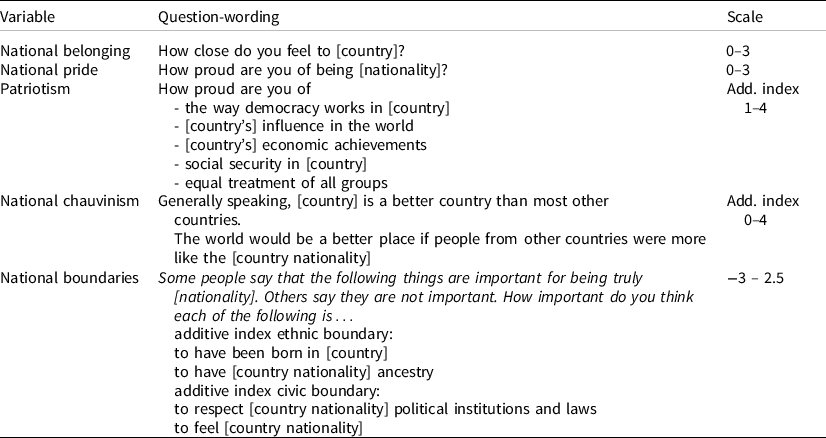
The operationalization of the five different forms of national identity follows Miller and Ali (Reference Miller and Ali2014) as well as Gustavsson and Stendahl (Reference Gustavsson and Stendahl2020) – see Table 1. First, national belonging is captured by whether individuals feel close to their country. Second, national pride follows the traditional question of whether the respondent is proud of their nation. Third, several questions capture patriotism about how proud the respondent is of specific national institutions and achievements. Fourth, the national chauvinism measure captures the respondents’ feeling of the superiority of their nation and the national population. Lastly, the normative perceptions of national boundaries are measured by an index of questions comprising the civic and ethnic dimensions of boundaries. The most commonly used items representing an ethnic boundary are about how important one thinks ‘having ancestry’ and ‘being born in the country’ is for belonging to the nation; whereas the civic boundary is primarily based on ‘feeling the country’s nationality’ and ‘respecting the country’s political institutions’ (Reeskens and Hooghe, Reference Reeskens and Hooghe2010; Davidov et al., Reference Davidov, Dulmer, Cieciuch, Kuntz, Seddig and Schmidt2016).Footnote 6 Having more ethnic or civic attitudes are not mutually exclusive – respondents often fall into both categories. For example, Smith (Reference Smith1991: 13) states that individuals always incorporate ‘civic and ethnic elements in varying degrees and different forms’. Those showing strong support for ethnic boundaries are also very likely to support civic boundaries; there is often a high correlation between these two measures. I follow Kunovich’s (Reference Kunovich2009) approach, which considers the relationship between the two dimensions by distinguishing the intensity of ethnic and civic conceptions and combining the two in one overall national boundary index. In a first step, separate additive indices for the two civic and ethnic items are constructed (ranging from 0 to 3). In a second step, the civic index is subtracted from the ethnic index, resulting in an overall index that clearly distinguishes individuals’ normative perceptions of who should belong to the nation. Higher values thereby mean a more ethnic perception of national boundaries.Footnote 7
Operationalization and distribution of nationalism in GER, UK, USA

Like national identity, redistributive solidarity has different dimensions. According to Cavaillé and Trump (Reference Cavaillé and Trump2015), one should distinguish redistribution from and redistribution to. The former focuses on social justice and the latter on support for welfare measures for more vulnerable groups. Overall, the analysis comprises four measures of redistributive solidarity: the support for social justice (equality), attitudes towards the role of government in welfare distribution (government), attitudes towards the welfare state (welfare), and welfare chauvinism.
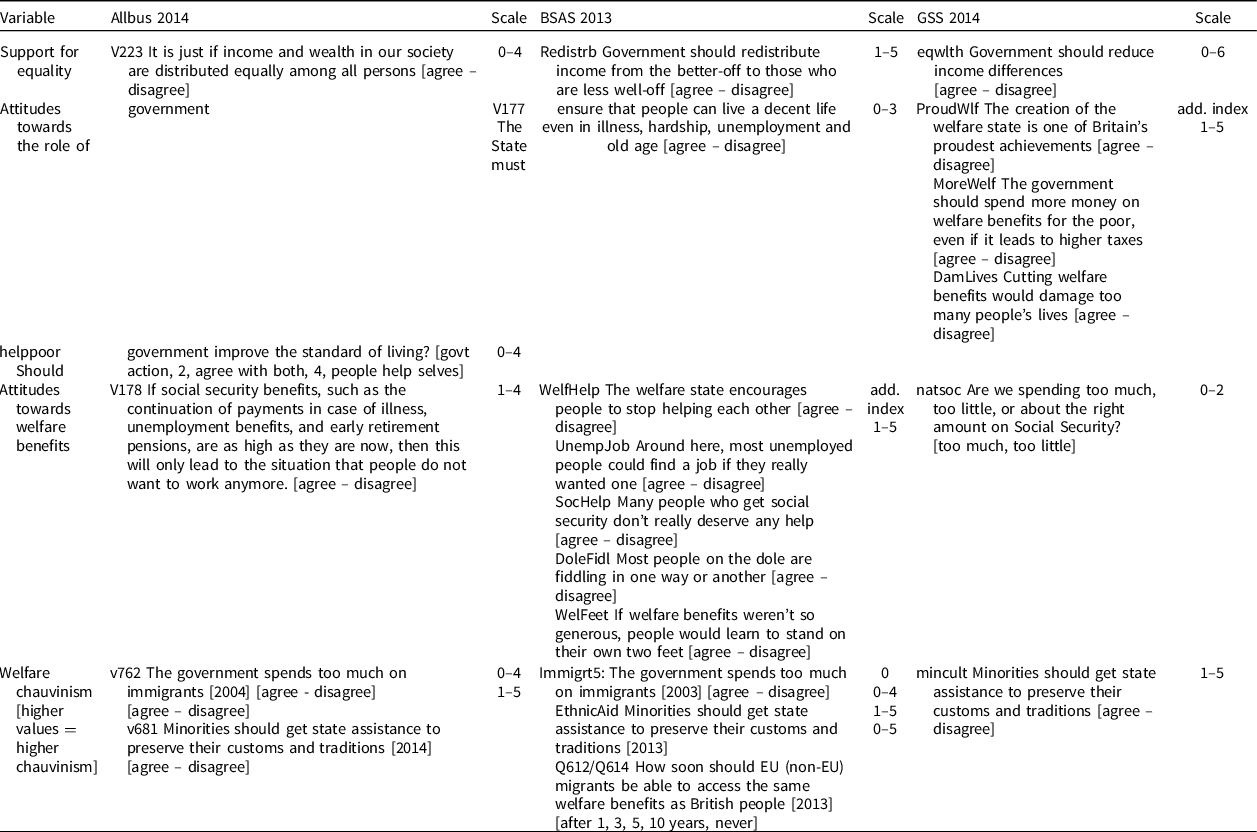
While the measures of national identity are the same in all three country data sets, the operationalization of the dependent variables varies (see a detailed list of question wordings in Table 2). The questions capturing the equality dimension of redistributive solidarity address the classical social justice question by asking whether income should be distributed equally in society (redistribution from). The government dimension includes questions that address the role of the government in distributing welfare benefits in a country, such as whether it is the government’s responsibility to ensure a decent life for all groups within society. In contrast, the general attitudes towards the welfare state dimension captures attitudes towards the amount and effects of social security spending. The BSAS provides the most accurate measures of these three dimensions, whereas the US GSS covers the least variety of measures. Nevertheless, all three data sets capture the three dimensions with at least one item that aligns with items presented in the study by Cavaillé and Trump (Reference Cavaillé and Trump2015). However, one must be aware that results between the countries might differ due to these diverse measures.
Question wording for dependent measures of redistributive solidarity

The last dimension of redistributive solidarity, welfare chauvinism, shows the greatest variation across the three countries. Accordingly, welfare chauvinism is measured with different items. For example, in connection with the 2003 ISSP, both the ALLBUS and the BSAS asked respondents whether they think the government is spending too much on immigrants. In addition, whether ethnic minorities should receive social assistance to maintain their customs and traditions was asked in all three countries in 2013 and 2014, respectively. Lastly, the BSAS 2013 includes the most typical questions for capturing welfare chauvinism: two items asked after how long EU or non-EU migrants should receive welfare benefits (Careja and Harris, Reference Careja and Harris2021). Yet, these two items were only asked for a small sub-sample (approx. 300 respondents).
Apart from the main variables of interest, the models include control variables that may influence the relationship between national identity and redistributive solidarity. First, attitudes towards redistribution are often influenced by a person’s placement on the left-right scale (Cavaillé and Trump, Reference Cavaillé and Trump2015), particularly in the US context (Theiss-Morse, Reference Theiss-Morse2009). More right-leaning individuals are more likely to show both stronger forms of national identity and less redistributive solidarity. Ideology is measured in the British and German data on the 11-point left-right scale, whereas the US data only includes party belonging as an indicator of ideology. Second, education is further known to impact both the degree of national identity and redistributive solidarity. Apart from ideology and education, the models control for respondents’ gender and age. The estimation of the results follows linear multiple regression analysis. All models are estimated with robust standard errors due to heteroscedasticity.
Results
The results address how different forms of national identity relate to different forms of redistributive solidarity in three different countries. Following the hypotheses, the expectations are that forms of national identity that include an outgroup boundary should negatively relate to redistributive solidarity (H1). In contrast, individuals high on national belonging, pride, and patriotism might be more likely to support the general idea of the NIA and positively relate to redistributive solidarity (H2). Moreover, the NIA should find more support in countries that either have strong traditions of shared national identities or share the value of a collectivistic identity. The results are presented graphically in coefficient plots comparing all three countries simultaneously. The detailed tables can be found in the online appendix. While the paper aims to find differences between countries, some of the results are not directly comparable due to differences in the measurement of the variables. The results on how national identity measures relate to welfare chauvinism are presented separately due to the larger incomparability.
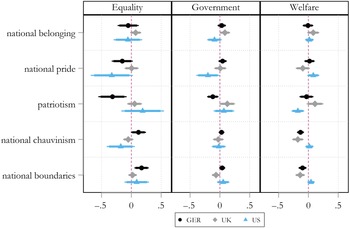
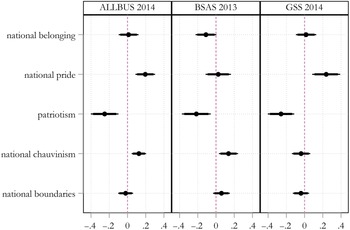
Figure 1 presents the combined findings for all three countries by the three dependent measures for redistributive solidarity. Following the first hypothesis, we should find that forms of national identity that refer to an outgroup, i.e., national chauvinism and the perception of national boundaries, should relate negatively to more redistribution, independent of which kind of redistributive solidarity measure one is considering. However, looking at Figure 1, we see that this assumption only applies to attitudes towards the role of government and welfare spending; and only in the UK and Germany. Here, individuals with more national chauvinistic attitudes or with a more ethnic perception of national boundaries are less likely to support the welfare state and welfare benefits. There is no significant finding in the USA concerning H1. A more counterintuitive picture is depicted when turning to the relationship between these two forms of national identity and support for social justice (Equality): higher values on these dimensions of national identity are related to more support for social justice, though this finding is only supported in the German sample.
Regression results – ALLBUS 2014, BSAS 2013, GSS 2014. Notes: 90%- and 95%-confidence intervals depicted; all models are estimated with multiple linear regression analysis with robust standard errors. All models control for respondents’ gender, age, education, and political ideology. The full models can be found in the online appendix; Data: ALLBUS 2014, BSAS 2013, GSS 2014 (NatCen Social Research, 2014; GESIS – Leibniz-Institut für Sozialwissenschaften, 2018; Williams and Smith, Reference Williams and Smith2019).

According to the second hypothesis, as well as Miller and Ali (Reference Miller and Ali2014), it should be most likely to find support for the NIA, when considering the relationship between national belonging and solidarity. Figure 1 reveals that national belonging is positively related to all three forms of redistributive solidarity, at least in the UK sample. For the other two countries, there is no significant effect detectable. This result can be due to national belonging being the least evaluative dimension of national identity. Hence, one would expect that national pride and patriotism show more pronounced results. Yet, the findings in Figure 1 show that both pride and patriotism largely vary in their relationship to the three dependent measures and the country’s context. Of all the five national identity measures, national pride is the only one that seems to play a role in explaining redistributive solidarity in the US context. This result supports the general notion that it is particularly national pride that the US population largely shares, supporting the assumption of H4. Yet, in contrast to the expectation from H2, national pride reveals a negative and significant relationship with support for social justice and attitudes towards the role of government in public spending. This finding is in line with the results by Gustavsson (Reference Gustavsson, Gustavsson and Miller2020, 72), where the theoretical argumentation follows the idea that pride might not enhance sympathy with others and thus exhibits a negative relationship to solidarity. Moreover, and according to Theiss-Morse (Reference Theiss-Morse2009), this can be traced back to the predominant idea of individualism in the USA, making any support provided by the state less desirable. In the other two countries, national pride does not significantly relate to the three solidarity measures.
Lastly, patriotism reveals slightly diverse findings across the three dependent measures and countries. For example, in the German case, individuals that evaluate the country’s institutions and achievements more positively show less support for social justice and have less positive attitudes towards the role of government in welfare spending; whereas this relationship reveals the opposite direction in the UK sample (though slightly non-significant).
National identity and welfare chauvinism
Compared to the prior section, the central hypothesis on the relationship between national identity and welfare chauvinism was that all forms of national identity would increase the likelihood of welfare chauvinistic attitudes (H3), whereby the effect should be the strongest for the forms that include an outgroup demarcation. In this section, the estimates are not presented combined for all countries but by measurement since the welfare chauvinism measures differ. Again, the results are presented graphically. All models control for gender, age, educational level, and political ideology. Full results can be found in the online appendix.
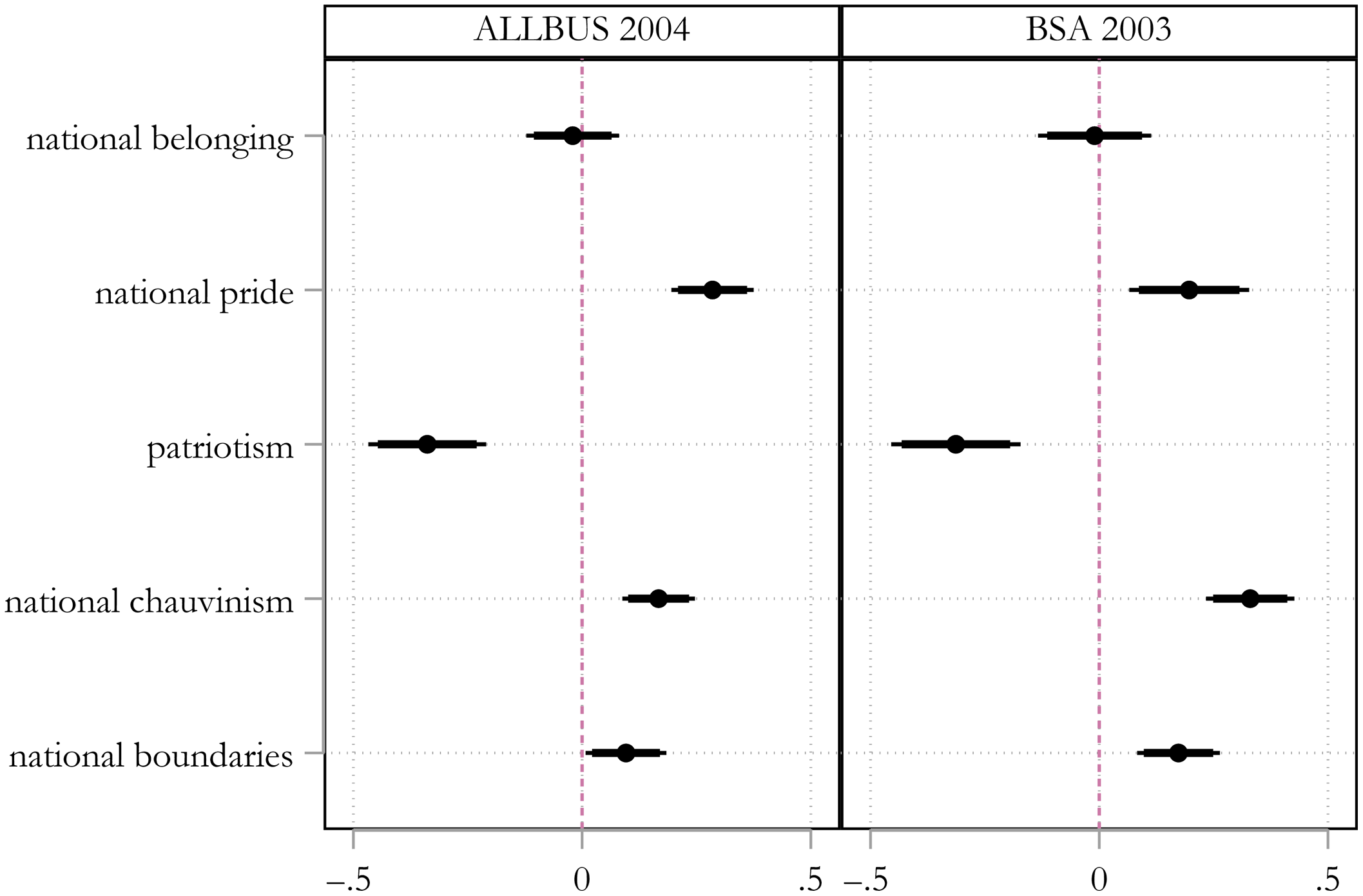
Figure 2 presents the estimates comparing results from the 2004 ALLBUS and the 2003 BSAS to determine whether respondents think the government spends too much on immigrants. At first glance, the patterns of results look the same in the two countries. However, in detail, national pride, national chauvinism, and the normative perception of national boundaries significantly relate to more welfare chauvinistic attitudes as predicted in H3. While the result for national belonging points in a diminishing direction, the estimates do not reach statistical significance. Surprisingly, and slightly in contrast to the findings in Figure 1, patriotism is the only dimension of national identity that decreases welfare chauvinism. Moreover, this is the largest effect across all national identity measures.
Welfare chauvinism 1: ‘The Government spends too much on immigrants’ (ALLBUS 2004 & BSAS 2003). Notes: 90%- and 95%-confidence intervals depicted; all models are estimated with multiple linear regression analysis with robust standard errors. All models control for respondents’ gender, age, education, and political ideology. The full models can be found in the online appendix. Data: ALLBUS 2004 (GESIS – Leibniz-Institut Für Sozialwissenschaften, 2008); BSAS 2003 (National Centre for Social Research, 2005).

Next, Figure 3 shows a comparison between the 2014 Allbus, 2013 BSAS, and the 2014 GSS data, which captured welfare chauvinism by the question of whether minorities should receive state assistance to preserve their customs and traditions. This form of welfare chauvinism has a more cultural dimension than the prior question and is directed at minorities in general, not immigrants in specific. Again, we can see similar patterns across the three countries: national pride relates positively to this form of chauvinism in Germany and the USA. However, it shows no significant influence in the UK sample. In contrast, national belonging negatively relates to this cultural form of welfare chauvinism, speaking against the assumption of H3 that all national identity measures should increase welfare chauvinistic attitudes. Here, individuals favour state assistance for minorities when they identify more strongly with Britain. In the other two countries, there is no such effect detectable. As predicted, national chauvinism reveals a positive relationship to welfare chauvinism. Yet, this is only the case in Germany and the UK. Similarly, the normative perception of national boundaries only shows a significant and positive relationship in the UK. Like before, patriotism is the only measure that significantly negatively relates to welfare chauvinism while at the same time showing a rather sizeable effect. In sum, there are some differences between the countries. Still, the general direction of the estimates mirrors each other, making it look like country differences are less important for the relationship between national identity and welfare chauvinism. While this finding does not support the general idea of the NIA, it supports prior findings that focus on national identity and welfare chauvinism.
‘Minorities should receive state assistance’ – GER, GB, USA. Notes: 90%- and 95%-confidence intervals depicted; all models are estimated with multiple linear regression analysis with robust standard errors. All models control for respondents’ gender, age, education, and political ideology. The full models can be found in the online appendix. Data:BSAS 2013, ALLBUS 2014, GSS 2014 (NatCen Social Research, 2014; GESIS – Leibniz-Institut für Sozialwissenschaften, 2018; Williams and Smith, Reference Williams and Smith2019).

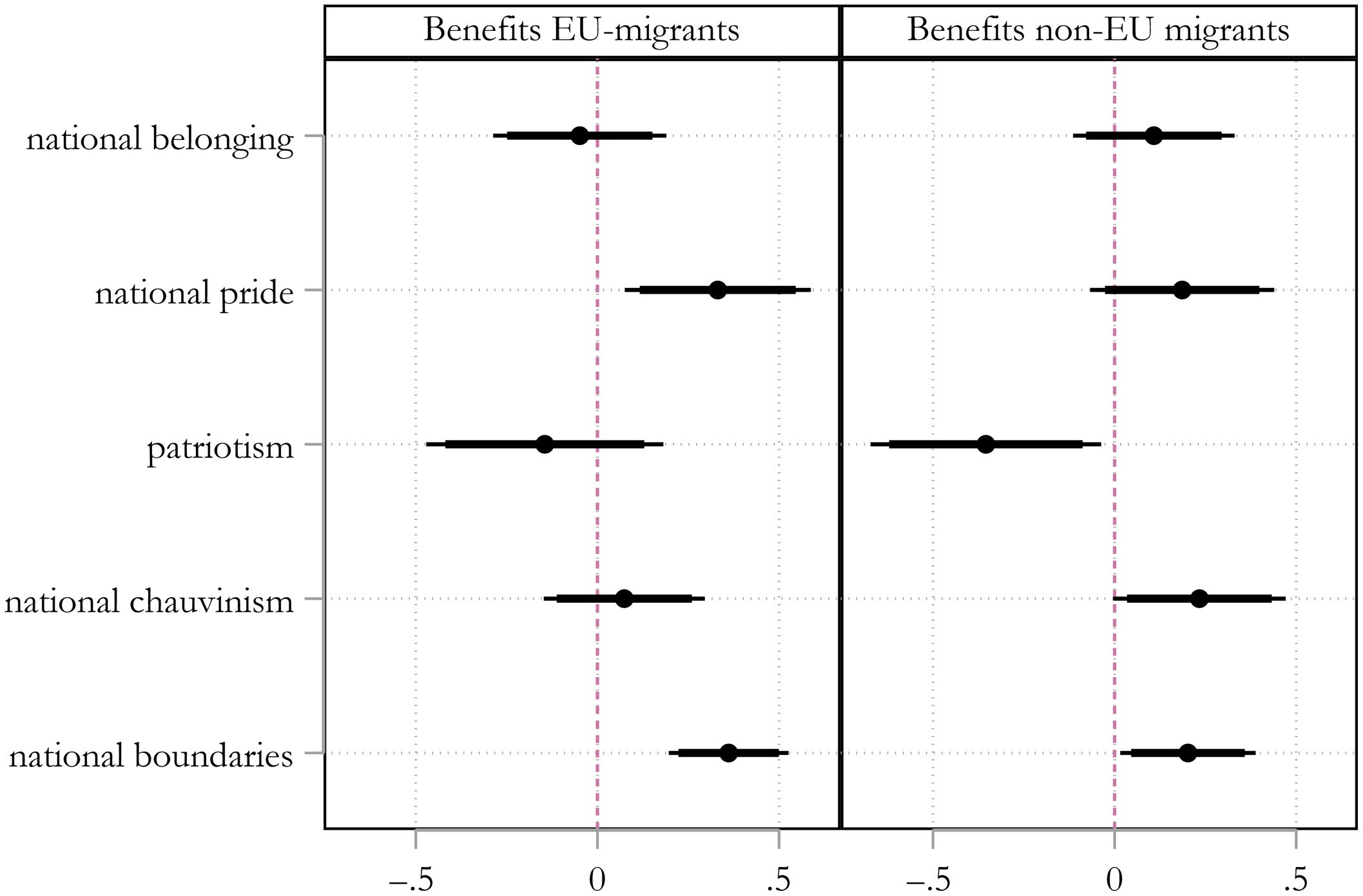
The last estimates test the relationship between national identity and welfare chauvinism focussing on a question that was only asked in the 2013 BSAS to a smaller sub-sample of respondents. This measure comes closest to the welfare chauvinism measure used by Johnston et al. (Reference Johnston, Wright, Soroka, Citrin, Banting and Kymlicka2017) as it asks respondents when immigrants from EU (non-EU countries) should receive equal access to welfare benefits (Careja and Harris, Reference Careja and Harris2021).
Figure 4 reveals similar patterns as in the findings above on the relationship between forms of national identity and welfare chauvinism. National belonging, national pride, national chauvinism and national boundaries relate positively to more chauvinistic attitudes against non-EU migrants, whereby the effects differ according to their statistical significance. For the case of EU migrants, the results are almost the same, except that national belonging shows no clear direction. As before, patriotism sticks out: the more positive individuals evaluate the institutions and achievements of the UK, the more likely they are to support equal rights for non-EU-migrants.
‘Social benefits for EU/non-EU migrants’. Notes: 90%- and 95%-confidence intervals depicted; all models are estimated with multiple linear regression analysis with robust standard errors. All models control for respondents’ gender, age, education, and political ideology. The full models can be found in the online appendix. Data: BSAS 2013 (NatCen Social Research, 2014).

Discussion of findings
The aim of the paper was manifold; thus, it is no surprise that the results reveal a manifold pattern that can be traced back to differences in the forms of national identity as well as differences between countries and dependent measures. While there is some support for the assumptions from H1 and H2, they do not universally apply to all country contexts. Especially, the German case seems to stand out by revealing several counterintuitive findings between national identity and redistributive solidarity. One explanation can be that the value of national identity is not largely shared in the German context due to its history of nationalism and lack of commitment to national symbols. At the same time, however, Germany is the case out of the three with the strongest tradition of a more comprehensive welfare state, making one expect to find more support for the NIA. Indeed, while there is less support for H1 in Germany, H4 and H5 can be slightly confirmed for this case – however, more detailed analyses are needed to investigate the potential contextual effect further.
The findings concerning the USA further support H4 and H5: here, there is a strong tradition of national pride – that is reflected in the findings – combined with a more individualistic culture and less commitment to the idea of having a comprehensive welfare state. Hence, the predominance of null findings between national identity and redistributive solidarity. Additionally, redistributive solidarity is highly related to party identification in the US context (see correlation matrix in the online appendix), implying that the US results could be biased when controlling for party identification. Figure A4.1 in the appendix tests the findings with and without party identification, revealing more support for H1 and H2 in the US context without controlling for party identification. Overall, the additional estimates show that the relationship between national identity and redistributive solidarity is, to some extent, suppressed by party identification, at least in the US context. As a robustness check, the British and German results were also re-estimated without controlling for political ideology (see Figures A4.2 and A4.3 in the appendix). There is no relevant change in the overall results.
A clearer finding across the countries is that national belonging does not influence different forms of redistributive solidarity, speaking against Miller and Ali’s (Reference Miller and Ali2014) assumption that the NIA should find most support when looking at national belonging as a national identity measure. On the other hand, patriotism reveals the strongest support for the NIA – even when looking at welfare chauvinism. Patriotism is the form of national identity that shows a relatively consistent pattern of enhancing more redistributive solidarity, supporting H2.
The presented results provide the most convincing support for H1, particularly regarding the relationship between national chauvinism and redistributive solidarity. Even though the estimates often fail to reach statistical significance, the general direction of the coefficients is negative. The same applies to the measure of national boundaries. Thus, it seems that forms of national identity that include outgroup differentiation are likely to reduce redistributive solidarity. However, the German case provides opposite evidence: individuals with strong ethnic boundaries support social justice, i.e., a redistribution between social groups within society. An explanation could be that individuals primarily understand social justice as the distribution from the rich to the poor instead of from majority to minority groups. To test this, we need more detailed measures of social justice.
Lastly, the clearest conclusion can be drawn when looking at the test of the NIA with a focus on welfare chauvinism. Here, the general idea of the argument is not supported. Yet, welfare chauvinism is a specific category of redistributive solidarity that distinguishes redistribution towards outgroups. This is a dimension the NIA seems to neglect, even though it states that national identity should foster solidarity in diverse societies. Moreover, the NIA does not hold when looking at increased immigration and ethnic diversity. In sum, the presented results encourage us to rethink the applicability of the NIA and adjust it to a different context and different measures of national identity and solidarity.
Conclusion
The universal applicability of the NIA has been challenged before, yet, there was scarce and mixed empirical evidence (Shayo, Reference Shayo2009; Johnston et al., Reference Johnston, Wright, Soroka, Citrin, Banting and Kymlicka2017; Gustavsson, Reference Gustavsson, Gustavsson and Miller2020; Gustavsson and Stendahl, Reference Gustavsson and Stendahl2020; Huddy and Ponte, Reference Huddy, Ponte, Gustavsson and Miller2020). This paper aimed to provide a more thorough empirical analysis of the NIA in different contexts, including five different measures of national identity. This paper looked at all the available data that combines ISSP-data with additional national surveys covering redistributive solidarity, namely data from Germany, the UK, and the USA. The results of this analysis are not as conclusive as the theoretical expectations were. The relationship between national identity and different forms of redistributive solidarity varies decisively between the three countries. Only the pattern between national identity and welfare chauvinism could unambiguously be replicated between the three contexts. The main conclusion following this analysis is that when considering different forms of national identity and redistributive solidarity in different countries, we cannot find enough evidence that either speaks in favour or against the general assumption of the NIA. However, we can conclude that the applicability of the NIA rests on whether we consider forms of national identity that include an outgroup demarcation dimension or not. There is considerable support that these forms, national chauvinism and the normative perception of national boundaries, encourage less redistributive solidarity.
This paper challenges the universal applicability of the NIA. Yet, the results are certainly not without shortcomings. First, the measures of redistributive solidarity differ between the countries, resulting in diverging findings. Second, it is very optimistic to conclude about potential contextual effects by only comparing three countries. The findings revealed that the context plays a decisive role in testing the NIA. On the one hand, the meaning and history of national identity and how national leaders instrumentalize nationality differ. On the other hand, redistributive solidarity may depend on the extent and tradition of the welfare state, making solidarity a general good that is incorporated in the nation or not. Some may even question if one can look at the concept of redistributive solidarity in the context of the USA, where the welfare state is limited to its minimum. Besides, increasing diversity within nations may emphasize the division between solidarity towards the ingroup and outgroups. Third, the findings are based on purely observational data, like most studies in this research area. They do not answer how national identity may influence actual behaviour. More studies, like the one by Charnysh et al. (Reference Charnysh, Lucas and Singh2015), are needed to transfer the idea of the NIA to a real causal claim.
What implication does this paper have for future research? First, tests of the NIA should indicate what kind of national identity and solidarity they are focusing on and adjust the theoretical assumptions accordingly. Moreover, future studies should be aware of the contextual dependencies of the NIA. Yet, this clearly demands more cross-national data. At the same time, while there is a demand for more comparative data covering both national identity and redistributive solidarity measures, this paper also emphasizes the need for more country in-depth analyses. It could be that the meaning of the different forms of national identity varies not only between countries but also between individuals. For example, Rapp (Reference Rapp2020) showed that national chauvinism has a different meaning depending on whether a person has a migration background. Further, Holtug (Reference Holtug, Gustavsson and Miller2020) argues that the sense of belonging to a country has political, social, or economic reasons that can have different effects on social cohesion and solidarity. Thus, we need more qualitative data analysing the meaning and understanding of national identity before moving on with large-scale country comparisons.
Further, there is a need to look deeper into solidarity between in- and outgroups. As the presented findings underline, solidarity becomes more challenging with increasing diversity across Western countries. To better understand the mixed findings concerning the NIA, one essential piece is taking diversity in terms of individuals’ migration backgrounds into account. Researchers around the NIA neglected the role migration background plays in the national identity-redistributive solidarity link. Many individuals living in European countries have an immigration background and often do not share the same nationality. Thus, they may not have the same feelings or degree of national belonging (Wright and Reeskens, Reference Wright and Reeskens2013). Additionally, diversity based on increased immigration can draw sharper lines between in-groups and outgroups – i.e., co-nationals and foreigners – challenging redistributive solidarity towards all individuals within a country as shown by the findings on welfare chauvinism (Lægaard, Reference Lægaard and Holtug2016; Cappelen and Peters, Reference Cappelen and Peters2017; Gugushvili et al., Reference Gugushvili, Ravazzini, Ochsner, Lukac, Lelkes, Fink, Grand and van Oorschot2021). If we know more about how solidarity can be created across groups, we can make better policy recommendations that foster it.
Beyond this, the paper’s findings also bear some practical implications for the future of solidarity following the rising influence of nationalistic parties. For example, many right-wing populist parties emphasize the solidarity aspect of their programs, yet, the understanding of redistributive solidarity is narrowly defined (Fenger, Reference Fenger2018). Given the presented results, the question is how these parties have and will influence the different forms of national identity on the one hand and the idea of solidarity within a nation on the other hand. At the same time, we could observe that throughout Europe, social democratic parties lost support and are facing a crisis of social democracy in general (Abou-Chadi and Wagner, Reference Abou-Chadi and Wagner2020). This development may be reflected in a crisis of societal and redistributive solidarity. Thus, newer data could answer the influence of party politics on the relationship between national identity and redistributive solidarity.
Supplementary material
To view supplementary material for this article, please visit https://doi.org/10.1017/S1755773922000200.
Acknowledgements
I would like to thank the three very constructive reviewers for their helpful comments as well as the journal editors for their support.