I. INTRODUCTION
Heusler Ni–Mn–(Ga, In, Sn, Sb) materials have attracted much attention due to their large magnetic-field-induced strain,Reference Krenke, Duman, Acet, Wassermann, Moya, Mañosa, Planes, Suard and Ouladdiaf1 giant magnetocaloricReference Krenke, Duman, Acet, Wassermann, Moya, Mañosa and Planes2 and magnetoresistance effectsReference Koyama, Okada, Watanabe, Kanomata, Kainuma, Ito, Oikawa and Ishida3 based on the first-order solid-state martensitic transformation. In the present work, we concentrate on the Ni–Mn–Sn alloy system, which is considered of high potential for large-scale magnetocaloric engineering applications.Reference Han, Wang, Zhang, Xuan, Gu and Du4–Reference Zheng, Wu, Xue, Frenzel, Eggeler and Zhai7 Up to date, significant efforts have been made to adjust their phase transformation and magnetic properties through doping the fourth element during the past decade.Reference Krenke, Duman, Acet, Moya, Mañosa and Planes8–Reference Cong, Roth and Schultz14 Krenke et al. Reference Krenke, Duman, Acet, Moya, Mañosa and Planes8 reported that substitution of Ni with Fe or Co would decrease the martensitic transition temperatures in Ni50Mn37Sn13 alloy, whereby Co reduces the magnetic entropy change (ΔS M), while 3 at.% Fe leads to an increase of it. They found that the transformation hysteresis (ΔT) narrowed with Co substitution, but broadened when Fe was added. When a larger atom Sn is substituted with a smaller atom Ge in Ni43Mn46Sn11 alloy, Han et al.Reference Han, Wang, Zhang, Xuan, Zhang, Gu and Du9 reported that the transition temperatures increased strikingly and pointed out that the adjustment of cell volume of austenite would be an effective way to tailor the martensitic transformation and magnetocaloric effect. Gao et al.Reference Gao, Hu, Shen, Wang, Sun and Shen10 reported that the Co addition notably enhances the magnetization discrepancy (ΔM) across the martensitic transformation in Ni43Mn46–xCoxSn11 alloys and more importantly, the ΔS M displays a table-like peak under a magnetic field of 5 T, which is favorable for Ericsson-type refrigerators. Fukushima et al.Reference Fukushima, Sano, Kanomata, Nishihara, Furutani, Shishido, Ito, Umetsu, Kainuma, Oikawa and Ishida11 observed that the Curie temperatures of austenite and martensite increase with Fe substitution for Mn in Ni2Mn1.48Sn0.52 alloy; however, the martensitic transition temperatures decrease steeply. Similar results were reported in Ni44–xCoxMn45Sn11 alloys. Reference Liu, Zhang, Han, Xuan, Wang and Du12 Wang et al.Reference Wang, Zhang, Xuan, Han, Zhang, Tang, Gu and Du13 obtained a larger ΔS M when substituting 2 at.% Al for Sn in Mn50Ni40Sn10 alloy although the ΔM across the martensitic transformation was smaller than those of Mn50Ni40Sn10 and Mn50Ni40Sn9Al1, and they ascribed to the narrower martensitic transformation temperature range. Recently, Cong et al. Reference Cong, Roth and Schultz14 studied the magnetic properties and the temperature- and magnetic-field-induced structural transformations in Ni50–xCoxMn39Sn11 alloys, and established a phase diagram for the alloy system from 500 K down to 10 K, which is beneficial to understanding the composition- and temperature-dependence underlying mechanisms in the Ni–Co–Mn–Sn materials.
On the other hand, it should be noted that secondary phase would form under these additions. For instance, Chen et al.Reference Chen, Tong, Huang, Tian, Li and Zheng15 identified a face-centered cubic (fcc) γ phase in Ni38Co12Mn41Sn9 bulk alloy, which could be fully suppressed under melt-spun rapid cooling condition. Homogeneously single-phased and highly textured Ni–Mn-based ribbons could be fabricated using melt spinning technique.Reference Santos, Sanchez, Alvarez, Sanchez, Sánchez Llamazares, Hernando, Escoda, Suñol and Varga16,Reference Hernando, Sánchez Llamazares, Santos, Escoda, Suñol, Varga, Baldomir and Serantes17 Babita et al.Reference Babita, Patil and Ram18 reported a ΔS M value of 6 J kg–1 K−1 under a magnetic field of 2 T from the as-received Ni49Mn37.4Sn13.6 ribbon, which is comparable to the high-temperature annealed Ni50Mn37Sn13 bulk alloy.Reference Krenke, Duman, Acet, Wassermann, Moya, Mañosa and Planes2 Wu et al.Reference Wu, Xue, Frenzel, Eggeler, Zhai and Zheng19 observed the ΔS M value of 10 J kg–1 K−1 under 1.8 T from the Ni50Mn37Sn13 ribbon after annealing at 1273 K for 15 min, which is much higher than that of the corresponding bulk alloy.Reference Krenke, Duman, Acet, Wassermann, Moya, Mañosa and Planes2
In brief, the previous studies concentrated on the effects of the fourth element on the martensitic transition temperatures and magnetic properties, and Co-doped Ni–Mn–Sn had demonstrated improved magnetocaloric effect.Reference Gao, Hu, Shen, Wang, Sun and Shen10,Reference Liu, Zhang, Han, Xuan, Wang and Du12,Reference Cong, Roth and Schultz14,Reference Chen, Tong, Huang, Tian, Li and Zheng15,Reference Wang, Yu, Zhai, Luo and Zheng28 However, to the best of our knowledge, limited research on the martensitic crystal structure in Ni–Mn–Sn–Co was reported either in bulk alloys or in ribbons, and thus the main objective of the present study is to provide such information based on a series of melt-spun Ni–Mn–Sn–Co ribbons for better understanding the compositional dependence on the martensitic transformation.
II. MATERIALS AND EXPERIMENTAL PROCEDURES
Five ingots with nominal compositions of (Ni49Mn39Sn12)100–xCox (at.%, x = 0, 2, 4, 6, 8) with mass about 80 g were prepared using conventional arc-melting from Ni, Mn, Sn, Co elements with purities of 99.99 wt.% under argon gas atmosphere. Additional amount of 5 wt.% Mn were added to compensate for evaporation losses. Then the ribbons were made using melt-spinning technique at a linear speed of 10 m s−1 and the resultant ribbons were ∼20 mm long, 4–6 mm wide, and 30–35 μm thick. Hereinafter these ribbons were referred as R-Co0, R-Co2, R-Co4, R-Co6, and R-Co8, respectively.
X-ray diffraction (XRD, D/MAX2200, Rigaku Co., Tokyo, Japan) measurements were conducted to identify the phases and crystal structures using Cu Kα radiation with a wavelength of 0.15418 nm. Microstructural observations were performed using a scanning electron microscope (SEM, Phenom™ Pro, Phenom-World BV., Eindhoven, Netherlands) operated at 15 kV, and a transmission electron microscope (TEM, JEOL JEM-2010F, JEOL Ltd., Tokyo, Japan) at 200 kV on a double-tilt stage. Thin foils for TEM observations were prepared according to standard metallographic procedures and double-jet electrochemical thinning method using solution of 5 vol% perchloric acid and 95 vol% alcohol at a voltage of 30 V at 240 K. Differential scanning calorimetry (DSC, NETZSCH DSC 204 F1, Germany) measurements were carried out to determine the characteristic transition temperatures at heating/cooling rates of 10 K min−1.
III. RESULTS AND DISCUSSION
A. Phase and crystal structure
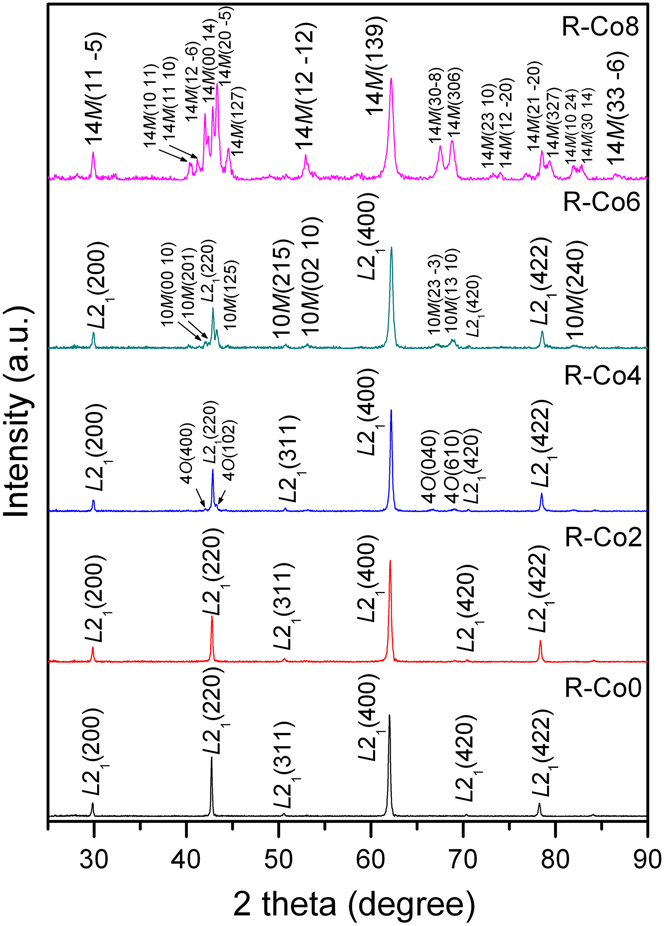
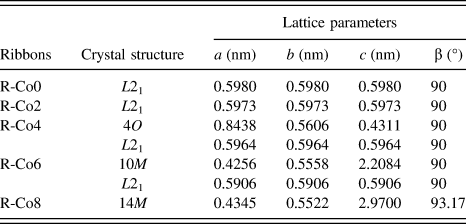
Figure 1 shows the XRD patterns of melt-spun Ni–Mn–Sn–Co ribbons at room temperature, in which both R-Co0 and R-Co2 are well indexed as L21 austenitic phase with cubic structure. At the doping level of 4 at.% Co, a mixture of L21 austenite and four-layered orthorhombic (4O) martensite was identified, whereas at 6 at.% Co doping, a mixture of L21 austenite and five-layered orthorhombic (10M) martensite was identified. Further increase of Co doping to 8 at.% Co yields a pure seven-layered monoclinic (14M) martensitic phase in the R-Co8. Miller indices (hkl) for the L21, 4O, 10M, and 14M structures are indexed in Fig. 1. The corresponding lattice parameters calculated using a least-squares method based on the XRD data are listed in Table I.
XRD patterns of melt-spun Ni–Mn–Sn–Co ribbons at room temperature.

Crystal structures and lattice parameters of melt-spun Ni–Mn–Sn–Co ribbons at room temperature calculated using the XRD data in Fig. 1.

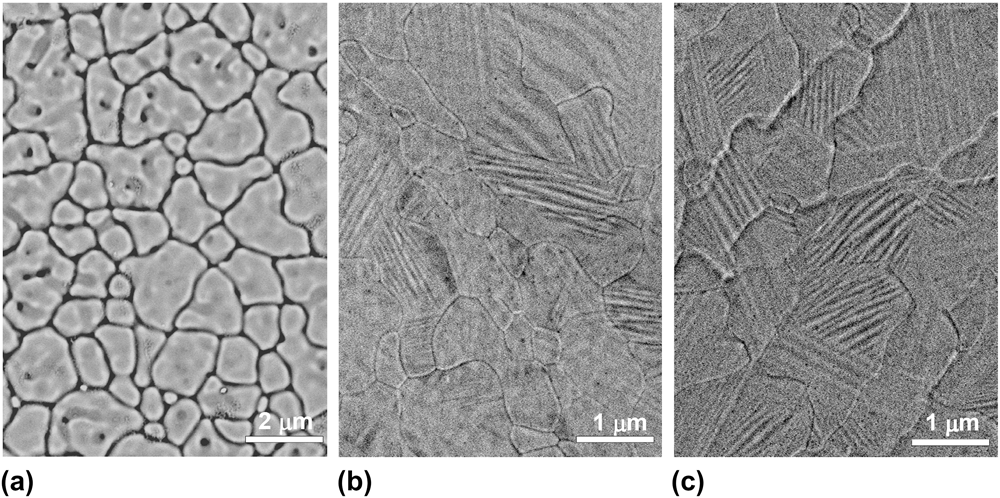
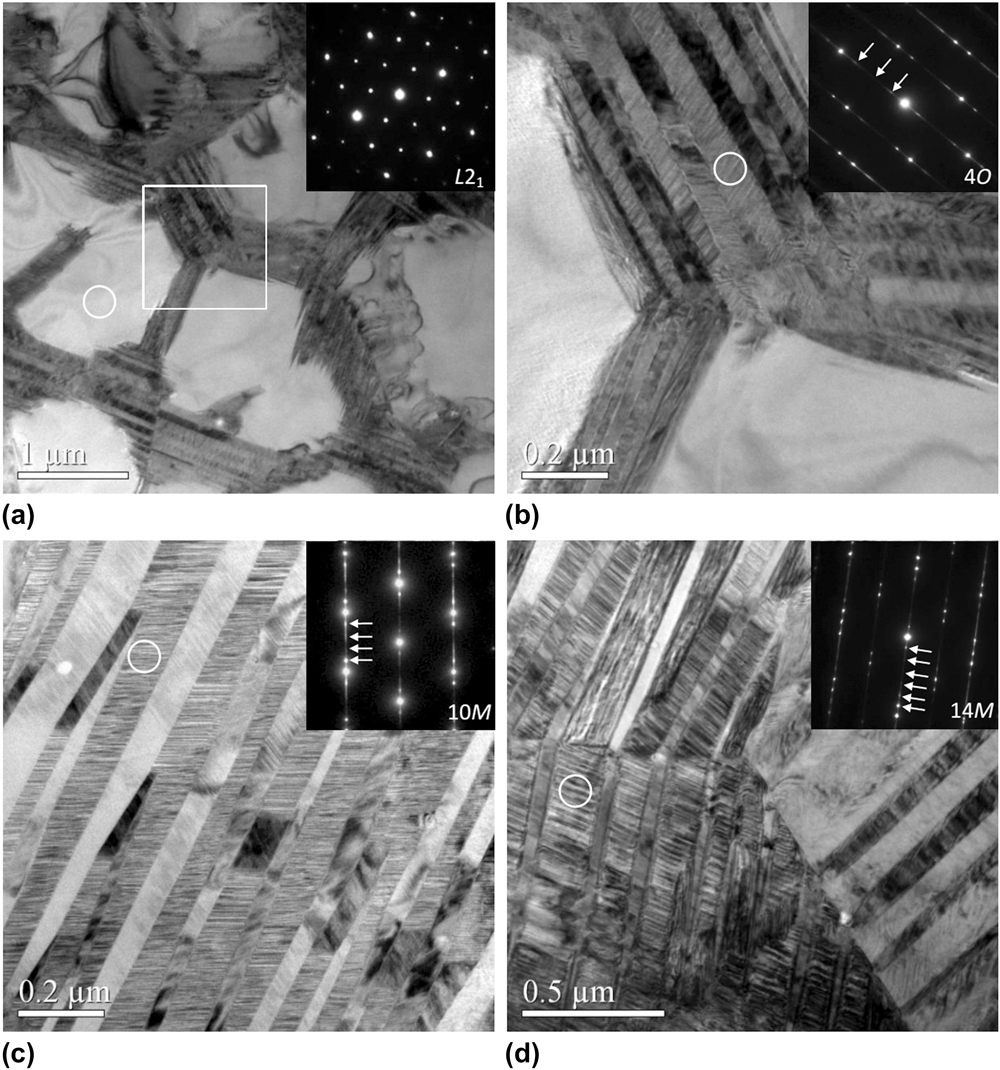
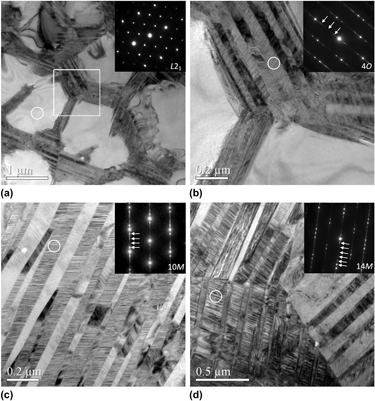
Figure 2 presents the backscattered electron (BSE) images taken from the free-surface of R-Co0, R-Co4, and R-Co6, respectively. All of them show equiaxed grains with size of ∼1–2 μm. In the sample of R-Co4, martensite plates are observed within some grains [Fig. 2(b)]. However, the sample R-Co6 is almost fully filled with martensite plates [Fig. 2(c)], and similar martensitic microstructure is also observed in R-Co8 (not shown here). From the SEM images alone, no clear difference can be distinguished among these three different martensites. Therefore, the crystal structures of martensite in R-Co4, R-Co6, and R-Co8 were further characterized using TEM. Figure 3(a) shows a low-magnification TEM bright-field image of R-Co4, where plate-like martensitic variants distribute along grain boundaries, and the grain center is the austenitic matrix according to the selected area electron diffraction pattern (SADP) shown in the inset. Figure 3(b) is a magnified image taken from the highlighted white rectangular field marked in Fig. 3(a). The inserted SADP in Fig. 3(b) displays three satellite spots between the fundamental maxima (marked by white arrows), which represents typical diffraction characteristics of the modulated 4O structure. Furthermore, it is reasonable to conclude that the martensitic phase initially nucleates near the grain boundaries and then grows to the interior of the grains during the subsequent martensitic transition from Fig. 3(a). The bright-field image of 10M martensite in R-Co6 is presented in Fig. 3(c) and its corresponding SADP shows four satellite spots between the fundamental maxima. The TEM image of R-Co8 shows three groups of 14M martensitic variants with different orientations [Fig. 3(d)]. In addition, it should be noted that no secondary phase is observed within the present studied composition range according to the XRD analyses and TEM observations.
BSE images of melt-spun R-Co0 (a), R-Co4 (b), and R-Co6 (c).

TEM images and the corresponding SADPs taken from the regions highlighted with white circles in melt-spun Ni–Mn–Sn–Co ribbons, indicating the presence of cubic L21 austenite and four-layered orthorhombic (4O) martensite in R-Co4 (a and b), five-layered orthorhombic (10M) martensite in R-Co6 (c), and seven-layered monoclinic (14M) martensite in R-Co8 (d), respectively.

B. Martensitic transformation
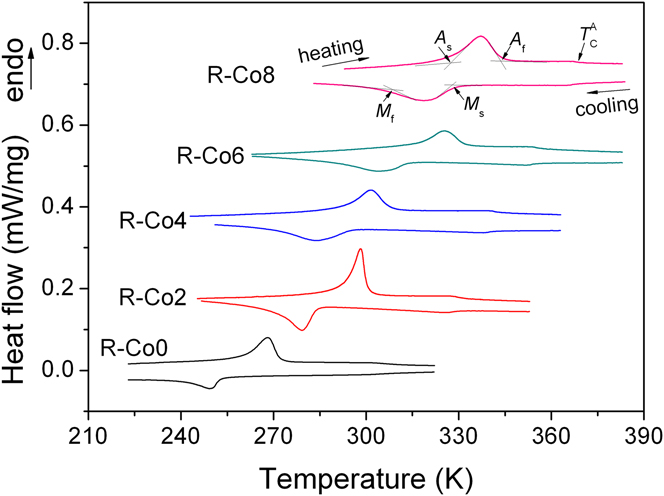
Figure 4 presents the DSC charts of the Ni–Mn–Sn–Co ribbons. The curves of R-Co2, R-Co4, R-Co6, and Co8 are shifted up for clarity. It is noticed that the transformational peaks shift progressively toward higher temperature regime with the Co addition. The characteristic transition temperatures, including reverse martensitic transition start and finish temperatures (A s and A f) and martensitic transition start and finish temperatures (M s and M f) are determined by a tangent method, as shown in the example of R-Co8. The weak exothermic (above A f) and endothermic peaks (above M s) upon heating and cooling, respectively, correspond to the magnetic transition of austenite ( $T_{\rm{C}}^{\rm{A}}$).
DSC charts of melt-spun Ni–Mn–Sn–Co ribbons. The curves of R-Co2, R-Co4, R-Co6, and R-Co8 are shifted up for clarity.

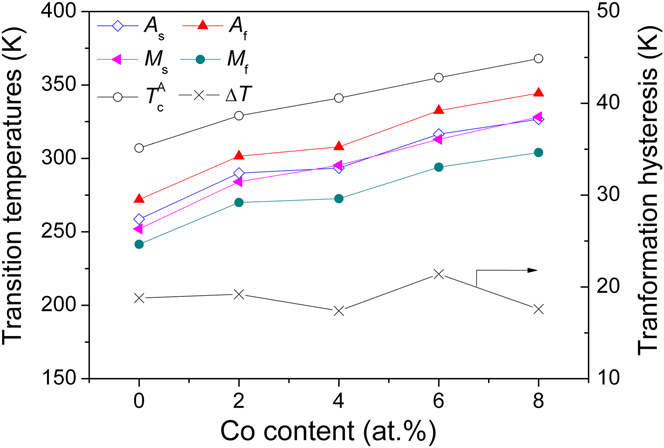
Figure 5 shows the compositional dependence of Co content on the martensitic/magnetic transition temperatures (M s, M f, A s, A f, and  $T_{\rm{C}}^{\rm{A}}$) and transformation hysteresis (ΔT). The transformation hysteresis (ΔT) is defined as the difference between the heat flow peak temperatures, which falls in the range around 18–20 K and varies slightly for all ribbons. The martensitic transition temperatures show a good linear relationship with the Co content, increasing about 8 K per at.% Co addition. Generally, the change in martensitic transition temperatures can be interpreted from the following two aspects. First, the phase transformation is closely associated with the valence electron concentration (e/a). It has been supposed that the L21-structured austenite is stabilized because the Fermi surface just touches the (110) Brillouin zone. Increasing e/a would overlap the Fermi surface and the (110) Brillouin zone, and thus lead to electrons above Fermi level moving to the corner states of the Brillouin zone. As a consequence, the excessive increase in system energy leads to the lattice distortion to minimize the free energy, i.e., the formation of martensite.Reference Smit20 In the present study, e/a increases from 8.11 to 8.18 with increasing Co content from 0 to 8 at.%. Here, it is assumed that the valence electrons per atom are 10 (3d 84s 2) for Ni, 7 (3d 54s 2) for Mn, 4 (5s 25p 2) for Sn, and 9 (3d 74s 2) for Co, respectively. It is clear that our results are in good agreement with the e/a-dependence rule.Reference Zayak, Adeagbo, Entel and Rabe21,Reference Krenke, Moya, Aksoy, Acet, Entel, Mañosa, Planes, Elerman, Yücel and Wassermann22 Second, the atom size effect originating from the unit-cell contraction of the high-temperature austenite would promote the martensitic transformation due to changes of the relative positions between the Fermi surface and the Brillouin zone.Reference Kokorin, Osipenko and Shirina23 The atom radii are 0.125 nm for Ni, 0.135 nm for Mn, 0.163 nm for Sn, and 0.126 nm for Co, respectively.Reference Chen, Yang, Lu and Qin24 As discussed above, since no secondary phase is formed in the studied ribbons, it is reasonably assumed that the unit-cell of the high-temperature L21 austenite would shrink with addition of smaller Co atoms. The calculated lattice parameters listed in Table I also support this point. In fact, the lattice contraction is evidenced from the fact that the diffraction peaks from L21 austenite shift toward high angles with Co addition in Fig. 1.Therefore, the atom size influences on the change of the transition temperatures to some extent in the present work.
Dependence of martensitic/magnetic transition temperatures and transformation hysteresis on the Co content.

Recently, the magnetic valence number (Z m) was proposed by Karaman et al. Reference Dogan, Karaman, Singh, Chivukula, Thawabi and Arroyave25 to describe the transition temperatures based on the fact that the spin-up d-band lies either entirely above or below the Fermi level in strong magnetic systems.Reference Williams, Moruzzi, Malozemoff and Terakura26 In the present study, the Curie temperature of austenite for all ribbons is higher than the martensitic transition start temperature, that is, the austenite is ferromagnetic prior to the martensitic transformation for all ribbons. The magnetic valence numbers are 0, 3, –4, and 1 for Ni, Mn, Sn, and Co, respectively,Reference Williams, Moruzzi, Malozemoff and Terakura26 and the Z m value increases monotonously from 0.69 to 0.715 with Co addition. However, recall that for the change of phase transition temperatures of the present ribbons, it is noticed that this is opposite to the Z m rule obtained in Co–Ni–Ga alloy system.Reference Dogan, Karaman, Singh, Chivukula, Thawabi and Arroyave25 There may be two reasons for this abnormal phenomenon: (1) the Z m rule is valid only in case of relatively lower e/a difference; and (2) the crystal structures of martensite in Ni–Mn–Sn–Co ribbons are complex in contrast to Co–Ni–Ga where only tetragonal martensite forms.Reference Dogan, Karaman, Singh, Chivukula, Thawabi and Arroyave25 The evolution of martensitic crystal structures in Ni–Mn–Sn–Co ribbons nicely fits our previous work in Ni–Mn–Sn bulk alloys.Reference Zheng, Wang, Xue, Zhai, Frenzel and Luo27,Reference Wang, Yu, Zhai, Luo and Zheng28
C. Magnetic transition of austenite
From Fig. 5, it is found that the magnetic transition temperature of austenite ( $T_{\rm{C}}^{\rm{A}}$) shows an increasing tendency with Co content, and the Z m factor applies well to the change in this case. It is well accepted that the magnetic transition strongly depends on the magnetic moment degree of matrix in Heusler Ni–Mn-based materials.Reference Dogan, Karaman, Singh, Chivukula, Thawabi and Arroyave25 Fecher et al. Reference Fecher, Kandpal, Wurmehl, Felser and Schönhense29 reported that the Curie temperature of Co2Fe-based Heusler alloys is linearly related to the total magnetic moments. The Curie temperature increases with increasing Z m in the Ni–Mn–Sn–Co ribbons, which is in agreement with the literature.Reference Dogan, Karaman, Singh, Chivukula, Thawabi and Arroyave25,Reference Sato, Okazaki, Furuya and Wuttig30,Reference Liu, Xia, Huang, Zheng and Li31 This fact can be explained as follows. First, Co atoms would work as ferromagnetic activator with Co addition to Ni–Mn–Sn and thus lead to ferromagnetic alignment of most Mn moments in the austenite.Reference Şaşıoğlu, Sandratskii and Bruno32–Reference Stager and Campbell34 Second, it has been proved that the Co–Mn ferromagnetic exchange interaction in Co2MnSn is several times larger than the Ni–Mn in Ni2MnSn based on density-functional studies.Reference Kurtulus, Dronskowski, Samolyuk and Antropov35 Similar results were presented by Han et al. in Mn2Ni1.64–xCoxSn0.36 alloys.Reference Han, Chen, Qian, Zhang, Jiang, Wang and Du36 It can be expected to strengthen the magnetic moments through partially replacing Ni–Mn exchange interaction by Co–Mn in Ni–Mn–Sn–Co ribbons. Lastly, the unit-cell shrinkage of austenite also favors the exchange interaction with doping smaller Co atoms. That is to say, the Co addition to Ni–Mn–Sn could effectively enhance ferromagnetic interaction of austenite and it is inevitable to cause an increase of the magnetic driving force against the thermal motion of lattice, and thus to promote the occurrence of the magnetic transition.
IV. CONCLUSIONS
In summary, the martensitic transformation of melt-spun (Ni49Mn39Sn12)100–xCox (x = 0, 2, 4, 6, 8) ribbons was investigated using x-ray diffraction, TEM, and thermal analysis. The following conclusions are obtained.
(1) The martensitic transition temperatures increase linearly about 8 K with 1 at.% Co addition, and the martensitic crystal structures evolve from 4O to 10M, and then 14M with increasing transition temperatures.
(2) The compositional dependence of martensitic transition temperatures is ascribed to the changes of valence electron concentration (e/a) and the unit-cell volume of high-temperature austenite.
(3) The Curie temperature of austenite increases with Co addition originating from the enhancement of ferromagnetic exchange interaction.
ACKNOWLEDGMENTS
The authors gratefully acknowledge the support from the National Natural Science Foundation of China (51201096), the Specialized Research Fund for the Doctoral Program of Higher Education of China (20123108120019), and the Scientific Research Foundation for the Returned Overseas Chinese Scholars, State Education Ministry.