Introduction
Antarctica is one of the most extreme environments on the earth and placing expeditioners outside the optimal physical, social and psychological parameters for performance (Steel, Reference Steel2016). Being exposed to these parameters requires an individual to significantly alter their pattern of thoughts and behaviour to be compatible with the surroundings. Adjustment typically refers to the rebalancing of one’s life practically, psychologically, and emotionally to new circumstances (de Ridder, Geenen, Kuijer, & van Middendorp, Reference de Ridder, Geenen, Kuijer and van Middendorp2008). Adjustment can result in an increase or decrease in distress, depending on the addition or subtraction of resources which an individual may utilise to cope (Crowley & Hobdy, Reference Crowley and Hobdy2003), thus suggesting that adjustment can be investigated through examining mood fluctuation patterns, hereafter referred to as mood fluctuations.
It has been theorised that mood fluctuations in expeditioners during Antarctic deployment are largely consistent across individuals or homogeneous (Bell & Garthwaite, Reference Bell and Garthwaite1987; Natani & Shurley, Reference Natani and Shurley1973; Sandal, Reference Sandal2002). This has been argued from the consistency in the physical and social parameters experienced and similarity in the psychological profiles of the expeditioners (Grant et al., Reference Grant, Eriksen, Marquis, Orre, Palinkas, Suedfeld and Ursin2007).
Parameters Influencing Mood Fluctuation in Antarctica
The physical, social and psychological parameters experienced by Antarctic expeditioners can be identified as being significantly removed from routine environments.
The physical parameters associated with Antarctic deployment are readily identifiable with Antarctica being characterised by extremely low temperatures (between −10oC and −60oC), extreme light–dark cycles and an overall reduction in environmental stimulation (Norris, Payton & Ayton, Reference Norris, Paton and Ayton2010). The physical parameters of Antarctica also make it impossible to sustain human life without technology, which provides protection from extreme temperatures, adequate food and water, and a livable environment which becomes the sole location for different functions or behaviours, such as work, leisure activities and socialising (Lugg, Reference Lugg2005). These physical parameters are in stark contrast to routine environments that are characterised by significantly warmer temperatures, stable light–dark cycles, significantly more environmental stimulation and less reliance upon technology for survival (Suedfeld & Steel, Reference Suedfeld and Steel2000).
The social parameters are sparse in comparison to routine environments that provide regular opportunities to socialise with a variety of people, across a diverse range of settings and contexts (Norris et al., Reference Norris, Paton and Ayton2010). During deployment, expeditioners not only have limited contact with their pre-existing social supports, but are forced to interact with a largely unchanging group of expeditioners, with factors such as age, gender and occupation, being significantly more homogeneous than those found in routine environments (Barnett & Kring, Reference Barnett and Kring2003).
The psychological parameters experienced by expeditioners are influenced by an individual’s perception, interpretation and response to the situation, rather than the physical or social environment (Barnett & Kring, Reference Barnett and Kring2003). A documented psychological response to deployment in Antarctica has been termed the ‘winter-over syndrome’, that is characterised by elevations in negative mood states, such as depression and anxiety, increased irritability and hostility, impairments in cognitive functioning such as memory and concentration, increases in psychosomatic complaints, fatigue, insomnia, and occurrences of mild hypnotic states, referenced to as the ‘Antarctic stare’ or ‘long-eye’ (Palinkas, Reference Palinkas2002). This constellation of symptoms has been identified as having similar impacts on expeditioner functioning as sub-clinical depression (Palinkas & Suedfeld, Reference Palinkas and Suedfeld2008).
Psychological Profile of Antarctic Expeditioners
The identification of expeditioners most likely to successfully adjust to deployment has been a core focus of research and National Antarctic programmes responsible for the selection, deployment and well-being of expeditioners.
To assist with this, most countries have adopted psychological screening and selection to minimise the risk of poor psycho-social adjustment (Lugg, Reference Lugg2005). These selection procedures aim to ‘select out’ unsuitable applicants due to a pre-existing, or an elevated risk of developing a psychiatric condition via psychological interviews and standardized testing (Palinkas et al., Reference Palinkas, Johnson, Boster, Rakusa-Suszczewski, Klopov, Fu and Sachdeva2004).
Following the application of the ‘select out’ criteria, psychological criteria are also utilised to ‘select in’ individuals with desirable characteristics, in an attempt to increase the likelihood of successful adjustment and performance during Antarctic deployment (John Paul, Mandal, Ramachandran & Panwar, Reference John Paul, Mandal, Ramachandran and Panwar2010). These ‘select in’ procedures commonly involve the identification of favourable personality characteristics to assist in the selection of expeditioners. Based on research, individuals high on conscientiousness, agreeableness, and affective stability (i.e., have low neuroticism), are viewed as favourable, as these traits have been identified as more adaptive and conducive to managing the extreme parameters experienced during the Antarctic deployment (Suedfeld & Steel, Reference Suedfeld and Steel2000). The earlier mentioned likelihood of expeditioners having a largely homogeneous psychological profile is further supported by the identification that Antarctic expeditioners have a smaller variation of personality characteristics than is seen within the general population (Rivolier et al., Reference Rivolier, Bachelard, Cazes, Gaud, Le Scanff, Rosnet and Sauer1998; Steel et al., Reference Steel, Suedfeld, Peri and Palinkas1997; Taylor, Reference Taylor1987).
Homogeneity of Mood Fluctuations in Antarctic Personnel
Although previous research has investigated the homogeneity of Antarctic expeditioners in research investigating mood and psychological adjustment via statistical assumptions associated with quantitative methods, such as analysis of variance, advances in statistical modelling may provide greater insight into the homogeneity of the population. Advances in statistical analysis also provide insight into whether moderating factors need to be investigated and analysed to explain the differences between any identified mood fluctuations. One such variable which has been suggested in the literature as impacting upon the mood fluctuations is the length and season for which the expeditioner is deployed.
Deployment Seasons in Antarctica
Antarctic deployments are typically divided into two distinct seasons – summer and winter, which differ along a spectrum with regard to the extreme physical and social parameters that an expeditioner experiences. The differing impact that deployment seasons may have on mood fluctuations can be argued as being implicitly suggested within the literature, as research investigating the psychological impacts of deployment in Antarctica has typically collected and analysed data collected from summer deployment seasons (Khandelwal, Bhatia & Mishra, Reference Khandelwal, Bhatia and Mishra2015; Peri, Scarlata & Barbarito Reference Peri, Scarlata and Barbarito2000; Ursin et al., Reference Ursin, Bergan, Collet, Endresen, Lugg, Maki and Olff1991) and winter deployment seasons (Barbarito, Baldanza & Peri, Reference Barbarito, Baldanza and Peri2001; Bhargava, Mukerji & Sachdeva, Reference Bhargava, Mukerji and Sachdeva2000; Chen, Wu, Li, Zhang & Xu, Reference Chen, Wu, Li, Zhang and Xu2016; Harris et al., Reference Harris, Marquis, Eriksen, Grant, Corbett, Lie and Ursin2010; McCormick, Taylor, Rivolier & Cazes, Reference McCormick, Taylor, Rivolier and Cazes1985; Nicolas, Suedfeld, Weiss & Gaudino, Reference Nicolas, Suedfeld, Weiss and Gaudino2016; Weiss & Gaud, Reference Weiss and Gaud2004; Weiss, Suedfeld, Steel & Tanaka, Reference Weiss, Suedfeld, Steel and Tanaka2000) separately, indicating they may not be comparable, and thereby not homogeneous. Yet an investigation of whether the deployment season has an impact upon the mood fluctuations in expeditioners has never been explicitly investigated within research.
Antarctic deployment during the summer season typically lasts between three to six months (Norris, Reference Norris2010) and is characterised by continuous daylight periods and more favourable weather conditions, with temperatures ranging between 0oC and −10oC (Palinkas et al., Reference Palinkas, Johnson, Boster, Rakusa-Suszczewski, Klopov, Fu and Sachdeva2004). These more favourable weather conditions allow habitation beyond the confines of the base. In comparison to this, the winter season typically lasts between eight to ten months and is characterised by several months of complete darkness, with temperatures falling below −40oC (Norris, Reference Norris2010), which makes life impossible without the life support system, with the research bases becoming the location for all daily activities.
The social milieu of Antarctic bases also differs between summer and winter. During the summer, Antarctica is inhabited by significantly more expeditioners, from a wide range of vocational roles (Palinkas et al., Reference Palinkas, Johnson, Boster, Rakusa-Suszczewski, Klopov, Fu and Sachdeva2004). This larger population of individuals creates a hive of activity within the bases and a high-pressure environment (Palinkas et al., Reference Palinkas, Johnson, Boster, Rakusa-Suszczewski, Klopov, Fu and Sachdeva2004). This is in contrast to population sizes on these bases during the winter period, creating a ‘skeleton crew’, whose primary job is to keep the stations operational (Tothill & Martin, Reference Tothill and Martin2012). This smaller group of expeditioners during the winter season increases the likelihood of social monotony and isolation, as there is a very limited group of individuals to interact with (Leon, Sandal & Larsen, Reference Leon, Sandal and Larsen2011).
Deployment season is also associated with deployment length, with a summer deployment lasting three to six months and winter deployment lasting seven to ten months. Deployment periods may also involve a combination of both summer and winter deployments, resulting in them being present or ‘on the ice’ for between 11 and 18 months (Norris, Reference Norris2010).
Phases of Deployment
A majority of research investigating mood fluctuations during Antarctic deployment has focused on mood fluctuations ‘on the ice’ (Norris et al., Reference Norris, Paton and Ayton2010). However, Antarctic deployment starts long before the individual reaches Antarctica, and continues post the expedition. In fact, Antarctic deployment can be broken down into four phases. The pre-deployment phase encompasses from when the individual finds out they will be working in Antarctica till the physical departure (Parcell & Maguire, Reference Parcell and Maguire2014). The second phase is the absence phase in which the expeditioner is physically working ‘on the ice’. The third phase, known as the reunion phase, consists of when the personnel returns home and can continue for two to three months, with the final phase, termed the reintegration period, typically following the reunion phase and can last for up to a year or more, depending on the circumstances and changes which have occurred during the deployment period (Norris, Reference Norris2010). Including all the phases of deployment within a model investigating the mood fluctuations to Antarctic deployment provides greater opportunity to have a holistic picture of Antarctic deployment (Norris, Reference Norris2010), and acknowledges the interactive processes of mood fluctuations across phases of deployment identified in other vocations requiring prolonged separation from home (Busuttil & Busuttil, Reference Busuttil and Busuttil2001).
Rationale
This study aims to address the following research question:
Across all phases of Antarctic deployment, are mood fluctuations in expeditioners homogeneous?
Identifying if mood fluctuations are homogeneous for expeditioners can be utilised to provide insight into the nature and timing of psychological services and prevention strategies to assist with any increases in distress, which may not only be detrimental to the individual, but the broader team with whom they are working, and to sustain well-being derived from meaningful work into reintegration. Furthermore, it will provide insight into whether these prevention and interventions strategies should differ depending on the deployment length and season the expeditioner is deployed for.
Method
Participants
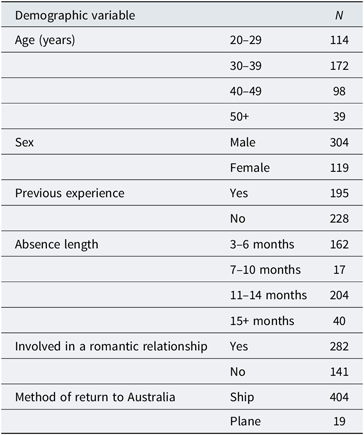
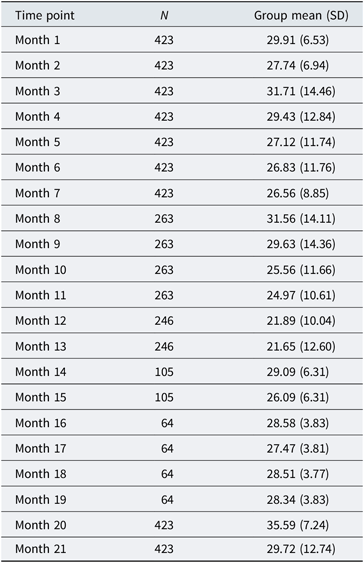
The original sample comprised 482 expeditioners, however, as incomplete data sets were excluded from the analysis, the final sample comprised of 423 expeditioners (304 male, 119 female), representing retention rates of 87.76%. All expeditioners were recruited from the Australian-Antarctic programme during the 2005/2006, 2006/2007 and 2007/2008 summer and winter deployment seasons. See Table 1 for additional participant characteristics and Table 2 for descriptive statistics.
Demographic information of participants

Descritpive statistics for total distress scores

Note: Month 1 = pre-deployment distress rating, Month 20 = reunion distress rating and 21 = reintegration distress rating. N = number of participants at time point. SD = Standard Deviation.
Materials
Hopkins symptoms checklist – 21 (HSCL-21)
The HSCL-21 (Green, Walkey, McCormick & Taylor, Reference Green, Walkey, McCormick and Taylor1988) is a 21-item self-report inventory measuring current levels of health, well-being and psychological distress. The scale comprises three subscales assessing performance difficulties, general distress and somatic distress, as well as providing a total distress score. The total distress score was used in this study and selected as changes in mood states can result in not only an increase (or decrease) in distress, but also somatic symptoms (somatic distress) and the ability to carry out tasks (performance difficulties). Participants reported how stressed they had been in the past 7 days on a 4-point Likert scale, from 1 (not at all) to 4 (extremely). Possible sub-scale scores range from 7 to 28, with higher scores indicating higher levels of distress. Scores range from 21 to 84, with higher scores indicating higher levels of distress. Cronbach’s alpha for this study was 0.93 for the total distress subscale.
Procedure
This study was approved by the Australian Antarctic Division Ethics Committee (Human Experimentation) and the Southern Tasmanian Human Research Ethics Committee.
Participants were recruited for the study via verbal presentations delivered during pre-departure training. Consenting expeditioners were provided with a copy of the questionnaire prior to departure, on the last day of each month during the absence period, and at both two months and twelve months post return to Australia from Antarctica. All questionnaires were received by email or mail and returned via email, fax or mail.
Analysis
Latent class growth analysis (LCGA) was used to identify if the sample included in the analysis was homogeneous. LCGA is a semi-parametric technique which can be used to identify distinct sub-groups of individuals which follow a similar pattern of change over time within a dataset (Andruff, Carraro, Thompson, Gaudreau & Louvet, Reference Andruff, Carraro, Thompson, Gaudreau and Louvet2009). Within LCGA, a person-centred approach is taken and the focus is on the relationships between individuals, rather than the relationships between dependent and independent variables, which is commonly seen within a variable-centred approach (Jung & Wickrama, Reference Jung and Wickrama2008; Muthén, Reference Muthén2004). LCGA assists with the identification of whether a sample can be described by a singular growth trajectory, or if individuals in the sample can be members of several sub-populations (known as classes), and thus be best described by a number of growth trajectories (Muthén, Reference Muthén2004). Within each class, the individual growth trajectories are characterised as homogeneous (Andruff et al., Reference Andruff, Carraro, Thompson, Gaudreau and Louvet2009). Once an optimal number of classes are identified, predictor variables can be subsequently added to the model to determine whether certain factors help distinguish individuals into different classes (Nagin, Reference Nagin2005), thus providing insight into the heterogeneity between classes, or sub-groups of individuals. Therefore, by grouping individuals based upon their similar trajectories, heterogeneity can be considered and provide insight into whether mood fluctuations in Antarctica expeditioners are homogeneous, as indicated by the identification of 1-class, or heterogeneous, as indicated by the identification of multiple classes within the dataset. If heterogeneity is identified, LCGA then allows subsequent predictor variables, such as absence length, to be added to the model to investigate if this explains the difference between classes.
LCGA assumes all variance and covariance for growth factors within each class are fixed at zero, which allows faster model convergence (Andruff et al., Reference Andruff, Carraro, Thompson, Gaudreau and Louvet2009). This is acceptable as individual differences are captured by the multiple trajectories included in the model (Muthén, Reference Muthén2004). The identification of the optimal number of classes in LCGA is determined by model fit indices.
Model fit indices
The optimal number of latent classes with the model was selected using guidelines outlined by Jung and Wickrama (Reference Jung and Wickrama2008). Specifically, the relative fits of 1–4 class models were compared using: Bayesian information criterion (BIC), Akaike’s information criterion, sample-size adjusted BIC (adjusted BIC) and entropy.
Although several formal statistical criteria have been identified to assist in the selection of the optimal model fit for the dataset in LCGA, it is also strongly suggested that theoretical considerations also be taken into consideration when selecting the optimal model fit (Jung & Wickrama, Reference Jung and Wickrama2008). The integration of pre-existing theoretical understanding to help guide model selection is due to the relative, rather than absolute, statistical selection criteria for selecting the optimal model fit (Nagin, Reference Nagin2005). Therefore, having a prior knowledge about the number of trajectories is considered preferable to provide conceptual support for the model. Based on the qualitative argument suggesting that mood fluctuations in expeditioners are largely homogeneous, there is conceptual support for a 1-class model.
Sample size
To conduct LCGA, the required sample sizes are quite large. However, it has been identified that a sample size of 300 has acceptable results in a Monte Carlo simulation study (Muthén, Reference Muthén2004), thus it was feasible to conduct LCGA on the current sample.
Analysis approach
The present analysis used Mplus version 7.4. An initial single class unconditional LCGA, characterised by the HSCL-21 total distress scores of the participants over time was conducted with linear, quadratic and cubic slopes to investigate the shape of the data. A series of subsequent unconditional models were then run, increasing in class number with each iteration using guidelines outlined (Jung & Wickrama, Reference Jung and Wickrama2008). If multiple classes were identified in the model, a conditional LCGA, including the predictor variable of ‘absence length’, was to be used to investigate whether this variable could explain the heterogeneity between classes.
Results
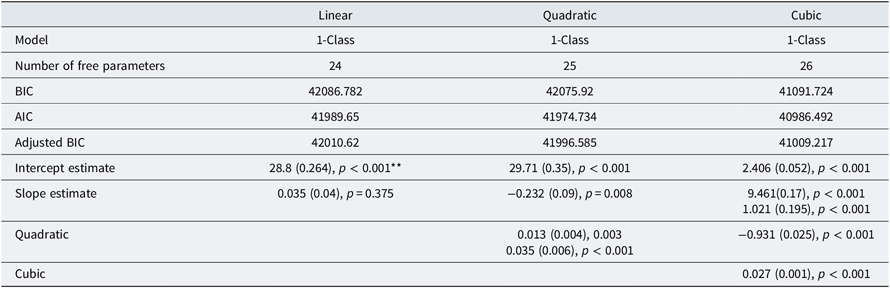
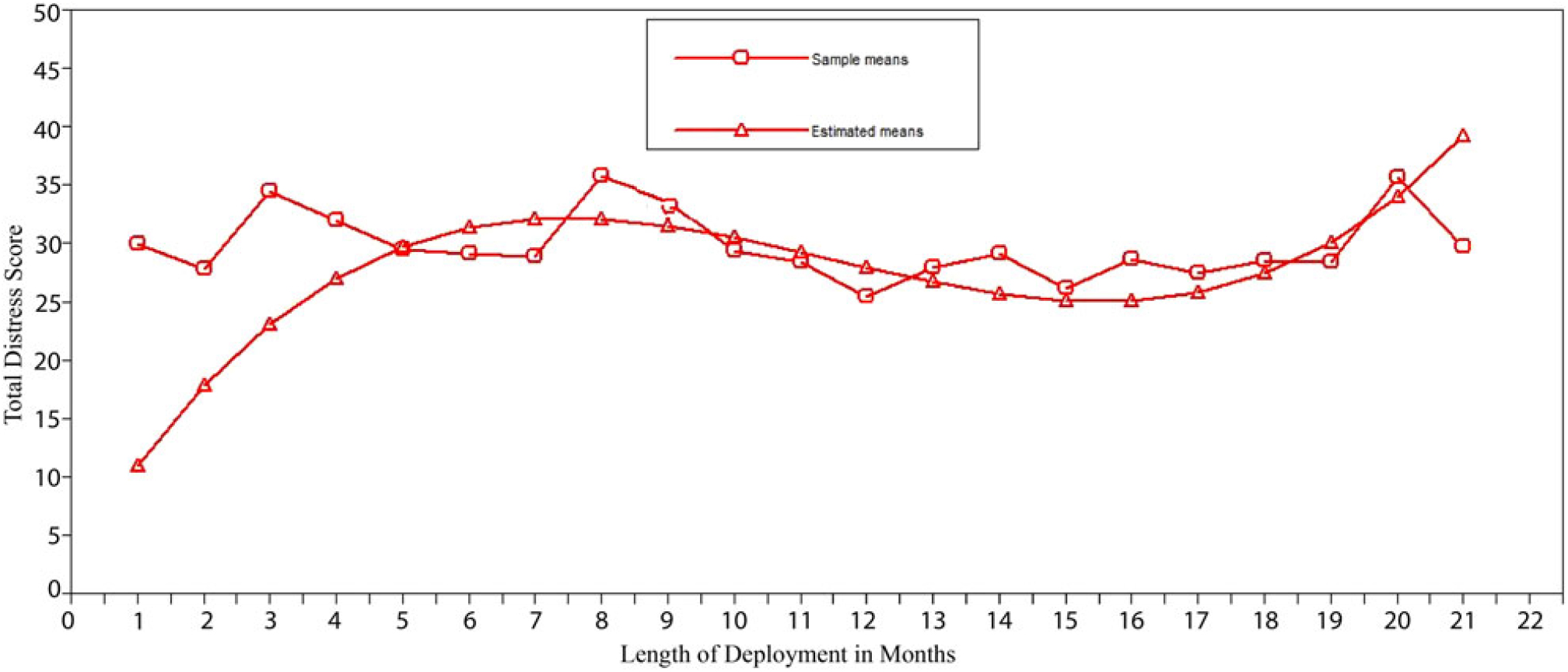
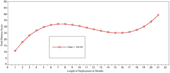
An initial unconditional 1-class model with only linear, linear and quadratic, and linear quadratic and cubic slope terms was modelled (Table 3). The significant cubic slope term and lower BIC value suggest that the unconditional latent growth curve with a cubic shape is the better fit (Fig. 1), therefore the linear, quadratic and cubic change parameters were included in subsequent models. A visual inspection shown in Fig. 1 suggests that the expeditioners within the current sample experienced two peaks in distress; the first during the initial stage of deployment, followed by a decrease in distress as deployment progressed, and a second increase in distress in the final month of deployment, the reunion and reintegration phases
Summary of model fit statistics for the unconditional linear, quadratic and cubic models

Note: BIC = Bayesian information criterion; AIC = Akaike’s information criterion; Adjusted BIC = sample-size-adjusted Bayesian information criterion; ** = p < 0.001.
Unconditional model with cubic change parameters. Note: Month 1 = pre-deployment distress rating, Month 20 = reunion distress rating and 21 = reintegration distress rating.

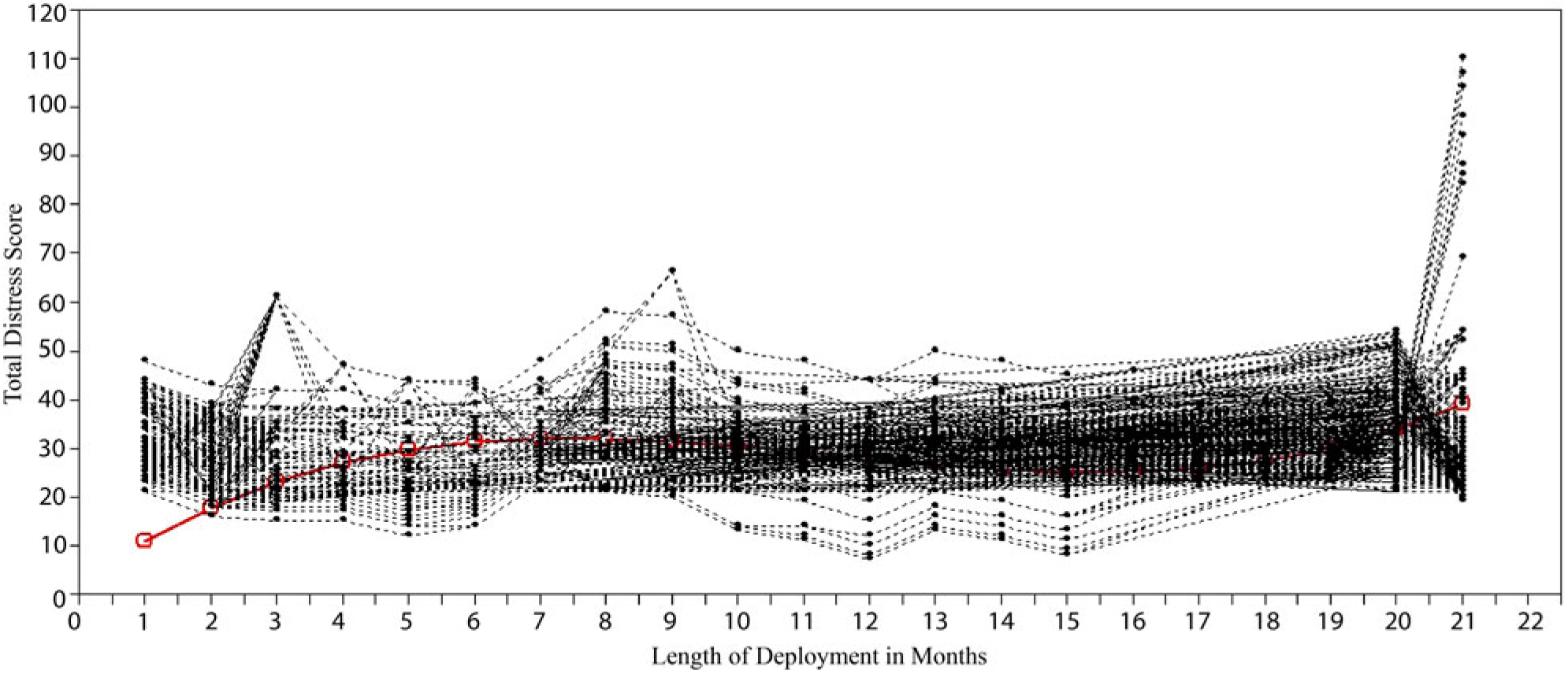
As shown in Table 4, subsequent unconditional models with cubic slope terms were modelled ranging from 1-class models to 4-class models. Mplus parameter defaults options were used, while variances were set to zero. Results showed support for a 1-class model (Figs. 2 and 3). This decision was made based on the consideration of all the model fit indices and conceptual consideration stemming from the pre-existing literature. Although the BIC was lower for the 2-class model (40515.57), in comparison to the 1-class model (BIC = 41091.72), investigation of the LMR and BLRT for the 2-class model was non-significant, therefore indicating no improvement to the model including 2 classes, in comparison to the 1-class model. Consideration of the average latent class probabilities values was also taken into consideration, with only 8% of individuals falling into class 1 in the 2-class model. This falls below the recommendation that class sizes should include at least 10% of participants (Dunn, Campbell & Jordan, Reference Dunn, Campbell and Jordan2013), thus it is not considered a reliable class. As well as support for a 1-class model based off the model fit indices, the 1-class model holds conceptual support and is in line with the theoretical argument that the mood fluctuations experienced by expeditioners are homogeneous.
Summary of model fit statistics for the unconditional cubic models ranging from models with 1-Class to 4-Classes

Note: BIC = Bayesian information criterion; AIC = Akaike’s information criterion; Adjusted BIC = sample-size-adjusted Bayesian information criterion; LMR = Lo-Mendell-Rubin likelihood ratio test; Adjusted LRT = Bootstrapped likelihood ratio test; C1- Class 1; C2 = Class 2; C3 = Class 3; C4 = Class 4.
1-Class cubic latent class growth model. Note: Month 1 = pre-deployment distress rating, Month 20 = reunion distress rating and 21 = reintegration distress rating.

Individual expeditioner distress scores within the 1-Class cubic latent class growth model. Note: Month 1 = pre-deployment distress rating, Month 20 = reunion distress rating and 21 = reintegration distress rating.

As a 1-class model was identified as the optimal fit for the dataset, subsequent conditional LCGA wase not conducted, as there was no heterogeneity between classes to be investigated.
Discussion
The primary aim of this study was to investigate, across all phases of Antarctic deployment, if mood fluctuations in expeditioners are primarily homogeneous regardless of deployment length and deployment season. Overall, a 1-class cubic model was identified as having the most optimal fit for the data, therefore suggesting that mood fluctuations in expeditioners are largely homogeneous.
The notion that mood fluctuations in expeditioners are largely homogeneous has been a long-standing postulation from a qualitative perspective when taking into consideration the common psychological profile of expeditioners (Steel et al., Reference Steel, Suedfeld, Peri and Palinkas1997) due to the rigorous selection process, undertaken by Antarctic research divisions (Lugg, Reference Lugg2005) and the unique physical and social parameters experienced by all expeditioners during Antarctic deployment (Suedfeld & Steel, Reference Suedfeld and Steel2000).
From a theoretical perspective, the rigorous selection procedures employed to identify expeditioners who are most likely to cope with the extreme parameters experienced in Antarctica may provide insight into why mood fluctuations are primarily homogeneous. It has already been identified within research that the individuals who apply to work in Antarctica have smaller variations in personality characteristics than is seen within the general population (Steel et al., Reference Steel, Suedfeld, Peri and Palinkas1997). An individual’s personality profile has been identified as influencing how an individual will cope in new situations (Carver & Connor-Smith, Reference Carver and Connor-Smith2010), with effect sizes investigating the influence that coping has on psychological adjustment typically being within the small-to-moderate range (Clarke, Reference Clarke2006). Additionally, specific coping responses are more strongly associated with certain personality traits. As previously indicated, ‘select in’ procedures aim to identify individuals high in emotional stability (or low neuroticism), conscientiousness and agreeableness, as these traits have been identified as being more adaptive and conducive to managing the extreme parameters experienced during deployment (Leon et al., Reference Leon, Atlis, Ones and Magor2002; Suedfeld & Steel, Reference Suedfeld and Steel2000). Individuals with personality profiles high in emotional stability, conscientiousness and agreeableness have been identified as being more likely to engage in specific coping recourses such as problem-solving, cognitive restructuring and seeking out social support to assist them in coping with stressors (Clarke, Reference Clarke2006). Therefore, if expeditioners are more likely to engage in similar coping responses to stressors during their deployment, it may increase the likelihood of a similar mood fluctuation patterns occurring.
The nature and severity of stressors has also been identified as moderating the relationship between personality and coping (Carver & Connor-Smith, Reference Carver and Connor-Smith2010). It can be argued that the nature and severity of the stressors experienced by all expeditioners have a smaller degree of variability between expeditioners, compared to those in the general population, due to the unique physical and social parameters experienced during Antarctic deployment (Suedfeld & Steel, Reference Suedfeld and Steel2000). Therefore, due to the capsulised living environment, exogenous factors, which would typically moderate how certain personality profiles cope and adjustment, are held constant, leading to a more homogeneous pattern in mood fluctuations.
The results from this study also suggest that the pattern of psychological adjustment in expeditioners is homogeneous regardless of deployment length or season. It has been suggested in research that the psychological adjustment in expeditioners may differ between the winter and summer deployment season, due to differences such as deployment length and differences in environmental characteristics including weather conditions, temperature and light/day cycles (Norris et al., Reference Norris, Paton and Ayton2010). However, the results in the current study suggest that a 1-class cubic model was the most optimal fit for the data despite having data included from expeditioners deployed during summer deployment periods, winter deployment periods and both deployment seasons continuously (variable absence length: see Table 1), therefore suggesting that regardless of deployment season or length, mood fluctuations in the current sample is largely homogeneous.
This finding also suggests that deployment season, or length, may not be a key contributor to mood fluctuations experienced by expeditioners during deployment, as a largely homogenous pattern was identified, even though the data set had been collected from several different deployment seasons, and different deployment lengths. This finding similarly supports the notion that it may be how an expeditioner copes, and the specific coping resources used, which influences mood fluctuations, and not necessarily the physical and social parameters, or the deployment season and deployment length, they experience. Research has indicated that there is a degree of consistency in coping when individuals use similar coping strategies on a repeated basis to deal with an ongoing stressor over time (Compas, Forsythe & Wagner, Reference Compas, Forsythe and Wagner1988). It can be identified that regardless of the deployment season, or length, the resources available, or more specifically unavailable to the expeditioners, due to the living environment in Antarctica, remain consistent, therefore limiting factors which are known to create variability in coping (Bonanno & Burton, Reference Bonanno and Burton2013). Therefore, the factors which may create variability in coping patterns between expeditioners deployed during different seasons, or for differing lengths of time, can be identified as being relatively constant and may provide insight into why a homogenous mood fluctuation pattern was identified in expeditioners, regardless of deployment season or length.
Theoretical and Practical Implications
The identification of homogeneous mood fluctuations in the current sample has theoretical implications. The mood fluctuation pattern in the current sample was best fitted with a cubic curve, therefore suggesting that mood fluctuations in expeditioners in non-linear in nature. A visual inspection of Figs. 1 and 2 suggests that the expeditioners within the current sample experienced an increase in distress during the initial stage of deployment, followed by a decrease in distress as deployment progressed, followed by a final increase in distress in the final month of deployment, the reunion and reintegration phases. Interestingly this cubic curve pattern does no support the notion of a third quarter phenomenon (TQP), as no increase in distress can be seen at the third quarter point within the current sample. Furthermore, if the TQP was evident, it would be assumed that multiple classes would have been identified to provide an optimal fit for the data to account for differing peak distress points associated with differing deployment lengths, rather than the identification of a 1-class model as the optimal fit. This finding is consistent with research identifying that the presence of the TQP is inconsistent within research (Ehmann, Altbäcker & Balázs, Reference Ehmann, Altbäcker and Balázs2018; Hawkes & Norris, Reference Hawkes and Norris2017).
Although the current project did not have the scope to explore all factors which have been hypothesised to influence mood fluctuations (e.g., sex, nationality, number of deployments on the ice, relationship status during deployment) (Ursin et al., Reference Ursin, Bergan, Collet, Endresen, Lugg, Maki and Olff1991), the results did suggest that regardless of the deployment season or length, there is a primarily homogeneous pattern. This suggests that factors which influence mood fluctuations in expeditioners may be readily identifiable across both deployment seasons. Therefore, future research should aim to look at factors which are consistent across the deployment seasons, such as expeditioner nationality, length of work shifts and pre-deployment training, as this may assist in identifying factors which can assist, or may adversely impact upon, expeditioner well-being.
From a practical perspective, the identification of a primarily homogeneous pattern suggests that psychological interventions and prevention strategies may not have to be altered depending on the deployment season, or deployment length, in which the expeditioner is deployed. Taking this into consideration, along with previous research indicating preventative intervention strategies may hold the most utility in assisting expeditioners undergoing psychological adjustment during deployment (Hawkes & Norris, Reference Hawkes and Norris2017), Antarctic research organisations responsible for the deployment of expeditioners, and their well-being will be able to develop generalisable support strategies to best support their expeditioners during deployment regardless of deployment seasons.
Strengths and Limitations
A key strength of this study is the sample size. A common methodological limitation in research investigating the psychological impact of Antarctic deployment is the small sample sizes (Chen et al., Reference Chen, Wu, Li, Zhang and Xu2016). The key factors contributing to these small sample sizes include the limited population available to participate in the research and the necessary requirement of voluntary participation (Hawkes & Norris, Reference Hawkes and Norris2017). This study overcame this common methodological limitation in Antarctic research by collecting data from expeditions across multiple Antarctic deployment seasons. The larger sample also allowed this study to utilise LCGA to investigate whether the current dataset was one homogeneous population, or included multiple homogeneous subpopulations within a larger heterogeneous population (Jung & Wickrama, Reference Jung and Wickrama2008). This study also included data collected from all phases of Antarctic deployment, which can be identified as a strength, as a majority of research investigating the psychological impact of deployment in Antarctica can be identified as focusing only on the absence phase, and thus not providing a holistic picture of the deployment experience for expeditioners.
Several limitations must be acknowledged in this study, including the common limitation in longitudinal research of missing data. To overcome this, missing data were handled utilising full information maximum likelihood estimation (FIML). FIML is a widely accepted method for handling missing data and is commonly implemented in growth modelling techniques, such as LCGA (Muthén, Reference Muthén2004), therefore it was considered appropriate in the present study. Additional limitations relate to the nature of the data, specifically the nationality of the participants and the age of the data. Firstly, the current sample was primarily the same nationality, and thus, may not be generalisable to multinational expedition teams. Investigation of how multinational teams adjust to deployment in the Antarctic has been identified as an area which needs further investigation (Zimmer, Cabral, Borges, Côco & Hameister, Reference Zimmer, Cabral, Borges, Côco and Hameister2013). The data in the current research are also over 10 years old. This is a limitation as there have been a number of changes in Antarctic deployment over the past decade, primarily related to infrastructure and technologies available to support human habitation (such as increased internet access). However, limited change has occurred in the fundamental nature of selection, training and deployment experiences during this period. Furthermore, station composition in terms of roles and gender ratios has largely remained constant over this time. Further, as the data referred to were obtained from multiple cohorts over multiple years (2005–2008), this does suggest a degree of stability of the findings independent of a given population at a single time-point as has been used in other studies. Overall, this study supports the long-standing notion that mood fluctuations in expeditioners are primarily homogeneous and can assist in the development and implementation of interventions for expeditioners.
Author ORCIDs
Clare Hawkes, 0000-0001-5326-1886; Kimberley Norris 0000-0003-3661-2749