1 Introduction
The realization of English syllable-final coronals, /n/ in particular, is known to be highly variable and prone to assimilation. As shown in (1), the alveolar /n/ undergoes optional place assimilation to [m] before labials (a), to [ŋ] before velars (b), and to [n̪] or [n̠] before dentals and post-alveolars (c) (Jones Reference Jones1962: 169, 171, 226–7).
(1)
(a) te[n] minutes ~ te[m] minutes
Londo[n] Bridge ~ Londo[m] Bridge
I'll soo[n] bring them ~ I'll soo[m] bring them
(b) u[ŋ]grateful, e[ŋ]courage
(c) i[n̪] there, e[n̪]thusiasm
e[n̠]roll
Similar observations are made by Gimson (Cruttenden Reference Cruttenden2014: 213), who specifically notes that ‘[t]he place of articulation of /n/ is particularly liable to be influenced by that of the following consonant’. His examples of /n/ assimilation in (2) involve (a) labial, (b) labio-dental, (c) dental, (d) post-alveolar and (e) velar realizations. Gimson also notes that such changes are typical of colloquial speech, although native speakers are usually unaware of them.
(2)
(a) te[m] people, te[m] boys, te[m] men
(b) i[ɱ]fant, i[ɱ]voice, o[ɱ] fire, i[ɱ] vain
(c) te[n̪]th, whe[n̪] they
(d) u[n̠]rest, He[n̠]ry
(e) te[ŋ] cups, te[ŋ] girls, I've bee[ŋ] gardening
Together these and other descriptive phonetic (e.g. Rogers Reference Rogers2000) and formal phonological accounts (e.g. Clements Reference Clements1985; Borowsky Reference Borowsky1986; Baković Reference Baković and Lacy2007; Gussenhoven & Jacobs Reference Gussenhoven and Jacobs2017) highlight that the syllable-final English alveolar nasal is highly variable both within and across words, adopting the place of articulation of the following consonant. Some of the changes are allophonic, producing non-phonemic nasals (e.g. /n/ to [n̪] or [n̠]), while others are neutralizing, producing nasals that are phonemic (/n/ to [m] or [ŋ]). Many of these changes are optional, being more probable in casual, colloquial speech.
The accounts mentioned above, however, are arguably overly general, as assimilation patterns do not necessarily involve categorical changes (e.g. /n/ → [m] or [ŋ]), but rather gradient, partial changes (see Nolan & Kerswill Reference Nolan, Kerswill and Ramsaran1990; Nolan Reference Nolan, Robert Ladd and Docherty1992). Moreover, patterns of assimilation are often highly variable across individuals, with some speakers more likely to produce assimilation (Ellis & Hardcastle Reference Ellis and Hardcastle2002). Such findings are typical of the recent instrumental phonetic studies reviewed in section 1.1 below, particularly those conducted using electropalatography (EPG; Gibbon & Nicolaidis Reference Gibbon, Nicolaidis, Hardcastle and Hewlett1999). Although extensive in nature, previous articulatory work on English nasal assimilation has rarely examined more than one or two phonetic contexts per study, typically focusing on a handful of utterances with little variation in the type of stimuli used and in the prosodic environments. Moreover, previous articulatory work on English nasal assimilation has studied British and, to a lesser extent, Australian varieties exclusively, raising questions as to whether the patterns found hold for other varieties.
In this article, we present results from a relatively large-scale articulatory investigation of word-final /n/-realization before consonants of all places and manners of articulation, and in different sets of data produced by three speakers of Canadian English. Our focus is on variation related to phonetic context and individual patterns of assimilation in different types of read speech – both carrier sentences and texts. In addition to contributing a new dataset and thus furthering our understanding of nasal assimilation across English varieties, we seek to achieve a better understanding of the place of English within the cross-linguistic typology of nasal assimilation.
The article is organized as follows. The remainder of this section reviews previous articulatory and acoustic work on English nasal assimilation and outlines the research questions of the study. Section 2 describes the methods; section 3 presents the results, organized separately by three datasets. Section 4 concludes with a discussion of the results within the context of previous phonetic work on nasal assimilation in English and other languages.
1.1 Previous articulatory studies of /n/ place variability
Barry (Reference Barry1985, Reference Barry1991) was among the first researchers to conduct an articulatory investigation of English nasal assimilation. Using EPG, he examined the realization of alveolar nasals before velars (e.g. in sequences such as hand grenade) in fast speech produced by several speakers of British English. He found that /n/-realizations fell into three broad categories involving either a full coronal gesture (with alveolar closure), a weakened coronal gesture (showing residual alveolar contact) or a velar-only gesture. The first two realizations were typically co-produced with an overlapping velar gesture, with greater overlap being observed in faster speech. The latter realization included the apparent deletion of the coronal gesture and an extension of the following velar gesture, thus involving categorical assimilation.
Hardcastle (Reference Hardcastle and Windsor Lewis1995) followed up on this work by examining pre-velar nasal (and stop) assimilation in a larger group of seven, mostly Southern British English speakers. His utterance list included a single sentence with three instances of /n/ before velars: Fred can go, Susan can’t go, and Linda is uncertain, produced by each speaker five times. This author also found that nasals either retained their alveolar gesture, being realized with a complete or partial closure ([n] or [n̞]), or lost it, assimilating to the following velar ([ŋ]). Complete and incomplete (partial closure) alveolars were always overlapped with velars, except in very careful speech. Overall, assimilated nasals (i.e. velar-only realizations) were much more common in the data than unassimilated alveolars, accounting for over 80 percent of tokens on average. Such realizations were slightly more common in the function word can than in the content word Susan, and less common in can't go, where the nasal was separated from the velar by an underlying /t/. Hardcastle noted, however, that differences in assimilation rates could also be due to differences in prosodic structure and vowel context, factors that were not controlled for in his study.
In a subsequent study, Ellis & Hardcastle (Reference Ellis and Hardcastle2002) explored interspeaker variability in velar assimilation. EPG data were collected from ten speakers (nine speakers of various varieties of British English as well as one Australian speaker) who produced two sentences involving /n/ + /k/ (It's hard to believe the ban cuts no ice) and /ŋ/ + /k/ sequences (I've heard the bang comes as a big surprise). Ten repetitions of each phrase were elicited at both slow and fast speech rates, intended to elicit careful and casual productions, respectively. Virtually no assimilation in the /n#k/ sequence was observed in the slow condition, a result that contrasted with the rather high rates of assimilation witnessed in Hardcastle (Reference Hardcastle and Windsor Lewis1995). In the fast condition, marked individual differences were observed: two speakers showed no assimilation in any of their repetitions; four speakers consistently produced what appeared to be categorical assimilations ([ŋk]); and the other four speakers showed variation between assimilated and unassimilated realizations. Among the latter four speakers, two showed a continuum ranging from fully realized alveolar closures to partially reduced (and strongly overlapped) alveolars, to fully deleted/assimilated velar nasals indistinguishable from phonemic /ŋ/. In contrast, the other two speakers in this latter group produced a binary distinction – nasal tokens involved either complete alveolars or assimilated velars. A follow-up experiment involving these two speakers using electromagnetic articulography (EMA, which tracks the movement of coils attached to the mid-sagittal plane of the tongue) confirmed the participants’ binary realization of alveolar-to-velar assimilation. Overall, the results of this study highlight the importance of paying close attention to individual production patterns in the realization of final nasals. As the authors conclude, some speakers are more prone in general to assimilate than others, and those who assimilate may use different strategies – categorical assimilation, gradient assimilation or a combination of the two.
Some individual differences in assimilation, as noted by Ellis & Hardcastle (Reference Ellis and Hardcastle2002), could be attributed to the speakers’ dialect. ‘Less-assimilating’ participants in that study were from Scotland and northeastern England, while ‘more-assimilating’ ones were Southern British English speakers. Apart from British English, only Australian English speakers have been studied in previous EPG investigations of place assimilation. The three Australian speakers in Stephenson & Harrington's (Reference Stephenson and Harrington2002) study showed variation in the realization of the /n/ + velar sequences produced in nonsense compounds that was very much similar to that observed in Ellis & Hardcastle's (Reference Ellis and Hardcastle2002) study of British English. Specifically, two of their speakers exhibited high (approximately 90 percent) rates of categorical assimilation, with only a few unassimilated alveolar tokens; the third speaker showed considerable variation with tokens of no assimilation, gradient assimilation (and overlap) and categorical assimilation. Overall, it remains unclear whether variation in English place assimilation is driven by dialect or individual differences.
The studies reviewed above were crucial for discovering the extent of the phonetic variation in the realization of English word-final nasals. The focus of this previous work, nevertheless, was exclusively on nasal + velar sequences. To date, little articulatory research on English has examined the realization of alveolar nasals before labials or coronals (other than alveolar stops). The reason for this restrictiveness lies perhaps in theoretical assumptions of Articulatory Phonology (Browman & Goldstein Reference Browman and Goldstein1989, Reference Browman and Goldstein1992), the framework that inspired many earlier studies of assimilation (Barry Reference Barry1991; Nolan Reference Nolan, Robert Ladd and Docherty1992; Zsiga Reference Zsiga, Connell and Arvanti1995). Within Articulatory Phonology, gestures are assumed to interact when they occur on the same representational tier (e.g. the tongue tip for alveolars and post-alveolars such as /s/ and /ʃ/) or minimally involve the same articulator (e.g. the tongue tip and tongue body gestures for /n/ and /k/). As coronals and labials do not share the same oral gesture or articulator, no articulatory-based assimilation is thus expected. Cases of assimilation as in te[m] people (see (1)), on this view, are understood to be perceptually based: as the tongue tip gesture for /n/ is overlapped by the following labial gesture, the place of the former becomes more confusable and is interpreted by listeners as assimilation (Byrd Reference Byrd1992). On this view, therefore, assimilation processes in nasal + velar and nasal + labial sequences are inherently different: the former result from the articulatory interaction of overlapped gestures on the same tier, the latter from perceptual misinterpretation of overlapped gestures on different tiers. While in the first case the tongue tip gesture of /n/ is gradiently reduced and coarticulated to the following velar /k/ or /ɡ/, in the second case the tongue tip gesture is not reduced or coarticulated, being unaffected by the labial /p/ or /b/ (apart from general syllable-final reduction; Browman & Goldstein Reference Browman, Goldstein, Bell-Berti and Raphael1995). Note that this is in contrast to many traditional phonological analyses of assimilation in which the two sequences are treated identically, resulting from spreading place features as a class (e.g. Clements Reference Clements1985; Gussenhoven & Jacobs Reference Gussenhoven and Jacobs2017; but see Jun Reference Jun1995).
Subsequent articulatory instrumental work has suggested that neither analysis can exclusively account for all patterns of nasal place assimilation (at least in the languages investigated). This is because both categorical and gradient realizations of coronals can be attested in some languages (e.g. German: Jaeger & Hoole Reference Jaeger and Hoole2011), while other languages show predominantly categorical (e.g. Japanese: Stephenson & Harrington Reference Stephenson and Harrington2002) or predominantly gradient effects (e.g. French: Steele, Colantoni & Kochetov Reference Steele, Colantoni and Kochetov2018). Further, some languages show categorical assimilatory changes of coronals before both velars and labials (e.g. Spanish nasals: Honorof Reference Honorof1999; Kochetov & Colantoni Reference Kochetov and Colantoni2011; Korean stops: Kochetov & Pouplier Reference Kochetov and Pouplier2008). The research presented in the current article, thus, is intended to fill the gap in the study of assimilation patterns in English by extending the scope to contexts before labials and other consonants (coronals and /h/), while also considering different types of read speech (carrier sentences and literary texts). The latter variable is of interest because the reading of such texts is likely to differ in terms of attention to speech and/or formality (hyper-/hypo-articulation). As has been widely documented in the sociolinguistic literature, one might expect differences in the degree of assimilation observed. These differences, on the other hand, can be enforced or mitigated by other factors, such as the relative frequency and lexical status (functional versus lexical) of words occurring in the sentences/texts.
1.2 Acoustic and perceptual studies of assimilation
Although the focus of our study is restricted to presenting articulatory evidence of variable place assimilation, we consider it important to briefly review the main findings of the acoustic and perceptual literature on assimilation for two reasons. First, a wider variety of structures and dialects has been studied within this literature. Second, acoustic analysis reveals that final nasals assimilate variably to the following consonant. Relatedly, perception studies show that English listeners have difficulty identifying nasal place in assimilated sequences, confusing underlying nasals with nasals in assimilated contexts.
As concerns acoustic evidence, a study of the Buckeye corpus (Pitt et al. Reference Pitt, Dilley, Johnson, Kiesling, Raymond, Hume and Fosler-Lussier2007), which consists of conversations of speakers from Ohio, found that 20 percent of final alveolar nasals assimilate to the following consonant. Evidence for variable incomplete/partial assimilation of labial and velar nasals to the following consonant has also been reported for a large corpus of British English (Renwick et al. Reference Renwick, Baghai-Ravary, Temple and Coleman2013). Finally, Mohaghegh (Reference Mohaghegh2016) found a very small difference between unassimilated coronal nasals and assimilated coronal and labial nasals in Canadian English. Importantly, this included not only spectral but also temporal differences. The results of recent perception experiments (Mohaghegh Reference Mohaghegh2016) using a priming paradigm revealed that Canadian English listeners misidentified target words containing an assimilated coronal nasal (e.g. Click on the line button) as the competing word with the labial nasal (e.g. lime).
Taken together, these acoustic and perception results suggest that North American English speakers partially and variably assimilate word-final nasals in place to the following consonant, and that this may result in some perceptual confusion of words ending in final nasals as produced in isolation. It is important to highlight, though, that previous acoustic analyses have focused on assimilatory patterns of nasals followed by stops, whereas here we expand our empirical coverage to include fricatives and sonorants, as well as a wide variety of contexts (i.e. different flanking vowels and prosodic conditions). This, in turn, will allow us to better understand the factors that impinge on nasal variability.
1.3 Research questions
Having discussed the ways in which word-final nasals assimilate in place within various English varieties, we now present the EPG study that sought to answer the following three research questions:
-
RQ1: What are the dominant patterns of word-final /n/ realization before consonants of different place and manner of articulation in Canadian English?
-
RQ2: What is the extent of within- and across-speaker variability in assimilatory patterns, and how does this variability interact with place/manner differences?
-
RQ3: Are the patterns of assimilation influenced by the type of read speech and/or frequency and lexical status of words?
Recall that, based on previous research, nasals are most variable before velars, showing both categorical and gradient assimilation. Importantly, this variation is expected to be observed across speakers and possibly within individuals. At least as concerns English, much less articulatory data exists on nasal realizations before labials, glottal /h/ and coronals of various manners of articulations. At the same time, impressionistic phonetic observations and perceptual results reveal at least occasional complete assimilation before labials. Taken together, we may expect to observe assimilation both before velars and labials, but perhaps less frequently in the latter context (see below). Given the relatively small (if any) place differences between /n/ and following coronals, assimilation in these contexts should be minimal. Finally, less assimilation is expected in content than in function words, less frequent words or utterances, and in prosodically weaker positions (e.g. unstressed syllables). However, it is unclear whether these factors play the same role with different place contexts.
Given the empirical focus of this study, a detailed evaluation of specific theoretical approaches to place assimilation is beyond the scope of our investigation. Nevertheless, it is worth contrasting some relevant predictions made by Articulatory Phonology (Browman & Goldstein Reference Browman and Goldstein1989, Reference Browman and Goldstein1992) and standard phonological feature theories (as in Clements Reference Clements1985; Gussenhoven & Jacobs Reference Gussenhoven and Jacobs2017) with regards to triggers of assimilation. As noted above, both approaches predict some kind of assimilation of /n/ before velars, while only the latter approach predicts (articulatory) assimilation before labials. Both approaches also predict some assimilation before coronals (when these differ from /n/ in its constriction location; e.g. dental versus post-alveolar) and lack of assimilation before /h/ (which lacks oral place). Finally, and importantly, the two approaches differ in how they view the realization of assimilation: the process is predicted to be gradient (partial) by Articulatory Phonology and categorical (complete) by traditional phonological theories.
2 Method
2.1 Speakers
The participants were three Canadian English speakers, one female (EN1; 31 years of age) and two males (EN2; 44 years and EN3; 32 years). EN1 and EN2 were from southern Ontario (Canada), while EN3 was from Vancouver, British Columbia (Canada). We are grouping all participants, since we are unaware of any previous work documenting differences between the two varieties of Canadian English with respect to the realization of consonants including nasals in particular.
2.2 Materials
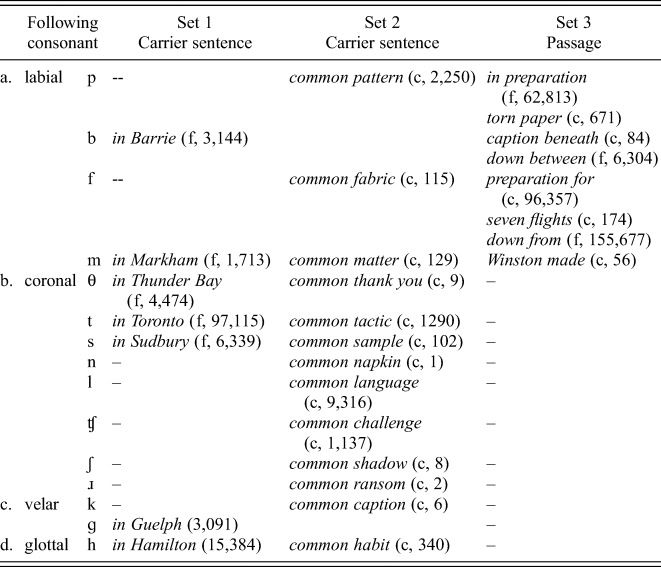
The stimuli consisted of three sets of read materials, recorded over several sessions. Each set included multiple words in which the word-final alveolar nasal /n/ occurred before consonants of different place or manner of articulation. Table 1 presents the complete set of utterances, with relative lexical frequency of collocations presented in parentheses (based on Davies Reference Davies2018). Set 1, designed for an exploratory investigation of assimilation, consisted of utterances with word-final /n/ in the function word ‘in’ occurring before seven consonants differing in place and manner of articulation, namely, /b, m, θ, t, s, ɡ, h/. The utterances contained familiar place names in the province of Ontario where the study was run, which were embedded in the carrier phrase He lives in ____. Following vowel context and stress were not controlled for. The utterances were randomized and read fifteen times by EN1 and EN2, and six times by EN3, resulting in 252 tokens in total.
Utterances used in the study organized by following consonant and set. Lexical class of the word with final /n/ (c = content word, f = function word) and relative lexical frequency of utterances presented in parentheses (based on the iWeb corpus, Davies Reference Davies2018)Footnote 3 are indicated in parentheses

Set 2 was designed to investigate nasal assimilation more systematically. It included utterances with an /n/-final content word common before thirteen words beginning with different consonants representing all places and manners of articulation except glides.Footnote 2 The preceding and following vowels were consistent (/ə/ and /æ/, respectively) and stress was controlled for (with the target nasal occurring in an unstressed syllable preceding a stressed syllable). The utterances in this set were embedded in the carrier phrase That's a ______. All speakers produced nine repetitions of the randomized stimuli interspersed with fillers, generating 351 tokens in total.
Finally, Set 3 included eight two-word sequences in which word-final /n/ occurred before four labial consonants differing in manner of articulation (nasals, stops and fricatives) and voicing (stops alone). The nasal occurred here in a combination of content and function words. These sequences came from a passage from George Orwell's novel 1984 (see the Appendix). This text was chosen to elicit more contextualized speech and various phenomena for a larger cross-linguistic project, as it was similar in style and formality to the texts used to study other languages (see e.g. Continuidad de los parques by Julio Cortázar, used in Colantoni & Kochetov Reference Colantoni and Kochetov2012 for Spanish). Moreover, it was thought to be familiar to many native speakers and, thus, would result in more fluent readings. These nasals occurred in a variety of prosodic contexts – neither the preceding segment nor word stress was controlled for. This set of stimuli was included in order to test whether the assimilation patterns observed in isolated utterances are comparable to those found in more contextualized read speech, following the methodology employed in Colantoni & Kochetov (Reference Colantoni and Kochetov2012). Participants EN2 and EN3 read the entire text nine times; EN1 read it four times, resulting in 176 tokens.
Given the various constraints imposed by the phonological criteria, it was not possible to control for word frequency. Note, however, that the relative frequency of the words in our texts largely paralleled their lexical status: the vast majority of function words in table 1 have (much) higher relative frequency. Given this, we took lexical status as a proxy for frequency in our statistical analyses (as discussed in section 2.4).
2.3 Instrumentation and procedure
Each participant was supplied with a custom-made 62-electrode artificial palate.Footnote 4 The data were collected using a WinEPG system by Articulate Instruments (Wrench, Gibbon, McNeill & Wood Reference Wrench, Gibbon, McNeill, Wood, Hansen and Pellom2002) at an articulatory sampling rate of 100 Hz. Prior to each recording, the participants took time to accommodate to the palate by reading the ‘North Wind and the Sun’ passage and by speaking to the experimenter. All of the speakers were familiar with the EPG recording procedure and accustomed to wearing the palate, as they were part of a larger cross-language articulatory study which involved multiple recording sessions.
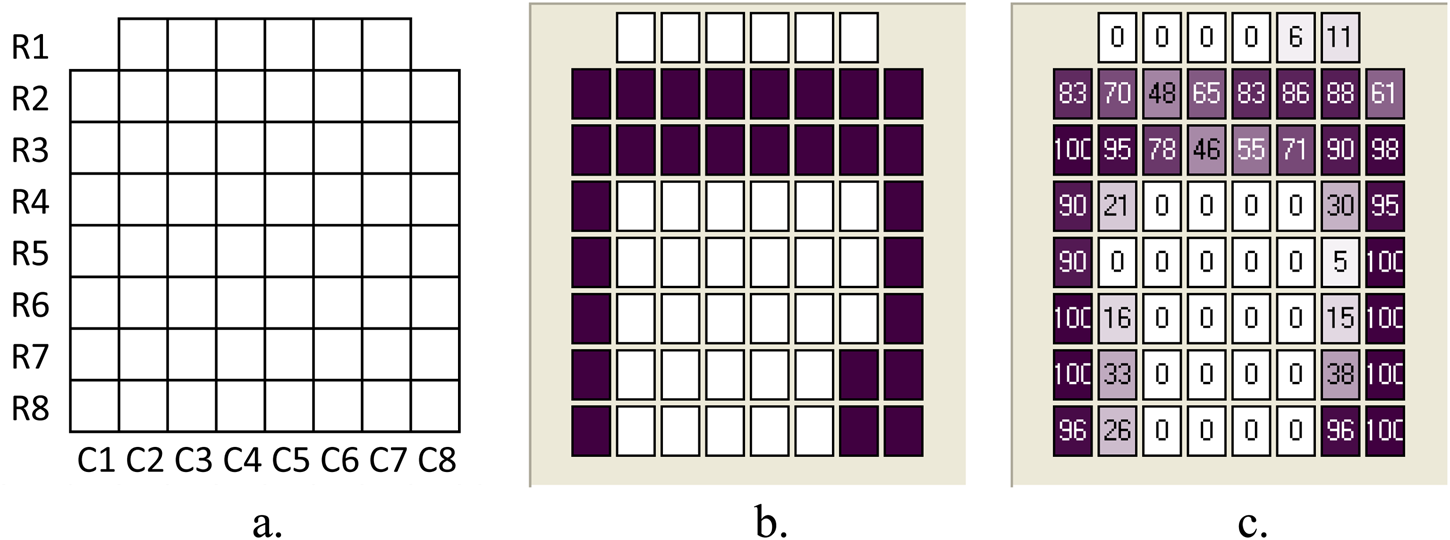
The EPG palate is zoned into eight rows (R1–R8) and eight columns (C1–C8) (figure 1a). Contact throughout rows 1–4 corresponds to coronal (denti-alveolar, alveolar and post-alveolar) articulations, while the central contact at rows 7 and 8 corresponds to velar articulations. The image in figure 1b illustrates a typical linguopalatal contact profile for a single alveolar nasal realization taken at the midpoint of the nasal closure for the word-initial /n/ in extra napkin produced by EN2. The closure is made in the second and third rows (i.e. it is alveolar); in addition, the sides of the tongue are in contact with the palate to further seal off the air passage. The image in figure 1c represents the average contact during the nasal interval taken over nine repetitions of the same utterance by the same speaker. The darkness of the shading indicates the mean percentage of contact (0–100%) for each electrode over the nine repetitions.
(a) Zoning of the EPG palate by rows (R1–R8) and columns (C1–C8); (b) a sample frame taken at the midpoint of the onset of the /n/ in extra napkin, token 1 by EN2; (c) an average profile for the entire duration of onset /n/, based on nine repetitions by the same speaker

2.4 Analysis
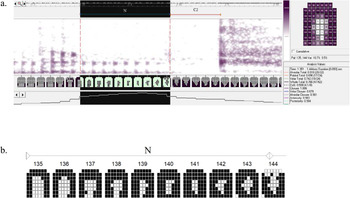
Among the 779 tokens collected, six tokens were excluded due to audible mispronunciations or pauses (for EN2 in Set 1 and EN3 in Sets 1 and 3). The data were annotated using the Articulate Assistant software (Wrench et al. Reference Wrench, Gibbon, McNeill, Wood, Hansen and Pellom2002), adding labels indicating the periods of nasal closure based on the acoustic record (waveforms and spectrograms). The same was done for the following consonant (stop or affricate closures; fricative and sonorant constrictions). Figure 2 shows a sample annotated token in (a), with the nasal interval (‘N’) selected in one of EN2's realizations of common caption. The palates below the spectrogram, enlarged in (b), show individual 10-ms frames, arranged in chronological order from left to right. The image on the right presents an averaged contact display over the selected interval. It can be seen from the temporal frame sequence at the bottom that the nasal involved an alveolar closure in all but the last frame. This alveolar closure, however, was accompanied by a velar closure in the second half of the interval as indicated by the activation of rows 6–8, resulting in the complex alveolar-velar articulation [n͡ŋ].
A sample token of common caption (with the /ənk/ sequence highlighted) as realized by EN2 (token 2), illustrating (a) the annotation of the nasal interval and the following consonant closure, and (b) a sequence of palates during the nasal

The analysis of nasal intervals was based on criteria established in previous EPG studies of assimilation and deletion (Barry Reference Barry1991; Hardcastle Reference Hardcastle and Windsor Lewis1995, among others; see section 1.1), according to which all nasal tokens were classified using broad categories of closure type and assimilation. Specifically, a nasal was considered to have a ‘complete’ alveolar/coronal closure, [n], if at least one frame involved a full row of electrodes in the anterior portion of the palate (rows 1–4; see figure 1). A ‘reduced’ alveolar, [n̞], was defined as having at least two electrodes activated in rows 1–4 and columns 2–7 (that is, anywhere except at the sides of the palate). A ‘deleted’ alveolar, [nØ], was defined as having one or zero electrodes in rows 1–4 and columns 2–7 (with or without the side contact). Note that the term ‘deleted’ here means that the alveolar gesture was not detected by the EPG system, which does not necessarily mean that the respective articulatory gesture was not produced (see Ellis & Hardcastle Reference Ellis and Hardcastle2002 for discussion). These three broad categories of alveolar nasal realizations will be referred to as ‘complete’, ‘incomplete’ and ‘deleted’ alveolars (see Shockey Reference Shockey1991; see also Wright & Kerswill Reference Wright and Kerswill1989, among others, for the alternative terms ‘full’, ‘partial/residual’ and ‘none/zero’ for essentially the same categories).
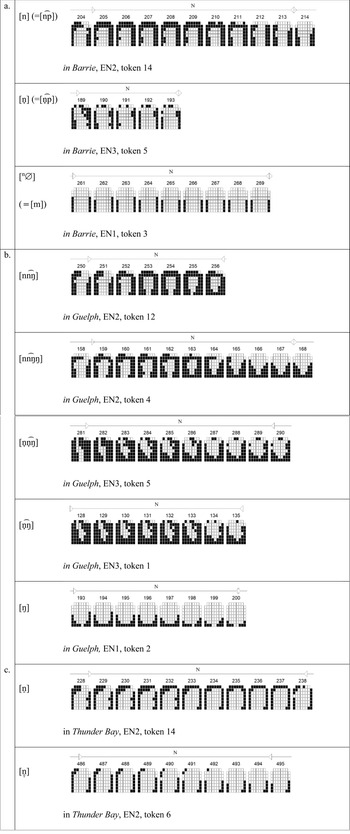
These three broad categories of alveolar nasal realizations can vary further and produce somewhat different outcomes depending on the place of articulation of the following consonant. Examples of each major outcome are illustrated in figure 3. Starting with /n/ before labials (figure 3a), the alveolar nasal can be produced as complete or incomplete. Complete and incomplete alveolars are presumably overlapped by the labial gesture, and therefore are transcribed as ‘[n͡p]’ and ‘[n̞͡p]’ (note that it is not possible to confirm the presence of a labial gesture with EPG). Deleted alveolar nasals are presumably assimilated to labials, and thus realized as [m].
Nasal consonant categories and sample tokens (temporal sequences of palates)

Nasal realizations before velars can be more complex (figure 3b; see Hardcastle's Reference Hardcastle and Windsor Lewis1995 classification of pre-velar nasals). A complete or incomplete alveolar is typically overlapped by the velar gesture. This overlap can be partial ([nn͡ŋ]: the alveolar gesture begins before the onset of the velar gesture) or complete ([n̞͡ŋ]: both gestures begin simultaneously); cases of partial overlap may also include a portion of the nasal that is velar-only ([nn͡ŋŋ]). For simplicity of presentation, we will collapse these different temporal types, differentiating only between complete and incomplete overlapped tokens ([(n)n͡ŋ(ŋ)] and [(n̞)n̞͡ŋ(ŋ]). A final and very important type of nasal realization before velars is [ŋ], which represents a case of alveolar gesture deletion and, thus, the nasal's assimilation to the velar place of the following consonant.
While nasal realizations before labials and velars often involve discrete types, realizations before coronals are typically gradient, involving a partial advancement or retraction of the closure. Figure 3c illustrates somewhat greater changes in /n/ before /θ/, where the closure is fronted to the denti-alveolar region (the first row) or to the front teeth, a region that is not captured by EPG. The latter realization still shows nasal murmur in the acoustics; this suggests that a (likely partial) tongue tip constriction for the nasal is made but is beyond the scope of the palate. Note that the first realization in (figure 3c) can be classified as place-only assimilation (/n/ to [n̪]), while the second one involves assimilation in both place and stricture (/n/ to [n̪̞]). These other assimilatory changes before coronals will be discussed in the following section.
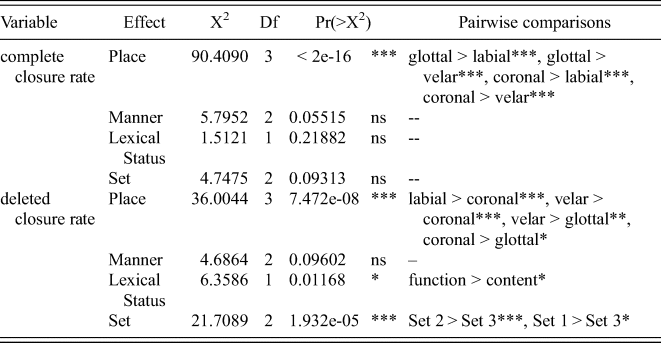
The statistical analysis of the data involved the discrete categories of complete, incomplete and deleted (assimilated) alveolar closures. Each token was classified as one of these categories, and the aggregate data fitted into Generalized Linear Mixed-Effects Models (GLMM) for binomial distributions (using the glmer function in the lme4 package, Bates et al. Reference Bates, Maechler, Bolker and Walker2014, for R; R Core Team 2014). Fixed effects were Place of the following consonant (labial, coronal, velar, and glottal), Manner (stop/affricate, fricative and sonorant), Lexical Status (content and functional) and Set (Sets 1, 2, and 3) (reference levels are underlined). Speaker was the random effect (with random intercepts). P-values were obtained using the chi-square test implemented in the Anova() function of lmerTest package (Kuznetsova, Brockhoff & Christensen Reference Kuznetsova, Brockhoff and Christensen2017). Bonferroni adjustments were applied for pairwise comparisons. Analyses were conducted separately for rates of complete, incomplete and deleted alveolar closures. As rates of incomplete closures are predictable from a sum of complete and deleted closures, only the results for the latter variables are presented. Further details of analyses are presented in section 3.
3 Results
3.1 An overview: the entire dataset
To examine general effects across the dataset, we fitted rates of complete and deleted closures into a GLMM with fixed factors Place, Manner, Lexical status, and Set, and the random factor Speaker.Footnote 5 The results, as summarized in table 2, revealed that complete alveolar rates were significantly affected by Place of the following consonant, but not Manner, Lexical Status or Set. With respect to place, rates were significantly higher (i.e. more complete closures for /n/) before coronals (on average 0.88 out of 1.00) and the glottal /h/ (0.90) than before labials (0.61) and velars (0.39). Deleted alveolar rates were significantly affected by Place, Lexical Status and Set, but not Manner. Significant place differences involved higher deletion rates before velars (0.49) and labials (0.19) than before coronals (0.00) and /h/ (0.05). Deletion in function words (0.17) was higher than in content words (0.09), and higher in Sets 1 and 2 (0.18 and 0.11) than in Set 3 (0.08).
Statistical results for the rates of complete and deleted closures across the entire dataset

Significance codes: 0 ‘***’, 0.001 ‘**’, 0.01 ‘*’, 0.05 ‘ns’
lmer(formula = complete/deleted ~ Place + Manner + Lex_status + Set + (1|Speaker), data = n, family = binomial). The results presented here are based on this model.
Taken together, the results revealed that nasal place assimilation (defined as a proportion of incomplete and deleted alveolar closures) in our data applied frequently before labials and velars, but rarely before the other places. Among the former two, assimilation was more common, and more often realized as complete deletion before velars than labials. Other factors, such as lexical status or the type of read speech were also important, but only in cases of complete deletion. The manner of following consonants did not play a significant role. Recall, however, that this factor is relevant primarily for coronals in Set 1, both coronals and labials in Set 2, and only labials in Set 3. Given this, the lack of significant effects may well be due to the skewed distribution of Manner across sets. The same can be said of other variables, as for example Lexical Status categories occur mutually exclusively in Sets 1 (functional) and 2 (lexical), but not in Set 3. Further, rates reported so far are averaged across speakers. As we will see, however, our speakers showed considerable differences in rates of assimilation. All this points to the need to examine the results in more detail. This will be done in section 3.2 for Sets 1 and Set 2 (which are more comparable in terms of Place categories) and in section 3.3 for Set 2.
3.2 Sets 1 and 2: place, manner, lexical status and speaker differences
Excluding Set 3 from the GLMMs produced similar results to those in table 2, but with a few important differences. Specifically, complete closure rate was affected not only by Place (with contexts before coronals and /h/ showing higher values than before labials and velars), but also by Manner and Set, which here fully coincided with Lexical Status (i.e. in Set 1 the nasal is in the coda of a content word, whereas in Set 2, /n/ is in the coda of a preposition). Manner differences involved higher rates (less assimilation) before sonorants (0.81) than fricatives (0.79), and higher rates before fricatives than stops (0.67). Differences between sets involved a higher rate in Set 2 (in the content word ‘common’ and overall less frequent utterances) than in Set 1 (in the function word ‘in’ and overall more frequent utterances). In addition, Place differences in this analysis showed significantly higher complete closure rates before labials than velars. As with the full dataset, deletion rates were significantly affected by Place (with more deletion before labials and velars than before coronals and the glottal) and not by Manner. In contrast to the full dataset, however, deletion rates did not significantly differ depending on Set (= Lexical Status).
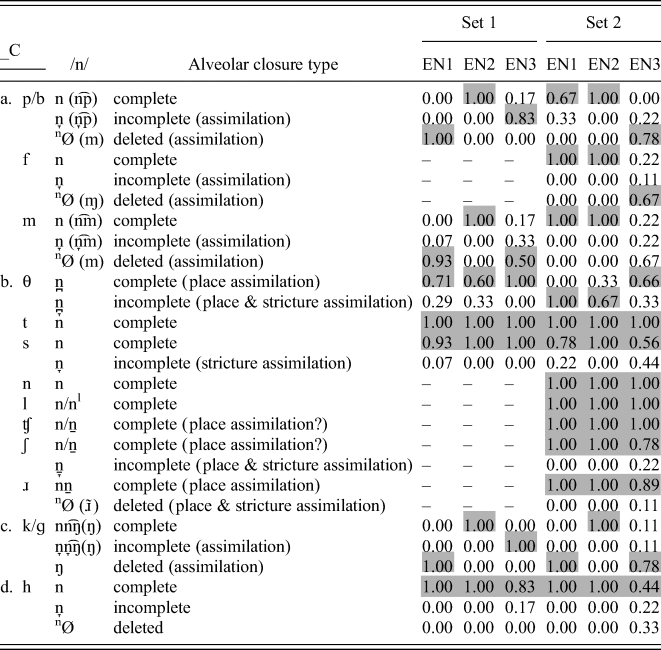
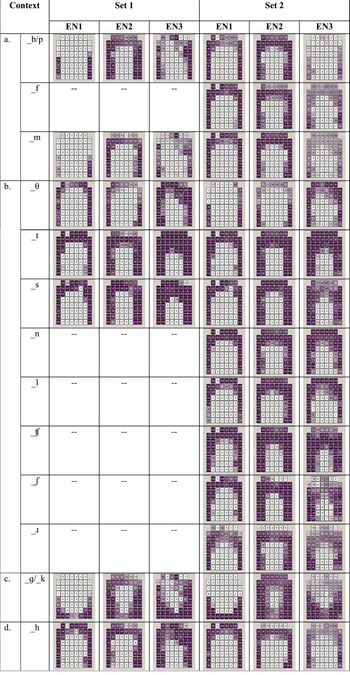
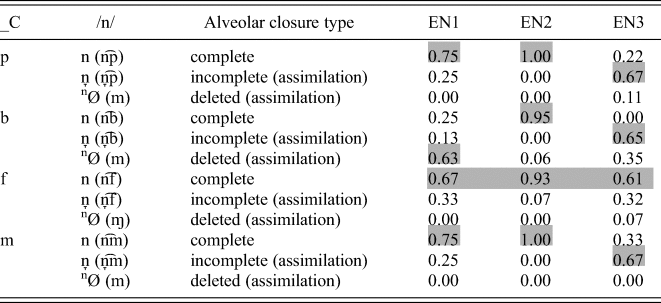
Having examined group results by general categories of place, manner and set, we will now turn to individual results by specific sequence. Table 3 summarizes these results for Sets 1 and 2, presenting the proportion of the various syllable-final /n/ realizations by speaker and following consonant. Each realization category is defined in terms of the ‘alveolar closure type’, which includes the ‘complete’, ‘incomplete’ and ‘deleted’ categories described in Section 2.4. The most frequent individual realizations are shaded. Across-context and -speaker differences can also be observed in average linguopalatal context profiles for the two sets presented in figure 4.
A summary of nasal realizations by the following consonant context in Set 1 (‘in _’) and Set 2 (‘common _’); proportions are based on 14 tokens per category for EN1, 15 for EN2 and 6 for EN3

Average linguopalatal contact profiles for /n/ before various consonants in Set 1 and Set 2 as realized by all three speakers

3.2.1 Nasal before labials
Recall that the statistical analyses of group data revealed frequent occurrence of incomplete and deleted nasals before labials. As seen in table 3a, however, this result was due exclusively to speakers EN1 and EN3, as the other speaker, EN2, exhibited complete closures before all labials in all sets. EN1 showed a largely binary pattern – either deletions (before /b, m/ in Set 1) or complete closures (before /p, f, m/ in Set 2). EN3's productions were more variable, involving all three categories, although favouring deletions (especially before /p, f, m/ in Set 2). The more variable realization of /n/ for EN3 can also be observed in the linguopalatal profiles in figure 4, in contrast to the consistent alveolar realizations for EN2, and either absent or present alveolar closures for EN1.
3.2.2 Nasal before coronals
Before the (inter-)dental /θ/ (table 3b), all of the speakers showed fronting of the closure (indicated as ‘n̪’), while EN1 and EN2 also showed a sizeable proportion of dental realizations with no central closure (at least as detected within the scope of the EPG palate; indicated as ‘n̪̞’). Interestingly, the latter effect was found more frequently in Set 2, which could be due to the vowel context (somewhat more posterior constriction next to [ɪ] in ‘in’ than next to [ə] in ‘common’). As expected, complete alveolar closures were the norm before the alveolars /t, s, n, l/ for all three speakers. It should be noted, however, that EN1 and EN3 showed some sizable proportions of incomplete closures before /s/. These reflect gradient assimilation in stricture, with some nasal tokens being produced with the fricative-like central channel. This is particularly evident in EN3's linguopalatal profile in figure 4. It should also be noted that all speakers tended to realize the nasal with a somewhat more fronted closure and reduced side contact before the lateral /l/, indicative of the adjustments made for the lateral release of the consonant ([nl]). The reduction of contact at the sides and some fronting of the alveolar closures are also evident in figure 4.
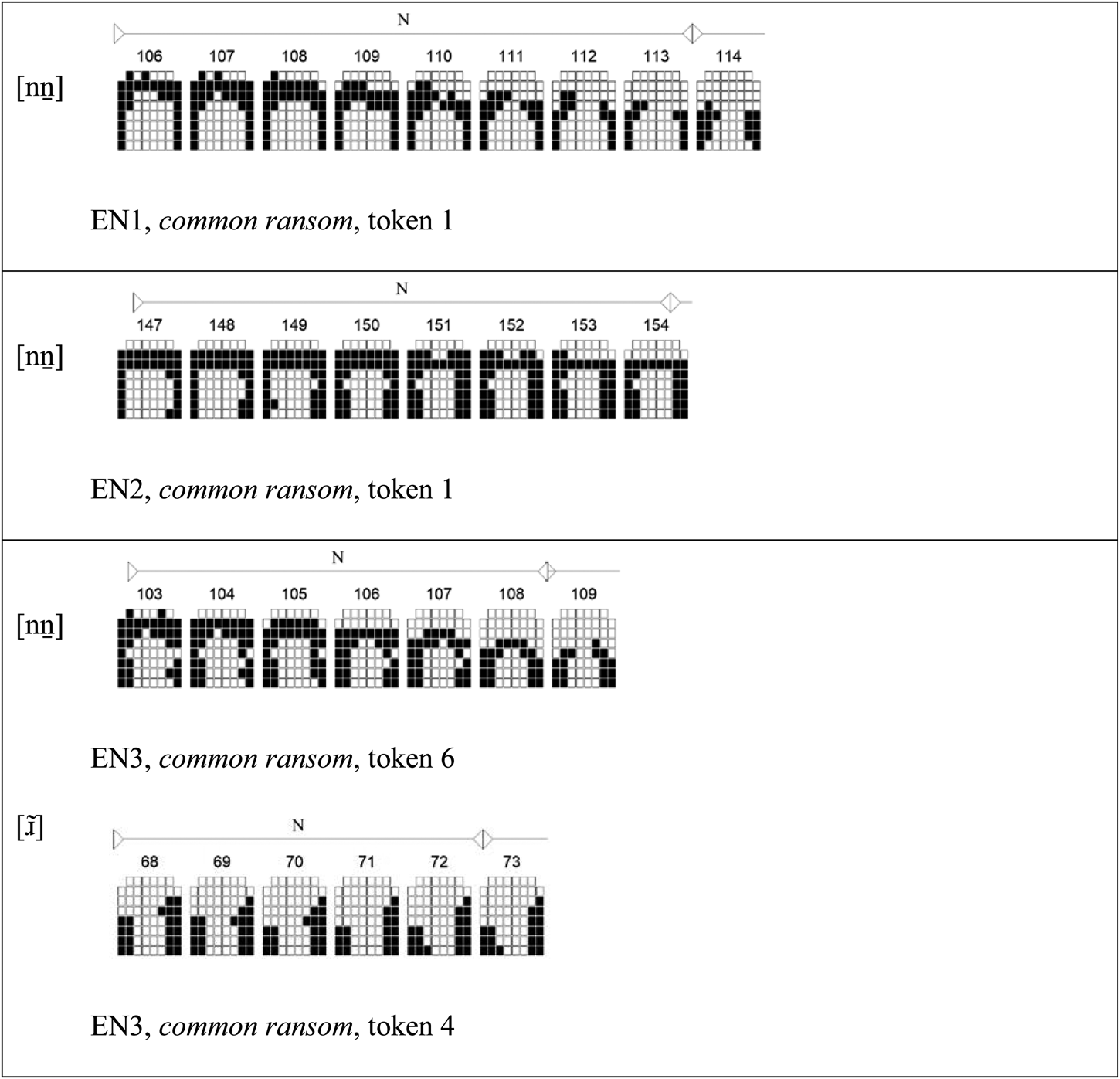
Before the posterior coronals /ʧ/ and /ʃ/, the nasal tended to be realized with somewhat greater side contact and occasionally more posterior closures (see figure 4). These gradient assimilatory changes, exhibited by all three speakers, are indicated by the symbols [n/n̠]. In addition, EN1 showed some incomplete closures before /ʃ/, typical of variable assimilation in stricture. Gradient assimilation was also exhibited before /ɹ/. Here /n/ had a clear dynamic component: the nasal began as alveolar but gradually showed retraction towards the post-alveolar and even palatal region (indicated as [nn̠]). EN3 also displayed a few cases of nasal deletion (presumably resulting in [ɹ˜]), as illustrated in figure 5.
Temporal sequences of palate frames illustrating retraction and reduction of the nasal before /ɹ/

3.2.3 Nasal before velars and /h/
The velar context (table 3c) was similar to the labial context in the sense that the speakers showed strikingly distinct patterns. EN1 had velar realizations (i.e. categorical assimilation) of /n/ 100 percent of the time. EN2 consistently maintained the alveolar closure co-produced with the velar closure. EN3's realizations exhibited incomplete alveolar closures (with overlap) in Set 1 and mostly deleted closures in Set 2. Once again, the distinct patterns can be readily observed in the palate profiles in figure 4, with EN1 showing a velar-only closure, EN2 showing complex alveolar-velar articulation, and EN3 showing a combination of these two patterns, yet with a consistently reduced alveolar gesture.
Finally, complete alveolar realizations were most common before /h/; these were exceptionless for EN1 and EN2 and dominant for EN3. The latter speaker's other realizations included incomplete closures and full deletions. Although EN1 and EN2 produced fully closed alveolars, as can be seen in figure 4, these articulations involved less contact than with /n/ followed by /t/ and /s/. This, together with clearer differences for EN3, indicates some gradient reduction of the gesture before the glottal /h/.
To summarize, a closer inspection of individual results and specific contexts revealed considerable variation in both sets of /s/, both within and (primarily) across speakers. The latter variation was most striking before labials and velars, with speakers showing assimilation (mainly categorical) or lack of it depending on the manner of the following consonant or the set. The velar contact favoured a binary distinction between complete and deleted closures, compared to higher rates of intermediate patterns (incomplete closures) in the labial context. Small-scale gradient assimilation was common before non-alveolar coronals, while some reduction was observed before the glottal /h/. It should be noted that some of the gradient changes, evident in figures 4 and 5, are not fully captured by our rather general categories of alveolar closure realizations. These changes, nevertheless, should be kept in mind when characterizing assimilation patterns in the data.
3.3 Set 3: manner, lexical status and speaker differences
We now turn to the results from Set 3, which involved final /n/ before various labial consonants in the reading passage. For this set, GLMMs were performed for complete and deleted closure rates using fixed effects Manner and Lexical Status, and Speaker as a random effect. Complete closure rates were significantly affected by Manner (X2 8.05, Df 2, Pr(>X2) = 0.017*), with the context before fricatives showing more complete closures (0.75) than before stops (0.56). Deletion rates were significantly affected by neither Manner nor Lexical Status. However, there was a non-significant tendency towards higher deletion in function words than in content words (Lexical Status: X2 3.8, Df 1, Pr(>X2) = 0.05; 0.16 vs 0.04).
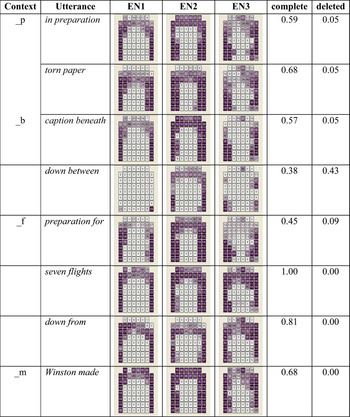
Turning to individual realizations and more specific segmental contexts, the results are summarized in table 4 (averaged over contexts) and figure 6 (by utterance). Overall, the interspeaker variation is less notable here, as all three participants tended to produce alveolar closures, either complete (EN1 and EN2) or incomplete (EN3). Similarly, differences among manner classes were not very obvious. Deletions were near-absent, with the notable exception of a single utterance, ‘down between’, where even EN2 showed some deletions. It is therefore of interest to examine more closely differences between utterances within the same context, as shown in figure 5.
A summary of nasal realizations by the following consonant context in Set 3; percentages are based on 4 tokens per category for EN1, and 9 tokens for EN2 and EN3

Average linguopalatal contact profiles for /n/ before various consonants by speaker and rates of complete closures and deleted closures (averaged across speakers) for Set 3

Starting with /n/ preceding /p/, within-speaker patterns in the utterances in preparation and torn paper are rather similar (with the exception of some retraction due to /ɹ/) – mainly complete alveolar realizations for EN1 and EN2, and incomplete alveolars for EN3. This is despite the fact that /n/ occurs in a function word (and an unstressed syllable) in the first case and in a content word (in a stressed syllable) in the second case. The utterances also differ drastically in their frequency (62,813 vs 671; see table 1). It should be noted that the average complete closure rate is somewhat lower for in preparation than torn paper (while their deletion rates are the same; see figure 5). This difference is nevertheless much smaller than would be expected based on our results for Sets 1 and 2. Here, for example, differences between the frequent function-word collocation in Barrie and the less frequent content-word collocation common caption were greater (complete closure rate: 0.44 vs 0.56; deleted closure rate: 0.42 vs 0.26), as well as greater than in the currently examined set.
Lexical status and frequency, however, can be invoked to explain differences between utterances involving the /b/ context: there is a drastic reduction in alveolar contact for /n/ in the more frequent function-word utterance down between compared to the less frequent content-word utterance caption beneath. Yet the relative frequency of down between is considerably lower than that of in preparation, which displays a higher rate of complete closures.
Before /f/, there is considerably more alveolar reduction in the relatively frequent content-word utterance preparation for than in the relatively rare content-word utterance seven flights. This is to be expected. At the same time, the highly frequent function word down from shows a much higher complete closure rate than, and about the same deleted closure rate as, the item preparation for. Finally, the patterns observed before /m/ in the least frequent utterance in this set, Winston made, are not strikingly different from those displayed in most other utterances. This suggests that neither manner nor lexical status or frequency is the crucial contributor to the variation observed in this dataset.
Note that syllable stress is another potential factor in assimilation (De Jong, Beckman & Edwards Reference De Jong, Beckman and Edwards1993). Specifically, we may expect that nasals are more prone to reduction and deletion in unstressed than in stressed syllables. This does not seem to be the case in this dataset either, as nasals in stressed and unstressed syllables (e.g. torn paper versus Winston made; down from versus seven flights) show similar rates of complete closures and deletions.
To conclude this section, the analysis of Set 3 involving data obtained from the reading of a literary text revealed considerably lesser rates of assimilation and interspeaker variation than we saw with the carrier sentences. The statistical analysis revealed that some variation was conditioned by the manner of the following consonant, while lexical status of words showed a non-significant tendency. These differences, however, were difficult to discern when examining results for specific utterances, suggesting that factors other than manner, lexical status (or frequency) and stress might be at play.
4 Discussion and conclusion
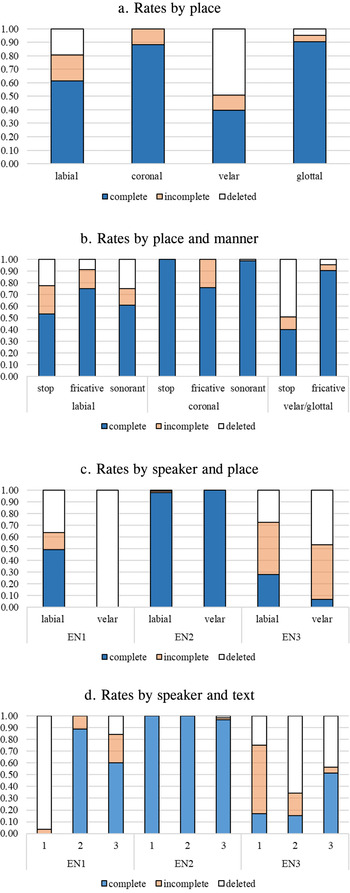
Our study's first goal (RQ1, see section 1.3) was to determine the dominant patterns of nasal assimilation in Canadian English, that is how word-final /n/ is realized when followed by word-initial consonants that differ in place and manner. Our analysis of three different datasets revealed some consistent patterns across places and manners of articulation as well as a high degree of interspeaker variability. Focusing on group patterns in terms of place, the top panel (a) of figure 7 plots average rates of deletion and complete and incomplete closures across the four major place categories. Overall, assimilation of /n/ was relatively common when the following consonant was of a different (labial or velar) oral place of articulation. In these cases, the nasal can partially retain its place (while losing the complete closure, i.e. gradient assimilation) or categorically assimilate in place (apparently becoming velar or labial). On average, assimilation was more common before velars than labials: complete closures were observed only 40 percent of the time with the former and 61 percent with the latter. The difference was even more robust in terms of rates of deletion: 0.49 with velars and 0.19 with labials. This suggests that, everything being equal, velars are more likely triggers of assimilation in our data. We should keep in mind, however, that this comparison does not take into account manner differences (which we will address later) and the proportionally greater number of tokens of /n/ before labials.
Average rates of complete, incomplete and deleted alveolar closures by (a) place, (b) place and manner of articulation, (c) speaker and place (non-coronal contexts) and (d) speaker and text (labial contexts)

The findings for variable assimilation before velars are fully consistent with EPG studies of British English (Barry Reference Barry1985, Reference Barry1991; Hardcastle Reference Hardcastle and Windsor Lewis1995; Ellis & Hardcastle Reference Ellis and Hardcastle2002) and Australian English (Stephenson & Harrington Reference Stephenson and Harrington2002). Specifically, they reveal that patterns observed for Canadian English are broadly similar, albeit involving somewhat lower rates of assimilation (see section 1.1). Our result also supports previous impressionistic accounts of pre-labial nasal assimilation (Jones Reference Jones1962; Cruttenden Reference Cruttenden2014) as well as acoustic findings (Renwick et al. Reference Renwick, Baghai-Ravary, Temple and Coleman2013).
Recall that, from the point of view of Articulatory Phonology (Browman & Goldstein Reference Browman and Goldstein1989, Reference Browman and Goldstein1992), place assimilation is expected before velars (albeit only gradiently) but not before labials. This is because the tongue tip gesture for /n/ and the tongue body gesture for /k, ɡ/ are part of the same articulator (the tongue), and thus are expected to influence each other. The lip gesture, on the other hand, is fully independent of the tongue, and thus the former should not affect the tongue tip gesture. Reports of nasal assimilation before labials have been attributed by proponents of Articulatory Phonology to overlap and the perceptual hiding of the tongue tip gesture (Byrd Reference Byrd1992). Our results, however, clearly show that nasals can assimilate to labials in production, and this assimilation can be categorical. This is consistent with traditional phonological analyses of assimilation, where labials as triggers of assimilation are treated similarly to velars, as both spread a general [Place] feature (e.g. Clements Reference Clements1985; Gussenhoven & Jacobs Reference Gussenhoven and Jacobs2017). Yet the greater propensity of velars to trigger assimilation remains unexplained under this approach.
Interestingly, some alveolar deletions were observed before /h/. This is also unexpected given the lack of a conflicting oral gesture. Some occurrence of incomplete closures in this context, on the other hand, is expected, being part of a general gradient reduction in syllable-final position (Browman & Goldstein Reference Browman, Goldstein, Bell-Berti and Raphael1995). The coronal contexts showed the least assimilation; all of these cases (0.10) involved incomplete closures that occurred mainly before fricatives. It should be kept in mind, however, that the categories in figure 6a capture relatively large-scale, discrete differences. Yet, as we saw in figures 4 and 5, patterns of assimilation before coronals tend to be relatively small in magnitude and gradient. The only exception in this regard is the relatively high rates of assimilation (in place and stricture) before the dental /θ/. Note that gradient assimilation before more anterior or more posterior coronals is expected due to gestural blending, as the consonants are produced by gestures occurring on the same articulatory tier (the tongue tip; Browman & Goldstein Reference Browman and Goldstein1989; Honorof Reference Honorof1999). Overall, the inclusion of various labial and coronal consonant contexts has allowed us to systematically investigate the effect of place in English assimilation, considerably expanding the empirical coverage of the phenomenon.
It should be noted that variable and gradient assimilation is not expected under traditional phonological accounts (see Nolan Reference Nolan, Robert Ladd and Docherty1992). Yet gradience is a logical outcome of overlapping gestures in Articulatory Phonology. We can therefore conclude that neither model per se is capable of fully capturing all the facts of place assimilation. One logical possibility would be to attribute categorical assimilation to phonological rules/constraints and gradient reduction to phonetic implementation (cf. Hayes Reference Hayes, Docherty and Robert Ladd1992). Yet the problem arises as to where to draw the line between the two types, as at least for some speakers (e.g. EN3) there is a continuum from no assimilation to categorical assimilation (see Kochetov & Pouplier Reference Kochetov and Pouplier2008 on Korean place assimilation in stops).
Turning to manner contexts (figure 7b), rates of assimilation/deletion were overall higher before stops than fricatives and sonorants (the complete closure rates of 0.64 versus 0.78 and 0.79 respectively). However, these differences are not meaningful per se, since manner effects were modulated by place. As seen earlier, stops that tended to trigger assimilation were of velar and labial place, while assimilation was absent before coronal stops (given no inherent differences with /n/) or gradient before affricates. Among coronals, only fricatives induced some (fairly moderate) rates of assimilation. This type of assimilation is expected in Articulatory Phonology, as the tongue tip gestures are assumed to blend not only in place but also in stricture, resulting in a fricative-like constriction in the nasal (see also Padgett Reference Padgett1995; Baković Reference Baković and Lacy2007 for accounts of categorical stricture assimilation). It should be noted, however, that most cases of coronal assimilation occurred in the context before the dental /θ/, and very rarely preceding the other fricatives, /s/ and /ʃ/. The lack of stricture assimilation in English nasal + fricative sequences has been previously documented for within-word sequences (Shosted Reference Shosted2011). This, together with the current findings, sets English apart from languages like Spanish, where stricture assimilation is (near-)categorical (Honorof Reference Honorof1999; Kochetov & Colantoni Reference Kochetov and Colantoni2011). The propensity of stops to trigger assimilation has been observed in cross-linguistic surveys of place assimilation and has been attributed to perceptual factors (Jun Reference Jun1995). Interestingly, Jun (Reference Jun1995) also provided typological evidence for the greater incidence of assimilation before velars than labials, which is consistent with the current findings. Our results, therefore, show that, while highly variable, the patterns of English assimilation observed in the current study are in line with broad cross-linguistic trends.
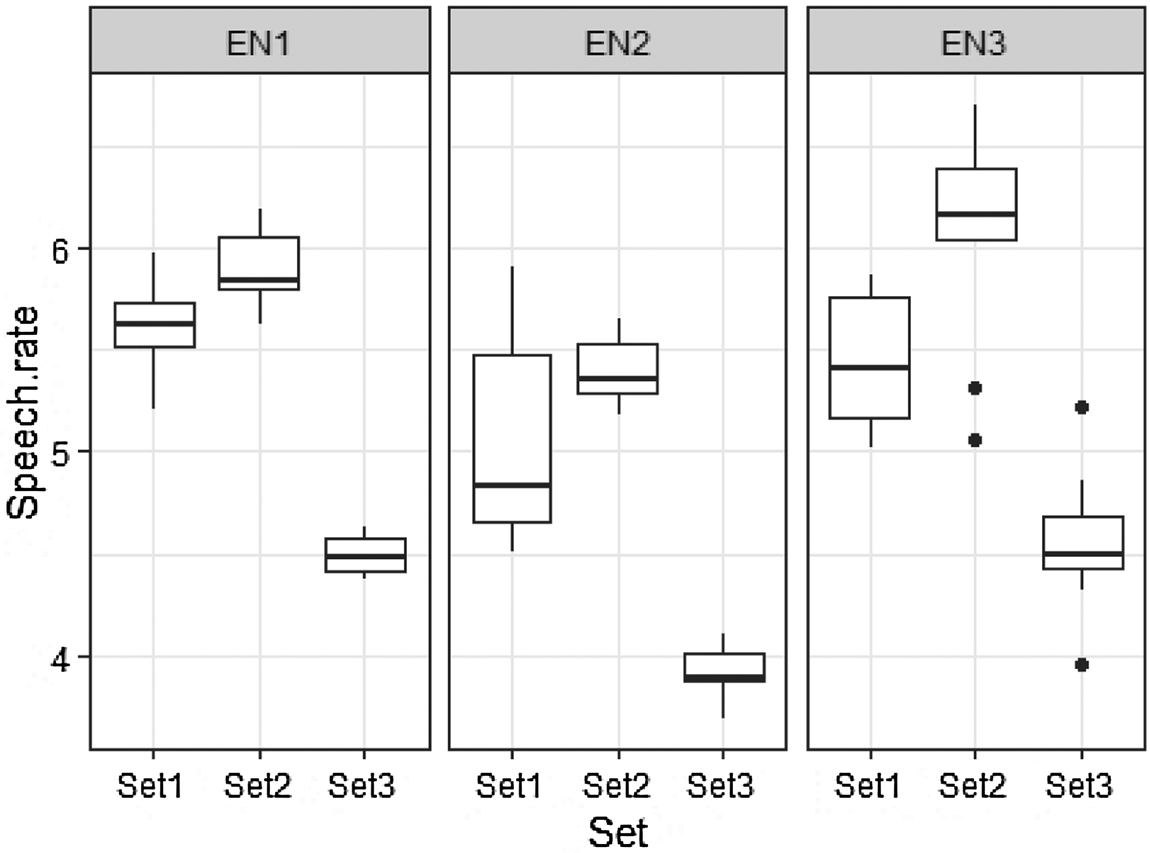
The second goal of this study was to examine within- and across-speaker variability in nasal assimilation; both types of variability were observed in our data. Particularly striking were the across-speaker differences in rates of assimilation in non-coronal contexts. These are plotted in figure 7c. Note that the lack of assimilation for EN2 contrasts with the extensive assimilation for the other speakers. Among these two, EN1 favours categorical assimilation (deletion), which reaches 100 percent in the velar context and 50 percent in the labial context; EN3, in contrast, favours gradient (incomplete) assimilation. These findings are reminiscent of Ellis & Hardcastle's (Reference Ellis and Hardcastle2002) results in a larger sample of (mostly) British English speakers: two of their participants showed no assimilation in the /n/ + /k/ sequence (yet with overlap, [n͡k]); four participants showed categorical assimilation ([ŋk]); and the other four speakers showed variation between the two realizations ([n͡k] ~ [ŋk]). Recall that similarly variable results were obtained by Stephenson & Harrington (Reference Stephenson and Harrington2002) for /n/ + velar sequences produced by three Australian English speakers. The novelty of our findings lies not only in confirming this for Canadian English, but also in documenting similar kinds of across- and within-speaker variation before labials. The extensive variability found within and across phonetic contexts further indicates that speakers can employ more than one strategy to implement hetero-organic nasal + consonant sequences, and the choice of these strategies is at least partly conditioned by place and manner of the following consonant, among other factors. Moreover, individual variability is not restricted to the structure under study here. Among the causes underlying individual variability, researchers have discussed differences in perceptual abilities (Perkell et al. Reference Perkell, Matthies, Tiede, Lane, Zandipour, Marrone, Stockmann and Guenther2004), in addition to social and demographic factors, widely documented in the sociolinguistics literature. As concerns the former, Mohaghegh (Reference Mohaghegh2016) reported interspeaker variability in the misidentification of assimilated final coronal nasals with labial nasals in Canadian English speakers. As concerns demographic factors, the only difference between our non-assimilating participant (EN2) and the other two participants is his age (i.e. he is approximately ten years older than the other two participants). Finally, interspeaker differences could be the by-product of differences in speech rate, i.e. slower speech may lead to less assimilation. Indeed, a follow-up examination of speech rate by our speakers revealed that EN2's speech was overall slower than for EN1 and EN3 (see figure A1).Footnote 6 Although we will leave this for future studies, previous studies (e.g. Colantoni & Kochetov Reference Colantoni and Kochetov2012) yielded mixed results regarding the correlation between segmental duration and degree of articulatory constriction.
Finally, our third goal was to determine if the patterns of assimilation were affected by the type of text used in the study (see figure 7d). The results of our statistical analysis showed some variation across the datasets: assimilation rates were lower in Set 2 than in Set 1. Recall that Set 1 included utterances with a function word, the preposition ‘in’. Set 2, in contrast, included a content word, the adjective ‘common’. Most utterances with the preposition ‘in’ are highly frequent (see table 1), while many utterances with ‘common’ are relatively infrequent. In both cases, the nasal was in a (lexically or sententially) unstressed syllable. Given this, the difference in assimilation rates (for EN1 and EN3) can be attributed to the lexical status of the words with the nasal, or relative frequency of the utterances.
It is worthwhile comparing overall rates of assimilation (deleted + incomplete) in nasal + /m/ sequences (the only sequences containing the same following labial consonants), as exhibited by the variation-prone speakers EN1 and EN3. The first speaker assimilates almost exclusively in Set 1 (1.00: 0.93 + 0.07), never in Set 2 (0.00: 0.00 + 0.00) and rarely in Set 3 (0.25: 0.00 + 0.25). The second speaker shows comparably high overall rates of assimilation in Set 1 (0.88: 0.50 + 0.33) and Set 2 (0.89: 0.67 + 0.22), and a somewhat lower rate in Set 3 (0.67: 0.00 + 0.67). Thus, both speakers show a reduction in assimilation in the passage compared to one or both carrier sentence conditions. This is contrary to our expectation: as suggested by sociolinguistic research, reading a passage should be a more natural task than reading words embedded in (somewhat artificial) carrier sentences. It may be the case, however, that our participants were more familiar reading carrier phrases (which was the elicitation used in most of the sessions) than longer texts, which were introduced later in our experimental paradigm. Our unexpected results could be attributed to a wider variety of contexts in the passage, with nasals occurring in stressed and unstressed syllables, as well as in content and function words. Most passage sentences were also considerably longer, adding to the cognitive and articulatory complexity of the reading task. Altogether, this appears to have slowed down the speakers’ speech rate in Set 2 (figure A1), thus inhibiting rates of assimilation.
While being a prominent factor in Sets 1 and 2, lexical status of words with nasals did not reach significance in Set 3. This suggests that differences between function and content words (as well as between more and less frequent utterances) could have been overridden by other factors, possibly by prosodic structure (intonational phrase boundaries, phrasal accent, etc.; see e.g. Cho & Keating Reference Cho and Keating2009; Krivokapić & Byrd Reference Krivokapić and Byrd2012). Clearly, more work is needed to elucidate the potential role of these factors in English place assimilation.
The current study expands our understanding of assimilation in English, in Canadian English in particular. Together with the previous literature on other varieties of English, this study provides evidence for highly variable patterns, which are in striking contrast to the overwhelmingly categorical nasal assimilation in languages like Japanese (Stephenson & Harrington Reference Stephenson and Harrington2002), Catalan (Recasens & Mira Reference Recasens and Mira2015), Spanish (Honorof Reference Honorof1999; Kochetov & Colantoni Reference Kochetov and Colantoni2011; Ramsammy Reference Ramsammy2011) and Italian (Farnetani & Busà Reference Farnetani and Busà1994; Celata, Calamai, Ricci & Bertini Reference Celata, Calamai, Ricci and Bertini2013), or consistently small-scale gradient assimilation in languages like French (Steele et al. Reference Steele, Colantoni and Kochetov2018). Future work should seek to further test these observations using larger samples of speakers and a variety of phonetic, both articulatory and acoustic, methods. With respect to the use of articulatory methods, combining EPG with ultrasound imaging or EMA is likely to provide a more effective way of distinguishing between gradient and categorical types of assimilation. Moreover, the use of EMA can provide some important insights into labial assimilation, something that could only be indirectly deduced in the current study.
Appendix
Sentences from the passage used in Set 3 (from George Orwell's 1984); words with the analyzed /n/ + consonant sequences are shown in bold.
1. Winston made for the stairs.
2. It was part of the economy drive in preparation for Hate Week.
3. The flat was seven flights up, and Winston, who was thirty-nine and had a varicose ulcer above his right ankle, went slowly, resting several times on the way.
4. BIG BROTHER IS WATCHING YOU, the caption beneath it ran.
5. Down in the street little eddies of wind were whirling dust and torn paper into spirals, and though the sun was shining and the sky a harsh blue, there seemed to be no colour in anything, except the posters that were plastered everywhere.
6. The black moustachio'd face gazed down from every commanding corner.
7. In the far distance a helicopter skimmed down between the roofs, hovered for an instant like a bluebottle, and darted away again with a curving flight.
Boxplot of speech rate (syllables per second) by speaker and set (see footnote 6 for details); higher values correspond to faster speech