The Kinship Online Module (Kinship Module), an online cultural competence learning and teaching tool, has the dual purpose of using narratives collected from Aboriginal people to embed mutual benefit in both a decolonising mainstream curriculum and as a site of empowerment in which Aboriginal people are able to voice their thoughts and experiences in meaningful ways and participate in the process of knowledge production (Blodgett, Schinke, Smith, Peltier, & Pheasant, Reference Blodgett, Schinke, Smith, Peltier and Pheasant2011, p. 523; see also Price, Reference Price and Price2012). The aim was to take Aboriginal knowledge and cultural practices and use the teaching within those practices, transposed in a Western system for non-Indigenous people who will work in professions that impact on Aboriginal people.
The Kinship Module is based on an interactive face-to-face presentation first developed in 1987 by Lynette Riley, a Wiradjuri and Gamilaroi woman, to help people understand traditional kinship structures and the impact of the breakdown of these structures through colonisation practices. In the initial years of creating this presentation, Riley sought advice from many Aboriginal people, from traditional through to urban communities, to ensure correct structures and knowledge was being imparted. The presentation is not meant to be all inclusive or an in-depth study of those structures, but rather an introduction to basic structures of kinship systems. Specific and in-depth knowledge must be gained from traditional knowledge holders within various Aboriginal nations and clan groups across Australia.
While the knowledge contained in the original interactive face-to-face Kinship presentation is a useful education program, the interactive face-to-face Kinship presentation has been dependent on one person — the author of the presentation — limiting opportunities for participation to the availability and time of the presenter. To create a process to allow greater distribution of the Kinship presentation for student/participant cultural competency growth, it was determined to offer the Kinship presentation as an e-learning experience. The move to the use of digital technologies also provided an opportunity to complement the original presentation with a range of resources. For example, one intention of the project has been to develop online learning tools while also ensuring the incorporation of the Aboriginal community, Elders, students and staff narratives into cross-cultural education. The project has thus involved developing the Kinship presentation into an online workshop, as well as using digital technologies to incorporate a range of other resources to complement the workshop online.
To achieve this end, we received funding for the development of the Kinship Online Module as a teaching and learning project (the project) from the Office for Learning and Teaching. The project itself is a partnership between Aboriginal and non-Aboriginal academics and an Aboriginal community working together respectfully and productively to embed Aboriginal knowledges and cultural practices into university teaching. This was achieved by conducting research with Aboriginal people in a culturally appropriate and sensitive manner and in accordance with both Aboriginal protocols and university ethical requirements (Riley, Howard-Wagner, Mooney, & Kutay, Reference Riley, Howard-Wagner, Mooney, Kutay, Craven and Mooney2013). As a cultural competence resource, the aim is to take Aboriginal cultural practice and use the teaching within those practices in Western systems for non-Indigenous people who are working in social systems that impact on Aboriginal people. To achieve this, the project is based on a partnership between Aboriginal and non-Aboriginal academics and the Aboriginal community, who work together respectfully and productively to embed Aboriginal knowledges and cultural practices into university teaching.
The long-term intent of the project is to impart Indigenous cultural knowledge to the broader staff and student body at the University of Sydney, many of whom will work with Indigenous employees or clients during their professional life. In the second semester of the 2014 teaching year, a pilot of the Kinship Module was undertaken, designed for the teaching of humanities- and social science-related subjects at the University of Sydney, such as sociology, law, education and social work.
Thinking through the development of the Kinship presentation in its transition to an online teaching (e-learning) resource necessitated developing an appropriate pedagogical framework that took into account Aboriginal epistemology both in methods and content, so that the Kinship Module provided an educational experience at the forefront, and is respectful of Aboriginal and Torres Strait Islander cultures and identity (National Aboriginal Education Committee [NAEC], 1985; Australian Government, 2010). In particular, we worked with Aboriginal people by ‘traversing the cultural interface’ (Nakata, Reference Nakata2002, p. 9). Their stories reveal the consequences of interchanges with Western ‘ways of knowing’.
The purpose of this article is to describe the teaching and learning framework underpinning the Kinship Module at the University of Sydney and to explain how the teaching and learning framework assists in embedding Aboriginal cultural knowledge and building cultural competence among humanities and social science students at the University of Sydney. This project is one of a number of initiatives being undertaken at the University of Sydney as part of a critical shift toward advancing cultural competency.
Background: Cultural Competency in Higher Education
University graduates with a better understanding and greater appreciation of the challenges facing Indigenous Australians are better able to contribute to addressing and overcoming racism, thus having the power to change the nature of Australian society and the quality of service provision to Indigenous Australians and the broader society (Universities Australia, 2011). It is for this reason that Universities Australia (2011) exhorts universities to take on the responsibility of ensuring that continuing generations of professionals have knowledge and understanding of Indigenous people's cultures and histories. These knowledges and understandings will prepare students with skills and strategies and the ability to critically analyse their specific profession's history and assumptions, and the socio-political contexts of the roles of their profession in shaping Indigenous peoples’ lives. The objective is to prepare these new professionals to become agents of change and work more effectively with Aboriginal and Torres Strait Islander clients, agencies and communities. To ensure this occurs, systemic cultural competence training of university staff aligned with the inclusion of Indigenous content into all university programs is essential not only for these future professionals, but also for the university sector to define itself as a global leader and agent of social change in contemporary Australia (Universities Australia, 2011).
In recognition of the significance of cultural competence skills, many Australian universities are endeavouring to improve the way in which Indigenous people are viewed, whether it is through improved visibility, participation and awareness of Indigenous people, or through the curriculum in Indigenous education or studies (University of Sydney, 2012, p. 2). The focus for Australian university initiatives has been on heightening cultural competence through governance, community and stakeholder engagement, and research. The aim is to create improved standards, particularly in teaching and learning, to recognise and encourage connections with cultural, historical and symbolic representations, to challenge assumed realities; and to provide an opportunity for Indigenous people to share, think, learn and contribute within the university.
While the construction of cultural competence in this way is not without its problems, the development of cultural competence in university students can provide an opportunity for many non-Indigenous people who are unaware of Indigenous narratives and cultural ways of being to learn directly from Indigenous people themselves (Behrendt, Larkin, Griew, & Kelly, Reference Behrendt, Larkin, Griew and Kelly2012; Rose, Reference Rose and Price2012; Universities Australia, 2011). Acquiring such awareness will provide real learning, knowledge and skills that will inform action in many fields of endeavour and disciplines across academic arenas, and for engagement in public service. It also assists in breaking down many stereotypes and generates greater understandings for improved engagement and communications with Aboriginal and Torres Strait Islander peoples and their communities.
While spaces for the teaching of Indigenous studies, including Indigenous knowledge systems and culture, have existed for some time within higher education institutions in Australia, the broader promotion of mainstream learning of Indigenous culture and knowledge from an Indigenous standpoint in Australian higher education is a more recent phenomenon (Universities Australia, 2011). In the Australian context of Indigenous education, the higher education landscape is predominately focused toward improving Aboriginal and Torres Strait Islander accessibility to tertiary education. Teaching Indigenous studies to enhance the prominence of Indigenous culture and knowledge has been secondary on campuses across Australia. The reason it has been secondary is due to inherent difficulties faced by non-Indigenous staff to effect this change, although this focus has been strengthened at the federal level in recent years (Universities Australia, 2011). This is in part attributed to the work of the Indigenous Higher Education Advisory Council, which recommended that institutions should enhance the prominence and status of Indigenous culture, knowledge and studies on their campuses (Universities Australia, 2011). It is generally believed that by enhancing the prominence and status of Indigenous culture, knowledge and studies on campuses around Australia, this would provide non-Indigenous students with an understanding of and respect for Indigenous knowledge and worldviews, to prepare them to live harmoniously in a land shared with Indigenous peoples (Phillips & Lambert, Reference Phillips and Lambert2005; see also Craven et al., Reference Craven, Halse, Marsh, Mooney and Wilson-Miller2005a, Reference Craven, Halse, Marsh, Mooney and Wilson-Miller2005b, Reference Craven, Halse, Marsh, Mooney and Wilson-Miller2005c). Hence, one of the key project objectives was to develop a pedagogical framework that takes into account Indigenous epistemology both in methods and content.
We did this so that the learning process builds on Indigenous cultures and identity, as was an original intention of the NAEC (1985) in the Australian educational landscape; further, the Australian Higher Education Support Act 2003 (AHESA; Australian Government, 2012) decreed that universities are expected to reflect the whole community and not simply one social or cultural sector. In Indigenous education this provides relevancy, rather than simply trying to fit Indigenous culture into Western ways of teaching. Price (Reference Price and Price2012) comments on this as a ‘window’ into Indigenous lives, while providing a ‘mirror’ for Indigenous students to see themselves reflected in the educational landscape. Currently and most often, teaching Indigenous Studies takes a very defensive stance informed by and based around colonisation, cultural loss and maintenance (Nakata, Reference Nakata2006). The Kinship Module is a cultural education teaching tool providing a more positive position in challenging stereotypes and perceived understandings of Indigenous culture, and moves the learner from an awareness of issues to assessing how they can use the knowledge gained to become more competent in working with people from different cultural backgrounds (Sefa Dei, Reference Sefa Dei2008).
The project as outlined in this article was developed in line with the government objectives of the promotion of excellence in learning and teaching in higher education programs, whereby the Office for Learning and Teaching aims to promote and support enhancement of learning and teaching in higher education institutions. In this project, we have aimed to promote excellence by developing a framework for augmenting cultural competence with high Aboriginal community involvement in the provision of an e-learning teaching tool. For example, Aboriginal people's stories are linked to the face-to-face presentation, which has been modified for an online environment. Hence, the e-learning tool provides an opportunity for teachers and lecturers to embed Aboriginal cultural learning in mainstream courses of study and provide an opportunity to listen to Aboriginal voices.
This focus in higher education also needs to be viewed in conjunction with the National Aboriginal and Torres Strait Islander Education Policy (Australian Government, 2010), which has four major goals with 21 aims. Hence, it is imperative that knowledge of Indigenous communities and their cultures are embedded in university teachings. This project is reflected under Major Goal 4 — ‘Equitable and Appropriate Educational Outcomes’ — within Aim 8: ‘To enable Aboriginal and Torres Strait Islander students at all levels of education to have an appreciation of their history, cultures and identity’ and Aim 9: ‘To provide all Australian students with an understanding of and respect for Aboriginal and Torres Strait Islander traditional and contemporary cultures’. We are therefore meeting the government's aims through the provision of a positive cultural e-learning teaching tool that provides an understanding of Aboriginal kinship but also highlights the importance of kinship systems in contemporary society.
Additionally, a key process in gaining cultural competence is one of challenging colonising assumptions concerning Indigenous cultures (Nakata, Reference Nakata2011; Moreton-Robinson, Reference Moreton-Robinson2004), which involves creating decolonising opportunities in an Australian educational context: hearing, recognising, and accepting the experience of Indigenous people (Green, Baldry, & Sherwood, Reference Green, Baldry and Sherwood2008). This project also addresses the concerns raised by Craven et al. (Reference Craven, Halse, Marsh, Mooney and Wilson-Miller2005a), who in their study of Primary Teacher Education Courses noted:
It also would appear that there is a need for greater understanding of the cultural values and identity of contemporary Aboriginal societies, even amongst teachers who are active supporters of Aboriginal people and Aboriginal Studies education. (p. 61)
The project is therefore committed to conveying Aboriginal cultural knowledge not only to pre-service teachers but to the broader student body, many of whom will graduate and work with Aboriginal employees or clients during their professional life. In the process of gaining this knowledge, participants gain an opportunity to question their knowledge of Aboriginal people and the role of the colonising processes in disenfranchising Indigenous peoples in Australia. It provides a small window to allow participants to question their knowledge base and start them on the path towards improving their cultural competency in understanding and working with Indigenous Australians in the future.
The project was a vehicle to ensure engagement between Aboriginal and non-Aboriginal educators and researchers, with Aboriginal people setting the parameters of what was required to be taught and researched and how this would occur, taking into consideration Aboriginal protocols of knowledge transference and participation timeframes. In addition, Aboriginal communities around Dubbo were invited to be involved in the development of the teaching tools by providing their stories; that is, ‘Community narratives’. These stories were incorporated into the website, and give teachers and students a better understanding of historical and cultural issues. It is also hoped that this resource will provide non-Indigenous students an opportunity in their course of study to hear Aboriginal voices and perspectives that they may never have had the opportunity to hear if not for the creation of this website.
We suggest that the validity of this project would be in question without the contributions of Aboriginal people of their ‘translation’ of their experiences into the new context (Ramsey & Walker, Reference Ramsay and Walker2010). In undertaking this project, we set out to reverse the previous, as Yunkaporta, (Reference Yunkaporta2009, p. 105) so aptly states, ‘systemic undervaluing of local knowledge and Aboriginal culture, a deeply ingrained unwillingness to “see” more sophisticated Aboriginal knowledge and processes’. Yunkaporta (Reference Yunkaporta2009) argues for the need to ensure that Aboriginal participants’ voices are heard, while Battiste (Reference Battiste2002) argues that integrating the voices and experiences of Aboriginal people into mainstream education creates a balanced centre from which to analyse European culture and learning. Due to the teachings in the Kinship Module, this project has proven to be effective, as teachers and students using the site have contacted the project leaders to say just how much they have ‘learned’ and how much it had improved their understanding of Aboriginal cultural knowledge.
The Kinship Module is a modified version of the face-to-face presentation, which uses digital technology to introduce new material alongside a recording of the face-to-face Kinship presentation. The website repository contains the Kinship workshop, so that the participants can view sector themes when they reach various points in the Kinship presentation video. This also allows the project team to continually update resources into the future. The final collection of the website repository is the Kinship presentation: ‘vox pops’ by participants from the face-to-face presentation, community stories, and additional resources that provide further material. The aim was to create an engaging online environment via the incorporation of, for example, Aboriginal narratives into the Kinship Module. The contributors have given their permission for their images and narratives to be used for teaching others, and this has the benefit of validating their expert knowledge and identity (Mooney & Craven, Reference Mooney and Craven2006; Willmot, Reference Willmot2010).
While we recognise that Aboriginal kinship systems vary throughout Australia and it is not possible in one presentation to examine the differences between them all, what this project does is give participants an introduction to Aboriginal kinship systems and the basic concepts within those systems. Hence, people who participate in the presentation gain a new and deeper understanding of how kinship systems operate. The introductory online presentation is designed to provide information for non-Indigenous students on how Aboriginal kinship systems work and how this affects reciprocal responsibilities and relationships within their cultures. Non-Indigenous participants are then presented with situations experienced by Aboriginal people after invasion, when kinship systems were ignored and their culture devalued and/or denigrated. Students are then asked to consider the various effects of European culture and introduced to ‘Pidgin English’ language on Aboriginal systems and culture.
The project enables educators to teach in a way that respects and allows Aboriginal voices to be highlighted (Healy-Ingram, Reference Healy-Ingram, Doecke, McLean Davies and Mead2011, p. 70). Pedagogically it involves the inclusion of Aboriginal people's first-hand accounts of their knowledges, issues, concerns and experiences into curricula via the incorporation of Aboriginal standpoint pedagogy (Nakata, Reference Nakata2007), alongside complementary Western pedagogical practices (see below). This enables the provision of a richer and deeper understanding of the issues that are presented to learners in studying Aboriginal content.
In developing the material for the creation of the website and a teaching and learning framework, advice was sought by Lynette Riley from her home community in Dubbo through direct kinship family, Elders and other significant Aboriginal people. In addition, input was sought from Aboriginal students in the Bachelor of Education (Secondary Aboriginal Studies) Block Mode program.
The Kinship Module is aimed at providing an introduction to Aboriginal kinship, roles and reciprocal responsibilities. The teaching objectives are that through this presentation, participants will gain an insight into the complexity and sophistication of Aboriginal kinship, identify differing levels of relationship, and understand how reciprocal bonds of relationship work. Through this module participants will gain:
1. greater understanding and experience of Aboriginal kinship systems;
2. insight into Aboriginal social structures and how these differ from Western societies;
3. knowledge of how cultural assessment assists in understanding these impacts;
4. greater awareness of potential conflict in working with people from differing cultural backgrounds; and
5. how this difference impacts upon Aboriginal people in the social systems that operate in Australia, such as through education, criminal justice systems and the legal system more broadly.
The Kinship Module is broken into eight themes and each has an aim and series of learning outcomes that build incrementally from Sector Theme 1 through to Sector Theme 8. This means participants need to be engaged from the start of the module to have greater understanding of the final learning outcomes. The themes are:
Sector Theme 1: Welcome and Acknowledgments
This sector provides an awareness of the significance and difference between a ‘Welcome to Country’ and an ‘Acknowledgment of Country’.
Sector Theme 2: Nations, Clans and Family Groups
This sector provides an overview of the range and diversity of the Aboriginal nations and clans that exist in Australia, and provides an introduction to Aboriginal protocols.
Sector Theme 3: First Level of Kinship — Moiety
The Moiety sector introduces the first level of Aboriginal kinship and the impact this has on a person's identity and relationships through reciprocal responsibilities.
Sector Theme 4: Second Level of Kinship — Totems
The Totem sector is an introduction to the second layer of kinship learning and obligations through links to the environment.
Sector Theme 5: Third Level of Kinship — Skin Names
The Skin Names sector provides an introduction to a third layer of kinship relationships: siblings, parents, grandparents and who people can marry.
Sector Theme 6: Language and Traditional Affiliations
This sector provides an overview of language, nation and clan links and the way in which protocols assist in these affiliations.
Sector Theme 7: Lines of Communication
This sector provides an overview of the network of links between nations, clans and family groups, for conservation, survival, marriage and ceremonial obligations.
Sector Theme 8: Disconnected Lines
This sector provides a small overview of how traditional lines have been impacted by colonisation and the impact of policies that have governed Aboriginal lives since first contact.
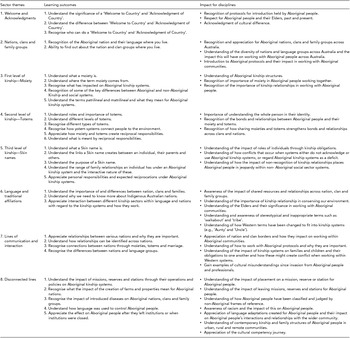
Table 1 outlines the sector themes, learning outcomes, and impact for disciplines.
Kinship Module: Sector Themes, Learning Outcomes and Impact for Disciplines

Each of the introduced themes has associated learning outcomes. It is expected that these learning outcomes will have direct impact on students who use this material, as it will provide knowledge and understanding of complex and sophisticated Aboriginal cultural roles and responsibilities as governed by their protocols and interactions through their kinship structures. In the past, the limited understanding of kinship connections has led to poor services for Aboriginal people, and cultural conflict and miscommunication between Aboriginal and non-Aboriginal people. The learning outcomes therefore provide valuable learning for individuals in their journey towards cultural competence in gaining skills to work specifically with Aboriginal people, by raising an awareness of the skills they will require to effectively work with people from a multitude of cultural backgrounds.
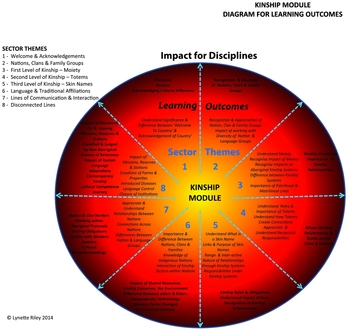
The Kinship Module has been broken into sectors to illustrate the Learning Outcomes and Impact for Disciplines. Figure 1, Kinship Online Module — Sector Themes, Learning Outcomes and Impact for Disciplines, shows the links in the teaching process between the sector themes of the kinship presentation, the learning outcomes associated with each theme, and the expected impact of each sector's associated learning outcomes for professionals in their area of discipline.
Kinship Module: Diagram For Learning Outcomes

What is demonstrated in Figure 1 is the incremental building up of knowledge and learning outcomes, with suggestions of impacts of that learning for disciplines of study within each learning sector.
Pedagogy and the Kinship Online Module
The project engages both Aboriginal and Western knowledges and pedagogical approaches to create a teaching and learning resource aimed at addressing cultural competency in non-Indigenous students. That is, it takes Aboriginal cultural practice and uses the teaching of that practice within a Western teaching and learning system to improve the cultural competency of non-Indigenous people working in social systems that impact on Aboriginal people. The intention of the project therefore was to develop online teaching and learning tools to incorporate Aboriginal knowledge inclusive of Aboriginal community narratives into a module for cross-cultural competency, focusing on the different responsibilities in Aboriginal societies and the impact this has had on Aboriginal people.
While the Kinship Module can be situated within any unit of study on Indigenous Australian issues, the pilot Kinship Module has been designed for the teaching of humanities- and social science-related subjects at the University of Sydney, such as sociology, law, education and social work. Its pedagogical purpose is to provide both non-Indigenous staff and students with a knowledge and understanding of Aboriginal kinship and build their cultural competency, which includes raising their awareness of Aboriginal protocols and culture and enhancing their capacity to work with Aboriginal and Torres Strait Islander people in different contexts.
Nakata (Reference Nakata2007) notes that there are often innate problems when:
Indigenous knowledge systems and Western scientific ones are considered so disparate as to be ‘incommensurable’ or ‘irreconcilable’ on cosmological, epistemological and ontological grounds.. . . Differences at these levels frame possible understandings and misunderstandings . . . it is not possible to bring in Indigenous knowledge and plonk it in the curriculum unproblematically as if it is another data set for Western knowledge to discipline and test. Indigenous knowledge systems and Western knowledge systems work off different theories of knowledge that frame who can be a knower, what can be known, what constitutes knowledge, what constitutes truth, how truth is to be verified, how evidence becomes truth, how valid inferences are to be drawn, the role of belief in evidence, and related issues.. . . we cannot just ‘do’ Indigenous knowledge in the curriculum. (p. 8)
As such, it is critical that there be improved interface with Aboriginal cultural knowledge holders and academia on the type, style and manner of representation to be presented. Nakata (Reference Nakata2007) goes on to say that what has occurred in the academy is that through non-Indigenous discourse there has developed an approach of knowing ‘about’ Aboriginal knowledge, cultures and issues, rather than incorporation of Indigenous voices and grounding of Indigenous knowledges, cultures and issues in the disciplines. We are working towards research that has equality for Indigenous peoples, which is often a challenge to the Western classifications developed to suit Western hierarchies, linearity, abstraction and objectification of Indigenous knowledges, cultures and issues (Nakata, Reference Nakata2007, p. 9; see also Williamson & Dalal, Reference Williamson and Dalal2007).
Arguably, this can be achieved via pedagogical teaching and curriculum content that embeds cultural knowledge as provided by appropriate cultural knowledge holders; recognises and understands the complexities at the cultural interface (Nakata, Reference Nakata2007), that is, the connection and differences between Indigenous and non-Indigenous worlds and knowledge economies; prioritises Indigenous voices and epistemologies (Minniecon, Franks & Heffernan, Reference Minniecon, Franks and Heffernan2007) with recognition of the diversity of cultural knowledges; builds in Indigenous intellectual and cultural knowledge rights of the cultural knowledge holders; and increases critical reflection capabilities of academics in teaching programs.
A primary process for provision of these goals through this project is via engagement with Aboriginal educators, researchers and local communities. The embedding of Aboriginal understandings through their narratives will assist non-Aboriginal academics teaching Indigenous content as part of mainstream curriculum to incorporate both Aboriginal standpoint pedagogy (Nakata, Reference Nakata2007) and Aboriginal voices into their teaching (Phillips & Whatman, Reference Phillips and Whatman2007).
In being cognisant of such complexities at the cultural interface, the project team adopted what Blodgett et al. (Reference Blodgett, Schinke, Smith, Peltier and Pheasant2011) refer to as a ‘cultural praxis’ to design and deliver a project utilising complementary Indigenous, social constructionist and critical methodologies. They define a praxis as an approach ‘aimed at mobilising transformation through the balancing of research, theory and practice’ (Blodgett et al., p. 523). Essentially, a praxis is about the reciprocal relationships between academic and applied work enhanced ‘by a commitment toward creating positive social change’ (Blodgett et al., p. 523). The term cultural praxis is used to explain their adopted research approach, which ‘engaged Indigenous community members as the experts of their own realities and enabled them to voice personal experiences regarding community-based research and then transform those experiences into empowering applied practices at the local level’ (p. 523). For Blodgett et al., the ‘emphasis is on bringing forth the voices of Indigenous people, in an attempt to better understand their experiences and to identify a strategy for social change that are developed for and by group members’ (p. 523). The central tenet of cultural praxis is thus ‘giving voice’ through culturally sensitive practice (Blodgett et al., Reference Blodgett, Schinke, Smith, Peltier and Pheasant2011).
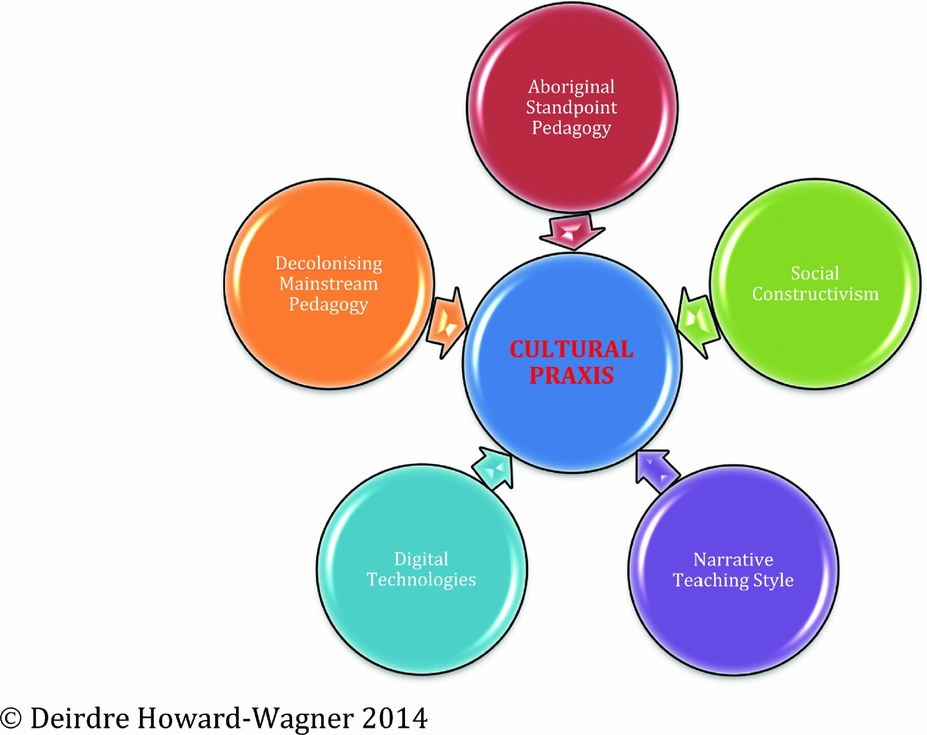
Blodgett et al. (Reference Blodgett, Schinke, Smith, Peltier and Pheasant2011) incorporate the cultural praxis into their research methodology and practice. We extend the cultural praxis to the pedagogical practice underpinning this project as a teaching and learning resource (Riley et al., Reference Riley, Howard-Wagner, Mooney, Kutay, Craven and Mooney2013). In the section that follows, we describe our use of the cultural praxis, which utilises five complementary pedagogical approaches to teaching and learning to inform the development of the online Kinship Module, including: a social constructivist approach, a narrative teaching style, Aboriginal standpoint pedagogy, decolonising mainstream pedagogy, and digital technologies (see Figure 2). We focus on describing how the five pedagogical approaches coalesce as a cultural praxis, making reference at times to their complementary epistemologies and practices.
Online Kinship Project: Pedagogy as a Cultural Praxis

Our aim in adopting a cultural praxis is to use Aboriginal knowledge productively to help non-Indigenous students understand traditional kinship structures and the impact of the breakdown of these structures through colonisation practices. Our overarching objective of bringing together the five complementary pedagogical approaches is not only to create an experience-rich, interactive, problem-oriented, scenario-based learning environment that privileges Aboriginal voices and embeds Aboriginal knowledge in mainstream humanities and social science units of study/subjects, but also to adopt these complementary teaching and learning approaches because they are in keeping with and allow us to respect Aboriginal standpoint pedagogy. The cultural praxis we describe here enables us to work at the cultural interface of Western and Indigenous knowledge systems.
In adopting an Aboriginal standpoint pedagogy (Yunkaporta, Reference Yunkaporta2009), this learning tool is aimed at enabling Aboriginal and non-Indigenous educators to teach in a way that respects and allows Aboriginal voices to be highlighted in lectures and tutorials (Healy-Ingram, Reference Healy-Ingram, Doecke, McLean Davies and Mead2011, p. 70). The inclusion of Aboriginal people's first-hand accounts of Aboriginal knowledges in mainstream curricula also reinforces the decentring of the non-Indigenous educator as an expert on Aboriginal identity (see below). Non-Indigenous students learn about Aboriginal people's perspectives from Aboriginal peoples, rather than non-Indigenous educators teaching their perspective on Aboriginal issues (Harrison & Greenfield, Reference Harrison and Greenfield2011). This enables non-Indigenous educators to provide non-Indigenous students with a richer and deeper understanding of the issues that are presented to them in studying Aboriginal content and to bring Aboriginal standpoints into mainstream curriculum.
In keeping with Aboriginal epistemology and standpoint theory too, our project uses an experiential format. It privileges Aboriginal voices, which are recorded and shared using digital technologies. Digital technologies and online learning scenarios allow us to not only provide an experience-rich, interactive, scenario-based learning environment, but also enable us to use an experiential format, which is an appropriate way of conveying Aboriginal knowledge systems and Aboriginal knowledge-sharing processes in an oral narrative form, bringing this into mainstream teaching. As Battiste (Reference Battiste2002) argues, integrating the voices and experiences of Aboriginal people into mainstream education creates a balanced centre from which to analyse European culture and learning. While the use of digital technologies to convey experiential accounts in Aboriginal narratives creates its own problems in terms of the ‘liveliness of Aboriginal knowledges’ (Christie, Reference Christie2005), decontextualising Aboriginal knowledges from place and space and presenting Aboriginal knowledges in a Western teaching format, it also enables the use of Aboriginal knowledges in a way that creates a positive and constructive interface between Aboriginal knowledges and Western knowledge. The critical concern here is to create an online teaching and learning resource using digital technologies in a way that is credible among Aboriginal people in that the process of collecting Aboriginal knowledges and conveying Aboriginal knowledges is respectful of these and respected by Aboriginal people (Christie, Reference Christie2005, p. 80). Aboriginal people conveying that knowledge must agree to how this knowledge will be used (e.g., in a digital format, as well as the format that this will take) and its intent, and permit the use of their knowledge in this way.
Indigenous research methodologies and protocols are thus an important aspect of the design of this project too (see Riley et al., Reference Riley, Howard-Wagner, Mooney, Kutay, Craven and Mooney2013). Aboriginal community engagement from an Aboriginal standpoint means, as Parsons (Reference Parson2008) states: ‘We are all stakeholders now’ (p. 99). Engaging Aboriginal stakeholders in the development and design of this project was a lengthy ethical process in keeping with Aboriginal protocols, which involved building research relationships and formalising the involvement of the community in the research to ensure that Aboriginal people involved in the research felt not only valued and in control of their engagement within the research, but agreed to the use of their stories in this way, the intent of their use, and permitted us to convey their stories using digital technologies for the purpose of decolonising mainstream curriculum and bringing about social change (see Riley et al., Reference Riley, Howard-Wagner, Mooney, Kutay, Craven and Mooney2013).
In this case, the project had the dual purpose of using the narratives collected from Aboriginal people to embed in the Kinship Module, yielding mutual benefit to both decolonising mainstream curriculum and being a site of empowerment in which Aboriginal people ‘are able to voice their thoughts and experiences in meaningful ways and participate in the process of knowledge production so that social transformations may be achieved’ (Blodgett et al., Reference Blodgett, Schinke, Smith, Peltier and Pheasant2011, p. 523). The embedding of Aboriginal understandings through their narratives will assist non-Indigenous academics teaching Aboriginal content as part of mainstream curriculum to incorporate both Aboriginal standpoint pedagogy (Nakata, Reference Nakata2007) and Aboriginal voices into their teaching (Phillips & Whatman, Reference Phillips and Whatman2007).
Social constructivism complements Aboriginal standpoint pedagogy in its approach to knowledge acquisition and its view on the role of social and cultural understandings of the world to knowledge acquisition. For example, social constructivism challenges traditional approaches to knowledge acquisition in learning, advocating an approach that enables students to learn through active formation of their own knowledge. That is, the emphasis is on ‘the active role played by the learner as he or she acquires new concepts and procedures’ (Lester, Stone, & Stelling, Reference Lester, Stone and Stelling1999, p. 2). More important is its premise that knowledge is socially constructed. While acknowledging its socially constructed nature in the context of social constructionism, for example, our approach treats culture as a social fact and everyday social phenomenon, identifying the importance of cultural competency among non-Indigenous students. For us, then, social constructivism in theory and practice acknowledges the significance of social and cultural contexts to the student's learning — that is, how our own social and cultural understandings of the world influence the way that we engage in and understand our world, and by exposing non-Indigenous students to Aboriginal worldviews we can change their understandings of the world, exposing their ways of doing business as the social and cultural practices of Whiteness. In others words, we acknowledge that knowledge can be socially manipulated to bring about social and cultural change and is a principle resource for mediating social and cultural change through social and cultural resources (Bitzer, Reference Bitzer2001, p. 99). For example, this cultural resource will allow students to hear Aboriginal voices and challenge ‘old’ understandings gained from cultural bias, cultural miscommunication and cultural misunderstandings. Accordingly, by designing an innovative cultural teaching resource that privileges Indigenous knowledge systems, culture and voices, we expose non-Indigenous staff and students to different worldviews.
Our use of a social constructivist approach thus serves the complementary purpose of decolonising mainstream pedagogy in a way that creates a deeper learning environment for both teachers as practitioners and their students as learners. For example, having completed the Kinship workshop, the student will have gained an appreciation and understanding of how Aboriginal authority structures and processes differ to those of Western authority and are structured by complex kinship and community protocols. This is achieved by adopting strategies that promote student-centred learning and encourage students to engage in reflective learning practices by fostering active learning and using digital technologies.
In decolonising mainstream pedagogy, for example, our intent is to implement a more inclusive way of engaging Aboriginal people in the research and development of the online Kinship presentation as a teaching resource. This was, for example, achieved via the design of the questions that would be used by interviewees to collect community narratives about experiences in relation to policy, and social service delivery in relation to say, the education system, legal system and other social service areas. This has been achieved by allocating stories to three aspects of kinship: to talk about their own kinship relationships; the effect of colonisation after invasion and in a particular cultural conflict; and the ongoing effect on people living under various professional services, such as the legal system or the education system.
Understanding relationships is the first priority in teaching kinship, and narrative pedagogy is the process used by Aboriginal teachers within the context of sharing Aboriginal knowledge. Within higher education more generally, narrative teaching styles have emerged from questioning, for example, whether conventional pedagogies prepare students for real life situations. In this context, narrative pedagogy is a phenomenological pedagogy that focuses on the lived experience. Narrative pedagogy in the higher education context emerges from listening to shared stories and the sharing of knowledge and lived experiences (Diekelmann & Diekelmann, Reference Diekelmann and Diekelman2009, p. xii). As Diekelmann and Diekelmann (Reference Diekelmann and Diekelman2009) note, a narrative pedagogy allows ‘. . . for a richer array of listening (interpreting) than that allowed by the usual application and presentation of disciplinary epistemologies’ (p. xv). The focus of narrative teaching style is on relationships and interaction.
In principle, a narrative teaching style is complementary to Aboriginal storytelling, that is, it is a teaching medium conducive to Aboriginal storytelling. Also, the use of narrative content forms has proven to be an effective way to teach non-Indigenous students (Egan, Reference Egan1998; Blakesley, Reference Blakesley2010; Andrews, Hull, & De Meester, Reference Andrews, Hull and De Meester2010) and to respect traditional Aboriginal storytelling methods (Bradley, Reference Bradley2010). This, too, provides the opportunity to use narratives from Aboriginal community members to convey a variety of perspectives on Aboriginal knowledge to non-Indigenous students.
In creating the teaching and learning framework it was clear that Indigenous narratives provided additional sources of information in line with three standpoints:
1. Aboriginal perspectives
These perspectives need to:
• get Aboriginal knowledge out to the wider community;
• get Aboriginal standpoint into mainstream education; and
• explain the complexity of Aboriginal peoples situations culturally, historically and socially and through different cultural perspectives pass on the depth of knowledge needed to understand what Aboriginal people do and why.
2. Educator perspectives
These perspectives help the educator to:
• convey experiences of different cultural groups to students;
• relate cultural, historical and social experiences for students learning in their professional context; and
• assess learning achieved in an open domain.
3. Student perspectives
These perspectives help students:
• to gain an understanding of Aboriginal spirituality and religion transmitted through kinship;
• to understand the meaning of the greeting ‘Welcome to Country’ and ‘Acknowledgment of Country’;
• to incorporate different perspectives — age, gender, nations and clans;
• to understand protocols for working with Aboriginal people and protocols between nations;
• to share personal histories of Aboriginal people;
• to avoid issues that may cause misunderstanding;
• to learn about the connection between kinship, land and people;
• to understand how Aboriginal people identify themselves and each other;
• to learn about traditional trading with those outside Australia;
• by providing resources with links to further information with a variety of learning resources;
• with practical learning;
• by providing language information;
• to understand changes for Aboriginal people due to: contact, stereotypes, self-images/identity;
• to appreciate and understand cultural differences between Aboriginal people and non-Aboriginal people and between nations;
• to explain relationships — traditional, contemporary, stolen generations; and
• by supporting them at all levels of educational understandings in their cultural competence journey.
Aboriginal narratives provide complementary voices from Aboriginal people to the Kinship workshop and the sectors within the presentation. This is done by providing a brief profile of the person telling their story and then information that may be about cultural practices of relevance to that person and/or where cultural miscommunication has taken place to create conflict; this may be in law, education, social policy, social work, or health.
The Aboriginal narratives provide additional information to be used in case studies, profiling a range of scenarios for different disciplines and field work, or simply to hear Aboriginal people's stories in relation to culture, conflict and working with public sector agencies. It is important that teachers and lecturers listen to these stories and assess for themselves the best way to use these narratives to complement their units of study for best effect for their students.
The key learning outcome from Aboriginal narratives is to gain first-hand content from Aboriginal voices on issues such as cultural significance, cultural conflict and working within mainstream systems. It is imperative to provide an opportunity for students undertaking studies to have an opportunity to hear from Aboriginal people about their culture and the issues which concern them, so as to enhance students’ knowledges and experiences for when they graduate and work with Aboriginal people and their communities.
Importantly too, having listened to Aboriginal peoples’ narratives in which Aboriginal people voice their issues, concerns and the impact of cross-cultural miscommunications, misunderstanding and the effect on their lives, the student will have learnt that Aboriginal communities are not homogenous, and nor are authority structures and processes in Aboriginal communities homogenous. The student should also now appreciate that an Aboriginal community is likely to be made up of traditional owners of the country and Aboriginal people from other areas whose families may have been placed on the local mission or reserve many generations ago, or they may have moved to the community as part of a more recent government relocation program. Furthermore, people may have moved of their own accord as proactive agents seeking employment or education opportunities. So, within the Aboriginal community in any area there are likely to be local family groups and groups who originate from other nation and/or clan groups. The student will gain an understanding of the long-term historical effects of past practices of colonisation, including how government laws and policies operate as instruments of colonisation. Thus, the student will learn through listening to a variety of Aboriginal people's narratives that ‘Aboriginal people are more than just a disadvantaged group but occupy a particular and unique position in the nation having been historically displaced in the process of colonisation’ (Martin, Reference Martin, Smyth, Reddel and Jones2005, p. 117).
As such, the project has the dual purpose of using the narratives collected from Aboriginal people to embed in the online project, yielding mutual benefit to both decolonising mainstream curriculum and being a site of empowerment in which Aboriginal people ‘are able to voice their thoughts and experiences in meaningful ways and participate in the process of knowledge production so that social transformations may be achieved’ (Blodgett et al., Reference Blodgett, Schinke, Smith, Peltier and Pheasant2011, p. 523).
Hence, there is a dual purpose of sharing Indigenous knowledge and decolonising mainstream curriculum, and embedding Indigenous knowledge and perspectives in the curriculum of mainstream disciplines, contributing to the broader project of decolonising Indigenous knowledge and learning in Western higher education institutions. As McLaughlin and Whatman (Reference McLaughlin and Whatman2007, p. 2) note, ‘highly provocative debates and insights concerning decolonising Indigenous knowledge and learning in western institutions of higher education emerged in the last half of the century championed by Indigenous scholars and intellectuals’.
This is particularly pertinent to disciplines such as sociology, law and education. If we in our disciplines teach Indigenous content without extensive knowledge of Indigenous cultures, histories and contemporary realities, we risk not only reducing Indigenous people's experiences such as inequality between Indigenous and non-Indigenous people to an equity/social justice issue, but also risk performing a colonial act of appropriation and/or embodying the very white habitus that many of us are attempting to critique. It is a complexity that requires deep thought and planning. It is invaluable for those among us with extensive knowledge of Indigenous cultures, histories and contemporary realities, both generally and discipline specific, who take the position of non-expert and recognise the important ethical sensitivities and limitation to be drawn in relation to teaching non-Indigenous students about Indigenous knowledge, kinship and culture, and who are searching for ways to ensure that we embed Aboriginal people's perspectives in the Indigenous content of our units of study or subjects.
Using the Kinship Module as a teaching resource will therefore enable non-Indigenous academics to go beyond simply forgoing our pretence to be an ‘academic expert’ and to teach in a way that respects and allows Aboriginal voices to be highlighted in our lectures and our tutorials (Healy-Ingram, Reference Healy-Ingram, Doecke, McLean Davies and Mead2011, p. 70), as well as providing non-Indigenous students with a richer and deeper understanding of the issues that are presented to them in studying Indigenous content in mainstream sociology, law and education units of study/subjects, for example. It will help to ensure that non-Indigenous academics teaching Indigenous content minimise the risk of undervaluing local knowledge and Indigenous culture. The inclusion of Indigenous people's first-hand accounts of Indigenous knowledges in mainstream curriculum will also reinforce the decentring of the white non-Indigenous academic as an expert on Indigenous identity, via the incorporation of Aboriginal standpoint pedagogy into our teaching, to support and demonstrate valuing of Aboriginal knowledge (Yunkaporta, Reference Yunkaporta2009). Battiste (Reference Battiste2002) argues that integrating the voices and experiences of Aboriginal people into mainstream education creates a balanced centre from which to analyse European culture and learning. This supports an online teaching approach that uses storytelling.
Thus, the coalescing of the five complementary pedagogies into a cultural praxis for us is about drawing on the complementary theoretical, research and practical aspects of each pedagogy to form a culturally sensitive, respectful and authentic approach to teaching and learning about Aboriginal knowledges for non-Indigenous educators as teachers of Indigenous content, non-Indigenous students as the recipients of those knowledges, and Aboriginal people in the sharing of their knowledge.
Conclusion
The intent of this project was to embed Aboriginal perspectives and pedagogies in mainstream university curriculum at the University of Sydney through a teaching and learning initiative designed to improve the cultural competence of humanities and social science students at the University of Sydney. In doing so, we have striven to provide a culturally appropriate space for Aboriginal people to share their stories and cultural knowledge, as well as a place for educators and students to access Aboriginal knowledges relevant to different university disciplines. The Kinship Module was designed to provide teachers and students with a knowledge and understanding of Aboriginal kinship, and includes raising their awareness of Aboriginal protocols and culture. We have respected our cultural knowledge holders by providing opportunities for Aboriginal people's involvement in the project through engagement in the development of this project and the provision of their stories for learning. The incorporation of Aboriginal experiential accounts into this project is critical for ensuring that non-Indigenous people learn from narratives that provide experience pertinent to their professions, beginning the journey of cultural competency in their professional lives and bringing about social change.
About the Authors
Lynette Riley, a Wiradjuri and Gamilaroi woman from Dubbo and Moree, is a Senior Lecturer, Academic Leader (Curriculum) in the National Centre for Cultural Competence, University of Sydney. Lynette has over 30 years’ experience as a teacher in Aboriginal education and administration within primary school, high school, VET, state office and universities. Lynette has been required to not only theorise about education to and for Aboriginal children and their communities and interwoven interactions with non-Aboriginal people, but to actively find solutions to create sustainable change for Aboriginal programs, entwining understandings and knowledge of cultural education and competence for all people.
Deirdre Howard-Wagner is a sociologist and socio-legal scholar who currently holds an ARC DECRA Fellowship in the Department of Sociology and Social Policy, University of Sydney. She is President of the Law and Society Association Australia and New Zealand (LSAANZ). Her research and publications examine how the state exercises control over Indigenous rights through law and policy; for example, giving detailed consideration to the intent and effects of the Northern Territory National Emergency Response laws and policy. She is currently undertaking an in-depth, place-based study of urban Aboriginal success in addressing disadvantage and improving wellbeing as a way of engaging analytically with the federal Overcoming Indigenous Disadvantage framework and its associated policies, programs and practices.
Janet Mooney is an Aboriginal woman from the Yuin nation from the South Coast of NSW. She joined the Institute of Positive Psychology and Education at the Australian Catholic University in February 2014 as a research-only Professor. She is a well-respected member of the Aboriginal community who is highly regarded as an academic with specialised knowledge in Aboriginal education. She is a qualitative researcher whose research interests include: the effective teaching of Indigenous students; Indigenous Studies; and interventions that make a difference in educational settings, that is, employment and education, education policy and teaching, social justice, culture, history.