Introduction
Over 450 species of non-native forest insects have established populations in the USA, many of which have become severely invasive and impose considerable environmental and economic costs (Holmes et al., Reference Holmes, Aukema, Von Holle, Liebhold and Sills2009; Aukema et al., Reference Aukema, Leung, Kovacs, Chivers, Britton, Englin, Frankel, Haight, Holmes, Liebhold, McCullough and Von Holle2011). For example, invasive forest insects can affect forest composition, biodiversity, and biogeochemical cycling (Liebhold et al., Reference Liebhold, Macdonald, Bergdahl and Maestro1995; Gandhi & Herms, Reference Gandhi and Herms2010a ) and management of these pests can cost billions of dollars per year (Aukema et al., Reference Aukema, Leung, Kovacs, Chivers, Britton, Englin, Frankel, Haight, Holmes, Liebhold, McCullough and Von Holle2011). Although the majority of invasive forest insects are foliage and sap feeders, in recent years there has been an increase in the number of wood-boring insects introduced to the USA (Aukema et al., Reference Aukema, McCullough, Von Holle, Liebhold, Britton and Frankel2010).
Among invasive wood-boring insects in the USA, emerald ash borer (EAB), Agrilus planipennis Fairmaire (Coleoptera: Buprestidae), has caused the most damage to date (Aukema et al., Reference Aukema, Leung, Kovacs, Chivers, Britton, Englin, Frankel, Haight, Holmes, Liebhold, McCullough and Von Holle2011). Since being accidentally introduced to North America from Asia sometime in the 1990s (Siegert et al., Reference Siegert, McCullough, Liebhold and Telewski2014), EAB has spread rapidly killing tens to hundreds of millions of ash (Fraxinus spp.) trees (Poland & McCullough, Reference Poland and McCullough2006; Herms & McCullough, Reference Herms and McCullough2014). The costs of managing EAB in the coming decade are projected to be over $10 billion in the USA (Kovacs et al., Reference Kovacs, Haight, McCullough, Mercader, Siegert and Liebhold2010), and EAB now poses a serious threat to ash species in Europe too (Straw et al., Reference Straw, Williams, Kulinich and Gninenko2013; Orlova-Bienkowskaja, Reference Orlova-Bienkowskaja2014). In addition to the economic costs associated with EAB, this pest has caused myriad effects on biodiversity (Gandhi & Herms, Reference Gandhi and Herms2010b ; Ulyshen et al., Reference Ulyshen, Klooster, Barrington and Herms2011; Koenig et al., Reference Koenig, Liebhold, Bonter, Hochachka and Dickinson2013; Gandhi et al., Reference Gandhi, Smith, Hartzler and Herms2014) and ecosystem processes (Flower et al., Reference Flower, Knight and Gonzalez-Meler2013a ), and EAB has the potential to functionally extirpate many North American ash species (Klooster et al., Reference Klooster, Herms, Knight, Herms, McCullough, Smith, Gandhi and Cardina2014). To create effective long-term management strategies for EAB, it will be crucial to further understand the population dynamics of this pest.
Like most wood-boring insects, EAB has a cryptic life cycle which presents several challenges to the study of their population dynamics. EAB females can lay about 100 eggs, typically in bark crevices and under bark flakes (Wei et al., Reference Wei, Wu, Reardon, Sun, Lu and Sun2007; Wang et al., Reference Wang, Yang, Gould, Zhang, Liu and Liu2010) in late spring and early summer in North America (Poland & McCullough, Reference Poland and McCullough2006). After eclosion, larvae burrow through the bark and begin to feed on phloem tissue and develop through four instars (L1–L4) during the summer and fall, in the process creating characteristic S-shaped galleries that in sufficient numbers can effectively girdle host trees. Apparently dependent on factors such as climate and host tree condition, EAB larvae can follow either a univoltine or semivoltine life cycle (Cappaert et al., Reference Cappaert, McCullouch, Poland, Mastro and Reardon2005a ; Duan et al., Reference Duan, Ulyshen, Bauer, Gould and Van Driesche2010, Reference Duan, Abell, Bauer, Gould and Van Driesche2014). Regardless of life cycle strategy, mature L4 larvae enter obligatory diapause and overwinter by folding into J-shaped larvae (JL), before maturing to prepupae (PP) and pupae (P), and emerging as adults (with a sex ratio of approximately 1:1) in spring (Cappaert et al., Reference Cappaert, McCullough, Poland and Siegert2005b ; Wang et al., Reference Wang, Yang, Gould, Zhang, Liu and Liu2010). EAB adults feed on ash foliage for around a week before they are ready to mate, with oviposition taking place after feeding for a further week (Cappaert et al., Reference Cappaert, McCullough, Poland and Siegert2005b ; Rodriguez-Saona et al., Reference Rodriguez-Saona, Miller, Poland, Kuhn, Otis, Turk and Ward2007). Although the cryptic nature of EAB larval galleries necessitates destructive sampling, one benefit of these galleries is that they preserve the fates of larvae and enable quantification of mortality factors.
Host-plant resistance is thought to be the most important mortality factor for EAB in Asia (Duan et al., Reference Duan, Yurchenko and Fuester2012a ), though some natural enemies (e.g., parasitoids and insectivorous birds) have also been shown to account for over 70% of mortality in some cases (Liu et al., Reference Liu, Bauer, Miller, Zhao, Gao, Song, Luan, Jin and Gao2007). Accordingly, the successful establishment and spread of EAB in North America is thought to primarily result from a lack of host resistance in native North American ash species (Rebek et al., Reference Rebek, Herms and Smitley2008) and a lack of native natural enemies. However, there is some evidence to suggest that woodpeckers might be positively responding to EAB in North America (Lindell et al., Reference Lindell, McCullough, Cappaert, Apostolou and Roth2008; Jennings et al., Reference Jennings, Gould, Vandenberg, Duan and Shrewsbury2013; Koenig et al., Reference Koenig, Liebhold, Bonter, Hochachka and Dickinson2013; Flower et al., Reference Flower, Long, Knight, Rebbeck, Brown, Gonzalez-Meler and Whelan2014), and a classical biological control program for EAB has led to the release of two larval parasitoids, Spathius agrili Yang (Hymenoptera: Braconidae) and Tetrastichus planipennisi Yang (Hymenoptera: Eulophidae), and one egg parasitoid, Oobius agrili Zhang and Huang (Hymenoptera: Encyrtidae). Both T. planipennisi and O. agrili appear to be establishing populations, and there is also evidence that several species of native parasitoids have started attacking EAB (Bauer et al., Reference Bauer, Liu, Haack, Gao, Zhao, Miller, Petrice, Mastro and Reardon2005; Duan et al., Reference Duan, Fuester, Wildonger, Taylor, Barth and Spichiger2009, Reference Duan, Bauer, Abell and Van Driesche2012b , Reference Duan, Bauer, Hansen, Abell and Van Driesche c , Reference Duan, Bauer, Abell, Lelito and Van Driesche2013a , Reference Duan, Abell, Bauer, Gould and Van Driesche2014; Abell et al., Reference Abell, Bauer, Duan and Van Driesche2014). Much of this research in the invaded range of EAB has been conducted at sites heavily infested with EAB, but it remains unclear to what extent these biotic factors affect EAB population dynamics at more recently colonized sites.
Our objective was to examine the effects of biotic mortality factors on the population dynamics of EAB at recently colonized sites. Toward that end, we created experimental cohorts of EAB larvae on ash trees in Maryland, and used a life-table approach to quantify the mortality factors affecting EAB over multiple years. This enabled us to determine the importance of biotic mortality factors such as host tree resistance and natural enemies on different life stages of EAB.
Materials and methods
Study sites
We selected a total of 12 sites (a minimum of 1.5 km apart) in Maryland in which to create EAB cohorts. Six of the sites were located in Allegany County (EAB first detected in 2011), and six in Southwestern Prince George's County and Northeastern Charles County (EAB first detected in 2010). All sites were initially selected to have relatively low EAB density, based on surveys using belt transects. Belt transects were 100 m long and 10 m wide, and these surveys collected data on the number and species of ash trees present, and for each ash tree we quantified: diameter-at-breast height (DBH) and crown condition. Crown condition was assessed on a scale of 1–5 (with 1 representing healthy crowns with no apparent EAB infestation, and 5 representing crowns with >80% reduction in cover likely caused by heavy EAB infestation) following the methods used by Smith (Reference Smith2006) and Flower et al. (Reference Flower, Knight, Rebbeck and Gonzalez-Meler2013b ). Data from these transects were used to calculate a mean crown condition for each site.
Five green ash (Fraxinus pennsylvanica) trees within each site were then chosen to host cohorts of EAB (mean ± SE = DBH 12.8 ± 0.4 cm). We preferentially selected green ash trees that did not exhibit external signs of EAB infestation, because the high number of wild EAB galleries in heavily infested trees can obscure the fates of experimental cohorts (Jennings et al., Reference Jennings, Gould, Vandenberg, Duan and Shrewsbury2013). When possible we also selected trees with DBH < 20 cm, because the thicker bark on larger trees is known to exclude some parasitoids from reaching EAB larvae (Abell et al., Reference Abell, Duan, Bauer, Lelito and Van Driesche2012). Because of this compromise between tree health and size, at most sites we ended up selecting some trees that were displaying signs of EAB infestation.
Two species of EAB larval parasitoids (S. agrili and T. planipennisi) were released at eight of the 12 sites as biological control agents. The mean numbers of each species varied among the release sites (S. agrili = 1532.9 ± 524.6, T. planipennisi = 3152.1 ± 1195.8), but the release methods were always similar and releases were conducted in mid to late summer (conducted at four sites in 2011 and 2012, and four sites in 2012 only). Specifically, for each species, parasitoids of both sexes were released as adults directly onto the lower 2.5 m of the ash trees hosting experimental cohorts. EAB parasitoids had not been released at any of these sites prior to our study.
Creation of experimental EAB cohorts
To create experimental EAB cohorts, we used the method modified from Duan et al. (Reference Duan, Ulyshen, Bauer, Gould and Van Driesche2010) and described in Jennings et al. (Reference Jennings, Gould, Vandenberg, Duan and Shrewsbury2013). Briefly, EAB eggs were obtained from laboratory-reared gravid females, using coffee filter paper as an oviposition substrate. Filter paper was then cut into thin strips containing 1–3 eggs before being transported to the field. Small patches of bark around selected host trees were shaved flat with a draw knife in five bands approximately 30 cm apart (to minimize EAB gallery overlap). Filter paper strips with eggs were affixed to the bark with standard wood glue, with a total of six eggs per band (30 eggs per tree). To protect the eggs from predators and weather conditions, egg strips were covered with cotton balls and then each band was covered in tree wrap. We created experimental cohorts of EAB on 60 trees in the summer of 2012, and 50 trees in the summer of 2013 (two sites were not used in 2013 because they no longer had any sufficiently healthy ash in the required size range). Trees were debarked the following spring to determine the fates of larvae in the 2012–2013 and 2013–2014 cohorts (hereafter referred to as the 2012 and 2013 cohorts, respectively).
Quantifying sources of EAB mortality
EAB were assigned to one of six fate categories based on evidence from their galleries. These fates included: (1) developed to adulthood (indicated by a D-shaped exit hole); (2) alive (indicated by the presence of a live individual larva/pupa); (3) diseased (indicated by fungi on the cadaver, but as diagnostic tests were not conducted this category also likely includes mortality from intraspecific competition); (4) killed by tree resistance (indicated by callous growth forming around the larval gallery); (5) parasitized (indicated by the presence of parasitoid larvae, pupae, adults, or exuviae); and (6) taken by predator (indicated by external damage to the bark being traced to an EAB gallery beneath). All live EAB or parasitoids (of any life stage) were collected and reared in incubators in the laboratory to quantify parasitism rates and taxa. Because damage to the tree caused by woodpecker predation occasionally made it difficult to identify the specific overwintering stages (i.e., JL, PP, or P) attacked, to be conservative these were grouped into one overwintering/mature category (OW).
Data analyses
Unless otherwise noted, analyses were conducted (and presented) using trees as the sample units. We were initially interested in examining how the overall proportions of EAB in different life stages and fate categories varied by cohort year, and host tree crown condition. We used Microsoft Excel to perform G-tests assessing the significance of life stage and fate category by cohort year. Because of a minimum expected value <5, when testing for variation in life stages and fate categories by host tree crown condition we used a G-test with Williams’ correction (Sokal & Rohlf, Reference Sokal and Rohlf1995).
We also wanted to determine how the proportion of larvae in each fate category varied by host tree crown condition and DBH, and mean site crown condition. Mean site crown condition was included to account for potential site-specific differences. Using the packages ‘stats’ and ‘car’ in R (R Core Team, 2014), data were fitted to generalized linear models with binomial error distributions (Warton & Hui, Reference Warton and Hui2011), and statistical significance was assessed using likelihood ratio (LR) χ2 tests with type II sums of squares. We tested for all two-way interactions, and non-significant interactions were dropped from the final models.
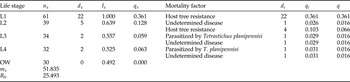
Life tables were constructed for each site in each cohort year following Southwood & Henderson (Reference Southwood and Henderson2000), and a representative life table is shown in table 1. The column headings used were: n x = number of live EAB entering each stage (based on reverse calculation of the different stages of EAB observed at the time of debarking); d x = number of dead EAB observed in each stage; l x = proportion of EAB surviving to each life stage; q x = apparent (stage-specific) mortality rate (d x /n x ); d i = number of EAB dying in association with the specific mortality factor observed, q i = apparent mortality rate caused by the specific biotic factor d i /n x ); q = real mortality (d x or d i /n 0), R 0 = net reproductive rate, calculated as the proportion of EAB surviving to adults multiplied by the age-specific fertility rate (m x ). Because we were not able to collect field data on adult female fecundity, we used laboratory data from Wang et al. (Reference Wang, Yang, Gould, Zhang, Liu and Liu2010). R 0 is interpreted as follows: if R 0 = 1, the population is constant; if R 0 > 1, the population is growing; and R 0 < 1, the population is declining. As we were deliberately trying to minimize EAB egg mortality, we omitted this stage from the life-table analyses as it did not represent the true mortality experienced by eggs. Additionally, any live L1–L4 larvae found were not included in the life-table analyses because they were likely part of a semivoltine life cycle and therefore would not have been exposed to different mortality factors for the same length of time as univoltine larvae. Finally, for the calculation of R 0 we made the assumption that all live EAB in the OW category reached adulthood and successfully reproduced.
Representative life table of the 2013 EAB cohort from one site in Maryland, showing the four larval instars (L1–L4) and overwintering/mature life stages (OW).

Column headings represent: n x , number of live EAB entering each stage (based on reverse calculation of the different stages of EAB observed at the time of debarking); d x , number of dead EAB observed in each stage; l x , proportion of EAB surviving each life stage; q x , apparent (stage-specific) mortality rate (d x /n x ); d i , number of EAB dying in association with the specific mortality factor observed, q i , apparent mortality rate caused by the specific biotic factor d i /n x ); q, real mortality (d x or d i /n 0), R 0, net reproductive rate, calculated as the proportion of EAB surviving to adults multiplied by the age-specific fertility rate (m x ) (Wang et al., Reference Wang, Yang, Gould, Zhang, Liu and Liu2010).
Results
After debarking, three trees were excluded from analyses (two because they were too heavily infested with wild EAB for us to identify the experimental cohort, and one because no eggs had hatched on it). Of the eggs on the remaining 107 trees, for both the 2012 and 2013 cohorts combined the overall hatching rate was 52.7 ± 0.6%. Consequently, we were able to determine the fates of a total of 1706 EAB larvae.
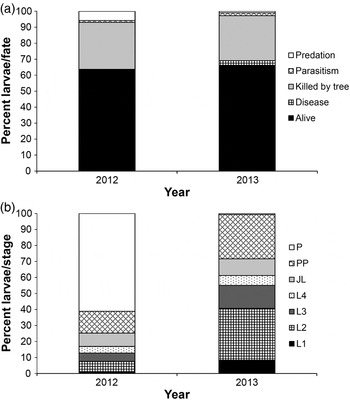
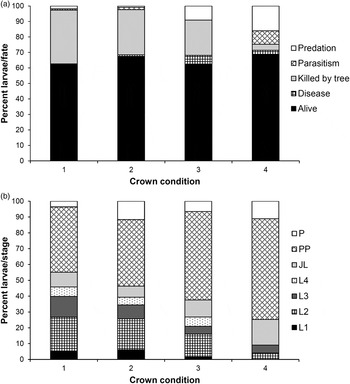
The proportions of larvae in each fate category were significantly different between the 2012 and 2013 cohorts (G = 55.8, 4 df, P < 0.001; fig. 1a). We found live larvae in all life stages at the time of debarking in both cohorts, and among these live larvae we found considerable variation in life stage even within the same tree at some sites. For example, larvae from cohorts on the same host tree were found to be in both early instar (L1–L2) and OW stages. This occurred on 11 trees in the 2012 cohort and 14 trees in the 2013 cohort. Additionally, larval development was significantly influenced by cohort year (G = 620.8, 6 df, P < 0.001), with more overwintering stages found in the 2012 cohort and more early larval instars found in the 2013 cohort (fig. 1b). Larval fate (G = 223.9, 12 df, P < 0.001; fig. 2a) and life stage also differed significantly by crown condition (G = 128.8, 18 df, P < 0.001; fig. 2b). In particular, we generally found more immature larval stages in healthy trees, while mature larvae and pupae were most commonly found in unhealthy trees.
Percentages of EAB larvae from experimental cohorts in different fates (a) and life stages (b) by cohort (2012 and 2013).

Percentages of EAB larvae from experimental cohorts in different fates (a) and life stages (b) by crown condition of host tree. Crown condition was assessed on a scale of 1–5 (with 1 representing healthy crowns with no apparent EAB infestation, and 5 representing crowns with >80% reduction in cover). Numbers of study trees in each crown condition were: 1 = 45, 2 = 38, 3 = 19, and 4 = 8.

Larval fate categories
No EAB were found to have developed into adults and exited trees, which was expected given the timing of debarking each year. Most of the EAB larvae we found in both the 2012 and 2013 cohorts were alive (64.6 ± 2.6%). Of these 1118 live larvae, 37.0% were in the L1–L4 stage and presumably following a semivoltine life cycle. The proportion of live larvae was significantly affected by the interaction between host tree crown condition and mean site crown condition (LR χ2 = 10.1, 1 df, P = 0.002). The interaction showed that when most trees at the site were healthy (i.e., with crown conditions of 1 or 2), more live larvae were found in unhealthy host trees (i.e., with crown conditions of 3 or 4, presumably from wild EAB infestations). As trees at sites generally became unhealthier, more live larvae were found in the healthier host trees. Tree DBH did not significantly affect the proportion of larvae found alive (LR χ2 = 2.2, 1 df, P = 0.140).
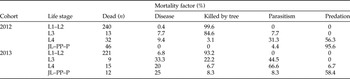
Tree resistance accounted for the fates of 28.8 ± 2.5% of all EAB larvae found. For early instars (L1–L2), tree resistance was responsible for over 90% of mortality in both cohorts (table 2). Tree resistance was still an important source of mortality for L3 larvae (particularly in the 2013 cohort), but then declined in L4 and OW stages. There were significant interactions between mean site crown condition and DBH (LR χ2 = 10.5, 1 df, P = 0.001), and host tree crown condition and DBH (LR χ2 = 5.6, 1 df, P = 0.018). Specifically, for the interaction between mean site crown condition and DBH, when sites generally had healthier trees more larvae were killed by tree resistance in larger host trees. When unhealthier trees were more common at sites, tree resistance killed more larvae in smaller host trees. Additionally, for the interaction between host tree crown condition and DBH, when host trees were healthy there was little difference in the proportion of larvae killed by tree resistance among DBH, but as host tree crown condition deteriorated more larvae were killed by this factor in larger trees.
Relative importance of four mortality factors at different EAB life stages by cohort. Shown are the total numbers of individuals in each life stage that died, and the percent mortality caused by each of the four factors.

We found 3.6 ± 1.1% of all EAB larvae had been taken by predators. This fate was also the main source of mortality for OW stages of EAB (table 2). Predation was significantly affected by the interaction between mean site crown condition and host tree crown condition (LR χ2 = 4.8, 1 df, P = 0.029). The interaction showed that when most trees at a site were healthy, slightly more larvae were killed by predators in healthy host trees, but as tree health deteriorated considerably more larvae were killed by predators in unhealthy host trees.
Disease was relatively low for both cohorts (1.6 ± 0.6%), but as a source of mortality it affected all larval stages (table 2). Mean site crown condition (LR χ2 = 44.3, 1 df, P < 0.001) and tree DBH (LR χ2 = 9.3, 1 df, P = 0.002) both significantly affected the proportion of diseased larvae found. Although diseased larvae were often found in more unhealthy trees, individual host tree crown condition did not significantly affect larvae in this category (LR χ2 = 0.1, 1 df, P = 0.788).
Overall, parasitism was the least common fate for EAB larvae (1.5 ± 0.4%), but it was the main source of mortality for L4 larvae (table 2). Parasitism was significantly affected by host tree DBH (LR χ2 = 18.2, 1 df, P < 0.001), and the interaction between mean site crown condition and host tree crown condition (LR χ2 = 11.3, 1 df, P = 0.001). For the interaction between mean site crown condition and host tree crown condition, when trees at a site were generally healthy, most parasitism was found in healthy host trees. However, as tree health deteriorated we found more larvae killed by parasitoids in unhealthy host trees. We recovered both of the biological control agents from EAB larvae at our sites, in addition to at least two other parasitoid species (table 3). Moreover, in the 2013 cohort we found T. planipennisi at two sites where no releases had been conducted.
Parasitoid assemblage associated with experimentally created EAB cohorts in Maryland.

Life-table analyses
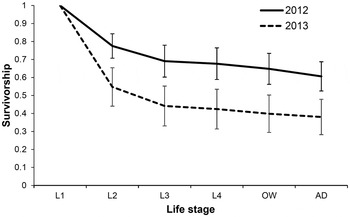
Analyses of the 22 life tables (Supplementary tables S1–22) revealed that there was a mean R 0 of 26.1 ± 3.4, indicating that EAB populations were growing fast. Only at one site was R 0 < 1 (in the 2013 cohort), and no trend between R 0 and site crown condition was apparent (Supplementary table S23). Additionally, survivorship was lower in the 2013 cohort, driven by an increase in mortality at the L1 stage (fig. 3).
Mean stage-specific survival of EAB for the 2012 and 2013 cohorts, based on data from the life tables (Supplementary tables S1–22). Black vertical bars represent ± SE.

Discussion
We found that the fates of EAB larvae were highly dependent on host tree crown condition and life stage. In relatively healthy trees (i.e., with a low EAB infestation) and for early instars, host tree resistance was the most important mortality factor. Conversely, in more unhealthy trees (i.e., with a moderate to high EAB infestation) and for later instars, parasitism and predation were the major sources of mortality. These findings have implications for EAB host selection, because unhealthy trees might be preferable for EAB oviposition and recruitment (Tluczek et al., Reference Tluczek, McCullough and Poland2011; Jennings et al., Reference Jennings, Taylor and Duan2014). If EAB adults do select more unhealthy trees, larvae could be less likely to encounter tree resistance and may have a higher probability of survival to later life stages.
Our results suggest that wild EAB populations in the Mid-Atlantic region of the USA are likely a mixture of univoltine and semivoltine life cycles, which is relatively similar to trends observed in the Midwest (Cappaert et al., Reference Cappaert, McCullouch, Poland, Mastro and Reardon2005a ; Duan et al., Reference Duan, Ulyshen, Bauer, Gould and Van Driesche2010, Reference Duan, Abell, Bauer, Gould and Van Driesche2014). Crown condition appeared to be an important factor affecting life cycles, with more immature larvae (i.e., those larvae likely to have a semivoltine life cycle) in healthier trees. However, it was notable that we found large variation in EAB life stages in a total of 25 trees, which was almost a quarter of all trees used. Temperature is known to affect larval development of EAB (Duan et al., Reference Duan, Watt, Taylor, Larson and Lelito2013b ) and other buprestids (Cárdenas & Gallardo, Reference Cárdenas and Gallardo2012), and our findings suggest that differences in microclimate affecting individual trees could also partly be responsible for variation in EAB life cycle strategies. Because trees were debarked at a similar time for both the 2012 and 2013 cohorts, another potential cause of the significant difference between cohort years in proportions of EAB in different life stages could be between-year variation in climate. For example, the mean summer, autumn, and winter temperatures around some of the sites in Maryland were all higher for the 2012 cohort (25.3, 13.8, and 3.4 °C, respectively) compared with the 2013 cohort (24.3, 13.7, and 0.7 °C, respectively) (NOAA, 2015).
It was not surprising to find that predation was significantly affected by host tree crown condition and mean site crown condition. Some species of insectivorous birds such as woodpeckers have been found to show a numerical response to EAB populations (Koenig et al., Reference Koenig, Liebhold, Bonter, Hochachka and Dickinson2013), and these birds are also known to prefer foraging on trees exhibiting signs of crown condition decline (Flower et al., Reference Flower, Long, Knight, Rebbeck, Brown, Gonzalez-Meler and Whelan2014). Reduced levels of predation in the 2013 cohort could have been affected by the smaller numbers of EAB found in OW stages, as previous work has shown those stages to consistently be attacked by woodpeckers (Lindell et al., Reference Lindell, McCullough, Cappaert, Apostolou and Roth2008; Duan et al., Reference Duan, Ulyshen, Bauer, Gould and Van Driesche2010, Reference Duan, Abell, Bauer, Gould and Van Driesche2014; Jennings et al., Reference Jennings, Gould, Vandenberg, Duan and Shrewsbury2013). Although woodpeckers can be effective predators of EAB in trees at heavily infested sites (Cappaert et al., Reference Cappaert, McCullouch, Poland, Mastro and Reardon2005c , Flower et al., Reference Flower, Long, Knight, Rebbeck, Brown, Gonzalez-Meler and Whelan2014), at recently colonized sites predation does not appear to be a major mortality factor for these beetles.
We generally observed increased numbers of diseased larvae in relation to declining host tree crown condition. Given that host tree crown condition at these sites is likely related to the presence of wild EAB larvae in the trees, this suggests that the diseased category may include mortality from intraspecific competition and potentially cannibalism (Duan et al., Reference Duan, Larson, Watt, Gould and Lelito2013c ). Greater intraspecific competition for resources in unhealthy trees has been shown with EAB (Limback et al., Reference Limback, McCullouch, Chen, Poland, Cregg, Lance, Buck, Binion, Mastro and Reardon2010) and other coleopteran larvae (Hanks et al., Reference Hanks, Paine and Millar2005). However, because disease and/or intraspecific competition tends to be more important in unhealthy trees it is another source of mortality that does not greatly contribute to suppressing EAB population growth in recently colonized trees and sites.
The observation of tree DBH significantly affecting parasitism was consistent with previous work demonstrating how thicker bark can prohibit parasitism by T. planipennisi because of its short ovipositor (Abell et al., Reference Abell, Duan, Bauer, Lelito and Van Driesche2012). The significant interaction between mean site crown condition and host tree crown condition on parasitism was surprising, but perhaps indicates a density-dependent response of the parasitoids to EAB. Alternatively, this interaction may reflect a correlation with another unknown environmental variable, or may simply be a spurious result caused by the low number of parasitized larvae we found. Compared with locations in Michigan (Bauer et al., Reference Bauer, Liu, Haack, Gao, Zhao, Miller, Petrice, Mastro and Reardon2005; Duan et al., Reference Duan, Bauer, Abell and Van Driesche2012b , Reference Duan, Abell, Bauer, Gould and Van Driesche2014) and Pennsylvania (Duan et al., Reference Duan, Fuester, Wildonger, Taylor, Barth and Spichiger2009), the composition of the parasitoid assemblage associated with EAB in Maryland appears to be less species rich and diverse. However, these observations could be attributed to EAB colonizing our study sites more recently, or potentially because of our choice of selecting relatively healthy ash trees to host cohorts (which could affect any host cues the parasitoids are responding to). Expanding future studies in Maryland to quantify mortality factors affecting wild EAB in more damaged trees should help to elucidate these observations. Encouragingly, we did recover the biological control agent T. planipennisi at two sites where no releases had been conducted, suggesting that this species may be establishing and dispersing. Given sufficient time, these populations of T. planipennisi in Maryland may grow and reach similar levels as those in Michigan, where both T. planipennisi and the egg parasitoid O. agrili appear to have become firmly established (Duan et al., Reference Duan, Bauer, Abell and Van Driesche2012b , Reference Duan, Larson, Watt, Gould and Lelito c , Reference Duan, Bauer, Abell, Lelito and Van Driesche2013a , Reference Duan, Abell, Bauer, Gould and Van Driesche2014).
Our findings provide further evidence of the mechanisms by which EAB has been able to successfully establish and spread in North America. Although green ash trees appear to have the ability to defend themselves against very small numbers of EAB larvae and resistance often acts as the major source of mortality to EAB in the early stages of EAB larval infestation, host tree resistance alone is insufficient to reduce EAB population growth. Furthermore, the natural enemy assemblage of EAB (including introduced biological control agents) appears to take several years before it is able to positively respond to populations of EAB and contribute to a significant amount of mortality (Duan et al., Reference Duan, Abell, Bauer, Gould and Van Driesche2014).
Supplementary Material
The supplementary material for this article can be found at http://www.journals.cambridge.org/BER
Acknowledgements
This work was supported by the USDA-ARS Specific Cooperative Agreement (58-1926-167), and the USDA National Institute of Food and Agriculture, McIntire-Stennis Project 1003486. We are extremely grateful to the Maryland Department of Agriculture for assistance with parasitoid releases and locating suitable study sites, particularly Dick Bean, Kim Rice, Charles Pickett, Steve Bell, Sam Stokes, Rose Buckner, Martin Proctor, and Aaron Shurtleff. We thank Mark Beals and Jesse Morgan (Green Ridge State Forest) for permission to use study sites, Jonathan Lelito and Stephanie Likens (USDA-APHIS) for providing parasitoids, and Kristi Larson, Jonathan Schmude, Sue Barth (all USDA-ARS), and Jackie Hoban (University of Delaware) for rearing EABs. We also thank Miles Wetherington, Trevor Scheffel, Meg Ryan, Jaclyn Mertz, Dan Nola, Katherine Rentas, Stokes Aker, Nancy Harding, Ashley Jones, and Grace Kunkel (all University of Maryland) for assistance in the field, and Doug Luster (USDA-ARS) and three anonymous reviewers for comments that greatly improved the manuscript.