Introduction
This is a report of the case of a 79-year-old male cardiac arrest survivor who suffered a thoracic vertebral fracture following cardiopulmonary resuscitation (CPR) with a LUCAS 2 (Physio-Control Inc.; Lund Sweden) device. There have been a number of articles examining the injuries following external compressions, both with an automated device as well as manual compressions.Reference Marshall, Kotecha, Chiba and Tennyson 1 While there has been a report of a prior vertebral fracture with manual CPR,Reference Black, Busuttil and Robertson 2 as well as a small number noted with the AutoPulse (ZOLL Medical Corporation; Chelmsford, Massachusetts) device,Reference Goldberg, Rowan and Anderson 3 these only were identified in autopsy studies. There have been no prior reports in the literature of thoracic fractures noted on imaging in survivors of a cardiac arrest from an automated compression device. As external compression devices become more widespread, it is important to highlight potential injuries that can be caused by use of these devices. This is the first reported case of a thoracic vertebral fracture identified outside of autopsy studies in a patient receiving CPR from a LUCAS device.
Case Report
A 79-year-old male, with significant past medical history of hypertrophic cardiomyopathy and prior coronary artery bypass graft surgery, was transferred from an outside hospital to the emergency department for post cardiac arrest care. The patient complained of bilateral shoulder pain prior to a witnessed sudden loss of consciousness. Emergency Medical Services (EMS) was activated and CPR was initiated by police who arrived at the scene, first with manual compressions. One shock was delivered by automated external defibrillator before EMS arrival. Upon EMS arrival, he was ventilated with bag-valve-mask, and chest compression were switched to a mechanical chest-compression device (LUCAS 2 chest compression system). Two more defibrillations were delivered for ventricular fibrillation and successful return of spontaneous circulation (ROSC) was obtained. Estimated time of CPR was six minutes, and mechanical chest-compression device was applied for less than two minutes. After ROSC, he was brought to the local emergency department where a definitive airway was placed to protect his airway and he was transferred to the tertiary care center. Of note, the patient did not have a history of osteoporosis or osteopenia.
On arrival, the patient was a hemodynamically stable, comatose elderly male on ventilator, with no signs of trauma. Additionally, there were no reports of any clinically significant trauma during his prehospital and hospital course.
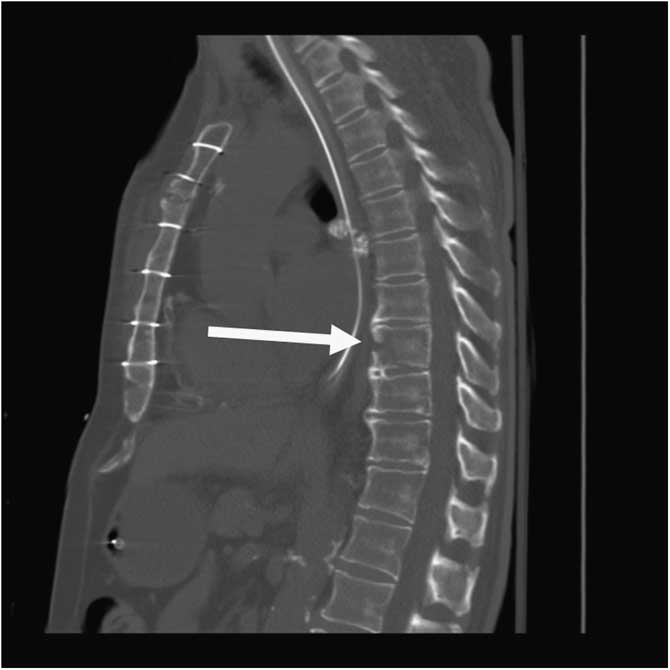
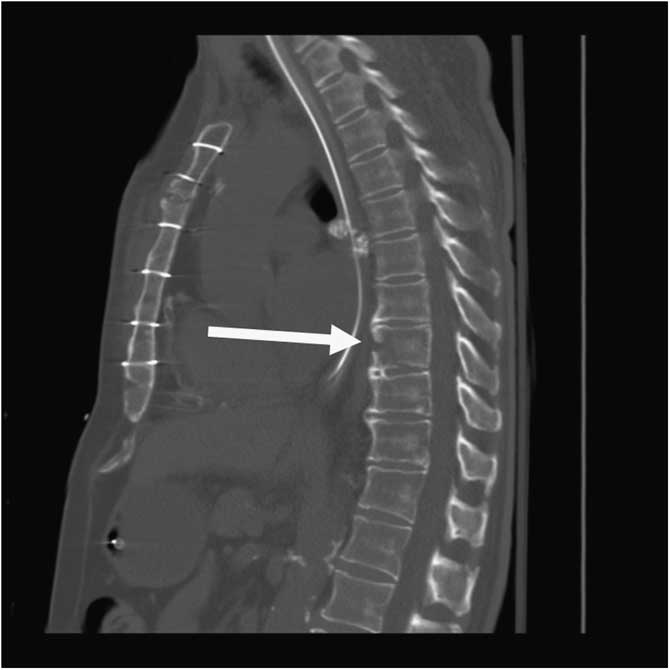
Computed tomography angiography of chest with contrast was obtained to rule out aortic dissection prior to heparin administration, and this revealed multiple bilateral minimally displaced and non-displaced anterior rib fractures and an anterior column fracture of T8 sparing the posterior cortex (Figure 1).
Computed Tomography (CT) Findings. Note: Sagittal CT image demonstrates an obliquely oriented fracture line (arrow) extending from the anterior vertebral body to the inferior end-plate with mild distraction of the fracture fragments anteriorly. The fracture is restricted to the anterior two-thirds of the vertebra, indicating a stable anterior column fracture.
The patient underwent therapeutic hypothermia. Cardiac catheterization and angiography during admission showed patent bypass grafts. The patient was fully recovered and discharged 14 days after admission with an intact neurological exam. The patient did not require additional procedures secondary to the vertebral body fracture and did not appear to have any long-term complications secondary to the injury.
Discussion
Mechanical compression devices have become more prevalent in recent years and, as the focus on high-quality CPR has increased, the efficacy of these devices has been studied at length.Reference Pinto, Haden-Pinneri and Love 4 , Reference Steen, Liao, Pierre, Paskevicius and Sjoberg 5 However, as these devices have become more wide spread, there have been increasing reports of injuries associated with these devices, ranging from skeletal injuries, damage to soft tissue, and cardiac injuries.Reference Smekal, Johansson, Huzevka and Rubertsson 6 , Reference Hoke and Chamberlain 7 This case provides another example of a potential injury pattern that can be identified in patient receiving mechanical compressions.
Chest compression within the context of CPR is an inherently traumatic procedure. The most common skeletal injury associated with chest compressions, whether manual or mechanical, is rib fracture, followed by sternal fracture.Reference Marshall, Kotecha, Chiba and Tennyson 1 , Reference Goldberg, Rowan and Anderson 3 , Reference Smekal, Johansson, Huzevka and Rubertsson 6 , Reference Giraud, Siegenthaler and Schussler 8 - Reference Buschmann and Tsokos 13 There is great variation in the current literature regarding incidence, likely attributable to study methodology. In a relatively large autopsy study of 222 patients, Smekal et al found that chest compressions resulted in rib fractures in approximately 65% of patients with manual compression and 79% of those with mechanical compressions using LUCAS 2. More than one-half of patients in both groups had multiple rib fractures. Sternal fractures were less frequent in both groups, with an incidence of 54% in those with manual CPR and 58% in those with mechanical CPR.Reference Lederer, Mair, Rabl and Baubin 9
Vertebral fracture is a rare complication of CPR.Reference Black, Busuttil and Robertson 2 , Reference Lederer, Mair, Rabl and Baubin 9 , Reference Hashimoto, Moriya and Furumiya 14 , Reference Azuma, Mashiyama, Goldsmith and Abbasi 15 It previously has been described only in autopsy studies and, prior to this report, had not been identified in a cardiac arrest survivor. In their autopsy study, Smekal et al found that two patients (1.4%) in the mechanical CPR group had vertebral fractures, compared to none in the manual CPR group.Reference Lederer, Mair, Rabl and Baubin 9 Other previously reported cases of vertebral fractures were associated with predisposing factors, including osteopenia, osteoporosis, or kyphosis which were not present in this case.Reference Hashimoto, Moriya and Furumiya 14 , Reference Azuma, Mashiyama, Goldsmith and Abbasi 15
The fracture pattern seen in this case is more consistent with an extension mechanism of injury. The lack of vertebral body compression argues against an axial loading mechanism of injury typically seen in cases of trauma. Previously reported cases do not describe vertebral fracture patterns in detail, limiting comparative evaluation. Given that there was no known traumatic injury, it was believed that the vertebral fracture was associated with CPR. Furthermore, the other traumatic injuries identified, including anterior rib fractures, are consistent with prior autopsy reports from the LUCAS 2 device.Reference Smekal, Johansson, Huzevka and Rubertsson 6 While the possibility that the injury was the result of manual CPR prior to the application of the device remains, the majority of CPR-associated spinal fractures reported in the literature are associated with mechanical devices.Reference Black, Busuttil and Robertson 2 , Reference Lederer, Mair, Rabl and Baubin 9 , Reference Hashimoto, Moriya and Furumiya 14 , Reference Azuma, Mashiyama, Goldsmith and Abbasi 15
Conclusions
This case report identifies an additional injury pattern that can be seen in survivors of cardiac arrest automated compression devices. This provides an important consideration for prehospital providers using a mechanical compression device and demonstrates the importance of communication from the prehospital providers regarding care provided in the field for ongoing patient care.