
I. INTRODUCTION
Lithium (Li)-based primary battery was first prepared in 1970 with the most electropositive and light weight Li metal as an anode.Reference Tarascon and Armand1 After two years in 1972, Exxon used Li as anode material for rechargeable lithium metal cells. The major issue with these cells was recognized as dendrite formation during charge/discharge or cycling which further caused the short circuiting of the cell. Further, in 1991, Sony introduced a much safer commercial lithium ion battery (LIB) based on the lithium ion rocking-chair mechanism by using a metal oxide as cathode and carbon material as an anode with working voltage (>3.6 V).Reference Tarascon and Armand1 Unlike Li metal as anode, these carbon based anodes were found to be much safer with no significant change in their morphology and structure during cycling.Reference Sacken, Nodwell, Sundher and Dahn2 Even today, in a typical Li ion cells, safer Li-based metal oxides and phosphates serves as positive electrode (lithium ion source) while carbon serves as host for lithium ions (negative electrode).Reference Goriparti, Miele, De Angelis, Di Fabrizio, Proietti Zaccaria and Capiglia3 These active electrode materials are parted by polyethylene or polypropylene separators filled with electrolyte (lithium salt in organic solvents). During charging, Li ions move from positive electrode to negative electrode under the influence of external power supply while during discharge, Li ions move back to the layered metal oxide structure, and electrons moving from the external circuit provide the energy required for the devices. Considering the requirement of a large number of continuous charge/discharge cycles, mechanical integrity of the electrode materials becomes a major factor for excellent cyclic stability of LIB. This is therefore that carbon materials are widely investigated as the anode materials for LIBs.
Further among three different types of electrode materials based on their reaction mechanism (intercalation/de-intercalation, alloying and conversion mechanism), carbon materials with electroinsertion mechanism are the most popular.Reference Goriparti, Miele, De Angelis, Di Fabrizio, Proietti Zaccaria and Capiglia3 In intercalation and de-intercalation reaction mechanism, Li ions reversibly insert into the active material (e.g., carbon) with a layered structure. These, insertion electrode materials with layered structure are extensively used in commercial LIBs due to their intrinsically facile charge discharge mechanism. Carbon based materials follow this intercalation and de-intercalation mechanism and show good cyclic performance (∼1000 cycles), lower redox potential versus lithium (intercalation takes place at <0.1 V) and reasonable capacity which ultimately led to the use of carbon as anode material widely for commercial LIB.Reference Goriparti, Miele, De Angelis, Di Fabrizio, Proietti Zaccaria and Capiglia3 Graphitic carbon with a theoretical capacity of 372 mA h/g (LiC6) was the popular choice for commercial battery applications due to its low irreversible capacity, long cyclic life, and improved electronic conductivity.Reference Shi, Barker, Saydi, Koksbang and Morris4–Reference Endo, Kim, Nishimura, Fujino and Miyashita7 Between natural and artificial graphite, natural graphite is preferable because of low cost and higher specific reversible capacity due to long rage order of graphene layers.Reference Dahn, Zheng, Liu and Xue8 However, graphitic carbons suffer from low energy density and poor rate capability. Alternatively, other carbon forms were explored as anode materials such as carbon nanofibers, carbon nanotubes, and hard carbons.
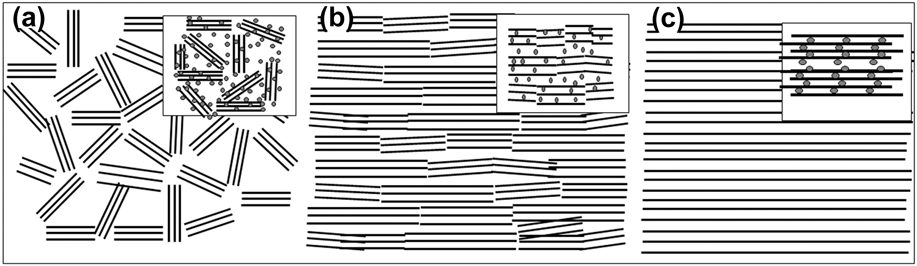
Although, carbon nanomaterials show high energy density, their scalability, production cost, and high initial irreversible capacity limits their use for commercial Li ion batteries. Further, hard carbons provide additional advantages such as ease of scalability, improved energy density, and a reasonably good rate performance due to their disordered crystal structure as shown in Fig. 1(a). Figure 1 shows the three different microstructures of carbon materials as proposed by FranklinReference Franklin9 while the inset images shows the lithium insertion into different carbon microstructures. Hard carbon electroinsertion mechanism was first explained by Dahn with the house of card model.Reference Liu, Xue, Zheng and Dahn10 The high capacities for these hard carbon materials were attributed to the adsorption of the Li ion on the internal surface of the nanopores formed by small graphene sheets arranged like house of cards, trapping of Li2 covalent compound in between two benzene rings, doping of Li at the edges and on the surface in small crystalline carbons apart from the Li insertion in between graphene layers with LiC6 stoichiometry.Reference Dahn, Zheng, Liu and Xue8,Reference Sato, Noguchi, Demachi, Oki and Endo11 Apart from with these crystalline imperfections, the presence of surface functional groups (–OH, –COOH) and hydrogen content which are very reactive to Li metal also play a significant role in determining the overall electrochemical performance of these hard carbon materials.Reference Liu, Xue, Zheng and Dahn10–Reference Wang, Yang, Zhou and Xie14 Enhanced capacities of hard carbon materials with improved rate capability attracts the interest of the scientific community in hard carbon materials. As a result of this, several types of hard carbon materials mainly derived from carbonization of polymer precursors and biomass have been extensively studied for LIB.Reference Kalyani and Anitha15 As compared to biomass derived hard carbon, polymer precursor derived carbons have the edge as it is easier to tune their morphology by using a toolkit of different micro and nanofabrication methods. Among various polymer precursor materials, carbon gels derived from the RF gel are of special interest because of their higher carbon yield (∼55%), tunable morphology, surface area, and porous structure.
Microstructure of (a) hard carbon; (b) soft carbon; (c) graphitic carbon and corresponding lithium insertion mechanism in inset.

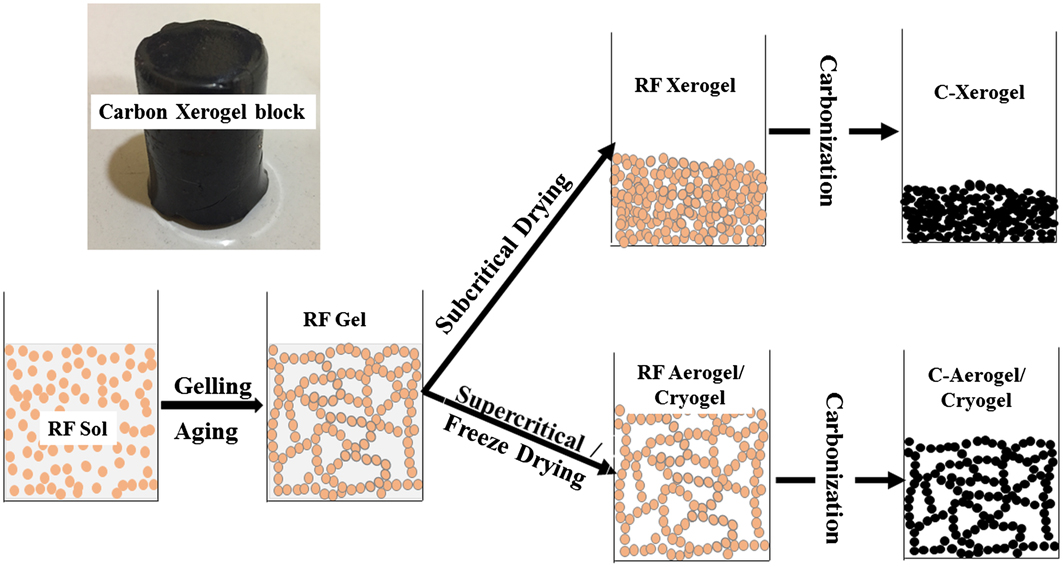
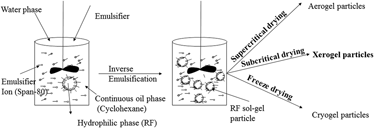
RF-based organic gel was first synthesized by Pekala from hydrolysis and condensation of resorcinol and formaldehyde.Reference Pekala16 These organic gels are classified into three different types based on their drying process, aerogels (supercritical drying), xerogels (oven drying), and cryogel (Freeze drying).Reference Czakkel, Marthi, Geissler and Laszlo17,Reference Al-Muhtaseb and Ritter18 Figure 2 shows the schematic of RF-based gels and their corresponding carbon gels synthesis process and a digital image of carbon xerogel block. Supercritical drying and freeze drying requires extreme pressures and involvement of external agents like solvents and carbon dioxide to prevent the collapse of polymer network during drying. In these two drying methods (supercritical and freeze drying), the polymer gel network does not collapse during the drying process which results in low-density higly porous aerogels and cryogels. However, when drying takes place at ambient pressure, shrinkage and collapse of the network occurs due to increase in surface tension. Carbonization of these organic gels results in carbon gels with different physiochemical properties.
Schematic of different carbon gels synthesis process and digital image of carbon xerogel block.

Carbon aerogel and cryogels have been studied in detail for supercapacitors owing to their higher surface area. However, carbon xerogels remained unnoticed till recently due to their non-porous morphology. In recent times, carbon xerogels have regained the attention due to the possibility of tailoring the synthesis conditions to achieve relatively high surface area structures, nonporous but large external surface area structure of wide range of morphologies. Apart from these technical characteristics, carbon xerogels can be prepared in an inexpensive way due to simple oven drying as compared to sophisticated supercritical and freeze drying. Another important advantage with carbon xerogles in electrode applications is high density (low volume). Higher density of electrode material results in higher specific volumetric intercalation capacity. Carbon xerogels density is about 1.2 g/cm3, where as carbon aerogels possesses very low density (0.43–0.98 g/cm3) considering this carbon xerogel-based electrode require almost two times lower volume when used as electrode material, which reduces the volume of the lithium ion battery eventually.Reference Kakunuri, Vennamalla and Sharma19,Reference Wu, Fu, Dresselhaus and Dresselhaus20
In fact, a limited surface area and tunable porosity make carbon xerogels more suitable candidate as an anode material for LIB due to their small initial irreversible capacity (low surface area) and lower production cost (ambient pressure drying) compared to high surface area carbon aerogels/cryogels. In few attempts, the carbon aerogel was examined as the anode material for LIB. Carbon aerogel and activated aerogel showed very poor initial cyclic initial efficiency of 20% and 17% (very high irreversible capacity) respectively with considerable fade in specific capacity over cycling.Reference Nian-Ping, Jun, Da-Yong, Dong, Xiao-Wei and Ya-Jie21,Reference Yang, Wei and Zhang22 Initial cycle efficiency of carbon aerogel was improved by synthesis of mesoporous activated carbon aerogel by microemulsion template method (42%).Reference Yang, Wei and Zhang22 However the capacity fade was significant in initial cycles (after 20 cycles, the capacity fade was 48%). However, these mesoporous activated carbon aerogels showed excellent rate performance due to their high surface area (2161 m2/g) and mesoporous structure.Reference Yang, Wei and Zhang22 High initial irreversible capacity and capacity fade confines their use as anode material for lithium ion batteries. So, comparatively carbon xerogel derived hard carbons with varying morphologies are studied well in recent literature have a great potential to be used as an anode material for LIB. In this review, we have summarized the synthesis of organic xerogels with different morphologies and effect of their physiochemical properties on the electrochemical performance of carbon xerogels.
II. SYNTHESIS OF CARBON XEROGELS WITH VARYING MORPHOLOGIES
A. Sol–gel emulsion
Carbon materials with tunable porosity, surface area, and hierarchical structure are of special interest due to their low density and low thermal conductivity. These carbon materials were synthesised by various methods such as activation,Reference Al-Muhtaseb and Ritter18 template assisted method,Reference Kruk, Dufour, Celer, Kowalewski, Jaroniec and Matyjaszewski23–Reference Zhou, Ji, He, Zhang and Zhao25 carbonization of polymer blends,Reference Kowalewski, Tsarevsky and Matyjaszewski26,Reference Ozaki, Endo, Ohizumi, Igarashi, Nakahara, Oya, Yoshida and Iizuka27 and sol gel techniques. Other than the sol–gel technique, activation, and template-based methods have limitations such as pore structure of resulting material in case of template method depends on template porosity and activation results in high degree of microporosity. Further, these methods are not suitable for large scale of applications as these methods involve sacrificing template and use of acids. In 1846, Ebelmen synthesized the first inorganic gel (silica gel), where M–OH–M or M–O–M bonding occurs between metallic atoms of the precursor during the polymerization process.Reference Pierre and Pajonk28 Using similar sol–gel synthesis first organic gel was prepared from resorcinol (R) and formaldehyde (F) by Pekala in 1989.Reference Pekala16 Sol gel polymerization of resorcinol with formaldehyde process is a two-step process, the formation of colloidal solution (sol) of monomers followed by formation of gel (an interconnected network of particles). In the sol–gel process, polymerization enables the gel formation in sol–gel synthesis, which takes place in aqueous medium or organic solvents and polymerization catalysts (Na2CO3, NaOH, and KOH).Reference Al-Muhtaseb and Ritter18,Reference Li, Lu and Guo29–Reference Zhu, Hu, Li and Zhang31 RF sol–gel addition and condensation reaction mechanism is explained in Fig. 3. In addition to RF gel, various organic gels such as phenol-formaldehyde, phenolic-furfural, and melamine-formaldehyde and resorcinol-furfural gels were also prepared and studied for various applications.Reference Li, Lu and Guo29,Reference Pekala, Alvisto, Lu, Gross and Fricke32–Reference Wu, Fu, Sun and Yu34
Schematic of the mechanism of polymerization of resorcinol and formaldehyde. Reproduced with the permission from Al-Muhtaseb et al.Reference Al-Muhtaseb and Ritter18

RF sol preparation starts with dissolving resorcinol pellets in formaldehyde at room temperature to get a uniform solution. The aqueous solution with a polymerization catalyst prepared separately is mixed with ready RF solution and stirred till brownish homogeneous solution obtained. Hydroxymethyl derivatives formation initiates from the reaction between resorcinol anion and formaldehyde. Further, these hydroxymethyl derivatives participate in condensation polymerization reaction to procedure cross-linked clusters (7–10 nm) and formation of these colloidal particles in a liquid is called sol formation. Over aging, these colloidal particles further produce a rigidly interconnected network with sub-micron sized pores.
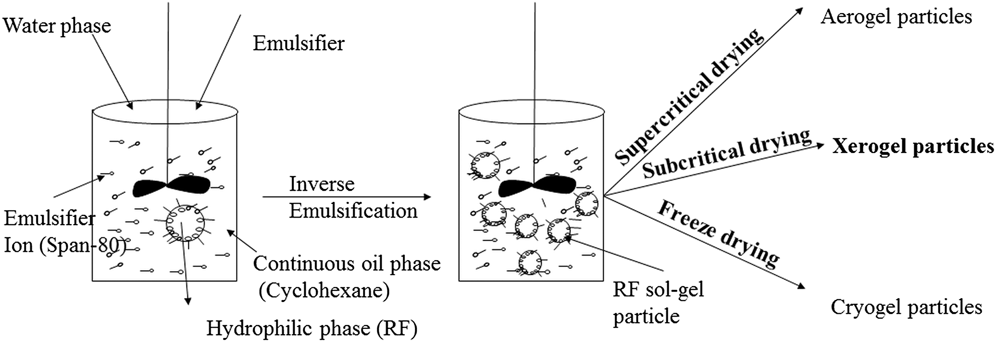
Inverse emulsification process is extensively used to prepare sol–gel particles and to tune the surface morphology of the carbon xerogels to meet the requirement of carbon xerogels for various applications. An emulsion is a combination of two immiscible phases, where one phase is dispersed as droplets in second continuous phase. In emulsion polymerization, a hydrophobic monomer is polymerized using an oil-in-water emulsifier and a water soluble initiator. In contrast to this, inverse emulsification polymerization of hydrophilic monomer takes place in a continuous oil phase using a water-in-oil emulsifier as shown in Fig. 4.Reference Gelman, Harrington and Vaynberg35 Inverse emulsion polymerization involves three components, water soluble monomers to be polymerized, nonpolar organic solvent (continuous phase), and a surfactant which stabilizes the emulsion.Reference Gelman, Harrington and Vaynberg35 Interfacial surface tension at the boundary of the dispersed phase and continuous phase minimizes by the emulsifier to yield spherical particles. Drying followed by carbonization results in three different types of carbon gel particles depending on the drying process as shown in Fig. 4.
Schematic of inverse emulsification process.

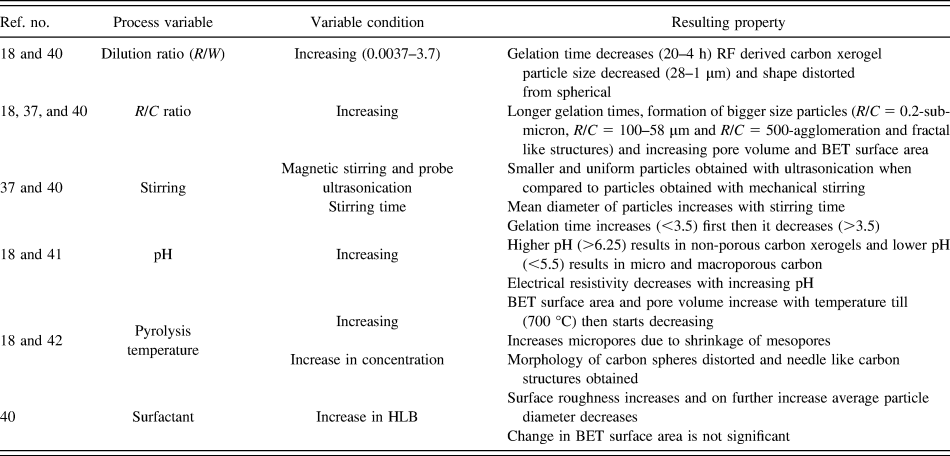
This inverse emulsification method is primarily used for the synthesis of micron and submicron size spherical RF particles. However, a large variety of morphologies such as porous, hallow and dense microspheres, microspheres with nanofeatures, microcapsules, and fractal like structures were obtained by varying the inverse emulsification synthesis parameters such as pH, sol concentration, catalyst amount, stirring time, and surfactant type.Reference Al-Muhtaseb and Ritter18,Reference Kim, Yamamoto, Endo, Ohmori and Nakaiwa36–Reference Sharma, Upadhyay and Sharma40 We have summarized the effect of these processing parameters on morphology or RF based organic gels in Table I.
Effect of inverse emulsification process parameters on morphology of RF gels.

B. Electrospraying/electrospinning
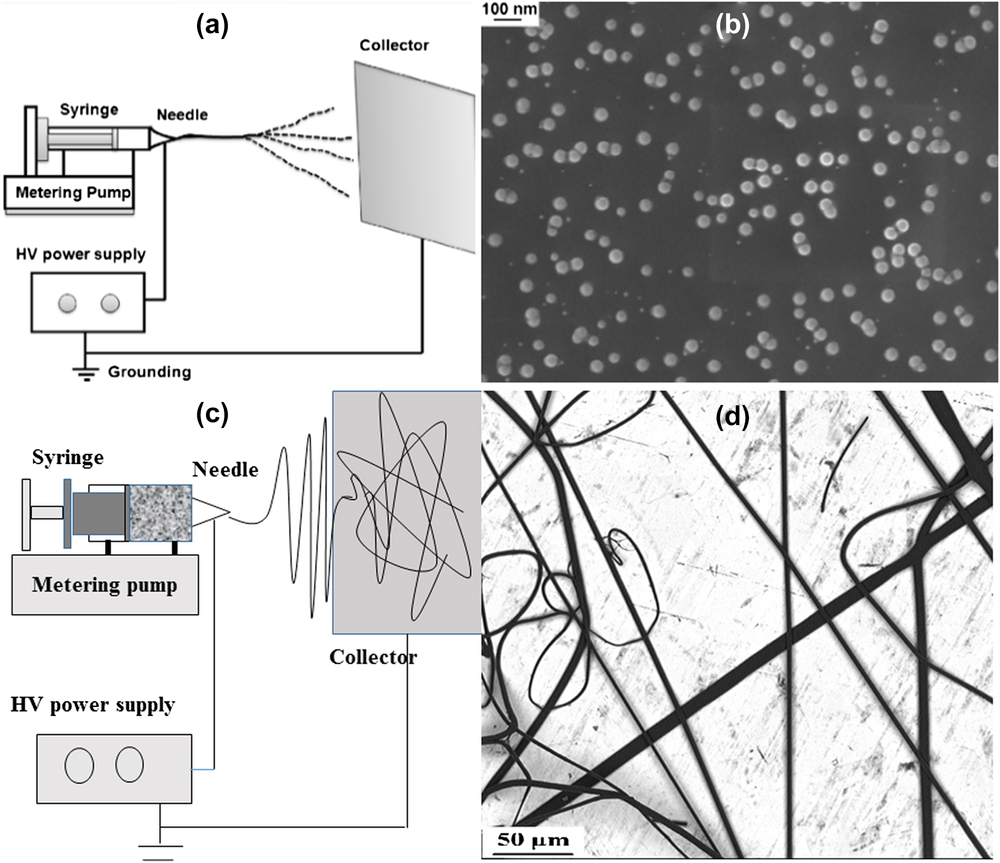
Inverse emulsification of RF sol is a widely used technique to synthesize micro/nano particles.Reference Al-Muhtaseb and Ritter18,Reference Kakunuri, Vennamalla and Sharma19,Reference Sharma, Kulkarni, Sharma and Madou37,Reference Tashima, Taniguchi, Fujikawa, Kijima and Otsubo41,Reference Lei, Song, Zhou, Zhang and Chen43 This method was well explored for the synthesis of carbon aerogel, xerogel, and cryogel particle synthesis by carbonization of RF gel particles in the inert atmosphere. Electrospraying is another alternative technique to produce micro/nano size particles using electrospinning setup.Reference Bagheri-Tar, Sahimi and Tsotsis44–Reference Chen, Pui and Kaufman46 In electrospraying, high voltage (tens of kilovolts) is applied on polymer droplet coming out of a syringe needle. Electrostatic force on the polymer droplet at the tip of the needle due to high voltage overcomes the surface tension and viscoelastic forces in less viscous polymer precursor and results in the breakup of polymer jet into nanometer sized droplets as shown in Figs. 5(a) and 5(b). The mean droplet size can be changed from few nm to µm by varying the spinning conditions.Reference Bagheri-Tar, Sahimi and Tsotsis44,Reference Chen, Pui and Kaufman46 Needle diameter (gauge), applied voltage, and flow rate of the polymer solution showed significant effect on particle size and distribution. Particle size observed to be reduced with increasing needle gauge (reducing needle opening), applied electric potential and flow rate. Larger needle opening and higher applied electric potential resulted in bimodal particle size distribution. Carbon particles size varied from 1.4 nm to 2.12 µm by changing these three parameters. Mono-disperse carbon nanoparticles of size 30.2 nm were obtained with these optimized electrospinning parameters. Electrospraying is still not fully explored as compared to its sister technology, electrospinning due to a wide range of applications for continuous electrospun nanofibers.Reference Sas, Gorga, Joines and Thoney47,Reference Huang, Zhang, Kotaki and Ramakrishna48 RF sol was the first electrosprayed into nearly mono-dispersed nanoparticles by Sharma et al.,Reference Sharma, Patil, Saurabh, Sharma and Venkataraghavan45 using electrospinning of viscous RF sol liquid before it converts in to viscoelastic solid. These electrosprayed particles were then carbonized in an inert atmosphere to yield carbon nanospheres (average diameter ∼30 nm).Reference Sharma, Patil, Saurabh, Sharma and Venkataraghavan45 However later, Mitra et al., reported the synthesis of RF based electrospun carbon nanofibers by blending RF sol with stretchable polymer poly (methyl methacrylate) (PMMA), to improve the spinnability of RF sol for the first time.Reference Mitra, Jain, Ahutosh and Basu49 Recently, electrochemical performance of RF-based carbon nanofibers were investigated as the anode material for LIB.Reference Mamidi, Kakunuri and Sharma50 Figures 5(c) and 5(d) shows the schematic of the electrospinning process for the RF-PMMA fiber formation and corresponding carbon fibers after pyrolysis.
(a) Schematic of electrospraying set upReference Sharma, Patil, Saurabh, Sharma and Venkataraghavan45; (b) SEM image of carbon nanoparticlesReference Sharma, Patil, Saurabh, Sharma and Venkataraghavan45; (c) Schematic of electrospinning setup; (d) SEM image of RF-PMMA derived carbon fibers.

C. Carbon xerogel thin films and monoliths
Carbon thin films and monoliths are also prepared from RF xerogels however find less interest for electrochemical applications as compared to other forms such as micro/nano size particles and powders due to the handling of thin films and thickness of monoliths. Chemical vapor deposition and spin coating of the polymer solution followed by pyrolysis in an inert atmosphere are common techniques to yield carbon thin films.Reference Obraztsov, Obraztsova, Tyurnina and Zolotukhin51,Reference Kakunuri and Sharma52 Self-supported carbon xerogel thin films of few micron thickness were prepared by a slit-space film technique.Reference Tao, Endo, Ohsawa, Kanoh and Kaneko53 As-prepared carbon xerogel films showed high surface area (915 m2/g) with bimodal pore size distribution. In the other way, carbon xerogel thin films were prepared on substrate with and without stretchable (PMMA) polymer and tested as anode material for LIB and scaffold for neural cells (cells of nervous system).Reference Mitra, Jain, Ahutosh and Basu49,Reference Sharma, Katepalli, Sharma, Teixidor and Madou54 Thin films on the substrate have an additional advantage compared to bulk carbon thin films produced from RF gels for electrochemical applications as these films do not need a binder and toxic solvent for electrode slurry preparation. Carbon thin films on conductive substrate can be directly used as anode material for LIBs, whereas free standing flexible carbon thin films are highly suitable for electrode materials in flexible electronics. In contrast to carbon thin films, carbon xerogel monoliths are bulk materials and similar to thin films we use monoliths as electrode material without any addition of binder and solvent. Monoliths can be prepared in the desired shape using molds. Often, RF sol before gelation will be filled into the mold of the desired shape. Depending on the type of carbon gel requirement, these organic monolithic hydrogels dried in mold below 100 °C. Thus obtained gels go for inert atmosphere carbonization to yield carbon gel. However, these monolithic gels can be cut into the desired shape before pyrolysis, preferably after semi curing (before completion of gelation and till these gels remains soft). Also, these mechanically robust monolithic carbon gels can be machined into sheets and blocks by wire-electrode cutting method after carbonization.Reference Jia, Dai, Zhu, Wang, Qiao, Long and Ling55 For electrochemical applications, machining of these monoliths into thinner sheets to utilize the active electrode material effectively is required.Reference Hasegawa, Kanamori, Kannari, Ozaki, Nakanishi and Abe56 These carbon monoliths have additional advantages as an electrode material for LIB such as shorter Li ion diffusion length, a large number of active sites, the high ionic conductivity of the electrolyte within the monolith structure and elimination of the binder or conducting agent.Reference Lee, Lytle, Ergang, Oh and Stein57
D. Three dimensional (3D) micropost arrays
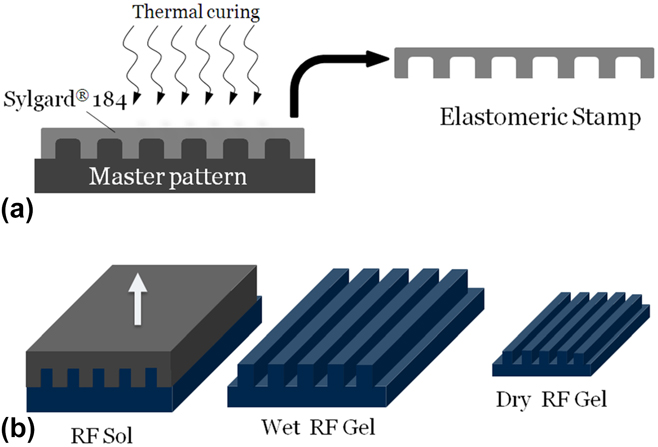
In commercial LIB, electrodes are two dimensional (2D) and a separator filled with electrolyte between these two electrodes prevents the electron transport and allows the ion mobility from one electrode to other electrode during charge discharge cycles. Keeping the thickness of the electrode material as few microns is a way for effective utilization of the active anode and cathode materials. This results in a lesser energy density (shorter operating time) of battery. To address this, other than nanostructuring the active material, fabrication of three-dimensional (3D) micropost array based electrode (a spatially arranged 3D cylindrical posts with diameter, height and spacing vin the range of few tens of microns) is an alternative way to enhance the active surface area for improving the electrochemical performance (energy storage per unit area) by decreasing the ion transport length and enhanced active electrode and electrolyte interface.Reference Long, Dunn, Rolison and White58 Photolithography is a widely used technique for fabricating 3D carbon structures using photoresist materials as precursors by carbon microelectro mechanical systems (C-MEMS) process.Reference Teixidor, Zaouk, Park and Madou59 As RF sol is not a photo sensitive material, a soft lithography based replica molding technique has been used to fabricate 3D carbon xerogel electrodes.Reference Sharma, Verma, Kulkarni, Upadhyay and Sharma60 SU-8, an epoxy based negative photoresist based high aspect ratio 3-D micropost arrays fabricated using photolithography were used as a master template for replica molding. Isotropic shrinkage of RF xerogel during drying and pyrolysis helps in the fabrication of 3D carbon xerogel electrode with same aspect ratio as a master pattern. It has been shown that after four cycles of drying and replica molding, one can reduce the feature size to almost one order of magnitude.Reference Sharma, Verma, Kulkarni, Upadhyay and Sharma60 This simple isotropic miniaturization in RF xerogel-based carbon allows good control on the overall dimensions of carbon monoliths and patterned arrays. Figure 6 shows the schematic of use of replica molding technique in preparing the 3-D micro-patterns in RF xerogel.
Schematic diagram of replica molding to fabricate 3D microposts arrays in RF xerogel. Reprinted with permission from Microfabrication of Carbon Structures by Pattern Miniaturization in Resorcinol-Formaldehyde Gel, Chandra S. Sharma, Ankur Verma, Manish M. Kulkarni, Devendra K. Upadhyay, and Ashutosh Sharma, ACS Applied Materials & Interfaces 2(8), 2193–2197 (2010). Copyright 2010 American Chemical Society.

Furthermore, the active electrode and electrolyte interface can be improved by using hierarchical structures as an electrode material and fractal 3D electrodes were observed to be most appropriate electrode shape.Reference Park, Zaouk, Wang and Madou61 These hierarchical structures can be fabricated by electrospraying of carbon precursors onto fabricated 3D electrodes prior to pyrolysis. Sharma et al., produced fractal 3D electrodes by electrospraying of RF sol particles on to 3D RF gel structure followed by pyrolysis.Reference Sharma, Katepalli, Sharma, Teixidor and Madou54
III. ELECTROCHEMICAL PERFORMANCE OF RF BASED CARBON XEROGELS
A. Effect of physiochemical properties
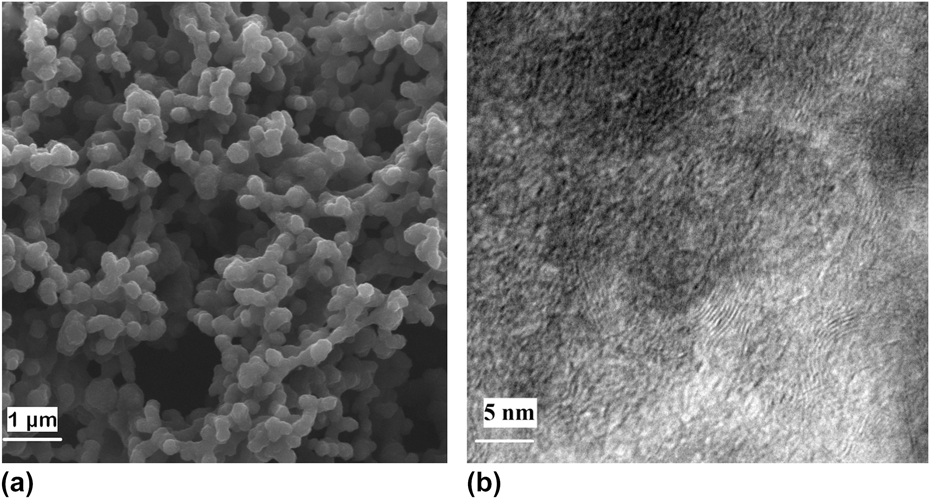
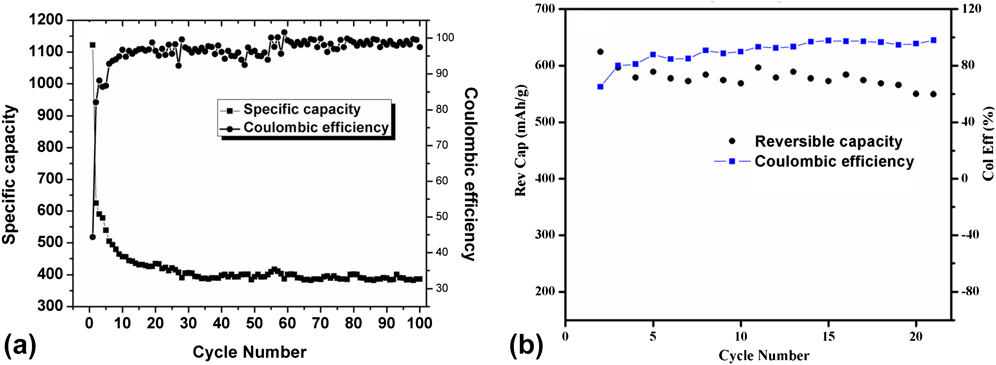
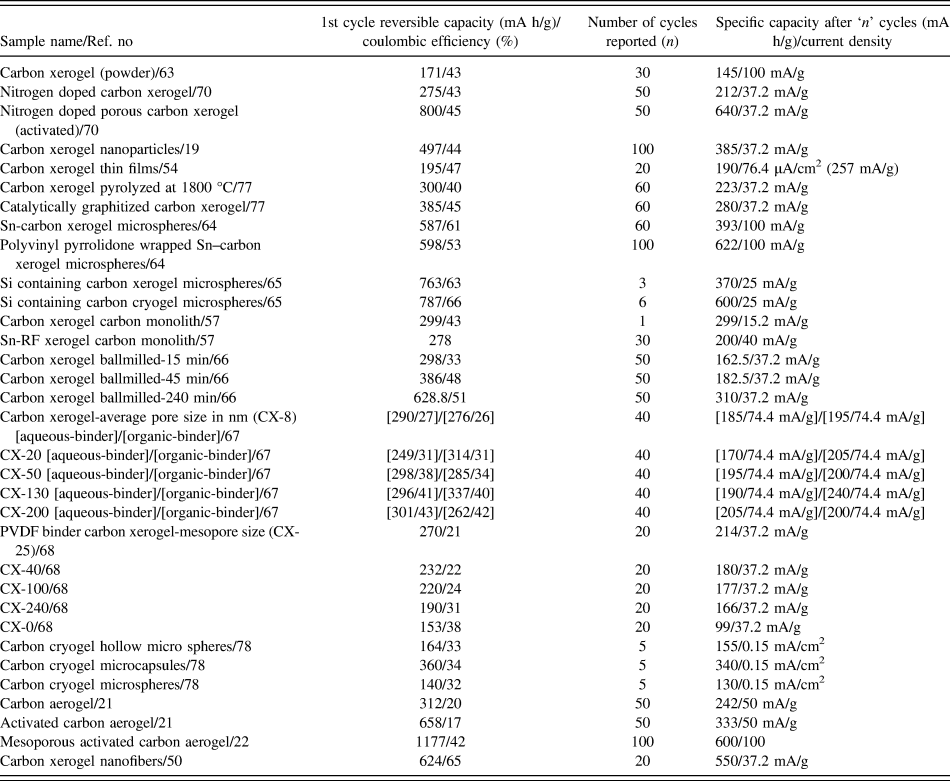
RF xerogel is a thermosetting polymer and over pyrolysis it yields hard carbon with short range arrangement of small crystallites.Reference Pandolfo and Hollenkamp62 Electrochemical performance of carbon xerogel as electrode material highly depends on its physiochemical properties such as surface area, crystallinity, porosity, conductivity, surface functional groups, and composite material. Carbon xerogel powder with conductive binder has shown a limited reversible capacity (171 mA h/g) with 43% of initial coulombic efficiency.Reference Yuan, Chao, Ma and Deng63 This limited capacity of carbon xerogel powder can be attributed to dense carbon xerogel particles of few micron size and limited surface area due to lack of nanostructuring.Reference Yuan, Chao, Ma and Deng63 Similar to this, carbon thin films have also shown the limited reversible capacity of 195 mA h/g. However, this can be attributed to additional resistance provided by Si substrate rather than thin film structure.Reference Kakunuri and Sharma52,Reference Sharma, Katepalli, Sharma, Teixidor and Madou54 Further, various forms of nanostructured carbon xerogels were prepared to see the effect of morphology on electrochemical performance. Carbon xerogel microspheres containing Si and Sn were prepared using inverse emulsification process. These carbon composites can take the advantage of high capacities and electronic conductivity of alloying materials and the ability to accommodate volume expansions due to the presence of the parent carbon structure. These composite materials showed very good initial reversible capacity (763 mA h/g) however due to nonporous nature carbon xerogel microspheres showed significant fade over cycling compared to porous cryogel particles.Reference Zhang and Yin64,Reference Hasegawa, Mukai, Shirato and Tamon65 In another approach, inverse emulsification process was slightly modified to fabricate interconnected carbon xerogel sub-micron particles. Using this approach, binder-free interconnected carbon xerogel nanoparticles electrodes were fabricated using sedimentation-assisted inverse emulsification process for a couple of cycles. The as-fabricated carbon xerogel particle network contains particles of ∼400 nm, and the carbon particles falls into hard carbons category as shown in Fig. 7(b) with a short range of graphene layer arrangement.Reference Kakunuri, Vennamalla and Sharma19 When compared to carbon xerogel powder (few micron particle size), specific capacity of carbon xerogel nanoparticles electrode increased significantly from 171 to 495 mA h/g and also showed excellent cyclic stability over cycling for 100 cycles as shown in Fig. 8(a). This improved capacity can be attributed to facile electron transport in the interconnected particles and less charge transfer resistance as measured by impedance spectroscopy due to excellent adhesion of the electrode material to the current collector.Reference Kakunuri, Vennamalla and Sharma19 Remarkably, the specific reversible capacity values were close to Sn, and Si incorporated carbon xerogel microspheres and scalability of synthesis process makes them the potential anode material for commercial batteries. Another alternative way reported in literature to change the carbon material particle size, morphology, and crystallinity was ball milling of inhomogeneous powder.Reference Gopalakrishna, Kakunuri and Sharma66 Ball milling not only reduced the particle size but also affected the crystallinity due to breakage of graphene layers bonded with each other using a relatively weak van der Waals force. For graphitic carbon xerogel, d-spacing changed substantially from 3.38 to 3.45 Å on milling for 15 and 240 min respectively. This change in crystallinity and surface area showed a remarkable effect on electrochemical performance. RF xerogel samples ball milled for a long time showed higher reversible specific capacities and excellent rate performance with a considerable capacity fade over cycling as described in Table II.Reference Gopalakrishna, Kakunuri and Sharma66
(a) SEM image, (b) TEM image of carbon xerogel nanoparticles.Reference Kakunuri, Vennamalla and Sharma19

Cyclic performance of (a) interconnected carbon xerogel nanoparticles,Reference Kakunuri, Vennamalla and Sharma19 (b) carbon xerogel nanofibers at a current density of 37.2 mA/g.Reference Mamidi, Kakunuri and Sharma50

A comparison of specific capacity for various organic gel derived carbon materials.

In yet another attempt, the porosity of the carbon xerogels was tuned and the effect of pore size on electrochemical performance was studied.Reference Rey-raap, Piedboeuf, Arenillas, Menéndez, Léonard and Job67,Reference Piedboeuf, Léonard, Deschamps and Job68 It was observed that increase in specific reversible capacity with an increase in pore diameter was not significant. However, irreversible capacity observed to be decreased significantly with increasing pore diameter and it resulted in 44% coulombic efficiency for carbon xerogel with 200 nm and 26% coulombic efficiency for sample with 8 nm pore size respectively. This study also investigated the compatibility of carbon xerogel materials with environmental friendly aqueous electrolyte and hardly found a change in electrochemical performance when compared to organic electrolyte.Reference Rey-raap, Piedboeuf, Arenillas, Menéndez, Léonard and Job67 Recently, RF xerogel-based electrospun carbon fibers produced by adding stretchable PMMA to RF sol were also tested as anode material for LIB. Specific reversible capacity values are remarkably higher than other configurations due to high surface area of carbon nanofibers and shorter ionic diffusion length. RF xerogel-based electrospun carbon nanofibers showed high reversible capacity of 624 mA h/g with 65% coulombic efficiency at initial cycle and reversible capacity retained above 500 mA h/g after 20 cycles as shown in Fig. 8(b).Reference Mamidi, Kakunuri and Sharma50 In addition to these structural properties surface functional groups of electrode material shows significant effect on electrochemical performance. Surface functional groups of carbon materials essentially depend on the pyrolysis temperature and precursor material. Carbon materials prepared at low temperatures contain oxygen and hydrogen, which reacts with lithium and form irreversible compounds showing higher reversible capacities compared to the sample prepared at high temperatures, but the capacity fade is higher in samples prepared at low temperatures.Reference Kakunuri and Sharma52,Reference Hasegawa, Mukai, Shirato and Tamon65 Carbon xerogels prepared at low temperatures showed large reversible specific capacity with a significant fade when compared to carbon xerogels prepared at higher temperatures.
B. Effect of carbon xerogel based electrode configuration
In contrast to conventional electrodes fabrication using slurry of active materials, there are many different forms of carbon xerogels, which can be used directly without binder and making slurry. This also affects the electrochemical performance of these materials. Self-supported carbon xerogel thin films and 3D microposts can be prepared using slit-space film technique and replica molding respectively as discussed previously. However, there is no report on measuring the electrochemical performance of self-supported thin films and 3D micro posts. Nonetheless, RF-based carbon nanofiber mat directly deposited on the substrate used as a current collector and carbon xerogel monolith-based electrodes were explored as anode material without binder. Interconnected particles show excellent performance as shown in Fig. 8(a) at low current density, while carbon xerogel monolith-based electrodes showed comparable specific reversible capacity values and good rate performance.Reference Lee, Lytle, Ergang, Oh and Stein57,Reference Shilpa, Katiyar, Kalaiselvi and Sharma69 Apparent deficiency in the reversible capacity of the monolithic structure can be ascribed to the thickness of monolithic structure when used as an electrode. Although these carbon xerogel materials with different configurations have additional advantages such as enhanced active electrode electrolyte interface, shorter ion diffusing lengths, and enhanced ionic conductivity, multiple processing steps involved in synthesis limit their use as the anode material for commercial LIB.
C. Effect of N doping and activation
Nitrogen doping increases the number of active sites for electrochemical reaction, defects, and electrical conductivity and thus improves the electrochemical performance significantly.Reference Liu, Li, Mei, Lau, Mi, Li, Liu and Liu70–Reference Ayala, Arenal, Rümmeli, Rubio and Pichler72 Nitrogen and boron were studied as dopants for carbon materials. B-doping results in electron deficient structure and stabilizes over Li ion absorption. However, N-doping results in an electron rich unstable structure with increased disorder with cavities and doped heteroatoms associated other atoms such as oxygen.Reference Zhou, Gao, Yan, Song and Morinaga73 Higher electronegativity of nitrogen and oxygen helps in improving the specific capacity by increasing electron density around doped atoms, further which helps in holding more lithium ions. N-doping not only increases the specific capacity values, it also minimizes the irreversible capacity (stable cycling) and improves the rate performance significantly.Reference Wu, Ren, Xu, Li and Cheng74 Nitrogen-doped RF derived carbon xerogels with a specific surface area of 744 m2/g showed a stable performance with reversible capacity ∼215 mA h/g over 50 cycles with very limited fade.Reference Liu, Li, Mei, Lau, Mi, Li, Liu and Liu70 Further, these carbon xerogel materials were activated by CO2 etching to yield high surface area (2912 m2/g) nitrogen doped carbon xerogels. These high surface area nitrogen doped carbon xerogels showed higher specific capacity and excellent cyclic and rate performance. This stable performance of activated high surface area carbon xerogels can be ascribed to nitrogen doping, as simply activated carbon aerogel exhibited very high irreversible capacity (83%) and significant fade (65%) on cycling.Reference Nian-Ping, Jun, Da-Yong, Dong, Xiao-Wei and Ya-Jie21 This observation suggests that simply activated carbon xerogels with higher surface area may not be the best materials for LIB applications. However, their performance can be improved by nitrogen doping. In general, activated carbons are highly suitable for supercapacitors where electrode surface area is critical but not preferred one for LIB due to their high initial irreversible capacity and capacity fade over cyclingReference Franklin9,Reference Borchardt, Oschatz and Kaskel75 In fact, that was the precise reason for much explored RF derived carbon aerogels and cryogels, rather than xerogels.
D. Catalytic graphitization of carbon xerogel
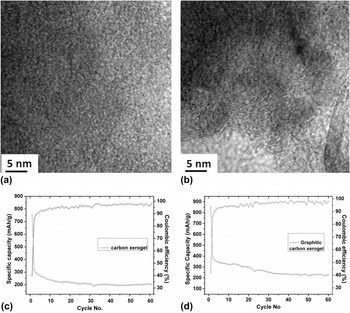
As RF derived carbon xerogels fall into the category of hard carbons, which are non-graphitizable carbon materials and do not graphitize on pyrolysis even at elevated temperatures.Reference Franklin9 Efforts have been made recently to graphitize these RF derived carbon xerogel through catalytic graphitization where metal catalyst was incorporated into the RF sol that acted as a graphitization catalyst. Fe and Ni have been reported to be effective metal catalyst in catalytic graphitization process.Reference Maldonado-Hodar, Moreno-Castilla, Rivera-Utrilla, Hanzawa and Yamada76 In this recent study on carbon xerogel catalytic graphitization, RF gel-derived carbon was prepared at different temperatures with and without a catalyst.Reference Kakunuri, Kali and Sharma77 Significant graphitization was found in samples pyrolyzed with the catalyst at 1800 °C compared to carbon xerogel prepared at same temperature without catalyst [Figs. 9(a) and 9(b)]. Further, the effect of graphitization on the electrochemical performance of carbon xerogel was investigated. RF xerogel based graphitic carbon xerogel showed superior initial reversible specific capacity (385 mA h/g) with the good coulombic efficiency of 45% when compared to 300 mA h/g and 40% efficiency for RF carbon xerogel based hard carbon. This improved electrochemical performance was ascribed to the enhanced electronic conductivity of graphitic carbon xerogels prepared with the metal catalyst at 1800 °C. Figures 9(c) and 9(d) shows the cyclic performance of RF xerogel based hard carbon and graphitic carbon for 100 cycles at 37.2 mA/g. As observed from the effect of nitrogen doping and catalytic graphitization we can suggest commercial battery manufacturers to work on graphitizaiton of activated carbons to supress the irreversible capacity and fade due to high surface area by increasing the electronic conductivity.
TEM image of (a) carbon xerogel, (b) catalytically graphitized carbon xerogel; cyclic performance of (c) carbon xerogel and (d) graphitic carbon xerogel.Reference Kakunuri, Kali and Sharma77

IV. FUTURE DIRECTIONS
A. Carbon xerogels for sodium (Na)-ion batteries
Na-ion battery is emerging battery technology with similar packing technology and electrochemical performance as LIB. However the major difference in Na-ion battery anode materials is that graphitic carbons are not the primary choice as large size of sodium ions do not intercalate into it. Relatively abundant availability of sodium makes Na-ion batteries attractive. Additional advantage such as the use of water based electrolytes instead of the organic ones and using Al current collector for anodes in place of Cu further makes the Na-ion batteries cheaper.Reference Kubota and Komaba79 Various carbon materials including graphite, nitrogen doped carbon, petroleum coke, carbon fibers, amorphous carbon black and hard carbons were studied for Na-ion intercalation.Reference Palomares, Serras, Villaluenga, Hueso, Carretero-González and Rojo80 Grpahitic carbons showed poor performance with a limited reversible capacity of 115 mA h/g due to difficulty in intercalation of Na ions into layers of graphite. Hard carbons with disordered structure showed promising electrochemical performance due to adsorption of Na ions on pores formed by random arrangement of small size crystallites and graphene layers. Further, nanostrucituring of hard carbon materials helps in improvement of electrochemical performance by increasing available sites for Na ion adsorption and shorter diffusion lengths. Hard carbon materials derived from RF gel have huge potential as anode material for Na-ion battery as their porosity and surface area can be tuned easily with well-established techniques. RF-based carbon gel spheres, monoliths and nitrogen doped spheres have been explored as an anode for Na-ion battery.Reference Hasegawa, Kanamori, Kannari, Ozaki, Nakanishi and Abe56,Reference Alcántara, Lavela, Ortiz and Tirado81–Reference Qu, Zhang, Du, Chen, Lai, Liu and Li84 In addition to the effect of morphology and nitrogen doping, the effect of pyrolysis temperature is also studied. It was suggested that carbon xerogels prepared at higher temperatures show better performance than the ones obtained at a lower temperature.Reference Hasegawa, Kanamori, Kannari, Ozaki, Nakanishi and Abe56,Reference Alcántara, Lavela, Ortiz and Tirado81 However, carbon xerogels obtained at pyrolysis temperature above 1600 °C were found to be not promising for sodium ion battery due to higher resistance to Na ion intercalation as carbon interlayer spacing reduces with increase in temperature.Reference Hasegawa, Kanamori, Kannari, Ozaki, Nakanishi and Abe56 All these recent studies clearly suggest the enormous potential for carbon xerogels materials with different morphologies and physiochemical properties as anode material for Na-ion battery.
B. Carbon xerogels for supercapacitors
Supercapacitors are alternative energy storage devices with high power density than lithium ion batteries and excellent cyclic life (104 to 105),Reference Murray and Hayes85 but their lower energy density (shorter operating time) limits their use alone for powering up systems like hybrid electric vehicles. Specific capacity and charging speed in carbon-based electrochemical double layer capacitors are ideally proportional to surface area of the carbon materials.Reference Inagaki, Konno and Tanaike86 So high surface area activated carbons, carbon aerogels, cryogels, graphene and CNT were extensively used as electrode for supercapacitors.Reference Zhu, Hu, Li and Zhang31,Reference Faraji and Ani87–Reference Davies and Yu90 Carbon aerogels are promising electrode materials for supercapacitors due to their tunable surface area, porosity, electrical conductivity and scope for increasing surface area further by activation.Reference Halama, Szubzda and Pasciak88,Reference Li, Wang, Wang, Huang, Dai, Gamboa and Sebastian89,Reference Kwon, Lee, Kim, Kim, Lee, Kim and Jung91 However, porous carbon xerogels with surface modification can be considered as electrode material for supercapacitors. In this context, various techniques for altering the carbon xerogels porosity for example by changing the catalyst concentration, using template for uniform pore size and activation have already been reported.Reference Zhu, Hu, Li and Zhang31,Reference Shen, Wu and Zhang92,Reference Mezzavilla, Zanella, Aravind, Della Volpe and Sorarù93 These modifications in porosity of carbon xerogels possess high capacitance similar to carbon aerogels and activated carbons and therefore opens new possibilities for widening their applications as electrodes for energy storage.
V. CONCLUSIONS
This review paper comprehensively discussed the effort toward using RF derived carbon xerogels as a potential anode material for lithium ion batteries. Various synthesis techniques and effects of process parameters on surface morphology and crystallinity of the carbon xerogels are discussed extensively. RF derived carbon xerogels have been synthesized in different forms such as micron sized spheres, fractal-like structures, nanoparticles, nanofibers, thin films and 3D high aspect ratio micropost arrays. Even controlling the heat treatment with and without the catalyst and N doping provided varying crystallinity in these carbon xerogels. The ability of tuning the microstructure and crystallinity of these RF derived carbon xerogel materials was then correlated with their electrochemical performance in the form of anode materials for LIB. A comparison of their electrochemical performance with carbon xerogel composites, aerogels and cryogels is also presented to bring more clarity to understand and appreciate the great potential of carbon xerogel materials. We have also discussed future scope for the carbon xerogels materials as electrode material for Na-ion and supercapacitors.