1. Introduction
The Zagros Mountains, located in the western part of Iran, constitute 20 per cent of the country's territory and are a politically strategic and economically valuable region (Fattahi et al., Reference Fattahi, Ansari, Abbasi and Khan Mohammadi2000). Historical records document livestock breeding, grazing and agriculture at least since the beginning of the 5th millennium cal BP, which shows the long history of settlement and utilization of natural resources in this part of the world (Wright et al., Reference Wright, McAndrews and Zeist1967; Djamali et al., Reference Djamali, De Beaulieu, Miller, Andrieu-Ponel, Ponel, Lak, Sadeddin, Akhani and Fazeli2009). The people living in the Zagros Mountains have been economically isolated from the rest of Iran. In recent decades, however, national efforts to develop rural areas have led to significant improvements in the socioeconomic situation (UNDP, 2004). Still, a large share of rural households of the Zagros remain poor (UNDP, 2004; Yachkaschi et al., Reference Yachkaschi, Adeli, Latifi, Mohammadi Samani and Seifollahian2010).
The Zagrosian villagers practise two main forest activities: animal husbandry and harvesting of firewood (Fattahi et al., Reference Fattahi, Ansari, Abbasi and Khan Mohammadi2000; Salehi, Reference Salehi2009). Collection of non-wood forest products (NWFPs) and cultivation under forest trees (agroforestry) are also practised but are of less economic importance. Domestic animals graze and browse in the forests, and trees are lopped to provide supplementary fodder (Fattahi et al., Reference Fattahi, Ansari, Abbasi and Khan Mohammadi2000; Salehi, Reference Salehi2009). Despite the increasing consumption of fossil fuels in many villages, firewood is still an important source of energy. Many households in the Zagros remain dependent on the forests, with a considerable proportion of their income coming from harvesting firewood and animal husbandry.
The Zagros Mountains were the cradle of goat domestication 10,000 years ago (Zeder and Hesse, Reference Zeder and Hesse2000), and goats are still important in rural livelihoods. The forests have been considered as pastoral ecosystems, where large numbers of livestock, mainly goats and to some extent sheep, have had a significant impact on the ecosystem and influenced its structure and function (Hoekstra and Shachak, Reference Hoekstra and Shachak1999). Due to fodder shortages and low-yield pasture, livestock husbandry has become more dependent on fodder from the forests in the last few decades (Sagheb-Talebi et al., Reference Sagheb-Talebi, Sajedi and Yazdian2004).
Animal husbandry affects forests in two ways: (i) directly by eating seeds, seedlings and sprouts (browsing), and (ii) indirectly by feeding in winter based on cut (lopped) and stored branches of oak trees. Excessive browsing can even kill some seedlings and sprouts, while cutting branches can reduce biomass. Therefore, both regeneration and tree growth will be hampered and forest density may be reduced (forest degradation). Studies based on forest inventories such as Jazirei and Rastaghi (Reference Jazirei and Rastaghi2003), Ravnborg (Reference Ravnborg2003) and Salehi (Reference Salehi2009) reported that, during the grazing period (April–July), the number of livestock in forest areas in Zagros is four times the carrying capacity. Overgrazing may therefore be a major factor explaining forest degradation in the Zagros.
Another factor contributing to forest degradation in the Zagros Mountains is firewood collection (Sagheb-Talebi et al., Reference Sagheb-Talebi, Sajedi and Yazdian2004; Yachkaschi et al., Reference Yachkaschi, Adeli, Latifi, Mohammadi Samani and Seifollahian2010), although it is less widespread than in the past (Yachkaschi et al., Reference Yachkaschi, Adeli, Latifi, Mohammadi Samani and Seifollahian2010). The use of forest biomass as the main source of energy in the mountains has a long history (Fattahi et al., Reference Fattahi, Ansari, Abbasi and Khan Mohammadi2000; Yachkaschi et al., Reference Yachkaschi, Adeli, Latifi, Mohammadi Samani and Seifollahian2010). In the early and mid-20th century, vast areas of forest resources around major cities in Zagros were degraded to meet firewood and charcoal demands (Yachkaschi et al., Reference Yachkaschi, Adeli, Latifi, Mohammadi Samani and Seifollahian2010). Today, rural people use firewood to meet daily needs such as heating, cooking and processing dairy products, while some urban people use firewood or charcoal for wedding and funeral ceremonies.
In 1963, the Forest, Range and Watershed Organization (FRWO) implemented a conservation policy by introducing state forest management plans designed to halt forest degradation in the Zagros. The policy has not been particularly successful (Ebrahimi Rastaghi et al., Reference Ebrahimi Rastaghi, Latifi and Bodaghy2003; Sagheb-Talebi et al., Reference Sagheb-Talebi, Sajedi and Yazdian2004). The main problems are the local communities’ low income level and high forest dependence, as well as the incompatibility of the plans with local needs (Fattahi et al., Reference Fattahi, Ansari, Abbasi and Khan Mohammadi2000; Ebrahimi Rastaghi et al., Reference Ebrahimi Rastaghi, Latifi and Bodaghy2003; Yachkaschi et al., Reference Yachkaschi, Adeli, Latifi, Mohammadi Samani and Seifollahian2010). Consequently, it has been argued that the major objectives of the rural development policy in the region should be poverty alleviation and reduced forest dependence (Salehi, Reference Salehi2009). Large amounts of funding and much effort have been put into the programme to lower local forest dependence. Some examples of the efforts are the government's current policy of supplying fossil fuels and providing subsidized inputs (e.g., fertilizer, pesticides and seeds) for cultivating forage crops.
Despite the centralized state forest-management regime mentioned above, traditional and informal types of forest management are still practised in the Zagros. The method of management has been applied by rural communities for thousands of years in different parts of the region (Yachkaschi et al., Reference Yachkaschi, Adeli, Latifi, Mohammadi Samani and Seifollahian2010) and includes several forms of community forest management. In the Northern Zagros, traditional community forest management is mainly family based and carries private rights to use forest resources, whereas in the Southern Zagros it is mainly village based. Hence, forests in the Zagros are owned by the state, but are managed by traditional institutions.
The challenges related to forest management in the Zagros are mainly linked to forest degradation (reduction in stocks) as a result of different uses rather than deforestation due to cultivation; the change in tree crown cover is less than 10 per cent (FAO, 2000). Recently, deforestation due to urbanization, infrastructure and industrial expansion into forest resources has become a new challenge for forest management in the Zagros (FRWO, 2005).
Given this long historical record of forest-based activities as well as the new challenges facing policy makers, it is of interest to know in more detail what factors influence forest degradation in the Zagros. The main objective of this article is to assess the links between and determinants of poverty, forest dependence and forest degradation in the Zagros. The objective is approached by addressing three closely related research questions:
-
(1) How important are forest resources for the livelihoods of rural households?
-
(2) What factors determine households’ forest dependence, and how do poverty and institutional arrangements condition this dependence?
-
(3) How do poverty, forest dependence and institutional arrangements affect forest degradation?
This article contributes to a growing literature on environmental income and dependence, resource degradation and poverty in several ways. First, this is a case study from Iran, a country barely represented in this literature. Second, we investigate the relations between forest dependence and forest degradation by grouping households based on their forest strategies and then assess the impact of each strategy on forest resources. Third, because our data include two sites which differ regarding community-based traditional forest management, we are able to explore whether the observed trends between poverty, forest dependence and forest degradation can be explained in terms of institutional differences. Fourth, our results are based on socioeconomic data combined with forest measurements. Combining household surveys and forest inventories to explore the links between poverty, resource dependence and resource degradation is still fairly rare in the literature.
The remainder of this article is organized as follows. In section 2, we present a review of the literature on links between poverty and forest resources, and also present the conceptual framework. In section 3, we describe the case study sites, method of data collection and data analyses. We present the results of our study in section 4, followed by a discussion of the main findings in section 5. We end the article with concluding remarks in section 6.
2. Conceptual framework
Three key issues related to the link between poverty and forest resources have been discussed in the literature: (1) whether poverty increases forest dependence; (2) whether poverty increases forest degradation; and (3) whether forest dependence increases forest degradation. We briefly review each of these issues below.
With respect to the first link between poverty and forest dependence, a growing body of literature quantifies how much local communities use and depend on forest resources. Such dependence is normally measured as the share of a household's total income derived from forest resources (e.g., Jodha, Reference Jodha1986; Cavendish, Reference Cavendish, Campbell and Luckert2002; Narain et al., Reference Narain, Cupta and Van de Veld2008; Babulo et al., Reference Babulo, Muys, Nega, Tollens, Nyssen, Deckers and Mathijs2009; Kamanga et al., Reference Kamanga, Vedeld and Sjaastad2009).
Several studies have demonstrated that poor households depend more on forest resources than better-off households (Cavendish, Reference Cavendish, Campbell and Luckert2002; Vedeld et al., Reference Vedeld, Angelson, Bojo, Sjaastad and Kobugabe Berg2006; Shackleton et al., Reference Shackleton, Shackleton, Buiten and Bird2007; Babulo et al., Reference Babulo, Muys, Nega, Tollens, Nyssen, Deckers and Mathijs2009; Kamanga et al., Reference Kamanga, Vedeld and Sjaastad2009), while others have found more complex relationships between forest dependence and income (Fisher, Reference Fisher2004; Narain et al., Reference Narain, Cupta and Van de Veld2008). Narain et al. (Reference Narain, Cupta and Van de Veld2008), for example, found that firewood dependence declined with an increase in income, while fodder dependence and construction wood from forests increased.
With respect to the second link between poverty and forest degradation, a large number of studies have been undertaken in different contexts and at different scales, making generalization difficult. A dominant narrative is that poverty is a major driver of environmental degradation (WCED, 1987). Deininger and Minten (Reference Deininger and Minten1999) showed in a study at the regional level that lower poverty leads to lower forest degradation. Sunderlin et al. (Reference Sunderlin, Dewi and Puntodewo2007) observed that poverty rates (but not absolute numbers of poor) were higher in forested areas in Brazil, Honduras, Malawi, Mozambique, Uganda, Indonesia and Vietnam. They note, however, that the causal link is complex, with some underlying factors such as remoteness and poor infrastructure explaining both high poverty rates and high forest cover. The hypothesized positive link from poverty to resource degradation is also questioned in studies at the regional level (Agudelo et al., Reference Agudelo, Rivera, Tapasco and Estrada2003; Ravnborg, Reference Ravnborg2003; Khan and Khan, Reference Khan and Khan2009). Finally, based on studies at national and international levels, some have argued that poor people are less responsible for the degradation of natural resources as high resource dependence also creates incentives for sound resource management and investments in the resources (Jodha, Reference Jodha1986; Heady, Reference Heady2000; Scherr, Reference Scherr2000; Swinton et al., Reference Swinton, Escobar and Reardon2003).
With respect to the third link between forest dependence and forest degradation, the empirical results reported in the literature on the direct link are limited. Instead, as noted above, many studies have focused on the generally positive relationship between forest dependence and income level, and assumed that the higher the dependence on natural resources, the larger the contribution to resource degradation. While the amount of forest resources used by households is part of the equations determining both forest dependence and forest degradation, many other factors condition the dependence–degradation relation. Forest dependence is an economic measure (defined as the share of household income derived from a forest), and is therefore strongly affected by forest product prices and total income. Forest degradation, which is assumed to occur when removals exceed sustainable yields, is measured as a reduction in forest biomass density, and is measured in relation to ecological factors, population density and carrying capacity. In short, a number of factors will condition the dependence–degradation relation, and two communities with the same level of forest dependence may generate very different long-term effects on forest degradation. Variations in ecological conditions and population density and the implications on resource degradation have been discussed in the literature (e.g., Soltani et al., Reference Soltani, Angelsen, Eid, Naieni and Shamekhi2012).
In addition, institutional arrangements for forest management may shape the links between poverty, forest dependence and forest degradation. In his seminal article, Hardin (Reference Hardin1968) claims that common property resources are exposed to overexploitation (‘the tragedy of the commons’), and resources should therefore be either privatized or controlled by the state. Conversely, a large number of scholars have addressed the positive aspects of common property resources, such as more equal distribution of forest benefits among users or preventing overexploitation by setting rules and regulations (e.g., Berkes, Reference Berkes1989; Ostrom, Reference Ostrom1990). Some studies have either indicated or provided empirical evidence that devolution of forest resources to local communities leads to better forest management (Agrawal and Yadama, Reference Agrawal and Yadama1997; Gibson et al., Reference Gibson, Williams and Ostrom2005; Zoysa and Inoue, Reference Zoysa and Inoue2008). Other studies have investigated specifically how different management regimes influence the link between poverty and forest dependence (Jodha, Reference Jodha1986; Adhikari et al., Reference Adhikari, William and Lovett2007). For example, Jodha (Reference Jodha1986) was among the first to claim that common property resources play a significant role in the livelihoods of the rural poor.
The fact that some policy makers concerned with the management of forests have given top priority to community-based forest management as a means to reduce forest degradation and reduce poverty and inequality indicates that it is important to provide further empirical evidence regarding the effectiveness of their policies. Can we expect, for example, that a management regime that is largely family based, with private rights to forest use, will result in larger income differences, where the high-income groups have the highest level of forest dependence, compared to community forest management, where resources are accessible to all community members and no individuals hold exclusive user rights, thus leading to a situation with smaller income differences, where the low-income groups have the highest level of forest dependence?
3. Data and methods
3.1. Study area
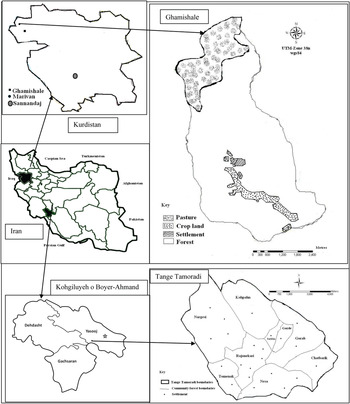
The Zagros Mountains are geographically divided into a northern part and a southern part. There are many similarities between the two parts regarding, for example, climate, topography, forest structure and species diversity, but the Northern Zagros is more humid and colder than the Southern Zagros (Sagheb-Talebi et al., Reference Sagheb-Talebi, Sajedi and Yazdian2004). The Kurds are settled in the north, whereas the Lor and Bakhtiari tribes are settled in the south. Our study was conducted at two sites: Ghamishale in the Northern Zagros and Tange Tamoradi in the Southern Zagros (figure 1). At both sites, the most important economic activities are crop cultivation (wheat and barley), animal husbandry (goats and sheep), forest-related activities (collecting firewood, making charcoal, livestock grazing, cultivation under forest trees and collecting medicinal plants) and non-farm activities (e.g., working in town as builders or drivers). Some relevant statistics for both sites are presented in table A1 in the online appendix available at http://journals.cambridge.org/EDE.
Study sites in Ghamishale (northern Zagros) and Tange Tamoradi (southern Zagros), Iran

3.1.1. Ghamishale
Ghamishale is located at 35°40′N and 46°16′E, 25 km south-east of Marivan and 101 km north-west of Sannandaj, in Kurdistan Province. Ghamishale comprises two villages, and parts of the local forest territory are divided between the families living in Ghamishale (i.e., traditional family-based forest management is practised). Each household lops trees, collects grass and fells trees for firewood on their own forest lots. Tree felling for firewood is a public right in some parts of the forest territory, whereas grazing and the collection of non-wood products are public rights within the entire territory (see table A2 in online appendix) (for more details, see also Soltani and Eid, Reference Soltani and Eid2013).
3.1.2. Tange Tamoradi
Tange Tamoradi is located at 30°29′N and 51°29′E), 45 km south-west of Yasooj, the centre of Kohgiluyeh o Boyer-Ahmand Province. Tange Tamoradi comprises seven communities with resident populations (Nargesi, Gorab, Rajonekari, Tomenak, Nesa, Chatbarik and Kohpahn), and two abounded settlements (Sorkho and Gorde). The forest territory is divided among the seven communities, each of which is responsible for managing its ‘own’ forest (i.e., traditional community forest management is practised). The forest territory belonging to each village in each community is not divided among the families but is a common resource pool for the community as a whole. Grazing, cutting trees for firewood and construction, and collecting NWFPs are done within each village's forest territory, but tree lopping and collecting grasses are not done in Tange Tamoradi (see table A2, online appendix). Cropland irrigated at higher levels than Ghamishale makes crop cultivation a comparatively more important activity in Tange Tamoradi.
3.2. Data collection
Household surveys yielded information on key socioeconomic elements, including household composition, education, asset ownership, income from different sources, sales and consumption of crops, livestock and forest products and participation in training and extension programmes. Prior to the main household surveys, we conducted pilot surveys among 10 households in Ghamishale and 30 households in Tange Tamoradi. Subsequently, we decided to survey all 69 households in Ghamishale. However, since some households were not present at the time of fieldwork, data were collected from only 59 households. In the case of Tange Tamoradi, 75 out of a total of 198 households were selected for study. The households were randomly chosen through stratified random sampling (Cochran, Reference Cochran1977), with 18 villages as strata. The sample size of each village was determined by proportional sampling. Both household surveys were completed in 2010.
A forest inventory comprising 111 circular 1,000 m2 sample plots, systematically distributed in a 400 m × 500 m grid, was made to establish forest resources data in Ghamishale (see details in Soltani and Eid, Reference Soltani and Eid2013). Within each sample plot, all standing trees (alive and naturally dead) with diameter at breast height (dbh) above 2.5 cm were recorded. All the trees with dbh below 2.5 cm were counted in a circular sub-plot of 100 m2. The third nearest living tree to the plot centre on all plots was selected for core sampling in order to establish basal area and volume growth estimates. In Tange Tamoradi, a forest inventory comprising 206 circular 1,000 m2 sample plots, systematically distributed in a 500 m × 650 m grid, was made by FRWO in 2005 to establish forest resources data (Headquarters of Natural Resources of Yasooj, 2005). The same information as described for Ghamishale was also recorded here.
Secondary data on the carrying capacity of pasture for grazing and population census in 2006 were used for both sites (FRWO, 2005; Headquarters of Natural Resources of Yasooj, 2005). Carrying or grazing capacity was defined as the maximum possible stocking of herbivores that rangeland could support on a sustainable basis and was estimated based on livestock feeding requirement and pasture forage supply (Headquarters of Natural Resources of Yasooj, 2005).
3.3. Data analysis
3.3.1. Importance of forest resources for rural households
Our first research question was to assess how important the forest resources are for the economic situation of rural households in the Zagros. The assessment was done by quantifying several measures, i.e., forest dependence, forest dependence groups and inequality.
Forest dependence is defined as the share of a household's total income that comes from forest resources. Forest income has three components: firewood, fodder and NWFPs. In addition to overall forest dependence, we also define firewood dependence, fodder dependence and NWFPs dependence as the share of total income from this set of forest products.
Forest dependent groups: we used factor and cluster analyses to group individual households into groups according to their different forest dependence strategies (FDS). The FDSs were a simple classification of households based on the type of forest income and using factor and cluster analyses. First, factor analysis was used on three variables: firewood dependence, fodder dependence and NWFPs dependence. Then, the rotated factor loading from the factor analysis served as input into the hierarchical clustering analysis and was followed by a k-means cluster analysis to correct for possible misclassification of observations at the boundaries between clusters (Hair et al., Reference Hair, Tatham, Anderson and Black2010). The outcome of the k-means cluster analysis was considered as FDSs and used in further analysis. Statistical tests (ANOVA) were used to clarify whether the households in the sample were categorized into mutually exclusive clusters.
Inequality measures: different inequality indices exist (Fields, Reference Fields2001), but the Gini coefficient applied in our study is perhaps the most commonly used, also in studies of forest dependence (Jodha, Reference Jodha1986; Fisher, Reference Fisher2004). Theoretically, the Gini coefficient can vary between zero and one, with higher values indicating greater inequality. Gini decomposition can also be used to better understand how different income sources contribute to income inequality. Following Lerman and Yitzhaki, (Reference Lerman and Yitzhaki1985), the Gini coefficient (G) for total income inequality can be decomposed as follows:
 $$G=\sum_{K=1}^K S_{K}G_{K}R_{K}$$
where S k represents the share of component k in total income, G k is the Gini coefficient for the particular income source k, and R k is the Gini correlation between income source k and the distribution of total income. In other words, Gini decomposition provides information on how important an income source is to total income (S k ), how equally or unequally distributed the income source is (G k ), and how the income source and the distribution of total income are correlated (R k ). Finally, we estimated the effect of a 1 per cent increase in income from source k on total income inequality. The effect is estimated by using the following formula:
 $${S_{K}G_{K}R_{K} \over G}-S_{K}.$$
In our analysis, all Gini coefficients were calculated by using household level per adult equivalent income data, for each of the two sites (for more details on adult equivalents, see Cavendish, Reference Cavendish, Campbell and Luckert2002).
3.3.2. Factors determining forest dependence
The second research question was related to the factors that determine forest dependence among households. This was approached by estimating linear regression models with factors potentially influencing forest dependence as independent variables. Separate models were estimated for firewood dependence and fodder dependence. No model was estimated for NWFPs because the income from this source was very low. The models for firewood dependence and fodder dependence were estimated in two stages (two-stage least squares method – 2SLS; Greene, Reference Greene2012); first, a model predicting a poverty index was estimated, and second, the two models predicting forest dependence (firewood and fodder) were estimated, using the predicted poverty index as one of the independent variables. The two-stage procedure was applied to avoid biases and inconstancies in the models, due to the poverty index potentially being endogenous. The independent variables used in the two stages are listed in table A3 in the online appendix.
Household asset holdings were divided into education, adult labour, training skill, irrigated land, financial capital and physical capital. The ecological condition was combined with population density by introducing the variable forest biomass availability. To do so, forest volumes (m3 per ha) for each site obtained from the systematic forest inventory done by Soltani and Eid (Reference Soltani and Eid2013) and the Headquarters of Natural Resources of Yasooj (2005) were multiplied by the forest area and divided by the number of people with access to the forest resources (traditional forest boundaries). Since family-based community forest management is implemented in Ghamishale and village-based community forest management in Tange Tamoradi, site was used as a proxy for institutional arrangement (table A3).
The poverty index (PI) used as dependent variable in the first stage of the analyses was calculated according to the following equation:
 $$PI = {y_i^s -y_i \over y_i^s}$$
where y i s = household poverty line and y i = household income. The household poverty line was estimated by Ebrahimi (Reference Ebrahimi2008), who applied ‘the cost of basic needs’ approach (Ravallion and Bidani, Reference Ravallion and Bidani1994). The poverty line was inflation-adjusted to the year of the survey by using the consumer price index (Central Bank of The Islamic Republic of Iran, 2011). The household income accounting method was based on Cavendish (Reference Cavendish, Campbell and Luckert2002), and we tried to record all cash and subsistence income sources. For accounting subsistence uses of forest products, the corresponding market price of the product was used.
3.3.3. Factors determining forest degradation
Our third research question concerned how poverty and different levels of forest dependence affect forest degradation. Two indices were developed and used as indicators of forest degradation, one related to harvesting of firewood and one to grazing in the forests. The use of NWFPs was not considered because the income from this source was very low. In the same way as for forest dependence, models for firewood harvest and grazing were estimated in two stages; first a model predicting the poverty index based on the potentially influential factors was estimated, and second, the two models predicting forest degradation were estimated based on the potentially influential factors, the predicted poverty index, and the forest dependence groups estimated as independent variables. All variables described in table A3 were used as independent variables.
The two degradation indices (DI) applied as dependent variables were computed according to the following equation:
 $$DI_i = {x_i-x_i^s \over x_i^s}$$
where x i = number of livestock units or LU (one goat = 0.75 LU; one sheep = 1 LU; one domesticated cow = 5 LU and dairy cow = 10 LU (Headquarters of Natural Resources of Yasooj, 2005) in each household (i = l), or the annual number of cubic metres of firewood harvested by each household (i = f), and x i s = average grazing capacity of forest use for livestock (i.e., allowed number of LU in the forests divided by the number of households that have access to forest) (i = l), or average annual growth in the forest (i.e., annual growth in the forest measured in cubic meter per year divided by the number of households that have access to forest) (i = f). DI l > 0 and/or DI f > 0 indicate forest degradation.
A thorough estimation of grazing capacity was not possible. Therefore we used the allowable number of LU estimated by the Headquarters of Natural Resources of Yasooj (2005) and the FRWO (2005). Forest growth estimation for Ghamishale was 0.56 m3/ha/year as estimated by Soltani and Eid (Reference Soltani and Eid2013). The estimation was based on a forest inventory including core samples. The core samples were analysed in a laboratory and annual growth for individual trees was estimated based on the core samples. The annual forest growth was computed by summarizing growth for all trees on the sample plots. Forest growth estimation for Tange Tamoradi was estimated by Soltani et al. (Reference Soltani, Angelsen, Eid, Naieni and Shamekhi2012) who estimated the annual forest growth based on core samples which were analysed in a laboratory and were equal to 1.83 per cent of growing stock. For example, if the growing stock is 22.9 m3ha−1, then the annual growth equals 0.42 m3ha−1 (Soltani et al., Reference Soltani, Angelsen, Eid, Naieni and Shamekhi2012). The total estimated annual growth for the whole forest was divided equally among households. There are uncertainties related to the growth estimates in the two studies. To obtain an accurate estimate of forest growth, we need a permanent sample plot forest inventory, which was not available in the two sites. Soltani and Eid (Reference Soltani and Eid2013) estimated the forest growth based on forest inventory with a 105 core sample. Soltani et al. (Reference Soltani, Angelsen, Eid, Naieni and Shamekhi2012) estimated the growing stock rate from a previous study on the neighbouring watershed with identical conditions (altitude, temperature, precipitation, as well as volume and species distribution). Although there are uncertainties related to the forest growth estimate in the two sites, there is reason to believe that applying the forest growth rates from these two studies is appropriate.
4. Results
4.1. Importance of forest resources for rural households
4.1.1. Forest dependence measures
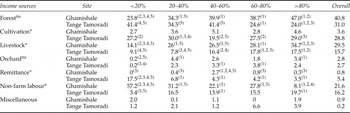
Our first research question concerns the importance of forests to rural households. Table 1 shows the households’ total income shares by source and for total income quintiles. Forest income represents about one-third of total household income for both sites. When grouping households in income quintiles, we observe a pattern where forest dependence increases with total income in the case of Ghamishale, while it decreases in the case of Tange Tamoradi. There are also some other differences in the income composition between the two sites. In Ghamishale, cultivation is of little importance, whereas livestock and non-farm labour are important. In Tange Tamoradi, crop cultivation is much more important, and although non-farm labour represents 16 per cent of total income, it is relatively less important than in Ghamishale.
Households’ total income shares by total income quintiles and income sources

Notes: *Overall significant difference between sites at 99% level.nsnot significantly different.(1, 2, 3, 4, 5)Statistically significant difference between income quintile no. x and the column income quintile for each income source.
There are significant differences among different quintiles in almost all income sources (except miscellaneous income sources). In particular, we note the very high reliance (57.2 per cent) on non-farm wage income for the lowest income quintile in Ghamishale.
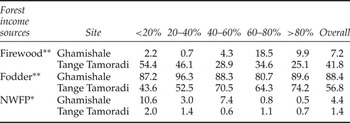
Table 2 shows that fodder is the main forest income source in both Ghamishale and Tange Tamoradi (88.4 and 56.8 per cent, respectively). Firewood represents more than 40 per cent of forest income in Tange Tamoradi, but only 7 per cent in Ghamishale. Firewood is the main component of forest income for low-income groups of households in Tange Tamoradi. Households in Ghamishale have a higher contribution of NWFPs in forest income compared to in Tange Tamoradi. We also note that NWFPs are more important to low-income groups, especially in Ghamishale.
Households’ forest income shares by total income quintiles and forest income sources

Notes: *Non-wood forest products, significant at 95% level; **significant at 99% level.
4.1.2. Forest-dependent groups
The factor and cluster analysis grouped households into three clusters of forest dependence. We summarized mean values and standard deviations for the variables used in the factor and cluster analysis for the full sample and for each cluster (table A4, online appendix). The results of pairwise comparisons for each variable between every combination of clusters showed statistically significant differences. The three clusters were named according to their characteristics: (1) ‘Not-dependent’: all forest income shares were small; (2) ‘Fodder-firewood’: 21 and 13 per cent of income came from fodder and firewood, respectively; and (3) ‘Fodder’: 38 per cent of the income came from fodder. In total, 86 per cent of households in the cluster ‘Fodder-firewood’ lived in Tange Tamoradi, while 90 per cent of households in the cluster ‘Fodder’ lived in Ghamishale. The average population density was 12.4, 17.5 and 8.0 for the clusters ‘Not-dependent’, ‘Fodder-firewood’ and ‘Fodder’, respectively. Forest biomass availability was 179, 117 and 200 m3 per person for clusters ‘Not-dependent’, ‘Fodder-firewood’ and ‘Fodder’, respectively. The results of the cluster analysis were used in a later analysis.
4.1.3. Inequality measures
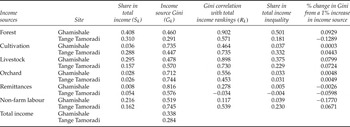
Table 3 presents the contribution of different income sources to income inequality. We note that both sites have fairly egalitarian income distributions, with Gini coefficients for both sites of around 0.3. The forest share in total income inequality in Ghamishale is larger (0.501) than forest share in total income (S k = 0.4082), whereas the opposite is the case in Tange Tamoradi (0.181 vs. 0.310). This is consistent with the forest income pattern of table 1. These differences between the two sites are also reflected in the last column of table 2; higher forest income would have an equalizing effect in Tange Tamoradi: a 1 per cent increase in forest income would result in a 0.1289 per cent decrease in the Gini coefficient. In Ghamishale, a 1 per cent increase in forest income results in a 0.0929 per cent increase in the Gini coefficient. Otherwise, we note that farm-related activities (cultivation, livestock and orchard) have an income equalizing effect, while non-farm income sources tend to increase income inequality. In Ghamishale and Tange Tamoradi, 11 and 13 per cent of households, respectively, are below the poverty line. When we exclude forest income from total income, 39 and 43 per cent of households fall below the poverty line in Ghamishale and Tange Tamoradi, respectively.
Gini decomposition by income sources

4.2. Factors determining forest dependence
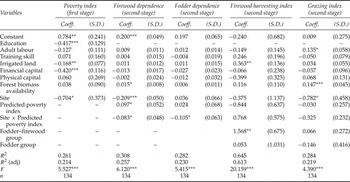
Education, irrigated land and financial capital, all of which were treated as variables related to household asset holdings, significantly contributed to explaining the variation in the poverty index in the first stage of 2SLS analysis (table 4). Since poverty might be endogenous, we instrumented the poverty index using the education variable. Education significantly influenced the poverty index, but had no significant effect on firewood dependence and fodder dependence, which is one of the criteria for being a suitable instrument. Even though the fit of the first stage of analysis was poor, the F-statistic showed the validity for instrumental variable. We also applied the OLS model for firewood dependence and fodder dependence. The coefficients for the OLS and 2SLS models were not significantly different, meaning that endogeneity is not an issue in this case. We also performed a Durbin–Wu–Hausman test to find out whether the variable financial capital was endogenous in poverty index regression. The results of the test confirmed that it was not necessary to use 2SLS and instrumental variable analysis to estimate the poverty index.
Determinants of poverty index, firewood dependence, fodder dependence, and firewood harvesting and grazing indices

Notes: *Significant at 90% level; **significant at 95% level; ***significant at 99% level.
The predicted poverty index is positively and significantly correlated with firewood dependence. The coefficient of predicted poverty index for Ghamishale (0.097 − 0.083 = 0.014) is smaller than for Tange Tamoradi (0.097). The predicted poverty index is negatively correlated with fodder dependence in the case of Ghamishale (0.081) and positively correlated in the case of Tange Tamoradi (0.024), even though the coefficient is not significant. Site has a negative and significant effect on firewood dependence, and a positive and significant effect on fodder dependence, meaning that households in Ghamishale are more dependent on fodder compared to households in Tange Tamoradi, whereas households in Tange Tamoradi are more dependent on firewood compared to households in Ghamishale. Forest biomass availability is positively correlated with firewood dependence.
4.3. Factors determining forest degradation
The forest degradation analysis follows a similar approach to the forest dependence analysis: in the first stage the poverty index is predicted, using education as an instrument; in the second stage, the predicted poverty index and the other stage one explanatory variables (except education) are used to predict firewood and fodder harvesting (table 4). In addition, variables describing the forest-dependent groups were included as independent variables. We observe a positive and significant correlation between adult labour and forest biomass availability and the grazing index. The negative correlation between site and both the firewood harvesting index and the grazing index indicates that the firewood harvesting and grazing indices are lower for households in Ghamishale compared to households in Tange Tamoradi. There is no significant correlation between the predicted poverty index and the indices for firewood harvesting and grazing. However, the signs are negative, which may indicate that households with a high poverty index contribute less to firewood harvesting and grazing. There is no significant association between the forest dependence strategy ‘Fodder group’ and firewood harvesting and grazing indices. However, being in the ‘Fodder-firewood’ group has a positive and significant effect on the firewood harvesting index.
5. Discussion
The situation in the Zagros Mountains is characterized by poverty and a long history of forest utilization and forest degradation; hence, the present study is a classical case concerning these challenges. Regarding the first research question (on the importance of forest resources in the household economy), rural communities in the Zagros are highly dependent on forest resources for their livelihood (table 1). Similar situations are also reported from several other studies in low- and middle-income societies (Fisher, Reference Fisher2004; Vedeld et al., Reference Vedeld, Angelson, Bojo, Sjaastad and Kobugabe Berg2006; Narain et al., Reference Narain, Cupta and Van de Veld2008; Babulo et al., Reference Babulo, Muys, Nega, Tollens, Nyssen, Deckers and Mathijs2009; Kamanga et al., Reference Kamanga, Vedeld and Sjaastad2009). However, forest income shares of 31 per cent and 41 per cent put our case at the high end of the scale in terms of direct forest dependence.
An interesting finding is the different patterns for the two sites regarding the link between income level (poverty) and forest dependence (table 1). Forest dependence increases with income in Ghamishale, with the wealthiest group having the highest dependence on forests, whereas in Tange Tamoradi forest dependence tends to decrease with income, although the medium group exhibits the highest dependence. This pattern is also reflected in the Gini coefficient analyses, and these results indicate that there are two different economic functions served by forests (cf. Cavendish, Reference Cavendish, Campbell and Luckert2002; Angelsen and Wunder, Reference Angelsen and Wunder2003). Forest resources are ‘pro-poor’ in Tange Tamoradi, meaning that forest resources increase the incomes of the poorest people in particular and thereby reduce markedly the incidences of poverty and income inequality. In contrast, forest resources are more ‘pro-rich’ in Ghamishale, meaning households in the top income quintile are more dependent on forest resources than households in the low income quintile, suggesting that forest resources can provide a way for households to increase their incomes and move out of poverty.
Further, there are two possible explanations as to why forest income seems to have an income equalizing effect in Tange Tamoradi, whereas the opposite effect was observed in Ghamishale. The first explanation relates to the fact that fodder derived from forests is a required input for livestock husbandry in the Zagros. The high share of fodder income illustrates the close link between livestock husbandry and forest resources for both sites (table 2). Livestock are generally taken to forested areas during spring, summer and autumn. The villagers also collect fodder from trees (by lopping) as a main winter feed for livestock, since understory grass constitutes a negligible proportion of the total feedstock requirement. Livestock is a highly capital intensive activity and an important source of income for the top income groups in Ghamishale (table 1), and therefore the wealthy households are most dependent on forest resources for fodder as an input for livestock husbandry (table 2). By contrast, in Tange Tamoradi the cultivation of crops is a more important source of income for households in the top income group while livestock plays a relatively minor role, which means that they are less dependent on fodder from forest resources.
Most studies find that forest resources contribute relatively more to the incomes of poor households compared to wealthier households (Cavendish, Reference Cavendish, Campbell and Luckert2002; Vedeld et al., Reference Vedeld, Angelson, Bojo, Sjaastad and Kobugabe Berg2006; Shackleton et al., Reference Shackleton, Shackleton, Buiten and Bird2007; Babulo et al., Reference Babulo, Muys, Nega, Tollens, Nyssen, Deckers and Mathijs2009; Kamanga et al., Reference Kamanga, Vedeld and Sjaastad2009). However, a few studies have not arrived at this conclusion. For example, Fisher (Reference Fisher2004) classified forest resource activities into two groups: high return activities (e.g., harvesting of timber) and low-return activities (e.g., firewood collection), and found a positive correlation between household income and dependence on income from high-return forest activities and a negative correlation for low-return activities. Similar to our findings, Narain et al. (Reference Narain, Cupta and Van de Veld2008) found a positive correlation between total income and fodder dependence, but a negative correlation between income and firewood dependence.
The second possible explanation for the different patterns relates to the role of institutional arrangements for forest management and property rights. Since there are no individual household rights in Tange Tamoradi and the forests are managed as a common resource pool for the villages, households have more equal access to forest resources, which in turn means there is a more equal distribution of forest income (i.e., a lower Gini coefficient for forest income; see table 3). By contrast, in Ghamishale a large part of the forest resources are managed by individual households, which may lead to less equal distribution of access to the resources. Households owning larger forest areas can also have more grazing and bigger herds, and therefore higher forest income in both absolute and relative terms.
A key insight from our study is therefore how the poverty–environment use link is conditioned on the institutions of forest management. Forest resources that are managed more like private property are more beneficial for wealthy households and imply lower equity, whereas forest resources that are managed more like a common resources pool imply higher equity (Ostrom, Reference Ostrom1990; McKean and Ostrom, Reference McKean and Ostrom1995) and are more beneficial for poor households (Jodha, Reference Jodha1986; Vedeld et al., Reference Vedeld, Angelson, Bojo, Sjaastad and Kobugabe Berg2006). As pointed out in section 3.1, we are aware that the institutional set-up is not the only difference between northern and southern study areas, but it represents a major difference.
With regard to the second research question (factors determining forest dependence), the results indicate – not surprisingly – that households with higher forest dependence tend to own or have access to more natural capital, as measured by forest biomass availability (table 4). Higher biomass increases the efficiency of time spent collecting forest products and consequently results in higher forest use and higher forest dependence. This finding is in line with Narain et al. (Reference Narain, Cupta and Van de Veld2008), who indicate that higher biomass availability may induce households to specialize in resource collection.
Regarding the third research question (factors determining forest degradation), the main finding is that we did not find any evidence to prove that poor people are those who extract most from the forests and thereby cause degradation. Households’ extraction of forest products is a function of their own private endowments, such as livestock. Poor households may have less capacity to extract intermediate forest products (e.g., fodder) and consequently their animals exert less grazing pressure (table 4). Furthermore, there is a limited market outlet for forest products and therefore small incentives to collect more than needed for household consumption or on-farm production. Thus the poor do not have many opportunities to use forest products as a cash earner, and in Ghamishale this function is served by the non-farm labour market.
Another possible explanation for lower degradation among poor people may be related to the place where they live. Quite often, poor people live in areas with a lower population density and where the forest growth per capita and carrying capacity per capita are higher (i.e., thresholds for overharvesting and overgrazing are higher), resulting in lower pressure on forest resources and less forest degradation (positive association between forest biomass availability and poverty index, even though the coefficient is not statistically significant).
Perhaps the most surprising result of the analysis is that it did not confirm a positive link between forest dependence and forest degradation. This suggest that forest dependence as an economic measure should be treated with caution in explanations of forest degradation as an ecological measure that is strongly connected with population density, forest biomass availability and institutions for forest management. Policies based upon the assumption that reducing forest dependence leads to lower forest degradation may therefore fail and have different consequences if they do not consider other factors. The fact that local communities have been dependent on forest resources in the Zagros may be one of the key reasons why the forests have survived to date (Fattahi et al., Reference Fattahi, Ansari, Abbasi and Khan Mohammadi2000). Forest dependence has been considered mainly a cause of forest degradation but fairly rarely considered an opportunity or an incentive for long-term sustainable forest use.
The link between forest dependence and forest degradation may become more important if we look at the current situation in Iran, where there is a high rate of urbanization. Urbanization may lead to deforestation since new land is required to build infrastructure for the growing urban population. Towns and small cities in the Zagros are expanding rapidly and increasing migration to suburban areas makes land use conversion attractive (convert forest resources to villas for the urban population). Urbanization also raises consumption levels and leads to an increase in demand for agricultural products. If local communities in rural areas are not dependent on forest resources for their livelihoods, they may convert the resources to other, more profitable land uses, such as cropland, land for villas and houses or gardens for urban populations.
Thus, institutional arrangements for forest management together with population density and carrying capacity appear to be more influential factors in explanations of forest degradation than poverty and forest dependence. The simple idea that forest dependency and poverty should be reduced in order to stop forest degradation could lead to deforestation and should probably be replaced by a more sophisticated policy that takes into account the complexities of local forest use and institutional arrangements, population density and the carrying capacity of forest resources. Such a policy measure should target households’ total forest use rather than households’ forest dependence. For example, a policy measure that increases households’ incomes through other income sources without any effect on the households’ forest use would not decrease pressure on forest resources (and would thus represent an ineffective policy measure), and forest dependence would decrease. It is also important for politicians and forest authorities to be aware of the tradeoff between equity and less degradation in different forms of community forest management.
The study was carried out at the micro-level (two sites). The sample covers 50 per cent of households in the two sites, which is appropriate for the statistical analyses. The fact that only two sites were represented, however, raises questions regarding generalization of the results and in making policy recommendations for the region as a whole. A larger number of sites covering more of Zagros might have revealed more variation and nuances, and also permitted better testing of village-level variables. However, the sites were selected carefully based on the socioeconomic situation and the ecological conditions. Forest activities, livelihood strategies, forest dependence level, poverty and forest degradation levels were some of the characteristics that we considered when selecting the sites. We avoided sites with extreme characteristics. Therefore, the two sites may be regarded as reasonably representative for Zagros.
6. Concluding remarks
There are three main findings from our study of the Zagros Mountains. First, there is a negative correlation between total income and firewood income share (dependence), and a positive correlation between total income and fodder income share. Overall, we therefore cannot claim that the poor are more forest dependent than those who are wealthy. Second, there is no significant correlation between poverty and forest degradation, which makes it reasonable to claim that the poor people are not the main agent of forest degradation. Third, households with high forest dependence do not necessarily contribute more to forest degradation compared to households that are less dependent on forest resources.
The findings have several policy implications. First, they provide Iranian policy makers with information that may help them to formulate more effective policy measures to abate forest degradation in the Zagros. The negative link between forest dependence and forest degradation may indicate that forest dependence is an opportunity to improve the forest resource conditions.
Second, the results have highlighted an important point in international literature on community forest management, namely that there is a tradeoff between equity and the sustainable use of resources. Poverty reduction and forest degradation reduction are main objectives that have led to widespread practices of community forest management. Although in our study area family-based traditional forest management seems to have resulted in less overexploitation and in halting forest degradation, the results in terms of equity and distributional benefits have been less successful. By contrast, the consequences of the village-based traditional forest management seem to have been equal distribution of benefits gained from forests, but at the same time higher levels of forest degradation.
Third, the results have highlighted the relative importance of income from forest resources in overall household incomes in the Zagros. These results contrast with the general perception among Iranian policy makers who regard livestock husbandry and cultivation as the core of rural livelihoods due to the lack of a well-functioning market to give value to forest products. We suggest that policy makers pay more attention and direct more efforts towards the forest section in the Zagros. Existing restrictions imposed by the FRWO on the access to and use of forest resources should be reconsidered. The FRWO should accept traditional forest rules and make efforts to improve them, so that local communities could benefit from forest resources without causing forest degradation.
Supplementary materials and methods
The supplementary material referred to in this paper can be found online at journals.cambridge.org/EDE/.