Introduction
Eggplant Solanum melongena Lin. (Solanaceae) is one of the most important vegetables of India and South East Asia. Eggplant in Asia accounts for 92% of total area in the world. Half of the total world area under eggplant cultivation is in South Asia. In India, eggplant is grown around the year in almost all the states. An annual production of 10.38 million tons of eggplant shares 7.5% of total vegetable cultivation. The average productivity in India is very low (17.3 t/ha) compared with that in Japan and Turkey (Anonymous, 2010).
The most important constraint in the cultivation of eggplant is the infestation of eggplant shoot and fruit borer (ESFB) Leucinodes orbonalis Guen. (Lepidoptera: Pyralidae). The yield loss due to ESFB varies from 37 to 63% in various states of India (Dhankhar, Reference Dhankhar1988) and up to 86% in Bangladesh (Ali et al., Reference Ali, Ali and Rahman1980). As a result of successive cropping, the pest remains active throughout the year except in areas having moderate climate. Damage to the fruits during autumn is very high, and the whole crop may be destroyed due to borer infestation. Immediately after hatching, the neonate larvae bore into the nearest flower, tender shoot or fruit. The young larvae inside the shoot or fruit plug the entry point with excreta. Infested tender shoots droop down, growing tips wither, damaged buds drop off and fruits bear circular exit holes. Damage to flowers adversely affects fruit set, causing direct yield loss.
The current trend of L. orbonalis management shows substantial dependence on synthetic insecticides. Insecticides are applied very frequently especially during post-flowering stage of the crop (Shivalingaswamy et al., Reference Shivalingaswamy, Satpathy, Tripathi, Pandey, Talekar, Rai, Swamy, Satpathy, Singh and Kumar2005). Their repetitive use resulted in progressive loss in effectiveness of organophosphates and development of resistance for synthetic pyrethroids (Ali, Reference Ali1994). Under this background, it is imperative to find alternative non-chemical tactics for ESFB management.
Diversity of vegetation can affect insect orientation and is one way to promote pest management without insecticides. Polycultures are ecologically complex because inter- and intra-specific plant competition occurs simultaneously with herbivores, insect parasitoids and predators (van Emden, Reference van Emden1965). Intercropping has been used in many systems to create vegetational diversity and reduce the incidence of pests. Antifeedants are applied directly to the surface to inhibit pest behaviour such as feeding and oviposition. The antifeedants, especially azadirachtin (Ascher, Reference Ascher1993), present in the extracts of the neem tree Azadirachta indica A. Juss. (Meliaceae) have attracted great interest in recent years. Preliminary evaluation of various intercrops with eggplant has shown the potential of fennel, coriander and nigella in suppression of ESFB infestation. Intercropping eggplant with coriander reduced the borer infestation more effectively (Ali et al., Reference Ali, Khorsheduzzaman and Karim1996; Khorsheduzzaman et al., Reference Khorsheduzzaman, Ali, Mannan and Ahmed1997; Gupta et al., Reference Gupta, Singh and Kumar1999). This study aimed to investigate the role of diverse intercrops with certain impact on insect orientation and the effect of antifeedants applied on eggplant, intercropped with fennel and coriander on ESFB infestation under field conditions.
Materials and methods
Laboratory and field experiments were conducted at the Indian Institute of Vegetable Research, Varanasi, Uttar Pradesh, India, to evaluate the role of intercrops and antifeedants on the control of ESFB.
Plants and insects
Healthy seeds of eggplant cultivar ‘Punjab Sadabahar’ were sown in raised beds 3.3 m long, 1 m wide and 6 cm high. The nursery soil was made loose and friable. Well-decomposed farmyard manure (FYM) (20 kg/bed) was mixed thoroughly in the soil. A fortnight after germination, seedlings were thinned to reduce competition to maintain healthy growth. The seedlings were protected with muslin cloth cages to avoid early pest infestation in the nursery.
Field evaluation of intercrops and antifeedants
Healthy seedlings of eggplant were transplanted in the last week of July in 4.9 × 4.2 m plots with four rows of eggplant and three rows of intercrop.
The experiment was laid out in a randomized complete block design (RCBD) with two factors, i.e. intercrops (IC1, coriander Coriandrum sativum L. (Apiaceae); IC2, fennel Foeniculum vulgare Miller (Apiaceae); IC0, no intercrop) and antifeedants (D1, neem seed kernel extract (NSKE) (4%); D2, Neemarin® (azadirachtin 3000 ppm; Biopest Laboratories, New Delhi) (0.3%); D3, ash at 50 kg/ha; D0, control). There were 12 treatment combinations altogether (IC1D1, IC1D2, IC1D3, IC1D0, IC2D1, IC2D2, IC2D3, IC2D0, IC0D1, IC0D2, IC0D3 and IC0D0) with three replications. Each plot was spaced 2 m on both sides to nullify the effect of treatments on adjacent plots.
The observations on total and damaged fruits (weight and number basis) during each harvest from 60 days after transplanting (DAT) to 120 DAT were taken. The yield of eggplant (total and marketable) was recorded during each harvest. Intercrops were harvested after maturity of the seeds, and the yield was converted into ha basis. In case of intercrop, the crop yield was converted into equivalent yield of eggplant (per ha) considering the row ratio of 2:1 (eggplant: intercrop). For yield conversion, the price of eggplant, coriander and fennel was assumed as Rs. 3, 35 and 40/kg, respectively.
ESFB moth orientation for oviposition in multiple choice chamber
The experiment was conducted in an aspirated multiple choice chamber to simulate the effect of intercrops on ESFB adult for orientation and egg-laying on eggplant in the presence or absence of intercrops. The multiple choice chamber consisted of three transparent plastic containers (each 20 cm high and 16 cm diameter) connected to a central adult chamber (same size) with transparent plastic tubes (20 cm long and 5.5 cm diameter). The adult chamber was connected to a vacuum pump to maintain airflow from three chambers (containing the host plants and intercrops) to the central adult chamber. In the three-choice chambers, eggplant and intercrop plants were potted in ice-cream cups (5 cm high and 6 cm diameter). The combinations for the three chambers were eggplant-2, eggplant-1+fennel-1 and eggplant-1+coriander-1. Freshly emerged adults (eight males and ten females) were collected after emergence from mass-reared pupae and released in the central chamber for one set of experiments. The airflow was maintained through a vacuum pump. The whole system was covered with black cloth to neutralize the effect of light on adult orientation. Subsequently, the adult orientation (male and female) and egg-laying on the eggplants in the different choice chambers were recorded at 24 h intervals from 24 to 72 h. The experiment was replicated eight times.
Rearing of eggplant shoot and fruit borer
ESFB was reared to obtain the mated females for the moth orientation study. The test insects were reared in a temperature and humidity-controlled rearing laboratory with 30 ± 2 °C temperature, 70 ± 5% relative humidity and 13 h illumination. Initial collection of ESFB larvae was derived from field-collected infested fruits of eggplant. Damaged fruits were cut open with a disinfected knife. The larvae from the cut fruits were collected with an insect brush (number 0) and released on freshly picked eggplant fruits collected from an insecticide-free crop. The larvae were transferred 2 days after feeding to fresh fruits in the same manner as mentioned earlier. These fruits were kept in polyvinyl containers (20 cm high and 15 cm diameter) having an inner layer of finely cut tissue paper in the bottom to absorb oozing, if any, from the fruits and facilitate the formation of pupal cover by the larvae in the advanced stages of growth. Rearing jars were covered with nylon nets (200 mesh) and tightly held over the top with rubber bands. The pupae were formed on the inner surface of the container or on the tissue paper. The pupae were collected and put in a separate oviposition jar of the same size, and cotton swabs soaked with 10% honey solution were put inside the oviposition jar for adult feeding. Fresh fruits were kept over the net cover to facilitate egg-laying by the mated females in the net just below the fruits. After egg-laying, the fruits over the net cover were replaced with fresh fruits after 2 days to attract the neonate larvae for feeding just after hatching. The larvae were removed after 4 days from the initially infested fruits. The fruits were changed on alternate days throughout the larval developmental period untill the formation of pupae, and after adult emergence the oviposition process was again repeated.
Statistical analysis
To study the cumulative effect of two factors, the mean fruit damage was calculated as the average of all the harvests. The damage (% arcsine transformed prior to analysis) for each observation was combined, averaged and statistically analysed by ANOVA (Gomez and Gomez, Reference Gomez and Gomez1983). Similarly, the data on yield, moth orientation and egg-laying were also analysed. In multiple choice tests, the data on mean adult orientation and egg-laying on eggplant in each condition, i.e. eggplant only, eggplant and coriander, eggplant and fennel, were analysed by ANOVA.
Results
Field evaluation of intercrops and antifeedants
Fruit damage
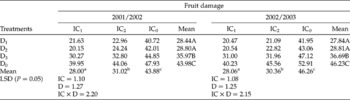
During the 2001/2002 cropping season, the data obtained on cumulative fruit damage (number basis) in each treatment revealed that the intercrop, antifeedant and the interaction significantly reduced the fruit infestation compared with the control (Table 1). The eggplant intercropped with coriander and fennel suffered significantly less fruit damage (28 and 31%) than the sole crop (43.9%) (F = 187.76, d.f. = 2, 22; P>0.05). However, the fruit infestation level in eggplant with either coriander or fennel as intercrop did not differ statistically (F = 187.76, d.f. = 2, 22; P>0.05).
Level of eggplant shoot and fruit borer infestation in fruits (% number basis) under different intercrop–antifeedant combinations

IC1, coriander; IC2, fennel; IC0, no intercrop; D1, NSKE (4%); D2, Neemarin® (0.3%); D3, ash at 50 kg/ha; D0, control.
Means followed by the same upper (for vertical comparisons) and lower (for horizontal comparisons) case letters are not significantly different.
Irrespective of the intercrop, the main effect of antifeedants was also pronounced. The significantly lowest fruit borer damage (28.4%) was observed in NSKE (4%)-treated plot being at par with the damage level (28.8%) in the Neemarin® (0.3%) treatment. Although the ash-dusted crop exhibited significantly less fruit damage (36%) compared with the untreated control (44%), it was inferior to both neem treatments (F = 108.2, d.f. = 3, 22; P < 0.05%). The interaction effect of the two factors, i.e. repellent-intercrop and antifeedant, on L. orbonalis damage was significant (F = 10.0, d.f. = 6, 22; P < 0.05%). The eggplant intercropped with coriander and protected with Neemarin® sprayed at 10-day intervals suffered least fruit damage (20.1%) at par with the fennel intercrop and NSKE (4%) combination (23%). The untreated control, i.e. sole eggplant crop with no antifeedant application, suffered the maximum fruit damage (47.9%). The fruit damage (44.8%) in the sole eggplant crop dusted with ash did not differ significantly from the control.
During the 2002/2003 cropping season, the mean fruit damage percentage (number basis) on eggplant under different intercrop combinations indicated significant influence of both the intercrops, i.e. coriander and fennel, on borer infestation (Table 1). Significantly less fruit damage was recorded in the eggplant–coriander intercrop (28.1%), followed by eggplant–fennel (30.4%) intercrop, compared with the eggplant monocrop (46.3%) (F = 267.42, d.f. = 2, 22; P < 0.05%). Irrespective of intercropping, the antifeedant applications also reduced fruit borer infestation significantly with 27.8, 28.8 and 36.7% for NSKE (4%), Neemarin® and ash application treatments, respectively (F = 151.55, d.f. = 3, 22; P < 0.05). There was no significant difference in fruit damage between the two neem treatments, whereas the untreated crop had significantly higher fruit damage (46.2%) than the other three treatments. The interaction of intercrops and antifeedants was significant (F = 8.62. d.f. = 6, 22; P < 0.05). The lowest fruit borer infestation (20.5%) was recorded in eggplants intercropped with coriander and treated with NSKE (4%), similar eggplant–coriander intercrop and Neemarin® (20.5%) and the eggplant–fennel intercrop and NSKE (4 and 21.1%) combinations, whereas with 52.9% the significantly highest fruit damage was recorded in the eggplant monoculture, without any protection.
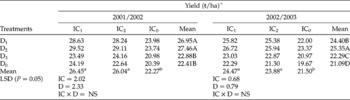
During 2001–2002, the total yields of eggplant (including the yield of intercrops converted to equivalent eggplant fruits) in coriander- and fennel-intercropped eggplant (26.45 and 26.04 t/ha, respectively) were significantly higher than the yield in the eggplant monoculture (22.27 t/ha) (F = 11.17; d.f. = 2, 22; P < 0.05%) (Table 2). The antifeedants also had significant effect on the yield (F = 11.08, d.f. = 3, 22; P < 0.05). The highest yield was recorded in the Neemarin® (27.5 t/ha) and the NSKE (26.95 t/ha) treatments, which were significantly higher than the yield in the untreated control. In the subsequent year also, similar yield results were obtained under different treatment combinations (Table 2). The Neemarin®-treated (main effect) crop produced significantly higher (25.3 t/ha) yields than the NSKE-treated crop (24.4 t/ha) and the control (21.1 t/ha) (F = 51.74, d.f. = 3, 22; P < 0.05%). In case of intercrops, the total eggplant yield with coriander as intercrop was higher (24.5 t/ha), being at par with fennel as intercrop (23.9 t/ha) (F = 45.12, d.f. = 2, 22; P < 0.05%). The main effect of treatments on yield indicated that yield of eggplant monoculture crop was significantly lower (21.1 t/ha) than intercropped eggplant (ANOVA, F = 0.87 d.f. = 6, 22; P < 0.05% and F = 1.02, d.f. = 6, 22; P < 0.05%).
Yield of eggplant in different antifeedant–intercrop combinations

IC1, coriander; IC2, fennel; IC0, no intercrop; D1, NSKE (4%); D2, Neemarin® (0.3%); D3, ash at 50 kg/ha; D0, control.
Means followed by the same upper (for vertical comparisons) and lower (for horizontal comparisons) case letters are not significantly different.
+ Intercrop yield is converted to equivalent yield of eggplant assuming the price of eggplant at Rs. 300/quintal, coriander at Rs. 35/kg and fennel at Rs. 40/kg.
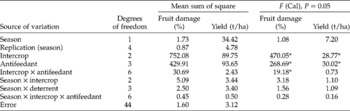
ANOVA, considering the planting season as fixed-factor variable, showed that the main effects of intercrop and antifeedant and the interaction effect of intercrop and antifeedant on fruit damage and yield were significant (Table 3). This indicates the consistency of a differential effect of the levels of a factor over the other factors.
ANOVA considering the planting season as fixed variable

* Significant at P = 0.05.
ESFB moth orientation for oviposition in multiple choice chamber
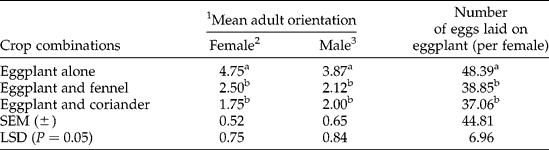
The mean number of female adults oriented towards sole eggplants was significantly higher (4.75) compared with that observed on eggplant in the presence of fennel (2.50) and coriander (1.75) (ANOVA, F = 37.22, d.f. = 2, 21; P = 0.05%) (Table 4). The orientation of females to eggplants in the presence of coriander or fennel did not differ significantly. However, the orientation to eggplant was least (1.75) in the presence of coriander. The males showed a similar type of orientation as the females (ANOVA, F = 13.42, d.f. = 2, 21; P < 0.05%); maximum orientation (3.87) was towards sole eggplants, followed by the eggplant–fennel (2.12) and eggplant–coriander combination (2.00), with no significant differences between the latter two treatments. The number of eggs laid by individual females on sole eggplant vis-à-vis the plant combinations differed significantly (ANOVA, F = 6.56, d.f. = 2, 21; P < 0.05%). In the presence of fennel and coriander, L. orbonalis females laid significantly fewer numbers of eggs (38.8 and 37.1/female, respectively) than on sole eggplants (48.4/female) (Table 4).
ESFB adult orientation and egg-laying on eggplant in the presence and absence of repellent crops in a multiple choice chamber
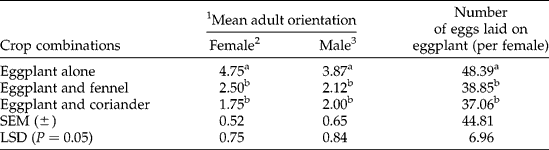
Means followed by the same letters (for vertical comparisons) are not significantly different.
1 Each value is the mean of eight observations.
2 Out of ten adults in central chamber.
3 Out of eight adults in central chamber.
Discussion
Our results on fruit infestation, adult orientation and egg-laying behaviour of females suggest that the coriander and, to a lesser extent, fennel intercrops repel L. orbonalis from their main host eggplant, resulting in significantly reduced fruit damage and lower population densities in intercropped eggplants compared with monocropped eggplants. Recently, polycultures, particularly intercropping of diverse plant types, have received greater attention in pest management research (Andow, Reference Andow1991). The observed lower fruit damage in intercropped eggplants in our study was due to reduced egg-laying as a result of impaired orientation of the females, corroborating the earlier hypothesis of Roots (Reference Roots1973) with respect to oviposition behaviour of specialist herbivores such as L. orbonalis and field observations of Ali et al. (Reference Ali, Khorsheduzzaman and Karim1996) and Khorsheduzzaman et al. (Reference Khorsheduzzaman, Ali, Mannan and Ahmed1997) in eggplant–coriander intercrops in Bangladesh. Recently, in field studies in Tamil Nadu (southern India), David et al. (Reference David, Balasubramanian, Rabindra and Veeraraghathatham2001) have also concluded that eggplant intercropped with two rows of coriander reduced the shoot and fruit damage. Coriander contains about 37 volatiles (Potter and Fagerson, Reference Potter and Fagerson1990), and some of them are probably responsible for the observed insect repellency. Saxena and Basit (Reference Saxena and Basit1982) also recorded 50% fewer leafhopper eggs on cotton associated with coriander. Hence our present and previous findings on the impact of coriander as an intercrop on ESFB infestations hold promise in the management of this important pest.
The tested antifeedants NSKE, Neemarin® and ash dust had an adverse effect on ESFB, resulting in reduced fruit damage compared with the untreated control. Both the neem products performed better than ash to curb fruit damage by L. orbonalis and were equally effective against ESFB. Previous field studies with NSKE (4%) and two other commercial neem products (Nimbecidine® and NeemAzal®) against ESFB also demonstrated reduced fruit damage and ovicidal action on the pest (Raja et al., Reference Raja, Rajendran and Papaiah1998; Srinivasan and Sundarababu, Reference Srinivasan and Sundarababu1998). The reduction in pest damage in neem-treated crops is not exclusively due to the antifeedant effect of the plant extracts but also due to the cumulative action as ovipositional deterrent, their ovicidal properties and direct mortality that they can cause in larvae as observed, for instance, by Samuel and Sundarbabu (Reference Samuel and Sundarababu1998) in ESFB. Indian vegetable growers have traditionally used ash for preventing insect infestation. Yet its mode of action is not well understood. Probably the leaf, plant or fruit surfaces covered with a layer of ash obstruct the females during oviposition and may subsequently cause dehydration of eggs and neonate larvae.
In addition to reduced ESFB infestation levels, yields of intercropped and neem/ash-treated eggplants were significantly higher compared with the untreated monocrop treatment, corroborating earlier results of Gupta et al. (Reference Gupta, Singh and Kumar1999) and David et al. (Reference David, Balasubramanian, Rabindra and Veeraraghathatham2001).
Conclusion
NSKE and the formulated neem product as antifeedants reduce the infestation level of eggplants by the shoot and fruit borer L. orbonalis. Lower ESFB infestation levels in fennel- or coriander-intercropped eggplants are due to impaired adult orientation and reduced egg-laying, and also due to the repellent effect of umbelliferous plants on female L. orbonalis.
Acknowledgements
The authors are thankful to the Director, Indian Institute of Vegetable Research, Varanasi, India, and Head, Department of Entomology and Agricultural Zoology, Institute of Agricultural Sciences, Banaras Hindu University, Varanasi, India, for providing the necessary facilities for carrying out the study.