1. Introduction
Post-orogenic extensional events associated with lithospheric thinning and generalized gravitational collapse are relatively poorly understood in the Cadomian orogen that fringed West Gondwana (e.g. Ballèvre et al. Reference Ballèvre, Le Goff and Hébert2001; Andonaegui et al. Reference Andonaegui, Arenas, Albert, Sánchez Martínez, Díez Fernández and Gerdes2016; Cambeses et al. Reference Cambeses, Scarrow, Montero, Lázaro and Bea2017; Fuenlabrada et al. Reference Fuenlabrada, Arenas, Sánchez Martínez, Díez Fernández, Pieren, Pereira, Chichorro and Silva2020). Orogenic collapses were responsible for the rapid and effective dismantling of the topographic bulge of fold-and-thrust belt edifices that, in the case of the Cadomian orogen, did not record major crustal thickening (Linnemann et al. Reference Linnemann, D’Lemos, Drost, Jeffries, Gerdes, Romer, Samson, Strachan and McCann2008). Owing to the common record of basement tilt and erosion, none of the preserved components of the Cadomian Orogen, which extends from Iberia to the Armorican and Bohemian massifs, contains a complete arc-to-rift stratigraphic record (Linnemann et al. Reference Linnemann, Gerdes, Hofmann and Marko2014). In this work, we attempt to describe and interpret the sedimentary environments and palaeogeographic setting of a sector of the Central Iberian Zone affected by the Cadomian arc-to-rift turnover, where the Fortunian age is well constrained chronostratigraphically by the ichno- and microfossil record.
2. Geological setting and stratigraphy
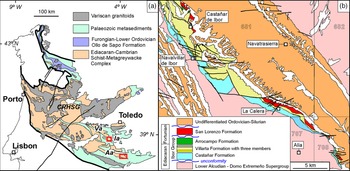
In the aftermath of the Cadomian Orogeny, the Iberian retro-arc basin recorded the onset of extensional troughs pointing to the beginning of rift conditions (Álvaro et al. Reference Álvaro, Cortijo, Jensen, Lorenzo, Palacios and Pieren2019, Reference Álvaro, Cortijo, Jensen, Martí Mus and Palacios2020). In the Central Iberian Zone (Fig. 1a), two kinds of Fortunian troughs are recorded: (i) those proximal to the Cadomian arc display a network of connected depressions, controlled by sharp collapses, and are characterized by deposition of chaotic megabreccias (Santamaría Casanovas & Pardo Alonso, Reference Santamaría Casanovas and Pardo Alonso1994; Santamaría Casanovas & Remacha Grau, Reference Santamaría Casanovas and Remacha Grau1994), olistostromes and mélange deposits (lower member of the Pusa Formation; Gabaldón López & Hernández Urroz, Reference Gabaldón López and Hernández Urroz1989; Vidal et al. Reference Vidal, Palacios, Gámez-Vintaned, Díaz Balda and Grant1994); this slope-related deposition of sediments derived from denudation of the Cadomian arc (Cíjara Formation) changed drastically to offshore-dominant settings episodically punctuated by phosphogenetic processes (Pusa Formation); whereas (ii) those back-arc settings far from the Cadomian arc influence comprised an assemblage of uplifted platform-blocks recording episodes of carbonate production and nucleation of microbial-Cloudina reefs (Ibor Group) that was replaced by an assemblage of horst-and-graben palaeoreliefs transgressively sealed by coarse-grained deposits (San Lorenzo Formation; Pieren & García-Hidalgo, Reference Pieren and García-Hidalgo1999; Álvaro et al. Reference Álvaro, Cortijo, Jensen, Lorenzo, Palacios and Pieren2019).
(a) Geological sketch of the Variscan Central Iberian Zone from the Iberian Massif with setting of the Ibor and Alcudia anticlines; abbreviations: Aa – Alcudia anticline; Ia – Ibor anticline; Va – Valdelacasa anticline; modified from Julivert et al. (Reference Julivert, Fontboté, Ribeiro and Conde1972); CRHSG – Ciudad Rodrigo–Hurdes–Sierra de Gata domain; Schist-Metagreywacke Complex refers to the Ediacaran–Cambrian strata unconformably overlain by the Lower Ordovician Armorican Quartzite formation. (b) Geological map of a part of the Ibor anticline (boxed in (a)) showing the scouring surface that marks the contacts of the Ibor Group/San Lorenzo Formation and Lower Alcudian – Domo Extremeño Supergroup/San Lorenzo unconformities; updated from Gil Serrano (Reference Gil Serrano1985), Monteserín López & López (Reference Monteserín López and López1985), Nozal Martín (Reference Nozal Martín1985) and Nozal Martín & Pérez Rojas (Reference Nozal Martín and Pérez Rojas1985); 681, 682, 707 and 708 refer to geological maps at 1:50 000 scale. Section logs in the vicinities of Castañar de Ibor (39° 38′ 41.87″ N, 5° 24′ 51.12″ W), La Calera (39° 30′ 45″ N, 05° 15′ 31″ W) and Alía (31° 29′ 36.25″ N, 5° 11′ 45.42″ W) villages.

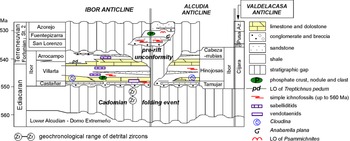
In the Ibor and Alcudia anticlines of the Central Iberian Zone (Figs 1b, 2), on which this paper is focused, the Ibor Group represents a sedimentary interval separating two gaps: (i) one associated with a late Cadomian folding event (c. 580–560 Ma; Apalategui et al. Reference Apalategui, Eguíluz, Martín-Torres and Palacios2009; Talavera et al. Reference Talavera, Montero, Martínez Poyatos and Williams2012, Reference Talavera, Martínez Poyatos and González Lodeiro2015; Linnemann et al. Reference Linnemann, Pieren, Hofmann, Drost, Quesada, Axel, Marko, Gärtner, Zieger and Jens2018), which caused tilting and erosion of the greywacke-dominated Lower Alcudian – Domo Extremeño Supergroup beds; and (ii) an intra-Fortunian pre-rift unconformity (Fig. 3). In the Ibor anticline, the Ibor Group is subdivided, from bottom to top, into the Castañar, Villarta and Arrocampo formations (Álvaro et al. Reference Álvaro, Cortijo, Jensen, Lorenzo, Palacios and Pieren2019). The Castañar Formation, up to c. 400 m thick, consists of basal breccia and coarse-grained sandstone-to-conglomerate interbeds that grade upward into shales with minor carbonate nodules. The Villarta Formation is a heterolithic succession, ranging from 100 to 250 m thick, which can be subdivided into three members, from bottom to top: (i) an alternation of lenticular and bedded carbonates embedded in greenish shales; (ii) a sandstone-dominant unit passing upward to sandy dolostones; and (iii) an alternation of shales and bedded carbonates. Cloudina-microbial build-ups, recorded in the lower member of the Villarta Formation (Álvaro et al. Reference Álvaro, Cortijo, Jensen, Lorenzo, Palacios and Pieren2019), have yielded, after acid etching, specimens of Cloudina, Sinotubulites and Protolagena (Cortijo et al. Reference Cortijo, Martí Mus, Jensen and Palacios2010, Reference Cortijo, Martí Mus, Jensen and Palacios2015). Vendotaenids are relatively common in the shale interbeds of the same member, whereas sabelliditids are abundant in the shale interbeds of the second member. Finally, the Arrocampo Formation, up to 350 m thick, is a shale-dominant unit with subsidiary sandstone interbeds increasing upward and local presence of carbonate nodules parallel to stratification. The basal part of the Arrocampo Formation contains the earliest ichnofossils assigned to Treptichnus pedum, providing evidence for a Fortunian (Cambrian) age (Álvaro et al. Reference Álvaro, Cortijo, Jensen, Lorenzo, Palacios and Pieren2019).
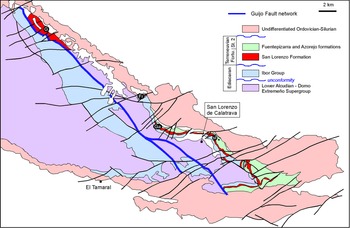
Geological map of the eastern edge of the Alcudia anticline showing the unconformities that mark the Ibor Group/San Lorenzo Formation contact and the base of the Lower Ordovician Purple Series and Armorican Quartzite formations; updated from Ortega Girones et al. (Reference Ortega Girones, Hernández Urroz and González Lodeiro1988), Lillo Ramos et al. (Reference Lillo Ramos, Pieren, Hernández Samaniego, Ólive Davo, Carreras Suárez, Gutiérrez-Marco, Sarmiento, Fernández Remolar and Gabaldón1998), Pieren & García-Hidalgo (Reference Pieren and García-Hidalgo1999) and Pieren Pidal (Reference Pieren Pidal2009); abbreviations: Fr – Fresneda river creek (38° 31′ 6″ N; 3° 53′ 44″ W); G – La Gitana mining area (38°35′ 2″ N; 4° 1′ 27″ W); Ga – Gargantilla stream (38° 29′ 51″ N; 3° 52′ 56″ W); st – stratotype of the San Lorenzo Formation (38° 27′ 57″ N, 3° 48′ 3″ W); * – stratotype of Fuentepizarra Formation; Fortu – Fortunian Stage; St. 2 – Cambrian Stage 2.

Stratigraphic units of the Ediacaran–Cambrian transition in the Ibor and Alcudia anticlines; abbreviations: Az. – Azorejo Formation; mb – megabreccias; St. – stage; updated from Álvaro et al. (Reference Álvaro, Cortijo, Jensen, Lorenzo, Palacios and Pieren2019).

In the Alcudia anticline, the Ibor Group has traditionally received another three-fold subdivision equivalent to that of the Ibor anticline, and includes the Tamujar, Hinojosas and Cabezarrubias formations (García-Hidalgo, Reference García-Hidalgo1985; San José et al. Reference San José, Pieren Pidal, García-Hidalgo, Vilas Minondo, Herranz Araújo, Peláez Pruneda, Perejón, Dallmeyer and Martínez García1990; Pieren Pidal, Reference Pieren Pidal2009) (Fig. 3). These units, up to 50, 80 and 120 m thick, respectively, display the same lithological and geometrical features as the Castañar–Villarta–Arrocampo triad from the Ibor anticline (Álvaro et al. Reference Álvaro, Cortijo, Jensen, Lorenzo, Palacios and Pieren2019).
The scouring surface that marks the pre-rift unconformity is capped by the San Lorenzo Formation, which unconformably overlies either the greywackes of the Lower Alcudian – Domo Extremeño Supergroup or any formation of the Ibor Group. The San Lorenzo Formation, up to 235 m thick, consists of variegated conglomerate, sandstone, shale and ironstone strata (Álvaro et al. Reference Álvaro, Cortijo, Jensen, Lorenzo, Palacios and Pieren2019). Its top is commonly eroded by the Lower Ordovician Purple Series and Armorican Quartzite formations but, at several spotty outcrops of the Ibor anticline (Fig. 1b) and the eastern edge of the Alcudia anticline (Fig. 2), the San Lorenzo Formation is conformably overlain by the Fuentepizarra Formation, a monotonous succession of shales, up to 80 m thick (Pieren & García-Hidalgo, Reference Pieren and García-Hidalgo1999). In the Alcudia anticline, the Fuentepizarra Formation contains several phosphorite and phosphatic carbonate interbeds, up to 30 cm thick, which have yielded microfossils after acid etching, such as helcionellids (Lorenzo Álvarez & Solé, Reference Lorenzo Álvarez and Solé1988; Vidal et al. Reference Vidal, Palacios, Moczydɬoska and Lorenzo Álvarez1995; Pieren & García-Hidalgo, Reference Pieren and García-Hidalgo1999) identified as Anabarella plana Vostokova (Gubanov in Vidal et al. Reference Vidal, Palacios, Moczydɬoska and Gubanov1999; Gubanov & Peel, Reference Gubanov and Peel2003). In the Siberian Platform, A. plana ranges from the late Nemakit-Daldynian (Khomentovsky & Karlova, Reference Khomentovsky and Karlova1994) to the late Tommotian (Gubanov & Peel, Reference Gubanov and Peel1999). A. plana co-occurs with Watsonella crosbyi (a candidate to mark the GSSP for the Cambrian Stage 2 base; Li et al. Reference Li, Zhao, Gubanov, Zhu and Na2011) in the Anabar Uplift of the Siberian Platform (Kouchinsky et al. Reference Kouchinsky, Bengtson, Landing, Steiner, Vendrasco and Ziegler2017).
3. Facies associations and geometrical relationships
In this section, new data focused on mapping, stratigraphic correlation and sedimentological analysis of the Fortunian strata capping the pre-rift unconformity are described and interpreted.
3.a. San Lorenzo Formation
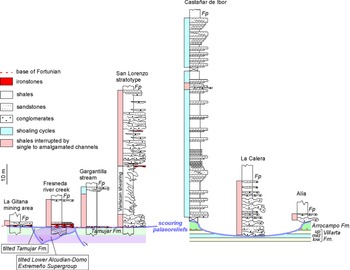
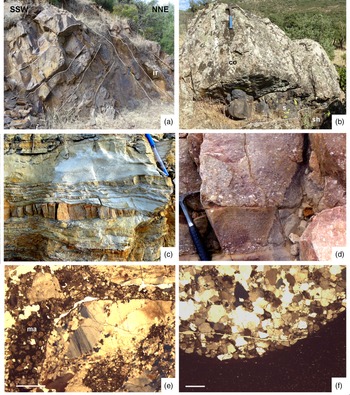
In the Ibor anticline, the Fortunian unconformity that marks the Ibor/San Lorenzo contact incises the Arrocampo Formation and the upper and middle members of the Villarta Formation. Its geometry preserves the erosion of a channel, c. 25 km wide and up to 150 m deep, linking Castañar de Ibor, Calera and Alía villages (Figs 1b, 4). In the eastern edge of the Alcudia anticline, the Hinojosas and Cabezarrubias formations are absent and the San Lorenzo Formation unconformably overlies either the Tamujar Formation (Ibor Group) or the greywackes of the Lower Alcudian – Domo Extremeño Supergroup. The geometry of this unconformity displays a channel, up to 7 km wide, with its deepest scouring setting (Fresneda river creek) preserving an angular discordance (Fig. 5a) owing to tilting of the Lower Alcudian – Domo Extremeño basement.

Facies and geometrical relationships of the San Lorenzo Formation. (a) Angular discordance separating the greywackes of the Lower Alcudian – Domo Extremeño Supergroup (left) from the overlying Fuentepizarra Formation; Fresneda river creek, Alcudia anticline. (b) Complete shoaling cycle from shales grading upsection into sandstone, pebbly sandstone and conglomerate from the San Lorenzo Formation at Gargantilla stream, Alcudia anticline. (c) Shale/sandstone alternations exhibiting thickening-upward cycles, up to 14 cm thick; Castañar de Ibor, Ibor anticline. (d) Pinkish conglomerate-to-pebbly sandstones with fining-upward trends from the San Lorenzo Formation at the stratotype. (e) Photomicrograph of a conglomerate with litharenitic matrix rich in polyphase clasts including vein quartz and ironstone subunits and mafic volcaniclasts from the San Lorenzo Formation at La Calera log. (f) Photomicrograph of a sandy channel scouring a massive iron oxyhydroxide groundmass from the base of the San Lorenzo Formation at Gargantilla stream; scale bars = 2 mm; abbreviations: co – conglomerate; ir – ironstone; ma – mafic volcaniclast; s – sandstone; sh – shale. Length of hammer for scale is 32 cm. Length of pen for scale is 13 cm.

Three facies associations are distinguished in the San Lorenzo Formation: coarsening-upward shales-to-conglomerate packages, conglomeratic channels encased in shales and ironstone beds.
(i) A heterolithic facies association, only recognized in Castañar de Ibor and Gargantilla stream logs of the Ibor and Alcudia anticlines, respectively (Fig. 4), consists of three facies: greenish shales, shale/sandstone alternations and conglomerates. Shales are noncalcareous and mainly structureless, and include subordinate massive to laminated claystone-to-siltstone alternations. Low-angle and trough cross-bedded sandstones form lenticular sets up to 0.8 m thick and topped with symmetric ripple laminations. They are composed of very fine- to coarse-grained litharenites, commonly marked by outsized clasts. Polymictic conglomerates occur as lenticular beds with scouring basal contacts, sets with normal grading and sharp to irregular tops. Most of these conglomeratic levels can be traced along strike for 100 m. Clast-supported conglomerates comprise rounded to sub-rounded, poorly sorted granules, pebbles and cobbles with a reddish-brown to purplish coarse-grained litharenitic matrix (ranging from 10 to 35 % in volume) rich in iron oxyhydroxide cements, which give the rock its typical variegated weathering aspect. Clasts of sandstone and conglomerate are composed of fragmented quartz vein, feldspar, lydite (black chert), iron oxyhydroxide, greywacke and shale. Most of the feldspar grains are partly altered to sericite leading to diagenetic (or secondary) greywackization sensu Cummins (Reference Cummins1962). The abundance of cross-bedding, cross-laminae, clast imbrication and scouring surfaces allows identification of palaeocurrent data: readings taken from foresets and imbricated pebbles show polymodal distributions, ranging from north to east.
The three facies are incorporated into coarsening- and thickening-upward cycles, up to 16 m thick (Fig. 5b). From bottom to top, the cycles display a succession from structureless shales to shale/sandstone alternations incorporating cross-stratified sandy sets capped by massive to cross-stratified litharenites and graded conglomerates sedimented as sinuous crested megaripples (Fig. 5c). The relative proportions of sandstone and shale interbeds vary considerably within these cycles. The upward transition from shale to conglomerate is gradational, whereas the contacts among cycles are abrupt. The high degree of rounding of the pebble-sized clasts suggests that they are far-travelled or, in the case of some intraclasts, the result of successive reworking or earlier lithified gravels. The mechanism proposed for the development of these cycles is analogous to prograding shoal complexes, which grow and migrate seaward during times of rapid sediment influx and shallowing.
(ii) Another facies association consists of whitish, single to amalgamated, channelized conglomerates embedded in shales. Their maximum dimensions are 0.5 m deep and 6 m wide. Clast-supported conglomerates comprise sub-rounded to subangular, poorly sorted granules and cobbles embedded in a sandy matrix. Grading is common in the basal centimetres (Fig. 5d). Clasts are dominated by quartz vein with subsidiary (<10 % in volume) lydite and monocrystalline quartz, iron oxyhydroxide, greywacke, shale, composite (polyphase) clasts and mafic volcaniclasts (Fig. 5e). Channel axes are oriented northeasternward.
Rapid lateral facies variations over tens of metres due to channel development suggest that the conglomerates were deposited as both basal lag and longitudinal gravel- to cobble-bar deposits in an upper flow regime. The textural maturity of this association reflects the marked abrasion and winnowing of the sediment. The facies association points to the onset of gravel braided distributary channels, preserved as interweaving stream-dominated fans scouring clayey-dominant marine substrates (McPherson et al. Reference McPherson, Shanmugam, Moiola, Nemec and Steel1998; Yin et al. Reference Yin, Hu, Ren, Wu, Chen, Zheng and Jiang2016).
A close link between the input of vein-quartz-rich clasts and the episodic activation of normal faults, hosting epithermal veins, can be suggested. The onset of conglomeratic channels was probably controlled by the balance between accommodation space and sediment supply, yielded by fault-related quartz veins. The encasing of conglomeratic channels in shales indicates incision and erosion of fault scarps. The progradation of irregular flows of clast-supported conglomerates suggests stream-flow sedimentation and erosion of steep uplifting footwalls. More distal and lateral facies associations recorded a decrease in channel amalgamation reflecting short-term flooding-events or short episodes of tectonic perturbations associated with transport of material eroded from the footwall (Catuneanu, Reference Catuneanu2002).
(iii) A distinct red to reddish ochre ironstone bed, up to 1.6 m thick, lines the unconformable Lower Alcudian – Domo Extremeño/San Lorenzo contact at the Fresneda river creek (Figs 4, 5a). Thinner crusts, up to 3 cm thick, punctuate the shales where the two above-reported facies associations are embedded. The ironstone bed is heterogeneous and comprises a centimetre-scale alternation of massive to crudely layered iron oxyhydroxides (including goethite, haematite and ferrihydrite; Pichler & Veizer, Reference Pichler and Veizer1999) and sandstone interbeds. Interbedded centimetre-scale brecciated ironstone comprises angular ironstone clasts encased in a matrix of massive fine-grained haematitic material. Green iron-rich clays and quartz and feldspar grains, averaging 10 % in volume, occur as ‘floating’ grains in the ferruginous groundmass. Under scanning electron microscopy, goethite and haematite show an assortment of features, with a massive amorphous groundmass locally interrupted by acicular, tabular and radial rod-like star-shaped crystal networks. Sandy interbeds are graded, clast-supported litharenites, with scouring bases (Fig. 5f). Granule to cobble clasts are sub-rounded and include vein and sedimentary quartz, feldspar and polyphase clasts cemented with iron oxyhydroxides. Interstitial matrix is mostly composed of unsorted granular coarse sandstone, similar in composition to the larger clasts. The rock is locally cross-cut by layer-parallel to irregular vein networks of quartz and haematite material. Shale conformably underlying and overlying the ironstone interbeds is strongly foliated and contains anastomosing shear zones, subparallel to stratification, and occluded with haematite.
The ironstone bed that marks the unconformable base of the San Lorenzo Formation reflects surface to near surface processes related to pedogenesis and/or weathering (Schaetzl & Anderson, Reference Schaetzl and Anderson2005), mostly related to groundwater fluctuation (Wright et al. Reference Wright, Sloan, Valero-Garcés and Garvie1992), or diagenetic processes driven by subsurface fluids that occasionally interacted with meteoric water (Chan et al. Reference Chan, Parry and Bowman2000). The textures shown by the iron oxyhydroxide groundmass suggest the alternation of two mechanisms: amorphous massive textures indicate rapid precipitation and a colloidal origin for the ferruginous material (Puteanus et al. Reference Puteanus, Glasby, Stoffers and Kunzendorf1991), whereas crystalline networks point to slow precipitation rates (Afify et al. Reference Afify, Sanz-Montero, Calvo and Wanas2015). Brecciated ironstone interlaminae were derived from the disruption of banded ironstone levels, with which they are interbedded. The precipitation of iron oxyhydroxides requires Fe to be dissolved, transported and precipitated where reducing fluids encounter oxidized meteoric waters. Therefore, the thicker ironstone crusts were constrained by reducing iron-rich fluids moving both laterally and upward through the angular discordance and associated fractures, and were episodically interrupted by the input of high-energy sandy blankets. The thinner crusts reflect low sedimentation rates and condensation episodes. Reducing conditions are considered to be a requirement for the mobility of iron at low temperatures as it depends primarily on Eh and pH parameters. Mixing of reducing fluids and meteoric waters was favoured by the tectonic movements associated with the onset of the angular discordance, which will be detailed in Section 4. In the underlying and overlying shales, haematite was introduced after deposition during shearing. In this case, secondary ironstone interlaminae formed syntectonically along bedding-parallel and low-angle shear zones.
3.a. Fuentepizarra Formation
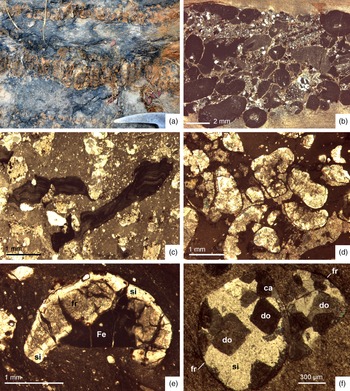
Some spotty outcrops of the Fuentepizarra Formation occur in the Ibor anticline (Fig. 1b). They reach up to 18 m in thickness and are unconformably overlain by the Armorican Quartzite. In contrast, the formation is well exposed in the eastern edge of the Alcudia anticline, where shales are up to 80 m thick and contain several phosphatic interbeds and ubiquitous disseminations (Fig. 6a). The green to ochre shales are fissile and contain fine quartz/feldspar silt, sericite, illite, elongate flakes of muscovite and other clay minerals. They exhibit few sedimentary structures, such as wavy and planar laminae, symmetric ripples and carbonate nodules parallel to stratification. Two kinds of phosphoritic (>18 wt % P2O5; Pufahl, Reference Pufahl, James and Dalrymple2010) interbeds can be distinguished: (i) thin (<2 mm), homogeneous crusts are made up of amorphous fluorapatite and occur interbedded in shales rich in phosphatic disseminations; and (ii) thicker (up to 30 cm thick), heterogeneous and polymictic lag deposits where a complex mixture of allochems is cemented with amorphous fluorapatite (Fig. 6b, c). Lags are interbedded with phosphatic limestone layers and nodules and shales, and display sharp upper and lower contacts. Phosphoritic and phosphatic limestone interbeds exhibit normal grading from packstone to mudstone rich in skeletons and extraclasts (up to 2 cm in size) embedded in a sparry mosaic of calcite. Allochems comprise silty to medium granule-sized particles composed of detrital and vein quartz, feldspar, chert, pyrite, rip-up shale, shells and reworked phosphatic intraclasts derived from both homogeneous and heterogeneous crusts. Shell material is mainly composed of abraded and fragmentary, calcite-walled conical and helicoidal microfossils (Fig. 6d, e), up to 1 cm long, in some cases telescoped. Shells occur as both isolated debris and embedded in composite (multiphase) clasts. The latter contain first-generation bioclasts and lithoclasts, accretionary mud-sized sediment and calcite and phosphate cements truncated at borders, indicating that at least parts of the seafloor were lithified. All these allochems are coated by single or multiple crusts of amorphous and microcrystalline fluorapatite. Interparticle pores are occluded by several generations of, in order of appearance, calcite/fluroapatite, dolomite and silica (Fig. 6f). Both the matrix and the different phases of erosion and reworking recorded in the composite clasts reflect successive repetitions of the same cement phases (Álvaro et al. Reference Álvaro, Shields, Ahlberg, Jensen and Palacios2016).
Field aspect and thin-section photomicrographs of the Anabarella-bearing phosphoritic and phosphatic limestone interbeds from the Fuentepizarra Formation in the eastern edge of the Alcudia anticline. (a) Two brownish phosphoritic interbeds in a monotonous greenish shaly succession. Length of hammer head for scale is 5 cm (b) Distal tempestite, about 1 cm thick, composed of imbricated, sub-rounded phosphatic clasts encased in a silty matrix. (c) Phosphatic limestone bed with two angular clasts composed of phosphatic crusts. (d) Packstone rich in Anabarella helicoidal shells (partly phosphatized) with intraparticulate and shelter porosity occluded with partly silicified drusy calcite cements; cements used as polarity criteria allows interpretation of polyphase clasts. (e) Detail of an Anabarella microfossil highlighting the partial silicification (si) of a phosphatic (fr) shell and the final infill of cracks by iron oxyhydroxides (Fe). (f) Detail of another Anabarella shell displaying the setting of dolomite (do) rhombs unaffected by silicification. Abbreviation: ca – calcite.

The phosphatic levels represent significant concentration pulses of fluroapatite generated by repeated alternations of low sedimentation rates and condensation, leading to hardground formation, in situ early diagenetic phosphogenesis, winnowing by wave- and storm-induced currents, and reworking of previously phosphatized skeletons and hardground-derived clasts. The succession of repeated cycles of sedimentation, phosphate concentration and reworking led to (i) multi-event phosphate deposits rich in allochthonous particles; and (ii) successive repetitions of porosity occlusion by calcite/apatite, dolomite and silica.
4. Palaeogeographic features
The erosive surface that marks the base of the San Lorenzo Formation rests unconformably, by paraconformable to angular discordant contacts, on top of different formations ranging from the Ibor Group to the Lower Alcudian – Domo Extremeño Supergroup. Remnants of the incised basement occur as clasts in the sandstones and conglomerates of the San Lorenzo Formation. Correlation between the San Lorenzo logs points to the extreme variability of sedimentary features (e.g. grain size, compositional and textural maturity) and thickness of the formation over short distances reflecting sealing of variable palaeotopographies. Where the troughs were wider and more subsiding, the San Lorenzo Formation was thicker, displaying shoaling-upward cycles, with siliciclastic shoal complexes prograding toward different depocentres. Palaeocurrents display polymodal arrangements reflecting a low-angle tilted basement. However, this stratigraphic architecture presents abrupt changes both in space and time owing to the activation of normal synsedimentary faults, which controlled the location of scarps as well as sharp changes in thickness and facies. Discrete normal faults are generally difficult to map as continuous structures, sealed by the Lower Ordovician Purple Series and Armorican Quartzite formations and superimposed on the Cadomian folding (Fig. 2). However, the recognition of normal faults bearing epithermal influence can be inferred owing to the preservation of their hydrothermal veining feeding sub-rounded vein quartz clasts that infilled slope-related channels. The nature and grain size of sediment are closely controlled by both the nature of the eroded basement rocks and the feeding of quartz vein clasts derived from contemporaneous normal faults.
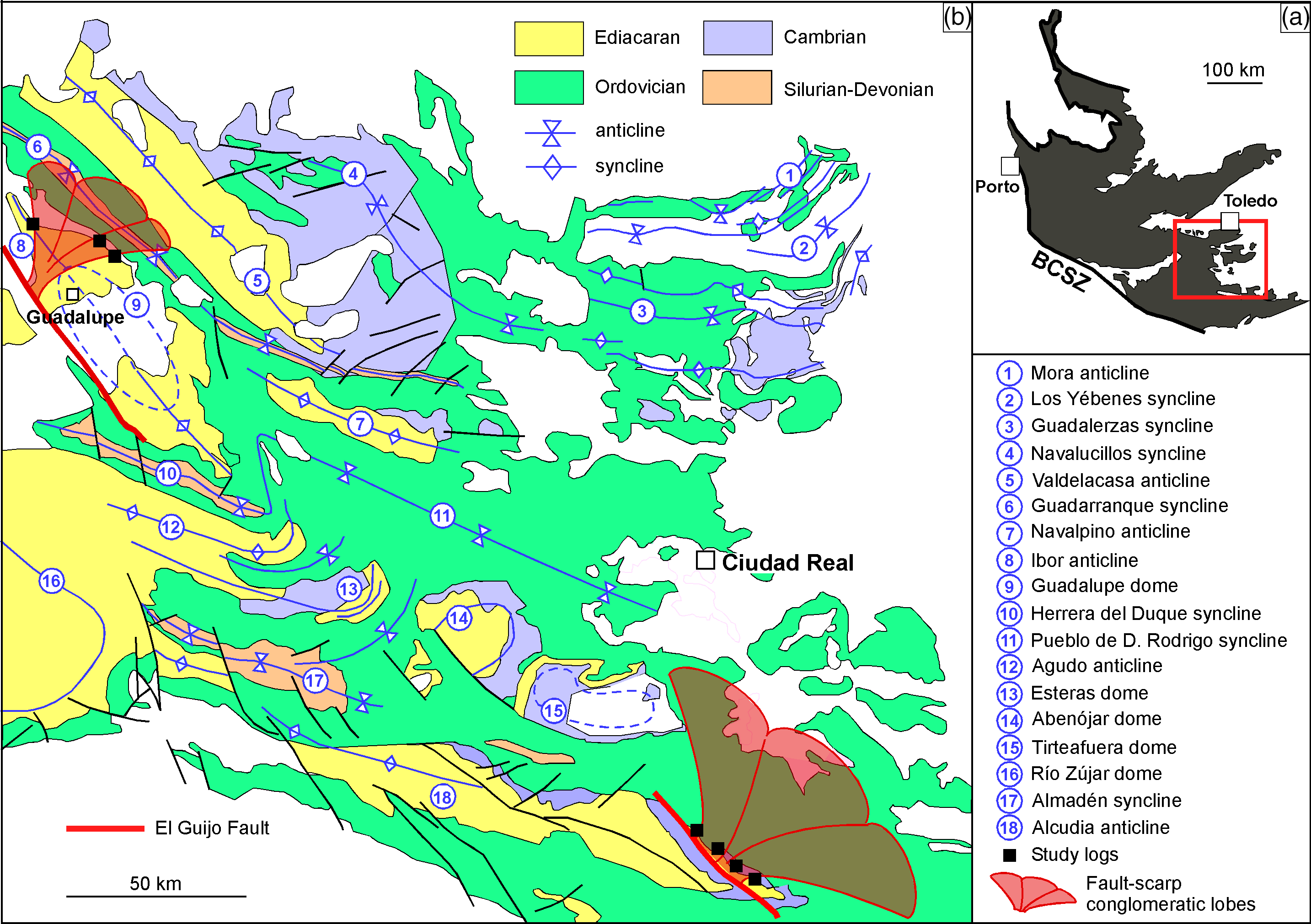
The basement scarps that controlled the record of slope-related channels are concentrated along an approximately NW–SE-trending belt, which has a mappable strike length of over 80 km (Fig. 7). The so-called El Guijo Fault (Palero, Reference Palero1993) separates two palaeogeographic domains (domains A and B sensu Ortega Girones et al. Reference Ortega Girones, Hernández Urroz and González Lodeiro1988), the nearest western part mainly characterized by unconformable Lower Alcudian – Domo Extremeño/megabreccia/Pusa contacts (so with reduced thicknesses, or simply absence, of the Ibor Group), and the nearest eastern part displaying tilted contacts of the former supergroup with either the Ibor Group or the San Lorenzo Formation (Lorenzo Álvarez & Solé, Reference Lorenzo Álvarez and Solé1988; Palero, Reference Palero1993). The pre-rift unconformity has been recognized throughout the whole Central Iberian Zone, where it marks both (i) the base of the chaotic megabreccias, olistostromes and mélange deposits that reflects the demise of Cadomian arc denudation (separating the Cíjara and Pusa formations; Álvaro et al. Reference Álvaro, Cortijo, Jensen, Lorenzo, Palacios and Pieren2019 and references therein); and (ii) a type 1 megasequence boundary that marks the IV/V facies associations contact in the Ciudad Rodrigo–Hurdes–Sierra de Gata domain (CRHSG; Ugidos et al. Reference Ugidos, Barba and Valladares2020 and references therein).
(a) Pre-Variscan outcrops (in black) of the Central Iberian Zone; Badajoz–Cordoba Shear Zone (BCSZ) marks its southwestern boundary. (b) Setting of the fault-scarp conglomeratic lobes described in the text, marking the pre-rift unconformity, in the Variscan anticline-to-syncline framework of the Central Iberian Zone (boxed in (a)); map based on Julivert et al. (Reference Julivert, Fontboté, Ribeiro and Conde1972), and El Guijo Fault path on Ortega Girones et al. (Reference Ortega Girones, Hernández Urroz and González Lodeiro1988) and Palero (Reference Palero1993).

Despite the importance of the intra-Fortunian extensional episodes, the earliest of which marks the pre-rift unconformity, a complete understanding of their precise nature and full extent over the Cadomian orogenic aftermath is still incomplete, owing to the generally poor field structural documentation and lack of direct geochronological constraints. As to the driving forces of such an important extensional episode, orogenic collapse seems the most likely first-order mechanism within the study area. Recently, Sánchez-García et al. (Reference Sánchez-García, Chichorro, Solá, Álvaro, Díez Montes, Bellido, Ribeiro, Quesada, Lopes, Dias da Silva, González-Clavijo, Gómez Barreiro, López-Carmona, Quesada and Oliveira2019) summarized three non-exclusive geodynamic models to explain the relatively sharp changes recorded in the Iberian margin of Gondwana from Cadomian subduction (latest evidence in Iberia at c. 533 Ma) to Cambrian rifting conditions (earliest evidence at c. 530 Ma) involving: (i) an oblique collision of a mid-ocean ridge with the trench located at the outer margin of West Gondwana that would have progressively transformed the former subduction margin into a transcurrent one (e.g. Murphy et al. Reference Murphy, Pisaresvsky, Nance and Keppie2004; Nance et al. Reference Nance, Gutiérrez-Alonso, Keppie, Linnemann, Murphy, Quesada, Strachan and Woodcock2012); (ii) a variation of the previous model adding a component of subduction of the mid-ocean ridge beneath the continental upper plate (e.g. Sánchez-García et al. Reference Sánchez-García, Bellido, Pereira, Chichorro, Quesada, Pin and Silva2010); and (iii) a process of slab-pull related to the onset of subduction triggering slab roll-back and back-arc rifting along the previous active margin (e.g. von Raumer et al. Reference von Raumer, Stampfli and Bussy2003; Stampfli & Borel, Reference Stampfli, Borel, Cavazza, Roure, Spakman, Stampfli and Ziegler2004). The beginning of rift conditions would be represented as well in the Central Iberian Zone by the mafic clasts that form the conglomerates of the San Lorenzo Formation (Fig. 5e). This kind of basic volcanism is absent in the underlying Lower Alcudian – Domo Extremeño Supergroup and Ibor Group of the study area, and mimics the intra-Fortunian tholeiitic rifting volcanism reported in the neighbouring Ossa-Morena Zone (Sánchez-García et al. Reference Sánchez-García, Chichorro, Solá, Álvaro, Díez Montes, Bellido, Ribeiro, Quesada, Lopes, Dias da Silva, González-Clavijo, Gómez Barreiro, López-Carmona, Quesada and Oliveira2019). The presence of upper Ediacaran–Terreneuvian volcanogenic rocks in the Central Iberian Zone has only been reported in the aforementioned CRHSG (Rodríguez-Alonso et al. Reference Rodríguez-Alonso, Peinado, López-Plaza, Franco, Carnicero and Gonzalo2004) (Fig. 1). These occur encased in laterally equivalent strata of the upper Ediacaran–Terreneuvian Ibor Group and the unconformably overlying Terreneuvian megabreccia beds and Terreneuvian–Cambrian Series 2 Pusa Formation (for a stratigraphic correlation, see Valladares et al. Reference Valladares, Barba, Ugidos, Colmenero and Armenteros2000; Ugidos et al. Reference Ugidos, Barba and Valladares2020). Their geochemical affinity displays a transition from calc-alkaline to tholeiitic-dominant affinities characterizing a transition from Cadomian arc to back-arc rifting conditions (Rodríguez-Alonso et al. Reference Rodríguez-Alonso, Peinado, López-Plaza, Franco, Carnicero and Gonzalo2004). The Terreneuvian volcanic activity recorded in the CRHSG represents the same beginning of rifting conditions in an inherited retro-arc basin.
Once the neighbouring Cadomian arc was peneplanized, the former back-arc basin underwent regional subsidence during end Fortunian times, causing both deepening of sedimentary environments (Fuentepizarra Formation) and flooding of areas previously emerged. Phosphogenesis was variable throughout the basin (see Álvaro et al. Reference Álvaro, Shields, Ahlberg, Jensen and Palacios2016). In the neighbouring Navalpino anticline, ore deposits of economic importance are represented by the Fontanarejo phosphorite Bed encased in the middle member of the Pusa Formation (Perconig et al. Reference Perconig, Vázquez, Velando, Leyva, Cook and Shergold1986; Gabaldón López et al. Reference Gabaldón López, Hernández Urroz, Lorenzo Álvarez, Picart Boira, Santamaría Casanovas, Solé Pont, Cook and Shergold1987; Picart, Reference Picart1988; Gabaldón López & Hernández Urroz, Reference Gabaldón López and Hernández Urroz1989; Santamaría, Reference Santamaría, Baldis and Aceñolaza1996). The richest phosphatic level (level Ic of Perconig et al. Reference Perconig, Vázquez, Velando, Leyva, Cook and Shergold1986) is largely confined to a NW–SE-trending, slope-related palaeochannel. Channel infill is dominated by homogeneous (amorphous to microcrystalline francolite) and polymictic clasts, phosphatized oncoids (up to 75 % in volume), with moderately sorted sericite, quartz and dolomite grains, and scattered hexactinellid sponge spicules (Reitner et al. Reference Reitner, Luo and Duda2012). As in the case of the Fuentepizarra phosphorites and phosphatic limestones, the Fontanarejo Bed is also characterized by partial silicification of the matrix and allochems, recognized as syntaxial overgrowths and subhedral to drusy mosaics infilling interparticle pores, and punctuating successive reworking and condensation processes (Álvaro et al. Reference Álvaro, Shields, Ahlberg, Jensen and Palacios2016). Silicification in the Fontanarejo Bed was so intense that it precludes extraction of microfossils by acid etching, which is not the case for the Fuentepizarra phosphates.
5. Conclusions
In the Ibor and Alcudia anticlines of the Central Iberian Zone, the Fortunian coarse-grained detrital units of the San Lorenzo Formation play an important role in deciphering the Cadomian aftermath of the Iberian margin in West Gondwana. During Fortunian times, the Cadomian retro-arc basin was affected by an orogen-scale collapse leading to the beginning of extensional conditions. The mapping of the Fortunian pre-rift unconformity and the petrographic nature of the recycled material are decisive for distinguishing between orogenic and rifting sediments. Sharp variations in thickness and facies and the polymodal character of the palaeocurrents reflect a lateral continuum of depocentres surrounded by topographic palaeohighs controlled by fault systems. Collapse-generated extension produced adjacent, slightly to highly rotated fault-blocks, which triggered the coeval deposition of pebbly conglomerates locally derived from vein erosion. Finally, the transgressive San Lorenzo–Fuentepizarra package buried and onlapped an eroded and sculptured palaeorelief. The two channelized palaeoreliefs described above display NE-directed palaeocurrent axes, and reflect the influence of a major synsedimentary normal fault, previously mapped as the El Guijo Fault. Both channels, up to 25 km wide and 150 m deep, represent the same pre-rift unconformity and are intra-Fortunian in age based on ichno- and microfossil controls.
Acknowledgements
The authors appreciate the constructive revisions made by Ulf Linnemann and an anonymous referee, and the editing proposals made by Sören Jensen, which helped to improve many ideas expressed earlier in the text. This paper is a contribution to projects CGL2017-87631-P from the Spanish Ministry of Science and Innovation and IGCP 683.