Introduction
In this paper we provide a preliminary species list, quantitative data on vegetation structure, and a description of plant associations and their soils for the San Pastor Savanna, a large isolated savanna area in Belize.
In the tropics savannas cover approximately 40% of the land area (Furley, Reference Furley1999), with more than 2 million km2 of the Neotropics dominated by this formation (Mistry, Reference Mistry2000). Apart from tropical forests they are the most ecologically dominant formation in the Neotropics. However, they suffer from great anthropogenic pressure, particularly through agricultural development (Alho & Souza Martins, Reference Alho and Souza Martins1995; Ratter et al., Reference Ratter, Ribeiro and Bridgewater1997). Within Central America and the Caribbean, extensive areas of savanna occur in Belize, Mexico, Honduras, Nicaragua, southwest Panama and central and eastern Cuba.
Savannas comprise 3077 km2 or 13.4% of the territory of Belize, and are the second largest natural biome after broadleaf forests (Meerman & Sabido, Reference Meerman and Sabido2001). An overview of the history of the classification of Belizean savannas is provided by Bridgewater et al. (Reference Bridgewater, Ibáñez, Ratter and Furley2002). The currently accepted Belize Ecosystems Map recognises four types of lowland needle-leaved forest, three types of submontane needle-leaved forest and two types of lowland savanna as existing within the territory (Meerman & Sabido, Reference Meerman and Sabido2001). Classification distinctions have been made primarily on altitudinal and structural differences. For the purposes of this paper the ‘needle-leaved forests’ as defined by Meerman & Sabido (Reference Meerman and Sabido2001) are considered to be a structurally dense form of savanna. For the most part their species composition is similar. In addition, the needle-leaved forests have an incomplete canopy with the herbaceous layer dominated by grasses and sedges. This is typical of savannas. Broadleaf forests lack such a grassy layer due to the shade produced by a near-complete canopy layer.
Pine (Pinus spp.), palmetto (Acoelorraphe wrightii (Griseb. & H.Wendl.) H.Wendl. ex Becc.), craboo (Byrsonima crassifolia Footnote 1), sandpaper tree (Curatella americana L.), Melastomataceae spp. and oak (Quercus oleoides Schltdl. & Cham.) are usually amongst the most structurally conspicuous non-herbaceous elements. Many savanna areas are hyperseasonal (Sarmiento, Reference Sarmiento1984), or experience prolonged flooding during the wet season, and periods of drought in the dry season.
There has been considerable confusion regarding Belize’s pines – in particular the correct name of those found at higher elevations. In the Flora of British Honduras, Standley & Record (Reference Standley and Record1936) list two species of pine as present: Pinus caribaea and P. oocarpa Schiede ex Schltdl. The former was distinguished in its longer and more slender foliage than the latter, with needles in bunches of 3–5 instead of 2–3. Standley & Steyermark (Reference Standley, Steyermark, Standley and Steyermark1958), in the Flora of Guatemala, list Pinus tecunumanii as a synonym of P. oocarpa. Four years later Thorpe & Stoddart (Reference Thorpe and Stoddart1962) suggest that in Belize, Pinus caribaea is the dominant pine below 2000 ft (600 m), with P. oocarpa var. ochoterenae Martínez dominant at higher altitudes, a view shared by Johnson & Chaffey (Reference Johnson and Chaffey1973). However, more recently, Farjon & Styles (Reference Farjon and Styles1997) have claimed that all of the pines in Belize described as Pinus oocarpa are P. tecunumanii, although in the recently published Checklist of Belize (Balick et al., Reference Balick, Nee and Atha2000) only P. caribaea var. hondurensis (Sénécl.) W.H.G.Barrett & Golfari and P. oocarpa are listed, with P. tecunumanii believed to be misapplied. A discussion on the pine species of San Pastor is provided later in this paper.
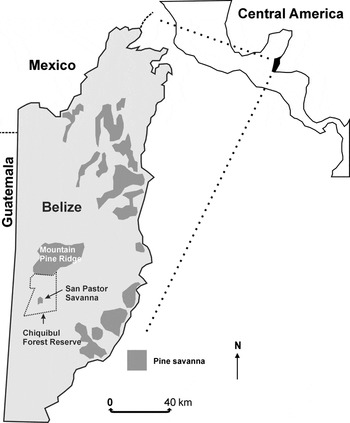
Lowland savannas (< 500 m altitude) occur throughout Belize. Some of the largest lowland savanna areas occur on the narrow coastal plain in Toledo and Stann Creek Districts, flanking the Western Highway between Belize City and Belmopan, around Northern Lagoon and Southern Lagoon, and in the vicinity of Crooked Tree, the Rio Bravo and inland from Maskall (Fig. 1). As a general rule they tend to occur on Quaternary (or earlier) deposited parent materials eroded from the Maya Mountains, or, particularly in northern Belize, from marine deposits left from retreating shorelines. Their soils are generally deep, acidic, of low fertility and coarse textured. They usually have a relatively well-developed woody component, although in some areas trees and shrubs are largely absent. Pine-dominated savannas also occur in upland areas, with the largest expanse (560 km2) occurring above the Palaeozoic granites and metamorphics of the Mountain Pine Ridge of central Belize.
The location of the San Pastor Savanna and distribution of savanna within Belize.

Various theories attempt to explain the occurrence of savannas, with Beard (Reference Beard1953) providing one of the first historical overviews of this field of study. These variously invoke climate (e.g. Nix, Reference Nix and Bourlière1983; Da Silveira Lobo Sternberg, Reference Da Silveira Lobo Sternberg2001; Hutyra et al., Reference Hutyra, Munger, Nobre, Saleska, Vieira and Wofsy2005), fire (see for instance Thorpe & Stoddart, Reference Thorpe and Stoddart1962; Taylor, Reference Taylor1963; Kellman, Reference Kellman1985) and soil factors (Furley, Reference Furley1974a, Reference Furley1974b, Reference Furley1976; Kellman, Reference Kellman1985), including topography and soil drainage, as being critical factors in maintaining this vegetation formation.
Despite covering 13.4% of Belize’s territory, the savanna flora remains very poorly described, and there is little knowledge of internal β-diversity patterns to assist in conservation planning. For the most part research has focused on the ecology of savannas – in particular those of the Mountain Pine Ridge – in an attempt to develop an understanding of the extent to which specific environmental factors, such as soil nutrient retention and fire, influence this ecosystem (e.g. Kellman, Reference Kellman1979; Kellman & Tackaberry, Reference Kellman and Tackaberry1993; Pither & Kellman, Reference Pither and Kellman2002). However, very few detailed floristic surveys have been published, although those that have been undertaken (Bridgewater et al., Reference Bridgewater, Ibáñez, Ratter and Furley2002; Laughlin, Reference Laughlin2002; Farruggia et al., Reference Farruggia, Stevens and Vincent2008) indicate that the formation is rich in plant species and supports endemics. A single survey of a small area of savanna and related ecosystems in the north of Belize, for example, found them to contain 7% of the Belizean flora (Bridgewater et al., Reference Bridgewater, Ibáñez, Ratter and Furley2002). In addition, Lenthall et al. (Reference Lenthal, Bridgewater and Furley1999) found the savannas of southern Mexico, Petén and Belize to be floristically distinct from other regional savanna areas.
Research Area
The current study focuses on the San Pastor Savanna (16°45′N, 89°00′W; 680 m), a large isolated area of submontane pine-dominated savanna (400 hectares) situated within the Chiquibul Forest Reserve and located in the heart of the Greater Mayan Mountains (Penn et al., Reference Penn, Sutton and Monro2004). This area of savanna has been variously classified as oak–pine forest by Wright et al. (Reference Wright, Romney, Arbuckle and Vial1959), needle-leafed hill forest over poor soil (Iremonger & Brokaw, Reference Iremonger and Brokaw1995), tropical evergreen seasonal needle-leaved submontane forest (Meerman & Sabido, Reference Meerman and Sabido2001) and open savanna with Pinus oocarpa (Penn et al., Reference Penn, Sutton and Monro2004). The Chiquibul Forest Reserve covers 59,822 hectares and forms a portion of the Chiquibul/Maya Mountain Key Biodiversity Area, which is recognised as a priority region for conservation by Conservation International (2004). A recent publication on the flora of the Chiquibul (Bridgewater et al., Reference Bridgewater, Harris, Whitefoord, Monro, Penn and Sutton2006a) highlighted several areas that are largely undescribed, with the San Pastor Savanna considered a priority for further investigation. The closest savanna to the San Pastor Savanna is the Mountain Pine Ridge, although this lies approximately 20 km to the north. Much of the bedrock of the Chiquibul Forest Reserve is metamorphic of sedimentary origin formed during the Palaeozoic era, although the western part of the Chiquibul is largely overlain by limestone deposited when it was submerged during the Jurassic and Cretaceous eras (Bateson & Hall, Reference Bateson and Hall1977). The climate of the region is strongly seasonal, with a marked dry season between February and June. Categorised as subtropical to tropical (Wright et al., Reference Wright, Romney, Arbuckle and Vial1959), the temperature varies between 16°C and 32°C with annual precipitation of about 1500 mm (Johnson & Chaffey, Reference Johnson and Chaffey1973; Meerman & Sabido, Reference Meerman and Sabido2001).
Methodology
The San Pastor Savanna was surveyed for a four-week period from 4 May to 5 June 2007, coinciding with the end of the dry season. The Point Centre Quarter (PCQ) method was used to gain structural data on the woody component of the savanna (Van de Vijver et al., Reference Van de Vijver, Foley and Olff1999). Through wide-patrolling, three clearly distinct structural savanna forms were identified and a single PCQ subjectively placed in the centre of each of these relatively homogeneous formations. Due to the differing structural nature of the vegetation types with two ecosystems dominated by small trees, different minimum diameters at breast height (dbh) were selected for the transects. Only trees with a minimum dbh of ≥ 3 cm were included for Transects 1 and 2, whilst the inclusion diameter for Transect 3 was ≥ 10 cm. The data from the three transects were processed using the methods outlined by Mitchell (Reference Mitchell2007). In addition, general collecting was undertaken in the vicinity of the transects and across the whole savanna area. The five duplicates of each collection are deposited at the Royal Botanic Garden Edinburgh (E), Forest Department, Ministry of Natural Resources, Belmopan, Belize (BRH), the Natural History Museum, London (BM), the Missouri Botanical Garden (MO) and Universidad Nacional Autónoma de México (MEXU).
To identify with certainty the species of Pinus present, needle cross-sections were made from all Pinus specimens collected in the region. The needles were rehydrated in a soapy-water solution for a period of 12–36 hours and sliced horizontally to a width of < 1 mm. Cross-sections were then mounted onto microscope slides using lactophenol cotton blue and examined using a Leica compound microscope at ×500 magnification. To provide supplementary floristic information an analysis was made of historical herbarium specimens collected within the San Pastor Savanna housed at the Missouri Botanical Garden, the Natural History Museum, London, the Royal Botanic Garden Edinburgh, the New York Botanical Garden and the Belize Forest Department.
Soil pits were dug and soil profiles described from each of the three vegetation types observed within the San Pastor Savanna. Where possible the demarcation of the master horizons for each profile followed that outlined by the FAO (1988) with the exception that the H horizon is incorporated in the O horizon, and the E horizon is not separated out. Thus, only the O, A and B master horizons were identified as a preliminary guide to the edaphic conditions. Soil colour was assigned using the Munsell (Reference Munsell1994) colour chart with horizons differentiated by colour, the degree of gleying, texture, visible moisture levels and the presence of organic matter. Without analytic data, the profiles have been ascribed provisionally into FAO–UNESCO soil units; the definitions need to be confirmed with future studies.
During the course of the fieldwork it became evident that the savanna area had been altered by human use. Through field observations, semi-structured interviews with key informants from the Las Cuevas Research Station (N. Bol, pers. comm.) and the Belize Forest Department (P. Cho, pers. comm.), and from an analysis of historical literature, a history of savanna use was constructed and an assessment made of the factors currently threatening this ecosystem.
Results
Floristic results
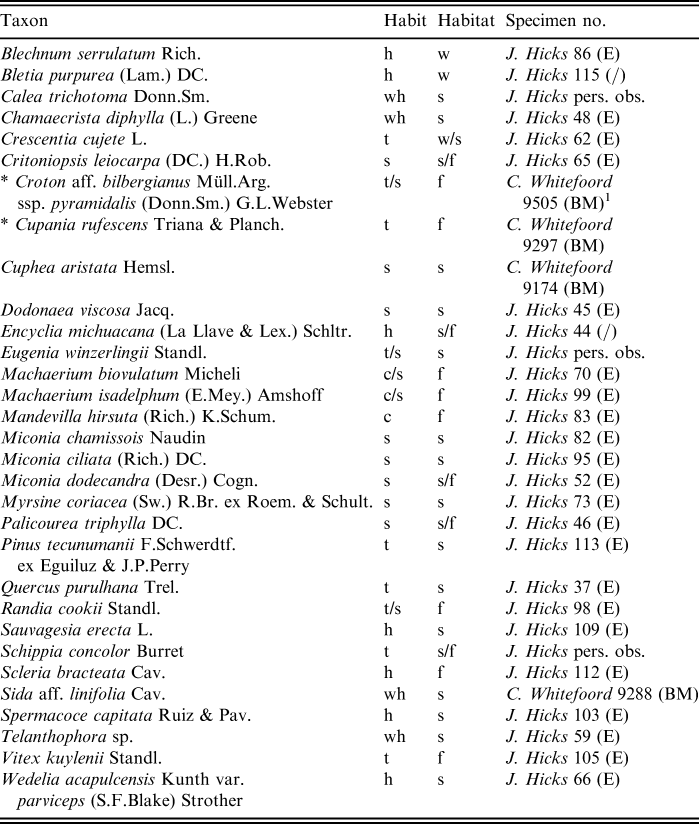
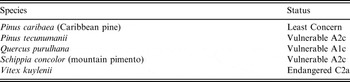
A total of 126 species of vascular plants are recorded here for the San Pastor Savanna with notes on growth form and habitat (Appendix 1). A list of the 28 species believed to be new records for the Chiquibul (not published in Bridgewater et al., Reference Bridgewater, Harris, Whitefoord, Monro, Penn and Sutton2006a) and one new record for the country, Randia cookii Standl., is provided in Table 1. Family delimitation follows APG II (Angiosperm Phylogeny Group, 2003), and generic delimitation follows the Angiosperm Phylogeny website (Stevens, Reference Stevens2008). A total of 78 trees and shrubs, 33 herbs and woody herbs and 15 climbers are included. This represents c.9% of the known Chiquibul vascular plant flora (Bridgewater et al., Reference Bridgewater, Harris, Whitefoord, Monro, Penn and Sutton2006a) and just under 4% of the total Belizean vascular flora as recognised by Balick et al. (Reference Balick, Nee and Atha2000). Of the 41 species of plants known to be endemic to Belize (Balick et al., Reference Balick, Nee and Atha2000), one has been recorded within the San Pastor Savanna, Schippia concolor (Arecaceae; J. Hicks, pers. obs.). In addition five species recorded at the San Pastor Savanna are listed in the 2009 IUCN Red List of Threatened Species (Table 2) (IUCN, 2009).
Species new to the Chiquibul Forest Reserve collected in the San Pastor Savanna. Additional species new to the Chiquibul Forest Reserve but not collected within the San Pastor Savanna are marked with *. For explanation of habit and habitat codes see Appendix 1
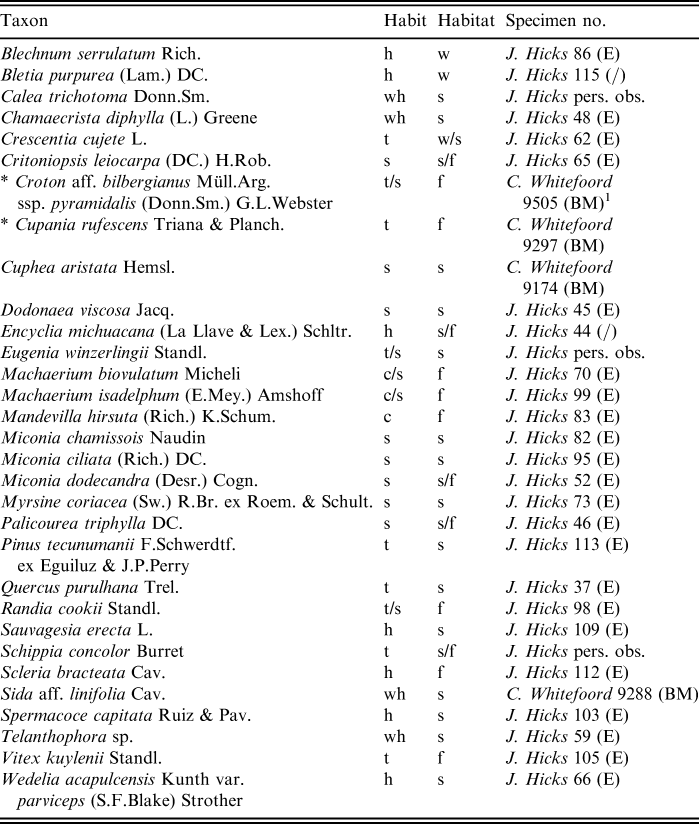
1 Determined as Croton aff. pyramidalis Donn.Sm.
Species on the 2009 IUCN Red List of Threatened Species (IUCN, 2009) recorded from the San Pastor Savanna

The pine species of San Pastor
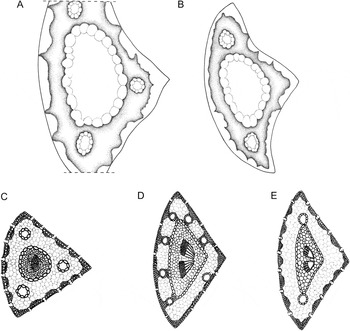
Work by Farjon & Styles (Reference Farjon and Styles1997) indicates that the position and number of resin ducts is a diagnostic character for the Central American Pinus species. When compared with the plates published by Farjon & Styles (Reference Farjon and Styles1997), the positions of the resin ducts in the needle cross-sections of the Pinus species from the San Pastor Savanna presented in Fig. 2 clearly show that two species are present: Pinus tecunumanii and P. caribaea var. caribaea.
Needle cross-sections of Pinus taxa. A, Hicks 113; B, Hicks 114; C, D & E modified from Farjon & Styles (Reference Farjon and Styles1997): C, Pinus tecunumanii F.Schwerdtf. ex Eguiluz & J.P.Perry; D, Pinus oocarpa Schiede ex Schltdl. var. oocarpa; E, Pinus caribaea Morelet var. caribaea.

Vegetation classification
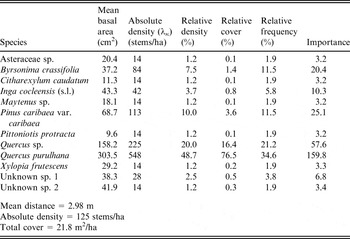
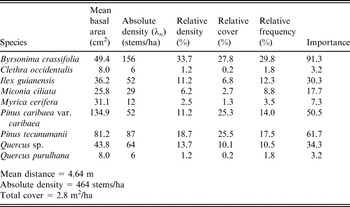
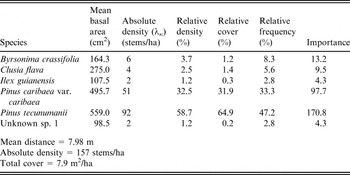
Based on physiognomy and dominant tree species three distinct vegetation types were observed within the San Pastor Savanna. These do not include the dissecting gallery or surrounding transitional broadleaf forests which have been described by Meerman & Sabido (Reference Meerman and Sabido2001) and Bridgewater et al. (Reference Bridgewater, Harris, Whitefoord, Monro, Penn and Sutton2006a). The vegetation types identified comprise (i) the main vegetation type, defined as Pine Savanna, (ii) a distinctly swampy area, defined as Savanna Swamp, and (iii) Quercus-dominated woodland fringing the north and south sides of the savanna, defined as Fringing Oak Woodland. Although there were subtle variations within each of these primary vegetation categories, these were deemed insufficient to warrant further subdivisions. Below is a summary of the three vegetation types, listing their respective percentage coverage across the San Pastor Savanna together with their dominant species. From the six soil pits dug throughout the San Pastor Savanna, three main soil types were observed corresponding to the three distinct vegetation types, and these are also described below. Phytosociological data from the transects are presented in Table 3. PCQ Transect 1 – Fringing Oak Woodland PCQ Transect 2 – Pine Savanna PCQ Transect 3 – Pine Savanna


Pine Savanna
This comprises the largest vegetation type for the San Pastor Savanna. It is dominated by Pinus tecunumanii and P. caribaea var. caribaea with Byrsonima crassifolia providing an important additional structural component. Other common woody associates include Crescentia cujete, Clethra occidentalis, Calliandra houstoniana, Lacistema aggregatum, Myrica cerifera, Miconia spp. and Citharexylum caudatum. The canopy cover and height ranges dramatically from very sparse with average tree height of 5 m, to a partially closed canopy with an average height of 10 m. The structurally developed areas were almost exclusively dominated by Pinus tecunumanii and P. caribaea var. caribaea. The herbaceous layer of this vegetation type ranges from 180 to 240 cm high, although it frequently reaches 300–450 cm high when dominated by very dense monodominant stands of dumbcane (Tripsacum latifolium). Tiger fern (Dicranopteris pectinata) also dominates the understorey.
Soil type: Provisional classification: Acrisol. The soil colour and texture were relatively constant within each of the three soil pits dug within the Pine Savanna, although depths varied slightly.
Horizon 1. O and A: Organic (O) horizon; thin, ranging from 0.5 to 1.5 cm in depth; dry to very dry; not well decomposed at all three of the soil pit locations. The A horizon varied in depth from 10 to 35 cm, as did the colour, ranging from yellowish brown (Munsell 10Y 5/6 – 5Y 5/8) to light grey (Munsell 10Y 7/1 – 10Y 7/2). For all soil pits the A horizon was comprised of sandy to silt loam; slightly damp; moderate root inclusion; moderate structure; small pores; firm to hard consistency.
Horizon 2. B: (Illuvial); approximately 10–45 cm in depth, yellowish brown to light grey (Munsell 10Y 5/6 to 10Y 7/1, respectively) with more than 20% red to dark yellowish brown mottles (Munsell 5R 3/6 to 7/1 – 10YR 4/6); damp; dense clay; few fine roots; weak structure; very small pores; hard to very hard, sticky consistency. Further depth was not investigated as a result of time constraints and compaction of the lower horizons.
Overall, the soils are typically deep, well drained for most of the year, usually coarse textured above an argillic subsurface, and of low fertility.
Savanna Swamp
Arboreal species are absent within this vegetation type although several shrub species are present including Critoniopsis leiocarpa, Miconia chamissois, Ludwigia peruviana and Solanum jamaicense. The dominant herbs are Blechnum serrulatum, Gynerium sagittatum, and to a lesser extent Costus pulverulentus and Heliconia sp. Although Tripsacum latifolium is present in this vegetation type, it is never dominant. This vegetation type with its mixture of forest and wetland species does not fit any marsh or wetland vegetation types previously described, such as by Bridgewater et al. (Reference Bridgewater, Ibáñez, Ratter and Furley2002).
Soil type: Provisional classification: Phaeozem. This ecosystem had a distinctively different soil type and visibly higher moisture levels than those recorded within the Pine Savanna and Fringing Oak Woodland.
Horizon 1. O and A: Organic (O) horizon 10 cm; herbaceous peat; high root inclusions. A horizon over 15 cm; constant dark brown colour (Munsell 10YR 3/3); cohesive peat; very damp; abundant fine roots; moderate structure; moderate pores; soft consistency.
Horizon 2. B: Although digging to well over 1 m, the bottom of the B horizon was not reached, so its depth can only be described as over 60 cm; yellowish brown (Munsell YR 5/6) and brown (Munsell YR 3/6) with between 2 and 20% mottles; peaty clay loam; very damp to wet; weakly moderate structure; small pores; soft consistency. This soil was very wet to the point that once the pit was dug, and images and notes collected, water had begun to pool in the bottom of the pit.
Overall, the soils are typically hydromorphic, with highly organic surface horizons, mostly coarse textured but exhibiting marked gleying in the subsurface with limited horizon development.
Fringing Oak Woodland
This savanna–forest transitional ecosystem occurs in long, narrow bands at both the northerly and southerly limits of the San Pastor Savanna. It is characterised by a high density of Quercus purulhana. The height of the closed to partially closed canopy ranges from 10 to 15 m. This appears to be an ecotone between the savanna and the surrounding broadleaf forest areas.
Soil type: Provisional classification: Cambisol. Interestingly, this soil type was present at every sampled location (approximately 20) throughout the Fringing Oak Woodland vegetation type at either end of the San Pastor Savanna.
Horizon 1. O and A: Organic (O) horizon 8 cm deep (12–15 cm on slopes), peaty, dominated by partially decomposed Quercus sp. foliage. The A horizon ranged from 30 to 40 cm; very pale brown to brownish yellow colour (Munsell 10YR 7/3 – 10YR 6/6); sandy gravel with little clay content; moderate fine and medium roots but with very high stone and gravel inclusions; weak structure; large pores; very weak consistency; very freely drained.
Horizon 2. B: Very weak horizon development from subsurface parent material. The soil appears to have developed in a residuum derived from sandstone or coarse-textured sedimentary and metamorphic rocks (Palaeozoic: Santa Rosa Group; Bateson & Hall, Reference Bateson and Hall1977).
Overall, the soils are poorly developed, organic but very coarse textured throughout the profile.
Human use
Two main threats to the area’s biodiversity were observed during the research period. These comprise insect damage and subsistence hunting. Approximately 40–60% of all Pinus individuals in the San Pastor Savanna were dead, with some pockets reaching 100% mortality, having been attacked and killed by insects. Numerous trunks from dead trees were examined and insect exit holes were observed in almost all the trees that still had bark. The attacks are by the pine beetles Dendroctonus spp. and Ips spp. which catastrophically damaged the Mountain Pine Ridge in 2001–2002 (Billings & Schmidtke, Reference Billings and Schmidtke2002).
Although there are no permanent legal settlements within the Chiquibul Forest Reserve, the extraction of Non-Timber Forest Products (NTFPs) within the reserve involves the creation of temporary camps and subsistence hunting. At present, the most significant NTFP activity is the illegal extraction of xaté (Chamaedorea spp.) leaf to supply the floricultural industry (Bridgewater et al., Reference Bridgewater, Pickles, Garwood, Penn, Bateman and Morgan2006b). Five camps were located around the perimeter of the San Pastor Savanna. Animal traps were present in two of these.
Discussion
Vegetation classification
Although they take different methodological approaches and use different terminologies, the four historical classifications and associated species lists published for the San Pastor Savanna (Wright et al., Reference Wright, Romney, Arbuckle and Vial1959; Iremonger & Brokaw, Reference Iremonger and Brokaw1995; Meerman & Sabido, Reference Meerman and Sabido2001; Penn et al., Reference Penn, Sutton and Monro2004) have been found to be largely accurate. However, the present study has substantially increased the floristic information available for the area. Meerman & Sabido’s (Reference Meerman and Sabido2001) classification of the area as Tropical evergreen seasonal needle-leaf submontane forest forms a valuable framework. However, being a nationwide study with limited ground-truthing, their classification terms are necessarily broad. As such, their classification of the San Pastor Savanna as a single vegetation formation considered to be identical with the northwest portion of the Mountain Pine Ridge does not adequately describe the variation of vegetation types within the San Pastor Savanna. In particular, no mention is made of the characteristic fringing oak woodland within the region, although this is most likely an ecotonal formation.
Floristics and regional affinities
The known San Pastor Savanna vascular plant flora consists of 126 species (119 angiosperm and 7 non-angiosperm species) in 55 families with 99 genera. The majority of those species (94%) are angiosperms. Approximately 38% (48) of the species of the San Pastor Savanna flora are classic dry savanna habitat species whilst 42% (53) are considered to be forest elements and 6.4% (8) are species preferring wetter savanna habitats and marshland. The San Pastor flora is also dominated by woody species, with trees and shrubs composing 62% (78) of the flora; 52% (25) of the dry savanna species are woody compared with 22% of ‘true savanna’ species described as woody at the Rio Bravo (Bridgewater et al., Reference Bridgewater, Ibáñez, Ratter and Furley2002).
Provisional floristic checklists have been published for only three savanna areas in Belize: the Monkey Bay Wildlife Sanctuary (MBWS) (Laughlin, Reference Laughlin2002), the Rio Bravo Conservation and Management Area (RBCMA) (Bridgewater et al., Reference Bridgewater, Ibáñez, Ratter and Furley2002) and Sapodilla Lagoon (Farruggia et al., Reference Farruggia, Stevens and Vincent2008), the last survey being of a periodically flooded hyperseasonal coastal savanna. These were relatively limited in scope and so we can assume that even if they were combined they would not represent a comprehensive checklist for all Belizean savannas. Nonetheless they represent the best floristic information currently available. The three previous surveys recorded between 200 and 250 vascular plant species each (MBWS, 198; RBCMA, 258; Sapodilla Lagoon, 201). This indicates that the present survey, finding only 126 species, may not have captured all the species diversity present within the San Pastor Savanna area. However, the near monodominance of tiger fern and dumbcane over large areas of the ground flora (due to human and natural disturbance) will undoubtedly have reduced its diversity. Under-representation may also be due to the survey period missing ephemeral flowering times, and the fact that families such as Xyridaceae and Lentibulariaceae, recorded from the other sites, may simply be absent due to the lack of suitable open, damp habitats at the San Pastor Savanna.
A floristic comparison of the 126 taxa identified for the San Pastor Savanna with those previously published surveys reveals 19, 35 and 27 taxa as being in common with MBWS, RBCMA and Sapodilla Lagoon, respectively. Those species in common are primarily well-known neotropical savanna and ecological generalists and include Byrsonima crassifolia and Crescentia cujete. Most of the San Pastor Savanna taxa (76; 60%) are not listed for the three other savannas. Many of these can be considered to be more typical of broadleaf forest. However, strong affinities certainly exist with the pine-dominated savannas of the Mountain Pine Ridge. Although the Mountain Pine Ridge has been relatively well collected, no detailed floristic list for the savannas exists. A priority for further study is a detailed characterisation of the pine-dominated ecosystems of this formation. Although not all of the other authors provide data from detailed soil analyses, their descriptions generally correspond with those of the San Pastor Savanna.
San Pastor Savanna physiognomy
Data from the PCQ transects are listed in Table 3. Pinus caribaea var. caribaea and Byrsonima crassifolia were the most widespread species, occurring in all three transects. Together with Pinus tecunumanii they comprise the dominant woody species of the area, although P. tecunumanii was absent from the Fringing Oak Woodland transect. The diversity of trees of all the San Pastor Savanna systems is poor when compared with the surrounding broadleaf forest, with the highest number of tree species recorded per PCQ being 12 in the Fringing Oak Woodland. The higher tree diversity of this system is not surprising considering its transitional nature and the presence of both typical savanna and typical forest species. By far the most dominant species within the Fringing Oak Woodland is Quercus purulhana, with an importance value of 159.8. Quercus purulhana and a second unidentified Quercus sp. together constituted 68.7% of the relative density, 92.9% of the relative cover and 55.8% of the relative frequency of all species. The presence of oak woodlands associated with savanna–forest boundaries has been noted elsewhere for Belize (Bridgewater et al., Reference Bridgewater, Ibáñez, Ratter and Furley2002), and oak-dominated thickets are common throughout the Mountain Pine Ridge. This transect also demonstrated a much higher absolute density of trees (1125 trees ≥ 3 cm) when compared with the San Pastor Pine Savanna (464 trees ≥ 3 cm). The tree density of the San Pastor Pine Savanna based on the transect data was 157 trees/ha (≥ 10 cm dbh), although in part this reflects the larger diameter class included. The density of trees in Belizean savannas varies greatly depending most notably on the fire regime and logging history. Studies have revealed densities varying from 167 trees/ha (Hillbank savannas; Bridgewater et al., Reference Bridgewater, Ibáñez, Ratter and Furley2002) to 1313 trees/ha (Spanish Lookout; Furley & Ratter, Reference Furley, Ratter and Munro1986).
San Pastor Savanna soils
Little information previously existed on the soils underlying the San Pastor Savanna, except for the statements that this savanna is mainly restricted to areas of poor, shallow soils originating from the surrounding Palaeozoic rock (Penn et al., Reference Penn, Sutton and Monro2004) and the soils are pale reddish or pinkish brown over sandy clay and well drained (Meerman & Sabido, Reference Meerman and Sabido2001). It is highly likely that soils of the San Pastor Savanna are derived from erosional deposits from the metamorphic rocks making up the Maya Divide. From the pedological observations, the soils of the Pine Savanna are provisionally classified as Acrisols (FAO, 1988). The soil profiles are however gleyed, characterised by high levels of mottling in the subsurface. This suggests that the Pine Savanna is subject to extreme seasonality, i.e. it becomes waterlogged during the wet season with free drainage in the coarse-textured soils during the dry season. The soils of the Fringing Oak Woodland seem to represent a transitional formation between those of the San Pastor Savanna and the more calcareous, limestone-derived and more fertile soils typical of the surrounding forest.
Together with climate and soils, fire is known to be important in the maintenance of savannas. Although no fire-scarred tree trunks or charcoal and/or ash presence were observed at the time of the study, charcoal was present in the B horizon at soil pit 1, suggesting that the San Pastor Savanna system is periodically fire-impacted. In addition, the great expanses of near-monodominant swathes of tiger fern may be indicative of burning, with this species commonly being associated with fire-impacted areas (Meerman & Sabido, Reference Meerman and Sabido2001). The most common cause of fires in the Chiquibul and Mountain Pine Ridge region is thought to be lightning strikes (Meerman & Sabido, Reference Meerman and Sabido2001).
Anthropogenic impacts
The widespread death of pine trees in the San Pastor Savanna is almost certainly related to the pine beetle attack which devastated extensive areas of pine stands of the Mountain Pine Ridge between 2000 and 2001. A review of the causes of this attack (including drought), and a taxonomic assessment of the beetle species primarily responsible (Dendroctonus spp.), is provided by Billings & Schmidtke (Reference Billings and Schmidtke2002) and Midtgaard & Thunes (Reference Midtgaard and Thunes2003). However, the San Pastor Savanna is 20 km from the Mountain Pine Ridge and Dendroctonus is known to be unable to fly more than 700 m. Thus it is probable that the San Pastor Savanna became infected by beetles transferred into the area by loggers who were working in the San Pastor Savanna at that time (P. Cho, pers. comm.). Although the broadleaf forest surrounding the San Pastor Savanna has long been logged for timber species such as mahogany (Swietenia macrophylla King), cedar (Cedrela odorata L.) and Santa Maria (Calophyllum brasiliense), no records exist for the extent of pine extraction. However, this is believed to have been extensive during the period 2000 to 2002, and tree stumps are frequent across the savanna area.
What makes the San Pastor Savanna unique within the Chiquibul Forest Reserve is that it is the only large area of savanna vegetation within the reserve. Regionally, one of the greatest ecological impacts on the forest has been the extraction of xaté. The San Pastor Savanna is significant to local xatero activity because one of its dominant herbs – Tripsacum latifolium – is relatively rare in the Chiquibul, except for disturbed areas such as river floodplains. This species provides an ideal source of forage for the horses used by xateros to transport Chamaedorea leaf across the border (N. Bol, pers. comm., 2007). The San Pastor Savanna’s remote situation in relatively close proximity (20 km) to the Guatemala border, and the year-round water supply found within localised caves and gallery forests, make it a perfect location for xatero base camps. This explains the existence of the five camps and presence of numerous trails dissecting the savanna. For example, the first author witnessed an estimated 60 loaded horses and accompanying xateros travelling east from the San Pastor Savanna into the Chiquibul forest during one day of his fieldwork. In addition to the impacts caused by grazing by the xatero horses, xateros are known to supplement their meagre diets through hunting. Protected species such as tapir (Tapirus bairdii [Gill 1865]), paca (Agouti paca [Linnaeus 1766]) and peccaries (Tayassu tajacu [Link 1795], T. pecari [Linnaeus 1758]) are widely targeted (Bridgewater et al., Reference Bridgewater, Pickles, Garwood, Penn, Bateman and Morgan2006b). There is concern within Belize that the demise of these protected animals may lead to an ‘empty forest’ sensu Redford (Reference Redford1992).
Conclusion
The San Pastor Savanna is a unique isolated formation within the Chiquibul Forest Reserve and Chiquibul National Park. It has clear affinities with other savanna areas within Belize, most notably with its nearest neighbour the Mountain Pine Ridge. Although it comprises part of the Chiquibul Forest Reserve and is thus protected, its inaccessible location makes frequent monitoring by the Forest Department problematic. It has a clear pivotal role in the xaté industry, an associated impact of which threatens regional wildlife. It is suggested that future logging concessionaires in the area are made aware of the dangers of transmitting pine beetles from the Mountain Pine Ridge and that appropriate actions are taken to prevent future infestations being spread to the San Pastor Savanna. In addition to the current contribution, only three published surveys of the savanna flora exist. A priority for future research is to conduct detailed inventories across Belize’s savanna landscape to provide the necessary baseline information to clarify patterns of diversity.
Acknowledgements
This work was supported by Darwin Initiative project No. 17022. Thanks are due to the staff of Las Cuevas Research Station and to Chris Minty for their invaluable support in the field, and to Caroline Whitefoord, Alex Monro, Jimmy Ratter, Gwilym Lewis, Nicholas Hind and Lulu Rico Arce for their vital assistance in plant identification. Figures 2A and 2B were drawn by Claire Banks from a photograph of a microscope slide. Figures 2C, 2D and 2E, by Rosemary Wise, are reproduced with permission of the publisher from Aljos Farjon and Brian T. Styles, Pinus (Pinaceae). Flora Neotropica Monograph 75, © 1997, The New York Botanical Garden Press, Bronx, New York.
All angiosperm plant families follow the Angiosperm Phylogeny website (Stevens, Reference Stevens2008), and all species names follow Balick et al. (Reference Balick, Nee and Atha2000) except where a name has since been updated.
Habit codes: c, climber; e, epiphyte; h, herb; s, shrub; t, tree; wh, woody herb.
Habitat codes: c, coast; f, forest; s, savanna; w, wetland.
* = Species not reported by Balick et al. (Reference Balick, Nee and Atha2000) for Belize.
† = Species not reported by Bridgewater et al. (Reference Bridgewater, Harris, Whitefoord, Monro, Penn and Sutton2006a) for the Chiquibul Forest Reserve.
§ = Species lacking inflorescence stage to further determine, but did not match any of the holdings at the Royal Botanic Gardens, Kew and, according to Asteraceae specialist Dr Nicholas Hind, most likely a species new to science.
(/) = Where a herbarium code is not cited no herbarium specimens were collected for that specimen and it is only known from an image.