

Introduction
To be able to predict accurately the impacts of global environmental change on grassland systems in Europe is vital for the elaboration of mitigation and adaptation strategies and for the implementation of food security policies. Modelling is an effective way to assess such impacts. The objective of this study is to use the SPACSYS model to predict global change effects on grassland production and to make consistent scenario-based projections of future grassland production on a site level.
Material and methods
In all, eight long-term (5 to 12 years of data) grassland sites were identified covering a gradient of geographic and climatic conditions and a variety of management practices: Grillenburg, Germany; Monte Bondone, Italy; Oensingen, Switzerland; Bonassai, Italy; Lempten, Germany; Lelystad, the Netherlands; Matta, Israel and Rothamsted, UK. The first three sites were equipped with an eddy covariance system measuring gross primary production (GPP) and ecosystem respiration (RECO).
Different scenarios for air temperature, precipitation and atmospheric CO2 concentration were produced based on historical climate data at the sites. The changes of temperature and precipitation from −25% to 25% of their standard deviations and of the atmospheric CO2 concentration from 5% to 100% of 380 ppm (taken as a baseline) with a 5% increment were used to generate the scenarios of the environmental changes.
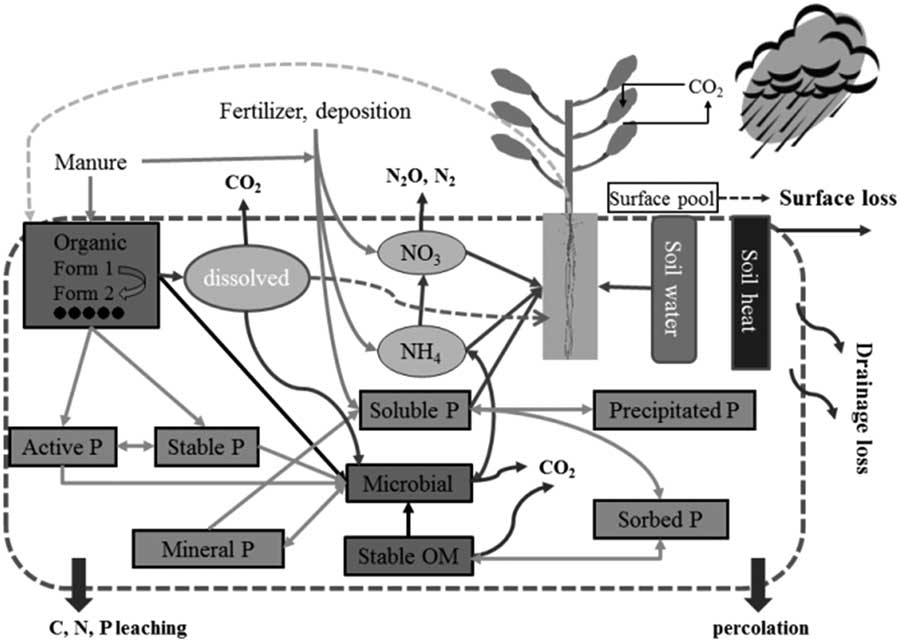
SPACSYS was employed to simulate grassland systems and investigate the sensitivity of simulated yields and other variables to increasing atmospheric CO2 concentrations and climate change in terms of temperature and precipitation. The model is a field scale, weather-driven and daily-time step dynamic simulation model (Wu et al., Reference Wu, McGechan, McRoberts, Baddeley and Watson2007 and Reference Wu, Bingham, Baddeley and Watson2009). It simulates plant growth and development, nitrogen, carbon and phosphorus cycling, soil water redistribution and heat transfer (Figure 1).
The framework of SPACSYS.

The model was validated with the data on cutting biomass, RECO, net ecosystem productivity (NEP), evapotranspiration rate (ET), soil temperature and soil moisture collected from the sites, and then a sensitivity test applied based on the scenarios. The change of one variable (temperature, precipitation or CO2) at a time only was considered in order to investigate single factor effects. The set of statistical methods suggested by Smith et al. (Reference Smith, Smith, Powlson, McGill, Arah, Chertov, Coleman, Franko, Frolking, Jenkinson, Jensen, Kelly, Klein-Gunnewiek, Komarov, Molina, Mueller, Parton, Thornley and Whitmore1997) was used to evaluate the performance of SPACSYS on the observed variables.
Results
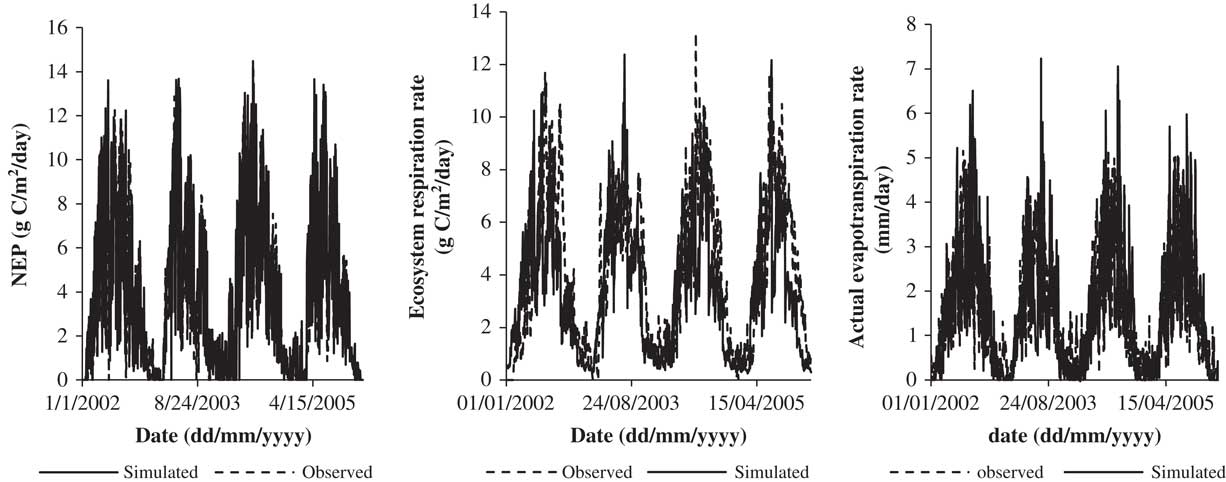
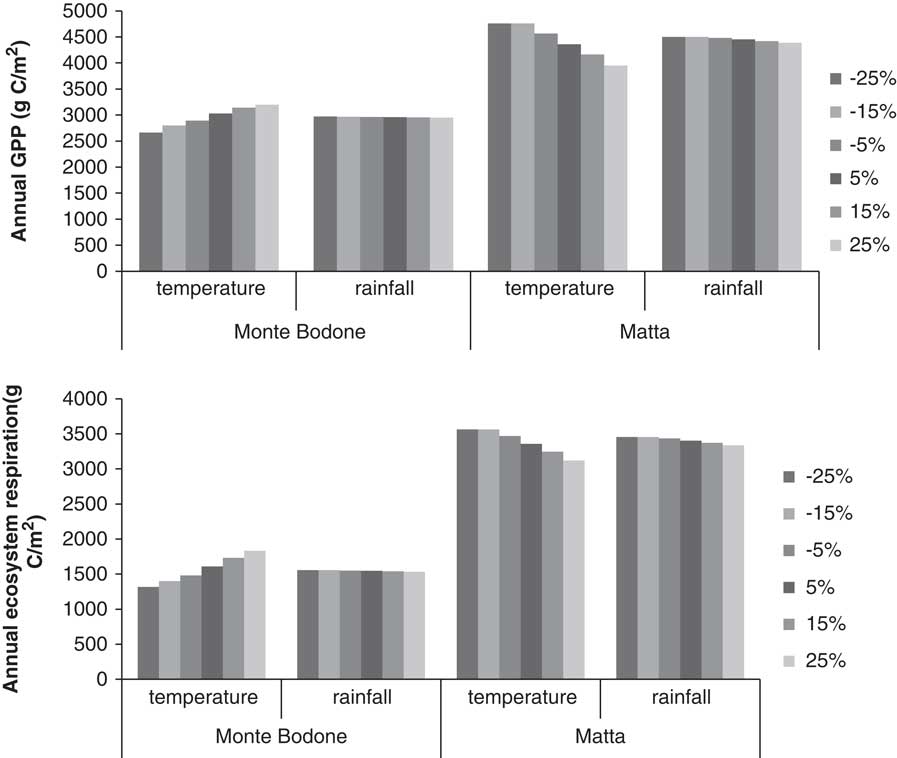
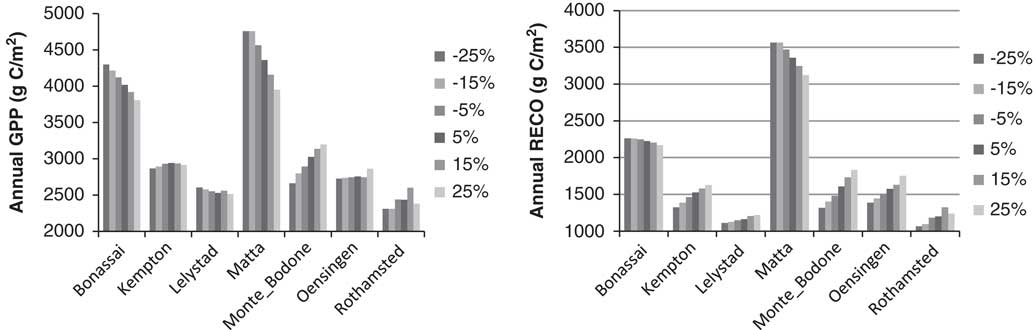
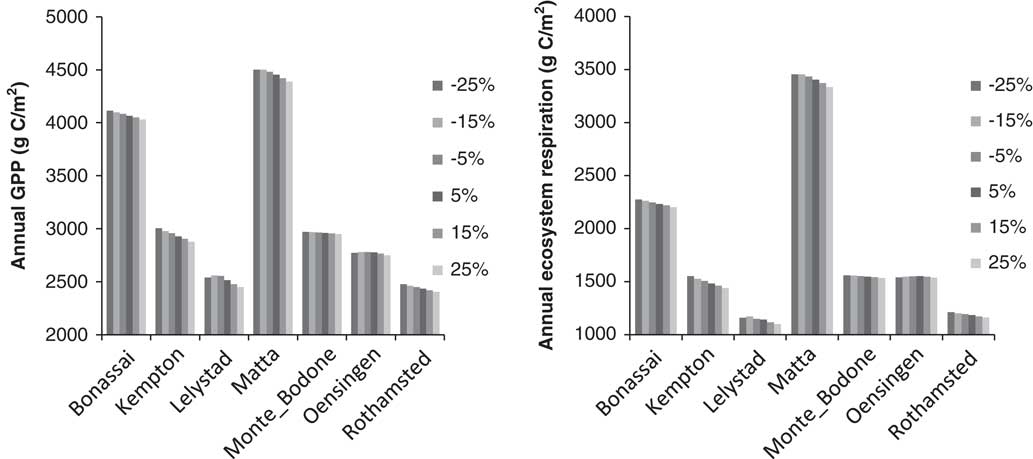
Simulations from SPACSYS showed good agreement with the observed data in NEP, RECO and ET (Figure 2). Statistical analysis also suggested that the simulations fit measured data reasonably well. Sensitivity analysis suggested that the response of simulated grassland variables to the changes in individual factors varied at a site (Figure 3). The response of simulated grassland variables to an individual factor varied at different locations (Figures 4 and 5).
Comparison of observed and simulated NEP (left), RECO (middle) and ET (right) at the Oensingen site. NEP=net ecosystem productivity; RECO=ecosystem respiration; ET=evapotranspiration rate.

Responses of average annual GPP and average annual ecosystem respiration at the Monte Bodone and Matta sites. GPP=gross primary production.

Responses of average annual GPP (left) and average annual ecosystem respiration (right) to the changes of air temperature at different sites. GPP=gross primary production.

Responses of average annual GPP (left) and average annual ecosystem respiration (right) to the changes of precipitation at different sites. GPP=gross primary production.

Acknowledgements
Rothamsted Research receives strategic funding support from Biotechnology and Biological Sciences Research Council. APW acknowledges funding from BBSRC as part of its contribution to the Joint Programming Initiative on Food And Climate Change (JPI-FACCE MACSUR Partner 65) grant reference number is BB/K008854/1.
Further information
The LiveM International Livestock Modelling and Research Colloquium was hosted by the Basque Centre for Climate Change (BC3) at the Maritime Museum in Bilbao, Spain between 14 and 16 October 2014. LiveM is the livestock and grassland modelling theme of the EU knowledge hub Modelling European Agriculture with Climate Change for Food Security (MACSUR). The MACSUR project is a pilot knowledge hub started by FACCE-JPI in 2012. It provides an opportunity to explore the role and potential of multi-disciplinary networking structures to address complex regional and global issues. More information on MACSUR and the LiveM theme can be found at www.macsur.eu, with PDFs of slides from conference presentations available through the conference website (http://www.livem2014bilbao.com/).