Increasingly universities are embracing a vocational orientation. The graduate attributes they set for their graduates to achieve align closely with the expectations of employers (Thomas & Day, Reference Thomas and Day2013). Yet we would expect that these attributes are covering the requirements of sustainable development, as is anticipated by governments and the international community (Department of the Environment, Water, Heritage and the Arts, 2009; UNESCO, 2010). This article, based on a survey of Australian employers, examines the extent to which sustainability connects higher education and employers’ interests.
We have a clear message from employers about the need for their employees to have capabilities in sustainability. A 2010 survey of over 760 United Nations Global Compact member CEOs indicated that, compared with 2007 when sustainability was identified as emerging on the periphery of business issues, sustainability had become ‘truly top of-mind for CEOs around the world’ (Lacy et al., Reference Lacy, Cooper, Hayward and Neuberger2010, p. 44). Further, 76% said it was important that companies should include sustainability objectives in employee performance assessment; and 49% said they already did this. As an example, one commented that ‘Future capabilities will be very different and will put a premium on lateral thinking and cross-functional, collaborative problem solving’ (Lacy et al., Reference Lacy, Cooper, Hayward and Neuberger2010, p. 44). In particular 88% of the respondents said it was very important or important for educational systems to develop mindsets and skills needed for future leaders to address sustainability, because 76% reported that performance on sustainability issues will be a very important or important differentiator in recruiting talent. A clear conclusion from the survey was that:
. . . CEOs see a critical need for business schools and education systems to focus on developing the next generation of managers and business leaders with the knowledge, skills, attitudes and behaviors to manage sustainability issues as an integral part of the way they think about business. (Lacy et al., Reference Lacy, Cooper, Hayward and Neuberger2010, p. 49)
Sustainability, or green, skills are being identified as requirements for an increasingly wide range of employees. As noted by the Department of Education, Employment and Workplace Relations (2011, p. 31):
Green skills, or skills for sustainability, are the professional and vocational skills, as well as the generic skills (such as sustainable approaches, innovation and problem solving) required for new green jobs and the greening of existing jobs across all industry sectors as a response to climate change and sustainability imperatives.
The department points out that new technologies and practices for a more sustainable world, embracing resource efficiency and waste reduction, will be needed. Hence, employees in a range of occupations, industries and sectors — not just to the trades — will need relevant skills; as examples they suggest this includes: lawyers, accountants and economists; planners, architects and engineers; business owners and operators; retailers, service providers and procurement managers; and primary producers. Specific skills have been identified by researchers. Summarising the findings of several studies from the 2000s, Willard et al. (Reference Willard, Wiedmeyer, Flint, Weedon, Woodward, Feldman and Edwards2010) reported a range, but noted that ‘communication skills were identified in more than one study, as was the ability to understand systems and to build the business case for sustainability’ (p. 11).
Graduate capabilities are potentially shaped and influenced by five key stakeholder groups: academics, professional bodies, employers, students and technology providers (Debuse & Lawley, Reference Debuse and Lawley2009). It is beyond our brief to examine the relations of all, but we have the opportunity to consider the relation between the worlds of academia and employment. In this context we need to consider the role of Higher Education (HE) institutions in educating people who will be both valued by organisations needing the capabilities noted above, and who will be able to bring ‘cutting edge’ insight to their employers. Through the following sections we will first consider the way in which HE institutions are engaging with capabilities and skills related to sustainability. Then we will report some results of an Australian survey of employers relating to their perceptions of the capabilities their employees will need. Finally, we will draw together these themes through a discussion of the connections between the needs of employers and how their employees, who have sustainability capabilities, can provide direction in sustainability matters.
Graduate Learning Outcomes
‘Graduate learning outcomes’ is a generic term for the range of words used to discuss the learning and related outcomes that are expected of HE graduates. This discussion introduces the complexity associated with both their description, or definition, and the associated terminology. In the literature and in related reports we find the terms ‘abilities’, ‘attributes’, ‘capabilities’, ‘competencies’ and ‘skills’ used to categorise the learning outcomes of higher education. As indicated below, the term ‘skill’ often has a vocational context, while over the past 2 decades, ‘attributes’ has been associated with universities; ‘competencies’ also has a vocational connection in Australia, but the connection is with HE in European countries; yet in the context of European qualifications, Méhaut and Winch (Reference Méhaut and Winch2012) discuss the complexities of the use of the terms ‘skills’ and ‘competencies’. In the following discussion of the literature we have retained the terms used by the authors. In later sections though, we use the term ‘capabilities’ to avoid the connotations just noted.
In the early 1990s, Gonczi (Reference Gonczi1994) noted that there was widespread involvement of the professions in discussions about competencies, but academics had been critical of being involved. He identified the following categories, or conceptions, of the nature of competence:
• task-based or behaviourist — competence is conceived of in terms of the discrete behaviours associated with the completion of specific, and detailed, tasks
• general attributes of the practitioner that are crucial to effective performance — this ‘approach concentrates on the underlying attributes, e.g. knowledge or critical thinking capacity, which provide the basis for transferable or more specific attributes’ (p. 29)
• combining the general attributes approach with their application — this conception considers ‘the complex combinations of attributes (knowledge, attitudes, values and skills) which are used to understand and function within the particular situation in which professionals find themselves’ (p. 29).
The latter understanding can be also found in the European competence discussion (e.g., Klieme, Hartig, & Rauch, Reference Klieme, Hartig, Rauch, Hartig, Klieme and Leutner2007) in which competencies are defined as ‘a roughly specialized system of abilities, proficiencies or skills’ (Weinert, Reference Weinert, Rychen and Salganik2001) that enable the individual to perform successfully in various complex situations. Dealing as they do with complex demands, they necessitate the interplay of a broad range of internal structures such as cognitive, emotional and motivational dispositions. Furthermore, the importance of certain ‘key’ competencies has been stressed, with the prefix ‘key’ standing for a qualitative extension that highlights the significance of certain competencies that are relevant across different spheres of life, and for all individuals. As such key competencies do not replace, but rather complement domain specific competencies (Rychen, Reference Rychen, Rychen and Salganik2003).
We also have the categorisations ‘generic’ skills, ‘core’ skills, ‘basic’ skills and sometimes ‘employability’ skills (Hager, & Holland, Reference Hager, Holland, Hager and Holland2006). These skills are in addition to the knowledge that an individual may need to perform in a particular situation. In the context of HE the term ‘graduate attributes’ has been used to cover the skills broadly sought by employers (Gilbert, Balatti, Turner, & Whitehouse, Reference Gilbert, Balatti, Turner and Whitehouse2004; Harvey, Reference Harvey2000). Barrie (Reference Barrie2006) comments that ‘“generic graduate attributes” have come to be accepted as being the skills, knowledge and abilities of university graduates, beyond disciplinary content knowledge, which are applicable in a range of contexts’ (p. 217). These attributes come from completing any undergraduate degree, and Hager and Holland (Reference Hager, Holland, Hager and Holland2006) note that they include:
thinking skills such as logical and analytical reasoning, problem solving and intellectual curiosity; effective communication skills, teamwork skill, and capacities to identify, access and manage knowledge and information; personal attributes such as imagination, creativity, and intellectual rigour; and values such as ethical practice, persistence, integrity, and tolerance. (p. 2)
Such attributes provide a basis for lifelong learning, and thereby provide the graduate with skills to deal with a range of situations and contexts.
Despite universities accepting the role of graduate attributes, Green, Hammer, and Star (Reference Green, Hammer and Star2008) note that their implementation within universities has been poor, because of conceptual confusion (e.g., over terminology) combined with diverse external pressures and internal management issues.
Speaking to a broad audience, the Australian Department of Education, Employment and Workplace Relations in its ‘Australian Jobs’ report used ‘skills’ as the term to discuss the needs of employers. Specifically:
Employability skills are non-technical or generic skills, such as communication, team work and problem solving, which contribute to (the employee's) ability to be an effective and successful participant in the workplace. They are sometimes referred to as key, core, life, essential, or soft skills. Unlike many technical skills, employability skills are transferable between jobs. (Department of Education, Employment and Workplace Relations, 2011, p. 30)
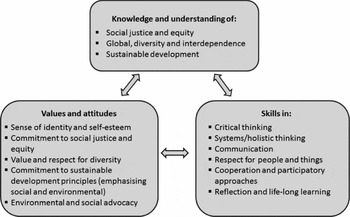
This report (Department of Education, Employment and Workplace Relations, 2011) noted that recent research of employers had identified that communication skills are one of the most important employability skills, but that such skills were most often lacking in job applicants. Employers also valued a range of learning relating to employability skills; these are noted in Figure 1 where an illustration of interconnections of skills, knowledge, understanding, values and attitudes categorises the range of employability skills.
Graduate capabilities associated with sustainability.

The need for such skills has been recognised in academia, with moves to identify the attributes that need to be developed through university programs. Since the mid-1990s employers have been reasonably clear about the generic skills that they wanted to see in their employees (Bowden & Masters, Reference Bowden and Masters1993, Department of Education, Employment and Workplace Relations, 2011); for example, literacy, teamwork, problem-solving and communication skills. As a consequence, Pitman and Broomhall (Reference Pitman and Broomhall2009, p. 440) note that university attributes came as the ‘response to a call from the business community for the post-compulsory education sector to produce graduates with contemporary, assessable and functional skills needed for the immediate and long-term economic benefit of the country’.
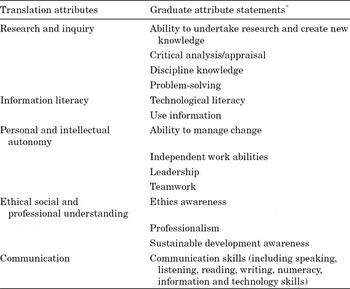
In the Australian context, related research (see Barrie, Reference Barrie2004, Reference Barrie2006) led to the development of a framework under the National Graduate Attribute Program (NGAP; Barrie, Andrews, Dean, & Heimanis, Reference Barrie, Andrews, Dean, Heimanis, Brown and Denton2010), which identified two levels of attribute statements. Translation attributes, with their associated graduate attribute statements (see Table 1), are those that assist the translation of university learning into other situations. Enabling attributes can be thought of as broader dispositions, covering: scholarship, global citizenship, and lifelong learning. They are the ‘aptitudes that lie at the heart of scholarly learning and knowledge’ (Barrie, Reference Barrie2006, p. 233) and which transform knowledge bases, and the individual.
Translation Attributes and Related Graduate Attribute Statements From the National Graduate Attribute Program

Note: * Associated with each statement are comments that provide detail and understanding of what is involved in the Statement. Source: Institute for Teaching and Learning, 2012.
While the translation attributes are generally the focus of interest of employers, we will see from the following sections that enabling attributes are also of interest to employers, and also connect to capabilities identified for sustainability.
Capabilities Associated With Sustainability
From the very beginning, the discussion of learning outcomes in education for sustainability (EfS) was closely related to the competence discourse. As sustainable development necessitates societal transformation and may only be realised by citizens capable of actively participating in societal decision-making, the importance of acquiring life skills is particularly emphasised (UNESCO, 2005). What is sought are learning outcomes of values, attitudes and behaviours alongside those of knowledge and skills. In contrast to purely instrumental approaches — often found in policy papers necessitating behaviour change and putting education as a ‘tool’ to facilitate this change (UNEP and Marrakech Task Force on Education for Sustainable Consumption, 2008) — a capability-oriented approach emphasises that complementary ways of learning with respective learning outcomes are required. On one hand, learning of a more instrumental nature is needed as a tool to promote skills and information to change behaviours, based on what is well known and agreed on at present. This learning relates to translation attributes (discussed previously). On the other hand, more empowering learning is the essential form of ‘building capacity to think critically about [and beyond] what experts say and to test sustainable development ideas’ (Vare & Scott, Reference Vare and Scott2007, p. 194) in the face of what is not adequately known and agreed on; equivalent to enabling attributes noted above.
It is the latter, emancipatory approach that figures prominently in the higher education for sustainability discourse (e.g., Burandt & Barth, Reference Burandt and Barth2010, Tilbury, Reference Tilbury, Corcoran and Wals2004). Aiming at future key agents for change, education for sustainability is about enabling students not only to acquire and generate knowledge, but also to reflect on further issues such as the complexity of behaviour and decisions in a future-oriented, global perspective of responsibility. Drawing on the work of researchers (e.g., Parkin et al., Reference Parkin, Johnson, Buckland and White2004, Shepherd, Reference Shephard2008) graduates specifically need to:
• know about sustainability issues
• have the skills to act sustainably if they wish to
• have the personal and emotional attributes that require them to behave sustainably.
The literature on EfS accordingly offers a number of approaches to frameworks that define the underlying cognitive and non-cognitive dispositions in greater or lesser detail. Wiek, Withycombe, and Redman (Reference Wiek, Withycombe and Redman2011) synthesised a framework for sustainability research and problem-solving capacity consisting of five key capabilities that show how such an approach can be used to inform work in the sustainability context. Critically, the framework helps to design and revise academic programs in general, and to formulate more specific learning outcomes in specific learning settings.
These directions are in keeping with the thinking of other researchers. They, more specifically see that sustainability related capabilities include but are not limited to:
• systems, critical, holistic and interdisciplinary thinking (Burandt & Barth, Reference Burandt and Barth2010; Sterling, & Thomas, Reference Sterling and Thomas2006; Sandri, Reference Sandri, Hegarty, Chambers and Beringer2011)
• affective outcomes such as values, ethics, attitudes and behaviour; for example, social justice and equity (Shephard, Reference Shephard2008; Sterling & Thomas, Reference Sterling and Thomas2006)
• big-picture’ (world) perspective (Barth & Rieckmann, Reference Barth and Rieckmann2009; Sterling & Thomas, Reference Sterling and Thomas2006)
• participatory decision-making and action (Hurlimann, Reference Hurlimann2009; Tilbury, Reference Tilbury, Corcoran and Wals2004);
• environmental advocacy and involvement in action (Jickling, Reference Jickling2003; Sterling & Thomas, Reference Sterling and Thomas2006)
• knowledge and information management (Sterling, & Thomas, Reference Sterling and Thomas2006; Hurlimann, Reference Hurlimann2009)
• critical reflection (Tilbury, Reference Tilbury, Corcoran and Wals2004; Holdsworth, Bekessy, Hayles, Mnguni, & Thomas, Reference Holdsworth, Bekessy, Hayles, Mnguni, Thomas, Filho and Carpenter2006).
All these approaches have in common that they not only focus on gaining knowledge, but the ability to act in a meaningful way (Barth & Michelsen, Reference Barth and Michelsen2013; Wals, Reference Wals2010).
Surveying Employers
In late 2010 we undertook a survey, the aim of which was to identify graduate capabilities most valued by employers. The survey also sought data about sustainability issues in respective industries and graduate capabilities associated with them. The survey was undertaken through Surveymonkey, an online survey tool. Referring to the discourse on capabilities associated with sustainability, we compiled a list of important aspects that provided the basis of our survey for seeing if employers consider these capabilities to be necessary for employees (see Figure 1). As with this type of survey the results are reliant on respondents interpreting the questions, and wording, in a consistent way, and that they report their opinions accurately. Ideally, such a survey would provide the base for follow-up interviews to check this and to gain understanding of the participants’ thinking behind their responses; however, resources were not available.
Just over 90 professional associations with an Australian focus were identified as having networks in which the survey could be promoted. In addition, 160 companies and organisations were identified by: being identified as an Australian company that actively recruited; or identified as a major organisation within the industry sector being researched. All organisations were contacted by telephone, followed by an email containing basic information about the project and a link to the survey. The communications took place with nominated Human Resources personnel responsible for the recruitment and management of staff, or the line managers of graduates.
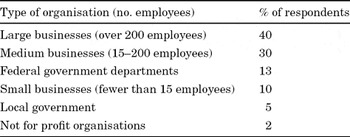
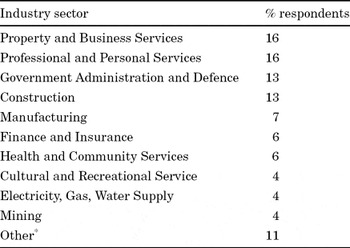
The survey was open for 3 weeks and 65 responses (25% response rate) were received, representing a range of organisation types (see Table 2) and industry sectors (see Table 3).
Organisation Types Represented

Industry Sectors Represented

Other includes: Consulting, Vertically Integrated, Engineering and Planning, Energy, IT, Oil and Gas, Auditing.
The graduates recruited took up positions in a variety of areas/specialisations/disciplines. While more than one category could be noted, the most noted were:
• Engineering: civil, environmental and chemical (49%)
• Finance and economics (32%)
• Engineering: aerospace, mechanical (28%)
• Business management and IT (23%)
• Property, construction and project management (23%).
Questions were also asked about sustainability activity in the organisation. Of the 39 responding to this section (of the initial 65), 15 said they had sustainability dedicated personnel. A follow-up question on the number of sustainability staff solicited 22 responses and of these a sustainability staff complement of:
• 0–2 was noted by 55%
• 3–5 was noted by 23%
• 6–10 noted by 9%
• 11–20 reported by 9%
• more than 20 by 4%.
The activities undertaken by the specialist sustainability staff included public relations, education and management of staff, management of projects, development of policy, implementation of practices, and strategic planning and recruitment.
Reported Capabilities
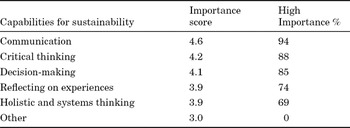
Survey participants were asked about the importance of specific knowledge, particular skills, and general capabilities. For each of the three categories, participants were presented with a list that had been derived from the literature where capabilities had been discussed. For each item they were asked to indicate if it was either: very important, important, good to have, less important, or not important. For analysis, the responses were weighted, with a score of 5 being allocated to very important, through to 1 for not important. The weighted responses were aggregated and divided by the number of responses for the item, to derive an ‘importance score’.
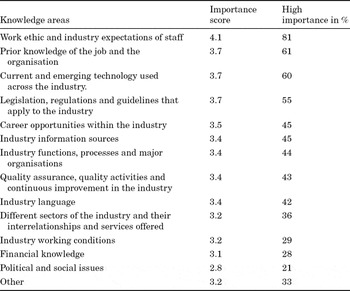
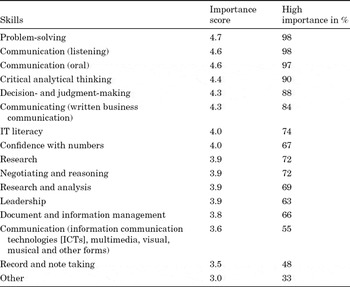
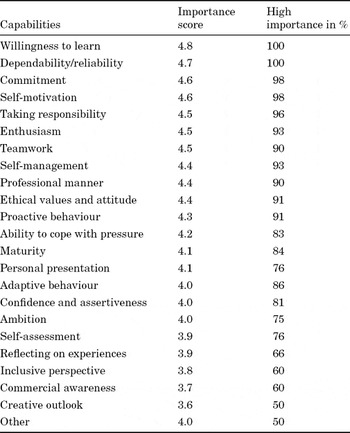
The results for specific knowledge areas, particular skills, and general capabilities are presented in Tables 4, 5 and 6, respectively.
Importance of Knowledge Areas

Note: High importance in % = percentage responding Very important + percentage responding Important. Data have been sorted by Importance score and sometimes minor discrepancies with High important are suggested, due to rounding up of the results. Other, with only two responses, included: Safety knowledge; Work experience in a similar discipline; Specific ‘content’ knowledge to practise in their profession/discipline; Alignment with values of the business.
Importance of Skills

Note: High importance in % = percentage responding Very important + percentage responding Important. Data have been sorted by Importance score and sometimes minor discrepancies with High important are suggested, due to rounding up of the results. Other, with only two responses, included: Open mind to receiving instruction/guidance; At least 3 months of work placements; Collaboration planning and organisation skills.
Importance of Capabilities

Note: High importance in % = percentage responding Very important + percentage responding Important. Data have been sorted by Importance score and sometimes minor discrepancies with High important are suggested, due to rounding up of the results. Other, with only two responses, included: Making it happen — drive, determination; time management with strong work ethic and resilience.
General Knowledge Requirements
Respondents clearly indicated the importance of work ethic and industry expectations of staff (Importance score 4.1). Knowledge relevant to the industry (about technology, legislation) and relevant to particular organisation were next most important. Given the importance that is placed on economics in business and government generally, it is surprising that financial knowledge was considered relatively unimportant. The low rank given political and social issues may suggest that either the respondents’ organisations had little contact or interest in these matters, or that respondents were thinking about junior staff when completing the survey (assuming these issues often would be the province of higher management).
General Skill Requirements
Almost unanimously respondents considered problem solving skills to be highly important (Importance score 4.7), and only very slightly less importance was placed on communication skills (listening and oral); while the three skills, critical analytical thinking, decision and judgment making, and communication (written) were reported to be somewhat less important they were all of relatively higher importance than any knowledge areas (Table 3). With the exception of record and note taking, all the listed skills were considered to be of high importance by more than 50% of the respondents.
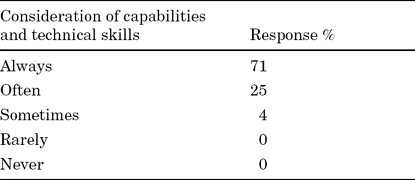
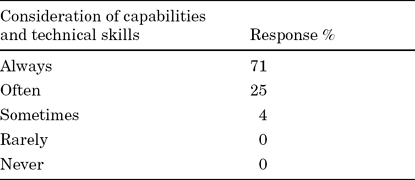
When asked how often these skills are assessed alongside technical skills in the recruitment process, the majority of respondents (71%) stated ‘always’.
General Capabilities Requirements
As with skills, there was almost unanimous agreement amongst respondents over four capabilities. Respondents considered willingness to learn, dependability/reliability, commitment and self-motivation to be highly important. The importance of all the capabilities to the respondents is indicated by them being considered to be of high importance by 50% or more. In the context of the dominance of economic matters, that ethical values and attitude are considered substantially more important than commercial awareness is noteworthy.
The relative importance of the broader capabilities is indicated by how often applicants’ broad capabilities are taken into account alongside their technical abilities when they are assessed for a position. The results presented in Table 7 clearly show that both are important; however, the survey question was not precise enough to determine if one was considered much more important.
Consideration of Broad Capabilities Alongside Technical Abilities for Assessing Applicants
Sustainability Capabilities
The final section of the survey focused on capabilities that were considered relevant to employees to work successfully as professionals involved with sustainability. Given the ambiguity that is associated the term ‘sustainability’, it was not defined in the survey, but was left to the participants to interpret.
To position the relative importance of sustainability in the organisations, or activities of the participants, they were initially asked ‘How important is it for graduates to have a sound knowledge of sustainability issues and requirements?’ At this point, the number of respondents dropped to 49, suggesting that roughly 25% of our sample felt that sustainability was not a consideration for their organisations. Those who responded reported knowledge of sustainability was:
• very important — 25%
• important — 36%
• good to have — 33%
• less important — 4%
• not important — 2%.
The (sustainability) skills needed to work with this knowledge were identified; these and their relative importance are reported in Table 8. In comparing these responses to those for skills generally (Table 5), strong similarities can be seen. The exception is the identification of skills associated with holistic thinking. This has been noted as important in the context of sustainability education (see discussion above) and the data shows it is important for employers, but less so than other broad skills. Likewise in relation to sustainability education, critical reflection has been noted and is also recognised by the respondents.
Skills for Sustainability

Note: Other: Divergent thinking to enable innovative (sustainable) solutions.
To ascertain if the participants could see connections between broad and sustainability capabilities in their industry, they were asked to verify that statement. For the 40 who responded, they were equally divided between 20 seeing connections and 20 not doing so.
Associated with those working in the environment and sustainability field has been personal interest (e.g., see Thomas & Nicita, Reference Thomas and Nicita2003). Our respondents also felt that those working in the field should have aligned attitudes. Participants were invited to indicate as many attitudinal indicators as appropriate, and (of the 49 responding) they identified that is was important for employees to be:
• able to exercise mutual respect and understanding — 73% (of the 49)
• able to exercise compassion and act responsibly — 57%
• willing to balance individual rights and interests with that of the community as a whole — 55%
• willing to contribute to the ‘common good’ — 51%
• self-aware in a global context — 43%
• advocates for improving the sustainability of the environment — 41%
• advocates for sustainable consumption practices — 33%
• (4% indicated none of the above).
As a conclusion, participants were asked how well they thought universities were performing in equipping graduates with suitable sustainability skills and knowledge. The following responses from 38 indicated that there is room for optimism in universities:
• very well — 5.3%
• well — 36.8%
• OK — 50.0%
• poor — 7.9%
• very poor — 0%.
Some respondents provided thoughts on how they felt universities could better prepare graduates. Although one commented that there was not a clear need to prepare graduates with special ‘sustainability’ capability, to improve the situation other respondents commented:
• ‘There is too much emphasis on academic results, practical approaches need to be introduced into all campus activities.’
• ‘Universities need to engage with business.’
• ‘University could be more than just the technical skills and teaching self-awareness and the ability for people to contribute as a team member.’
• ‘Give students understanding that sustainability is about balancing environmental, social, and economical interests.’
• ‘. . . provide more “hands on” experience rather than an all “academic” experience’.
In general these points align closely with the capabilities identified in the literature regarding EfS.
Discussion
With the limited resources available for the research, obtaining a representative sample of employers was always going to be problematic. Considering the potential range of employers associated with the organisations we contacted, having only 65 participating in the survey was disappointing, but not surprising. Even so, the variety of organisations and industries was sufficient to indicate that our results would provide an overview of thinking across Australia.
The data collected in the first part of the survey relating to employment generally shows the relative importance of knowledge, skills and broad capabilities. Several knowledge areas were considered to be of varying importance (Table 4), but most, like the highest scoring ‘work ethic and industry expectations of staff’ were associated with broad issues across an industry, and were not related to specific technical knowledge; with the possible exception of ‘legislation, regulations and guidelines’.
The range of skills commented on was similarly broad, and the three most important (e.g., ‘problem-solving’; see Table 5) were very strongly supported. Further, the vast majority of the listed skills were considered to be of high importance by more than 50% of the respondents. In comparison with knowledge areas, skills were ranked more highly, with the top third all being of relatively higher importance than any knowledge area. This greater interest in skills is consistent with some comments made about how universities could better prepare graduates, and with the messages coming from the literature (discussed above), for example the identification of translation attributes and enabling attributes.
Looking at the category of capabilities (Table 6), more were responded to than knowledge (Table 4) or skills (Table 5). Importantly, roughly half were very strongly supported. Considering the high importance results for the three categories, the results for capabilities demonstrates that employers consider these broad capabilities to be much more important than knowledge areas, and somewhat more important than skills. Further, the literature, and comments by respondents about better preparation of graduates, both indicate the importance of broad capabilities. Likewise, the data in Table 7 regarding the parallel consideration given to broad capabilities and technical abilities for assessing applicants again points to the importance of broad capabilities.
Turning to employment related to sustainability, around three quarters of our participants contributed responses related to sustainability. These responses demonstrated that some 60% of the respondents with a sustainability interest considered knowledge about sustainability to be highly important. They also identified skills employees would need (Table 8), and which were very similar to the most important skills for employment generally (Table 5). In addition, they saw that attitudes such as being able to exercise mutual respect and understanding were important. Interestingly, the three most important indicators relate to social and interpersonal matters, such as being able to exercise compassion and act responsibly, rather than a focus on the principles of sustainability. Again, these findings are compatible with the analysis of researchers such as Hurlimann (Reference Hurlimann2009), Jickling (Reference Jickling2003), Shephard (Reference Shephard2008), Sterling and Thomas (Reference Sterling and Thomas2006), and Tilbury (Reference Tilbury, Corcoran and Wals2004).
Of specific relevance to educators in the university sector is that the respondents thought universities were doing a reasonable job in preparing graduates for sustainability-related positions. This contrasts with reports of the progress of education for sustainable development (or for sustainability) reported elsewhere (e.g., Global University Network for Innovation, 2011; Lang, Thomas, & Wilson, Reference Lang, Thomas and Wilson2006). Even so, some respondents noted a need for universities to provide more emphasis on the development of general capabilities rather than focus on knowledge.
To overcome this deficit, Australian universities have developed graduate attributes (discussed above), yet their implementation and incorporation into curricular has been difficult (de la Harpe, & Radloff, Reference de la Harpe and Radloff2006). However, implementation of attributes represents a significant change in universities, and we must recognise how difficult implementation of change can be (de la Harpe & Thomas, Reference de la Harpe and Thomas2009), especially when the process of curriculum change is compounded by a range of factors where the academics are only one part (de la Harpe & Thomas, Reference de la Harpe and Thomas2009). So it is perhaps not surprising that a noticeable proportion of the respondents felt that graduates were still not well prepared for industry positions.
Reflections and Directions
In discussing a hierarchy of capabilities related to sustainability, Sterling and Thomas (Reference Sterling and Thomas2006) have noted that groupings of capabilities may be understood to be: of a basic nature, that is, ‘awareness’ of sustainability (sustainable development); become more complex to develop ‘process’ capabilities (to drive change); then develop capabilities for ‘integration’ (holistic thinking and action). They also see the need for a fourth level of capabilities, that is, ‘transformative’, where students and graduates operate as critically reflective practitioners of sustainable development. In essence, this level of capabilities allows employees to reflect on their own practice and to critically assess the broadly accepted ways of thinking about environment, society and economy.
From this and related work, we see that in academia there has been an evolving discussion about what constitutes EfS and what its outcomes for graduates should be. At the same time we see that industry has identified key capabilities that are sought in employees. While across industry sectors these capabilities may not be identified as being of specific relevance to sustainability, there is considerable similarity. Many industry representatives identify sustainability as an important aspect of their activities, yet those that currently do not may have some catching up to do in their understanding of what it means to be a sustainability practitioner, as the capabilities they seek broadly correlate with such a practitioner.
A complication for industry may be the broad range of rather generic capabilities and skills discussed, suggesting that academics need a framework to assist the design of learning and teaching experiences. With the compatibility indicated by our research (between the capabilities sought by employers generally and those for sustainability), sustainability offers such a meta-topic with a ‘win-win-situation’ by both introducing the concepts of sustainability while also supporting the development of the capabilities sought by industry. Using sustainability as the framework, developing those enabling attributes discussed earlier, academics can fulfil their obligations of fitting graduates with currently important translational attributes, while also helping students develop the capabilities to actively change industry and society from within.
This sort of change will not happen quickly; nor, as noted in the previous section, will it be achieved by academics alone. Rather we see need for continuous conversation between sustainability practitioners and industry (those in government, businesses, and community who employ graduates) so that both sides can benefit. Academia will benefit by understanding industries’ needs. Industry will benefit by obtaining a clearer idea of the capabilities that are now available for and through students, and how these capabilities can be applied to solve the increasingly complex social and environmental problems our species faces.
Author Biographies
Ian Thomas teaches in undergraduate and postgraduate environmental policy programs at RMIT University in Melbourne, Australia, and has written on environmental impact assessment, environmental policy and environmental management systems. In his research Ian has investigated the issues of embedding environmental education and sustainability education in the curricula of universities, examined the status of tertiary environmental programs, and investigated employment of graduates from these programs. His recent research has focused on capacity building of academics to support Education for Sustainability curriculum, and the graduate capabilities sought by employers in relation to sustainability.
Matthias Barth is director of the Centre for Learning and Teaching in Environmental Science at the University of Applied Science Ostwestfalen-Lippe in Germany, developing and researching programs to support the development of key competencies for a sustainable future. Previously he was a senior research fellow at RMIT University, funded by the postdoc program of the German Academic Exchange Service (DAAD), researching implementation patterns of sustainability into higher education and related students’ competencies. He was also a lecturer in sustainability science at the UNESCO Chair of Higher Education for Sustainability, Leuphana University of Lüneburg until 2010.
Teresa Day has had an ongoing connection with environmental issues and specifically with the environmental profession. Beginning with a degree in Environmental Policy and Countryside Planning, she worked with the Royal Society for Protection of Birds before moving to Australia and undertaking the organisation of volunteers for the Sustainable Living Foundation. Coordinating positions with the Victorian Association for Environmental Education and Environmental Jobs Network led to her interest in researching the opportunities for employment in the environment profession in Australia. As a research assistant at RMIT, Teresa was jointly involved in surveying employers about the qualities expected in their employees. Subsequently, Teresa has undertaken further studies and consultancy work.