


Introduction
Probably the commonest interpersonal reaction to ideas of threat and feelings of anxiety is to seek reassurance from a trusted person and we tend to feel relieved if that person then seeks to allay our fears. Such reassurance convinces us that our fears were less justified (or less serious) than we had previously thought. It seems that reassurance can restore our sense of perspective; when a trusted person tells us we “don't need to worry so much”, our sense of threat is typically reduced, and for good reasons. For those with nurturing and consistent caregivers in their early life, other people can usually be relied upon to take responsibility for any threat; this reliance on others reduces the scope and extent of fears and the sense of threat in the face of uncertainty. Often, that responsible person can help to discriminate a real from an imagined threat by providing accurate reassurance. As children grow up, reassurance from their parents gradually evolves into the ability to reassure themselves. However, we continue to rely on reassurance in conditions of uncertainty where we consider the threat to be particularly likely or serious, particularly when we are uncertain about our ability to deal with it.
Thus, even for mature adults, reassurance is often a helpful mechanism that allows us to control our sense of threat and thus regulate our anxiety. When things become more complicated, ambiguous, and threatening, we may need stronger reassurance from those with special expertise and/or authority; in the ideal world, reassurance from our doctor reduces fears about our health, whilst reassurance from our financial advisor reduces concerns about our investments or debts. Such reassurance works either because we are convinced by someone who knows that our worries are groundless, or because the seeking of such reassurance results in the identification of real threats such that counter-measures can be initiated, often with the help of the other (reassuring) person. Again, when we seek expert reassurance, we typically try to use that experience to build internal resources and understanding, which may subsequently allow us to depend less on the experts and more on our own abilities to deal with our concerns. We seek to become our own expert, and are able to shift our focus away from fears about the disasters that may happen and on to the things that we strive to achieve, including satisfactory resolution of real threat. On the other hand, we may conclude that the best strategy is to rely on the trusted person to deal with any such future threats. Thus, reassurance is a tried and tested way of alleviating anxiety, and most of the time it is an effective method for dealing with ambiguity related to potential threat.
Therefore, it is not surprising that we typically tend to seek reassurance when we perceive high levels of uncertainty with potentially serious consequences in situations where we believe that we have little personal control. However, experience of mastering such situations typically reduces our need for reassurance and decreases our overall perception of threat in similar contexts. As we depend less on reassurance from others, we become more confident about our independent abilities or we downgrade the perception of threat itself.
Excessive reassurance seeking in anxiety disorders
In severe and persistent psychological problems involving anxiety, reassurance can cease to be a benign way of reducing anxiety and may instead become part of an escalating pattern of anxiety-related behaviours, not only for the sufferer but also for those who are close to them and are trying to help. Although reassurance has been reported in the full range of common mental disorders (depression and anxiety), it is most prominent and obviously pervasive in both health anxiety (Hypochondriasis) and OCD (Salkovskis, Reference Salkovskis and Salkovskis1996). Salkovskis suggests that this may be because in these disorders the feared consequences are delayed (less imminent) relative to those in problems such as panic disorder or social phobia, thereby increasing the likelihood that reassurance seeking will occur as a safety-seeking behaviour as opposed to a more immediate attempt to avert the disaster, such as fleeing from the situation or seeking safety within the situation itself (Salkovskis, Reference Salkovskis1991, Reference Salkovskis and Salkovskis1996). In health anxiety, the patients’ fears tend to be ego-syntonic, which means that the reassurance seeking is easier to understand for the person from whom it is being sought (Warwick and Salkovskis, Reference Warwick and Salkovskis1985).
In contrast, in some cases of OCD, reassurance is sought from others in ways that are not only intrinsically distressing and disabling (both for the person seeking reassurance and the person providing it), but also appear, at best, difficult to understand and are often seen as completely bizarre or “mad”. Examples include the husband who has washed his hands in strong disinfectant until they are red and bleeding and repeatedly asks his wife whether or not she thinks his hands are clean, then repeats the questioning continuously for over an hour, pausing only to wash his hands further. A patient walks down the street repeatedly asking his wife whether she has seen him lick the ground; when she expresses bemusement, he becomes angry and accuses her of not caring. A woman who believes that she has been guilty of a terrible but ill-defined offence in the distant past asks her elderly parents to respond to a series of stereotyped questions with a series of exact answers several times, becoming distressed if there are any hesitations or deviations from the required pattern, to the point of self-harming. A man checks the security of his house in a series of defined rituals involving door and window checking, followed by requiring his wife to check the same things using a written checklist, which he uses to seek reassurance from. . . .is she sure that she pushed against the door three times? Is she sure that everything is OK? A man drives down the street, constantly listening for bumps that might indicate that he has knocked someone over, checking his rear-view mirror to ensure that someone standing by the side of the road is not now lying in the road bleeding to death. When he gets home (having driven some part of the route twice over in an attempt to be sure that he has not caused a serious accident) he telephones the police to check if there has been an accident in the area. Later, he also seeks reassurance by calling the local hospitals to find out if there have been any accidents; next day he listens to the radio news and reads the newspapers in a further attempt to be sure that he did not cause harm.
It goes without saying that extreme and repetitive reassurance seeking of the type described above may lead to interpersonal difficulties by causing others to become frustrated. When the problem becomes entrenched and chronic, reassurance seeking can dominate most of the interactions between OCD sufferers and those to whom they are close, thereby contributing to the “empty life” problem sometimes noted in severe long-term OCD (Salkovskis, Forrester, Richards and Morrison, Reference Salkovskis, Forrester, Richards, Morrison, Tarrier, Wells and Haddock1998).
Occasionally, reassurance seeking in OCD can be subtle and/or infrequent. Even very low frequency and intensity reassurance seeking can play an important maintaining role in OCD because the memory of the reassurance (and in some cases even the anticipation of future reassurance) may be used as a type of safety-seeking behaviour. Indirect information obtained through reassurance seeking, such as non-verbal aspects of the response (e.g. the tone of a person's words, their manner, emotional expression, and so on) may be considered reassuring. The failure to flinch when the patient asks a question can be reassuring even in the absence of a verbal response. It is typical for people with OCD to turn to friends or family members for reassurance. The trusted person is not only repeatedly asked the reassurance-seeking questions, but also may be asked to participate in or assist the sufferer in their rituals, such as being asked to watch them as they do things to make sure they are being done properly (often with the patient having the option of verbally checking. . . “Did I do it right?” or even “Did I do it?”). It seems highly likely that the transfer of responsibility is involved in such instances.
Almost by definition such patients fail to build the type of confidence that, in people not suffering from such problems, leads to a reduction in the need for externally sought and internally generated reassurance. Salkovskis (Reference Salkovskis1985, Reference Salkovskis1999) suggests that reassurance can best be conceptualized as a type of checking behaviour, in which the individual seeks not only to ensure that they have done their best to prevent harm, but also to disperse any responsibility of harm to others. Thus reassurance is, for some people suffering from OCD, particularly effective as a way of reducing anxiety as it deals with both the perception of threat itself and can transfer responsibility (and the possibility of being blamed) to another person. Rachman (Reference Rachman2002) adopts a similar view, suggesting that excessive reassurance-seeking, compulsive checking, and other forms of OCD-related neutralization behaviour can all be construed as strategies aimed at exerting influence over negative outcomes (i.e. reducing “threat”) and reducing one's perceived responsibility for such outcomes, thereby reducing anxiety. Unfortunately, reassurance has another similarity to compulsive checking: the reductions in perceived threat and responsibility that follow repeated reassurance are at best temporary, and the attempt to be reassured may even be directly counterproductive (van den Hout and Kindt, Reference van den Hout and Kindt2004; Rachman, Reference Rachman2002; Rachman and Hodgson, Reference Rachman and Hodgson1980; Salkovskis, Reference Salkovskis1999). Thus both the functions and the long-term consequences of reassurance seeking and compulsive checking in OCD appear functionally similar, and reassurance seeking is routinely targeted in response-prevention treatments for OCD (see Clark, Reference Clark2004; Marks, Reference Marks1981; Salkovskis and Warwick, Reference Salkovskis and Warwick1986; Steketee, Reference Steketee1993; Tolin, Reference Tolin2001).
Empirical findings about reassurance in anxiety disorders
Only a few studies have investigated reassurance in anxiety. Parrish and Radomsky (Reference Parrish and Radomsky2006) asked non-clinical participants to perform a complex manual classification task (in this case, pill-sorting) under conditions of high or low responsibility/threat using a responsibility manipulation protocol. In the high responsibility/threat condition, participants were told that their results would be used to develop a safe and reliable system for sorting and distributing medications in a third-world country. Participants in the low responsibility/threat condition were told that the study sought to determine how quickly and accurately people could sort pills according to their colour and shape. Consistent with Rachman's (Reference Rachman2002) theory, participants reported greater urges to check and seek reassurance under conditions of high (vs. low) responsibility/threat. This suggests that these two behaviours may be functionally equivalent and/or driven by similar processes.
Thereafter, Parrish and Radomsky (Reference Parrish and Radomsky2010) assessed factors involved in the onset, maintenance, and termination of reassurance seeking and repeated checking. They employed a semi-structured interview with non-depressed OCD respondents, clinically depressed individuals without OCD, and healthy control participants. The findings revealed that individuals with OCD reported seeking reassurance primarily about perceived general threats (e.g. fire, theft), while the depressed group reported seeking reassurance primarily about perceived social threats (e.g. abandonment, loss of support). Clinical participants reported greater anxiety, sadness, and perceived threat in association with reassurance seeking and repeated checking than healthy control participants.
Since the present work was completed, two other scales have been developed to measure reassurance seeking in anxiety disorders. Rector, Kamkarb, Cassina, Ayearstd and Laposa (Reference Rector, Kamkarb, Cassina, Ayearstd and Laposa2011) developed the Reassurance Seeking Scale (RSS) and tested it with 283 individuals with several anxiety disorders. The RSS assesses triggers/motivations to seek reassurance, and was found to consist of three factors: (1) uncertainty about decisions; (2) attachment and the security of relationships; and (3) perceived general threat and anxiety. Psychometric properties of the RSS were verified, and all the subscales were positively and moderately correlated with measures of anxiety, stress, and depression (Rector et al., Reference Rector, Kamkarb, Cassina, Ayearstd and Laposa2011), although there was no evidence of specificity. Cougle et al. (Reference Cougle, Fitcha, Finchamb, Riccardia, Keoughc and Timpano2012) describe the Threat-related Reassurance seeking Scale (TRSS), assessing two facets of reassurance seeking: (1) the first type of reassurance seeking, related to general threats, is carried out to receive assurance from others that negative outcomes will not occur (general threat-related reassurance seeking). The second type is more self-focused and evaluative in nature and is carried out so that the individual is assured that others do not think negatively of him or her (evaluative threat-related reassurance seeking). Cougle et al. (Reference Cougle, Fitcha, Finchamb, Riccardia, Keoughc and Timpano2012) demonstrated in a student sample that the TRSS is associated with symptoms of both OCD and social anxiety after controlling for trait anxiety depression, and even intolerance for uncertainty. Both scales of reassurance seeking (RSS and TRSS) mainly measure triggers and motivations for reassurance seeking, as opposed to sources from which they seek reassurance, frequency, process (how they seek), and consequences of reassurance seeking.
More recently, Kobori, Salkovskis, Read, Lounes and Wong (Reference Kobori, Salkovskis, Read, Lounes and Wong2012) sought to characterize the way individuals with OCD try to seek reassurance and the perceived consequences of reassurance seeking. They employed a semi-structured interview in order to ask individuals with OCD to reflect on occasions when they sought reassurance, and its impact on themselves and others. Ten interviews were conducted, transcribed, and analysed in detail using Thematic Analysis; moreover, four overarching themes were identified: (i) Interrogating feelings to achieve a sense of certainty; (ii) Ceaseless and careful effort; (iii) Reluctance to seek reassurance; and (iv) Interpersonal concern. This qualitative analysis suggests that the reduction of uncertainty is a key perceived motivation to seek reassurance in OCD, and sufferers constantly strive to ensure the validity of reassurance they obtain whilst they frequently seek to minimize the negative impact of reassurance seeking and the possibility of linked interpersonal problems (Kobori et al., Reference Kobori, Salkovskis, Read, Lounes and Wong2012).
Reassurance seeking is a core feature in hypochondriasis, and forms part of the diagnostic definition. It has been suggested that hypochondriasis may be better categorized as an anxiety disorder (health anxiety) with much in common with both OCD and panic disorder (Salkovskis and Warwick, Reference Salkovskis and Warwick1986; Warwick and Salkovskis, Reference Warwick and Salkovskis1990). It has also been suggested that reassurance seeking is a fundamental mechanism involved in the development and maintenance of severe and persistent health anxiety. Among individuals with health anxiety, requests for reassurance tend to focus on health status (e.g. “Do I have a disease?”; “Is this spot cancerous?”). In these contexts, excessive reassurance seeking has been shown to contribute to unnecessary health costs (e.g. due to increased and unnecessary medical consultation in the case of health anxiety; Salkovskis and Warwick, Reference Salkovskis and Warwick1986), and the long-term exacerbation of compulsive behaviour (e.g. increased demands for additional reassurance; Hadjistavropoulos, Craig and Hadjistavropoulos, Reference Hadjistavropoulos, Craig and Hadjistavropoulos1998; Salkovskis and Warwick, Reference Salkovskis and Warwick1986).
Purpose of the present study
In severe and persistent health anxiety, reassurance is known to be highly prevalent and in fact forms part of the definition of the problem. Much less is known about the extent and impact of reassurance in OCD. Therefore the purpose of the present study is to build upon a previous qualitative study (Kobori et al., Reference Kobori, Salkovskis, Read, Lounes and Wong2012) using a self-report questionnaire devised to measure the range of manifestations of reassurance seeking behaviour; that is, to (1) describe the sources from which they seek reassurance, frequency, process (how they seek), and consequences of reassurance seeking and (2) to identify the degree to which reassurance is specific to OCD as opposed to panic disorder. This includes the subjectively positive aspect of reassurance seeking in terms of obtaining a sense of relief or diminution of anxiety.
Method
Design
The present study was a cross-sectional one in which OCD patients were assessed using a newly devised measure of reassurance seeking. Results were compared with patients suffering from another anxiety disorder (panic disorder with/without agoraphobia), and healthy controls were drawn from the community in order to provide a benchmark.
Standardized measures
Structured Clinical Interview for Diagnostic and Statistical Manual of Mental Disorders (4th ed.) (DSM-IV) (SCID; First, Spitzer, Gibbon and Williams, Reference First, Spitzer, Gibbon and Williams1996) is a diagnostic interview with acceptable reliability and validity.
Obsessive-Compulsive Inventory-Distress scale (OCI; Foa, Kozak, Salkovskis, Coles and Amir, Reference Foa, Kozak, Salkovskis, Coles and Amir1998) is a 42-item measure of OCD symptoms.
Responsibility Attitude Scale (RAS; Salkovskis et al., Reference Salkovskis, Wroe, Gledhill, Morrison, Forrester and Richards2000) is a 26-item self-report measure that investigates general assumptions, attitudes, and beliefs held regarding responsibility for harm to self and others.
Responsibility Interpretations Questionnaire (RIQ; Salkovskis et al., Reference Salkovskis, Wroe, Gledhill, Morrison, Forrester and Richards2000) is a 22- item self-report measure of the frequency and degree of beliefs in individuals’ interpretations (immediate appraisals) of specifically identified recent intrusions with regard to harm coming to themselves or others.
Beck Anxiety Inventory (BAI; Beck, Epstein, Brown and Steer, Reference Beck, Epstein, Brown and Steer1988) is a 21-item self-report measure that assesses anxiety.
Beck Depression Inventory (BDI; Beck and Steer, Reference Beck and Steer1987) is a 21-item self-report measure of depression severity.
Reassurance-Seeking Questionnaire (ReSQ) is a questionnaire that was designed with four different scales and a separate section that assesses emotional reactions. The following four scales were used so that the questionnaire comprehensively assesses the way people seek reassurance and its consequences: (i) which source they seek reassurance from; (ii) how much they trust the source; (iii) how many times they seek reassurance in a single episode; and (iv) how careful they become when they seek it and, in a separate section, the consequence of seeking reassurance (reported elsewhere)
(i) Source of reassurance: This section of the questionnaire enquires how frequently participants seek reassurance from a range of sources and originally comprises 26 items. Each item (e.g. “I ask for reassurance from my family”) is rated in terms of how often it occurs, on a scale graded from never (0), rarely (1), sometimes (2), often (3), very often (4), to always (5).
(ii) Trust: This section presents questions about how much participants trust a range of information sources and originally comprises 18 items. Each item (e.g. “I trust reassurance from my family”) is rated in terms of how much they trust the particular source of reassurance, ranging from not at all (0), slightly (1), partially (2), moderately (3), strongly (4), to completely (5). For the items in which they do not use a particular source for reassurance, they put N/A. For the purposes of analysis, the ratings of N/A were then replaced by the mode of each participant's other ratings.
(iii) Intensity: This section asks how many times participants seek the same reassurance until they stop and originally comprises 19 items. They read each item (e.g. “I ask for reassurance from my family”) in terms of the number of times they seek the same reassurance, ranging from never (0), only once (1), twice or three times (2), four to six times (3), to many times (4). For the items that they do not use as reassurance, they put N/A. The ratings of N/A were then replaced by the mode of each participant's rating.
(iv) Carefulness: This section measures how careful participants become when they are seeking reassurance and comprises originally 13 items. They read each item (e.g. “I listen very carefully to how the person answers my question”) and rate it in terms of what they usually do, ranging from never (0), rarely (1), sometimes (2), often (3), very often (4), to always (5).
Procedure
Questionnaires were completed by the participants in their own time; those recruited from treatment settings were assessed prior to treatment. Participants recruited from the charity organizations for OCD (OCD-UK, OCD Action) and anxiety (Anxiety UK) received and returned the questionnaire by post. Non-clinical participants recruited from the community, such as railway stations and supermarkets, took the questionnaire home. For test-retest evaluation, participants were asked to complete a second copy of ReSQ after a gap of 24 hours; they returned the completed questionnaire by post. Participants were offered a £10.00 gift voucher for their participation.
Participants
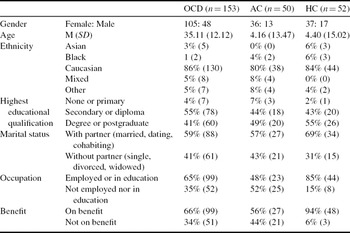
There were three participant groups (Table 1): 153 individuals who met the DSM-IV criteria for a principal diagnosis of OCD (OCD group); 50 individuals who met the DSM-IV criteria for a principal diagnosis of panic disorder with or without agoraphobia (AC group); and 54 healthy controls for the control group (HC group).
Demographic status of the participants

Seven anxious controls and two healthy controls who scored over 70 points as the total score on the Obsessive Compulsive Inventory (Foa et al., Reference Foa, Kozak, Salkovskis, Coles and Amir1998) were excluded from the analysis. Although 83 obsessionals and 35 anxious controls were directly diagnosed using the Structured Clinical Interview for DSM-IV (SCID, First et al., Reference First, Spitzer, Gibbon and Williams1996) by trained psychologists at the time they participated in this study, 70 obsessionals and 12 anxious controls had been self-diagnosed or diagnosed locally (e.g. by a General Practitioner or Primary Care Trust). However, individuals with OCD who were SCID screened and those who were not did not significantly differ in terms of the total score for OCI, RAS, RIQ, BDI, and BAI.
Anxious controls who were SCID screened and those who were not did not significantly differ in terms of the total score for OCI, RAS, BDI, and BAI.
Demographic status
A one-way ANOVA revealed that the three groups differed in terms of age, F(2, 246) = 4.348, p = .014; post-hoc multiple comparison using Tukey HSD suggests that the OCD group was marginally younger than the AC group, p = .053, and the HC group, p = .054. The three groups were compatible in terms of gender ratio, χ2(2) = .444, p = .800, ethnicity ratio, χ2(8) = 11.032, p = .199, highest educational qualification, χ 2(4) = 4.30, p = .35, and marital status, χ2(2) = 2.11, p = .347. Occupational status was significantly different between groups, χ2(2) = 15.042, p < .001, thereby indicating that a larger proportion of both clinical groups were not working or studying relative to the healthy controls. Similarly, benefit/welfare status was significantly different, χ2(2) = 19.336, p < .001, thereby indicating that only a small proportion of healthy controls were on benefit/welfare payments relative to the clinical groups.
General measures of psychopathology
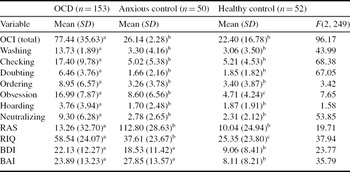
A one-way ANOVA revealed that the three groups were significantly different in all the general measures of psychopathology (all ps < .001). Post-hoc multiple comparison using Tukey HSD indicated that the OCD group scored higher on OCI, RAS, and RIQ than the AC and HC groups. The OCD and AC groups scored higher on BDI and BAI than the HC group and did not differ from each other (Table 2).
General measures of psychopathology

Note: The identical superscript letters indicate no significant difference between groups, based on Bonferroni multiple comparison test (significance <.05).
Results
Overview
First, we present the analyses aimed to establish the validity and reliability of a new measure of reassurance seeking, the ReSQ. The factorial validities and internal consistencies of reassurance sources, trust, intensity, and carefulness scales were investigated by factor analyses using only the OCD group. Next, test-retest reliabilities were examined from a subgroup of the HC group. Thereafter, the concurrent validities of each scale of the ReSQ were investigated by correlating with the OCI, RAS, RIQ, BDI, and BAI only by the OCD group. The main analysis is a comparison of scores among the three key criterion groups: OCD, AC and HC groups; this is done so that we can identify the descriptive aspects of reassurance seeking as measured by this scale specific to OCD and opposed to anxiety disorders in general, with the healthy controls providing a benchmark.
Factorial validity and reliability
The item selection procedure was based on factor analyses using only participants in the OCD group (n = 153). Parallel analysis was employed in order to statistically decide the number of factors. This method is statistically based and is considered by some authorities to be superior to other procedures; it typically yields optimal solutions to the number of components (O'Connor, Reference O'Connor2000). In parallel analysis, the focus is on the number of components that account for more variance than the components derived from random data. The present study began with the minimum number of factors that parallel analysis suggests, and the number of factors was increased until the maximum number of factors is reached so that the factors obtained become meaningful clusters from the theoretical and clinical point of views. The original items or each section were subjected to a principal axis factoring with Varimax orthogonal rotation. In order to increase the factor analytic validity of the scale, only items with clear factor loading patterns were selected; the items were excluded if they loaded less than .40 or over .40 on two factors (Floyd and Widaman, Reference Floyd and Widaman1995). The remaining items were then again subjected to a principal axis factorizing. This procedure was repeated until the simple structure was obtained.
However, the items relating to “partner”, “religious authority” and “technical professional” were included, even if it had an insufficient loading, for the following reasons. Although patients’ partners are often involved in reassurance seeking, 41% of the OCD group did not have a partner and this may have an adverse impact on the variance of the items. Religious authorities would be involved more in reassurance seeking in countries where the majority of people are religious, and technical professionals would be asked for reassurance in areas where such expertise is particularly relevant.
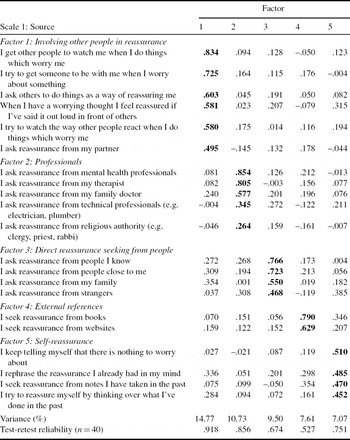
Source. The parallel analysis suggested that the number of factors ranged from three to six. We employed a 5-factor model so that each factor becomes a meaningful cluster from the theoretical and clinical points of view. Table 3 presents the result of the factor structure, and the final version of the scale comprises 21 items. Factor 1 was named “Involving other people in reassurance”, factor 2 was named “Professionals”, factor 3 was named “Direct seeking from people”, factor 4 was named “External references”, and factor 5 was named “Self-reassurance”. These five factors accounted for 49.70% of the total variance. The internal consistency (Cronbach alpha) for the overall 21-item scale was .862, and the test-retest reliability for the overall scale was .816, and the test-retest reliability for each factor ranged from .527 to .918.
Factor structure of Source scale
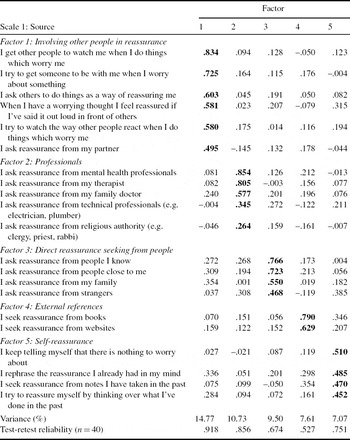
The first factor, “Involving other people in reassurance”, reflects asking others to be with them, watch/assist them, and to do something as a way of reassurance. The item “I ask for reassurance from my partner” in this factor suggests that partners are likely to be involved in these interactions. The second factor, “Professionals”, involves reassurance seeking from health professionals and technical professionals who would provide specific information that other people might not know. This factor may also reflect behaviours typically found in individuals with health anxiety. The third factor, “Direct seeking from people”, reflects asking reassurance from people. The fourth factor, “External references”, involves seeking reassurance from books and websites. Individuals may turn to these external references when they need specific information (e.g. serious medical illness), or they may use books or website to “double check” what professionals have told them. It can be frustrating for individuals with OCD to check a variety of websites, since most of the websites are not regulated and they may have different (sometimes contradicting) information. These results are consistent with clinical accounts of who patients with OCD seek reassurance from. The fifth factor, “Self-reassurance”, involves mental checking and self-talks in order to reassure themselves. Individuals may develop these strategies particularly when reassurance is not available (e.g. there is no one to ask) or when they feel embarrassed or sorry to ask for reassurance. Self-reassurance may take the form of “mental argument”, where the “logical self” tries to reassure them, but the “emotional self” disagrees and ultimately wins.
Trust and intensity scales
The trust and intensity scales produced broadly similar results.
Trust
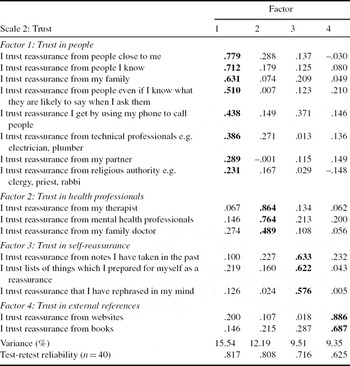
The parallel analysis suggested that the number of factors ranged from 3 to 6. We employed a 4-factor model so that each factor became a meaningful cluster from the theoretical and clinical point of views. Table 4 presents the result of the factor structure, and the final scale comprises 18 items. Factor 1 was named “Trust in people”, factor 2 was named “Trust in health professionals”, factor 3 was named “Trust in self-reassurance”, and factor 4 was named “Trust in external references”. These four factors accounted for 46.59% of the total variance. Table 4 presents the result in terms of the factor structure. The internal consistency (Cronbach alpha) for the overall scale was .838, and the test-retest reliability for the overall scale was .745, and the test-retest reliability for each factor ranged from .625 to .817.
Factor structure of Trust scale

Intensity
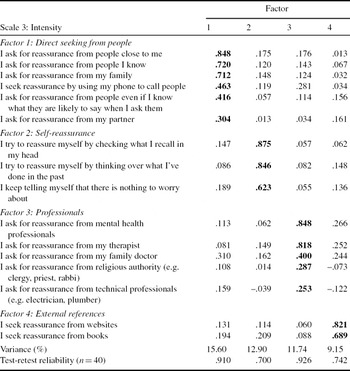
The parallel analysis suggested that the number of factors ranged from three to four. We employed a 4-factor model so that each factor becomes a meaningful cluster from the theoretical and clinical points of view. Table 5 presents the result of the factor structure. The item “I ask for reassurance from my family doctor” was included in factor 2 since the loading was almost .40 and it was meaningfully related to the other items on factor 2. Factor 1 was named “Direct seeking from people”, factor 2 was named “Self-reassurance”, factor 3 was named “Health professionals”, and factor 4 was named “External reference”. These four factors accounted for 49.40% of the total variance. Table 5 presents the result of the factor structure, and the final scale comprises 16 items. The internal consistency (Cronbach alpha) for the overall scale was .821, and the test-retest reliability for the overall scale was .826, and the test-retest reliability for each factor ranged from .700 to .926.
Factor structure of Intensity scale

The factor structures of these two scales are generally consistent with the Source scale, except that they do not indicate a specific “Involving other people in reassurance” factor. The major difference in the factor structures between the two scales would be that while items related to religious authorities and technical professionals belong to the “Trust in people” factor in the Trust scale, these items belong to the “Professionals” factor in Intensity scale. Therefore, trust in religious authorities and technical professionals may be different from trust in health professionals.
Carefulness
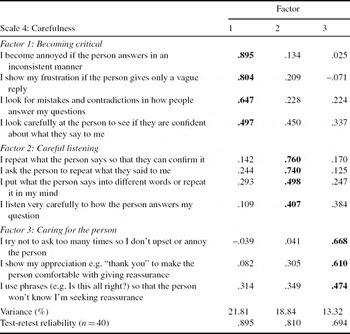
The parallel analysis suggested that the number of factors ranged from two to three. We employed a 3-factor model so that each factor becomes a meaningful cluster from the theoretical and clinical point of views. Table 6 presents the result of the factor structure. Factor 1 was named “Becoming critical”, factor 2 was named “Careful listening”, and factor 3 was named “Caring for the person”. These three factors accounted for 53.97% of the total variance. Table 6 presents the result of the factor structure, and the final scale comprises 11 items. Although one item (“I look carefully at the person to see if they are confident about what they say to me”) had a loading greater than .400 on both factors 1 and 2, it was included in factor 1 (Becoming critical) since the loading on factor 2 (Careful listening) made sense. The internal consistency (Cronbach alpha) for the overall scale was .850, and the test-retest reliability for the overall scale was .870, and the test-retest reliability for each factor ranged from .694 to .895.
Factor structure of Carefulness scale

The first factor, “Becoming critical”, reflects the way individuals critically evaluate the accuracy of the reassurance they are offered and become frustrated if, for example, they think that the reassurance is not good or the person giving it does not look sufficiently serious or confident. The second factor, “Careful listening”, reflects the amount of effort and attention they apply when they are offered reassurance. Listening to and processing reassurance from other people would be strategic rather than automatic, and individuals may try too hard to ensure that the reassurance received is “just right”. These two factors would be potentially related to the experience of strain and disruption that carers occasionally experience, since they also have to be very careful in order to meet the demand of the sufferer. The third factor, “Ensuring that the other person cares”, reflects the way people try to get others “on their side” by making it easy for them to provide reassurance. These behaviours might include “trick” questions so that providers do not notice that they are seeking reassurance.
Criterion-referenced validity
The concurrent validity of the ReSQ was assessed in the OCD group only. All the overall scales and subscales were computed based on simple sum scores divided by the number of items. This was done first by conducting a stepwise multiple regression with OCI total, OCI checking, and OCI washing as dependent variables, with the four ReSQ scales as independent variables. With the OCI total as dependent variable, “Carefulness” was the best predictor (R 2 = .129, p < .0001). For checking OCI subscale again, only “Carefulness” was entered, (R 2 = .102, p < .0001). For the washing OCI subscale, none of the four reassurance scales were entered (p > .05).
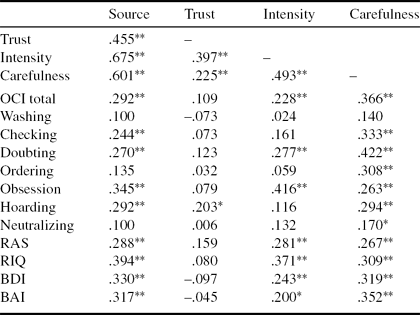
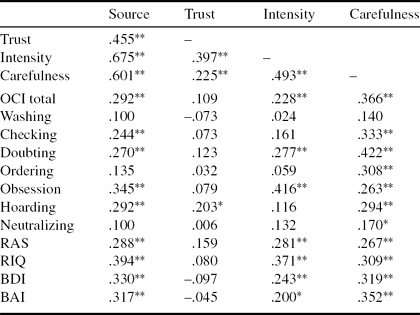
Second, we calculated the correlations between the ReSQ factorially derived scales and other variables (Table 7). The result suggests that Source, Trust, Intensity, and Carefulness had significant correlations with each other, with the correlation between Source and Intensity being the highest (.675).
Inter-correlations between ReSQ scales and measures of general psychopathology
*p < .05, **p < .01. n = 153.
With regard to the correlations with OCI total and its subscales, ReSQ scales showed different patterns. Source had moderate correlations with OCI total, Checking, Doubting, Obsession, and Hoarding. Trust had no significant correlation with OCI and its subscales, except for Hoarding. Intensity had moderate correlation with OCI total, Doubting, and Obsessions. Carefulness had moderate correlations with OCI total, Checking, Doubting, Ordering, Obsession, Hoarding, and Neutralizing.
In terms of the relationship with other variables, Source, Intensity, and Carefulness had low to moderate significant correlations (from .200 to .394) with responsibility attitude, responsibility interpretation, depression, and anxiety, while Trust was not significantly correlated with these variables.
Criterion group comparison across reassurance seeking questionnaire scales and subscales
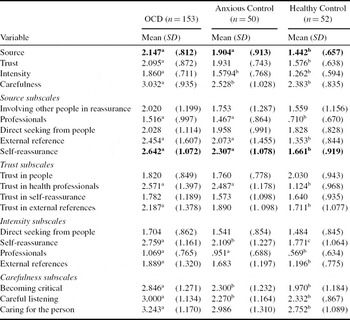
The raw scales of the reassurance seeking questionnaire were compared among groups in order to identify the degree to which reassurance is specific to OCD as opposed to anxiety in general. All the scores were divided by the number of items to provide comparable means (see Table 8).
Group differences of ReSQ scales

Note: The identical superscript letters indicate no significant difference between groups, based on Bonferroni multiple comparison test (significance <.05).
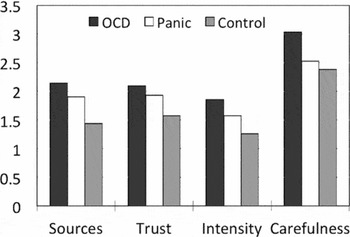
A 3 × 4 mixed model multivariate analyses of variance (MANOVA) was conducted in order to compare groups (OCD, AC, and HC) across the four types of measures (Source, Trust, Intensity, and Carefulness). A one-way MANOVA revealed significant main effects for Group F(8, 474) = 4.960, p < .001. Follow-up ANOVAs revealed significant main effects for Group on all the scales, and the post-hoc multiple comparison using Tukey HSD revealed that the OCD group had higher scores on the Intensity and Carefulness scales relative to the AC and HC groups. OCD group scored higher on Trust scale relative to the HC group, and the OCD and AC groups scored higher on Source than the HC group (see Figure 1).Footnote 1
Group differences of ReSQ scales

Next, a MANOVA was performed in order to compare Source subscales among the three groups. A MANOVA of Source subscales revealed significant main effects for Group (between factor), F(10, 490) = 5.628, p < .001. Follow-up ANOVAs revealed significant main effects for Group on all the subscales except for Direct seeking from people. The post-hoc multiple comparison using Tukey HSD revealed that the OCD and AC groups scored higher on Professionals, External reference, and Self-reassurance than the HC group. Only OCD group scored higher on Involving other people in reassurance.
Thereafter, a MANOVA was performed in order to compare Trust subscales among the three groups. The MANOVA of Trust subscales revealed significant main effects for Group (between factor), F(8, 490) = 9.724. Follow-up ANOVAs revealed significant main effects for Group only on Health professionals and External references. The post-hoc multiple comparison using Tukey HSD revealed that the OCD group scored higher on Trust in External reference than the HC group, and the OCD and AC groups scored higher on Health professional than the HC group.
A MANOVA was next performed in order to compare Intensity subscales among three groups, revealing significant main effects for Group, F(8, 484) = 5.629, p < .001. Follow-up ANOVAs revealed significant main effects for Group on all the subscales except for Direct Seeking of reassurance from People. The post-hoc multiple comparison using Tukey HSD revealed that the OCD group scored significantly higher on Self-Reassurance relative to both anxiety disorder and the HC groups, the OCD group scored higher on External Reference than the HC group, and the OCD and AC groups scored higher on Professionals compared to the HC group.
Finally, a MANOVA was performed in order to compare the Carefulness subscales between the three groups, thereby indicating significant main effects for Group, F(6, 494) = 5.532, p < .001. Follow-up ANOVAs revealed significant main effects for Group on all the subscales. The post-hoc multiple comparison using Tukey HSD revealed that the OCD group scored higher on Becoming Critical and Careful Listening than both anxiety and HC groups, and the OCD group scored higher on Caring Person than the HC group.
Discussion
Overview
The purpose of the present study was to measure the scope, extent, and process of reassurance seeking behaviour, and to identify the degree to which reassurance is specific to OCD as opposed to panic disorder.
Validity and reliability of the scale
Criterion-referenced validity was examined by the use of stepwise multiple regression and correlation with other variables using the OCD group only. The “Carefulness” subscale predicted both OCD (OCI) totals and the OCI checking subscale, with none of the reassurance scales being related to the OCI washing subscale. Correlations among Source, Trust, Intensity, and Carefulness scales and subscales suggest that although individuals with OCD may seek reassurance from sources they trust, they would repeatedly ask for it and become very careful when they receive it. This may frustrate carers since the sufferers do not appear to trust them. Source, Intensity, and Carefulness had low to moderate correlations with obsessionality, responsibility attitude, responsibility interpretation, depression, and anxiety, suggesting that reassurance seeking is a safety-seeking behaviour motivated by obsessional beliefs and interpretations (Salkovskis, Reference Salkovskis1985, Reference Salkovskis1999). However, Trust was not related to these variables, thereby suggesting that the level of trust was not related nor changed by the degree of OCD, depression, and anxiety. Inspection of the correlation with OCI subscales revealed that reassurance seeking is most strongly associated with checking, doubting, and obsessions rather than washing, ordering, and neutralizing. This is understandable given that reassurance seeking is conceptualized as a form of checking “by proxy” (Rachman, Reference Rachman2002). The relationship with doubting and obsessions may reflect self-reassurance in which the individual attempts to reassure themselves in their mind, consistent with the finding of Cougle et al. (Reference Cougle, Fitcha, Finchamb, Riccardia, Keoughc and Timpano2012) that among OCD symptoms measured by Padua Inventory (Burns, Reference Burns1995), only thoughts of harm were uniquely related to excessive reassurance seeking.
Specificity of reassurance seeking to OCD
The degree of specificity of reassurance seeking to OCD as opposed to panic disorder was rather less than had been anticipated. The results suggest that individuals with both anxiety disorders seek reassurance more frequently than healthy controls. However, individuals with OCD reported seeking reassurance more intensely and more carefully than both anxious and healthy control groups. Therefore, reassurance seeking is not entirely specific to OCD, but there was evidence that individuals with OCD tend to repeat the same reassurance seeking until they stop, and to exercise more care and make a greater effort when they seek reassurance; the latter finding converges with the multiple regression, which suggests that the care with which reassurance is sought and received is most strongly related to OCD in general and checking in particular.
A more detailed analysis of the intensity of reassurance indicates that individuals with OCD would engage in self-reassurance more than both anxious and healthy controls. Self-reassurance, where they report trying to reassure themselves by telling themselves something or trying to remind themselves of something, seems another specificity to OCD. Because individuals with OCD are often told that they should not seek reassurance or they feel embarrassed when they seek reassurance, it is possible that they may develop self-reassurance as a substitute or “contingency plan”.
In terms of the Carefulness scale, the OCD group rated themselves as more concerned about the impact on others of requiring the provision of reassurance, for example, being aware that reassurance seeking puts a strain on others and how it can lead to interpersonal conflicts. What is specific to OCD would be the amount of effort they put into reassurance seeking. Compared to both anxious and healthy controls, individuals with OCD rated themselves as trying harder when they seek reassurance by examining the person carefully, listening carefully, asking others to repeat, and rephrasing the reassurance in their mind.
These findings suggest that it would be difficult for both sufferers and carers to identify problematic reassurance seeking and providing, because direct reassurance from people and asking them to do something as a way of reassurance are common phenomena. However, it would require a huge mental effort and puts strain on both individuals with OCD and their carers when they repeatedly ask for reassurance and seek reassurance in concealed and “careful” ways, although there is evidence that OCD patients are aware of this and try to compensate for it (Kobori et al., Reference Kobori, Salkovskis, Read, Lounes and Wong2012).
The finding of specificity in self-reassurance by individuals with OCD raises interesting issues. On one level, self-reassurance is quite different in that the patient does not involve another person. One possible account is that in self-reassurance, it can be said that the person's “emotional self” is interrogating their “objective/rational self” about their rational response to fearful questions in order to achieve a feeling of complete certainty. The motivation to achieve such certainty lies in the concern that there is not only a danger, but also that one is responsible for its cause or prevention. In self-reassurance, achieving the transfer of responsibility is not possible, and failure to obtain such feelings will require continued self-questioning until they are achieved. Thus, in seeking reassurance from others, the focus is both on achieving the complete transfer of responsibility as well as the achievement of certainty that the feared harm will not occur. Although inflated responsibility as a motivation to seek reassurance was identified qualitatively (Kobori et al., Reference Kobori, Salkovskis, Read, Lounes and Wong2012) and experimentally (Parrish and Radomsky, Reference Parrish and Radomsky2006), the relationships between ReSQ scales and responsibility were moderate, and Reassurance Seeking Scale (Rector et al., Reference Rector, Kamkarb, Cassina, Ayearstd and Laposa2011) does not involve responsibility as a motivation/trigger to seek reassurance.
Limitations and future directions
Because the sample size in the present study is relatively small for a factor analysis, further validation studies with larger samples are required to ensure the construct validity and factor stability of the scale. Additionally, there could be substantial item redundancy within and across subscales. This could be clarified in a study using Item Response Theory analyses. Another issue is that the clinical samples were limited to individuals with OCD and panic disorder. It remains unknown whether individuals with other anxiety disorders (e.g. health anxiety, social phobia, specific phobia) show similar patterns to OCD or panic disorder on scores of ReSQ. It should also be acknowledged that a subgroup of clinical groups had no verified diagnoses. Although individuals who were SCID screened and those who were not did not significantly differ in measures for psychopathology, this limits the generalizability of our findings. Additionally, this study did not exclude psychopathological disorders in the nonclinical group other than by the OCI score. This might have affected the specificity of reassurance seeking in anxiety disorders compared to healthy controls.
In order to enhance the discriminant validity of the scale, the questionnaire should also be tested with depressive individuals since they tend to seek reassurance regarding issues related to self-worth (e.g. “Do you really care about me?”). Further, the sample of the present study was limited to an English-speaking population; however, the questionnaire should be implemented with individuals who speak other languages. Currently, the Japanese version of ReSQ is being evaluated in order to examine cross-cultural compatibility. We also need to test the associations between reassurance seeking and obsessional beliefs. Although we hypothesized the inflated responsibility and reassurance seeking, the correlations between RAD, RIQ, and ReSQ scales were moderate, while Threat-related Reassurance seeking Scale (Cougle et al., Reference Cougle, Fitcha, Finchamb, Riccardia, Keoughc and Timpano2012) had moderate to high correlations with intolerance of uncertainty. Future studies should incorporate other belief measures such as perfectionism and intolerance of uncertainty, and investigate which belief(s) predicts ReSQ scales more than others. It would be particularly interesting to test whether Carefulness is predicted mostly by perfectionism, because individuals with perfectionism try hard to detect and modify mistakes.
Experimental tests on the function of reassurance with individuals diagnosed with OCD must be conducted in future research. Several authors have proposed that one motivation to seek reassurance would be to disperse responsibility (Rachman, Reference Rachman2002; Salkovskis, Reference Salkovskis1985, Reference Salkovskis1999) and decrease the level of uncertainty (Abramowitz, Franklin and Cahill, Reference Abramowitz, Franklin and Cahill2003). Parrish and Radomsky (Reference Parrish and Radomsky2010) compared the function of reassurance seeking and checking in a semi-structured interview. They found that its function is similar to that of checking: decreasing anxiety mood, preventing harm, and decreasing responsibility for harm. Several authors have experimentally confirmed the short-term and long-term effects of reassurance in health anxiety (Salkovskis and Warwick, Reference Salkovskis and Warwick1986) in an ABAB design case study of childhood OCD (Fransis, Reference Fransis1988), and in patients assessed on gastroscopy (Lucock, Morley, White and Peake, Reference Lucock, Morley, White and Peake1997). Salkovskis and Warwick (Reference Salkovskis and Warwick1986) suggests that reassurance produced an immediate but transient reduction in the anxiety of hypochondriasis patients; however, providing reassurance may have enhanced anxiety, increased the urge to seek reassurance, and strengthened negative cognitions over the ensuing 24 hours. However, no studies that experimentally test the function of reassurance in OCD have yet been conducted.
It is still unclear what the relative merits of different kinds of reassurance might be (e.g. verbal answers from close or distant others, from professionals, self-reassurance, external references such as the internet, or the function of asking others to assist in rituals). How patients with OCD decide when to stop seeking reassurance is also likely to be important (Parrish and Radomsky, Reference Parrish and Radomsky2010), as is how long the beneficial effect will continue and what will trigger renewed episodes of seeking it. The manner in which individuals with OCD and other anxiety disorders emotionally react to the different outcomes of reassurance seeking is reported elsewhere (Salkovskis and Kobori, Reference Salkovskis and Kobori2012). Following that, since reassurance seeking involves interpersonal processes, it is important to consider the role and experience of the persons from whom reassurance is sought. Partners and family members are most likely to be involved in this process, and we are currently examining their reports on how often they are asked for reassurance, how they are asked (e.g. directly, indirectly, asked to take part in rituals), how often they provide reassurance, how they feel and how they think sufferers would feel when they provide and do not provide reassurance, and what motivates them to provide reassurance.
Finally, direct or subtle reassurance-seeking also tends to occur in the course of therapy, most commonly without the patient being aware that “just mentioning” something they did as part of therapy to the therapist is problematic. In addition, therapist-directed exposure and behavioural experiments could, under some circumstances, act to provide inappropriate reassurance and hence unwittingly lead to failure of response prevention (Salkovskis et al., Reference Salkovskis, Forrester, Richards, Morrison, Tarrier, Wells and Haddock1998). Thus, it is important to identify how clinicians judge whether the request from patients can be characterized as reassurance seeking, how they identify subtle and indirect reassurance seeking from patients, and how they deal with when they are asked for reassurance.
Acknowledgements
The work was supported by the Japan Society for the Promotion of Science (Social Science 728).



Comments
No Comments have been published for this article.