Growing evidence confirms that high levels of stress during pregnancy hamper the development of systems that support offspring behavioral and emotional regulation, including the hypothalamic–pituitary–adrenal (HPA) axis (Glover, O'Connor, & O'Donnell, Reference Glover, O'Connor and O'Donnell2010). It is not surprising that research finds that prenatal stress increases risk for internalizing (e.g., depression, anxiety) and externalizing (e.g., disruptive behavior, attention problems, hyperactivity) problems during childhood and adolescence (Davis & Sandman, Reference Davis and Sandman2012; O'Connor et al., Reference O'Connor, Ben-Shlomo, Heron, Golding, Adams and Glover2005; Van den Bergh, Van Calster, Smits, Van Huffel, & Lagae, Reference Van den Bergh, Van Calster, Smits, Van Huffel and Lagae2008). However, the characteristics of prenatal stress responsible for its noxious effects on children's mental health are not well understood, and research to date has largely ignored the impact of exposure to intimate partner violence (IPV) during pregnancy, a common, chronic, and severe interpersonal traumatic stressor.
Research on prenatal IPV is scarce. In contrast, much more research has focused on IPV exposure during childhood. Intimate partner violence is a well-established risk for a variety of internalizing and externalizing problems (Bogat, DeJonghe, Levendosky, Davidson, & von Eye, Reference Bogat, DeJonghe, Levendosky, Davidson and von Eye2006; Grych, Jouriles, Swank, McDonald, & Norwood, Reference Grych, Jouriles, Swank, McDonald and Norwood2000; Levendosky, Bogat, & Martinez-Torteya, Reference Levendosky, Bogat and Martinez-Torteya2013), as well as altered HPA axis regulation (Hibel, Granger, Blair, & Cox, Reference Hibel, Granger, Blair and Cox2011; Saltzman, Holden, & Holahan, Reference Saltzman, Holden and Holahan2005; Sturge-Apple, Davies, Cicchetti, & Manning, Reference Sturge-Apple, Davies, Cicchetti and Manning2012). Based on these findings and the large prenatal stress literature, we propose that pregnancy IPV exposure will result in higher levels of internalizing and externalizing problems during childhood. The relationship between IPV exposure and HPA axis activity seems to be complex and is not well explained by linear associations: Patterns of both lower cortisol secretion or blunted reactivity (Sturge-Apple et al., Reference Sturge-Apple, Davies, Cicchetti and Manning2012) and higher cortisol secretion or reactivity (Hibel et al., Reference Hibel, Granger, Blair and Cox2011; Saltzman et al., Reference Saltzman, Holden and Holahan2005) have been reported among IPV-exposed children. Following Cicchetti and Rogosch (Reference Cicchetti and Rogosch2001), we propose that both patterns of adrenocortical dysregulation (i.e., hyper- vs. hyporeactivity) are predicted by prenatal IPV exposure, but each cortisol pattern is differentially associated with specific types of behavioral problems. Based on a large literature examining children who are depressed, experiencing high levels of internalizing problems, or at risk for depression, we hypothesize that high cortisol reactivity is associated with internalizing problems (Essex, Klein, Cho, & Kalin, Reference Essex, Klein, Cho and Kalin2002; Lopez-Duran, Kovaks, & George, 2009). The literature evaluating the link between cortisol and externalizing symptoms is less consistent (Alink, van IJzendoorn, Bakermans-Kranenburg, Mesman, Juffer, & Koot, Reference Alink, van IJzendoorn, Bakermans-Kranenburg, Mesman, Juffer and Koot2008), but findings suggest associations between cortisol hypoactivity and externalizing problems (Shirtcliff, Granger, Booth, & Johnson, Reference Shirtcliff, Granger, Booth and Johnson2005; Snoek, Van Goozen, Matthys, Buitelaar, & van Engeland, Reference Snoek, Van Goozen, Matthys, Buitelaar and van Engeland2004).
The present study examined (a) the long-term influence of IPV during pregnancy on children's stress-induced cortisol levels and on their internalizing and externalizing symptoms, and (b) differential associations of specific patterns of cortisol activity with internalizing and externalizing problems. A multiple-method, multiple-informant, prospective longitudinal design was used to maximize internal validity. Latent profile analysis (LPA) was used to empirically derive distinct patterns of HPA axis reactivity. Person-oriented methods (i.e., LPA) are best suited to identify the proposed patterns of cortisol dysregulation and were used to evaluate the hypothesized nonlinear relationships between pregnancy IPV, cortisol secretion patterns, and internalizing/externalizing symptoms.
The Effects of Prenatal Stress on Offspring Development
The prenatal environment can have lasting effects on the neural systems that coordinate emotional and behavioral responses to the environment, which are proposed to increase or decrease the individual's susceptibility to later illness (Barker, Eriksson, Forsen, & Osmond, Reference Barker, Eriksson, Forsen and Osmond2002). During pregnancy, the fetus experiences rapid brain development and may be particularly susceptible to insults (Huizink, Mulder, & Buitelaar, Reference Huizink, Mulder and Buitelaar2004; Talge, Neal, & Glover, Reference Talge, Neal and Glover2007), making gestation a vulnerable period for brain development. Lupien, McEwen, Gunnar, and Heim (Reference Lupien, McEwen, Gunnar and Heim2009) propose that a stressful or adverse environment during pregnancy can “program” the offspring's HPA axis, influencing the biobehavioral response to stressors after birth and ultimately leading to maladaptation during childhood, adolescence, or adulthood.
Ample evidence is consistent with this notion. High levels of stress during pregnancy, such as maternal traumatic stress, chronic stress, and emotional distress, predict offspring HPA axis functioning during infancy, childhood, and adolescence, including higher resting, wakening, and stress-induced cortisol levels (for a review, see Glover et al., Reference Glover, O'Connor and O'Donnell2010). Prenatal stress also predicts temperamental and regulatory difficulties during infancy (e.g., Austin, Hadzi-Pavlovic, Leader, Saint, & Parker, Reference Austin, Hadzi-Pavlovic, Leader, Saint and Parker2005; Bergman, Sarkar, O'Connor, Modi, & Glover, Reference Bergman, Sarkar, O'Connor, Modi and Glover2007; Huizink, de Medina, Mulder, Visser, & Buitelaar, Reference Huizink, de Medina, Mulder, Visser and Buitelaar2002), higher negative emotionality and inhibition during the preschool years (Martin, Noyes, Wisenbacker, & Huttunen, Reference Martin, Noyes, Wisenbaker and Huttunen1999), and more internalizing and externalizing problems during school age (Davis & Sandman, Reference Davis and Sandman2012; O'Connor et al., Reference O'Connor, Ben-Shlomo, Heron, Golding, Adams and Glover2005; Van den Bergh et al., Reference Van den Bergh, Van Calster, Smits, Van Huffel and Lagae2008). Empirical evidence also provides some support for the proposed associations between HPA axis dysregulation and maladaptation: Van den Bergh and colleagues (Reference Van den Bergh, Van Calster, Smits, Van Huffel and Lagae2008) found that high maternal anxiety during pregnancy predicted higher diurnal cortisol levels among offspring during adolescence, which were associated with depressive problems among girls.
However, the extant research is not without limitations. Few longitudinal studies with prenatally stressed children have integrated both cortisol and behavioral outcomes. In addition, studies primarily use maternal mental health (i.e., levels of depression and/or anxiety) as a proxy for prenatal stress. Although stressors contribute to mental health problems, psychological symptoms are also determined by a myriad of additional individual factors, such as genetic vulnerability, personality, and/or social supports (Kendler & Myers, Reference Kendler and Myers2010), such that stress and maternal mental health are certainly not interchangeable constructs. Notably, IPV, a chronically stressful and/or dangerous environment, has not been evaluated, despite indications that its effects may be even more pronounced and long lasting than those of milder or less frequent stressors (Bergman et al., Reference Bergman, Sarkar, O'Connor, Modi and Glover2007).
IPV Exposure
IPV during pregnancy is a widespread societal problem, with reported rates among low-income young women as high as 30% (Gazmararian et al., Reference Gazmararian, Lazorick, Spitz, Ballard, Saltzman and Marks1996; Taillieu & Brownridge, Reference Taillieu and Brownridge2010). IPV is defined as physical, sexual, or psychological harm by a current or former partner or spouse, and it typically involves repeated acute traumatic events, in the context of chronic anticipation of a partner's unpredictable abusive behaviors (Brownridge et al., Reference Brownridge, Taillieu, Tyler, Tiwari, Chan and Santos2011). During pregnancy, IPV can result in a number of fetal insults, leading to higher risk for perinatal death, preterm delivery, and low birth weight (Coker, Sanderson, & Dong, Reference Coker, Sanderson and Dong2004; Huth-Bocks, Levendosky, & Bogat, Reference Huth-Bocks, Levendosky and Bogat2002; L. Saltzman, Reference Saltzman1990). The role of pregnancy IPV as a risk factor for behavioral and emotional problems after birth has been rarely evaluated, but a few studies suggest that prenatal IPV can lead to temperamental difficulties and more internalizing and externalizing problems during infancy and the preschool years (Burke, Lee, & O'Campo, Reference Burke, Lee and O'Campo2008; Levendosky, Leahy, Bogat, Davidson, & von Eye, Reference Levendosky, Leahy, Bogat, Davidson and von Eye2006; Martinez-Torteya et al., Reference Martinez-Torteya, Field, Bogat, Levendosky, Davidson and von Eye2009). However, no study to date has evaluated if the influence of in utero IPV is maintained in the long term or has evaluated the effect of prenatal IPV on later HPA axis functioning.
Multiple studies have linked exposure to IPV during childhood to concurrent and later psychological problems (Bogat et al., Reference Bogat, DeJonghe, Levendosky, Davidson and von Eye2006; Levendosky et al., Reference Levendosky, Bogat and Martinez-Torteya2013; Wolfe, Crooks, Lee, McInthyre-Smith, & Jaffe, Reference Wolfe, Crooks, Lee, McInthyre-Smith and Jaffe2003) and HPA axis dysregulation (Hibel et al., Reference Hibel, Granger, Blair and Cox2011; Saltzman et al., Reference Saltzman, Holden and Holahan2005; Sturge-Apple et al., Reference Sturge-Apple, Davies, Cicchetti and Manning2012). Exposure to IPV increases risk for externalizing, internalizing, posttraumatic, and dissociative symptoms, with rates as high as 60% of school age witnesses displaying clinical levels of psychopathology (Graham-Bermann, Gruber, Howell, & Girz, Reference Graham-Bermann, Gruber, Howell and Girz2009; Grych et al., Reference Grych, Jouriles, Swank, McDonald and Norwood2000).
Reports of HPA axis activity among IPV-exposed children are mixed. Decreased cortisol reactivity during toddlerhood has been reported (Sturge-Apple et al., Reference Sturge-Apple, Davies, Cicchetti and Manning2012), as has the opposite pattern of increased resting and stress-induced cortisol levels during toddlerhood and school age (Hibel et al., Reference Hibel, Granger, Blair and Cox2011; Saltzman et al., Reference Saltzman, Holden and Holahan2005). These results mirror those of studies of HPA axis functioning among children exposed to other interpersonal trauma, such as maltreatment (e.g., Cicchetti & Rogosch, Reference Cicchetti and Rogosch2001). In their study of maltreated children, Cicchetti and Rogosch (Reference Cicchetti and Rogosch2001) found higher morning, afternoon, and total cortisol secretion among a subgroup of maltreated children who also experienced high levels of internalizing symptoms. In contrast, another subgroup of their maltreated sample was characterized by low levels of morning cortisol and high levels of externalizing problems. Taken together, these findings suggest a complex relationship between IPV exposure and cortisol activity; the apparently conflicting results may represent subgroups of IPV-exposed children who exhibit opposite patterns of cortisol secretion, characterized by hypoactivity and hyperactivity. To uncover associations between IPV exposure during pregnancy and HPA axis activity, empirically derived patterns of cortisol reactivity, as opposed to levels of cortisol at a single point in time, are needed to determine whether prenatal IPV is a predictor of these patterns of cortisol secretion.
Cortisol Dysregulation and Internalizing/Externalizing Symptoms
Associations between cortisol dysregulation and internalizing or externalizing outcomes are proposed by the prenatal “programming” hypothesis (Lupien et al., Reference Lupien, McEwen, Gunnar and Heim2009). These relationships are well supported by the internalizing literature. Depressed youth and children with high levels of internalizing symptoms are characterized by a hyperactive cortisol response to psychosocial stress and higher resting cortisol levels (Essex et al., Reference Essex, Klein, Cho and Kalin2002; Lopez-Duran et al., Reference Lopez-Duran, Kovacs and George2009), as compared to “healthy” controls (Hankin, Badanes, Abuela, & Watamura, 2010) or youth with other psychiatric diagnoses (Luby et al., Reference Luby, Heffelfinger, Mrakotsky, Brown, Hessler and Spitznagel2003). In contrast, externalizing problems are associated with lower basal and challenged cortisol levels (Shirtcliff et al., Reference Shirtcliff, Granger, Booth and Johnson2005; Snoek et al., Reference Snoek, Van Goozen, Matthys, Buitelaar and van Engeland2004), but research suggests this association is less robust (Alink et al., Reference Alink, van IJzendoorn, Bakermans-Kranenburg, Mesman, Juffer and Koot2008). Maladaptation can be linked to more than one pattern of cortisol secretion, suggesting that evaluation of linear relationships, with adaptation tied to one end of the spectrum and maladaptation tied to the other, may not capture this link between specific profiles of altered HPA-axis functioning and different clinical presentations (i.e., internalizing or externalizing). Methods that can identify these potentially distinct patterns within the population, such as LPA, are needed to clarify the correlations between IPV exposure during pregnancy, cortisol reactivity, and internalizing and externalizing problems.
Moreover, the nature of the associations between HPA activity and internalizing/externalizing symptoms is difficult to characterize. Some have proposed HPA axis dysregulation as an etiological mechanism for particular types of psychopathology, specifically through “wear and tear” caused by chronic activation of the stress response (McEwen & Stellar, Reference McEwen and Stellar1993). However, empirical evidence that evaluates a causal association is hard to obtain as it requires longitudinal assessment of environmental influences, cortisol activity, and behavioral outcomes. Studies reveal that cortisol precedes symptom expression, lending some support to its being a marker of psychopathology: abnormal cortisol levels characterize first degree relatives of depressed individuals (Young, Vazquez, Jiang, & Pfeffer, Reference Young, Vazquez, Jiang and Pfeffer2006) and dysregulated cortisol activity in childhood predicts the development of internalizing symptoms later on (Essex et al., Reference Essex, Klein, Cho and Kalin2002). In contrast, other research suggests bidirectional associations over time, with increases in internalizing or externalizing problems leading to changes in cortisol reactivity (Granger, Weisz, McCracken, Ikeda, & Douglas, Reference Granger, Weisz, McCracken, Ikeda and Douglas1996; Ruttle et al., Reference Ruttle, Shirtcliff, Serbin, Ben-Dat Fisher, Stack and Schwartzman2011), suggesting it may be a consequence or “scar” of maladaptation.
The Present Study
Research to date demonstrates the deleterious influence of stress during pregnancy, but stressors and maternal mental health problems are often confounded. In addition, prenatal IPV exposure, a strong predictor of maternal physical and psychological problems and negative perinatal outcomes (Huth-Bocks et al., Reference Huth-Bocks, Levendosky and Bogat2002; Taillieu & Brownridge, Reference Taillieu and Brownridge2010), has not been included in prenatal stress assessments, and its long-term effects on child outcomes are largely unknown. It is important to understand the effect of prenatal IPV because it is a high-impact stressor disproportionally experienced by low-income young women, a group that is already at risk for detrimental offspring outcomes. In addition, few longitudinal prenatal stress studies have integrated biopsychosocial outcomes when evaluating the long-term influence of prenatal stress or included multiple assessments of the postnatal environment. Studies have primarily relied on evaluation of linear associations using a variable-oriented approach, which may obscure the interpretation of findings if distinct profiles of cortisol secretion exist (e.g., normative, hypo- and hypercortisolism).
The present study examined (a) the long-term influence of IPV during pregnancy on children's patterns of stress-induced cortisol activity and on their internalizing and externalizing symptoms, and (b) whether specific profiles of cortisol reactivity are differentially associated with internalizing and externalizing problems. To address some of the limitations of previous research, we used a prospective multimethod longitudinal design and assessed IPV exposure among women–offspring dyads followed from pregnancy and until the child was 10 years old. To avoid confounds related to type of stressor (IPV vs. maternal distress) and timing (pregnancy vs. childhood), maternal distress during pregnancy, child lifetime IPV, and child recent IPV exposure were controlled for in data analyses. In addition, assessment of child outcomes spanned multiple levels of functioning (cortisol reactivity and behavior), and multiple methods and reports (child-report, maternal report questionnaire, semistructured clinical interview with mother) were used to enhance construct validity.
We used person-oriented methods to derive empirically supported patterns of cortisol secretion and examined the relationships among prenatal IPV, cortisol secretion profiles, and internalizing/externalizing symptoms. Person-oriented methods are ideal for this purpose as they permit consideration of empirically based subgroups that may exist within the larger population (e.g., Bergman & Magnusson, Reference Bergman and Magnusson1997; von Eye & Bergman, Reference von Eye and Bergman2003). Typically, research employs variable-oriented approaches that assume universal laws of human behavior, aggregate data across individuals, and discuss associations among variables. Such approaches ignore heterogeneity among a sample, assuming that summary statistics capture reality for each individual, that variables typically have linear relationships with one another, and that error is randomly and normally distributed. Person-oriented approaches, in contrast, assume that development is at least partly specific to an individual, that human behavior is complex and multiply determined, and that variables, in and of themselves, are of little interest; rather, their importance lies in their interdependence in creating patterns or profiles that describe individuals or groups of individuals (see Bergman & Magnusson, Reference Bergman and Magnusson1997; Bogat, von Eye, & Bergman, in press).
We proposed the following hypotheses:
-
1. Prenatal IPV exposure predicts higher levels of internalizing and externalizing symptoms at age 10.
-
2. Prenatal IPV exposure predicts specific patterns of HPA axis reactivity at age 10, as measured via salivary cortisol.
-
a. More prenatal IPV exposure predicts a profile of cortisol hyperactivity.
-
b. More prenatal IPV exposure predicts a profile of cortisol hypoactivity.
-
c. Less prenatal IPV exposure predicts a “healthy” or “normative” cortisol pattern.
-
-
3. HPA axis reactivity pattern is associated differentially with internalizing and externalizing symptoms at age 10.
-
a. A profile of cortisol hyperactivity is associated with more internalizing symptoms.
-
b. A profile of cortisol hypoactivity is associated with more externalizing symptoms.
-
Methods
Participants and procedures
Participants were a subset of mother–child dyads recruited through a longitudinal study of IPV (http://www.msu.edu/~ MIS). Participants of the larger longitudinal study were 206 pregnant women recruited from a midsize Midwestern city. Community recruitment was conducted using fliers posted at obstetric/gynecologic or women's health clinics (39%); libraries, laundromats, stores, and similar public sites (27%); social service programs, such as the Family Independence Program, Women Infants and Children Program, Head Start, Jump Start, and Maternal Infant Outreach Program (26%); childbirth classes (5%); the county prosecutor's office (2%); and a local domestic violence shelter (1%). Inclusion criteria for the longitudinal study were (a) being in the last trimester of pregnancy at the time of the initial interview, (b) 18–40 years of age, (c) involvement in a romantic relationship for at least 6 weeks during the pregnancy, and (d) understanding English well enough to complete questionnaires and interviews.
Pregnant women contacted the research office if they were interested in participation, completed a brief telephone screening to determine eligibility and exposure to IPV during pregnancy (using the physical violence scale from the Conflict Tactics Scale; Straus, Reference Straus1979), and received a description of the assessment protocol. Women who did and did not experience IPV during pregnancy were invited to participate in the study, with the goal of obtaining two groups of similar size. Advanced undergraduate and graduate research assistants conducted the pregnancy assessment. The interviews lasted about 3 hr and were conducted at the women's homes or the project office. After the initial interview, women were contacted again for interviews around their child's first to seventh birthday. In-person interviews (during the age 1 to 5 assessments, and again at age 7) and telephone interviews (at age 6) were conducted by trained research assistants using a variety of questionnaires. A number of procedures were used to reduce attrition: from the beginning of the study, women were contacted every 3 months to update their contact information, until the children were 7. In addition, women provided information on up to 3 recontact people (e.g., relative, friend).
Women and their children were invited again to complete an evaluation in our project offices when the children were 10 years of age (M = 10 years, 6 months; SD = 3 months). Their most recent contact and recontact information was used to locate participants. Because levels of salivary cortisol naturally rise and decrease with the circadian rhythm, all interviews started between 4:00 and 5:00 p.m. to restrict the potential influence of time of saliva collection. Upon arrival, mother and child completed the informed consent and informed assent procedures and then completed the rest of the assessment in separate rooms. The mother completed questionnaires and interviews with a Master's level clinician, while the child completed questionnaires and the stress challenge task in a separate room with a research assistant. Saliva was collected during resting conditions (prior to stressor) about 20 min after arrival to the laboratory, 20 min after the challenging task, and 40 min after the challenging task. Interviewers administered the violence questionnaires last to minimize examiner bias based on the woman's IPV status.
The final sample for the present study consisted of 119 mother–child dyads (65 boys, 54 girls). Ethnicity was 50% White, 23% African American, 23% multiracial, 2% Latino, 1% Native American, and 1% Asian American. The mean monthly family income was $3,196 (SD = $2,805). Eleven percent of the women had not completed high school, 28% completed high school, 42% completed some college or trade school, 11% had a BA or BS, and 6% had some graduate school or a graduate degree. Participants who were included in the present study did not differ significantly from those who did not participate but were part of the original longitudinal study (excluded participants n = 87) in regard to ethnicity, maternal education, maternal marital status, maternal age, child's gender, maternal depression, anxiety, or posttraumatic stress disorder during pregnancy, maternal lifetime IPV exposure, and maternal IPV exposure during pregnancy. However, women who did not participate in the current study had significantly lower monthly family income during pregnancy, F (1, 203) = 4.12, p = .04 (included M = $2,002, excluded M = $1,573).
Measures
Prenatal levels of IPV (maternal report), as well as self-reported maternal depression and anxiety were obtained during the first wave of data collection (M = 33 weeks gestation) using questionnaires. Exposure to IPV was also measured yearly via maternal report near the child's birthday (ages 1–7). During the in-person assessment conducted when children were about 10 years old, internalizing and externalizing problems (measured via multiple indices, maternal and child report), HPA axis functioning (via salivary cortisol collected during resting and challenge conditions), and IPV exposure (maternal and child report) were measured.
Dependent variables: Maternal report
Schedule for Affective Disorders and Schizophrenia for School-Age Children—Present and lifetime version (K-SADS)
The major depressive disorder (MDD), oppositional defiant disorder (ODD), and attention-deficit/hyperactivity disorder (ADHD) modules (parent report) were used to assess children's current depressive symptoms, disruptive behaviors, and attention/hyperactivity problems during the 10-year assessment. This semistructured clinical interview (Kaufman, Birmaher, Brent, Rao, & Ryan, Reference Kaufman, Birmaher, Brent, Rao and Ryan1996) is based on DSM-IV criteria and provides reliable and valid psychiatric diagnoses for children 6–18 years old. Interrater reliability for the MDD, ODD, and ADHD modules is high (κ = 0.90 for current diagnosis), and test-retest reliability is good (r = .77–.90; Kaufman et al., Reference Kaufman, Birmaher, Perel, Dahl, Moreci and Nelson1997). Validity for the K-SADS is good, and current diagnoses are consistent with the Child Behavioral Checklist (CBCL) and the Child Depression Inventory. In the present research, mothers were asked about both lifetime and current symptoms, and the skip-out criteria was not used. Symptoms were rated as not present (0), subthreshold (1), and present (2). A sum score of current symptoms was used in all analyses (depression α = 0.81, range = 0–20, M = 1.34, SD = 1.86; ODD α = 0.83, range = 0–14, M = 1.15, SD = 2.74; ADHD α = 0.94, range = 0–34, M = 6.83, SD = 10.02).
CBCL for ages 6–18 (CBCL/6–18)
This 113-item questionnaire (Achenbach & Rescorla, Reference Achenbach and Rescorla2001) was used at the 10-year assessment to obtain maternal reports of child behavioral and emotional problems, yielding two broadband internalizing and externalizing scales. The survey consists of brief qualitative statements (e.g., “acts too young for his/her age”), and respondents are asked to rate whether the statement is not true (0), somewhat/sometimes true (1), or very/often true (2) regarding the child. Internalizing and externalizing scores are calculated by summing the responses to related items then converting the raw scores into age-normed T scores. This checklist has good reliability. Internal consistency ranges from α = 0.72–0.94 and test–retest reliability ranges from r = .82 to .92. Validity is supported through correlations with the Behavior Assessment System for Children (BASC) scales (r = .38 to .88) and a high percentage of correct classification of referred versus nonreferred children (80%–85%; Achenbach & Reschorla, 2001). We used T scores (M = 50, SD = 10, range = 30–100) for the internalizing and externalizing scales; higher scores indicate higher levels of psychological/behavioral problems as compared with other children of the same age. For the present sample, internalizing α = 0.82, M = 53.11, SD = 6.61 and externalizing α = 0.88, M = 47.34, SD = 10.22. Thirteen percent of children had internalizing and 13% had externalizing levels above the borderline cutoff (T score ≥ 60).
Dependent variables: Child report
Children's Depression Inventory (CDI)
The 27-item CDI questionnaire (Kovacs, Reference Kovacs1992) was used at the 10-year assessment to measure depressive symptoms among 6- to 17-year-old children. Children are asked to select one out of three statements that best describes his/her feelings during the prior 2 weeks. For example, “I am sad once in a while (0),” “I am sad many times (1),” “I am sad all the time (2).” A total score is obtained by summing all items and converting raw scores to age-normed T scores. This is a reliable and well-validated measure. Internal consistency coefficients range from α = 0.71–0.89, test–retest coefficients range from r = .74 to .83, and discrimination of depression versus other psychiatric problems is adequate (Kovacs, Reference Kovacs1992). The total T score (range = 30–100, M = 50, SD = 10) was used; higher scores reflect higher levels of depression. For the current sample α = 0.83, M = 44.90, and SD = 7.68. Six percent of children had depression levels above the borderline cutoff (T score ≥ 60).
BASC: Self-report of Personality
This 131-item self-report measure assesses behavioral and emotional problems among 8- to 11-year-old children (Reynolds & Kamphaus, Reference Reynolds and Kamphaus2002). The depression, attention problems, and hyperactivity subscales were used at the 10-year assessment to evaluate children's internalizing and externalizing symptoms. Children are asked to rate items (e.g., “I get nervous”) as true (0) or false (1) or in a 4-point frequency scale (0 = never, 1 = sometimes, 2 = often, 3 = almost always). Some items are reversed scored so that higher scores reflect higher levels of psychological problems. Scale scores are obtained by summing all related items, per the scale-scoring instructions. Good reliability and validity have been reported (Reynolds & Kamphaus, Reference Reynolds and Kamphaus2002). For the current sample, depression subscale α = 0.71, M = 3.38, and SD = 2.78; attention problems subscale α = 0.65, M = 7.29, and SD = 2.98; and hyperactivity problems α = 0.74, M = 5.24, and SD = 3.41.
Salivary cortisol and experimental manipulation
Trier Social Stress Test for Children (TSST-C)
These combined tasks were completed during the age 10 assessment. The procedure, adapted from a standardized adult stress paradigm, was selected because it has been reliably used to elicit a physiological stress response among children 9 to 14 years of age (Buske-Kirschbaum et al., Reference Buske-Kirschbaum, Jobst, Wustman, Kirschbaum, Rauh and Hellhammer1997). The task includes social-evaluative threat, uncontrollability and predictability, three characteristics that are important for mobilization of a cortisol response (Dickerson & Kemeny, Reference Dickerson and Kemeny2004). In addition, post-TSST-C increases in cortisol have been associated with internalizing problems (i.e., larger increase linked with more internalizing problems; Klimes-Dougan, Hastings, Granger, Usher, & Zahn-Waxler, Reference Klimes-Dougan, Hastings, Granger, Usher and Zahn-Waxler2001), suggesting that children who are highly anxious or depressed are more sensitive to this procedure. Post-TSST-C reactivity may also be relevant for externalizing pathology, as children with high levels of disruptive behavior disorders may be underreactive to the social threat posed by the speech and calculation tasks (Adam, Klimes-Dougan, & Gunnar, Reference Adam, Klimes-Dougan, Gunnar, Coch, Dawson and Fischer2007).
After a brief period of nonstressful interactions, the experimenter told the child that she or he had to create a very exciting 5-min ending for a story and his or her response would be videotaped and reviewed by a judge. After a 5-min preparation period, a second experimenter, unknown to the child, entered the room and asked the child to stand by the camera and finish the story so that his or her performance could be video recorded and reviewed by the “judge.” The experimenter maintained a serious stance while listening to the child's story, and if the child finished the story in less than 5 min, she or he was asked to elaborate further on the story.
Children were then asked to serially subtract the number 7 from 758 as fast and as accurately as possible and were told their performance would be compared to other children's. On every failure, the experimenter said “Stop, please start again,” and the child had to restart at 758. After four mistakes the task was discontinued. Children were debriefed, told their performance was positive, and received a certificate for their efforts. Children also completed a one-item check of how stressful they found the speech and arithmetic tasks, choosing whether the combined tasks were “not stressful at all (1),” “a little bit stressful (2),” “somewhat stressful (3),” “quite stressful (4),” or “very stressful (5).” In the present sample, children found this task to be somewhat stressful (M = 3.24), with 87% of children giving a rating of “somewhat stressful,” “quite stressful,” or “very stressful,” and only 5% of children providing a rating of “not stressful at all.”
Salivary cortisol collection
Saliva samples were obtained using the passive drool method: children were asked to gently pass saliva into a 2 ml tube using a straw. Children provided the first saliva sample after a 20-min “rest” period during which they provided assent and answered questions. Children were asked about medication use and general health during the prior 48 hr, as well as about the last time they ate and slept, because these factors have been found to influence cortisol values (Granger, Hibel, Fortunato, & Kapelewski, Reference Granger, Hibel, Fortunato and Kapelewski2009). Because time of day also influences cortisol values, all interviews were conducted starting between 4:00 p.m. and 5:00 pm. The stressful task was then conducted and saliva was collected again 20 and 40 min after the end of the TSST-C. After the stress challenge task (before the second and third saliva collections), children spent 20 min engaged in age-apropriate free play, to promote return to a positive mood and baseline levels of stress.
The timing of saliva samples was designed to capture the expected poststressor cortisol increase and potential return to baseline prestress levels, based on the methods used by available studies that report task-induced elevations in salivary cortisol levels among children ages 7 to 17. Although the methodology of studies varies in regard to the timing of cortisol samples (some studies collected samples based on the time since the beginning of the stressor, others timed samples based on the end of the stressor), most studies reported maximum cortisol levels 20–30 min after the end of the stressor (Bouma, Riese, Ormel, Verhulst, & Oldehinkel, Reference Bouma, Riese, Ormel, Verhulst and Oldehinkel2009; Buske-Kirschbaum et al., 2003; Jansen, Gispen-de Wied, & Kahn, Reference Jansen, Gispen-de Wied and Kahn2000; Klimes-Dougan et al., Reference Klimes-Dougan, Hastings, Granger, Usher and Zahn-Waxler2001; MacMillan et al., Reference MacMillan, Georgiades, Duku, Shea, Steiner and Niec2009; Pesonen et al., Reference Pesonen, Kajantie, Heinonen, Pyhälä, Lahti and Jones2012; Popma et al., Reference Popma, Jansen, Vermeiren, Steiner, Raine and Van Goozen2006) or between 30 and 45 min after task initiation (Gunnar, Frenn, Wewerka, & Van Ryzin, Reference Gunnar, Frenn, Wewerka and Van Ryzin2009; Krämer et al., Reference Krämer, Seefeldt, Heinrichs, Tuschen-Caffier, Schmitz and Wolf2012; Kudielka, Buske-Kirschbaum, Hellhammer, & Kirschbaum, Reference Kudielka, Buske-Kirschbaum, Hellhammer and Kirschbaum2004), which coincides with our 20-min post-TSST-C sample timing. Fewer studies reported maximum increases in cortisol levels 20–25 min after task initiation or 0 to 10 min after the end of the task, but most of these studies report maintained elevations 20 min after the end of the TSST-C (Gordis, Granger, Susman, & Trickett, Reference Gordis, Granger, Susman and Trickett2006; Hankin et al., Reference Hankin, Badanes, Abuela and Watamura2010; Lester et al., Reference Lester, LaGasse, Shankaran, Bada, Bauer and Lin2010; McBurnett et al., Reference McBurnett, Raine, Stouthamer-Loeber, Loeber, Kumar and Kumar2005).
Salivary cortisol was used as a measure of HPA axis functioning, as it is a minimally invasive procedure and salivary cortisol levels are highly correlated with blood serum cortisol levels (Schwartz, Granger, Susman, Gunnar, & Laird, Reference Schwartz, Granger, Susman, Gunnar and Laird1998). Samples were stored at –70 °C after the interview was completed and shipped to Salimetrics, LLC to be assayed in duplicate for salivary cortisol levels. The assay (25 µl test volume) is 510K cleared (US FDA) as a diagnostic measure of adrenal function: the range of detection is from 0.003 to 3.0 µg/dl, and the inter- and intraassay coefficients of variation are less than 10% and 15%. The assay is highly specific to cortisol, with less than 0.5% cross-reactivity for other steroids. Due to indications of nonnormality and following conventional practices, cortisol scores were log transformed to improve normality (baseline M = 0.08, 20-min post-TSST-C M = 0.07, 40-min post-TSST M = 0.05).
Independent variable: Maternal report
Severity of Violence Against Women Scales (SVAWS)
This 46-item questionnaire assesses violent behaviors and threats that the woman has experienced from her partner during their pregnancy (M = 33 weeks gestation; Marshall, Reference Marshall1992). Examples of items include “destroyed something belonging to you,” and “punched you.” Women rate each item on a 4-point frequency scale (0 = never, 3 = many times), and a full scale score is obtained by summing all ratings. High internal consistency (α = 0.97) has been reported for the full scale (Huth-Bocks, Levendosky, & Semel, Reference Huth-Bocks, Levendosky and Semel2001) and was obtained with this sample (α = 0.91–1.0). Higher scores represent more frequent abuse (pregnancy IPV range = 0–62; M = 5.34, SD = 9.90). Sixty percent of women endorsed some IPV exposure during pregnancy and experienced, on average, 8.82 instances of violence while pregnant. Among these women, 28% reported moderate to severe physical and sexual violence, including behaviors such as “slap you,” “beat you up,” or “made you have sex against your will.”
Covariates
SVAWS
Women also completed the SVAWS yearly around their child's birthday from ages 1 through 7 and once again at the age-10 assessment. Correlations between different time periods ranged from r = .03–.67, and the average for all correlations was r = .35. The IPV total scores at age 1, 2, 3, 4, 5, 6, 7, and 10 were summed to obtain a lifetime IPV exposure variable (M = 30.34, SD = 49.64), which was used in analyses. In the present sample, 76% of children were exposed to IPV at some point from birth to age 10. Children exposed to IPV experienced, on average, 40 instances of violence from birth to age 10.
Conflict Tactics Scale—Child Report
The modified 19-item verbal/symbolic and physical aggression scales from the Conflict Tactics Scale—Form N was completed during the age 10 assessment (Straus, Reference Straus1979). The scale measures child reports of the frequency with which their mother and her male partner use aggression to resolve conflict, using a 7-point scale, ranging from 0 (never) to 6 (more than 20 times during the past year). Item examples include “Father insulted or swore at mother” and “Father pushed or shoved mother.” Internal consistency for this adapted measure is high (α = 0.87; O'Brien, Bahadur, Gee, Balto, & Erber, Reference O'Brien, Bahadur, Gee, Balto and Erber1997). The total score for male-to-female aggression (range = 0–76) was obtained by summing all items; higher scores indicate higher levels of IPV during the prior year. For the present sample, IPV during the prior year α = 0.80, M = 4.95, and SD = 6.71. Sixty-four percent of the children reported some verbal or physical IPV toward their mother during the past year.
Maternal distress during pregnancy
The Beck Depression Inventory (Beck, Mendelson, Mock, & Erbaugh, Reference Beck, Mendelson, Mock and Erbaugh1961) and the anxiety subscale of the Brief Symptom Inventory (Derogatis & Melisaratos, Reference Derogatis and Melisaratos1983) were administered during the pregnancy interview. The Beck Depression Inventory is a 21-item self-report questionnaire measuring symptoms of depression. Women selected the best evaluative statement out of four options that describe their feelings and behaviors during the prior 2 weeks, with values from 0 to 3 (e.g., “I have no appetite at all anymore” = 3). Good internal consistency has been reported (α = 0.86; Beck, Steer & Garbin, Reference Beck, Steer and Garbin1988). Items were summed to obtain a total score (range = 0–63); higher scores reflect more severe symptoms. For this sample, pregnancy depression α = 0.86, M = 10.10, and SD = 6.91. The 6-item Brief Symptom Inventory anxiety scale measures symptoms of anxiety. Participants rated how much each symptom affected them during the prior 2 weeks using a 5-point scale, ranging from not at all to extremely. Examples of items include “feeling easily annoyed or irritated,” “feeling fearful,” and “feeling that you are watched or talked about by others.” Derogatis and Melisaratos (Reference Derogatis and Melisaratos1983) report good internal consistency (α = 0.81) and adequate test–retest reliability (r = .79). Items were summed to obtain a total score (range = 0–24); higher scores indicate more severe anxiety. For this sample, pregnancy anxiety α = 0.83, M = 4.52, and SD = 4.38. The correlation between maternal depression and anxiety was large (r = .70), and standardized depression and anxiety Z scores were summed into one “pregnancy distress” variable (range = –1 to 3.27, M = 0, SD = 0.78).
Results
Missing data
Missing data for the 119 mother–child dyads that were assessed at age 10 were imputed using the expectation–maximization algorithm on SPSS 17.0. Overall, 7% of all data points were imputed. To identify any possible differences between participants with missing data and the rest of the sample, mean differences in demographic and risk variables were evaluated between participants with missing data and those with complete data. The results showed nonsignificant differences on all variables used in data analysis. In addition, the Little's missing completely at random test indicates that the data was missing completely at random (χ2 = 11.46, df = 7, p = .12). Thus, the imputed data set was used for all analyses.
Descriptive statistics and bivariate associations
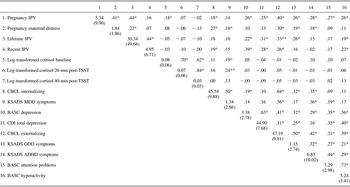
Descriptive statistics for all variables are shown in Table 1. Average levels for the three log-transformed cortisol samples (baseline M = 0.08, 20-min post-TSST M = 0.07, and 40-min post-TSST M = 0.05) were consistent with those generally reported by previous research examining childhood psychopathology and cortisol reactivity (Hankin et al., Reference Hankin, Badanes, Abuela and Watamura2010; Rao, Hammen, Ortiz, Chen, & Poland Reference Rao, Hammen, Ortiz, Chen and Poland2008; Spinrad et al., Reference Spinrad, Eisenberg, Granger, Eggum, Sallquist and Haugen2009). Medication, health, and food intake can influence cortisol levels (Granger et al., Reference Granger, Hibel, Fortunato and Kapelewski2009). In this sample, use of medication in the prior 2 days (yes/no), health quality in the prior 2 days (0–5), time from last meal, and time from waking up were not significantly associated with cortisol levels at baseline, 20-min post TSST-C, or 40-min post TSST-C, use of medication analysis of variance baseline cortisol, F (1, 119) = 2.17, p = .12; 20-min cortisol, F (1, 119) = 0.32, p = .73; 40-min cortisol, F (1, 119) = 0.36, p = .70; correlations with health quality, time from last meal, and time from waking up (r = –.11 to .11, ns). Although the sample as a whole failed to display a pattern of increasing cortisol after the stress-induction laboratory manipulation, on average, the task was reported to be “somewhat stressful (3)” (distress M = 3.24), with 73% of children giving a rating of “quite stressful (4)” or higher and only 5% of children providing a rating of “not stressful at all (1).” In addition, as reported below, a subgroup of children did show increased cortisol post-TSST-C.
Descriptive statistics and bivariate correlations

Note: Means (standard deviations) are on the diagonal.
*p < .05.
Rates of behavioral and emotional problems of clinical concern ranged based on the method of classification used (e.g., K-SADS vs. CDI). Overall, 10% of children experienced clinical levels of internalizing/depressive problems, as reported by either the child or the child's mother and 30% experienced clinical levels of externalizing problems, as reported by either the child or the mother, while 31% percent of children experienced symptoms of clinical significance (internalizing or externalizing) when all measures and reports were taken into account. These rates are much higher than those reported in large epidemiological studies in the United States and other countries (e.g., 13% in Merikangas et al., Reference Merikangas, He, Brody, Fisher, Bourdon and Koretz2010; 9.5% in Ford, Goodman, & Meltzer, Reference Ford, Goodman and Meltzer2003).
Per expectations, pregnancy IPV was associated with maternal distress during pregnancy and lifetime IPV exposure, and correlations were modest in size (r = .41–.44). In addition, cortisol levels were strongly associated over time (r = .72–.84) and correlated with exposure to IPV during pregnancy (baseline cortisol r = .18). Child outcomes evidenced mostly high within-construct correlations when rated by the same observer (r = .32–.73), but correlations across observers ranged from nonsignificant to moderate (r = .10–.44).
Hypothesis 1: Pregnancy IPV and child internalizing and externalizing levels
Structural equation models (Mplus 6.11; Muthén & Muthén, Reference Muthén and Muthén1998–2010) were used to test the proposed effect of prenatal IPV as a predictor of internalizing and externalizing problems, while controlling for the potentially confounding effects of maternal distress during pregnancy, lifetime IPV, and recent IPV exposure. To address normality concerns, maximum likelihood parameter estimates with standard errors and a mean-adjusted chi-square test statistic were used, utilizing the MLM estimator method in Mplus (Satorra & Bentler, Reference Satorra, Bentler, von Eye and Clogg1994).
Independent models were estimated using child and maternal reports as outcomes, based on theoretically important qualitative differences between children's subjective experiences and their mother's perceptions of their problems, as well as nonsignificant associations between mother and child reports for some measures. Model fit was evaluated based on the Pearson χ2 statistic, the root mean square error of approximation (RMSEA), and the comparative fit index (CFI). Excellent fit is demonstrated by a χ2 statistic with p > .05, RMSEA < 0.08, and CFI ≥ 0.95 (Schreiber et al., Reference Schreiber, Nora, Stage, Barlow and King2006). Based on the commonly used guideline of 5 to 10 cases per observed variable (Bentler & Chou, Reference Bentler and Chou1987), the present sample size was adequate to test the proposed hypotheses.
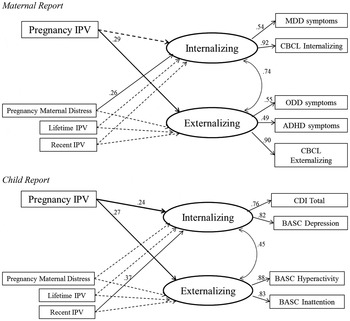
The estimated model for mother-reported child outcomes is shown in Figure 1. The model estimated two latent variables, using the CBCL internalizing T score and KSADS-MDD symptom count as indicators of internalizing symptoms, and the CBCL externalizing T score, KSADS-ODD symptom count, and KSADS-ADHD symptom count as indicators of externalizing symptoms. Direct paths were also estimated from pregnancy IPV and the covariates (pregnancy maternal distress, lifetime IPV, and recent IPV exposure) to both internalizing and externalizing latent variables. Model fit was excellent, Pearson χ2 (16, N = 119) = 15.28, p = .50, CFI = 1.0, RMSEA = 0. Pregnancy IPV had a significant effect on externalizing symptoms (standardized b = 0.29, p = .00), above and beyond the nonsignificant effects of all covariates. Pregnancy IPV did not have a significant effect on internalizing symptoms, but maternal distress during pregnancy did (standardized b = 0.26, p = .01).
Pregnancy intimate partner violence predicts child internalizing and externalizing problems. Dashed lines represent nonsignificant estimated paths.

The estimated model for child-reported outcomes is also shown in Figure 1. The model included the same predictors but used the CDI total T score and the BASC depression score as indicators of internalizing symptoms, and the BASC attention problems and BASC hyperactivity scores as indicators of externalizing symptoms. Model fit was excellent, Pearson χ2 (9, N = 119) = 9.41, p = .40, CFI = 1.00, RMSEA = 0.02. Pregnancy IPV predicted both the internalizing and externalizing latent variables (standardized b = 0.28, p = .03, and standardized b = 0.28, p = .01, respectively) above and beyond the influence of covariates. The only covariate that had a significant effect was IPV exposure, which predicted child-reported internalizing symptoms (standardized b = 0.37, p = .00). In sum, Hypothesis 1 was mostly supported by the data, as pregnancy IPV predicted child- and mother-reported externalizing and child-reported internalizing symptoms.
Hypothesis 2: Pregnancy IPV and profiles of cortisol reactivity
Latent profile analysis (Gibson, Reference Gibson1959; Lazarsfeld & Henry, Reference Lazarsfeld and Henry1968) was used to identify the number of profiles that best characterized different patterns of cortisol reactivity. Latent profile analysis is an empirically based method that defines classes or profiles of individuals based on common characteristics, using continuous indicators. Models with an increasing number of profiles are estimated and the best solution can be selected based on model fit, using indicators of external validity or generalizability, such as log-likelihood, adjusted Bayesian information criterion and Akaike information criterion (best for smaller values), as well as indicators of maximal distinction between the groups, such as entropy (best for values closer to 1.0; Kline, Reference Kline2005).
Models with one through five latent profiles were estimated using baseline, 20-min post-TSST, and 40-min post-TSST cortisol scores (Mplus 6.11). Fit indices (see Table 2) suggested that Akaike information criterion and adjusted Bayesian information criterion significantly improved as the number of profiles increased from the one-profile to the three-profile model, and they showed small improvements to the four- and five-profile models. In addition, the four- and five-profile models had one profile comprising less than 5% of the sample, suggesting the solution may be unstable (McCrae, Chapman, & Christ, Reference McCrae, Chapman and Christ2006). Thus, the three-profile model was selected as the best fitting solution. To test the effect of IPV on cortisol secretion patterns, the three-profile model was estimated again, using pregnancy IPV and the covariates as predictors of latent profile membership. This approach is thought to be superior to a multiple-step model where profile membership is determined independently from predictor variables because it leads to more accurate estimates and standard deviations (Asparouhov & Muthén, Reference Asparouhov and Muthén2014).
Fit indices for 1 to 5 profile models using latent profile analysis

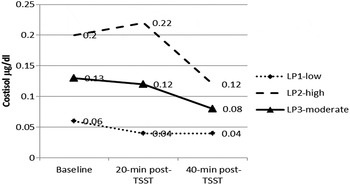
The three latent profiles in the final model are shown in Figure 2. The results suggest a group of children with consistently low levels of cortisol at the 3 measurement times (LP1-low n = 88; baseline M = 0.06 µg/dl, 20-min M = 0.04 µg/dl, 40-min M = 0.04 µg/dl). The second profile comprised a small group of children who displayed cortisol levels that were consistently higher than the other two profiles, increased from baseline to the peak score 20-min poststressor and then decreased by 40-min poststressor (LP2-high n = 10; baseline M = 0.20 µg/dl, 20-min M = 0.22 µg/dl, 40-min M = 0.12 µg/dl). Children in the third profile displayed moderate levels of cortisol consistently (LP3-moderate n = 21; baseline M = 0.13 µg/dl, 20-min M = 0.12 µg/dl, 40-min M = 0.08 µg/dl). To evaluate if the shape or trajectory of cortisol secretion differed for the three groups of children, a repeated measures analysis of variance with planned comparisons for polynomial effects was conducted. This analysis revealed significant differences between the three groups in their polynomial shape (b = 0.08, p = .00), confirming that these groups not only had different average levels of cortisol but also different trajectories of reactivity.
Latent profiles of cortisol secretion.

Pregnancy IPV was a significant predictor of group membership, above and beyond the covariates. Pregnancy IPV increased the likelihood of membership in LP2-high, as compared to LP1-low (standardized b = 2.34, p = .02) and LP3-moderate (standardized b = 2.24, p = .03), above and beyond the effect of all covariates. Mean pregnancy IPV exposure scores were LP1-low M = 2.77, LP2-high M = 7.40, and LP3-moderate M = 0.76. In terms of covariate effects, membership in LP2-high, as compared to LP1-low, was also predicted by recent IPV exposure (standardized b = 2.05, p = .04; LP2-high M = 20.37 and LP3-moderate M = 9.10). Thus, Hypothesis 2 was partially supported by the data, as pregnancy IPV predicted a profile of cortisol hyperactivity but not a profile of hypoactivity.
Hypothesis 3: Pregnancy IPV, cortisol reactivity profile, and child internalizing and externalizing levels
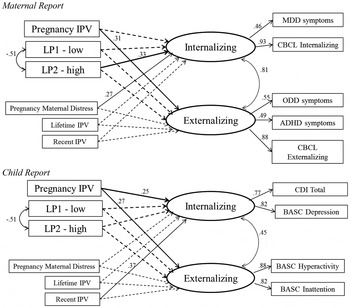
The last set of analyses examined the associations among prenatal IPV, latent profile membership, and child behavioral outcomes. Structural equation modeling using the MLM estimator method in Mplus was used to test for associations between the high-cortisol profile and internalizing symptoms as well as between the low-cortisol profile and externalizing symptoms. The proposed model included two dummy coded variables that represented class membership (LP1-low = 1 vs. 0, LP2-high = 1 vs. 0) as predictors of internalizing and externalizing problems. In addition, direct paths from each covariate and pregnancy IPV to internalizing and externalizing symptoms were included. Again, the correlation between the internalizing and externalizing latent variables was computed (see Figure 2). Independent models were estimated for maternal and self-report of child outcomes.
The model predicting maternal report of child outcomes was estimated first. The proposed model had excellent fit statistics, Pearson χ2 (26, N = 119) = 25.11, p = .51, RMSEA = 0, CFI = 0.97. Membership in LP2-high predicted mother report of internalizing problems (standardized b = 0.32, p = .00) but not externalizing problems. Membership in LP1-low was not associated with behavioral outcomes (see Figure 2). The second model predicted child-reported internalizing and externalizing problems. This model also fit the data very well, Pearson χ2 (17, N = 119) = 16.14, p = .51, RMSEA = 0, CFI = 1.00. The two cortisol profile dummy variables were not associated with self-reported child outcomes. Overall, the results provide mixed support for Hypothesis 3; mother-reported child internalizing problems were associated with a profile of cortisol hyperactivity, but mother-reported externalizing and child-reported outcomes were not associated with children's profile of cortisol secretion.
Discussion
The present study sought to evaluate the long-term influence of IPV during pregnancy on children's HPA axis activity (stress-induced cortisol levels) and their levels of internalizing and externalizing behaviors at age 10, as well as associations between specific patterns of cortisol activity and particular behavioral outcomes (internalizing vs. externalizing problems) in the context of prenatal IPV exposure. This study is the first examination of long-term offspring outcomes after IPV exposure in utero, a common and very stressful experience for women (Taillieu & Brownridge, Reference Taillieu and Brownridge2010). In addition, the study employed rigorous methodology, including a prospective longitudinal design, multiple assessment methods and informants, and state-of-the art statistical techniques. This research used person-oriented methods to capture the hypothesized nonlinear relationships between pregnancy IPV and cortisol secretion (i.e., prenatal IPV increases risk for both high and low cortisol reactivity), a strategy that has not been used previously to assess the influence of prenatal stress.
A profile of high cortisol secretion predicts mother-rated child internalizing problems. Dashed lines represent nonsignificant estimated paths.

We hypothesized that (a) prenatal IPV increases risk for internalizing and externalizing problems, (b) prenatal IPV increases risk for a profile of cortisol hyper- and hypoactivity in response to stressors, and (c) these patterns of hyper and hypo activity are differentially associated with internalizing and externalizing symptoms. The results partially supported these hypotheses: exposure to IPV during pregnancy predicted child-reported internalizing and externalizing problems, mother ratings of child externalizing problems, and a profile of high cortisol secretion before and after stress challenge. These results were significant above and beyond the influence of maternal distress during pregnancy and IPV that occurred during the child's life or recently. In addition, a profile of high cortisol secretion was associated with maternal reports of child internalizing behaviors. However, cortisol hyperactivity was not associated with child-reported internalizing problems. Also contrary to hypotheses, IPV during pregnancy was not associated with a profile of hypocortisolism, and cortisol secretion profiles were not associated with child externalizing behaviors. The results provide additional evidence to the growing literature that confirms that prenatal stress can lead to long-term disruptions in adaptation (for a review, see Glover et al., Reference Glover, O'Connor and O'Donnell2010). Findings also highlight the importance of assessing for and addressing IPV experiences during pregnancy in addition to general levels of distress. This research points to the need for large longitudinal studies with IPV-exposed pregnant women to better understand the mechanisms responsible for the lasting detrimental outcomes documented in our study.
Pregnancy IPV exposure predicted higher levels of child-reported internalizing and externalizing symptoms and mother-reported externalizing symptoms. These relationships replicate those reported by other longitudinal examinations of a positive association between pregnancy maternal stress and distress and both internalizing and externalizing problems during school age and adolescence (Davis & Sandman, Reference Davis and Sandman2012; O'Connor et al., Reference O'Connor, Ben-Shlomo, Heron, Golding, Adams and Glover2005; Van den Bergh et al., Reference Van den Bergh, Van Calster, Smits, Van Huffel and Lagae2008), as well as reports of associations between pregnancy IPV exposure and early childhood temperamental difficulties and externalizing problems (Burke et al., Reference Burke, Lee and O'Campo2008; Levendosky et al., Reference Levendosky, Leahy, Bogat, Davidson and von Eye2006; Martinez-Torteya et al., Reference Martinez-Torteya, Field, Bogat, Levendosky, Davidson and von Eye2009). This finding suggests that prenatal IPV is a strong predictor of child cortisol levels and behavioral outcomes even when more recent stressors are considered (i.e., child report of recent IPV), a variable that is often unavailable in other longitudinal studies of prenatal stress (e.g., those assessing one-time, man-made, or natural disasters; Huizink et al, Reference Huizink, Bartels, Rose, Pulkkinen, Eriksson and Kaprio2008). In contrast, IPV during pregnancy was not a predictor of mother-reported child internalizing problems. This may be due to well-documented discrepancies between parent and child reports of internalizing symptoms (Briggs-Gowan, Carter, & Schwab-Stone, Reference Briggs-Gowan, Carter and Schwab-Stone1996) and children being somewhat better reporters of their internal states (e.g., sadness, lack of enjoyment, worry) than their parents (Kolko & Kazdin, Reference Kolko and Kazdin1993; March & Albano, Reference March, Albano, Ollendick and Prinz1998).
Using LPA, we identified three distinct patterns of stress-induced cortisol response, which were characterized by consistent low cortisol levels (LP1-low n = 88), consistent moderate levels (LP3-moderate n = 21), and high levels of cortisol that peaked 20-min poststressor (LP2-high n = 10). These profiles differed in overall cortisol secretion during the measurement period as well as the trajectory of change in cortisol levels over time. The three empirically derived patterns were somewhat consistent with expectations, representing a tendency to produce high, moderate, and low levels of cortisol in a stressful situation. Moreover, the profile of high cortisol secretion before and after the TSST-C was predicted by IPV experienced in utero. This finding is consistent with other longitudinal studies of non-IPV stress and maternal distress, which have reported increased diurnal or resting cortisol levels at ages 5, 10, and 14 (Gutteling, de Weerth, & Buitelaar, Reference Gutteling, de Weerth and Buitelaar2005; Huizink et al, Reference Huizink, Bartels, Rose, Pulkkinen, Eriksson and Kaprio2008; O'Connor et al., Reference O'Connor, Ben-Shlomo, Heron, Golding, Adams and Glover2005; Van den Bergh et al., Reference Van den Bergh, Van Calster, Smits, Van Huffel and Lagae2008). Our study advances previous research by documenting differences in challenged cortisol secretion, in addition to previously reported altered diurnal cortisol regulation, and identifying prenatal IPV exposure as a strong influence that affects different biobehavioral domains well into the middle-childhood years.
The lasting effects of prenatal IPV suggest that chronic traumatic stress during this sensitive period of rapid fetal brain development might set the foundation for HPA axis functioning and broader behavioral and emotional regulation in the long term (Huizink et al., Reference Huizink, Mulder and Buitelaar2004; Talge et al., Reference Talge, Neal and Glover2007). The notion that these environmentally induced prenatal adaptations are somewhat stable is consistent with findings of multiple biological abnormalities among children exposed to prenatal stress, including larger amygdala volumes at age 7 (Buss et al., 2012) and shorter telomere length among newborns and adults (Entringer et al., Reference Entringer, Epel, Kumsta, Lin, Hellhammer and Blackburn2011, Reference Entringer, Epel, Lin, Buss, Shahbaba and Blackburn2013). Several mechanisms have been proposed to account for the potent effect of prenatal stress, which may also apply to prenatal IPV exposure. These mechanisms include maternal HPA axis dysregulation (Inslicht et al., Reference Inslicht, Marmar, Neylan, Metzler, Hart and Otte2006; Johnson, Delahanty, & Pinna, Reference Johnson, Delahanty and Pinna2008; Seedat, Stein, Kennedy, & Hauger, Reference Seedat, Stein, Kennedy and Hauger2003), which may then lead to increased cortisol passing through the placenta to the fetus; decreased levels of 11β-hydroxysteroid dehydrogenase 2 (11β-HSD2), the enzyme that metabolizes cortisol, leading to higher placental cortisol levels, as well as cortisol-induced supression of uteroplacental blood flow (see de Weerth & Buitelaar, Reference de Weerth and Buitelaar2005; and O'Donnell, O'Connor, & Glover, Reference O'Donnell, O'Connor and Glover2009, for reviews). In addition, there may be IPV-specific effects. Experiencing IPV can interfere with a pregnant woman's ability to develop maternal representations of her growing fetus, a natural process that influences the quality of later mother–child attachment (Crawford & Benoit, Reference Crawford and Benoit2009; Dayton, Levendosky, Davidson, & Bogat, Reference Dayton, Levendosky, Davidson and Bogat2010).
This unique effect of pregnancy IPV exposure on child HPA axis activity and internalizing/externalizing levels, which was found above and beyond the effects of maternal distress, challenges the assumption that all stressors are equivalent when it comes to predicting the influence of stress during pregnancy on child outcomes. Most large longitudinal studies have relied on accounts of global stress levels, distress, or depression and anxiety symptoms, including pregnancy specific anxiety (Davis & Sandman, Reference Davis and Sandman2012; Huizink et al, Reference Huizink, Bartels, Rose, Pulkkinen, Eriksson and Kaprio2008; O'Connor et al., Reference O'Connor, Ben-Shlomo, Heron, Golding, Adams and Glover2005; Van den Bergh et al., Reference Van den Bergh, Van Calster, Smits, Van Huffel and Lagae2008). These studies have made very significant contributions and paved the way for future studies with more nuanced assessments of prenatal stress that take into account important characteristics of stressors, such as type (interpersonal vs. noninterpersonal), frequency and duration (chronic vs. single event), etc. This research is essential for a more comprehensive understanding of the links between prenatal stress and offspring outcomes, especially in situations of severe stress, such as IPV and other forms of victimization. This finding also has practice implications, suggesting that it is essential to screen for and address IPV experiences during pregnancy, as their noxious effects may be difficult to reverse, even in the absence of significant depression or anxiety reactions.
Mother-reported child internalizing problems were associated with the high-cortisol profile, a finding that is consistent with previous studies (Essex et al., Reference Essex, Klein, Cho and Kalin2002; Hatzinger et al., Reference Hatzinger, Brand, Perren, von Wyl, von Klitzing and Holsboer-Trachsler2007; Lopez-Duran et al., Reference Lopez-Duran, Kovacs and George2009). HPA axis activity and children's behavioral outcomes were assessed concurrently, precluding identification of cause–effect relationships or testing of mediation methods. However, many have hypothesized that HPA axis dysregulation may be a mechanism of risk implicated in the development of depression and anxiety problems. Goodyer (Reference Goodyer2008) proposed that chronic tissue exposure to the deleterious catabolic effects of cortisol impairs neural circuits responsible for threat signal detection and regulation of pleasure and motivation. These neural systems are involved in key features of depression and anxiety, including high levels of negative affect (e.g., frequent sad mood, worry) and low levels of positive affect and enjoyment (e.g., anhedonia). Research examining etiological factors for adult depression suggests a link between early trauma, HPA axis hyperactivity, and depression among a distinct subset of depressed (adult) individuals (Heim, Newport, Mletzko, Miller, & Nemeroff, Reference Heim, Newport, Mletzko, Miller and Nemeroff2008).
In contrast, no associations were found between child-related internalizing problems and patterns of cortisol secretion. Self-reports are typically considered a better reflection of children's internal states (Kolko & Kazdin, Reference Kolko and Kazdin1993) than parental reports. However, our mother-report latent factor included the MDD symptom score from a semistructured clinical interview (K-SADS), an instrument that takes into account clinical judgment in regard to the frequency and severity of symptoms. The K-SADS-MDD score had the highest bivariate correlations with cortisol scores. Because there was no equivalent interview used for the child-report latent factor, the differential association of cortisol profiles with child- and mother-reported internalizing behaviors may reflect measurement error. In addition, the differential association reported may suggest that cortisol hyperactivity is related specifically to MDD symptoms, rather than the more general domain of internalizing behaviors.
Some of the findings were not consistent with a priori hypotheses. We did not find associations between IPV during pregnancy and the low-cortisol profile or low cortisol secretion and externalizing outcomes. However, it is unlikely that the LP1-low profile constitutes a pattern of true hypocortisolism; this profile characterized the majority of children in our sample, suggesting it does not reflect maladaptation. There are several potential explanations for this finding. First, it may be a result of the psychosocial stressor used in this study. The TSST-C induces mild stress and was rated on average to be “somewhat stressful” in this sample. Even though this task is helpful to identify children who are highly sensitive to stressors, perhaps a more impactful stressor is required to distinguish children who are somewhat resilient to stress from those who display a truly blunted response to stressors, characterized by lack of reactivity in situations that would mobilize a cortisol response for most other children. In their review, Adam et al. (Reference Adam, Klimes-Dougan, Gunnar, Coch, Dawson and Fischer2007) suggest that more severe provocation stressors (e.g., listening to a peer denigrating the subject's performance) may be more effective at differentiating not at risk children from those with a blunted cortisol response. Second, it may be that trauma exposure leads to a pattern of initial high reactivity that evolves into dampened reactivity and low diurnal cortisol levels over time, such that the system is downregulated after a long period of chronic activation (Heim et al., Reference Heim, Newport, Mletzko, Miller and Nemeroff2008). Support for a similar developmental progression was provided by Trickett, Noll, Susman, Shenk, and Putnam (Reference Trickett, Noll, Susman, Shenk and Putnam2010), who reported initially high diurnal cortisol levels among sexually abused children and adolescents, which eventually shifted into low diurnal cortisol levels during adulthood. If this is the case, the sample assessed may be too young to display a pattern of trauma-related hypocortisolism.
Relationships between child outcomes and other covariates included in analyses emerged. Consistent with previous research, maternal prenatal distress predicted mother-reported internalizing problems while child reports of recent IPV exposure predicted child-reported levels of internalizing symptoms (O'Connor et al., Reference O'Connor, Ben-Shlomo, Heron, Golding, Adams and Glover2005; Van den Bergh et al., Reference Van den Bergh, Van Calster, Smits, Van Huffel and Lagae2008; Wolfe et al., Reference Wolfe, Crooks, Lee, McInthyre-Smith and Jaffe2003). In addition, the high-cortisol profile was also associated with children's reports of IPV experienced during the past year. It is important to note that this finding supports a nondeterministic view of “programming” processes; that is, additional stressors can have a unique negative influence on cortisol regulation, regardless of levels of prenatal stress, such that the prenatal environment does not fully determine childhood outcomes. Other research has shown ongoing influences of stress on HPA axis functioning throughout childhood (Cushing & Kramer, Reference Cushing and Kramer2005). This finding is also consistent with the literature that links IPV exposure during childhood with HPA axis activity (Hibel et al., Reference Hibel, Granger, Blair and Cox2011; Saltzman et al., Reference Saltzman, Holden and Holahan2005). Perhaps children who are repeatedly exposed to IPV are more sensitive to relatively mild stressors because they assign threatening meanings to events more often than nonexposed children (Cohen, Perel, DeBellis, Friedman, & Putnam, Reference Cohen, Perel, DeBellis, Friedman and Putnam2002; DeJonghe, Bogat, Levendosky, von Eye, & Davidson, Reference DeJonghe, Bogat, Levendosky, von Eye and Davidson2005). The frequent perception of threat may result in the high baseline and stress-induced cortisol levels observed in the high-cortisol profile.
Limitations and future directions
We did not assess negative life events or other stressful events experienced during pregnancy. However, most research on the effects of maternal mental health and life event stressors during pregnancy report that pregnancy maternal mental health (which is included in our models in the maternal distress construct) is a stronger predictor of child outcomes than general stress (Austin et al., Reference Austin, Hadzi-Pavlovic, Leader, Saint and Parker2005; Mohler, Parzer, Brunner, Wiebel, & Resch, Reference Mohler, Parzer, Brunner, Wiebel and Resch2006), making it unlikely that our results would be changed if we included a measure of life events during pregnancy. In addition, many of the important risk indicators assessed in this study (e.g., prenatal IPV exposure, maternal mental health, maternal harsh parenting) were measured using maternal reports only, increasing the potential influence of socially desirable responding on our results. Thus, findings should be replicated using information from additional reporters (e.g., other caregivers).
Moreover, we assessed the HPA axis stress-response and children's behavioral outcomes concurrently, precluding identification of cause–effect relationships. The stress-induction procedure and the saliva sampling framework used could have failed to capture some of the variability that exists in individual responses to stressors; for example, research has found that anticipatory anxiety can influence baseline cortisol values (Martel et al., Reference Martel, Hayward, Lyons, Sanborn, Varady and Schatzberg1999) and repeated baseline sampling or a more extensive rest period (as compared to the 20-min rest period used in this study) have been used to counter these effects (e.g., Allwood, Handwerger, Kivlighan, Granger, & Stroud, Reference Allwood, Handwerger, Kivlighan, Granger and Stroud2011). In addition, tasks that vary in level of stressfulness from mild to severe may provide more nuanced information about profiles of stress-induced cortisol secretion and their correlates. Given the low prevalence of the high-cortisol profile (n = 10), replication of our findings using larger samples is needed. In addition, longitudinal research is needed to clarify potential directional relationships between cortisol activity and internalizing/externalizing symptoms.
It is important that the average internalizing and externalizing scores in our sample were well within normative levels: only 10% of children experienced clinical levels of internalizing/ depressive problems as reported by either the child or mother, and 30% of children had clinically significant levels of externalizing problems, according to either reporter. Thus, findings from our sample best represent moderately at-risk children and may not be applicable to a clinical population. The frequency of IPV experienced by this community sample was, on average, 9 instances of violence during pregnancy (range = 0–62) and 40 instances of violence throughout the child's lifetime. Although these levels of IPV are consistent with those reported by other researchers (e.g., Graham-Bermann & Miller, Reference Graham-Bermann and Miller2013), this experience may not be representative of that of women who experience chronic and/or severe IPV, which may be more characteristic of samples recruited through domestic violence shelters.
Conclusion
This study provided the first prospective evidence of the long-term negative effects of exposure to IPV during pregnancy on child development. Children with prenatal IPV exposure were more likely to display a pattern of high cortisol secretion in response to stressors and more child-reported internalizing and child- and mother-reported externalizing behaviors. These results were significant above and beyond the influence of maternal distress during pregnancy and more recent IPV exposure, supporting the growing consensus that prenatal stress can lead to lasting disruptions in adaptation after birth. Findings also highlight the need for more longitudinal examinations of prenatal IPV exposure as well as the importance of professionals assessing and addressing IPV experiences when working with pregnant women.