INTRODUCTION
Studies examining changes in assemblages of parasites across space and time have sparked considerable interest in the field of parasite community ecology. However, few studies have included replication over multiple years and those that have, yielded contradictory results; studies involving comparisons across disparate localities are even less common (González and Poulin, Reference González and Poulin2005). This study focuses on trends in prevalence and intensity in the three cestode species parasitizing the spiral intestine of the spiny dogfish, Squalus acanthias L., across seasons over a 3-year period in the northwestern Atlantic Ocean. This work was designed to allow comparison with a previous study of one of the species, in the northeastern Atlantic, which suggested that the prevalence of Trilocularia gracilis in S. acanthias varies among seasons (McCullough et al. Reference McCullough, Fairweather and Montgomery1986). In combination, these studies provide an opportunity for comparison of infection parameters across disparate parts of the geographical distribution of this host species, as well as across cestode species within one locality.
Squalus acanthias is considered to be the most abundant shark species in the world, and is important to many commercial fisheries (Compagno et al. Reference Compagno, Dando and Fowler2005; Gallucci et al. Reference Gallucci, McFarlane and Bargmann2009). Despite such fishing pressure, this relatively small shark species remains widely distributed in temperate to subarctic and subantarctic waters globally, inhabiting the Atlantic and South Pacific Oceans (Compagno et al. Reference Compagno, Dando and Fowler2005; Ebert et al. Reference Ebert, White, Goldman, Compagno, Daly-Engel and Ward2010). While the ecology of S. acanthias has been studied extensively (e.g. Gallucci et al. Reference Gallucci, McFarlane and Bargmann2009), much less is known about the ecology of its cestodes. Basic parasite survey data for this shark indicate that its tapeworm fauna consists of three species: Gilquinia squali (Fabricius, 1794) Dollfus, 1930, Phyllobothrium squali Yamaguti, 1952, and T. gracilis (Olsson, 1867) Olsson, 1869 (see McCullough and Fairweather, Reference McCullough and Fairweather1983). The infection parameters of the latter species (as Trilocularia acanthiaevulgaris) in S. acanthias were monitored through time in a study conducted in the northeastern Atlantic Ocean in the Irish Sea (McCullough et al. Reference McCullough, Fairweather and Montgomery1986).
McCullough et al. (Reference McCullough, Fairweather and Montgomery1986) observed seasonal fluctuations in the prevalence and abundance (= mean worm burden) of T. gracilis. In male sharks they found peak infections occurring in June and July for each of the 2 years sampled. They also noted increased development of proglottids on the strobila, as well as a greater number of free proglottids produced during these peak months, indicating substantial reproductive effort. Free proglottids were no longer found by August and September and the overall prevalence of worms also declined sharply at that time. The mean number of worms in female sharks showed no seasonal pattern or peak, although far fewer female sharks were examined than males (43 females; 181 males). McCullough et al. (Reference McCullough, Fairweather and Montgomery1986) hypothesized that the seasonal trends seen in male sharks may be due to one of several factors which included water temperature, cyclical changes in levels of reproductive hormones and thyroid activity associated with migration and mating of hosts, or, alternatively, diet and the availability of infected intermediate hosts.
In order to place these previous findings in a more global context and to better characterize the widely distributed cestode species with complex life cycles parasitizing S. acanthias, this study explored seasonal fluctuations in all three cestode species in a geographic region removed from that of the McCullough et al. (Reference McCullough, Fairweather and Montgomery1986) Irish Sea study – the northwestern Atlantic Ocean off Rhode Island, USA. If cestode species exhibit similar patterns globally, we would expect to find the highest prevalence, intensity and egg production occurring in the summer months for T. gracilis in the northwestern Atlantic. Furthermore, given the different evolutionary histories of the three cestode species, we might expect to see different trends among the species comprising this community. If, however, cestode patterns are more dependent on shared ecological conditions (e.g. proximal environmental conditions) rather than evolutionary history, we expect to see similarities among the cestode species. Discovering the drivers of fluctuations of elasmobranch cestode infections will further our understanding of the transmission dynamics of organisms with complex life cycles in the vast ocean environment.
MATERIALS AND METHODS
Sampling and cestode identification
Between February 2007 and October 2009, 217 spiny dogfish, S. acanthias, were obtained from a commercial trawler working off the coast of Rhode Island, USA from the region circumscribed by 41°18′53·99″N, 71°42′29·99″W; 41°10′30·00″N, 71°16′18·00″W; 40°53′30·06″N, 71°40′23·97″W. Sharks were examined seasonally (i.e. winter [Dec–Feb], spring [Mar–May], summer [June–Aug], autumn [Sept–Nov]) during the 3-year period. For each shark, total length and sex were recorded, and the spiral intestine was removed, opened with a longitudinal mid-ventral incision and immediately examined under a stereomicroscope for cestodes. Cestodes recovered were either fixed in 95% ethanol or 4% seawater-buffered formalin. The spiral intestine of each shark was then fixed in 4% seawater-buffered formalin and later transferred to 70% ethanol for storage and subsequent more careful examination for additional cestodes using a stereomicroscope. Cestodes were prepared as whole mounts on glass slides using standard protocols (e.g. Pickering and Caira, Reference Pickering and Caira2008), identified, sorted by species and counted.
Water temperature data
Average surface water temperature for the 30 days prior to each collection date was estimated from data obtained from NOAA's National Oceanographic Data Center (NODC) website (http://www.nodc.noaa.gov/dsdt/cwtg/natl_tmap.html). Stations used were those closest to the collection sites, either Newport, RI (Station ID: 8452660; 41°30·3′N, 71°19·6′W) or Montauk, NY (Station ID: 8510560; 41°2·9′N, 71°57·6′W). For comparative purposes, average monthly water temperatures for the coastal water of Ireland from 1961–1990 were obtained from The Irish Meterological Service Online (http://www.met.ie/marine/marine_climatology.asp), as they included the dates of the McCullough et al. (Reference McCullough, Fairweather and Montgomery1986) study (i.e. 1981–1983).
Statistical analyses
All statistical analyses were performed using R software (R Development Core Team, 2011). Measures of infection explored were prevalence and mean intensity for each cestode species, all calculated following Bush et al. (Reference Bush, Lafferty, Lotz and Shostak1997). These infection parameters were analysed separately for each cestode species using generalized linear models (GLMs). For prevalence data, a logistic regression specifying a binomial distribution with a logit-link was used. For intensity data, because of the heavily aggregated nature of worm count data, a negative binomial regression model was used. Season, shark total length (binned by size class), year and presence of other cestode species were included as categorical variables in the model. Only main effects are reported here. Post-hoc tests (Wald's test and ANOVA [Type III]) were used to help interpret the overall significance of the variables.
Comparing northwestern Atlantic data to Irish Sea data
For comparative purposes, the McCullough et al. (Reference McCullough, Fairweather and Montgomery1986) data for prevalence and abundance were averaged by season, in order to allow direct comparison with our data for the northwestern Atlantic. However, given that their sample sizes for each collection event were not reported, it was not possible to generate s.e. bars for each seasonal mean.
RESULTS
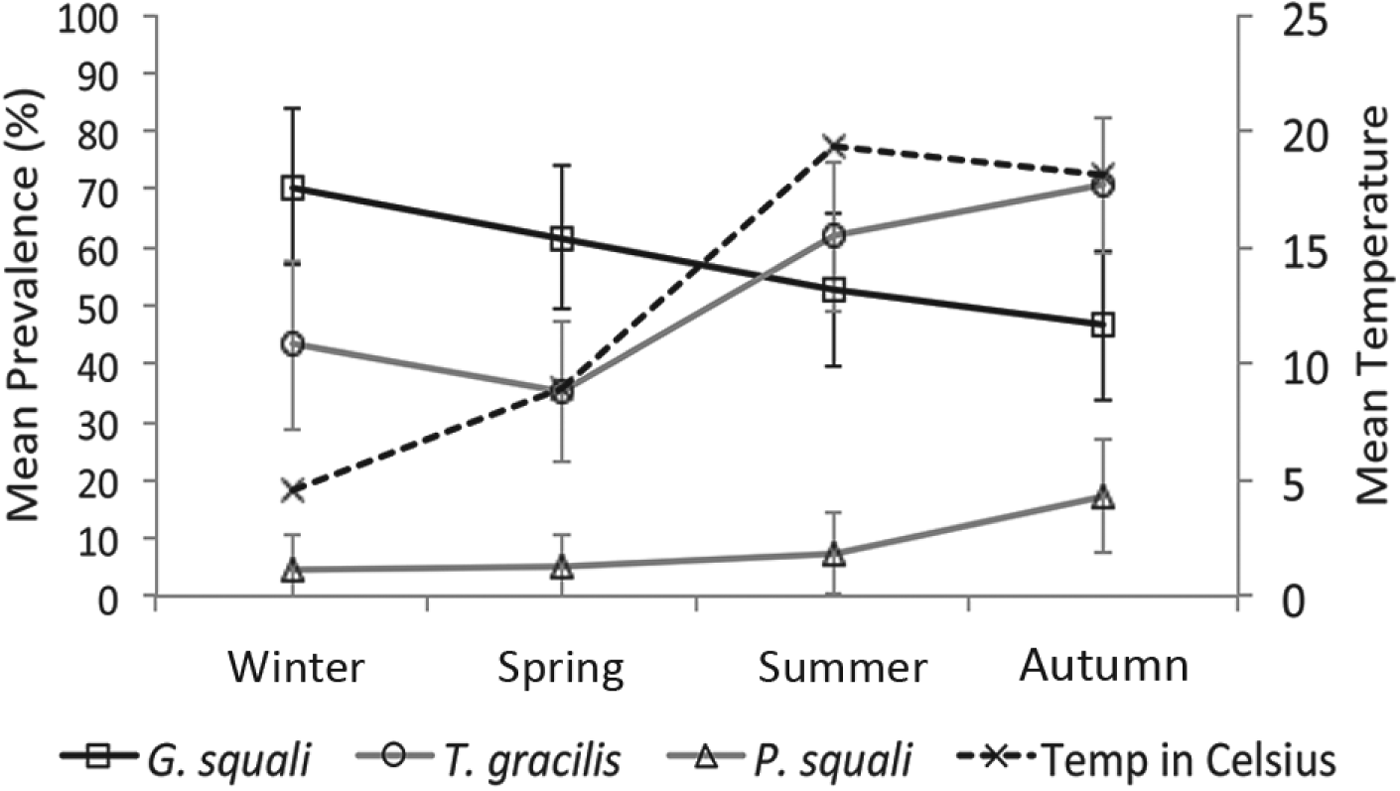
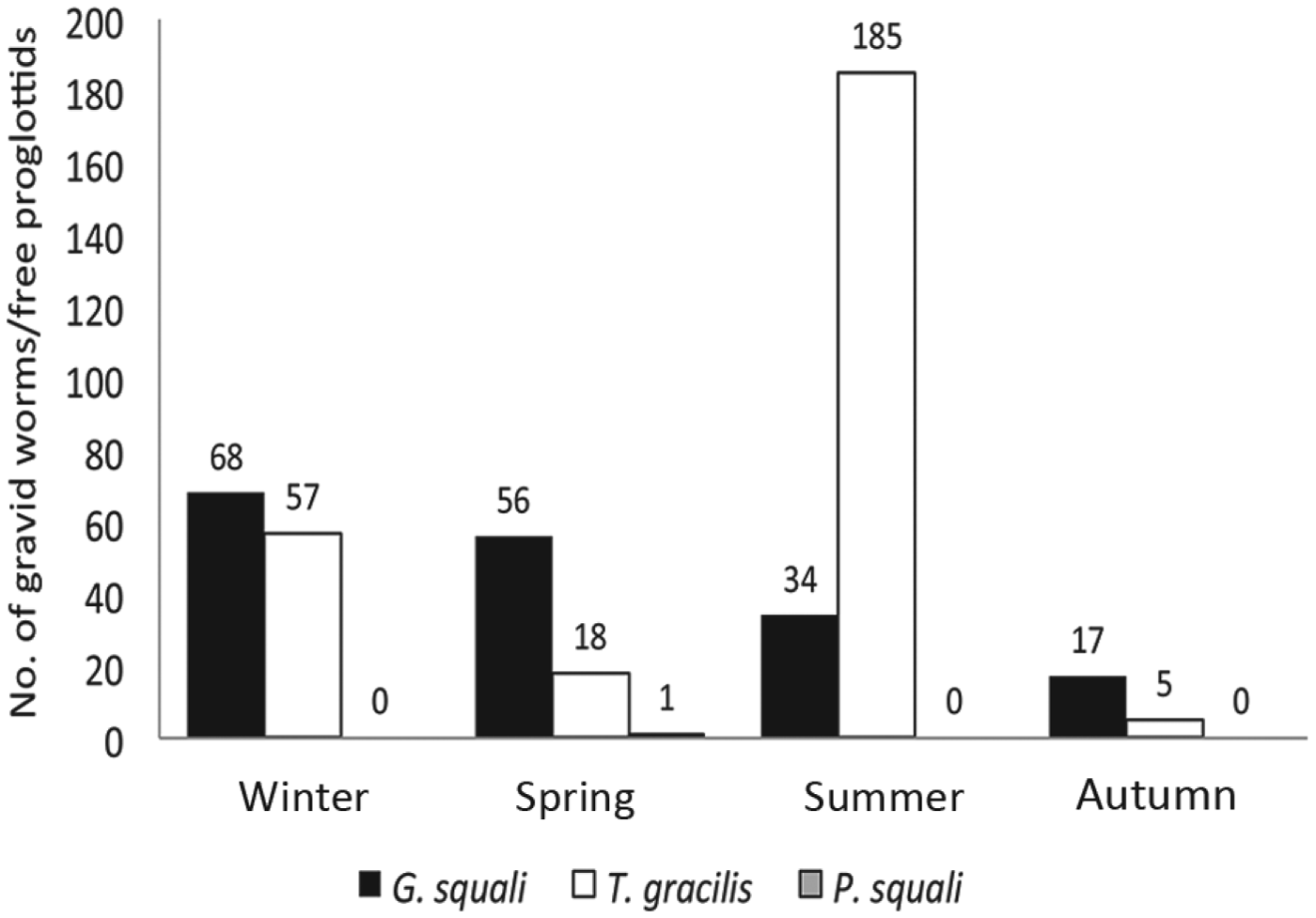
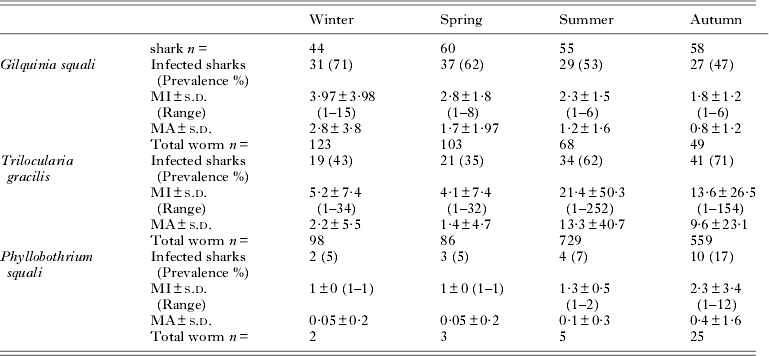
Sample sizes per seasonal collection event ranged from 10 to 30 sharks with a mean of 18±6. In total, the 217 shark specimens examined, which consisted of 189 females and 28 males, yielded 1850 individual cestodes, specifically 1472 specimens of T. gracilis, 343 specimens of G. squali, and 35 specimens of P. squali. Mean prevalence and intensity data for the three cestode species are given in Table 1. Mean prevalence across seasons over the 3 years of the study for each of the three cestode species is shown in Fig. 1, as is average water temperature by season. Number of gravid worms or, in the case of the hyperapolytic T. gracilis, free proglottids by season and species is shown in Fig. 2. Unfortunately, the skewed nature of the sex ratio of sharks examined (i.e. 87% female) prevented statistical analysis of the effect of sex on measures of infection across season.
Seasonal mean prevalence of three cestode species infecting Squalus acanthias off Rhode Island from 2007–2009; average temperature (°C) is also reported. Bars represent 95% confidence intervals.

Total number of gravid worms or free proglottids recovered by season over 3 years from Rhode Island, USA.

Seasonal data from collections of three cestode species found parasitizing shark, Squalus acanthias over 3 years from off the coast of Rhode Island, northwestern Atlantic. Prevalence, mean intensity±s.d. (MI±s.d.), mean abundance±s.d. (MA±s.d.) of cestode species, and total worm counts reported by season

Gilquina squali: Both season and shark total length were found to be significant predictors (χ 2 = 8, d.f. = 3, P = 0·046; χ 2 = 5·9, d.f. = 1, P = 0·015, respectively) of prevalence of G. squali with larger sharks being infected more often. Prevalences seen in winter and spring were not significantly different from one another (χ 2 = 2·8, d.f. = 1, P = 0·096), but prevalence in winter and spring was significantly higher than in autumn (χ 2 = 8·5, d.f. = 2, P = 0·004; χ 2 = 4, d.f. = 1, P = 0·044, respectively); summer prevalence did not significantly differ from winter, spring, or autumn (χ 2 = 1·9, d.f. = 1, P = 0·16; χ 2 = 3·2, d.f. = 1, P = 0·07; χ 2 = 0·004, d.f. = 1, P = 0·95, respectively) (see Fig. 1). Of the parameters examined, only season was found to have had a significant effect on intensity (χ 2 = 16·5, d.f. = 3, P<0·001). Seventy-one per cent of gravid worms were found in the winter and spring.
Trilocularia gracilis: The overall effect of season was significant with respect to the prevalence (χ 2 = 17·8, d.f. = 3, P<0·001) and intensity (χ 2 = 24·3, d.f. = 3, P<0·001) of T. gracilis. In fact, the combined season model (winter+spring and summer+autumn) was found to be the best model, and was significant for both prevalence (χ 2 = 16·8, d.f. = 1, P<0·001) and intensity (χ 2 = 21·4, d.f. = 1, P<0·001). The higher water temperatures found in the summer and autumn were associated with higher prevalence and infection intensities (see Fig. 1). Seventy per cent of gravid-free proglottids were found in the summer.
Phyllobothrium squali: The rarity of P. squali in sharks collected in all seasons prevented meaningful statistical analysis. As a consequence only descriptive statistics (Table 1) are reported for this species. This species exhibited relatively low infections overall; both prevalence and intensity were higher in the autumn than at other times of the year. Only a single gravid worm was found; it was found in the spring.
Multiple infections
Out of the 176 sharks (158 female and 18 male) parasitized by cestodes, the majority (57% or 101 sharks) were parasitized by only a single cestode species. Approximately 39% (68 sharks) of infected sharks hosted two species, and only 4% of infected sharks (seven sharks) were parasitized by all three species of cestode. These data are summarized by cestode species in Fig. 3.
Venn diagram showing total number of sharks (of n = 217) from Rhode Island, USA infected by all combinations of the three cestode species.

Comparison to the Irish Sea data for T. gracilis
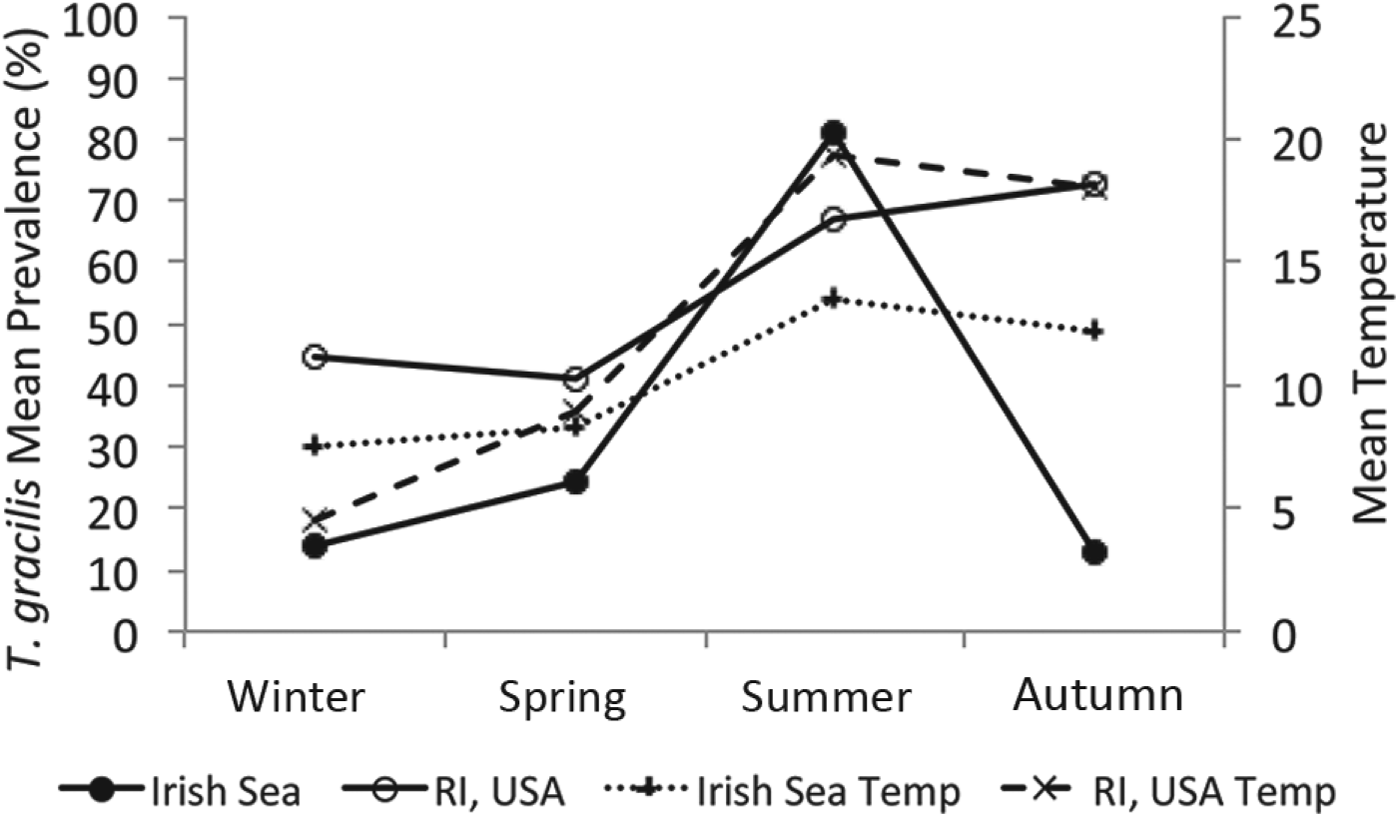
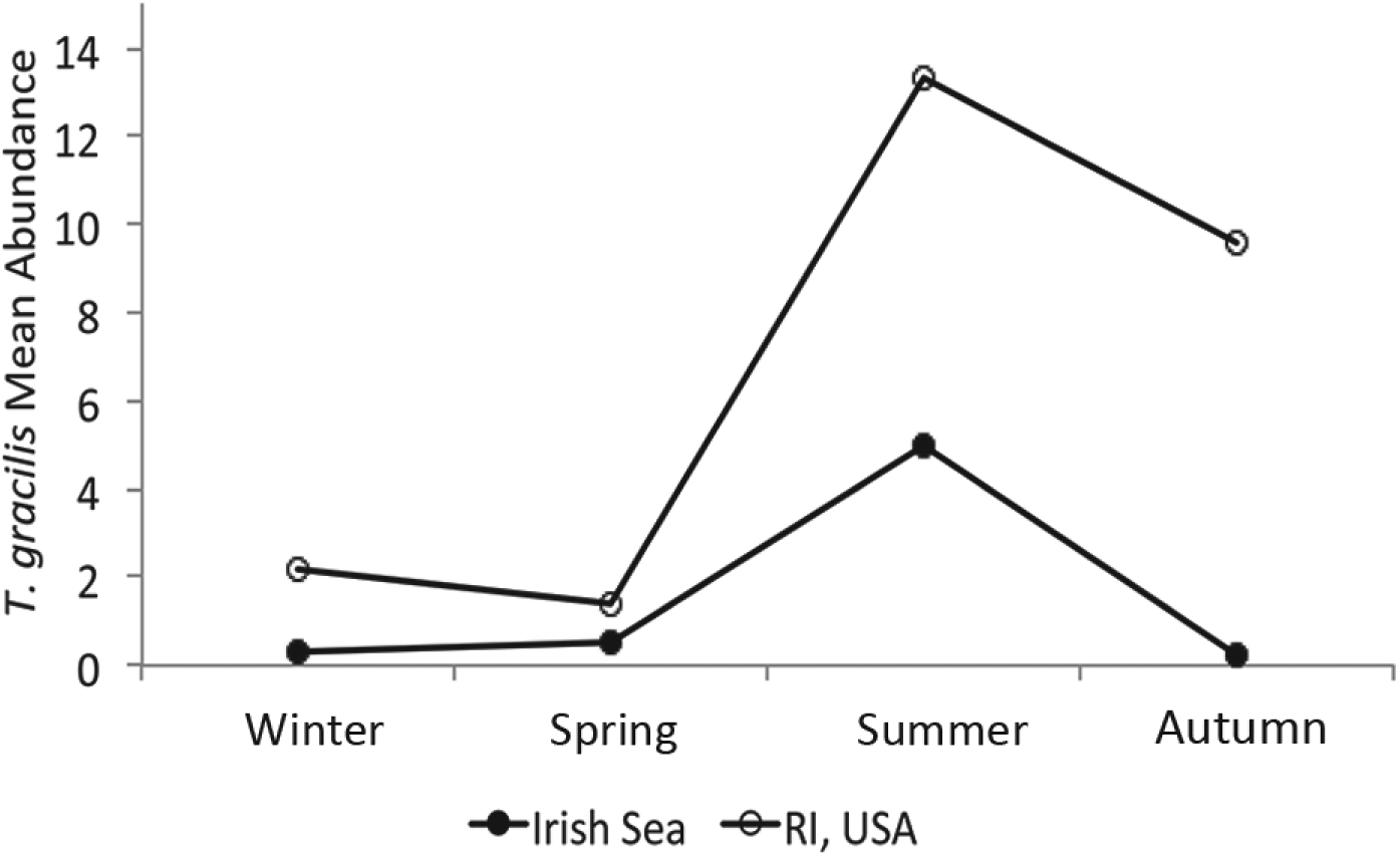
For comparative purposes, the mean prevalences of T. gracilis across seasons recorded in our study and also in McCullough et al.'s (1986) study are shown in Fig. 4. The trend in prevalence across seasons was similar between the two localities, most strikingly, both localities see a dramatic increase occur between spring and summer seasons. However, the overall prevalence of T. gracilis in sharks in Rhode Island in autumn, winter, and spring was higher than in the Irish Sea. While the Irish Sea data showed a sharp decline in prevalence in the autumn, this was not the case in Rhode Island, the peak in prevalence seen in the summer continued through the autumn. Trends in abundance of T. gracilis were also similar between localities. However, the overall mean abundance in all four seasons was higher in sharks in Rhode Island than in the Irish Sea (Fig. 5).
Seasonal mean prevalence of Trilocularia gracilis from Irish Sea (2 years) and Rhode Island coast (3 years). (Modified Irish Sea data from McCullough et al. Reference McCullough, Fairweather and Montgomery1986). Average temperature by season for Irish Sea and Rhode Island coast.

Seasonal mean abundance of Trilocularia gracilis from Irish Sea (2 years) and Rhode Island coast (3 years). (Modified from McCullough et al. Reference McCullough, Fairweather and Montgomery1986).

DISCUSSION
The impetus of this study was, in part, to place the results of McCullough et al. (Reference McCullough, Fairweather and Montgomery1986) into a global perspective – to determine whether the seasonal trends they observed in T. gracilis in the Irish Sea would be detected in a locality relatively far removed from that of their study (i.e. the northwestern Atlantic Ocean). In addition, we were interested in determining whether the two other species that comprise the cestode fauna of S. acanthias, specifically, G. squali and P. squali, would show the same seasonal pattern as T. gracilis and whether it was like that seen in the northeastern Atlantic. In regards to the hypotheses put forth by McCullough et al. (Reference McCullough, Fairweather and Montgomery1986) to explain their results, similarities between localities would provide support for both their water temperature and host hormones hypotheses, while differences between localities might indicate seasonal trends are more likely attributable to host diet and access to intermediate hosts, which, given that cestodes are trophically transmitted, are intimately tied.
When comparing our results to those of McCullough et al. (Reference McCullough, Fairweather and Montgomery1986), at the outset it is important to recognize the difference in host sex ratio between the two studies. Whereas McCullough et al.'s (Reference McCullough, Fairweather and Montgomery1986) sample consisted predominantly of male sharks, ours was much more heavily skewed towards females (specifically, 1 : 4 vs 6·75 : 1 females to males, respectively). Given that S. acanthias travels in schools segregated by sex and size (Compagno et al. Reference Compagno, Dando and Fowler2005) and there is evidence that different sexes have a preference for different water depths and salinities (Shepherd et al. Reference Shepherd, Page and Macdonald2002), perhaps balanced sex ratios were unlikely, for in the cases of both studies samples were largely dependent upon commercial fishers who have fishing preferences for specific fishing grounds. Nonetheless, this difference is important to recognize.
Despite difference in sex ratios, the overall trend in infection parameters of T. gracilis was remarkably similar between the two localities. Both studies found similarly low prevalences and intensities of infection in the spring and high prevalence and intensity of infection during the summer months. Both studies also saw peak reproduction, as indicated by the number of free gravid proglottids produced, occurring in the summer months. However, some differences were seen. While Irish Sea sharks showed declining prevalence and intensity of T. gracilis in autumn, this substantial decline was not seen in Rhode Island sharks until winter. Average annual prevalence was higher in Rhode Island than in the Irish Sea (53% vs 32%, respectively), and at no time did seasonal prevalence in Rhode Island drop below 35%. In contrast, the Irish Sea prevalence rates remained below 35% except during the summer.
One of the hypotheses proposed by McCullough et al. (Reference McCullough, Fairweather and Montgomery1986) for the seasonal trends they observed in prevalence, abundance and reproductive output of T. gracilis in the Irish Sea was that these parameters may be tied to water temperature. Indeed, surface water temperature data over a 30-year period (1961–1990) obtained from the Irish Meteorological Service indicate that average water temperatures in the months with the highest prevalence of T. gracilis (i.e. June and July) were relatively high, but the highest temperatures were in August and September, months in which McCullough et al. (Reference McCullough, Fairweather and Montgomery1986) saw a sharp decline in T. gracilis prevalence. Water temperatures in the northwestern Atlantic when infections of T. gracilis were at their highest prevalence in summer and autumn were at average temperatures much higher than those seen in Ireland (see Fig. 4). Our study suggests that water temperature is a good predictor of the intensity of T. gracilis infections (higher temperatures, higher infections). However, the difference in the Irish Sea data (i.e. sharp decline of T. gracilis in the autumn while temperatures are still relatively high), as well as different patterns in the other cestode species, suggest that the relationship between temperature and infection is more complex than a direct one. Perhaps these patterns reflect how temperature affects other aspects of the life cycle (e.g. encounters with intermediate hosts, etc.). Surface water temperature can be used as a proxy for the more complex seasonal interactions that appear to be occurring and driving these patterns.
It should be noted that Henderson et al. (Reference Henderson, Flannery and Dunne2002), who also surveyed the metazoan parasites of the S. acanthias from off the coast of Ireland for one year, not only found the prevalence of T. gracilis to be highest in the spring rather than the summer, but also found prevalence to be substantially lower (∼24%), than seen in either McCullough et al.'s (Reference McCullough, Fairweather and Montgomery1986) or our study. However, given the limited time frame of their study, and perhaps more importantly, that their sharks were frozen prior to examination, a suboptimal method for the preservation of cestodes which can lead to their destruction and likely resulted in an underestimate of infection rates, we have refrained from any further comparisons. It is also possible that the dramatic decline of S. acanthias in the northeastern Atlantic (Pawson et al. Reference Pawson, Ellis, Dobby, Gallucci, McFarlane and Bargmann2009) from the time of McCullough et al.'s (Reference McCullough, Fairweather and Montgomery1986) to Henderson et al.'s (Reference Henderson, Flannery and Dunne2002) study influenced the transmission success of the cestode fauna, leading to the low numbers seen in the latter study. This idea is further supported by the conspicuous absence of G. squali larvae seen in North Sea whiting in the 1990s (K. MacKenzie, personal communication, 18 November 2013) despite its presence in the 1960s and 1970s (MacKenzie, Reference MacKenzie1965, Reference MacKenzie1975).
General trends across cestode species
Seasonal infection parameters differed across the three cestode species comprising the fauna of S. acanthias (see Figs 1 and 2). Given that the two most common cestode species parasitizing S. acanthias were found to show different seasonal trends, while there may be a relationship between infection parameters and water temperature, it is clearly not a consistent one. In addition, given the differences seen between species, it seems unlikely that seasonal variation in infection parameters is due to changes in host hormones associated with migration or reproduction as was suggested by McCullough et al. (Reference McCullough, Fairweather and Montgomery1986), for both species occupy the same habitat (i.e. the spiral intestine) and thus, are likely exposed to the same hormone levels. It is of course possible that the two species respond differently to changes in temperature and/or hormones.
However, given that the three species of cestodes examined here collectively represent two distinct orders of cestodes (G. squali is a trypanorhynch, and T. gracilis and P. squali are tetraphyllideans), an explanation involving differences in life history strategies is plausible. Marine cestodes are trophically transmitted, and exhibit complex life cycles that typically involve a diversity of larval forms passing through at least three hosts over the course of their development (e.g. Sakanari and Moser, Reference Sakanari and Moser1989; Palm, Reference Palm2004). Thus the seasonal differences seen between G. squali and T. gracilis may reflect their different life histories. While the complete life cycle of both species is unknown, by examining the little that is known about their intermediate hosts, we can hypothesize about some of the trends seen here. In the case of G. squali, data exist only for the last larval stage and suggest that certain bony fish serve as appropriate penultimate hosts. Plerocercoid larvae have been reported from the eyes of fish, specifically the salmonid Oncorhynchus tshawytscha in British Columbia (Kent, Reference Kent2000) and the gadiform Merlangius merlangus in the North Sea (MacKenzie, Reference MacKenzie1965, Reference MacKenzie1975). The flatfish Citharichthys stigmaeus in the northeast Pacific was also reported as a potential intermediate host (Kuitunen-Ekbaum, Reference Kuitunen-Ekbaum1933). The limited distributions of these fish species, in comparison to the widespread distribution of S. acanthias, lead us to believe that other fish species may serve as appropriate hosts for plerocercoids, particularly since neither of the aforementioned fish species is found off Rhode Island. Indeed, the larval stages of marine cestodes generally exhibit relaxed specificity for their intermediate hosts (Palm and Caira, Reference Palm and Caira2008; Jensen and Bullard, Reference Jensen and Bullard2010). Furthermore, spiny dogfish are opportunistic feeders – ingesting a wide variety of prey that includes a diversity of both pelagic and benthic fish (Stehlik, Reference Stehlik2007). Stomach content data for spiny dogfish in the northwest Atlantic (Stehlik, Reference Stehlik2007) include additional gadiform fishes, such as Melanogrammus aeglefinus (haddock), Merluccius bilinearis (silver hake), Urophycis chesteri (long-finned hake) and Urophycis chuss (red hake). Determination of additional hosts of plerocercoids of G. squali and the time of year they are most commonly present and consumed by spiny dogfish will greatly help to understand the transmission dynamics of this cestode. It is interesting to note that in the case of plerocercoid infections of G. squali in M. merlangus in the North Sea, MacKenzie (Reference MacKenzie1975) found no regular seasonal pattern, and the prevalence of infections with plerocercoids was highest (9·8%) in larger fish with a total length of about 30 cm. Although one of these fish was found to host 18 plerocercoids, 75·5% of infected fish hosted only a single plerocercoid. If this low intensity and prevalence is typical of plerocercoid infections in other fish species, it has interesting implications for our Rhode Island adult worm data. The highest intensity of G. squali in Rhode Island was in two female sharks, each of which hosted 15 adult worms. Either these sharks acquired their infections by consuming multiple fish each infected with a small number of plerocercoids, or they consumed a single heavily infected intermediate/paratenic host. It has been shown that other species of parasite that infect fish eyes can inhibit vision (Owen et al. Reference Owen, Barber and Hart1993). If infections of plerocercoids in the eye of the intermediate host affect the host's vision and thus predator avoidance behaviour, they are more likely to be eaten, which may account for a relatively high prevalence of G. squali in definitive hosts (58%) compared to the relatively low (<10%) infection rates in intermediate hosts.
Our data contribute to understanding duration of infection. If these cestodes are long lived in their definitive host, we would expect to see an accumulation of worms over time (assuming no acquired immunity), in which case infection intensity would be positively correlated with host size. But, host size was not found to have a significant effect on intensity; larger sharks did not harbour significantly higher intensities of infection with G. squali than smaller sharks. This leads us to believe that G. squali is relatively short lived within its shark definitive host. However, prevalence of G. squali was significantly affected by shark size – larger sharks were more likely to be infected. This may account for the fact that the highest percentage of intermediate hosts infected are of the 30 cm size class (MacKenzie, Reference MacKenzie1975), and only sharks of a certain size or above are able to capture and consume them. Alternatively, it is possible that larger, older sharks have been around longer, which increases their chances of encountering an infected intermediate host.
With respect to its life cycle, T. gracilis is very unusual among cestodes in that its definitive host also appears to serve as its final intermediate host (McCullough and Fairweather, Reference McCullough and Fairweather1983, Reference McCullough and Fairweather1984; Pickering and Caira, Reference Pickering and Caira2013). Juveniles of this species initially occupy the stomach of S. acanthias and subsequently migrate posteriorly to the spiral intestine where they develop into the hyperapolytic adult form. While the complete life cycle is unknown, these observations led McCullough et al. (Reference McCullough, Fairweather and Montgomery1986) to suggest that the life cycle of T. gracilis is unusual in including only two (rather than three) host species and perhaps S. acanthias consumes the first intermediate host of T. gracilis directly. The first intermediate host in the life cycle of most cestodes is considered to be a small invertebrate (see Jensen and Bullard, Reference Jensen and Bullard2010) able to consume eggs containing oncospheres. This would require that S. acanthias consume such small prey items. Indeed stomach content analyses show that both euphausiids and shrimps are included among the prey items consumed by S. acanthais, and, in fact, there is evidence that dogfish may be a major predator of euphausiids during the summer in some areas (Hanchet, Reference Hanchet1991; Sameoto et al. Reference Sameoto, Neilson and Waldron1994). Infection with T. gracilis was also found to have no relationship to host size, indicating that dogfish, small or large, are equally susceptible to infection; stomach content data support this, as sharks of all sizes are known to consume small crustaceans (Stehlik, Reference Stehlik2007).
The low prevalence and intensity of P. squali throughout the 3 years of this study is puzzling in the context of the maintenance of a viable population of this cestode species. The vast majority of sharks infected with P. squali hosted only a single worm, although a few hosted two worms and a single shark collected in the autumn was infected with 12 worms – all juveniles. However, P. squali appears to be more prevalent in other localities. Of note, Vasileva et al. (Reference Vasileva, Dimitrov and Georgiev2002) reported P. squali infecting 43% of sharks in spring months and 60% of sharks in summer months in the Black Sea. It is possible these areas of high prevalence allow the life cycle to continue successfully, providing enough progeny to account for areas with a dearth of infection. The large size discrepancy in size between the single gravid worm found in the spring in Rhode Island and the immature worms seen throughout the remainder of the year, suggests that maturation is a relatively long process, and that the lifespan of this cestode may be substantially longer than that of the two other species.
In conclusion, this study has demonstrated that seasonal trends are exhibited by elasmobranch cestodes, but these trends differ across cestode species and likely reflect their different life history strategies and evolutionary histories. While some general trends observed may be maintained across disparate localities, one is likely to see spatial variation due to differences in accessibility to intermediate hosts and host diet across sites. We predict that the more similar intermediate hosts and definitive host diets are across localities, the more similar the seasonal trends observed in their parasite species will be. Given the intimate interaction between hosts and their parasites, much can be inferred about the former species from the latter. Investigations to further determine intermediate hosts and diet in different localities, not only will inform us about the maintenance of cestodes in the vast ocean environment, but will also provide knowledge about host movements and habits.
ACKNOWLEDGEMENTS
We would like to thank Rodman Sykes and Dr Lisa Natanson for their aid in the collection of hosts, and acknowledge assistance with collection of cestode specimens from the enthusiastic members of the University of Connecticut parasitology community, including Leah Desjardins, Beth Barbeau, Claire Healy, Carrie Fyler and Florian Reyda. We would also like to thank Nigel F. Delaney, Paul Cislo and Kevin Lafferty for their valuable advice on the statistical analyses.
FINANCIAL SUPPORT
This material is based upon work supported by the National Science Foundation under Grant numbers 0818696 and 0818823, and in part by funding from the Judith H. Shaw Parasitology Fund.