INTRODUCTION
Although the law and the courts have been playing an increasingly important role in authoritarian regimes over the past decade (Reference Ginsburg and MoustafaGinsburg & Moustafa, 2008; Reference MoustafaMoustafa, 2014), judicial processes in these states have routinely been depicted as repression (Reference CheesmanCheesman, 2015; Reference CrossCross, 1999; Reference Escribà-FolchEscribà-Folch, 2013; Reference RajahRajah, 2012; Reference Trevaskes, Nesossi, Golley, Jaivin and TombaTrevaskes & Nesossi, 2017; Reference YoungersYoungers, 2000). In Putin's Russia, for example, the regime employs charges of tax evasion against business oligarchs who finance opposition groups (Reference BækkenBækken, 2018; Reference GoldmanGoldman, 2010). In Kazakhstan, the ruler used prolonged criminal prosecutions and lengthy prison sentences to keep opposition leaders in custody (Reference LaPorteLaPorte, 2017). In Croatia, the regimes used defamation and libel laws to silence political dissidents on media outlets (Reference PusicPusic, 1998). In Malaysia, Malawi, and Ukraine, government chiefs, for the purpose of consolidating their political power, launched criminal prosecutions for corruption against their political rivals (Reference DardenDarden, 2008).
As illustrated in existing studies, judicial processes have been employed to penalize political rivals (Reference FelkerFelker, 2000; Reference LaPorteLaPorte, 2017), to persecute political dissidents (Reference DavenportDavenport, 2014; Reference OliverOliver, 2008), to legitimize the usurpation of political power (Reference Levitsky and WayLevitsky & Way, 2010; Reference RajahRajah, 2012), and to ensnare competitors inside the ruling political party (Reference PosnerPosner, 2005; Reference Shen-BayhShen-Bayh, 2018). Reference Levitsky and WayLevitsky and Way (2010, p. 9) define tactics of this type broadly as “legal repression,” by which they mean “the discretionary use of legal instruments … to punish (political) opponents.” Reference Shen-BayhShen-Bayh (2018, p. 330) uses “judicial repression” to describe the repression of political challengers through the courts, and she further points out that judicial repression deals more effective with internal threats than with external threats.
While much scholarly attention has been devoted to the judicial repression of political opponents, whether and how judicial processes are employed to repress ordinary individuals have not been studied in such depth. Unlike political rivals and dissidents, who are close to the center of power, common people are peripheral to power and seldom claim political rights. When they mobilize, their main objective is economic benefit (Reference Feng and HeFeng & He, 2018; Reference Liebman, Woo and GallagherLiebman, 2011; Reference MinznerMinzner, 2006). Although some of them may employ disruptive tactics or engage in mass events to have their voices heard, they seldom join organizations or threaten political elites (Reference Feng and HeFeng & He, 2018). They can therefore be distinguished from the typical targets of judicial repression, who pose a direct threat to the regime. For this reason, the authorities are unlikely to exercise judicial repression on ordinary civilians, at least in the same way as they do on “opponents” or “political challengers.” In fact, conventional wisdom indicates that the authorities in authoritarian regimes are more inclined to set the law and the courts aside and employ extralegal repression strategies as they manage the social disturbance caused by ordinary individuals (see e.g., Reference Lee and ZhangLee & Zhang, 2015; Reference O'Brien and LiO'Brien & Li, 2006).
Drawing on evidence from Chinese courts, this article proposes that there is an emerging pattern of social management in China—stability justice—that rests on criminal procedures to contain and deter disruptive claimants of citizens' rights while maintaining governance legitimacy. Stability justice is distinguished from Reference Levitsky and WayLevitsky and Way's (2010, p. 9) “legal repression” and Reference Shen-BayhShen-Bayh's (2018, p. 330) “judicial repression,” both of which normally target political dissidents or rivals. In the cases described here, stability justice targets common folk instead of political enemies, and is thus subtle and covert. Judicial proceedings are employed not as a weapon to torture, punish, or eliminate enemies, but as a tool for social control. The main goal is to achieve social stability. Stability maintenance has also been repeatedly mentioned in the literature on Chinese courts and China's legal system (see e.g., Reference HeHe, 2014; Reference Liebman, Woo and GallagherLiebman, 2011; Reference Peerenboom, Woo and GallagherPeerenboom, 2011). However, rarely studies have dwelled into how this policy affects case outcomes empirically.
Our findings should provide new insights into the changing significance of the law and the courts in authoritarian regimes (Reference Ginsburg and MoustafaGinsburg & Moustafa, 2008; Reference MoustafaMoustafa, 2014). As recent studies on authoritarian resilience point out, social control in authoritarian regimes is gradually turning from violent repression that terrorizes citizens into submission to subtler means, such as informational control (Reference Guriev and TreismanGuriev & Treisman, 2019) or the production of moral order (Reference TsaiTsai, 2021). This article adds new fuel to this line of discussion by illustrating that judicial processes provide another meaningful alternative to violent repression, as they are not only subtler but also more legitimate. This article also contributes to studies on both comparative judicial politics and Chinese judicial behaviors by presenting relatively new and solid empirical evidence. Previous studies in these fields have mostly drawn on news reports, selective cases, and narratives of third parties. This article tries to use nationwide individual-level data to evaluate whether and how judicial processes repress civic rights claimants, which should provide strong evidence for some classic knowledge that scholars in these fields have previously obtained anecdotally.
In the following sections, we first develop our theoretical framework by analyzing the mechanism of stability justice as a tool for social control. Second, we illustrate the ways in which stability justice is being exercised against Chinese petitioners, and then we propose our hypotheses about how some petitioners come under covert biases in criminal procedures. Third, we test our hypotheses through a statistical analysis of the published judgments on “picking quarrels and provoking trouble,” which is the most common criminal accusation made against petitioners. In the concluding part, we discuss the implications of stability justice.
STABILITY JUSTICE
In this article, stability justice refers to the tactics carried out, via formal judicial procedures with reference to the law, for social control purposes, such as containing citizens' rights claimants who are accused of threatening social stability, and deterring socially disruptive activities. Typical strategies of stability justice in criminal adjudication include: the selective application of criminal statutes, discretionary detention and custody, and severe penalties. While all decisions are made with reference to the law, these legal tactics may incorporate both procedural and distributive biases in ways that are hard to detect in individual cases.
Stability justice as a tool for social control
In practice, stability justice is mainly employed as a tool for social control. It is embedded in China's long-standing national policy of maintaining social stability. From the Hu Jintao era (2003–2013) to the Xi Jinping era (2013-now), the elimination of social disturbance and social unrest has been regarded as of paramount concern in state governance and social management. To get their voices heard, however, some rights claimants inevitably employ tactics that operate near the boundary of the authorized channels, causing varying degrees of social disturbance and posing a threat to social stability (Reference O'Brien and LiO'Brien & Li, 2006). Under the top-down system for responsibility, which aims to resolve disputes at grassroots level and to avoid dispute escalation, Chinese authorities at various levels are motivated to employ all available means to eliminate the problems caused by these rights claimants before they reach senior authorities.Footnote 1 Some authorities used to rely on violent and extralegal means of repression to manage these problems (Reference HouHou, 2012; Reference YuYu, 2005).
Since the 2010s, a new mode of social management has been emerging in China, owing to the evolving power relations between the common people and the state authorities. On the one hand, the past decade has witnessed substantial changes in the social control policies of the Chinese Communist Party (CCP). The CCP has officially mandated restrictions on, and the partial abolishment of, the use of violent repression strategies in social control, with the purpose of pushing forward law-based governance and enhancing governance legitimacy.Footnote 2 For example, the infamous re-education through labor system, which was a frequently used mechanism to detain “citizen trouble-makers,” was abolished in December 2013, and all the detainees were immediately released.Footnote 3 Although some empirical evidence indicates the continued existence of extralegal repression strategies at grassroots level (Reference Fu and DistelhorstFu & Distelhorst, 2017; Reference SteinhardtSteinhardt, 2021; Reference TruexTruex, 2019), the regime has become more cautious over the use of violence in its governance (Reference TsaiTsai, 2021).
On the other hand, there is an awakening of a consciousness of rights among ordinary Chinese people. Accompanied by social and economic development, ordinary people can easily access laws and central policies on the Internet, and, accordingly, have become more inclined to struggle for their rights with reference to the law (Reference GallagherGallagher, 2017). The development of social media and online communication platforms such as Weibo and TikTok (Douyin) has provided people with a new channel for voicing their grievances and gaining public attention. Chinese authorities have also become increasingly aware of the risk that their improper use of extralegal repression strategies can easily hit the headlines on the Internet and lead to political consequences.
Faced with the changing political climate and the evolving social context, some authorities have turned to modest extralegal methods to contain discontent and maintain social stability, since violent repression is more likely to backfire and lead to sanctions from senior authorities (cf. Reference DobsonDobson, 2012; Reference SullivanSullivan, 2016). Scholars have noticed the use of relational repression (Reference Deng and O'BrienDeng & O'Brien, 2013; Reference O'Brien and DengO'Brien & Deng, 2017),Footnote 4 bureaucratic absorption (Reference ChuangChuang, 2014; Reference Lee and ZhangLee & Zhang, 2015),Footnote 5 informational autocracy (Reference Guriev and TreismanGuriev & Treisman, 2019; Reference King, Pan and RobertsKing et al., 2013; Reference RobertsRoberts, 2018),Footnote 6 infiltration and persuasion (Reference Greitens and TruexGreitens & Truex, 2020; Reference MattinglyMattingly, 2019; Reference WangWang, 2015),Footnote 7 and emotional mobilization (Reference HouHou, 2019; Reference Hu and TongHu & Tong, 2020).Footnote 8
The modest extralegal strategies mentioned above are able to solve problems, but they may become ineffective on those occasions that demand swift and coercive resolution. In Reference Hu and TongHu and Tong's (2020) research on emotional mobilization, for example, petitioning social workers in Shanghai spent years establishing emotional ties with Chinese veterans who were claiming pensions and social welfare. They finally reached a consensus, but this strategy succeeded because the veterans, a highly organized group with a strong sense of honor and patriotism, trusted in the government and were willing to solve their problems through lengthy negotiations. Their protests, which served the purpose of taking the upper hand at the negotiating table, were organized and self-restrained. By comparison, common disputants may lack patience and confidence in state authorities and government cadres, which undermines the probability of reaching consensus (Reference O'Brien and LiO'Brien & Li, 2006). Their activities are less stable and predictable than organized petitioning groups, which increases the risk of modest strategies being implemented (Reference Feng and HeFeng & He, 2018). Therefore, as a supplement to the use of modest social control strategies, some authorities find it necessary to use forceful means of social control as a substitute for the violent repression that has now been officially discouraged, with the purpose of eliminating social disturbances swiftly and effectively.
It is in the above circumstances that stability justice, which has turned judicial processes into a tool for social control, is used. In sharp contrast to either the abolished means of violent repression or the modest extralegal strategies, stability justice contain discontent and deter social disturbance in a swift and coercive manner without seriously infringing upon the regime's legitimacy and resilience (cf. Reference NathanNathan, 2003; Reference RajahRajah, 2012). As Reference MoustafaMoustafa (2014, p. 286) points out, while authoritarian regimes “typically pin their legitimacy to the achievement of substantive outcomes, … they also attempt to make up for questionable procedural legitimacy by preserving judicial institutions.” Although Chinese courts have traditionally been regarded as politically embedded institutions (Reference Ng and HeNg & He, 2017), recent empirical studies report growing support for the judiciary among ordinary people since the implementation of the post-2014 judicial reforms (Reference FengFeng, 2020; Reference He and FengHe & Feng, 2021; Reference LiebmanLiebman, 2014).Footnote 9 In the minds of ordinary people, the decisions made in judicial proceedings are more trustworthy than those made through extralegal channels (Reference GallagherGallagher, 2017; Whiting, 2017). Stability justice is thus able to achieve social control purposes through what appear to be due procedures.
Stability justice versus judicial/legal repression
Despite its innate repressiveness over the threats to social stability, stability justice is distinguished from the classic notions of “judicial repression” (Reference PosnerPosner, 2005; Reference Shen-BayhShen-Bayh, 2018) and “legal repression” (Reference Levitsky and WayLevitsky & Way, 2010, p. 9). As is well illustrated in existing studies, judicial (legal) repression normally targets political enemies and is mostly unlawful. Although the law is selectively employed, law enforcement organs are actually turning against the formal law to enforce the will of the autocratic rulers (Reference Levitsky and WayLevitsky & Way, 2010; see also, Reference DavenportDavenport, 2014; Reference EarlEarl, 2011; Reference LaPorteLaPorte, 2017; Reference OliverOliver, 2008; Reference Shen-BayhShen-Bayh, 2018). Reference TruexTruex's (2019) research on preemptive detention, for example, showed that political dissidents in China were more likely to be detained shortly before or during politically sensitive periods and were released shortly after the end of those periods (see also Reference SteinhardtSteinhardt, 2021). Although all decisions on detention and release are supposed to be made with reference to the law, such a “catch-and-release” dynamic indicates a hollow implementation of legal procedures and an overt disregard for the law.
In contrast to repression, stability justice is a more formal type of justice. It mainly targets claimants to individual rights and interests, and it is achieved through the technically correct application of the law. While citizens' rights claimants may cause social problems, they are peripheral to power and seldom claim political rights. Accordingly, since these people and their problems are no threat to their rule, the authorities have incentives to respect the rule of law and judicial fairness (Reference WangWang, 2014). Therefore, stability justice is subtle, covert, and relatively modest in practice, and all decisions are made through set procedures with reference to the law.
In the eyes of the general public, stability justice looks similar to run-of-the-mill judicial behavior. Strong evidence of repression is hard to see in any particular case. That is why the results of stability justice are more likely to convince people than the results of extralegal or violent repression. As will be illustrated in this article, however, large N analyses of the subjects of stability justice reveal that they may suffer from structural biases in both procedural and distributive aspects, when compared with common litigants. This is not merely a consequence of a lack of litigation ability or party resources (cf. Reference GalanterGalanter, 1974; Reference He and YangHe & Yang, 2013). Through the selective enforcement of the law and the tactical use of judicial discretion, defendants from designated groups may receive biased treatment, such as longer detention or heavier penalties than usual. By employing stability justice, the authorities are able to contain particular groups of individuals, eliminate social problems in an efficient and effective manner, and enhance their authority as rule makers, while, most importantly, avoiding the risk of damaging their governance legitimacy.
PETITIONERS VERSUS NON-PETITIONERS IN CRIMINAL JUSTICE
Employing stability justice to manage petitioning
To illustrate the mechanism of stability justice, we focus on the way in which grassroots authorities manage petitioning in China. Petitioning, known as shangfang or xinfang, refers to “an effort to go past basic-level institutions to reach higher-level bodies, express problems and request their resolution” (Reference MinznerMinzner, 2006, p. 103).Footnote 10 As a controversial and yet widely used administrative remedy (Reference YingYing, 2004), petitioning has become a social phenomenon in China. It is estimated that the Chinese government at all levels and the official offices for receiving petitions receive more than 10 million petitions annually (Reference YangYang, 2017). To get their voices heard, some petitioners have turned their complaints into “a populist threat” to authority (Reference Liebman, Woo and GallagherLiebman, 2011, p. 269). They petition repeatedly for years or even decades to achieve their goals (Reference YuYu, 2005); they employ disruptive tactics and frame their disputes as political problems to get their complaints treated seriously (Reference Feng and HeFeng & He, 2018); and they flock to Beijing, the national capital, during political events or times of leadership turnover for an opportunity to attract attention at a senior level and to exert pressure on local authorities (Reference Li, Liu and O'BrienLi et al., 2012).
In the Chinese petitioning system, the central government and the local authorities have distinct goals as they manage petitioning. While the central government may tolerate petitioning for the purpose of collecting local information and getting to grips with social problems, lower-level authorities are generally more inclined to eliminate petitioning as petitioning activities cause embarrassment at higher levels (Reference Feng and HeFeng & He, 2018; Reference HouHou, 2012). Grassroots authorities are the main forces that manage petitioning in China. Embedded in a top-down system of responsibility, they are motivated to employ all available means to eliminate petitioning at grassroots level and avoid the escalation of disputes (Reference CaiCai, 2008; Reference LandryLandry, 2008; Reference Liao and TsaiLiao & Tsai, 2019). While petitioning remains a prominent social phenomenon, the way in which Chinese authorities manage it has undergone radical changes over the past decade. Grassroots authorities used to control petitioning activities through violent and extralegal means (Reference YuYu, 2005). In 2014, the CCP promulgated “The Resolution of the CCP Central Committee on Certain Major Issues Concerning Comprehensively Advancing the Law-Based Governance of China,” in which “bringing petitioning into the rule of law framework” was officially declared to be national policy.Footnote 11 Meanwhile, re-education through labor, and other unlawful means for repressing petitioning, were officially abolished.Footnote 12 Judicial processes gradually came to be employed as an alternative way of managing the “populist threat” of petitioning activities.
Dealing with cases involving petitioners, the courts could hardly ignore the social control objectives of the government. Although the government has, since the 2010s, been officially deprived of the power to interfere with the courts' finance and personnel arrangements, basic-level courts remain an integral part of the local social management system (Reference HeHe, 2021a; Reference Zhang and GinsburgZhang & Ginsburg, 2019). Embedded in the local social and bureaucratic networks, judges cannot easily avoid interference from local government cadres. In practice, local government chiefs may draw on either their administrative authority or their personal connections, and delegate to the leaders of the grassroots courts the task of containing petitioners who are accused of threatening social stability; the court leaders are normally willing to help, in exchange for the support of the local administrative power and the favor of local government cadres.Footnote 13
Consequently, there has been a growing tendency in recent years for grassroots courts to manage petitioners through stability justice. As Reference Wang and LiuWang and Liu (2017) pointed out in their research on adjudication committees in China's basic-level courts, a common purpose of judicial decision-making at the grassroots level is to mediate in conflicts between legal and political concerns, and thus to figure out resolutions that are acceptable to the government while not contradicting the law. In the management of petitioning, stability justice is regarded as a “balanced” resolution, since it achieves local governments' objective of maintaining stability, within the legal framework.
Accordingly, the number of criminal accusations against petitioners climbs quickly at grassroots level in recent years. The statistics of China Judgments Online, which is the official website for judicial disclosure, indicate that the number of criminal cases associated with petitioning almost doubled from 2014 through 2018.Footnote 14 Among all the published cases involving petitioner defendants, 91.9% of the cases were adjudicated in the trial courts, 7.8% in the intermediate courts, and merely 0.3% in the high courts.Footnote 15 No case reached the Supreme People's Court.
Accusing petitioners of picking quarrels and provoking trouble
Given the difficulty of comparing the sentences meted out to people charged with different crimes, we focus on the crime of picking quarrels and provoking trouble (xunxinzishizui). Picking quarrels and provoking trouble is the most common criminal accusation against a petitioner in China.Footnote 16 According to Article 293 of the PRC Criminal Law, the crime of picking quarrels and provoking trouble encompasses the following actions: (1) beating another person at will and to a flagrant extent; (2) chasing, intimidating, or hurling insults at another person to a flagrant extent; (3) forcibly taking or demanding, or willfully damaging, destroying, or occupying, public or private money or property to a flagrant extent; or (4) rampaging in a public place, thus causing serious disorder in such place.
Originating from the crime of hooliganism (liumangzui) in the 1979 Criminal Law,Footnote 17 the offense of picking quarrels and provoking trouble was first enacted in the 1997 Criminal Law for the purpose of punishing hooligans and bullies who intentionally harass people for no justifiable reason (Reference ChenChen, 2015). Dubbed a “pocket statute,” however, it has been criticized for its over-general scope and ambiguous terminology (Reference ZhangZhang, 2015, p. 3). In particular, there are no undisputed definitions of the core concepts of “intimidating,” “taking,” or “rampaging.” Nor do we know exactly what constitutes “a flagrant extent.” Although the Supreme People's Court and the Supreme People's Procuratorate issued a judicial interpretation in 2013 to narrow the scope of the statute,Footnote 18 the answers to these questions remain vague and, in practice, depend largely on the discretion of prosecutors and judges (Reference Zhao and PengZhao & Peng, 2015). Given its vagueness, this crime has frequently been associated with petitioning strategies and is accordingly employed to carry out stability justice.
While the accusation of picking quarrels and provoking trouble may lead to a harsh punishment for a petitioner, it does not repress petitioners in an overt manner. In the traditional means of repression, the officials of grassroots authorities held the power to contain petitioners without justifiable cause or procedure. Take re-education through labor, for example. Petitioners could be sentenced to a maximum of 4 years' forced labor for no other reason than that they had petitioned the central institutions in Beijing, even though petitioning Beijing was not a violation of the law (Reference HouHou, 2012; Reference YuYu, 2005). There used to be no due procedure for decision-making, either. The decisions were made by the police through administrative procedures.Footnote 19
By making an accusation of picking quarrels and provoking trouble, by contrast, an authority is trying to establish a legal basis and a due procedure for its decisions. To hold a petitioner in custody, the police have to follow arrest procedures and seek approval from the procuratorate; to declare a petitioner guilty, a formal trial is mandatory; and to sentence a petitioner to fixed-term imprisonment, the decision must be made with reference to the criminal law under the principle of nulla poena sine lege (zuixingfading) (Reference ChenChen, 2015). This is in sharp contrast to the cases of re-education through labor, in which many petitioners were sanctioned purely for petitioning, in an arbitrary decision-making process. By introducing legal rules and procedures into the management of petitioning, the authorities have enhanced their governance legitimacy.
The apparent legitimacy of the criminal procedures is, however, undermined by covert biases in both the procedural and the distributive aspects. Drawing on our interviews with Chinese judges and prosecutors in 2019 and 2020,Footnote 20 we have found that some grassroots courts have deliberately been reproducing these biases to contain “trouble-makers” and deter certain disruptive petitioning strategies that may threaten social stability.
On the procedural aspect, some courts have employed pre-trial detention (jiya) to control petitioners. Pre-trial detention is a type of coercive criminal measure that is used to hold a suspect in custody for the purpose of investigating their alleged criminal offenses. Although Article 154 of the Criminal Procedural Law of the PRC stipulates that the term of pre-trial detention should not exceed 2 months, the procuratorate retains the discretion to grant an extension in “major and complex cases.”Footnote 21 To prevent petitioners from carrying on their petitioning activities, the authorities are motivated to impose longer terms of pre-trial detention on them. The hypothesis that derives from the discre use of pre-trial detention is as follows:
1 Hypothesis: Petitioner defendants receive longer terms of pre-trial detention than non-petitioner defendants, ceteris paribus.
Since pre-trial detention requires merely preliminary evidence of an alleged criminal offense, it has sometimes been used as a technically lawful tool to deprive petitioners temporarily of their personal freedom during certain periods.Footnote 22 Compared to routine practice in ordinary times, the authorities have a heavier burden of maintaining social stability during politically sensitive periods—that is, periods when significant social or political events are taking place. As these periods draw close, the authorities are more inclined to hold petitioners in custody through pre-trial detention (Reference SteinhardtSteinhardt, 2021; Reference TruexTruex, 2019). We thus expect:
2 Hypothesis: Petitioner defendants are more likely than non-petitioner defendants to be detained before a politically sensitive period.
On the distributive aspect, petitioners also suffer from covert biases. The routine sentences for picking quarrels and provoking trouble include fixed-term imprisonmentFootnote 23 criminal detention,Footnote 24 and community correction.Footnote 25 Both fixed-term imprisonment and criminal detention are custodial sentences. Under the law, judges have the discretion to sentence petitioners to up to 60 months in prison. For the purposes of retaliation and deterrence, the authorities may consciously impose severer penalties on petitioner defendants. This yields the following hypothesis:
Hypothesis 3: Petitioner defendants receive longer custodial sentences than non-petitioner defendants, ceteris paribus.
In addition to custodial sentences, biases also exist in the judicial decisions to grant probation.Footnote 26 Probation is a common tool used by grassroots judges to grant leniency (Reference LiebmanLiebman, 2015). However, since petitioners on probation retain a high degree of freedom and may employ new petitioning strategies, judges are less likely to show leniency to them. We thus expect:
Hypothesis 4: Petitioner defendants have fewer opportunities to be granted probation than non-petitioner defendants, ceteris paribus.
In the following sections, we will rely on statistical analysis to test our hypotheses.
DATA, VARIABLES, AND METHODS
Studying stability justice in China's criminal justice, we drew on the judgments published on the Internet in cases of picking quarrels and provoking trouble. We collected all the verdicts on picking quarrels and provoking trouble published on China Judgments Online, and obtained 92,494 judgments made between 2014 and 2018.Footnote 27 We tried to probe the biases in the accusations and the sentences against the petitioners through comparative analysis.
Among all the judgments, a total of 2314 cases involved petitioner defendants, accounting for about 2.5% of the entire caseload. We were concerned that the low percentage of petitioners' cases may lead to an estimation bias on the effect of petitioning if our estimation was based on a representative sample (Reference King and ZengKing & Zeng, 2001), so we adopted an oversampling strategy and generated a new sample in which the petitioners' cases accounted for 50% of the sample and the cases with non-petitioner defendants for the other 50%. First, we extracted all the judgments in which the defendants were accused because of their petitioning strategies and obtained 2314 cases (hereinafter termed “the petitioner group”). Second, we tried to sample 2314 cases with non-petitioner defendants (hereinafter termed “the non-petitioner group”) from the remaining 90,180 cases. To increase the similarity of the two groups, we divided the remaining cases into province-year strata, identified the number of the petitioners' cases in each province-year, and simply randomly sampled the same number of cases from the corresponding non-petitioner stratum. The non-petitioner group thus has the same number of cases, which are randomly sampled, as the petitioner group in any specific province-year. Finally, our sample consisted of 4628 cases, in which one half of the sample are petitioners' cases and the other half are non-petitioners' cases with similar features.Footnote 28
We coded our variables of interest from the combined sample. Our dependent variables are the length of pre-trial detention (DETENTION), which is measured in weeks, and the length of custodial sentence (SENTENCE), which is measured in months. We also generated a dichotomous variable PROBATION, in order to figure out whether petitioners were less likely to be put on probation than non-petitioners.
The key independent variable of interest is PETITION, which equals 1 if the particular accusation arose, completely or partly, from the defendant's petition experiences and 0 if not. To avoid the potential for omitted variable bias, we also included a number of control variables. As the severity of the penalty is directly related to the factual circumstances, as stipulated in Article 293 of Criminal Law of China, we adopted four dummy variables that characterize the criminal acts with which the defendants were charged, namely BEATING (Article 293-1), INTIMIDATING (Article 293-2), TAKING (Article 293-3), and RAMPAGING (Article 293-4).Footnote 29 To distinguish principal offenders from secondary offenders, we generated a variable named ORDER OF DEFENDANT to indicate the sequence of defendants in the case. The NUMBER OF DEFENDANTS in a case was also included as a control variable, given its potential influence on sentencing. Since maintaining social stability is the top priority of the Chinese judiciary (Reference HeHe, 2014), we also created a variable of MASS EVENT to identify whether the defendant had taken part in a mass event and had thus exerted populist pressure on the judicial decision-making process. We gave a value of 1 if the verdict mentioned any type of mass event, and a value of 0 if not. Since the Criminal Law of China stipulates certain mitigating and aggravating circumstances that may reduce or increase the sentence,Footnote 30 we also generated two dummy variables, namely MITIGATION and AGGRAVATION, to examine whether the judgments specified these circumstances.
We also included a set of other confounding variables at both individual level and institutional level. The variables at individual level included gender (male or female), education level (primary school education or below, junior high school education, senior high school education, college education), ethnicity (Han or ethnic minority), and age. We also generated a dummy variable, LEGAL COUNSEL, to identify whether the defendant was represented by legal counsel. As for the variables at institutional level, we controlled for the court hierarchical status by a dummy variable TRIAL COURT to identify whether the case was judged in a trial court or a senior court. We also generated a set of provincial-level variables to capture the social, economic, and geographical characteristics of the place of adjudication.Footnote 31 These are the logarithm of POPULATION, the logarithm of GDP PER CAPITA, EXPENDITURE ON PUBLIC SECURITY, and EXPENDITURE GROWTH ON PUBLIC SECURITY.Footnote 32
Data at a glance
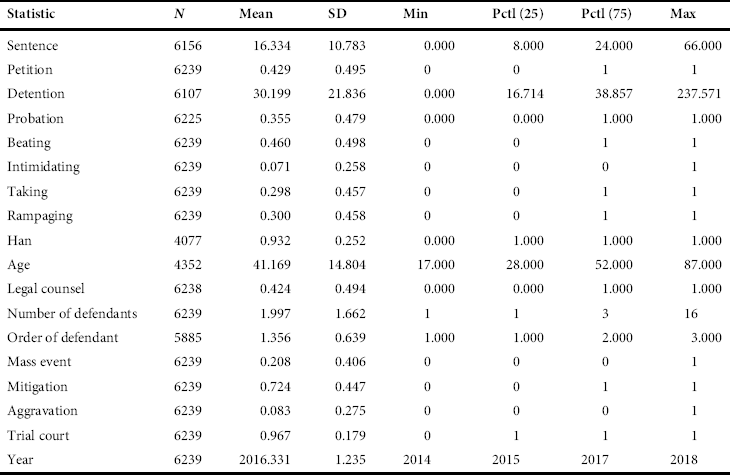
From the combined sample (4628 cases), we obtained a total of 6239 individual observations, with 2675 petitioner defendants and 3564 non-petitioner defendants.Footnote 33 Table 1 presents the descriptive statistics of the sample. As for our dependent variables, the average length of pre-trial detention was 30.2 weeks, and the mean for a custodial sentence was 16.3 months. The probation rate was 35.5%, which means that around one third of the defendants were sentenced to community correction instead of a custodial sentence. The proportion of petitioner defendants in our sample was 42.9%.
Summary of descriptive statistics

In our sample, both petitioners and non-petitioners were accused of offenses relating to a social disturbance, such as harassing a government official or destroying public property, with reference to the statute on picking quarrels and provoking trouble and the relevant judicial interpretations. No defendant was convicted for petitioning alone. In fact, the judges may have paid more attention to the legal reasoning in the cases where the defendant was a petitioner. One piece of evidence for this is that the verdicts in the petitioner group are significantly longer than the verdicts in the non-petitioner group. The mean of the total number of words for all the cases is 6160 in the petitioner group and 2620 in the non-petitioner group. This finding supports the assertion of our interviewees that the courts try to ensure there is a solid legal basis for their decisions on petitioners (authors' interviews with Chinese judges and procuratorates, 2020). The proportion of defendants with a criminal record is 3.63% in the petitioner group and 8.84% in the non-petitioner group. This implies that the vast majority of the petitioners in our sample were being prosecuted for the first time. It helps to rule out one possible reverse causation route, that petitioners who have been treated badly by the courts will petition to protest about their maltreatment. Our interviews also indicate that the deterrent effect of a criminal sanction is strong enough to change the behavior patterns of a prosecuted petitioner: most petitioners stop petitioning after a criminal sanction, and all of them become extremely cautious about engaging in new activities to pursue their rights (authors' interviews with Chinese judges and procuratorates, 2020; see also Reference Feng and HeFeng & He, 2018).
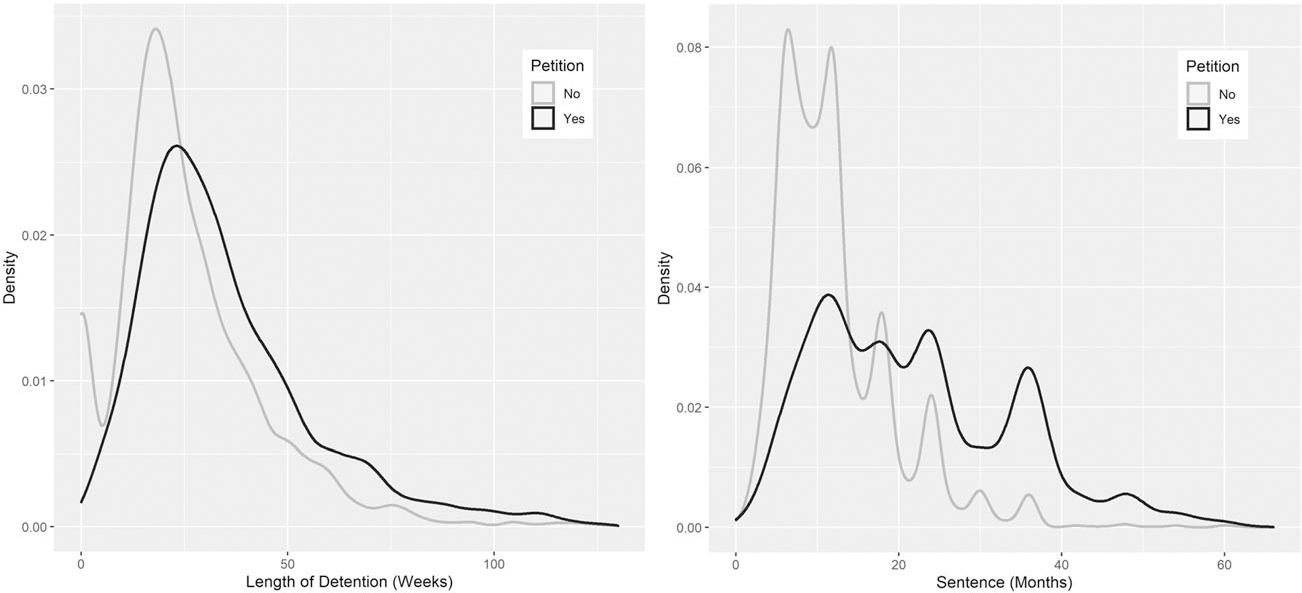
As we are interested in the differences in our dependent variables between the petitioner group and the non-petitioner group, we drew graphs of the lengths of the pre-trial detentions and custodial sentences for these two groups. Figure 1 shows how the lengths of the pre-trial detentions and custodial sentences are distributed among the petitioner defendants and the non-petitioner defendants. As shown in this figure, the petitioners were generally detained before their trials for longer periods than the non-petitioners, and similarly, the petitioners received longer custodial sentences.
Distributions of pre-trial detention and custodial sentence

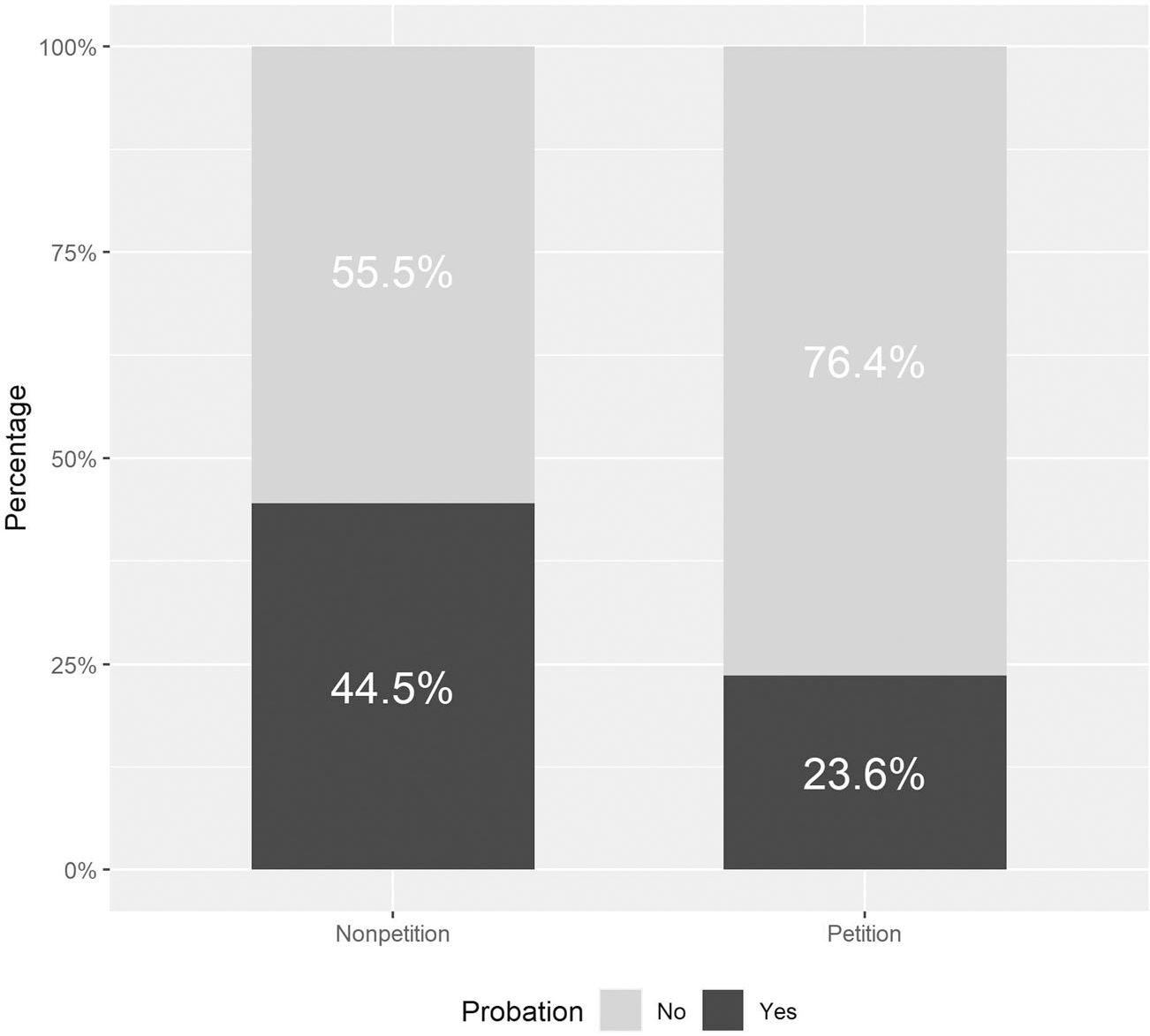
As for probation, we can see from Figure 2 that there is a significant difference between the petitioner group (23.6% were granted probation) and the non-petitioner group (44.5%). The probation rate for non-petitioners is almost twice that for petitioners. These figures provide a rudimentary overview of the effects of petitioning on pre-trial detention, custodial sentence, and probation. They provide preliminary evidence that petitioners receive biased treatment in criminal adjudications. To avoid omitted variable biases, we controlled for the potential confounding factors and present more rigorous statistical analyses in the following sections.
Probation rates for petitioners and non-petitioners

Estimating strategies
Although our dataset is constructed from judgments, we opted for defendants as the unit of analysis. Our baseline model is a linear model that incorporates fixed effects, as specified below:

yijt are our dependent variables, that is, the length of the pre-trial detention or custodial sentence imposed on defendant i in province j and adjudicated in the year t. α is the coefficient for the variable of interest, PETITION, and β is a vector of coefficients for the control variables xijt. Since we are also interested in the effect of petitioning on the opportunity to be put on probation, we use a logistic model with fixed effects instead for this estimate.
RESULTS
Our statistical analysis of the published judicial documents reveals that the accusation against a petitioner of picking quarrels and provoking trouble may contain social control purposes of stability maintenance. This kind of stability justice functions in two dimensions. As regards the procedural aspect, petitioner defendants, compared to non-petitioner defendants, suffer from longer periods of pre-trial detention when they are accused of picking quarrels and provoking trouble. As regards the distributive aspect, petitioner defendants are given severer penalties and are less likely to be put on probation, with other legal circumstances held constant.
Procedural biases
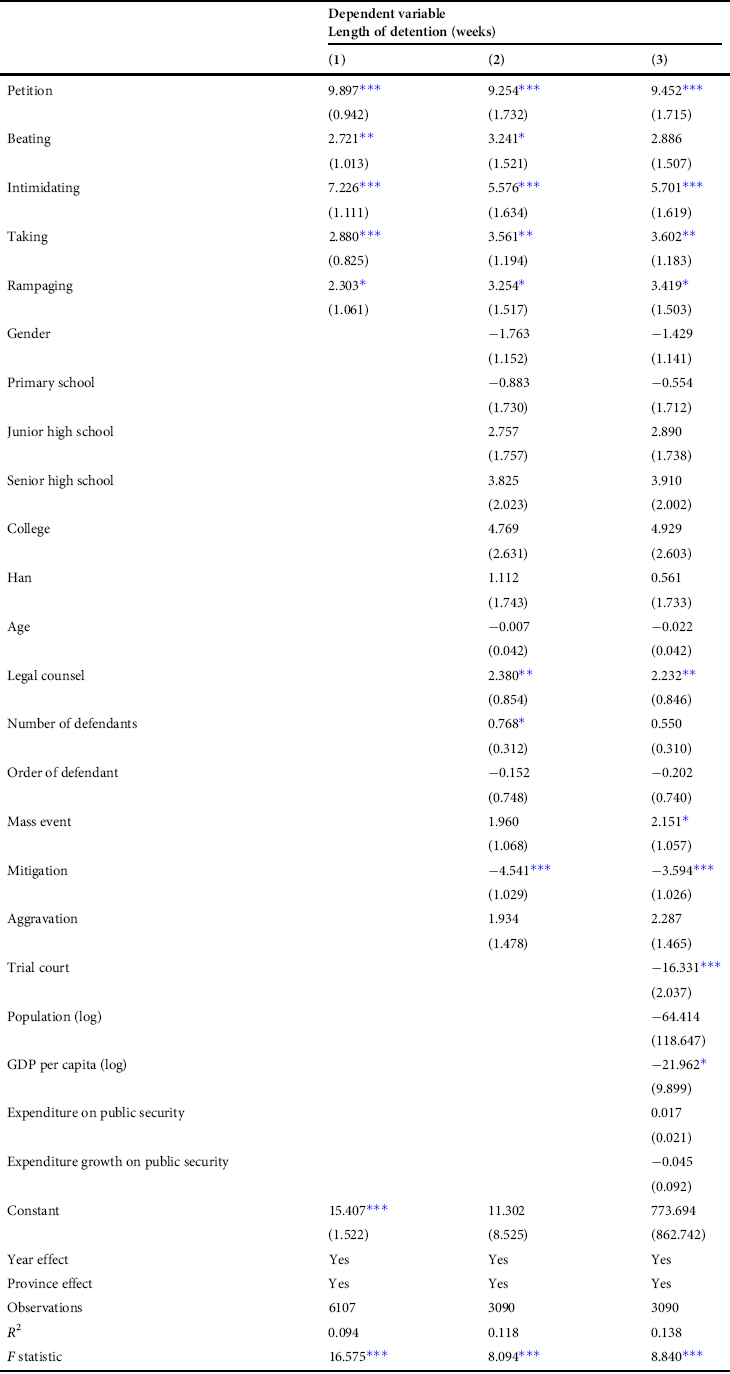
Table 2 presents the results of our regression analyses for detention length. We ran three regression specifications. The first specification contains only the independent variable of interest and covariates relating to the criminal circumstances. The second specification includes covariates at the individual level. The third specification incorporates covariates at the institutional level.
Petition and length of pre-trial detention

*p < 0.05; **p < 0.01; ***p < 0.001.
As we can see from Table 2, all the coefficients for PETITION are positive and significantly different from zero at the 0.1% significance level. For example, the coefficient value in Column 3 is 9.452, which means that a petitioner will be detained for about 9 weeks longer than a non-petitioner, with the other factors fixed. The effect is far from trivial if we note that the average detention length in our group is 30.2 weeks. The results support our first hypothesis that the authorities repress petitioners by imposing longer pre-trial detention sentences on them.
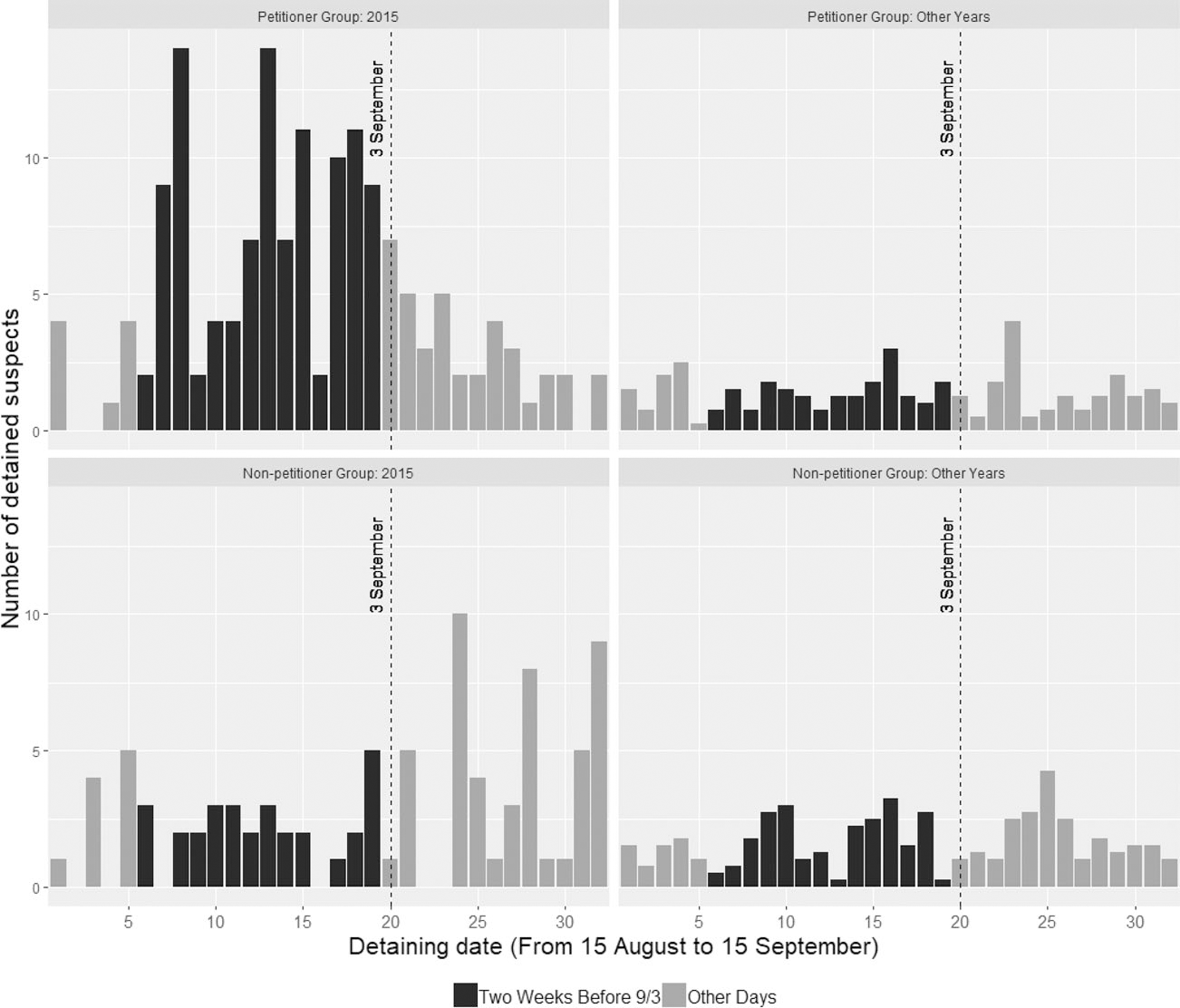
Further, to study whether pre-trial detention is employed as a tool for containing petitioners during politically sensitive periods, we tried to detect changes in the patterns of pre-trial detention immediately before significant political events. Since the judicial verdicts do not mention the causes of pre-trial detention, we adopted a strategy that measures the effect of the occurrence of an unconventional political event. Unlike a routine political event, such as the Two Conferences,Footnote 34 an unconventional political event is exogenous to the grassroots authorities. It functions as an external shock and allows us to detect real patterns of change.Footnote 35 From 2014 to 2018, one of the most important national political events was the 2015 China Victory Day Parade, which took place on September 3rd 2015 for the purpose of celebrating China's victory in World War II. Since this was a unique political event that happened only in 2015, it allows us to use the patterns for pre-trial detention in other years as a control. To detect whether the grassroots authorities consciously detained petitioners, a comparison is drawn between the petitioner group and the non-petitioner group.
Figure 3 shows the daily numbers of petitioners and non-petitioners arrested from August 15th to September 15th in 2015 and in other years (2014, 2016, 2017, and 2018). In the top left panel of the figure, we can see that the daily number of petitioners arrested increased sharply in the 2 weeks before the event, and fell back after September 3rd. As a comparison, we did not find such surges in other years, as shown in the top right panel. Also, the number of suspects arrested is much smaller in the years other than 2015, if we compare the histograms in the two top panels. With our observations for non-petitioners as a control, we find no surge between 2014 and 2018 in the two bottom panels. These results show that the grassroots authorities are more likely to detain petitioners, but remain indifferent to non-petitioners, as significant political events draw close. This supports our empirical findings that, acting under pressure to maintain social stability, grassroots authorities employ pre-trial detention as a means to control petitioners temporarily during politically sensitive periods.
Pre-trial detention, 2015 China victory day parade, and petitioning. We extracted the starting date of detention of every defendant in our sample from the verdicts, and calculated the number of defendants who were first detained on each day. The histograms show the daily numbers of suspects detained from 15th August to 15th September between 2014 and 2018. The two histograms in the left panels show the number of petitioners and non-petitioners, respectively, whose detention began on each day before the China Victory Day Parade in 2015, and the two histograms in the right panels illustrate the average number of petitioners and non-petitioners whose detention began on each day for this period in the other 4 years (2014, 2016, 2017, and 2018).

However, we cannot easily attribute the above surge in the number of detainees to the authorities' preventive control of “trouble-makers.” It could be caused by the increasing disorder as a result of mounting petitioning strategies during politically sensitive periods. The surge in the number of detained petitioners could be attributable to the authorities' law-based responses to the burst of social disturbances. Therefore, to support our argument and rule out the influence of mounting disorder in politically sensitive periods, we did an additional test on the detention of petitioner defendants during politically sensitive periods. We went through all the cases and found 64 petitioners who were detained during the week before the 2015 China Victory Day Parade (from August 27th to September 2nd), and then we checked the date of the offenses of which they were accused. Among these petitioners, only half were detained within 4 weeks after the alleged offense, while 26 were detained for offenses committed more than 2 months before, and eight of them were even detained for petitioning activities in the previous year (2014). This presents a sharp contrast to the petitioners detained during the same period of the year in 2014, 2016, 2017, and 2018, of whom 73.8% were detained within 4 weeks after the alleged offense. The results show that, while some of the detentions may have been the result of the mounting disorder before and during the politically sensitive periods, pre-trial detention as a means of temporary control does exist.
Distributive biases
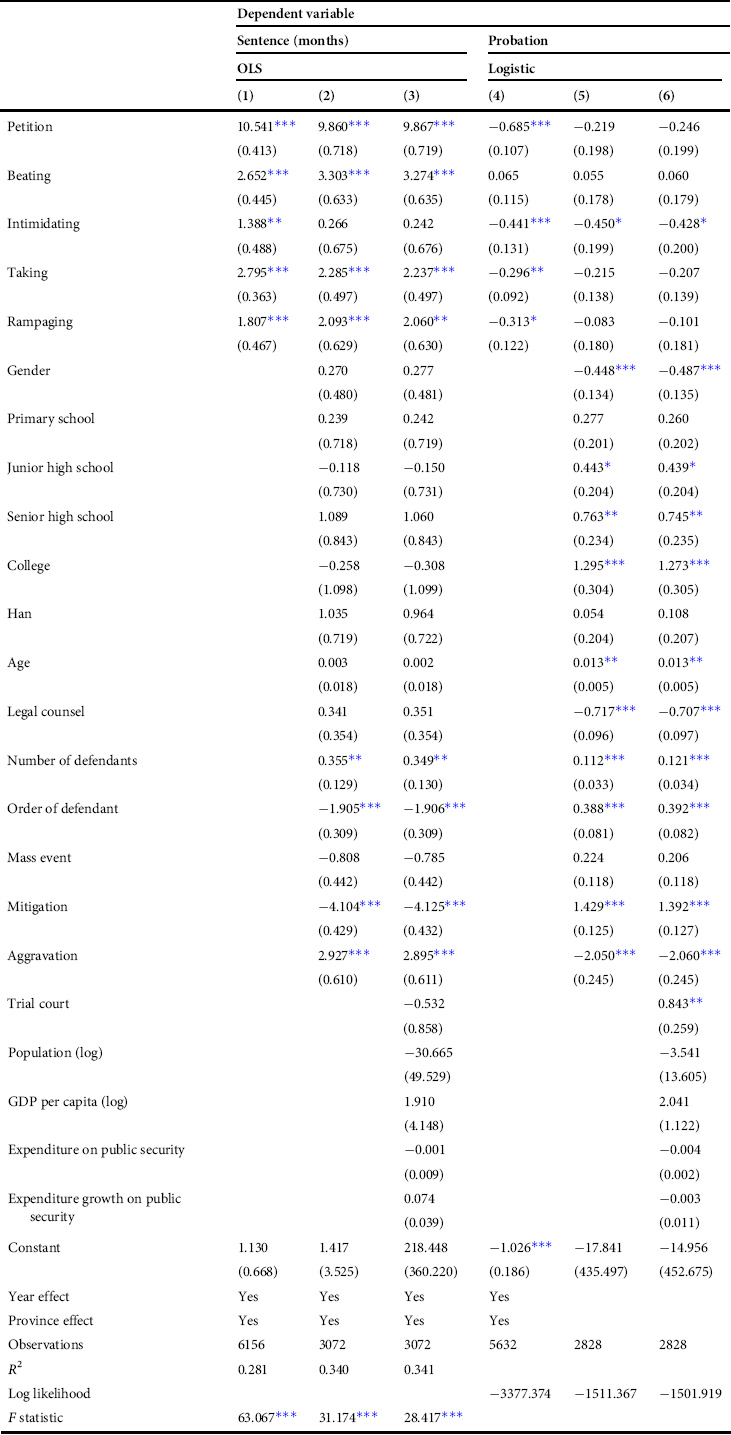
To probe whether and how petitioner defendants suffer from distributive biases when they are accused of picking quarrels and provoking trouble, we ran the three regression specifications in Table 2 for the sentence and probation respectively, and the results are reported in Table 3. In the first three columns, we find that the coefficients of PETITION are all significantly positive at the 0.1% significance level. The coefficients are of a tremendous effect size. Take the estimate in Column 3, for example. If the defendant is a petitioner, he receives an additional 9.867 months for his custodial sentence, ceteris paribus. As we know from Table 1, the average sentence in our sample is 16.334 months. The result provides strong evidence that petitioner defendants suffer from distributive biases.
Petition, sentence, and probation

*p < 0.05; **p < 0.01; ***p < 0.001.
As for probation, we find a negative association between probation and petitioners, which may imply that petitioners are less likely to be put on probation than non-petitioners, if all other conditions are equal. Although the coefficients are all negative in the three specifications, not all of them are statistically significant, especially when more control variables are added. The results provide weak support for our fourth hypothesis about the relationship between probation and petition. We will discuss this result further in the following section on robustness checks.Footnote 36
Robustness checks
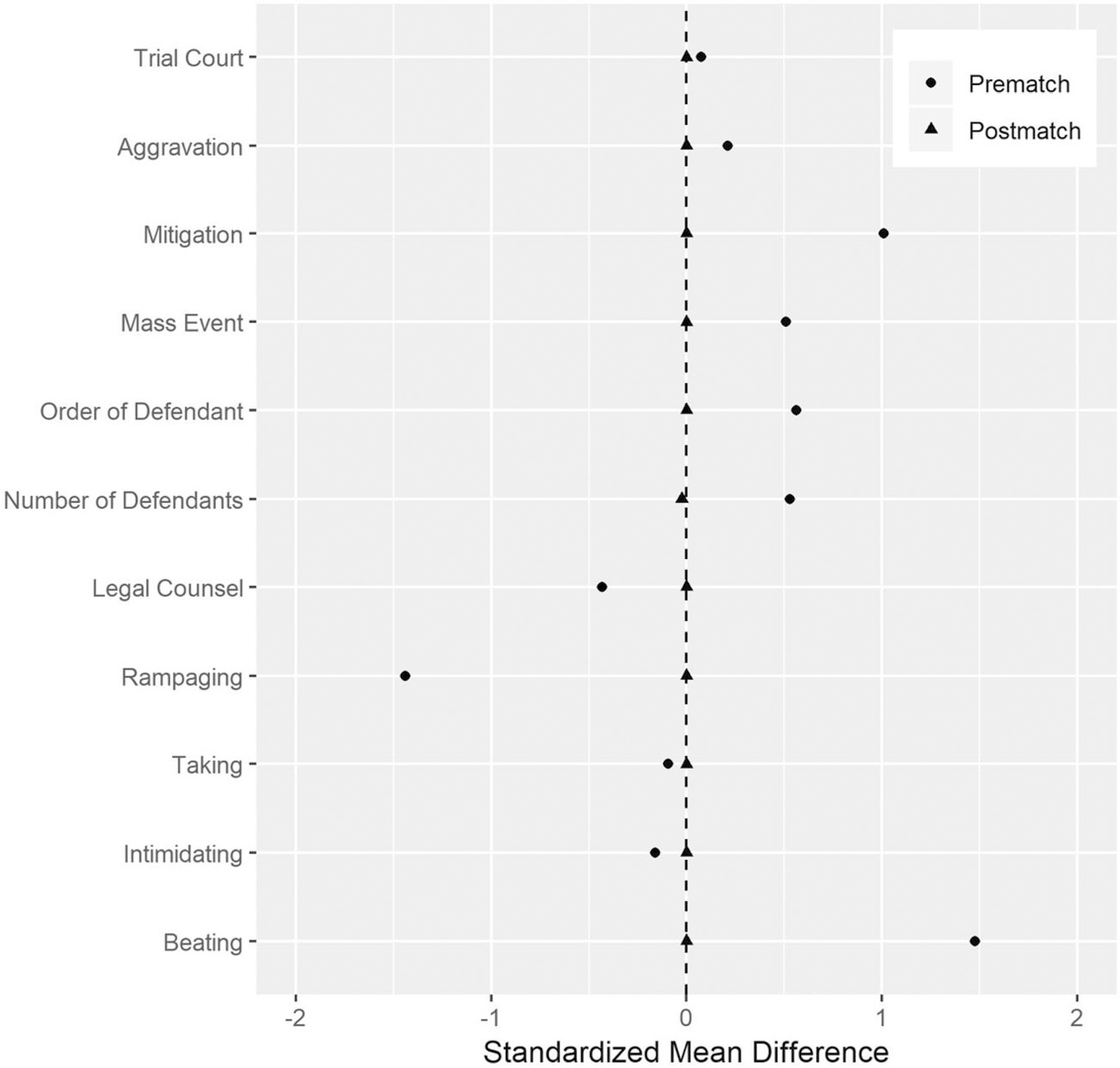
As our research is based on online verdicts, the “missingness problem” of court disclosure is worth considering (Reference Liebman, Roberts, Stern and WangLiebman et al., 2020). According to the 2016 Amendment of the Regulation on Publishing Judgments on the Internet by People's Courts, local courts retain the discretion not to upload verdicts if they regard them to be “inappropriate to disclose online.” Since there is no clear standard for “inappropriateness,” we have little information about whether cases are missing at random. By comparing the number of officially reported cases to the number of cases disclosed online, we roughly estimate that the percentage of undisclosed cases for the crime of picking quarrels and provoking trouble is around 27%.Footnote 37 Given the possible selection bias caused by missing cases, we preprocessed the combined sample using the matching method. Matching is a powerful nonparametric approach for improving causal inference by reducing the confounding influence of pretreatment control variables between the treatment and control groups in non-experimental data (Reference Ho, Imai, King and StuartHo et al., 2007; Reference StuartStuart, 2010). As Reference King and NielsenKing and Nielsen (2019) have pointed out, propensity scores matching (PSM), a commonly used matching method, suffers from problems of increasing imbalance, inefficiency, model dependence, and bias. We thus used coarsened exact matching (CEM) to preprocess our data.Footnote 38
Figure 4 shows the covariate balance of the control variables for petitioner defendants and non-petitioner defendants before and after matching. We found that we had a balanced sample after using CEM.
Covariate balance of control variables

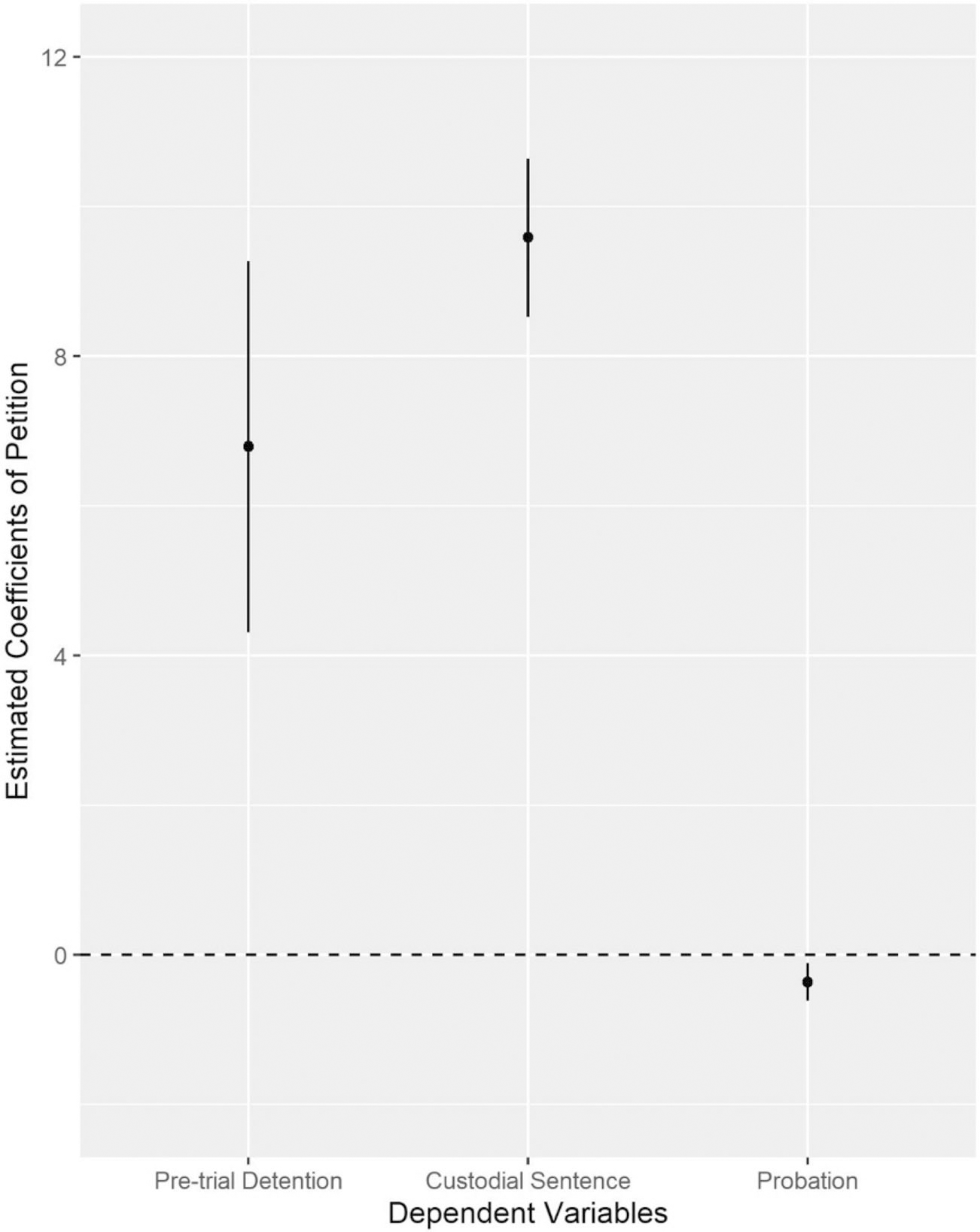
We ran regression analyses on pre-trial detention, custodial sentence, and probation, with our matched sample. The results are presented in Figure 5. Consistent with the findings in the previous section, there is a positive and significant effect of being a petitioner on the length of pre-trial detention.
Effects of petition on pre-trial detention, custodial sentence, and probation in the matched sample

As we can see from the figure, the effect of being a petitioner on pre-trial detention is also significantly positive, and the value of its coefficient is not much different from the values in Table 3. Interestingly, we find a significantly negative effect of being a petitioner on the opportunity to be put on probation if we control for a set of variables. The coefficient is −0.36, which means that if a defendant is a petitioner, the odds of being put on probation are decreased by 30.2%. This provides alternative evidence for our fourth hypothesis about the negative relationship between probation and being a petitioner.
DISCUSSION
This article studies the mechanism of stability justice by analyzing cases arising from accusations of picking quarrels and provoking trouble against petitioner defendants and non-petitioner defendants. Drawing on statistical analyses of published judicial documents, we provide evidence that, while accusations of picking quarrels and provoking trouble follow formal legal procedures and comply with the law, they may serve stability maintenance purposes by creating both procedural and distributive biases. On the procedural aspects, petitioner defendants may receive longer periods of pre-trial detention than other defendants. Petitioners are also more likely to be detained during politically sensitive periods, when local authorities have a stronger motivation to repress petitioning. On the distributive aspects, petitioner defendants may be sentenced to significantly longer custodial sentences and granted fewer opportunities for probation than non-petitioners, with other conditions held constant. The purpose is to take action against “trouble-makers,” to prevent petitioning activities, and to deter potential petitioners. With the deliberate implementation of all the biases, seemingly justified processes are sometimes turned into a tool for containing petitioners and deterring petitioning strategies.
Stability justice is more formal and transparent than traditional tools for social control. If traditional means of repression symbolize total and unchecked power of authoritarian rule, then stability justice, which is subject to the constraints of legal rules and procedures, illustrates the self-limit of power and thus leads to a step forward towards law-based governance. However, it should be noted that the employment of stability justice may incur the risk of creating more governance obscurity. Unlike violent forms of repression, which seldom provide legitimate causes for penalizing the discontented, stability justice does uphold some law-based standards for petitioning activities, since all decisions are made in accordance with formal procedures and with reference to the law (Reference Stern and O'BrienStern & O'Brien, 2012, p. 177). The problem is, since the decisions are made through the arbitrary use of judicial discretion and the covert manipulation of legal rules and procedures, these obscure standards do not clearly signal the limits of what is permissible, that is, whether particular resistance strategies will be tolerated or suppressed—before repression occurs (cf. Reference Shen-BayhShen-Bayh, 2018). Judicial procedures are, accordingly, turned into a black box, in which the application of the law shields the authorities' social control tactics from supervision and erodes the authority of the judiciary. This echoes the findings of guilt construction in Reference MouYu Mou's (2020) study on Chinese criminal justice, as well as Reference LiuSida Liu's (2020) argument that the Chinese legal system has become a “cage for the birds” with its rising formal rationality and instrumentality.
The findings of stability justice also spur us on to reconsider the role of the courts in contemporary China. Accompanied by the increasing significance of the law and the courts over the past two decades (Reference MoustafaMoustafa, 2014), the role of the judiciary in authoritarian regimes has become more important and complex. Meanwhile, new problems have arisen in this process. In our case of the Chinese judiciary, notable changes have taken place in recent years, as Chinese judges have increasingly served the function of enhancing regime legality by producing procedural and distributive justice within China's social governance. However, the courts, embedded in China's bureaucratic system, inevitably encounter external interference from the local authorities, and this is particularly evident at the grassroots level (See also Reference HeHe, 2021a; Reference Ng and HeNg & He, 2017). In this sense, more emphasis should be laid on enhancing the significance of law and courts in social management.
The theory of stability justice has a huge potential for generalization. Due to the limits of our data, this article focuses on the context of criminalizing petitioning and discusses how stability justice has been increasingly employed to contain petitioners who are accused of threatening social stability. The scope of stability justice, however, is far beyond criminal justice vis-à-vis particular social groups. It is a broad concept that encompasses different areas of justice and various types of judicial behaviors. For example, dealing with labor protests, the courts, echoing the demands of building “a harmonious society,” give a privileged share of access to cases that are bolstered by protest actions and decide in favor of common protesters rather than government agencies, through a flexible interpretation of labor laws and procedural requirements (Reference Chen and XinChen & Xin, 2012; Reference Su and HeSu & He, 2010). In divorce cases, judges fudge the issue of domestic violence, suppress rightful claims to divorce, and prefer mediation to adjudication, in an effort to maintain stability and avoid “vicious incidents” caused by enraged litigants (Reference HeHe, 2021b; Reference MichelsonMichelson, 2019). In a way, stability justice may provide a feasible theoretical frame for explaining and analyzing the complex judicial behaviors in contemporary China. Further discussion is required to consolidate and extend the notion of stability justice in the Chinese context.
Moreover, stability justice not only deepens our understandings in the Chinese judiciary, but also provides theoretical lens to assess the law and courts in many contexts around the world. It has been shown that judiciaries in different authoritarian regimes may well serve the functions of strengthening political control (Reference Levitsky and WayLevitsky & Way, 2010; Reference MoustafaMoustafa, 2014; Reference RajahRajah, 2012), maintaining cohesion inside the ruling coalition (Reference Shen-BayhShen-Bayh, 2018), facilitating economic development (Reference WangWang, 2014), and bolstering governance legitimacy (Reference BiddulphBiddulph, 2015; Reference Ginsburg and MoustafaGinsburg & Moustafa, 2008). Our analysis further illustrates that the judiciary does have the potential to be adopted as an effective tool for social control. A close examination of the judiciaries in Myanmar (Reference CheesmanCheesman, 2015), Indonesia (Reference HurstHurst, 2018), and Russia (Reference Solomon, Ginsburg and MoustafaSolomon, 2008) also reveals that, with similar imperatives of stability and order, judicial institutions can be used to serve social control purposes. These studies seem to indicate that measures of stability justice may have already been employed in some authoritarian regimes, and more questions are thus raised: What are the patterns, implications, and consequences of stability justice in authoritarian regimes? Does stability justice also exist in democracies, possibly with the purpose of managing highly sensitive social conflicts? Whether and how does the employment of stability justice differ among different contexts? Further research should focus on the application of stability justice in different contexts. These questions could only be satisfactorily answered if more empirical data and studies become available.