Since 2002, the number of major US disaster declarations (an average of 65 per year) has markedly increased. In 2011, the Federal Emergency Management Agency (FEMA) issued 90 major disaster declarations. The growing scale and frequency of disasters emphasize not only the probability of these events but the likelihood that the resources required for successful response and recovery from each disaster will be progressively scarce. The economics of disaster has become a contentious policy issue; in 2011, amendments to the Stafford Act, which provides for federal disaster relief and emergency assistance, were vigorously argued in Congress. Given the alarming disaster statistics and concurrent budget debate, the need for communities to harness the full range of governmental and nongovernmental assets is increasing. Federal dollars may prove to be insufficient to facilitate recovery or to support community resilience-building activities.
Previous disasters underscore the value of integrated planning among government and nongovernmental organizations (NGOs), including nonprofit, community, and faith-based organizations, and businesses,Reference Moore, Chandra and Feeney1 and the role that NGOs take in reducing reliance on external aid. Yet, recovery has been diminished because communities are unable to effectively coordinate with and integrate the activities of NGOs in ways that avoid duplication and streamline services.Reference Moore, Chandra and Feeney1-Reference Joshi5 NGOs act as community hubs, and it is hypothesized that NGOs efficiently execute certain activities (eg, disaster case management, long-term health and social services, community mapping of needs). Without a clear framework on which to compare service delivery quality and cost-effectiveness, this hypothesis is informed by limited empirical data.6-Reference Acosta, Chandra, Sleeper and Springgate8
While common wisdom argues that all response and recovery is local, this reality has only recently been recognized nationally. With the advent of FEMA's whole community engagement approach,9 community resilience has become the guiding goal of the National Health Security Strategy.10 With the advent of FEMA's “whole community engagement”, community resilience as the guiding goal of the National Health Security Strategy, and formal involvement of NGOs in the recent Department of Homeland Security Community Resilience Task Force report, there are new expectations and responsibilities being placed on NGOs.11
Also, FEMA and the American Red Cross (ARC) have a memorandum of agreement (MOA) to work together to achieve their designated responsibilities in the National Response Framework. This MOA tasks the ARC with convening other NGOs around mass care.12 Although these policy documents call for improvement in partnerships with government and other NGOs, little operational guidance supports these changes at the local level. Operational guidance on NGO involvement is needed to ensure implementation of policy and to support planning efforts. Without it, policy enhancements may remain unrealized. To address this gap, an operational model has been developed that describes the unique capabilities, roles, and responsibilities of NGOs before, during, and after a disaster. This model could be applied as a unifying framework for national preparedness and recovery policy, and provide structure to community planning, resource allocation, and metrics on which to evaluate NGO disaster involvement.
Methods
To develop the operational model, we analyzed peer-reviewed literature, relevant policy, and federal guidance to characterize the capabilities of NGOs, contextual factors that determine their involvement in disaster operations, and key services they provide during disaster response and recovery.
Peer-Reviewed Literature
The literature search focused on the roles of NGOs in emergency preparedness, response, and recovery. Articles from 2000 or later were identified using a title search of Medline (PubMed) and PsychInfo. Search terms included nongovernment* or nonprofit or faith-based or business or community-based AND disaster or resilience or preparedness or emergency or mitigation.
Policy and Federal Guidance
We also reviewed the following recent policy documents to identify NGO roles in current policy and federal guidance: National Health Security Strategy,10 National Security Strategy,15 National Disaster Recovery Framework,16Homeland Security Presidential Directive 21, 17Grand Challenges for Disaster Reduction, 18Guide for All- Hazard Emergency Operations Planning, 19HHS Pandemic Influenza Plan, 20 and FEMA's A Whole Community Approach to Emergency Management.9
Review and Abstraction of the Literature, Policy, and Guidance
Use of a data abstraction form (DAF) facilitated systematic evaluation by capturing from each document several elements regarding content (eg, type of study, data collection method, analytic approach, and summary of key findings). The DAF was used to catalogue the unique capabilities of NGOs referenced in each citation (eg, flexibility), determinants of involvement in disaster operations (eg, financial considerations), services provided during disaster response and recovery (eg, shelter, food), and how these key services differed for routine and emergency times. The catalogue of DAF contents was synthesized into a single list of unique capabilities, determinants, and services for routine and emergency times. All capabilities, determinants, and services cited in the documents were retained on the list, regardless of the frequency with which they appeared. However similar capabilities, determinants, and services were grouped together.
Results
The literature search identified 40 articles. A title and abstract review narrowed the search to 23 articles. Also included were articles that described NGOs efforts to participate in disaster preparedness, response, or recovery, and recent reports written by the authors.Reference Chandra, Acosta and Stern2-Reference Chandra and Acosta4, Reference Acosta, Chandra and Feeney7, Reference Chandra, Acosta and Meredith13, Reference Acosta, Chandra and Sleeper14 One reviewReference Chandra, Acosta and Meredith13 included an assessment of 86 articles on community resilience (from 464 initial citations), which added another 40 articles with substantive focus on NGOs and disaster.
Findings from our review have been summarized in 4 interrelated key areas from which the NGO operational model (Figure) was developed. The first area describes the current policy landscape supporting partnerships between NGOs and government agencies and among NGOs and the common challenges to developing and leveraging these partnerships. The second area indicates the capabilities and determinants of NGO capacity to respond to disaster. The third area describes the services offered by NGOs and their roles and responsibilities. This area in particular helps define the underlying premise of the model—that NGOs should be involved to provide their routine services more quickly and to a greater and broader population during a disaster. The fourth area underscores the importance of involving NGOs in disaster response and recovery for potential long-term benefits, including building NGO capacity and encouraging ongoing community development.
Operational Model for Involving Nongovernmental Organizations (NGOs) in Disaster Preparedness, Response, and Recovery.

The Figure shows how these components are woven into the model. Key NGO capabilities include their knowledge of local needs and assets developed over time through their relationships with other NGOs. Other determinants of their capacity influence involvement in delivering routine and disaster-related activities, such as financial (asset level, reimbursement) and social responsibility (mission, motivations). When a disaster affects a community, NGOs apply their capabilities and accelerate the delivery of services to accommodate new community needs. They are not asked to conduct new services or assume new responsibilities but to increase their efforts by providing more services faster and to a broader population. During disaster recovery, NGOs continue providing services and begin transitioning families back into the routine service delivery system (eg, Temporary Assistance for Needy Families). As part of continued community development, these improvements can stimulate economic recovery, improve service delivery for future disasters, and provide general strengthening of resilience. Lessons learned about what worked and what failed during a disaster can also provide critical information to further enhance NGOs capacity.
Preparedness Partnerships
Federal policy underscores the importance of NGO partnerships with the government and among themselves. The National Security Strategy10 emphasizes strategic partnerships with NGOs in the for-profit and nonprofit sectors to ensure domestic security, including containing pandemics and spread of infectious diseases. The National Health Security Strategy10 and the National Disaster Recovery Framework16 highlight the importance of these partnerships and focus on a broad range of stakeholders from local, state, territorial, tribal, and federal government; community-based organizations; business; and academia. The first objective of the National Health Security Strategy10 is to foster informed and empowered communities, including individuals and NGOs. The FEMA-ARC MOA also specifies that ARC convene other NGOs to provide mass care. Together, these policy documents assign responsibility to NGOs without specifying effective models for partnership.
Developing partnerships involves building deep local networks and broad networks that reach from the local to the federal government.Reference Kusumasari, Alam and Siddiqui21 Research describes the importance of not just developing partnerships with NGOs but integrating these organizations to strengthen the public health and medical systems to adequately prepare for, respond to, and recover from disasters. Integrating organizations can increase trust and knowledge and contribute to a community's ability to enhance plans and speed recovery.Reference Baezconde-Garbanati, Unger, Portugal, Delgado, Falcon and Gaitan22-Reference Wise25 Buckland and RahmanReference Buckland and Rahman26 note that mutual respect between NGOs and government agencies and open, 2-way communication are essential for community effectiveness in disaster management. Partnerships can help improve the relationships between NGOs and community residents, making NGOs more effective in delivering routine services during nonemergency times.Reference Dawes, Cresswell and Cahan27
However, partnerships with and among NGOs are not optimal unless models exist to facilitate them.Reference O'Dempsey and Munslow28 Our research suggests that a lack of formal partnerships between NGOs and state and local public health officials has limited involvement of NGOs in emergency planning and exercises.Reference Chandra and Acosta4, Reference Acosta, Chandra and Feeney7 This challenge is exacerbated because many NGOs that engage in disaster response and recovery have limited experience with emergency preparedness and response and the incident command structure.Reference Eide29 Even collaborations of NGOs with expertise in disaster response, such as the National Voluntary Organizations Active in Disaster (VOAD), face challenges in coordinating with NGOs and with government agencies and managing the surge of volunteers and donations during disaster.30 These partnerships may also be hindered by the NGOs’ financial constraints, which could limit their investment in disaster preparedness relative to routine activities.
Determinants of NGO Capacity to Respond to Disaster
Understanding what capacities NGOs need and the factors that influence their ability to perform during a disaster are important in partnership models to achieve optimal NGO performance.Reference Motoyoshi, Takao and Ikeda31 NGOs often maintain a strong network of local contacts and grassroots links during routine and emergency conditions.Reference Muller and Whiteman32 NGOs can empower groups of people to address community problems collaboratively by using resources in the community.Reference Patterson, Weil and Patel33, Reference Eikenberry, Arroyave and Cooper34 By operating outside of the state or federal system, NGOs have a more flexible structure that can shift in response to changing conditions created by disasters.Reference Troy, Carson, Vanderbeek and Hutton35
The social and financial environment influences the ability of the NGO to perform during a disaster.Reference Patterson, Weil and Patel33 Attitudes of organizational leadership toward risk and industry norms commonly govern the investments in disaster response and recovery by private businesses,Reference Faulkner36 while ethical and mission-driven considerations usually drive the more service-oriented NGOs.Reference Acosta, Chandra and Feeney7 For example, an organization such as Catholic Charities, whose mission is “to provide service to people in need,” may give priority to vulnerable individuals, while private businesses participating in disaster response may consider the impact on employees and their overall financial stability.
A lack of appropriate funding mechanisms and complex reimbursement procedures have been reported as barriers to active NGO participation.Reference Eikenberry, Arroyave and Cooper34, Reference Runyan37 These challenges are increased in communities with multiple and overlapping disasters, creating competition for time-limited resources that ebb and flow with each subsequent event.Reference Joshi5 This situation can severely constrain the NGOs’ capacity to deliver services in the long term.Reference Gajewski, Bell, Lein and Angel38 NGOs staff are limited, and to increase capacity effectively in response to a disaster, innovative workforce training and credentialing models are needed.Reference Merlot and DeCieri39
Discussion
Little empirical information exists on the challenges and negative consequences of NGO participation.Reference Joshi5 Although NGOs provide invaluable support for response and recovery, challenges to their work (eg, inadequate governmental planning) are substantial, and many questions remain about the ability of communities to use the capabilities of NGOs to restore routine community functioning.Reference Baezconde-Garbanati, Unger, Portugal, Delgado, Falcon and Gaitan22 Further, very little is known about what impedes NGOs from supporting holistic recovery or local sustainability after a disaster.Reference Runyan37, 40
To our knowledge, the current literature does not indicate how variability in size, resources, and affiliations of NGOs influence their response reliability.Reference Jackson41 No studies estimate the surge capacity of NGOs, a figure on which these organizations rely for specific roles or responsibilities, or determines which are capable of responding effectively during certain phases of disaster.42 In addition, some confusion exists among governmental agencies about the best way to coordinate with NGOs. Working through state and local VOADs has been one strategy, but not all NGOs are members.10 An operational model can not only delineate NGO capacities but also be used to measure their ability to activate and sustain long-term disaster response.
Roles, Responsibilities, and Services
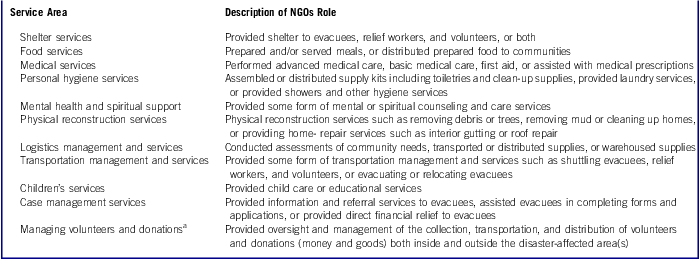
Case studies have shown that NGOs provide an array of critical services to meet the needs of those affected by disaster. NGOs participate in joint planning to mitigate effects of disasters and to improve community development overall.Reference Pyles43 Joint planning also provides an opportunity for shared agreements (eg, memoranda of understanding, MOAs, and contracts) to be developed among NGOs and between NGOs and government agencies to guide activities during response and recovery. A study by the Homeland Security Institute6 found that NGOs were highly beneficial by providing shelter, food, medical services, hygiene services, mental health and spiritual care, physical reconstruction, logistics management and services, transportation, children's services, and case management during and after Hurricane Katrina (Table 1).
In spite of these roles and resources, guidance for how NGOs should prepare to increase capacity is limited and nonspecific. Current federal guidance10, 15, 16 provides scant operational detail, but some information in the National Disaster Recovery Framework16 suggests that NGO leaders could identify ways to participate in predisaster planning and postdisaster recovery via a checklist of recovery responsibilities. For-profit NGOs can develop business plans to ensure continuity and speedy recovery of critical infrastructure,Reference Alesi44 and nonprofit NGOs can provide an array of disaster services (eg, physical health, mental health, housing).Reference Allen45 However, no document offers operational information on how NGOs should prepare for the inevitable augmentation of services in the acute phase of response; what algorithms NGOs should use for calculating resource deployment; and how NGOs should plan for a cycle of disaster response and recovery that also accounts for routine operations.
Maximizing Ongoing Community Development and Public-Private Partnerships for Disaster Resilience
Partnerships among public entities (government) and the private sector are critical for usual emergency preparedness activities.Reference Keim46 In difficult financial times, these public-private collaborations are critical because they optimize the resources of both entities by decreasing administrative hassles, creating new revenue streams in communities, and developing sustainable plans for ongoing community revitalization.Reference Thomas, Roggiero and Silva47, Reference Suwanvanichkij, Murakami and Lee48 Public-private and private-private (eg, nonprofit to for-profit) partnerships can be used to build ongoing capacity that ultimately improves a community's resilience to disasters, including mitigating vulnerabilities of the population and infrastructure.Reference Kilby49-Reference Embrey, Clerman, Gentilman, Cecere and Klenke51
NGOs play a key role in sustainable approaches to long-term recovery from disaster.Reference Eide29 A case study of disaster recovery after Hurricane Mitch suggested that because NGOs are a permanent part of the community they are more focused on community development and resilience building during disaster response and recovery.Reference Telford, Arnold and Harth52 In particular, NGOs can participate in legislative activities postdisaster to strengthen building codes and alter land-use designations to ensure the physical infrastructure is built better for a future disaster. NGOs can provide support to displaced residents who migrate to surrounding cities. They can contribute to overall economic revitalization by providing vocational education and training and case management for affected residents to restore daily functioning.Reference Kilby49 NGOs, particularly schools, recreation centers, and restaurants are a key part of the social infrastructure, thus supporting individual-level mental health and community emotional well-being.
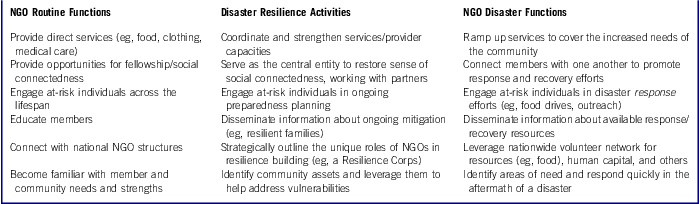
NGOs are central to partnerships that can improve community health and well-being and build resilience. They also have insights into community problems that can impede effective disaster response and exacerbate a disaster.Reference Patterson, Weil and Patel33 This unique lens could be used to address community health and well-being on a daily basis, addressing vulnerabilities that are mutable, and ensuring community preparedness for the changing scope and scale of emergencies.Reference Kusumasari, Alam and Siddiqui21, Reference Nepal, Banjerjee, Slentz, Perry and Scott53, Reference King54 Government funding provided to NGOs could require disaster-resilience building, such as ensuring that at-risk populations have information needed to withstand and recover from disaster, and could provide incentive for activities that have dual benefit (eg, chronic disease prevention that provides emergency preparedness information; see Table 2). To date, limited guidance is found in government grants that would specifically charge NGOs with these tasks, provide them with operational support to achieve such tasks, and aid them in gathering data that could ultimately assist the resilience level of a community. Providing data that could classify communities for certain funding and calibrate expectations for the length of disaster recovery is essential for future disaster resource allocation.
Community Resilience Represents Intersection of NGO Routine and Disaster Functions
Abbreviation: NGO, nongovernmental organization.
In addition to leveraging NGO-government partnerships for ongoing community development, the relationships among NGOs in a community, particularly between for-profit and nonprofit businesses, are integral to disaster resilience.Reference Muller and Whiteman32 The business sector is central to the economic health of a community,Reference Watkins, Cooke, Donovan, MacIntyre, Itzwerth and Plant55 and nonprofit organizations serve a dual role in a community: a “safety net” for populations that are historically underserved and a hub for social and spiritual connection.Reference Pyles43 Business and nonprofit sectors can partner to ensure that community residents have employment, that family health and social needs are met, and that a robust plan is available for community growth. A more holistic framework has not been developed that fully exploits the intersection of these sectors at all levels of community strengthening; such a framework would support more coordinated private sector response in disasters.
Limitations and Next Steps
While this report advances a critical discussion, a few important limitations are noted. Although NGOs represent both nonprofit and for-profit entities, our analysis did not refine roles and responsibilities by NGO type (beyond basic service areas), because research on their critical differences is lacking. The 2011 Public Health Preparedness Capabilities 11 organizes NGOs into 11 sectors, but limited information is available about how that organization will be implemented in communities and what implications it has for NGO resource allocation and quality of engagement.
In addition, most research to date has been descriptive, with little prospective assessment of how NGO engagement evolves through the disaster continuum. Further, few comparative frameworks have been used to analyze NGO engagement in communities to identify key characteristics in specific phases of disaster.
In spite of these challenges, the operational model identifies research areas that will improve coordination and communication between NGOs and government. An empirical study would be helpful to earmark targets for building capacity and improve a community's ability to identify NGOs that are most reliable for specific phases of disaster. Also, an algorithm to determine how resources should be allocated, based on core NGO functions in the operational model, could inform more appropriate NGO funding and expectations for that funding (eg, metrics). In addition, the operational model includes a feedback loop of lessons learned to mitigate predisaster vulnerabilities through smarter rebuilding. A study to explore this continuous quality improvement would add detail to this model.
Conclusion
The operational model is a first step toward establishing a common language and understanding of the unique roles and responsibilities of NGOs related to disaster using the limited research available. The model is valuable because it offers a common operating picture and identifies research questions to explore how NGO efforts articulated in recent policy documents can be realized. The operational model now needs to be applied and tested in future community planning and disaster response to discern the important levers of NGO engagement and to solidify core NGO functions.
Funding and Support
Work related to the topics described in this article has been funded by the RAND Gulf States Policy Institute, the Allstate Foundation, and grant EASPR080292 from the Assistant Secretary of Preparedness and Response of the US Department of Health and Human Services.